
Reports
The Global Automotive IoT Market was valued at USD 41493.55 Million in 2025 and is anticipated to reach a value of USD 127815.39 Million by 2033 expanding at a CAGR of 15.1% between 2026 and 2033. Growth is driven by software-defined vehicle architectures, embedded 5G connectivity, over-the-air software updates, V2X communication, ADAS integration, and OEM monetization of connected-vehicle services.
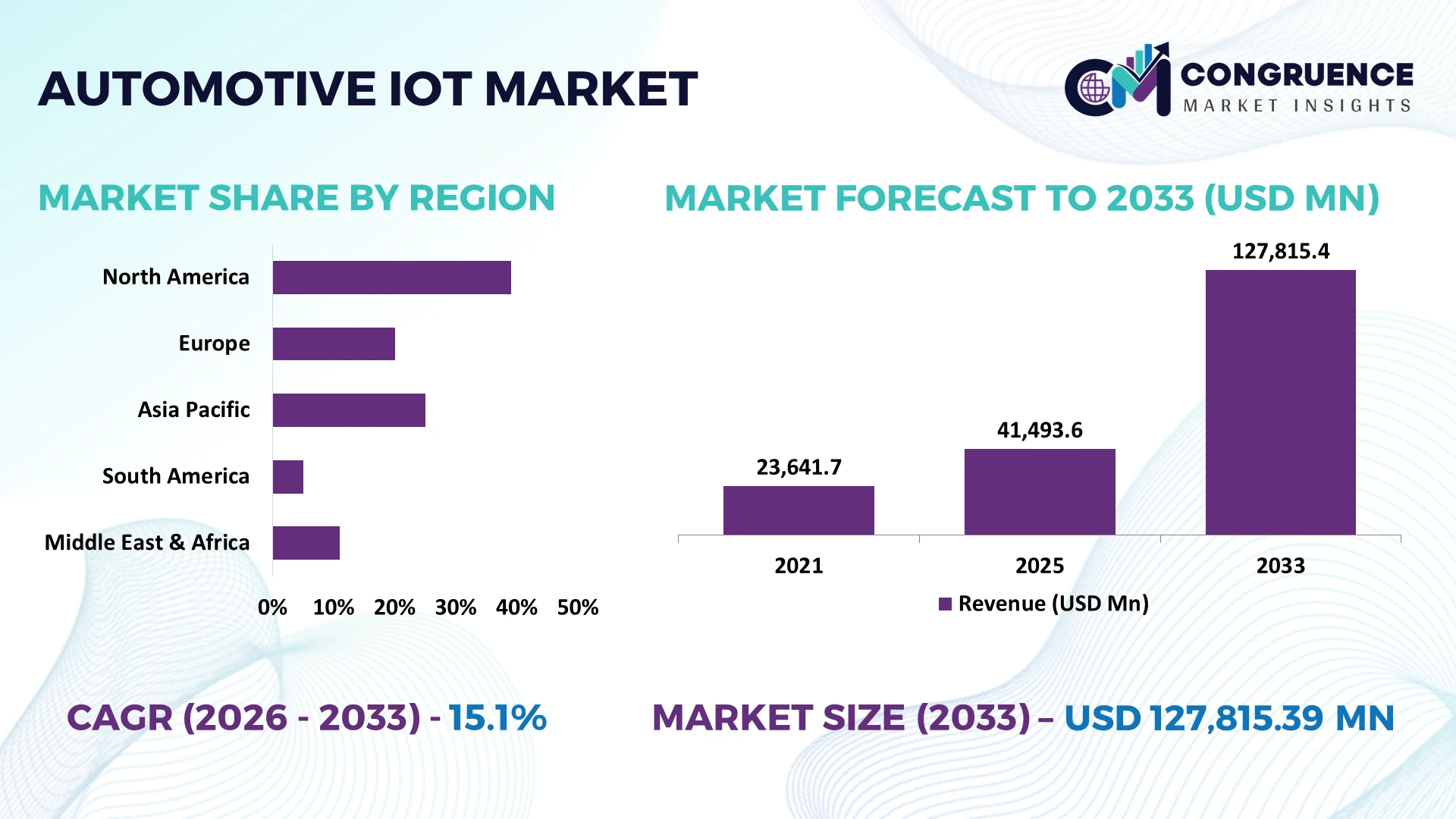
China anchors the global Automotive IoT ecosystem within Asia-Pacific, which accounted for approximately 40.8% of market activity in 2025, supported by the world’s largest automotive manufacturing base, rapid EV penetration, C-V2X deployment, and domestic electronics supply chains. New-energy vehicles represented more than 40% of Chinese new-car sales during 2024, strengthening demand for connected diagnostics, intelligent cockpits, and cloud-based vehicle platforms. The United States remains stronger in autonomous-driving software and cloud ecosystems, while trade restrictions and 100% tariffs on Chinese EV imports reinforce technology localization.
Strategically, OEMs and technology suppliers should prioritize scalable vehicle software, embedded connectivity, cybersecurity, and localized digital ecosystems as automotive differentiation shifts toward continuously connected platforms.
Market Size & Growth: USD 41,493.55 million in 2025 advances to USD 127,815.39 million by 2033 at 15.1% CAGR, driven by software-defined vehicles and embedded connectivity.
Top Growth Drivers: Asia-Pacific holds approximately 40.8% share, Chinese new-energy vehicles exceed 40% of new-car sales, and connected-service investment captures roughly 35% of automotive AI spending.
Short-Term Forecast: By 2028, centralized computing and OTA architectures are positioned to shorten software-development and feature-release cycles by approximately 20–30% versus fragmented electronic architectures.
Emerging Technologies: 5G-V2X, edge AI, digital twins, and centralized vehicle computing are advancing rapidly, with automotive AI investment exceeding USD 100 billion globally since 2021.
Regional Leaders: Asia-Pacific approaches USD 52 billion, North America approximately USD 35 billion, and Europe roughly USD 30 billion by 2033, supported respectively by EV scale, software innovation, and connected-vehicle regulation.
Consumer/End-User Trends: Connected vehicles increasingly support subscription services, predictive diagnostics, and remote functions; major connectivity platforms already manage more than 25 million vehicles across global OEM programs.
Pilot/Case Example: In 2025, HARMAN expanded Pune automotive-electronics manufacturing capacity by more than 50%, strengthening localized production for connected cockpits and telematics systems.
Competitive Landscape: Bosch maintains an estimated high-single-digit share, competing with Continental, Qualcomm, Harman, and NXP across telematics, vehicle computing, connectivity, and intelligent mobility platforms.
Regulatory & ESG Impact: EU rules require all new cars sold from July 2024 to incorporate specified advanced safety systems, accelerating sensor, connectivity, and vehicle-data integration.
Investment & Funding: Automotive AI investment has exceeded USD 100 billion since 2021, with funding increasingly concentrated on autonomous driving, connected services, software platforms, and high-performance vehicle computing.
Innovation & Future Outlook: Software-defined architectures are consolidating dozens of electronic control units into centralized computing domains, enabling OTA feature delivery, AI workloads, and faster lifecycle upgrades across global vehicle platforms.
The Automotive IoT Market is shifting from basic telematics toward software-defined mobility ecosystems integrating connected cockpits, predictive diagnostics, ADAS, fleet intelligence, V2X communication, and remote vehicle management. China’s new-energy vehicles represented more than 40% of new-car sales during 2024, expanding the addressable installed base for embedded connectivity and cloud services. Centralized computing, 5G, edge AI, and OTA platforms are reducing dependence on fragmented electronic architectures, while cybersecurity regulation is forcing secure lifecycle management. These developments establish vehicle software, connectivity, and data orchestration as the next strategic competitive layer.
Automotive IoT is becoming a strategic competitive layer as vehicle differentiation shifts from mechanical engineering toward software, connectivity, and continuously upgradeable digital functions. China’s new-energy vehicles exceeded 40% of new-car sales in 2024, expanding the installed base for telematics, intelligent cockpits, ADAS, and cloud services. Meanwhile, cybersecurity and safety regulation is restructuring electronics procurement toward secure, updateable platforms and localized semiconductor supply chains.
Centralized vehicle computing provides a decisive technology advantage over legacy distributed ECUs, reducing wiring complexity and supporting 20–30% faster software integration and validation. China leads deployment scale through EV manufacturing and C-V2X infrastructure, while the United States concentrates investment around autonomous driving, cloud platforms, and connected services. Through 2026–2028, 5G connectivity, edge AI, and zonal architectures will progressively replace fragmented vehicle electronics.
A practical deployment model combines embedded telematics with OTA software management, allowing manufacturers to diagnose faults and update functions without workshop visits. OEMs are therefore deepening partnerships with semiconductor, telecom, cloud, and software providers while increasing internal software investment. Long-term advantage will depend on controlling vehicle data, computing architecture, cybersecurity, and recurring digital-service delivery.
Software-defined vehicle adoption is accelerating Automotive IoT deployment as manufacturers consolidate electronics, connectivity, and digital functions onto centralized computing platforms. Chinese new-energy vehicles represented more than 40% of new-car sales in 2024, while battery-electric vehicles accounted for approximately 15% of global car sales, expanding the addressable base for OTA updates and connected diagnostics. Advanced connected platforms can shorten software feature-release cycles by approximately 20–30% compared with fragmented ECU architectures. The EU’s mandatory advanced safety requirements for new vehicles since July 2024 further increase sensor and software integration. Automakers are responding with zonal architectures, embedded 5G, software partnerships, and dedicated development organizations. Strategically, centralized computing enables manufacturers to reuse software across multiple models, lowering lifecycle complexity while accelerating monetizable feature deployment.
Automotive IoT remains constrained by dependence on advanced semiconductors, connectivity modules, sensors, and high-performance computing hardware. A connected premium vehicle can contain more than 3,000 semiconductor components, while automotive semiconductor content per vehicle has risen substantially as electrification and ADAS expand. Taiwan produces more than 60% of global semiconductors and over 90% of the most advanced chips, creating geographic concentration across critical computing supply chains. U.S.–China technology restrictions and localization policies further complicate sourcing strategies for globally standardized platforms. Supply disruption directly increases production scheduling risk and limits rapid connected-platform scaling. Automakers are responding through multi-year chip agreements, supplier diversification, redesigned electronic architectures, and localized procurement. The critical constraint is increasingly computing-component availability rather than conventional vehicle production capacity.
Connected vehicles create opportunities beyond hardware sales by converting operating data into subscription services, fleet intelligence, predictive maintenance, insurance analytics, and downloadable functions. More than 95% of new vehicles in major developed automotive markets are expected to incorporate embedded connectivity during the current decade, while connected platforms already manage tens of millions of vehicles globally. OTA technology can eliminate selected dealership software visits entirely, reducing service intervention costs while accelerating feature delivery. India offers additional upside as connected functionality spreads from premium vehicles into mass-market passenger cars alongside expanding 5G coverage. OEMs are investing in application ecosystems, cloud partnerships, subscription platforms, and vehicle-data analytics. The non-obvious opportunity is lifecycle monetization: manufacturers can generate repeated customer interactions from vehicles years after the initial sale instead of concentrating economics at production and purchase.
Automotive IoT execution increasingly depends on securing vehicles throughout operating lifecycles that commonly exceed 12 years. Modern connected vehicles can contain more than 100 electronic control units and process extensive external communications through telematics, infotainment, Bluetooth, cellular networks, and diagnostic interfaces, expanding potential attack surfaces. UNECE cybersecurity requirements already influence vehicle approval across more than 50 participating markets, forcing manufacturers to maintain cybersecurity management and software-update processes beyond production. The challenge intensifies as OTA functions connect millions of vehicles to common backend infrastructure, where one vulnerability can affect an entire fleet. OEMs and suppliers must strengthen hardware security modules, intrusion detection, software bills of materials, secure OTA pipelines, and continuous vulnerability monitoring. Competitive durability will depend on treating cybersecurity as lifecycle infrastructure rather than a vehicle-launch compliance task.
Zonal Architectures Replace ECU Sprawl: Automakers are consolidating 70–150 distributed ECUs into fewer domain and zonal controllers, reducing wiring requirements by roughly 20–30% and vehicle weight by 10–20 kg in advanced architectures. OEMs are redesigning electrical/electronic platforms around high-speed Ethernet, enabling faster diagnostics and simplifying assembly. Semiconductor suppliers are responding with integrated processors, networking chips, and reference architectures optimized for centralized vehicle control.
Vehicle Connectivity Moves Toward 5G: Embedded 5G is replacing 4G-first telematics in premium and next-generation platforms, delivering latency below 10 milliseconds under optimized conditions and theoretical speeds exceeding 1 Gbps. China’s expanding C-V2X infrastructure is accelerating deployment across intelligent vehicles. Automakers and telecom suppliers are integrating 5G modules, edge processing, and V2X stacks to support richer infotainment, cooperative safety, and high-volume vehicle-data transmission.
Digital Cockpits Consolidate Functions: Cockpit architectures increasingly combine navigation, infotainment, voice assistants, driver monitoring, and vehicle controls through unified computing platforms. Digital instrument clusters now exceed 70% penetration across several major new-vehicle markets, while large displays increasingly replace physical interfaces. Automakers are partnering with semiconductor and software companies to standardize cockpit platforms, reducing hardware duplication while enabling differentiated interfaces and faster application deployment.
Cybersecurity Becomes Lifecycle Workflow: UNECE cybersecurity requirements affect vehicle approvals across more than 50 participating markets, shifting security from launch-stage testing toward continuous monitoring. Connected vehicles can operate for 12–15 years, substantially extending vulnerability-management requirements. OEMs are establishing security operations centers, automated threat detection, penetration-testing workflows, and secure firmware management, turning cybersecurity capability into a procurement criterion for connected-platform suppliers.
Embedded Systems lead the Automotive IoT market with an estimated 40–45% share, supported by factory-installed telematics control units, infotainment hardware, connectivity modules, and integrated vehicle sensors. Their dominance reflects direct access to CAN/Ethernet networks, consistent performance, security control, and uninterrupted connectivity independent of personal devices. Tethered Systems remain relevant in cost-sensitive vehicle programs because external connectivity reduces onboard hardware requirements, although dependence on paired devices limits functionality and data continuity.
Cloud-Connected Systems represent the fastest-growing type as manufacturers increasingly transfer diagnostics, vehicle health, navigation intelligence, and fleet data into scalable backend environments. Cloud integration can reduce selected data-processing and software-management workloads by 20–30% compared with isolated onboard architectures. Smartphone-Integrated Systems retain strong consumer relevance through navigation, media, and application mirroring but provide less control over vehicle-level data. OEMs are consequently prioritizing embedded-plus-cloud architectures while partnering with telecom, semiconductor, and hyperscale technology providers, shifting investment toward persistent connectivity and centralized data management.
Telematics leads Automotive IoT applications with an estimated 30–35% share, reflecting its foundational role in remote diagnostics, emergency assistance, driver information, connectivity, and vehicle-data transmission. Vehicle Tracking remains mature across commercial operations, while Connected Navigation increasingly combines live traffic, charging locations, weather, and cloud-based route optimization. Fleet Management builds on these capabilities by integrating vehicle utilization, fuel consumption, driver behavior, maintenance scheduling, and dispatch workflows across centralized platforms.
Predictive Maintenance is the fastest-growing application as connected sensors and machine-learning models replace mileage-based servicing with condition-based intervention. Predictive analytics can reduce unplanned vehicle downtime by approximately 20–30% and lower maintenance expenditure by 10–20% in optimized fleet environments. Usage-Based Insurance is expanding through driving-behavior telemetry but remains dependent on regulatory and customer-data frameworks. Technology suppliers are integrating telematics, analytics, maintenance, and tracking within unified platforms, while fleet operators increasingly prioritize applications that convert connectivity into measurable vehicle availability and operating-cost improvements.
Passenger Vehicle Owners represent the largest end-user segment, accounting for approximately 45–50% of Automotive IoT demand because passenger cars dominate global vehicle production and increasingly incorporate factory-installed connectivity. Adoption concentrates around navigation, remote vehicle controls, diagnostics, infotainment, emergency services, and smartphone integration. Automotive Manufacturers remain strategically important buyers because they control embedded architecture, connectivity specifications, software ecosystems, and vehicle-data access across production platforms. Rental and Leasing Companies increasingly use connected systems for mileage monitoring, vehicle recovery, maintenance scheduling, and automated fleet administration.
Commercial Fleet Operators represent the fastest-growing end-user group as connected platforms become essential for utilization, safety, maintenance, and operating-cost control. Telematics-driven fleet programs can reduce fuel consumption by approximately 5–15% and lower idling by 20% or more through driver analytics and automated coaching. Logistics Companies intensify adoption where route visibility and delivery performance directly affect margins. Providers are responding with per-vehicle subscriptions, integrated fleet platforms, API connectivity, and customized analytics, shifting competitive focus toward measurable operating returns.
Asia-Pacific accounted for the largest market share at 40.8% in 2025 however, North America is expected to register the fastest growth, expanding at a CAGR of 16.2% between 2026 and 2033.

Software-Defined Vehicles Reshape Connected Mobility
North America represents approximately 29% of Automotive IoT activity, anchored by extensive embedded telematics, cloud-connected vehicle services, fleet digitization, and autonomous-driving development. U.S. automakers are restructuring electronic architectures around centralized computing, Ethernet networking, OTA management, and subscription-enabled software. More than 90% of new U.S. passenger vehicles offer some form of embedded connectivity, creating a large installed base for remote diagnostics, navigation, safety services, and predictive maintenance. Qualcomm, automotive OEMs, cloud providers, and telecom operators are strengthening cross-industry partnerships as vehicle computing becomes increasingly software-intensive. The region also benefits from mature commercial telematics adoption, with connected fleet platforms managing millions of vehicles. Investment is shifting toward scalable digital architectures that reduce ECU fragmentation and support continuous feature deployment throughout vehicle lifecycles.
United States Market Outlook: The United States combines major automotive production clusters with advanced cloud, semiconductor, AI, and autonomous-driving ecosystems. Light-vehicle sales exceeded 15 million units in 2024, creating substantial annual capacity for factory-installed connectivity. Detroit, Silicon Valley, and emerging southern manufacturing hubs increasingly connect vehicle engineering with software development, semiconductor sourcing, and fleet-data platforms.
Regulation Accelerates Connected Safety Architecture
Europe represents approximately 24% of Automotive IoT activity, with connected-vehicle deployment increasingly shaped by cybersecurity, road-safety, emissions, and software-update requirements. EU General Safety Regulation requirements applying to new vehicles since July 2024 expanded mandatory integration of intelligent speed assistance, reversing detection, driver monitoring, and other advanced safety functions. UNECE cybersecurity and software-update regulations simultaneously require manufacturers to manage connected-vehicle risks throughout development and operation. Germany, France, Sweden, and Italy provide strong automotive engineering and electronics ecosystems, while European telecom infrastructure supports increasingly sophisticated connected services. Manufacturers are integrating telematics, ADAS sensors, secure gateways, and centralized computing instead of deploying isolated electronic functions. The strategic shift favors suppliers capable of providing functional safety, cybersecurity, connectivity, and lifecycle software management within common vehicle architectures.
Germany Market Outlook: Germany remains Europe’s strategically significant Automotive IoT market because Volkswagen Group, Mercedes-Benz, BMW, Bosch, Continental, and major engineering suppliers concentrate vehicle software and electronics development within the country. Germany produced more than 4 million passenger cars in 2024, giving connected-platform suppliers substantial factory integration opportunities across premium and mass-market programs.
Manufacturing Scale Accelerates Connected Vehicle Adoption
Asia-Pacific accounts for approximately 40.8% of Automotive IoT activity, supported by exceptional vehicle production scale, EV adoption, semiconductor manufacturing, and rapidly expanding intelligent-transport infrastructure. China, Japan, South Korea, and India collectively provide large manufacturing bases where embedded telematics, connected cockpits, ADAS, navigation, and remote diagnostics are increasingly integrated during production. China produced more than 31 million vehicles in 2024, giving domestic IoT platforms exceptional deployment scale and supporting rapid iteration of connected features. South Korea and Japan contribute advanced automotive electronics and semiconductor expertise, while India provides expanding software engineering and connected-car demand. Manufacturers are localizing digital platforms, communications modules, and computing hardware as geopolitical technology controls reshape automotive supply chains. Scale increasingly allows Asian OEMs to spread software-development costs across larger connected fleets.
China Market Outlook: China combines the world’s largest vehicle market with extensive EV manufacturing, 5G infrastructure, navigation ecosystems, and C-V2X development. New-energy vehicle sales exceeded 12 million units in 2024, rapidly expanding the addressable connected-vehicle fleet. Domestic OEMs increasingly integrate intelligent cockpits, OTA functionality, advanced driver assistance, and proprietary software platforms as standard competitive features.
Fleet Digitization Anchors Connected Demand
South America represents approximately 3–4% of Automotive IoT activity, with adoption concentrated in fleet telematics, stolen-vehicle recovery, logistics monitoring, connected navigation, and increasingly factory-installed passenger-car connectivity. Brazil provides the region’s principal automotive manufacturing and connected-fleet base, while Argentina, Chile, and Colombia support additional commercial telematics demand. Brazil registered more than 2.6 million new light vehicles during 2024, providing meaningful scale for embedded connected systems. Logistics operators increasingly deploy GPS, driver monitoring, fuel analytics, and predictive maintenance to control operating costs across long-distance transport networks. However, uneven 5G availability, vehicle affordability, and aging fleets constrain sophisticated IoT penetration outside major urban corridors. Providers are addressing these limitations through retrofit telematics, cellular multi-network connectivity, subscription pricing, and scalable fleet-management platforms rather than relying exclusively on factory-installed systems.
Brazil Market Outlook: Brazil combines high vehicle production, extensive road freight activity, and growing connected-service adoption. More than 60% of domestic freight movement depends on roads, making fleet visibility operationally important. OEMs, insurers, logistics companies, and telematics providers increasingly use connected data for theft prevention, route optimization, maintenance scheduling, and driver-performance management.
Smart Mobility Investment Expands Connected Fleets
Middle East & Africa represents approximately 3% of Automotive IoT activity, with adoption concentrated in Gulf smart-mobility programs, commercial fleets, logistics, premium connected vehicles, and digitally managed public transportation. Saudi Arabia and the UAE lead deployment through strong 5G coverage, smart-city investment, and increasingly sophisticated transportation infrastructure. Saudi Arabia’s Vision 2030 mobility agenda is supporting connected logistics, EV infrastructure, autonomous-vehicle testing, and domestic automotive manufacturing initiatives. The UAE similarly uses connected transportation platforms across Dubai and Abu Dhabi, where fleet management and intelligent road infrastructure support high vehicle connectivity. African adoption remains concentrated in South Africa and selected logistics corridors, where tracking, insurance telematics, and fleet-security applications address operational requirements. Suppliers are emphasizing cloud-based fleet platforms and cellular connectivity that can scale despite uneven infrastructure maturity.
Saudi Arabia Market Outlook: Saudi Arabia is building a connected automotive ecosystem around domestic manufacturing, logistics modernization, and smart-city projects. The country targets production capacity of more than 300,000 vehicles annually by 2030. NEOM and other mobility programs create deployment environments for connected fleets, intelligent transportation, EV monitoring, autonomous systems, and centralized mobility-data platforms.
Bosch, Continental, Qualcomm, Harman, and NXP compete across connected vehicle hardware, telematics, computing, software, and semiconductor platforms, while OEMs increasingly internalize software capabilities. The top five suppliers collectively represent approximately 30–35% of market activity, preserving space for cloud, connectivity, cybersecurity, and specialized analytics providers. Competition centers on processing performance, integration speed, cybersecurity, and platform cost; centralized architectures can reduce wiring complexity by 20–30%, while OTA platforms shorten selected software release cycles by roughly 25%. Qualcomm and NXP compete through automotive compute and connectivity silicon; Bosch and Continental leverage deep OEM integration; Harman emphasizes connected cockpit and telematics platforms. Suppliers are expanding through software partnerships, acquisitions, reference platforms, and vertical integration. The competitive shift favors software-defined architectures over standalone components. Automotive qualification cycles, functional-safety requirements, semiconductor access, and OEM integration remain substantial entry barriers. Winning requires scalable computing, secure connectivity, rapid software deployment, and proven automotive-grade reliability across global vehicle programs.
Robert Bosch
Continental
Qualcomm
Harman International
NXP Semiconductors
Denso
Aptiv
Infineon Technologies
Valeo
TomTom
Geotab
Verizon Communications
Cisco Systems
Intel
Current Automotive IoT stacks combine embedded telematics, 4G/5G connectivity, GNSS, vehicle Ethernet, cloud analytics, OTA management, and centralized computing. Connected platforms can reduce diagnostic time by 20–30%, while predictive analytics can lower unplanned fleet downtime by roughly 20%. Embedded connectivity is increasingly standard in new vehicles, giving OEMs continuous visibility into vehicle health, software status, location, and customer-service requirements.
Emerging technology centers on zonal architectures, edge AI, V2X, digital twins, and high-performance cockpit/ADAS processors. Consolidating distributed ECUs into domain or zonal computers can cut wiring complexity by 20–30% and accelerate software integration versus legacy architectures by approximately 25%. Mahindra’s latest electric SUVs demonstrate adoption through 5G connectivity, more than 230,000 DMIPS of cockpit compute, and OTA-enabled digital services. Semiconductor, Tier-1, and cloud suppliers benefit as computing content shifts toward fewer, more capable platforms.
Disruptive development is moving toward AI-native software-defined vehicles combining cockpit, ADAS, connectivity, and cloud services within unified architectures. Edge inference reduces dependence on constant cloud communication and enables faster safety-critical decisions. Through 2026–2028, centralized compute, GenAI assistants, and secure OTA pipelines will expand across mainstream vehicles. Companies investing now gain faster feature deployment, lower electronic complexity, stronger lifecycle data control, and recurring digital-service capability across global fleets.
March 2024 NXP launched S32 CoreRide, integrating processing, vehicle networking, power management, and software for software-defined vehicles. The S32N processor supports centralized computing, reducing integration complexity and giving OEMs a scalable architecture for connected functions across vehicle domains. Source: NXP
January 2025 Qualcomm and Mahindra deployed Snapdragon Digital Chassis in BE 6 and XEV 9e electric SUVs, delivering over 230,000 DMIPS, 5G connectivity, and more than 60 applications. The integration strengthens India’s AI-enabled connected-vehicle ecosystem and service capability. Source: Qualcomm
September 2025 Geotab surpassed 5 million connected-vehicle subscriptions worldwide, adding its latest million in under two years and processing over 100 billion data points daily. The scale strengthens AI-driven fleet benchmarking, predictive analytics, safety, and operational optimization globally. Source: Geotab
July 2026 Eagle Wireless expanded Ohio connected-car hardware manufacturing as U.S. sourcing rules reshape automotive supply chains, targeting annual production capacity of 2 million modules. The expansion provides automakers with localized alternatives for compliant domestic vehicle connectivity hardware. Source: Reuters
The Automotive IoT Market report evaluates Embedded Systems, Tethered Systems, Smartphone-Integrated Systems, and Cloud-Connected Systems across Telematics, Predictive Maintenance, Fleet Management, Vehicle Tracking, Connected Navigation, and Usage-Based Insurance. Embedded Systems account for approximately 40–45% of type-level activity, while telematics represents roughly 30–35% of application demand, reflecting the concentration of connectivity within factory-installed vehicle architectures.
The report examines Passenger Vehicle Owners, Commercial Fleet Operators, Logistics Companies, Rental and Leasing Companies, and Automotive Manufacturers across North America, Europe, Asia-Pacific, South America, and Middle East & Africa. Technology coverage includes 5G-V2X, edge AI, zonal computing, OTA platforms, digital twins, cybersecurity, and AI-enabled telematics. Analysis through 2026–2033 supports investment prioritization, geographic expansion, technology partnerships, product positioning, supply-chain planning, and competitive decisions as automotive value shifts toward software-defined, continuously connected vehicle ecosystems.
| Report Attribute/Metric | Report Details |
|---|---|
Market Revenue in 2025 | USD 41493.55 Million |
Market Revenue in 2033 | USD 127815.39 Million |
CAGR (2026 - 2033) | 15.1% |
Base Year | 2025 |
Forecast Period | 2026 - 2033 |
Historic Period | 2021 - 2025 |
Segments Covered | By Type
By Application
By End-User
|
Key Report Deliverable | Revenue Forecast, Growth Trends, Market Dynamics, Segmental Overview, Regional and Country-wise Analysis, Competition Landscape |
Region Covered | North America, Europe, Asia-Pacific, South America, Middle East, Africa |
Key Players Analyzed | Robert Bosch, Continental, Qualcomm, Harman International, NXP Semiconductors, Denso, Aptiv, Infineon Technologies, Valeo, TomTom, Geotab, Verizon Communications, Cisco Systems, Intel |
Customization & Pricing | Available on Request (10% Customization is Free) |




