
Reports
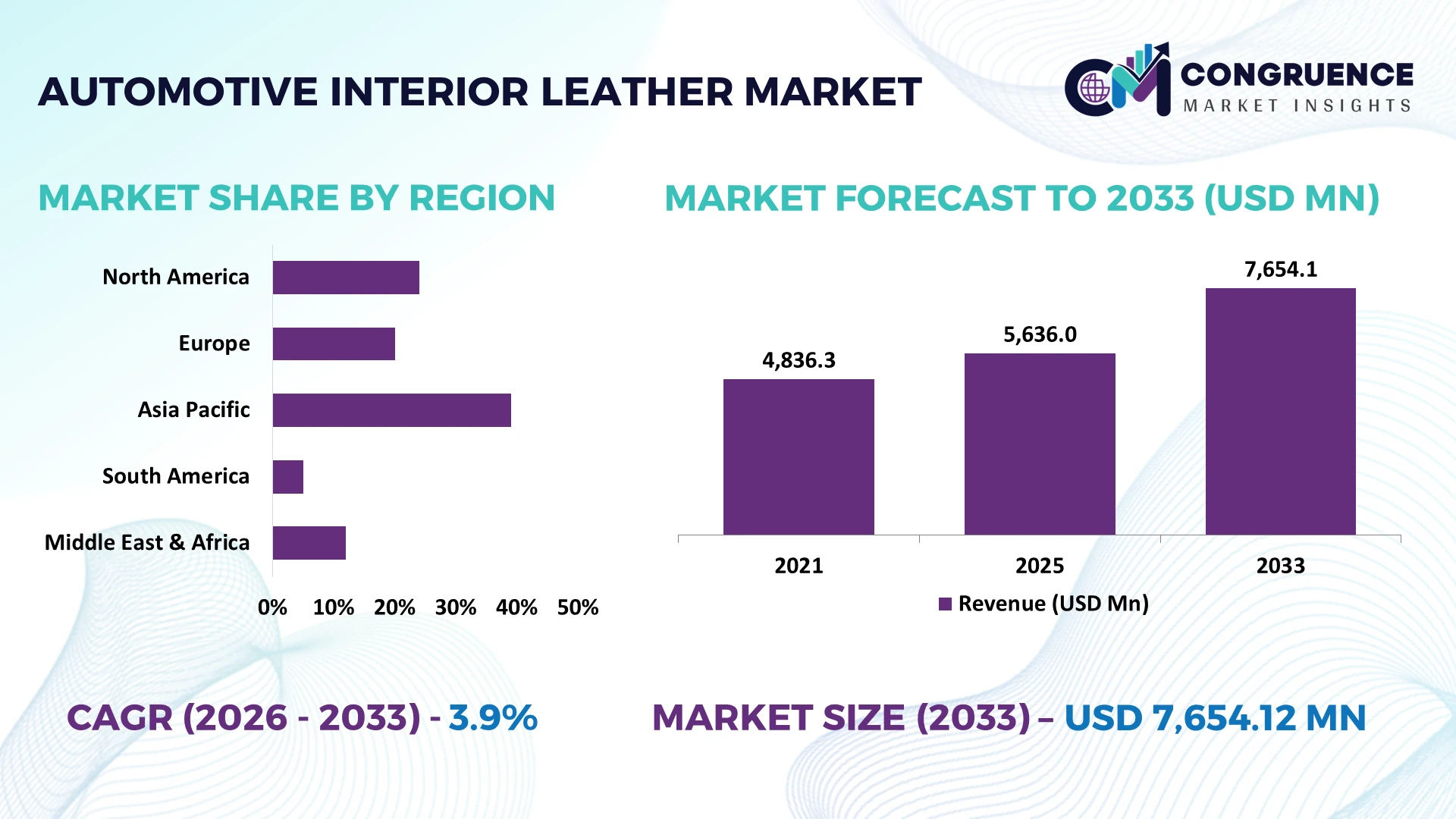
The Global Automotive Interior Leather Market was valued at USD 5636 Million in 2025 and is anticipated to reach a value of USD 7654.12 Million by 2033 expanding at a CAGR of 3.9% between 2026 and 2033. Growth is being driven by premium vehicle production, sustainable leather processing technologies, lightweight interior engineering, and increasing integration of luxury cabin features across electric and high-end passenger vehicles.
China accounts for approximately 34% of global automotive interior leather manufacturing capacity, supported by multi-billion-dollar automotive investments, advanced EV production, and strong domestic supply networks, while Germany contributes nearly 18% through premium automotive manufacturing and high-value leather innovation. The ongoing diversification of supply chains beyond single-country sourcing following global trade realignments in 2026 is accelerating regional production resilience and digital manufacturing adoption across the sector.
Manufacturers securing localized leather sourcing, advanced finishing capabilities, and sustainable material portfolios will strengthen long-term competitiveness across premium and mass-market vehicle segments.
Market Size & Growth: USD 5636 Million in 2025, projected to reach USD 7654.12 Million by 2033 at 3.9% CAGR, supported by premium vehicle production and advanced interior material innovation.
Top Growth Drivers: Premium vehicle demand contributes nearly 38%, electric vehicle interiors 31%, and sustainable leather processing adoption exceeds 27% across leading manufacturers.
Short-Term Forecast: By 2028, automated leather cutting and digital quality inspection reduce material waste by approximately 15% while improving production efficiency by 18%.
Emerging Technologies: AI-based defect detection, automated stitching systems, and bio-based leather finishing technologies increase manufacturing precision by over 20%.
Regional Leaders: Asia Pacific exceeds USD 3.2 Billion with EV expansion, Europe approaches USD 2.1 Billion through luxury vehicle production, while North America surpasses USD 1.5 Billion with premium SUV adoption.
Consumer/End-User Trends: More than 46% of premium vehicle buyers prioritize sustainable, ventilated, and digitally integrated leather interiors over conventional cabin materials.
Pilot/Case Example: In 2026, smart automated leather inspection deployment improved defect detection accuracy by approximately 30% while reducing production rework by 18%.
Competitive Landscape: Top manufacturers collectively control nearly 42% of the global market, led by Lear Corporation, Adient, Toyota Boshoku, Faurecia, and Katzkin.
Regulatory & ESG Impact: Low-emission tanning processes reduce chemical usage by nearly 25%, aligning with stricter environmental compliance and global automotive sustainability targets.
Investment & Funding: More than USD 1.4 Billion has been directed toward advanced interior manufacturing, regional expansion, and sustainable processing amid ongoing supply-chain diversification.
Innovation & Future Outlook: High-performance recycled leather composites, digital traceability, and intelligent cabin materials are strengthening next-generation automotive interior strategies and long-term product differentiation.
Automotive Interior Leather Market demand continues expanding across electric vehicles, luxury SUVs, and connected mobility platforms as manufacturers introduce low-emission tanning technologies, recycled leather composites, and AI-enabled quality inspection. Sustainable interior materials now influence over 35% of premium sourcing decisions, while regional supply-chain localization and stricter environmental compliance accelerate production modernization, setting the stage for broader strategic market evaluation.
Automotive interior leather is becoming a strategic differentiator as vehicle manufacturers compete through premium cabin experience, sustainability, and intelligent manufacturing rather than mechanical performance alone. Supply-chain restructuring after recent global trade disruptions is accelerating localized leather processing, digital quality inspection, and multi-country sourcing strategies, enabling manufacturers to improve procurement resilience while reducing production lead times. Premium electric vehicles and luxury SUVs continue raising demand for advanced interior materials with higher durability and lower environmental impact.
AI-enabled leather inspection systems identify surface defects with nearly 30% greater accuracy than conventional manual inspection while reducing material waste by approximately 15%, improving production consistency and operating efficiency. China leads high-volume manufacturing through vertically integrated supply networks, whereas Italy remains focused on premium leather craftsmanship and advanced finishing technologies for luxury automotive brands. Over the next two to three years, automated cutting and digital traceability systems are expected to exceed 40% adoption across leading interior component suppliers.
A practical example includes automotive seat manufacturers integrating automated nesting software with robotic cutting equipment to optimize leather utilization and shorten production cycles. Companies are expanding partnerships with sustainable leather processors, investing in localized manufacturing, and strengthening digital production ecosystems. Organizations combining advanced manufacturing with responsible sourcing will secure stronger competitive positioning and long-term operational resilience.
Premium vehicle production, localized sourcing, and sustainable leather processing are reshaping industry demand. Nearly 52% of luxury vehicle interiors now incorporate advanced treated leather with enhanced durability and low-emission finishing processes, while automated leather cutting improves material utilization by around 18%. China continues expanding domestic automotive supply clusters, encouraging manufacturers to establish regional leather processing facilities to reduce import dependency and logistics exposure. This structural shift improves supply continuity and production flexibility. Companies are responding through investments in automated finishing lines, partnerships with certified leather suppliers, and expanded capacity for premium interior components. Businesses integrating sustainable processing with digital manufacturing achieve stronger quality consistency and improved procurement resilience, strengthening long-term supplier competitiveness.
Volatility in premium hide availability and stricter environmental compliance requirements continue increasing production complexity. Processing expenses have risen by approximately 12% in facilities adopting advanced wastewater treatment, while premium raw leather price fluctuations frequently exceed 15% during supply disruptions. Brazil and other major livestock-producing countries remain important sourcing locations, yet weather variability and transportation bottlenecks periodically constrain supply reliability. These pressures reduce margin stability for manufacturers serving cost-sensitive vehicle segments. Companies are mitigating exposure through diversified sourcing agreements, localized inventory strategies, long-term procurement contracts, and greater use of recycled leather composites. Strengthening supplier diversification has become a critical operational strategy for maintaining production continuity and protecting profitability.
Digital manufacturing and circular material innovation are creating new competitive opportunities beyond premium vehicle applications. AI-enabled production analytics improve leather yield by approximately 14%, while recycled and bio-based leather materials now represent nearly 20% of new premium interior development programs. Japan continues advancing precision manufacturing technologies that enhance leather finishing quality and production consistency. Companies are expanding research collaborations, investing in traceable material ecosystems, and developing next-generation surface treatments with lower environmental impact. An emerging strategic opportunity lies in combining digital traceability with sustainable material certification, enabling manufacturers to strengthen customer confidence while improving operational transparency and supporting evolving procurement requirements from global automotive brands.
Scaling advanced leather manufacturing consistently across multiple production sites remains a significant execution challenge. More than 35% of suppliers continue operating mixed production environments where legacy equipment limits automation efficiency, while skilled workforce shortages affect advanced leather processing and digital inspection implementation. Germany's premium automotive ecosystem requires uniform quality standards across international supplier networks, increasing operational complexity during capacity expansion. Companies must integrate robotics, manufacturing execution systems, and workforce upskilling without disrupting production schedules or quality performance. Strategic investment in standardized digital platforms, technical partnerships, and specialized training programs is becoming essential to maintain product consistency, improve manufacturing scalability, and preserve long-term competitiveness across global automotive supply chains.
AI-Powered Quality Inspection Expansion Automated visual inspection platforms now improve surface defect detection by nearly 30% while reducing manual inspection time by around 22%. Labor shortages and stricter premium quality standards are accelerating deployment across manufacturing plants in China and Germany. Interior suppliers are integrating AI vision systems with digital production lines, improving leather utilization, reducing rework, and strengthening consistency through enterprise-wide manufacturing automation.
Certified Sustainable Leather Adoption More than 35% of premium automotive leather programs now require certified low-impact processing, while water consumption in advanced tanning operations has declined by approximately 20% through upgraded treatment technologies. Tightening environmental compliance is encouraging manufacturers to restructure supplier qualification processes. Companies are expanding partnerships with certified tanneries and implementing digital traceability platforms to strengthen procurement transparency and maintain export competitiveness.
Localized Multi-Country Supply Networks Automotive interior manufacturers have reduced dependence on single-country sourcing by nearly 18% through supplier diversification and regional processing hubs. Supply-chain disruptions and geopolitical trade adjustments continue driving localized procurement strategies across Mexico, China, and Eastern Europe. Companies are restructuring logistics, increasing regional inventory buffers, and expanding long-term sourcing partnerships to improve delivery reliability and stabilize production scheduling.
Digital Manufacturing Process Integration More than 40% of leading automotive interior facilities now operate connected manufacturing systems combining robotic cutting, automated stitching, and production analytics. Digital workflow integration shortens production cycles by approximately 16% while improving material yield by 14%. Manufacturers are scaling smart factory investments and collaborative technology partnerships to standardize quality, optimize workflow efficiency, and accelerate premium interior customization.
Genuine Leather remains the dominant segment, accounting for approximately 43% of total demand because of its premium appearance, durability, and strong acceptance in luxury and premium passenger vehicles. Automotive manufacturers continue integrating advanced finishing technologies that improve wear resistance by nearly 18% while maintaining premium aesthetics. Synthetic Leather has strengthened its position through improved texture consistency and lower maintenance requirements, whereas PU Leather is the fastest-growing segment as sustainable formulations and lightweight characteristics gain preference among electric vehicle manufacturers. Adoption of PU Leather has increased by approximately 24% across new premium EV interior programs.
PVC Leather continues serving cost-sensitive vehicle platforms where durability and affordability remain priorities, although environmental considerations are gradually reducing its strategic importance. Interior suppliers are expanding bio-based PU production, improving coating technologies, and collaborating with OEMs to develop differentiated interior solutions. Investment priorities increasingly favor sustainable materials that combine performance, regulatory compliance, and manufacturing flexibility while supporting vehicle weight optimization and premium cabin design.
Seats represent the largest application segment with approximately 49% market share, reflecting their extensive leather coverage, direct consumer visibility, and importance in perceived vehicle quality. Advanced seat manufacturing technologies have improved leather utilization by nearly 16%, while ventilated and heated seating systems continue increasing demand for premium leather finishes. Door Panels are the fastest-growing application as manufacturers expand soft-touch interior concepts and premium cabin styling across mid-range vehicle platforms, with adoption increasing by approximately 21%.
Steering Wheels maintain stable demand through ergonomic design upgrades and integrated heating functions, while Dashboard and Gear Knobs increasingly utilize specialized leather finishes to enhance cabin consistency and premium aesthetics. Automotive suppliers are investing in automated wrapping technologies, digital pattern engineering, and modular production systems to improve efficiency and customization. Demand is steadily shifting toward integrated interior packages where coordinated leather applications strengthen brand differentiation and customer experience.
Passenger Vehicles account for approximately 61% of automotive interior leather demand due to higher production volumes, greater premium feature adoption, and stronger consumer preference for enhanced cabin comfort. Luxury SUVs and premium electric vehicles continue increasing leather content per vehicle, while interior customization demand has expanded by approximately 20% across high-value vehicle programs. The Aftermarket represents the fastest-growing end-user segment as personalization trends and vehicle refurbishment services continue expanding, supported by nearly 18% growth in premium interior replacement demand.
Automotive OEMs remain central decision-makers by defining material specifications, sustainability standards, and long-term supplier relationships, while Commercial Vehicles selectively adopt premium leather solutions for executive transport, buses, and high-end fleet applications. Companies are strengthening OEM collaborations, expanding customized product portfolios, and developing modular interior solutions that simplify installation and reduce production complexity. Competitive positioning increasingly depends on balancing premium quality, sustainable materials, and scalable manufacturing capabilities across both factory-installed and replacement markets.
Asia-Pacific accounted for the largest market share at 46.8% in 2025 however, Middle East & Africa is expected to register the fastest growth, expanding at a 5.4% between 2026 and 2033.
Premium Vehicle Manufacturing and Smart Interior Integration
North America represents a mature automotive interior leather market supported by premium vehicle production, advanced manufacturing automation, and high-value SUV demand. The region contributes approximately 24% of global consumption, with OEMs increasingly integrating digitally monitored leather inspection, automated cutting, and traceability systems across production facilities. More than 45% of premium vehicles assembled in the United States and Canada incorporate leather seating packages as standard or optional equipment. Manufacturers continue investing in localized supply networks to reduce logistics risk while strengthening partnerships with certified leather processors. Enterprise adoption of robotic leather handling has improved production consistency by nearly 17%, enabling suppliers to reduce material waste and accelerate customized interior programs for luxury and electric vehicle platforms.
United States Market Outlook: The United States remains the regional leader because of its extensive premium vehicle manufacturing base, strong supplier ecosystem, and continuous investment in advanced interior technologies. More than 60% of North American premium vehicle production is concentrated in the country, encouraging suppliers to expand automated leather processing, digital inspection, and sustainable sourcing capabilities. Automotive OEM collaboration with interior specialists continues strengthening localized manufacturing resilience and product innovation.
Luxury Manufacturing and Sustainable Material Transformation
Europe maintains a strong position through premium automotive manufacturing, advanced leather craftsmanship, and strict environmental compliance. The region accounts for approximately 27% of global market activity, supported by luxury vehicle manufacturers emphasizing sustainable leather processing and premium cabin differentiation. Digital finishing technologies and low-emission tanning processes have reduced production resource consumption by nearly 20% across several manufacturing operations. Automotive suppliers continue modernizing facilities through automation and certified material sourcing while expanding partnerships with sustainable processing companies. Enterprise investment increasingly targets traceable leather supply chains, enabling compliance with evolving environmental standards without compromising premium product quality.
Germany Market Outlook: Germany remains Europe's strategic center for automotive interior leather due to its concentration of premium OEMs, advanced manufacturing infrastructure, and engineering leadership. Nearly half of the region's premium vehicle production is linked to German manufacturing networks, driving demand for high-performance leather interiors. Suppliers continue investing in automated finishing technologies, intelligent manufacturing systems, and sustainable procurement programs to support long-term production efficiency and premium product positioning.
Large-Scale Manufacturing and Export-Led Expansion
Asia-Pacific dominates the automotive interior leather market through integrated automotive manufacturing ecosystems, competitive production costs, and expanding electric vehicle output. The region contributes nearly 47% of global production, supported by vertically integrated supply chains and extensive component manufacturing capacity. Automated leather processing adoption has increased by approximately 28% across leading manufacturing facilities, improving productivity and reducing processing variability. Automotive suppliers continue expanding smart manufacturing capacity while strengthening regional sourcing partnerships to improve supply continuity. Export-oriented production and continuous factory modernization reinforce the region's leadership in both premium and high-volume vehicle interior manufacturing.
China Market Outlook: China leads regional development through its large automotive production base, advanced EV manufacturing ecosystem, and integrated leather processing industry. The country accounts for approximately 34% of global automotive interior leather manufacturing capacity and continues expanding automated production lines with AI-enabled quality inspection. Strong domestic supplier networks and ongoing investment in sustainable processing technologies support operational efficiency and strengthen China's long-term global manufacturing competitiveness.
Localized Manufacturing and Export Supply Development
South America is strengthening its position through expanding vehicle assembly operations, growing leather processing capabilities, and regional supplier development. The region contributes approximately 6% of global demand, supported by established livestock resources and increasing automotive manufacturing investment. Production efficiency has improved by nearly 14% through modernization of leather processing facilities and greater integration with automotive supply chains. Infrastructure constraints and logistics costs continue influencing operational performance, encouraging manufacturers to prioritize localized production and long-term sourcing agreements. Companies are strengthening regional partnerships to improve delivery reliability while supporting both domestic vehicle production and export markets.
Brazil Market Outlook: Brazil remains the region's primary automotive interior leather market because of its established leather industry, strong livestock base, and significant automotive manufacturing capacity. The country supplies a substantial share of processed automotive-grade leather used across regional vehicle production. Manufacturers continue investing in environmentally compliant processing technologies, automated finishing equipment, and export-oriented operations to strengthen competitiveness and improve supply reliability.
Industrial Diversification and Automotive Investment Expansion
Middle East & Africa is undergoing gradual transformation through industrial diversification strategies, expanding automotive assembly operations, and investments in advanced manufacturing infrastructure. The region contributes approximately 5% of global market activity while recording increasing adoption of premium vehicle interiors. Industrial modernization initiatives have improved localized component manufacturing capability by nearly 16%, encouraging suppliers to establish regional partnerships and processing facilities. Governments continue supporting industrial development through manufacturing incentives and logistics infrastructure upgrades, improving operational efficiency and strengthening regional automotive supply chains for long-term growth.
Saudi Arabia Market Outlook: Saudi Arabia is emerging as the region's leading strategic market through industrial diversification initiatives, automotive manufacturing investments, and expanding supplier ecosystems. National industrial development programs continue attracting vehicle manufacturers and component suppliers while strengthening logistics infrastructure. Increasing localization of automotive production and investment in advanced manufacturing technologies position the country as a future hub for premium interior component manufacturing and regional supply-chain development.
Global leaders including Lear Corporation, Adient, Toyota Boshoku, Faurecia, and Katzkin compete directly with regional leather processors and specialized interior suppliers for OEM contracts, while premium material innovators challenge cost-focused manufacturers through sustainable processing and advanced finishing technologies. The top five players collectively account for approximately 42% of market activity, creating a moderately consolidated competitive structure. Competition is driven by manufacturing efficiency, customization capability, supply-chain resilience, and material innovation, with automated production reducing processing waste by nearly 15% and digital inspection improving defect detection by about 30%. Companies are expanding localized production, forming strategic partnerships with certified leather processors, and strengthening vertical integration to secure raw material availability. Competitive momentum increasingly favors suppliers offering traceable sustainable materials alongside scalable manufacturing capacity. High qualification standards, OEM approval cycles, and investment-intensive production systems remain significant entry barriers. Winning requires premium quality, operational reliability, digital manufacturing excellence, and resilient global sourcing capabilities.
Lear Corporation
Adient plc
Toyota Boshoku Corporation
Forvia
Katzkin Leather Inc.
Eagle Ottawa LLC
GST AutoLeather
Scottish Leather Group
Benecke-Kaliko AG
Kyowa Leather Cloth Co., Ltd.
Mayur Uniquoters Limited
Boxmark Leather GmbH
Elmo Sweden AB
Wollsdorf Leather GmbH
Automotive interior leather manufacturing is transitioning toward AI-enabled inspection, robotic cutting, and digital traceability to improve production precision and sustainability. AI vision systems now achieve approximately 30% higher defect detection accuracy than conventional manual inspection while reducing material waste by nearly 15%. Around 45% of premium leather production lines have adopted automated quality inspection, enabling manufacturers to shorten production cycles, improve consistency, and strengthen OEM compliance. Companies integrating these technologies gain measurable operational advantages through lower rework rates and faster product validation.
Emerging technologies include bio-based tanning chemistry, laser-guided cutting, digital twins for production optimization, and blockchain-enabled material traceability. Compared with legacy mechanical cutting, AI-assisted nesting software improves leather utilization by approximately 18% while lowering processing costs by nearly 12%. Deployment of connected manufacturing platforms has exceeded 40% among leading global suppliers, allowing synchronized production planning, predictive maintenance, and transparent supplier coordination. Premium OEM suppliers benefit most by combining sustainable processing with intelligent manufacturing to strengthen quality differentiation and procurement resilience.
Between 2026 and 2028, intelligent manufacturing ecosystems will accelerate through integrated robotics, advanced analytics, and low-impact leather finishing technologies. Digital production networks are expected to support over 55% of premium automotive leather programs, improving manufacturing flexibility and reducing inspection time by approximately 20%. Companies investing now in automated processing, sustainable materials, and traceable supply chains will secure stronger competitive positioning as vehicle manufacturers increasingly prioritize certified, technology-enabled interior solutions.
March 2024 Dow introduced a polyolefin elastomer-based artificial leather solution for automotive interiors, supporting animal-free material innovation with 100% POE-based technology for improved recyclability and durability. The launch strengthened sustainable interior material development.
January 2025 Jaguar Land Rover and Maserati joined the Leather Working Group, expanding responsible leather sourcing across global vehicle programs through certified environmental compliance standards. The initiative strengthens supply-chain transparency and supports broader sustainability implementation.
February 2026 Adient announced Sculpted Soft Trim, an interior seating innovation delivering enhanced surface definition and comfort while supporting premium vehicle interior differentiation. The product expands advanced trim capabilities across OEM programs.
April 2026 Adient acquired an automotive seating foam plant in Romulus, Michigan, expanding North American manufacturing capacity through localized production integration. The acquisition strengthens supply-chain resilience and supports faster customer response for seating systems. Source: (Adient Investors)
This report provides comprehensive strategic coverage of the automotive interior leather market across Genuine Leather, Synthetic Leather, PU Leather, and PVC Leather, with detailed assessment of Seats, Steering Wheels, Door Panels, Dashboard, and Gear Knobs across Passenger Vehicles, Commercial Vehicles, Automotive OEMs, and the Aftermarket. The analysis spans North America, Europe, Asia-Pacific, South America, and Middle East & Africa, while evaluating competitive positioning across more than 10 major industry participants and identifying deployment trends, technology adoption, and evolving procurement strategies.
The report examines AI-enabled inspection, automated leather processing, sustainable tanning technologies, digital traceability, and smart manufacturing integration influencing industry transformation between 2026 and 2033. It highlights segment-level adoption patterns, manufacturing localization, supplier diversification, and premium interior material deployment, while delivering actionable insights for investment prioritization, capacity expansion, partnership evaluation, competitive benchmarking, and long-term market positioning across established and emerging automotive manufacturing hubs.
| Report Attribute/Metric | Report Details |
|---|---|
Market Revenue in 2025 | USD 5636 Million |
Market Revenue in 2033 | USD 7654.12 Million |
CAGR (2026 - 2033) | 3.9% |
Base Year | 2025 |
Forecast Period | 2026 - 2033 |
Historic Period | 2021 - 2025 |
Segments Covered | By Type
By Application
By End-User
|
Key Report Deliverable | Revenue Forecast, Growth Trends, Market Dynamics, Segmental Overview, Regional and Country-wise Analysis, Competition Landscape |
Region Covered | North America, Europe, Asia-Pacific, South America, Middle East, Africa |
Key Players Analyzed | Lear Corporation, Adient plc, Toyota Boshoku Corporation, Forvia, Katzkin Leather Inc., Eagle Ottawa LLC, GST AutoLeather, Scottish Leather Group, Benecke-Kaliko AG, Kyowa Leather Cloth Co., Ltd., Mayur Uniquoters Limited, Boxmark Leather GmbH, Elmo Sweden AB, Wollsdorf Leather GmbH |
Customization & Pricing | Available on Request (10% Customization is Free) |




