
Reports
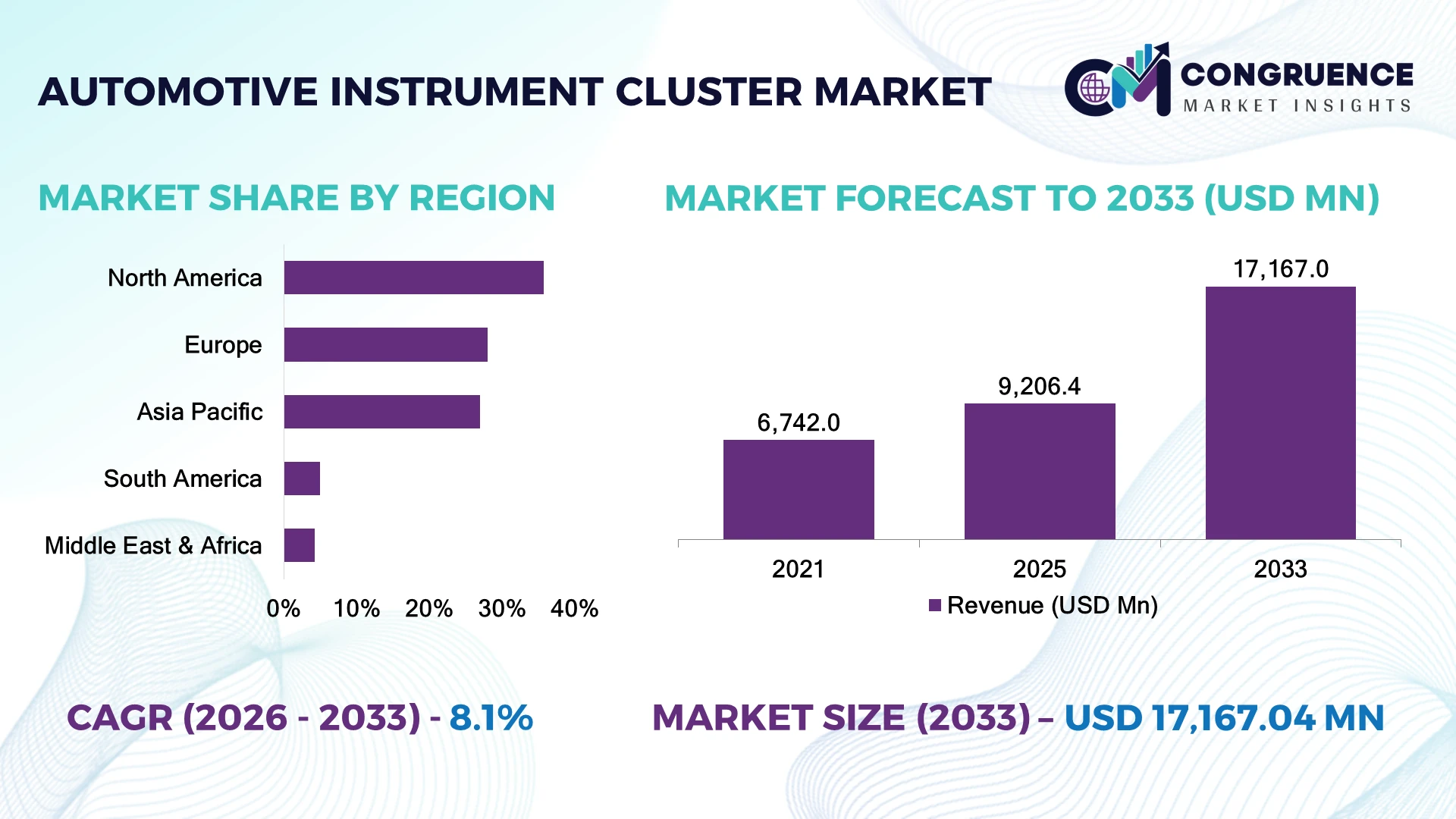
The Global Automotive Instrument Cluster Market was valued at USD 9,206.4 Million in 2025 and is anticipated to reach a value of USD 17,167.0 Million by 2033 expanding at a CAGR of 8.1% between 2026 and 2033. Growth is driven by the transition from analog gauges to configurable digital displays, increasing electric vehicle production, and the integration of navigation, driver-assistance alerts, and real-time vehicle diagnostics into connected cockpit systems.
China remains the dominant automotive manufacturing hub, producing approximately 34.5 million motor vehicles in 2025 and accounting for roughly one-third of global output. Its large electric vehicle ecosystem and rapid model launches support demand for digital clusters and integrated cockpit electronics. The United States, with approximately 10.2 million vehicles produced in 2025, represents a smaller manufacturing base but remains strategically important for advanced vehicle electronics. Trade tensions and shifting tariffs are prompting automakers to reassess regional sourcing and electronics supply chains.
Suppliers should prioritize scalable digital-display platforms, software integration, and regionally resilient manufacturing to strengthen OEM relationships across high-volume and premium vehicle programs.
Market Size & Growth: The market was valued at USD 9.21 billion in 2025 and is projected to reach USD 17.17 billion by 2033, supported by digital cockpit integration, electric vehicle adoption, and advanced driver-assistance systems.
Top Growth Drivers: Digital display adoption, electric vehicle production, and integration of navigation and driver-assistance information are reshaping OEM requirements and cockpit electronics procurement.
Short-Term Forecast: By 2028, reusable cockpit software and automated validation are expected to reduce duplicated engineering work and accelerate vehicle-program development, with actual savings dependent on platform complexity.
Emerging Technologies: AI-enabled interfaces, OLED displays, integrated cockpit controllers, and software-configurable layouts are advancing personalization and the consolidation of driver information.
Regional Leaders: North America remains an important market for advanced cockpit electronics, Asia-Pacific benefits from China's automotive production scale, and Europe emphasizes premium interfaces and safety-system integration.
Consumer/End-User Trends: Passenger cars accounted for an estimated 56.2% of the market in 2025, reinforcing demand for clear displays, configurable information layouts, and intuitive driver interfaces.
Pilot/Case Example: During 2026–2028, shared cockpit platforms are expected to support broader software reuse across vehicle models, helping automakers streamline integration and reduce repeated engineering effort.
Competitive Landscape: Continental, Bosch, Denso, Visteon, and Nippon Seiki compete through display technology, software capabilities, production scale, and long-term OEM relationships; comparable market-share figures vary by segment and geography.
Regulatory & ESG Impact: European vehicle-safety requirements reinforce the need for legible warnings and effective driver-information presentation, while durable electronics and longer-lived platforms support lifecycle resource efficiency.
Investment & Funding: Automotive electronics investment increasingly targets software-defined cockpits, integrated display systems, and regional supply resilience as automakers manage electronics complexity and changing trade conditions.
Innovation & Future Outlook: Competition is shifting from standalone display hardware toward software-configurable clusters, integrated cockpit computing, and over-the-air feature updates that support differentiation throughout the vehicle lifecycle.
The automotive instrument cluster market is evolving from a conventional gauge-supply business into a broader cockpit-electronics opportunity. Passenger cars, electric vehicles, and connected vehicle architectures are increasing demand for displays that combine speed, battery status, navigation, safety alerts, and diagnostics. TFT displays remain important for cost-sensitive and high-volume applications, while OLED and integrated cockpit systems support premium differentiation. As automakers reassess electronics sourcing amid changing trade conditions, suppliers with reusable software, reliable display supply, and flexible integration capabilities are better positioned to support vehicle launches and long-term OEM programs.
Automotive instrument clusters are becoming strategically important because they influence driver interaction, safety communication, cockpit differentiation, and the speed at which automakers introduce new vehicle features. As vehicles become increasingly software-defined, OEMs are evaluating clusters as part of connected cockpit architectures rather than isolated hardware components. This shift increases the importance of reusable software, display integration, and sustained engineering support throughout a vehicle's lifecycle.
Traditional analog gauges provide a comparatively simple and established solution, whereas digital clusters support configurable layouts, real-time diagnostics, navigation, and driver-assistance information. TFT technology accounted for an estimated 61.2% of display technology in 2025, reflecting its balance of cost, brightness, and manufacturing maturity. OLED and integrated cockpit displays offer greater design flexibility but require careful management of cost, thermal performance, and durability. China benefits from high vehicle production volumes and rapid electric vehicle development, while European automakers emphasize premium interface design and safety-system integration.
During 2026–2028, platform reuse, automated software validation, and common cockpit computing architectures will influence supplier selection. An automaker can deploy a shared cluster software foundation across several vehicle models while customizing graphics and functions by trim level. Suppliers are responding through modular software, cybersecurity engineering, and regional integration partnerships. Competitive advantage will increasingly depend on reliable integration, development efficiency, and lifecycle support rather than display specifications alone.
The transition toward software-defined vehicles is increasing demand for configurable digital instrument clusters that combine vehicle speed, battery status, navigation, and driver-assistance alerts. TFT displays represented an estimated 61.2% of display technology in 2025, reflecting their suitability for volume production and varied screen formats. China produced approximately 34.5 million motor vehicles in 2025, creating a substantial manufacturing base for digital cockpit deployment. As automakers introduce electric and connected models, shared cockpit architectures help standardize hardware while differentiating software by trim level. Suppliers are responding through modular display platforms, embedded software development, and closer OEM engineering partnerships. The strategic advantage lies in winning reusable platforms across multiple models rather than supplying isolated display assemblies.
Advanced instrument clusters require display panels, graphics processors, memory, power-management components, and automotive-grade validation, increasing costs relative to conventional gauges. TFT technology's estimated 61.2% share in 2025 reflects its established cost-performance position against more expensive premium alternatives. Semiconductor supply disruptions and specialized component requirements can affect production schedules, particularly when clusters depend on dedicated processors or customized display sizes. Cost pressure is especially significant in entry-level vehicles, where OEMs have limited room to absorb additional electronics content. Suppliers are reducing exposure through common hardware designs, multi-sourcing, longer-term procurement agreements, and component standardization. The operational priority is to deliver useful digital functionality without pushing cockpit costs beyond the economics of high-volume vehicle programs.
Software-defined vehicle architectures create opportunities to supply clusters that support feature updates, configurable interfaces, and shared computing resources with infotainment systems. Passenger cars accounted for an estimated 56.2% of the automotive instrument cluster market in 2025, providing a substantial base for platform-based product development. OLED displays, integrated cockpit controllers, and personalized driver interfaces offer further differentiation, particularly in premium electric vehicles. During 2026–2028, suppliers can expand beyond hardware through software integration, lifecycle maintenance, and validated feature packages. Automakers are also pursuing common electronic architectures to reduce duplicated development across models. Suppliers investing in reusable software frameworks and regional integration teams can improve scalability while helping OEMs shorten development cycles and manage vehicle-platform complexity.
Instrument clusters must operate reliably with vehicle networks, driver-assistance systems, infotainment platforms, and safety-critical signals. Integration errors can compromise warning visibility, synchronization, and the consistency of information presented to drivers. Connected vehicle architectures also increase exposure to software vulnerabilities, making cybersecurity and update management central engineering requirements. Shared cockpit platforms spanning multiple vehicle models and markets multiply software configurations, validation scenarios, and regional compliance requirements. Automakers and suppliers must coordinate functional safety, secure boot, software version control, and regression testing throughout the vehicle lifecycle. Investment in automated validation, cybersecurity engineering, and standardized interfaces is therefore essential. The strategic challenge is to scale software reuse without allowing configuration complexity to weaken safety, reliability, or update consistency.
Integrated Cockpit Computing Expands — Automakers are consolidating instrument clusters, infotainment, and vehicle-interface functions into shared electronic architectures. With passenger cars representing an estimated 56.2% of the market in 2025, reusable cockpit platforms offer substantial deployment potential. Suppliers are building common software foundations while preserving model-specific graphics, functions, and display configurations. This approach can simplify development, although integration and validation requirements remain important cost considerations.
OLED Displays Strengthen Premium Differentiation — OLED technology is attracting interest for high contrast, flexible design, and premium cockpit presentation, while TFT remains an established volume technology, representing an estimated 61.2% of display technology in 2025. Suppliers are balancing visual performance against component cost, thermal behavior, durability, and automotive-grade qualification. The commercial opportunity is strongest where display quality contributes directly to vehicle positioning and customer experience.
Software Reuse Reshapes Development Workflows — OEMs are adopting shared software components and automated validation to support multiple vehicle platforms with fewer duplicated engineering tasks. Reusable architectures can reduce repeated development effort, although realized savings depend on software complexity and testing scope. Suppliers are investing in modular code, simulation tools, and standardized interfaces to shorten integration cycles and improve consistency across vehicle programs.
Regional Sourcing Gains Strategic Importance — Trade uncertainty and changing automotive production footprints are encouraging manufacturers to reassess electronics sourcing and local engineering support. China's production of approximately 34.5 million vehicles in 2025 highlights its manufacturing scale, while North American and European OEMs prioritize supply continuity and regulatory alignment. Suppliers are diversifying sourcing and strengthening regional production and support capabilities to reduce exposure to trade disruptions and improve responsiveness to customer requirements.
Digital instrument clusters represent the leading type, accounting for an estimated 48% of the global market in 2025, supported by configurable displays, improved information presentation, and integration with navigation and advanced driver-assistance systems. Hybrid clusters retain relevance by combining digital screens with conventional gauges, offering automakers a practical transition path without the full cost of a completely digital cockpit. Analog clusters remain important in entry-level vehicles and cost-sensitive commercial applications, where simple architecture and established manufacturing processes support affordability. However, their limited flexibility reduces their appeal in vehicles requiring richer driver information and software-enabled functions.
Fully digital clusters are positioned for the strongest adoption growth as electric vehicles and software-defined vehicle architectures expand. The increasing need to display battery state, energy consumption, regenerative braking, and driver-assistance alerts strengthens their value proposition. OLED and higher-resolution TFT implementations are helping suppliers differentiate premium systems, while reusable software platforms support deployment across multiple vehicle models. Companies are prioritizing integrated cockpit electronics, scalable display designs, and partnerships with automotive software developers. The business implication is a gradual shift in investment from standalone gauge production toward configurable digital platforms that can support multiple vehicle classes and longer software lifecycles.
Passenger cars represent the leading application, accounting for an estimated 72% of automotive instrument cluster demand in 2025. Their dominance reflects higher production volumes, frequent model refreshes, and growing integration of infotainment, navigation, and driver-assistance information. Digital clusters are increasingly specified across mid-range and premium vehicles, while analog and hybrid systems continue to serve affordability-focused models. Commercial vehicles account for a smaller share but require durable displays that present speed, fuel or battery status, diagnostics, and operational warnings under demanding driving conditions. Fleet operators prioritize readability, reliability, and serviceability, creating a different purchasing emphasis from passenger-car manufacturers focused on design differentiation and personalized interfaces.
Commercial-vehicle applications are positioned for comparatively strong digitalization as fleet electrification, telematics, and vehicle-health monitoring become more important. Electric buses, delivery vans, and heavy-duty trucks require instrument displays that communicate range, charging status, energy efficiency, and system alerts. An estimated 25% of new cars sold globally in 2025 were electric, highlighting the growing importance of energy-related information in passenger-car clusters as well. Suppliers are responding with modular display architectures, vehicle-specific software, and integration capabilities that can be adapted across platforms. Investment priorities are therefore shifting toward reusable electronics and software while retaining ruggedized, cost-conscious solutions for commercial fleets.
Original equipment manufacturers represent the dominant end-user group, accounting for an estimated 88% of automotive instrument cluster demand in 2025. Their leading position reflects direct integration into new vehicles, high-volume sourcing agreements, platform-level engineering requirements, and stringent validation standards. OEM purchasing decisions prioritize component reliability, display readability, software compatibility, functional safety, and continuity of supply throughout a vehicle program. The aftermarket serves replacement, repair, refurbishment, and customization needs, particularly when clusters fail outside warranty coverage. Unlike OEM procurement, which is shaped by vehicle launches and production schedules, aftermarket demand depends more heavily on the installed vehicle fleet, component availability, repair economics, and compatibility with specific models.
The aftermarket offers opportunities in replacement displays, refurbished electronic assemblies, and repair services, although security controls and vehicle-network integration limit universal plug-and-play substitution. OEMs remain the primary route to large-scale adoption of advanced digital clusters, while independent repair networks and specialist suppliers address older vehicles and cost-sensitive replacement requirements. Suppliers are strengthening OEM relationships through co-development, platform standardization, and long-term technical support, while aftermarket participants focus on diagnostics, compatibility, and dependable replacement inventory. An estimated 12% aftermarket share illustrates its supporting role rather than parity with new-vehicle procurement. Future competitive positioning will depend on balancing large OEM program wins with serviceable products that extend cluster life and reduce replacement costs.
North America accounted for the largest market share at an estimated 35.7% in 2025 however, Asia-Pacific is expected to register the fastest growth, expanding at an estimated CAGR of 8.1% between 2026 and 2033.

Digital Cockpit Integration and Advanced Vehicle Electronics Strengthen Regional Demand
North America remains a major automotive instrument cluster market, supported by established vehicle manufacturing, premium passenger cars, pickup trucks, and growing integration of digital cockpit electronics. The region accounted for an estimated 35.7% of global market demand in 2025, reflecting its concentration of automotive OEMs and advanced vehicle platforms. Automakers are prioritizing configurable displays, driver-assistance information, and integrated vehicle interfaces to differentiate models and support software-defined architectures. Supply-chain localization has gained importance as manufacturers reassess tariff exposure and semiconductor sourcing. Shared cockpit platforms are also helping suppliers reduce duplicated engineering across vehicle models. Competitive positioning increasingly depends on reliable OEM integration, software capabilities, and regional technical support rather than display hardware alone.
United States Market Outlook: The United States remains the region's principal automotive production and technology center. OICA data indicate that the country produced approximately 10.24 million motor vehicles in 2025. Its extensive light-truck market, established automotive electronics ecosystem, and demand for connected vehicle features support instrument cluster innovation. Suppliers that provide scalable digital displays, robust vehicle-network integration, and cybersecurity capabilities are well positioned to serve domestic OEM programs. Manufacturing localization and dependable component sourcing will remain important as automakers balance product complexity with cost and delivery requirements.
Premium Digital Displays and Safety-Centric Cockpit Engineering Shape Demand
Europe accounted for an estimated 28% of the global automotive instrument cluster market in 2025, supported by Germany's premium vehicle manufacturers and established automotive engineering centers in France, Italy, Spain, and Central Europe. Regional demand emphasizes display clarity, sophisticated driver interfaces, integration with advanced driver-assistance systems, and consistent performance across vehicle platforms. European vehicle production reached approximately 17.2 million units in 2025, although output declined slightly year over year. This uneven industrial environment is encouraging OEMs to control development costs through standardized electronics and software reuse. Suppliers are prioritizing scalable cockpit platforms, display customization, and compliance-oriented engineering to preserve competitiveness in both premium and mass-market vehicle programs.
Germany Market Outlook: Germany remains Europe's leading automotive engineering and manufacturing hub, with strong capabilities in premium vehicles, automotive electronics, and software-integrated cockpit systems. The country's established OEM-supplier networks support collaborative development of high-resolution displays, configurable interfaces, and integrated vehicle computing. As manufacturers adapt to electrification and software-defined architectures, instrument cluster suppliers must deliver reliable integration with navigation, battery-management information, and driver-assistance functions. Investment in reusable software and validation processes can help German automotive programs manage engineering complexity while maintaining differentiation across vehicle brands and model ranges.
High-Volume Vehicle Manufacturing Accelerates Digital Cluster Adoption
Asia-Pacific is the fastest-growing automotive instrument cluster market, supported by China's manufacturing scale, India's expanding vehicle industry, and established automotive electronics capabilities in Japan and South Korea. The region's estimated market contribution was approximately 27% in 2025, while its broader Asia-Oceania automotive industry produced around 59.2 million vehicles during the year. China's electric vehicle ecosystem is increasing demand for displays that communicate battery status, energy consumption, range, and driver-assistance information. Japanese and South Korean suppliers contribute expertise in compact electronics, display technology, and automotive-grade reliability. Companies are expanding modular product portfolios and local engineering support to serve high-volume vehicle programs while balancing affordability with growing expectations for digital cockpit functionality.
China Market Outlook: China is the region's most strategically significant market because of its extensive vehicle production, electric vehicle leadership, and fast product-development cycles. OICA reported approximately 34.53 million vehicles produced in the country in 2025, including 16.63 million new-energy vehicles. This manufacturing ecosystem supports demand for digital clusters with energy-management displays, customizable interfaces, and integrated driver-assistance information. Domestic electronics suppliers and international manufacturers compete on development speed, component cost, software integration, and OEM responsiveness. Suppliers that localize engineering and standardize platforms without sacrificing model-specific customization can strengthen their position in China's highly competitive automotive market.
Regional Vehicle Production Supports Cost-Efficient Electronics Modernization
South America accounted for an estimated 5% of the global automotive instrument cluster market in 2025, with Brazil serving as its principal manufacturing and demand center. The region produced approximately 3.17 million motor vehicles during the year, providing a meaningful base for OEM-supplied instrument clusters and replacement electronics. Demand remains concentrated in conventional passenger cars, utility vehicles, and commercial fleets, where cost, durability, and serviceability influence component selection. Digital displays are gaining relevance as automakers introduce refreshed models and more connected vehicle functions, but affordability remains important outside premium segments. Suppliers are emphasizing modular hardware, localized customer support, and flexible sourcing to manage currency movements, import costs, and uneven production cycles.
Brazil Market Outlook: Brazil is South America's leading automotive manufacturing market, producing approximately 2.64 million vehicles in 2025. Its established assembly plants, automotive supplier base, and large domestic vehicle market create demand for both original-equipment clusters and replacement components. Automakers need display systems suited to a broad mix of vehicle price points, operating conditions, and equipment levels. Suppliers can strengthen competitiveness through locally responsive engineering, cost-optimized digital and hybrid clusters, and dependable component availability. As vehicle electronics become more sophisticated, balancing advanced functionality with affordability will be critical to winning high-volume programs.
Vehicle Assembly Investment and Fleet Modernization Support Gradual Market Expansion
The Middle East and Africa accounted for an estimated 4.3% of the global automotive instrument cluster market in 2025. Demand is supported by vehicle imports, commercial fleet operations, regional assembly initiatives, and gradual modernization of passenger vehicles. South Africa and Morocco remain important African automotive manufacturing centers, while Gulf markets provide demand for premium vehicles, fleet electronics, and connected vehicle features. Africa produced approximately 1.23 million motor vehicles in 2025, illustrating its smaller but established manufacturing base. High import dependence in several markets, uneven local supplier capacity, and price sensitivity constrain rapid adoption. Suppliers are responding through durable product designs, distributor partnerships, and selective localization to improve service coverage and control landed costs.
South Africa Market Outlook: South Africa is a strategically important automotive production and export base, supported by established assembly operations and supplier networks. The country produced approximately 618,000 motor vehicles in 2025, creating demand for factory-installed instrument clusters and related electronic components. Vehicle programs must accommodate local production requirements, export-market specifications, and varied price points. Suppliers can build stronger positions through dependable OEM supply, repair-channel availability, and products engineered for durability under demanding operating conditions. Partnerships with local assemblers and distributors can improve responsiveness while reducing reliance on long-distance component replenishment.
Continental, Bosch, Denso, Visteon, and Nippon Seiki lead global instrument-cluster programs, competing with regional suppliers such as Pricol and Chinese cockpit-electronics firms. Global Tier-1 suppliers win complex contracts through engineering depth and worldwide support; regional players challenge them on cost, localization, and faster adaptation to domestic OEM requirements. Market concentration estimates vary: the five largest vehicle-cluster manufacturers are estimated to exceed 80% combined share in some industry assessments, a directional figure rather than an independently audited total. Competition centers on price, display quality, software integration, delivery reliability, and customization. Suppliers target 10–20% manufacturing-cost advantages through platform reuse and process optimization. Visteon is expanding cockpit controllers with Mahindra, Continental is integrating new display functions, and Nippon Seiki is localizing TFT production in India. The shift is from standalone gauges to software-defined cockpits. Automotive qualification, safety validation, and long OEM design cycles deter entrants. Winning requires scalable software, dependable supply, and localized cost competitiveness.
Digital TFT clusters are replacing analog gauges through configurable layouts, clear warnings, and integration with navigation and driver-assistance systems. TFT remains the volume choice; OLED targets premium models. Shared software and graphics can reduce duplicated engineering, although savings vary by vehicle architecture across models and trims. Adoption is strongest in new passenger cars and electric vehicles, where battery state, range, and regenerative-braking information need prominent presentation.
Cockpit domain controllers consolidate cluster, infotainment, camera, and connectivity functions. Visteon’s SmartCore Pro collaboration with Mahindra supports three displays, while Qualcomm platforms enable shared compute across cockpit and driver-assistance workloads. Consolidation can reduce wiring and hardware duplication, but universal savings percentages are not defensible for OEMs and reduce integration rework. Continental says its Ac2ated Sound display can save up to 90% of conventional speaker-system weight and space.
AI-enabled interfaces, over-the-air updates, and cybersecurity-by-design are differentiators for 2026–2028 programs. Context-aware assistance improves personalization, while remote updates reduce physical service visits for eligible changes. Suppliers with validated software and long-term support benefit most; hardware specialists need software partners. Investment should prioritize reusable code, secure update pipelines, display durability, and integration testing, enabling feature expansion without multiplying hardware variants or compromising functional safety throughout the vehicle lifecycle.
January 2026 Visteon and Mahindra introduced SmartCore Pro for the XUV7X0 lineup, integrating cockpit computing, telematics, surround-view cameras, and three displays. The partnership advances localized digital-cockpit adoption and strengthens Visteon’s position in India’s expanding SUV electronics market production. Source: Visteon.com
March 2025 Continental unveiled Ac2ated Sound, embedding audio actuators into the display surface instead of conventional speakers. The company reports up to 90% lower speaker-system weight and space requirements, creating packaging flexibility for integrated cockpits and electric vehicles. Source: Continental.com
April 2025 Nippon Seiki and Emerging Display Technologies agreed to establish an Indian TFT LCD module joint venture, with a 2,500-square-metre facility targeting automotive mass production in 2027. Local manufacturing is intended to reduce transport and tariff costs. Source: global.nippon-seiki.co.jp
July 2026 Qualcomm became BMW Group’s lead compute-silicon provider for future digital-cockpit and driver-assistance systems through the next decade. The agreement extends platform integration across cockpit and automated-driving functions, strengthening centralized computing for next-generation vehicles and software integration. Source: Reuters.com
The report segments automotive instrument clusters by type—analog, digital, and hybrid; application—passenger cars and commercial vehicles; and end-user—OEMs and the aftermarket. It assesses TFT LCD and OLED displays, cockpit domain controllers, software-configurable interfaces, and electric-vehicle functions such as battery-status and range visualization. Regional coverage includes North America, Europe, Asia-Pacific, South America, and the Middle East and Africa, with country-level analysis of major automotive manufacturing hubs.
Competitive coverage includes Continental, Bosch, Denso, Visteon, Nippon Seiki, regional suppliers, and emerging cockpit-electronics firms. Analysis evaluates localization, OEM programs, display integration, software reuse, cybersecurity, and supply resilience. Segment estimates distinguish mature analog and hybrid demand from digital adoption. Findings support investment planning, market entry, partnership selection, competitive positioning, and product-roadmap decisions for 2026–2033, particularly across cost-sensitive and premium vehicle platforms.
| Report Attribute/Metric | Report Details |
|---|---|
|
Market Revenue in 2025 |
USD 9,206.4 Million |
|
Market Revenue in 2033 |
USD 17,167.0 Million |
|
CAGR (2026 - 2033) |
8.1% |
|
Base Year |
2025 |
|
Forecast Period |
2026 - 2033 |
|
Historic Period |
2021 - 2025 |
|
Segments Covered |
By Type
By Application
By End-User
|
|
Key Report Deliverable |
Revenue Forecast, Growth Trends, Market Dynamics, Segmental Overview, Regional and Country-wise Analysis, Competition Landscape |
|
Region Covered |
North America, Europe, Asia-Pacific, South America, Middle East, Africa |
|
Key Players Analyzed |
Continental AG, Robert Bosch GmbH, Denso Corporation, Visteon Corporation, Nippon Seiki Co., Ltd., Marelli Holdings Co., Ltd., Yazaki Corporation, Panasonic Automotive Systems Co., Ltd., Pricol Limited, Stoneridge, Inc., Hyundai Mobis Co., Ltd., Desay SV Automotive Electronics Co., Ltd., Garmin Ltd., HARMAN International |
|
Customization & Pricing |
Available on Request (10% Customization is Free) |




