
Reports
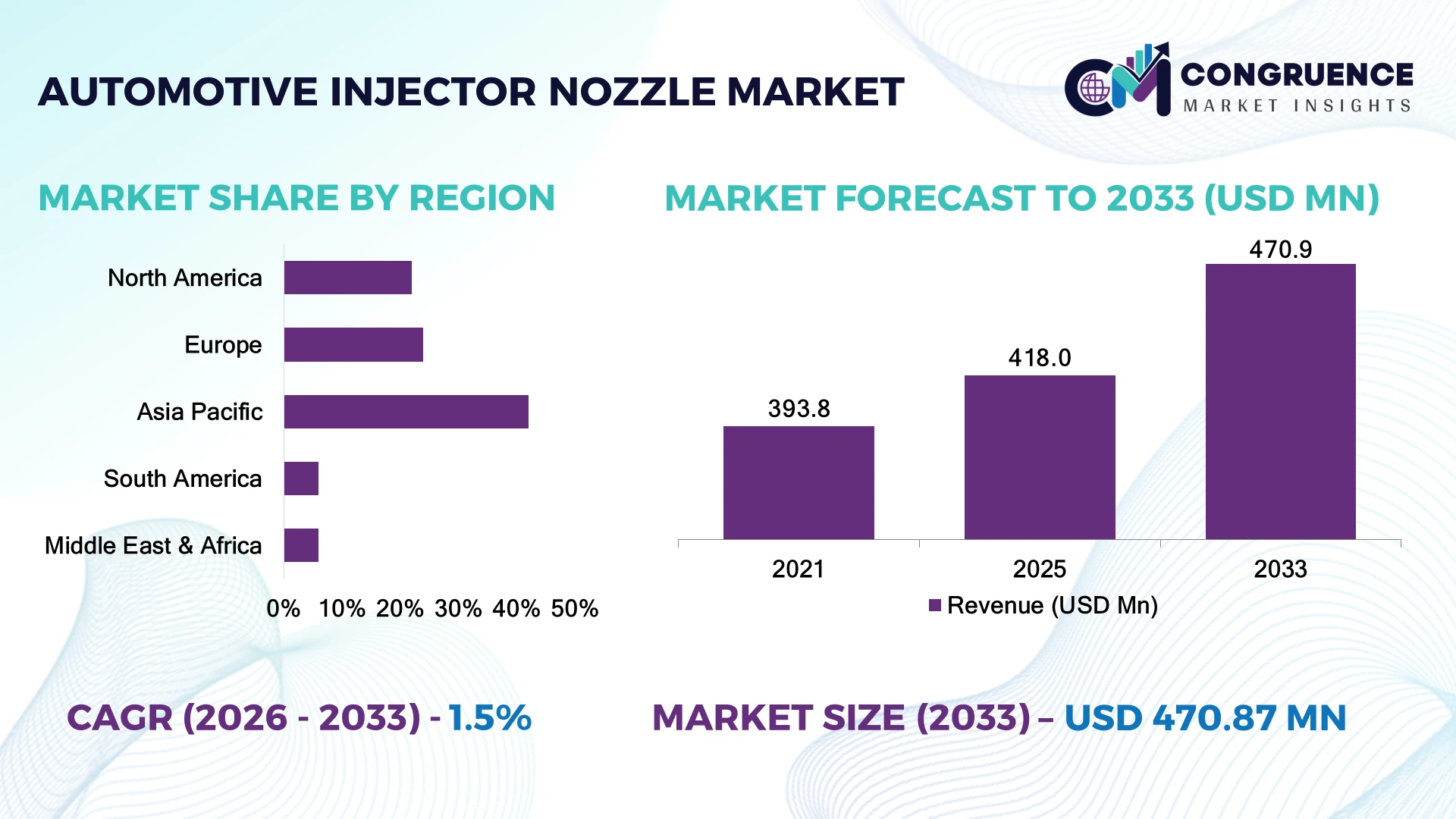
The Global Automotive Injector Nozzle Market was valued at USD 418.0 Million in 2025 and is anticipated to reach a value of USD 470.9 Million by 2033 expanding at a CAGR of 1.5% between 2026 and 2033. Growth is driven by advanced fuel injection technologies, stricter emission standards, and rising adoption of precision-engineered nozzles for improved combustion efficiency in modern vehicles.
China dominates the automotive injector nozzle landscape with nearly 32% market share, supported by large-scale vehicle production, expanding EV-hybrid manufacturing, and investments in fuel system automation. Japan and Germany remain technology leaders, with over 70% adoption of high-pressure injection systems in premium and commercial vehicles. China produces more than 25 million vehicles annually compared with Germany’s approximately 4 million, reflecting manufacturing scale advantages.
Strategic suppliers are prioritizing localized production, digital quality control, and next-generation injection solutions to strengthen global competitiveness.
Market Size & Growth: USD 418.0 Million (2025) to USD 470.9 Million (2033) at 1.5% CAGR, driven by precision fuel injection upgrades and emission compliance requirements.
Top Growth Drivers: Fuel efficiency improvement (35%), emission reduction requirements (30%), advanced engine technologies (25%).
Short-Term Forecast: By 2028, automated injector calibration adoption increases by 20%, improving manufacturing accuracy and reducing production defects.
Emerging Technologies: AI-based injector testing, smart manufacturing automation, and advanced alloy nozzle materials are reshaping production processes.
Regional Leaders: Asia Pacific reaches USD 210 Million with automotive manufacturing expansion; Europe reaches USD 120 Million through emission-focused innovation; North America reaches USD 95 Million through commercial vehicle upgrades.
Consumer/End-User Trends: Over 60% of new diesel commercial vehicles use advanced electronically controlled injection systems for improved performance.
Pilot/Case Example: 2024 smart injector manufacturing programs achieved nearly 15% reduction in quality inspection time through automated monitoring systems.
Competitive Landscape: Bosch leads with approximately 20% share, followed by Denso, Delphi Technologies, Continental, and Stanadyne in the global injector ecosystem.
Regulatory & ESG Impact: Euro 7 emission regulations drive cleaner fuel systems, supporting up to 25% reduction in particulate emissions from optimized injection technologies.
Investment & Funding: More than USD 2 billion invested globally in fuel system modernization, automation, and automotive component manufacturing expansion.
Innovation & Future Outlook: Next-generation injectors focus on higher pressure systems, lightweight materials, and integration with hybrid powertrain platforms.
Automotive Injector Nozzle Market development is increasingly shaped by high-pressure injection systems, precision manufacturing, and hybrid vehicle compatibility. Manufacturers are introducing improved nozzle geometries and digital testing platforms, while more than 50% of automotive suppliers are upgrading production capabilities to meet evolving efficiency standards. Supply-chain localization in Asia and stricter vehicle emission regulations are accelerating technology adoption across major automotive hubs, creating new opportunities for advanced injector solutions.
The Automotive Injector Nozzle Market is becoming strategically important as automakers focus on fuel efficiency, emission control, and optimized combustion performance across passenger vehicles and commercial fleets. Global supply-chain restructuring, especially after semiconductor and component shortages, has encouraged manufacturers to expand regional production networks and strengthen partnerships with precision component suppliers.
Advanced high-pressure injector systems are replacing conventional designs by delivering improved fuel atomization and combustion control. Modern electronically controlled injectors achieve approximately 10–15% better fuel delivery precision compared with legacy mechanical systems while reducing maintenance requirements. Europe emphasizes regulatory-driven innovation through strict emission standards, whereas Asia Pacific maintains larger deployment volumes due to its expanding automotive manufacturing base.
Companies are investing in automated inspection systems, smart factories, and localized component production to improve reliability and reduce operational risks. For example, injector manufacturers are integrating AI-enabled testing platforms that detect manufacturing variations during production cycles, improving quality consistency. Over the next 2–3 years, competitive advantage will depend on technological flexibility, regional manufacturing strength, and the ability to deliver efficient injector solutions aligned with evolving vehicle architectures.
Rising adoption of high-pressure fuel injection systems is accelerating automotive injector nozzle upgrades, driven by stricter emission standards and demand for improved combustion efficiency. Modern gasoline direct injection and common rail diesel systems improve fuel atomization accuracy by nearly 15–20% compared with conventional designs. China’s vehicle manufacturing expansion and Germany’s premium automotive production are increasing demand for precision-engineered injector components. Euro 7 emission requirements are pushing suppliers to enhance nozzle design, testing automation, and material durability. Companies including Bosch, Denso, and Continental are investing in smart manufacturing facilities and advanced calibration technologies to improve production consistency and strengthen supply-chain competitiveness.
Complex manufacturing requirements and dependence on precision machining create cost and scalability challenges for injector nozzle producers. Advanced injector components require micron-level machining accuracy, with production tolerance requirements often below 5 microns, increasing equipment and quality-control expenses. Supply disruptions for specialized alloys and semiconductor-based control components have affected manufacturers across Japan, Germany, and South Korea. Rising raw material costs, including steel and specialty coatings, have increased component expenses by nearly 10–15% in recent years. Companies are reducing exposure through supplier diversification, localized production facilities, and long-term material contracts to maintain operational stability and protect margins.
The shift toward hybrid vehicles and intelligent manufacturing is creating new opportunities for advanced injector nozzle technologies. Hybrid powertrains are expected to account for more than 20% of new vehicle adoption in several major automotive markets by the early 2030s, increasing demand for efficient combustion systems. AI-enabled inspection and automated calibration can improve manufacturing productivity by approximately 15%, creating cost advantages for suppliers. India’s expanding automotive component ecosystem and Mexico’s growing vehicle export manufacturing base provide new investment opportunities. Companies are strengthening R&D partnerships and developing lightweight materials, adaptive injection systems, and digitally monitored production platforms to capture emerging demand.
Increasing vehicle architecture diversity is creating integration challenges for injector nozzle manufacturers, particularly across hybrid, commercial, and performance vehicle platforms. More than 40% of new vehicle development programs require customized fuel system calibration, increasing engineering complexity and testing requirements. Advanced emissions regulations in Europe and North America require continuous adaptation of injector technologies, increasing validation cycles and compliance costs. Limited availability of skilled precision-engineering workers in manufacturing hubs such as Japan and Germany further affects production scalability. Companies must expand automation capabilities, strengthen technical partnerships, and invest in digital simulation tools to maintain consistent performance across evolving vehicle platforms.
AI-Based Quality Control Expansion: Automotive suppliers are deploying AI-enabled inspection systems to improve injector nozzle manufacturing accuracy, with automated testing reducing defect detection time by nearly 20% and improving production consistency by 15%. Manufacturers in Japan and Germany are integrating machine vision, predictive analytics, and digital calibration workflows to address skilled labor shortages and maintain high-precision output.
Localized Supply Networks Growth: Supply-chain restructuring is accelerating as companies reduce dependency on concentrated component sources after global logistics disruptions. Over 30% of automotive suppliers are increasing regional sourcing activities, while manufacturers in China and India are expanding local production capacity for fuel system components. This shift improves delivery reliability, lowers logistics exposure, and supports faster customization for vehicle platforms.
Lightweight Material Adoption Rise: Injector nozzle producers are increasing the use of advanced alloys and surface coatings to enhance durability and thermal resistance. New material solutions improve component lifespan by approximately 10–15% and support higher-pressure injection systems. Companies are investing in material research partnerships to achieve better performance without increasing manufacturing complexity.
Digital Manufacturing Integration: Smart factory adoption is transforming injector production through connected equipment, real-time monitoring, and automated process control. Manufacturers implementing industrial automation report productivity improvements of nearly 15–25% across precision component operations. Companies are expanding Industry 4.0 partnerships to improve traceability, reduce downtime, and strengthen competitiveness amid evolving vehicle technology requirements.
High-pressure fuel injector nozzles represent the leading type segment, accounting for approximately 55% of market adoption due to superior combustion efficiency, precise fuel delivery, and compatibility with modern diesel and gasoline direct injection systems. Their ability to support emission reduction targets and improve engine performance has strengthened adoption among passenger vehicle and commercial vehicle manufacturers. Conventional injector nozzle systems maintain demand in cost-sensitive applications, particularly in developing automotive markets where affordability remains a key purchasing factor. Advanced electronically controlled nozzles are gaining momentum as automakers prioritize smarter fuel management. Electronically controlled injector nozzles are the fastest-growing type segment, expanding as manufacturers integrate digital controls and hybrid powertrain technologies. Adoption has increased by nearly 20% in newer vehicle platforms due to improved response time and fuel optimization capabilities. Companies are focusing investments on precision manufacturing, sensor integration, and advanced materials to improve reliability. The shift toward intelligent injection systems is encouraging suppliers to move from component supply toward integrated fuel management solutions.
Passenger vehicles represent the leading application segment, contributing approximately 60% of injector nozzle demand due to high global production volumes and increasing adoption of advanced fuel systems. Rising consumer preference for fuel-efficient vehicles and stricter emission requirements are accelerating upgrades in gasoline direct injection and diesel common rail systems. Commercial vehicles remain strategically important because of their intensive operating cycles and demand for durable injection components. Commercial vehicle applications are the fastest-growing segment, supported by fleet modernization programs and logistics expansion in countries such as India and China. Adoption of advanced injector technologies in heavy-duty vehicles has increased by nearly 15% as operators focus on fuel savings and maintenance reduction. Manufacturers are developing customized solutions for trucks, buses, and industrial vehicles while strengthening partnerships with fleet operators. The application shift highlights increasing demand for reliable, high-performance injection systems across transportation industries.
Automotive manufacturers represent the leading end-user segment with approximately 65% market share, driven by large-scale vehicle production, supplier integration, and continuous technology upgrades. Original equipment manufacturers require precision injector components to meet performance standards, emission regulations, and production reliability targets. Tier-1 suppliers and aftermarket providers continue supporting demand through replacement cycles and vehicle maintenance requirements. Commercial fleet operators are the fastest-growing end-user group, supported by increasing focus on operating cost reduction and fuel efficiency improvements. Fleet adoption of advanced injector systems is rising by nearly 18% as logistics companies upgrade vehicles to meet environmental standards and improve utilization rates. Companies are targeting this segment through customized maintenance packages, long-term supply agreements, and integrated service partnerships. Future demand is shifting toward users requiring measurable efficiency gains rather than standalone component replacement.
Asia-Pacific accounted for the largest market share at 42% in 2025 however, Europe is expected to register the fastest growth, expanding at a CAGR of 2.1% between 2026 and 2033.

North America holds approximately 22% of the global automotive injector nozzle market, supported by strong commercial vehicle production, advanced engine technologies, and replacement demand across the United States and Canada. The region’s adoption is concentrated in heavy-duty trucks, performance vehicles, and fuel-efficient passenger cars requiring precision injection systems. More than 60% of new commercial vehicles in the U.S. incorporate electronically controlled fuel injection technologies, improving combustion control and operational efficiency. Automakers and suppliers are increasing investments in automated testing, localized component production, and emission-compliant injector solutions to strengthen supply reliability. Strategic partnerships between vehicle manufacturers and Tier-1 suppliers are accelerating technology integration across advanced powertrain platforms.
United States Market Outlook: The United States remains the dominant country within North America due to its extensive automotive manufacturing base, commercial fleet activity, and technology-driven component ecosystem. The country accounts for nearly 80% of regional vehicle production capacity and continues expanding fuel system modernization programs. Growing demand from logistics operators and stricter federal emission requirements are encouraging suppliers to enhance injector durability, automation, and precision manufacturing capabilities.
Europe represents nearly 24% of the global automotive injector nozzle market, driven by premium vehicle manufacturing, strict emission regulations, and advanced automotive engineering capabilities. Germany, Italy, and France maintain strong production concentration through established OEM networks and fuel system specialists. The transition toward Euro 7 compliance is accelerating investment in advanced injection technologies, with manufacturers improving combustion efficiency and reducing particulate emissions. Over 70% of new premium vehicles produced in Germany utilize electronically controlled fuel management systems, highlighting strong technology penetration. Companies are expanding R&D activities, improving testing facilities, and developing lightweight injector components to meet sustainability and performance targets across evolving vehicle platforms.
Germany Market Outlook: Germany leads Europe’s injector nozzle ecosystem through its high-performance automotive manufacturing infrastructure and engineering expertise. The country contributes nearly one-third of European vehicle production and hosts major automotive technology clusters focused on fuel efficiency and emission reduction. German suppliers are prioritizing smart manufacturing, digital calibration systems, and advanced materials to maintain competitiveness in global automotive supply chains.
Asia-Pacific dominates the automotive injector nozzle market with approximately 42% share, supported by large-scale vehicle production, expanding automotive component manufacturing, and strong supplier networks. China, Japan, India, and South Korea account for major production activities, with China alone manufacturing more than 25 million vehicles annually. Rising adoption of advanced fuel injection systems in passenger and commercial vehicles is encouraging suppliers to expand localized production facilities. More than 50% of regional automotive component manufacturers are increasing automation investments to improve precision and reduce production costs. Companies are strengthening partnerships with OEMs, establishing regional manufacturing hubs, and integrating digital quality systems to support high-volume production requirements.
China Market Outlook: China maintains the strongest position in Asia-Pacific due to its automotive manufacturing scale, extensive supplier base, and growing investment in intelligent vehicle technologies. The country contributes over 30% of global vehicle production and continues expanding fuel system component capabilities. Domestic suppliers are increasing automation adoption and improving precision manufacturing to compete with established international injector technology providers.
South America accounts for nearly 6% of global automotive injector nozzle demand, supported by vehicle replacement cycles, commercial transportation activity, and expanding automotive production in Brazil and Argentina. Demand is concentrated in passenger vehicles, agricultural machinery, and logistics fleets where fuel efficiency remains a major operational priority. Brazil’s automotive industry contributes more than 2 million vehicle units annually, creating opportunities for injector component suppliers. However, limited local precision manufacturing capacity and dependence on imported components affect supply flexibility. Companies are responding through regional partnerships, distributor networks, and selective localization strategies to improve availability and reduce import dependency.
Brazil Market Outlook: Brazil represents the largest automotive market in South America, supported by its established vehicle manufacturing ecosystem and commercial fleet demand. The country hosts major automotive production facilities and contributes more than half of regional vehicle output. Suppliers are focusing on aftermarket expansion, local assembly partnerships, and durable injector solutions suited for diverse operating environments.
The Middle East & Africa region contributes approximately 6% of the automotive injector nozzle market, with demand influenced by commercial vehicle operations, infrastructure development, and fleet modernization initiatives. Gulf countries are investing in transportation infrastructure and logistics networks, increasing demand for efficient diesel-powered vehicles and advanced fuel systems. South Africa remains a key automotive manufacturing hub, producing over 600,000 vehicles annually and supporting regional component supply chains. Companies are expanding distribution networks, strengthening aftermarket capabilities, and introducing durable injector technologies designed for challenging operating conditions. Government-led industrial diversification programs are also encouraging automotive component investments across selected markets.
South Africa Market Outlook: South Africa holds the strongest automotive manufacturing position in the region through established OEM facilities, export-oriented production, and skilled technical infrastructure. The country supports a significant portion of regional vehicle assembly activity and is attracting supplier investments focused on component localization. Manufacturers are improving service networks and adopting advanced testing solutions to support long-term market development.
The Automotive Injector Nozzle Market features competition between global fuel system leaders such as Bosch, Denso, Continental, and Delphi Technologies against regional suppliers and specialized component manufacturers. The top five players collectively control nearly 55% of the market, creating a moderately consolidated structure. Competition is based on precision technology, pricing efficiency, supply reliability, and customization, with advanced manufacturers improving injection accuracy by 10–15% through digital calibration. Global leaders compete through automation, R&D partnerships, and vertical integration, while regional suppliers focus on cost advantages and localized production. Companies are expanding manufacturing capacity in China, India, and Mexico to strengthen supply chains. The competitive landscape is shifting toward intelligent injection systems, lightweight materials, and emission-focused solutions. High capital requirements, engineering expertise, and OEM qualification processes create significant entry barriers. Winning players must combine technological innovation, manufacturing scale, and dependable global supply networks.
Denso Corporation
Continental AG
Delphi Technologies
Hitachi Astemo
Stanadyne
Woodward
Keihin Corporation
Shandong Longkou Zhongyu
Yasunaga Corporation
Magneti Marelli
Siemens Mobility
Rheinmetall
Sogefi
Advanced electronic fuel injection systems are transforming injector nozzle technology through precise control, digital calibration, and sensor integration. Modern systems improve fuel delivery accuracy by 15–20% compared with conventional mechanical injectors, enabling lower emissions and improved engine performance. Over 60% of newly manufactured commercial vehicles now use electronically controlled injection platforms, giving suppliers with software capabilities a competitive advantage.
AI-enabled quality inspection, predictive maintenance, and automated manufacturing are becoming important differentiators. Smart production lines reduce inspection time by nearly 20% and improve consistency across high-volume manufacturing operations. Companies investing in Industry 4.0 platforms benefit through faster production cycles, reduced defects, and improved traceability across global supply chains.
Between 2026 and 2028, hybrid-compatible injector technologies, advanced coatings, and lightweight materials will influence competitive positioning. New-generation injector designs deliver improved durability by approximately 10–15% compared with older materials. Global suppliers with strong R&D networks and OEM partnerships are positioned to capture demand as vehicle platforms become more efficient, digitally managed, and emission-focused.
January 2025 Bosch continued advancing high-pressure injector solutions with its third-generation piezo injector technology featuring up to 2,700 bar injection pressure and up to 10 injections per cycle. The innovation improves combustion control and supports OEM demand for efficient powertrain systems. Source: www.bosch-mobility.com
August 2025 Denso launched a digital manufacturing platform project with Dream Incubator for India’s mobility supply chain, integrating manufacturing data and aftermarket operations. The initiative runs through 2027 and strengthens production efficiency, localization, and supplier ecosystem development. Source: www.denso.com
March 2025 Continental introduced an AI-based requirements engineering solution developed with Microsoft and NTT DATA, reducing specification analysis effort by up to 80%. The digital transformation supports faster automotive development workflows and improves engineering productivity across vehicle component programs. Source: www.continental.com
April 2025 Astemo strengthened its global mobility strategy by rebranding Hitachi Astemo Europe and expanding focus on electrification, intelligent mobility, and software-defined vehicles. The transition supports broader technology integration and reinforces its position as a global automotive supplier.
The Automotive Injector Nozzle Market Report provides comprehensive coverage across injector types, including high-pressure and electronically controlled systems, applications such as passenger vehicles, commercial vehicles, and industrial transportation, and end-users including automotive manufacturers, fleet operators, and aftermarket providers. The analysis evaluates major markets across North America, Europe, Asia-Pacific, South America, and Middle East & Africa.
The report examines technology trends including digital calibration, smart manufacturing, advanced materials, and hybrid vehicle compatibility. It highlights adoption patterns, supplier strategies, competitive positioning, and emerging opportunities across automotive production hubs. With analysis of leading companies, deployment trends, and evolving fuel system requirements, the report supports investment decisions, expansion planning, partnership strategies, and long-term positioning through 2026–2033.
| Report Attribute / Metric | Details |
|---|---|
| Market Revenue (2025) | USD 418.0 Million |
| Market Revenue (2033) | USD 470.9 Million |
| CAGR (2026–2033) | 1.5% |
| Base Year | 2025 |
| Forecast Period | 2026–2033 |
| Historic Period | 2021–2025 |
| Segments Covered |
By Type
By Application
By End-User
|
| Key Deliverables | Revenue Forecast; Market Trends; Growth Drivers & Restraints; Technology Insights; Segmentation Analysis; Regional Insights; Competitive Landscape; Regulatory & ESG Overview; Recent Developments |
| Regions Covered | North America; Europe; Asia-Pacific; South America; Middle East & Africa |
| Companies Profiled | Bosch; Denso Corporation; Continental AG; Delphi Technologies; Hitachi Astemo; Stanadyne; Woodward; Keihin Corporation; Yasunaga Corporation; Magneti Marelli; Siemens Mobility; Rheinmetall; Sogefi |
| Customization & Pricing | Available on Request (10% Customization Free) |




