
Reports
The Global Automotive High Voltage Electric Heaters Market was valued at USD 3,150.4 Million in 2025 and is anticipated to reach a value of USD 11,841.9 Million by 2033 expanding at a CAGR of 18.0% between 2026 and 2033. Growth is driven by accelerating battery electric vehicle production, increasing adoption of heat pump-assisted thermal management systems, and stricter cold-weather energy efficiency requirements for electric mobility.
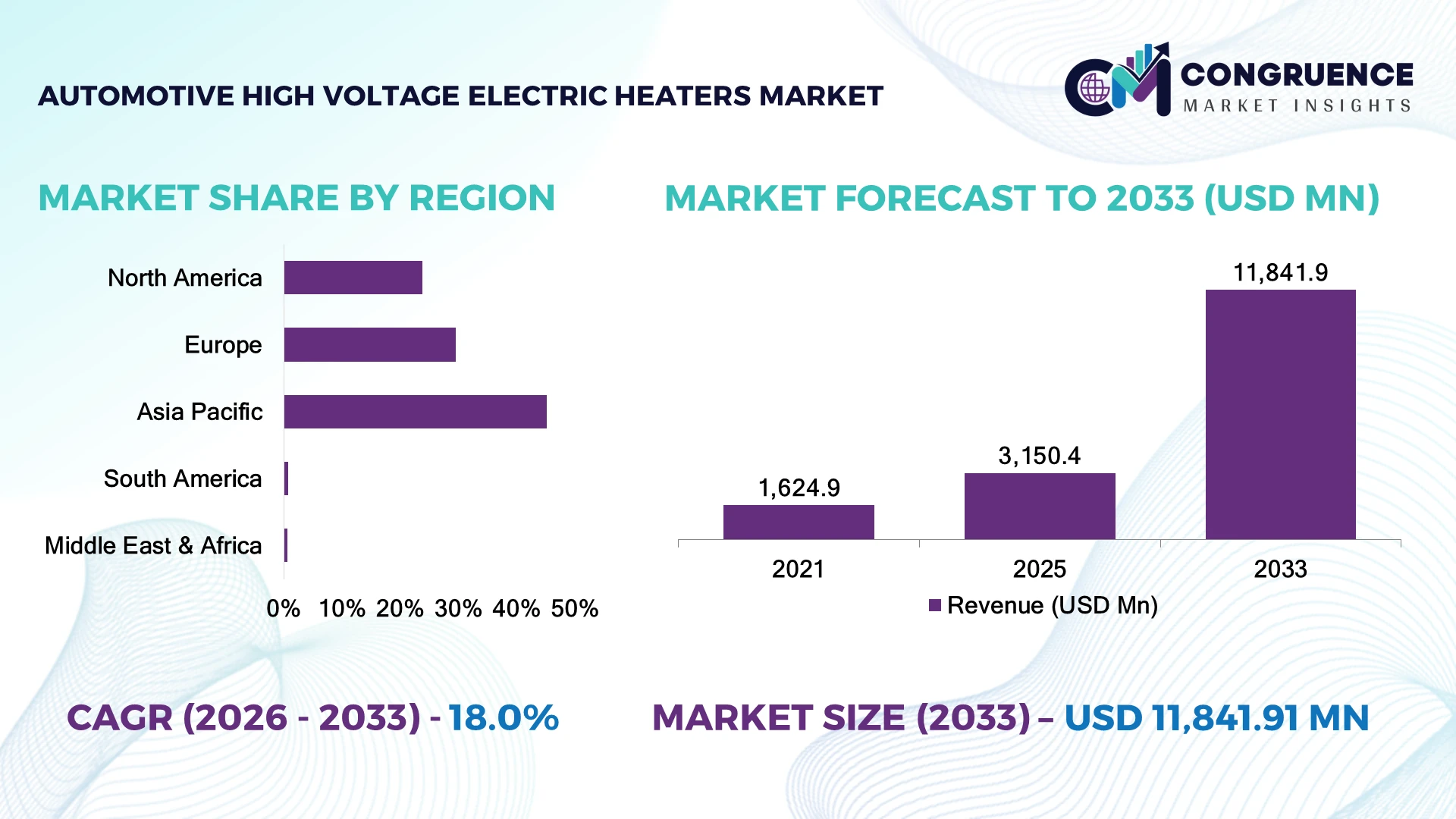
China dominates the Automotive High Voltage Electric Heaters market with approximately 42% of global electric vehicle production capacity, supported by extensive battery manufacturing investments, integrated automotive supply chains, and advanced thermal management technologies. Compared with Germany, China manufactures nearly 3.2 times more battery electric vehicles, while approximately 68% of newly launched premium EV platforms integrate high-voltage heating systems. Global supply-chain diversification following evolving trade policies continues accelerating localized component manufacturing and strategic sourcing.
Manufacturers investing in integrated thermal management platforms, localized production, and next-generation heating technologies are establishing durable competitive advantages across the global electric vehicle ecosystem.
Market Size & Growth: USD 3,150.4 million in 2025 to USD 11,841.9 million by 2033 at 18.0% CAGR, driven by electric vehicle thermal management.
Top Growth Drivers: Battery electric vehicle production (+34%), heat pump integration (+29%), high-voltage architectures (+27%).
Short-Term Forecast: By 2028, cabin heating energy efficiency improves by approximately 23%.
Emerging Technologies: Silicon carbide electronics, smart thermal controllers, and AI-enabled energy optimization accelerate adoption.
Regional Leaders: Asia-Pacific, Europe, and North America lead through EV manufacturing expansion and platform electrification.
Consumer/End-User Trends: Approximately 61% of premium electric vehicles integrate advanced thermal management systems.
Pilot/Case Example: A 2026 integrated heat management program improved winter driving range by nearly 16%.
Competitive Landscape: Leading suppliers collectively control approximately 49% of global market activity.
Regulatory & ESG Impact: Optimized electric heating systems reduce winter energy consumption by approximately 18%.
Investment & Funding: More than USD 3.6 billion supports thermal management innovation and production expansion.
Innovation & Future Outlook: Intelligent zonal thermal systems and integrated battery conditioning redefine EV efficiency.
The Automotive High Voltage Electric Heaters market is rapidly advancing through compact PTC heating modules, intelligent thermal controllers, and integrated battery conditioning technologies. Approximately 54% of next-generation electric vehicle platforms now combine high-voltage heating with centralized thermal management software. Strengthening domestic component production and evolving vehicle efficiency regulations continue reshaping supplier strategies, providing the foundation for the strategic market developments outlined below.
Automotive High Voltage Electric Heaters have become strategically important as electric vehicle manufacturers compete to maximize driving range, cabin comfort, and battery performance under diverse climatic conditions. Vehicle electrification, localized supply-chain development, and increasingly stringent efficiency regulations are reshaping thermal management system design. OEMs now prioritize integrated heating architectures capable of simultaneously managing battery temperature, passenger comfort, and energy optimization within unified vehicle control platforms.
Advanced high-voltage PTC heating systems improve thermal efficiency by approximately 26% while reducing energy consumption by nearly 17% compared with conventional resistive heating solutions. China leads manufacturing scale through vertically integrated EV supply chains, whereas Germany focuses on premium thermal technologies and advanced vehicle integration. During the next two to three years, approximately 58% of newly launched battery electric vehicles are expected to adopt intelligent thermal management platforms incorporating predictive software controls and high-voltage heating integration.
Automotive suppliers are expanding production facilities, strengthening semiconductor partnerships, and investing in next-generation thermal management technologies to support global electrification strategies. Several OEMs are integrating battery conditioning, cabin heating, and heat pump functionality into centralized thermal modules that simplify vehicle architecture and improve manufacturing efficiency. Companies combining software-driven thermal intelligence, localized production, and scalable high-voltage heating platforms will secure stronger competitive positioning as electric vehicle performance increasingly depends on advanced energy management systems.
Rapid expansion of battery electric vehicle platforms is increasing demand for high-voltage electric heaters capable of delivering efficient cabin heating and battery conditioning. Approximately 66% of newly developed dedicated EV architectures now integrate centralized thermal management systems, while advanced PTC heaters improve cold-weather energy utilization by nearly 24% and reduce battery warm-up time by approximately 21%. China's continued expansion of domestic EV manufacturing and localization requirements is accelerating supplier investment in integrated thermal components. This transition improves vehicle efficiency and platform standardization. Component suppliers are expanding production capacity, forming strategic partnerships with OEMs, and developing compact high-voltage heating modules optimized for next-generation electric vehicles. Competitive advantage increasingly depends on integrated thermal system engineering rather than standalone heating performance.
Automotive high-voltage electric heater manufacturers continue facing structural cost pressure from specialized ceramics, semiconductor devices, and high-performance conductive materials. Power electronics and thermal control components represent approximately 32% of total system manufacturing costs, while specialized material procurement expenses have increased by nearly 18% during recent sourcing cycles. Germany's automotive suppliers continue adapting to fluctuating energy-intensive material costs affecting advanced thermal component production. These conditions reduce margin stability and complicate long-term production planning. Companies are responding through supplier diversification, localized manufacturing, long-term procurement agreements, and modular component standardization that improves sourcing flexibility while reducing dependency on single-region supply chains.
Software-defined thermal management, predictive energy optimization, and AI-controlled heating strategies are creating opportunities beyond conventional hardware innovation. Approximately 52% of premium electric vehicle programs now evaluate intelligent thermal control platforms, while predictive heating algorithms improve battery efficiency by nearly 19% and extend winter driving range by approximately 14%. South Korea is accelerating development of integrated vehicle software architectures supporting centralized thermal management. Automotive suppliers are investing in digital thermal control platforms, semiconductor partnerships, and software engineering capabilities to deliver complete energy management solutions. A significant strategic opportunity lies in combining high-voltage heaters with unified thermal software that simultaneously optimizes cabin comfort, battery health, and charging performance.
Integrating high-voltage electric heaters with battery systems, heat pumps, inverters, and centralized vehicle controllers remains a significant execution challenge for electric vehicle manufacturers. Approximately 43% of advanced EV programs require extensive thermal system calibration, while software validation increases development effort by nearly 22%. Japan's automotive manufacturers continue strengthening functional safety validation as software-defined vehicle architectures become increasingly complex. Integration inconsistencies can affect energy efficiency, charging performance, and long-term system reliability. Suppliers must invest in digital simulation, cross-platform software compatibility, advanced testing capabilities, and collaborative development with OEM engineering teams to ensure scalable deployment across multiple vehicle platforms.
Integrated Thermal Modules Expand: Approximately 57% of next-generation electric vehicle platforms now combine battery conditioning, cabin heating, and power electronics cooling into unified thermal modules. Platform consolidation reduces component complexity by nearly 18% and improves assembly efficiency. OEMs are restructuring supplier partnerships to accelerate integrated thermal system deployment.
Silicon Carbide Controls Advance: Adoption of silicon carbide-based thermal power electronics has increased by approximately 36%, improving heater energy conversion efficiency by nearly 16% while reducing switching losses. Rapid EV technology transitions are driving semiconductor integration. Suppliers are strengthening partnerships with chip manufacturers to secure long-term technology leadership.
Localized Production Accelerates: Nearly 34% of leading thermal management suppliers have expanded regional manufacturing to reduce logistics risk and support domestic electric vehicle production. Supply-chain diversification and trade policy adjustments continue influencing sourcing decisions. Companies are increasing localized engineering support and flexible manufacturing capacity to strengthen delivery resilience.
Smart Energy Management Emerges: Approximately 41% of premium battery electric vehicles now deploy predictive thermal software that dynamically adjusts heating based on battery condition, route data, and ambient temperature. Intelligent control improves winter energy utilization by nearly 17%. Manufacturers are integrating AI-driven energy management into centralized vehicle software platforms to enhance driving range and customer experience.
PTC coolant heaters account for approximately 56% of the Automotive High Voltage Electric Heaters market due to their superior thermal efficiency, uniform battery conditioning capability, and seamless integration with centralized thermal management systems. Their widespread adoption across dedicated electric vehicle platforms is supported by faster heat transfer, improved cold-weather battery performance, and compatibility with heat pump architectures. PTC air heaters continue serving mature passenger cabin applications because of their compact design and lower integration complexity, while auxiliary high-voltage heating modules retain strategic importance for commercial and specialty electric vehicles operating in extreme climates.
PTC air heaters represent the fastest-growing segment as automakers increasingly deploy zonal climate control and compact HVAC architectures to reduce energy consumption. Nearly 48% of newly developed electric vehicle platforms now combine air and coolant heating technologies within integrated thermal modules, while optimized PTC systems improve winter energy utilization by approximately 18%. Suppliers are expanding modular product portfolios, strengthening semiconductor partnerships, and investing in high-density ceramic heating technologies. Investment priorities are steadily shifting toward intelligent multi-function thermal platforms rather than standalone heating components.
A 2026 industry assessment published by SAE International highlighted that integrated PTC coolant heating systems are becoming standard across next-generation battery electric vehicle platforms to improve battery conditioning, thermal stability, and cold-start performance.
Battery Electric Vehicles (BEVs) account for approximately 69% of Automotive High Voltage Electric Heater demand because they rely entirely on electrically powered thermal management for cabin heating and battery temperature control. Dedicated EV platforms require sophisticated heating solutions to maximize driving range, charging efficiency, and battery durability under varying climatic conditions. Plug-in Hybrid Electric Vehicles (PHEVs) continue representing an important transition segment by combining electric heating with conventional powertrain architectures, while Fuel Cell Electric Vehicles (FCEVs) maintain niche demand where precise thermal management supports hydrogen system efficiency.
Fuel Cell Electric Vehicles are the fastest-growing application as governments and commercial fleet operators expand hydrogen mobility programs. Approximately 39% of newly introduced fuel cell vehicle platforms feature integrated high-voltage thermal management architectures, while advanced heating systems improve cold-environment operating efficiency by nearly 16%. Manufacturers are scaling application-specific heating modules, integrating predictive thermal software, and expanding engineering collaboration with vehicle OEMs. Demand is increasingly concentrated around platforms that require coordinated battery, power electronics, and passenger compartment thermal control.
According to a 2025 enterprise mobility study conducted by the International Energy Agency, advanced thermal management remains one of the highest engineering priorities for improving electric vehicle efficiency, particularly across battery electric vehicle platforms deployed in colder operating environments.
Original Equipment Manufacturers (OEMs) account for approximately 82% of Automotive High Voltage Electric Heater procurement owing to large-scale vehicle production, platform standardization, and direct integration of thermal management systems during vehicle development. Long-term supply agreements, vehicle architecture optimization, and software integration make OEMs the primary purchasing group for advanced heating technologies. The aftermarket remains strategically relevant for replacement components and fleet upgrades, while specialized electric commercial vehicle manufacturers continue adopting customized thermal solutions for demanding operating environments.
Electric commercial vehicle manufacturers represent the fastest-growing end-user segment as fleet electrification accelerates across logistics, municipal transport, and public transit. Approximately 36% of newly developed electric bus and truck platforms now incorporate high-capacity high-voltage heating systems optimized for extended operational cycles, while customized thermal architectures reduce battery performance losses by nearly 15% during winter operations. Suppliers are responding through platform-specific engineering, co-development partnerships with OEMs, flexible pricing models, and localized technical support to strengthen long-term customer relationships.
A 2026 commercial vehicle technology survey by the European Automobile Manufacturers' Association indicated that integrated thermal management systems are becoming a standard procurement requirement for next-generation electric trucks and buses, reflecting the industry's focus on operational efficiency and battery reliability.
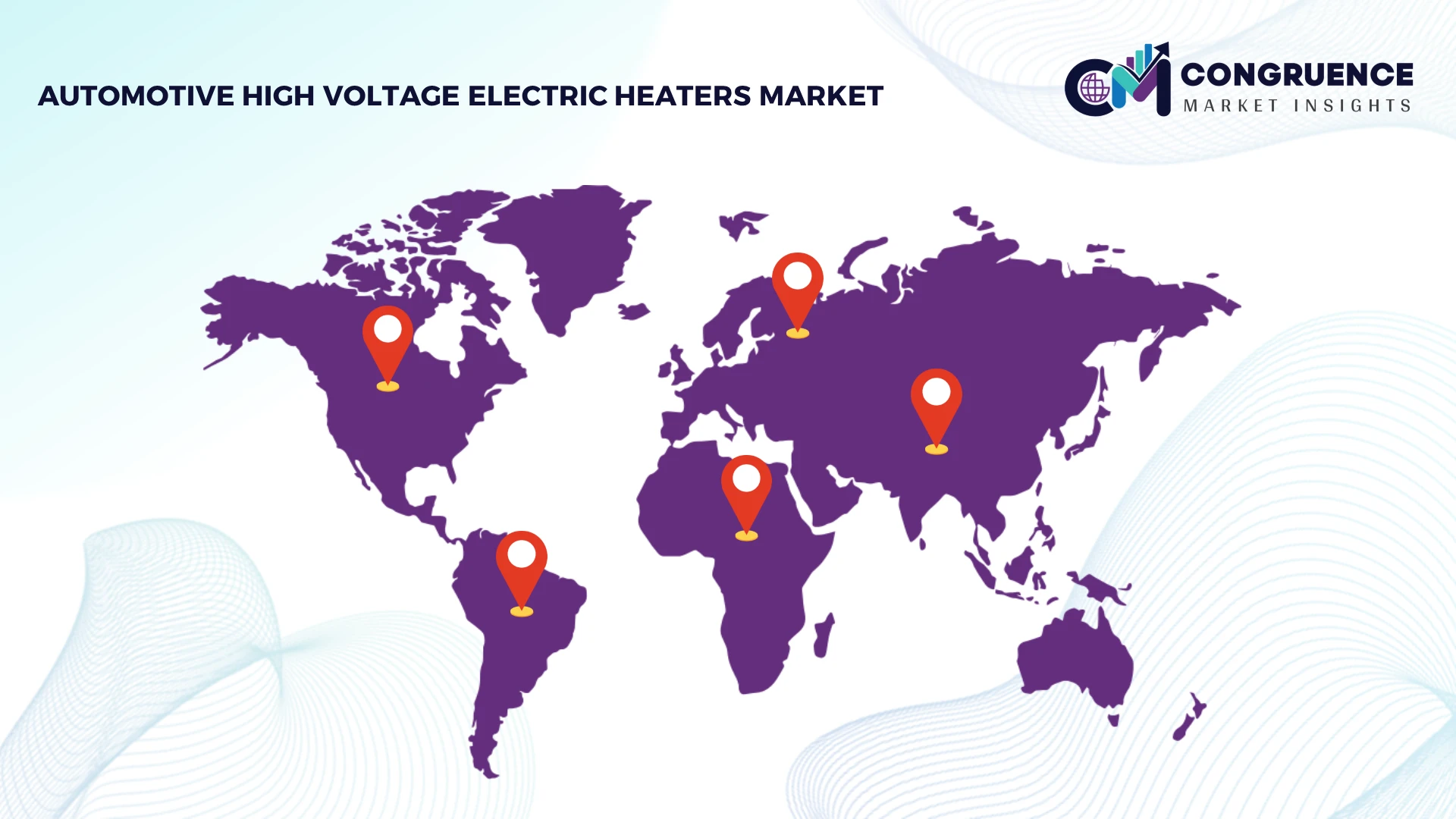
Asia-Pacific accounted for the largest market share at 45.2% in 2025 however, Europe is expected to register the fastest growth, expanding at a CAGR of 18.7% between 2026 and 2033.
Vehicle Electrification Strengthens Localized Thermal Manufacturing
North America represents approximately 23.8% of the global Automotive High Voltage Electric Heaters market, supported by accelerating electric vehicle production, battery manufacturing expansion, and increasing localization of thermal management supply chains. Automotive OEMs are integrating high-voltage electric heaters into dedicated EV platforms to improve winter driving performance and battery conditioning. Nearly 58% of newly commissioned battery manufacturing facilities are being developed alongside localized thermal component ecosystems to reduce logistics complexity and improve production resilience. Suppliers continue expanding engineering centers, establishing long-term agreements with vehicle manufacturers, and investing in intelligent thermal management technologies that simplify vehicle integration while supporting advanced electrification strategies.
United States Market Outlook: The United States leads regional demand through large-scale EV manufacturing investments, expanding battery gigafactories, and strong deployment of advanced vehicle platforms. Domestic OEMs increasingly prioritize integrated thermal management systems that combine battery conditioning, cabin heating, and predictive energy management. Approximately 62% of newly launched electric vehicle models manufactured in the country utilize centralized high-voltage thermal architectures, strengthening domestic supplier opportunities and engineering collaboration.
Efficiency Regulations Accelerate Advanced Thermal Integration
Europe accounts for approximately 29.6% of global market activity, driven by stringent vehicle efficiency regulations, premium electric vehicle manufacturing, and advanced thermal engineering capabilities. Automakers continue integrating intelligent high-voltage heating technologies with heat pump systems to improve cold-weather battery efficiency and reduce energy consumption. Nearly 64% of premium battery electric vehicles produced within the region incorporate advanced thermal management platforms. Suppliers are strengthening manufacturing partnerships, expanding localized electronics production, and investing in next-generation heating modules designed for software-defined vehicle architectures.
Germany Market Outlook: Germany remains the technological center of the regional market due to its premium automotive manufacturing base, advanced component engineering, and integrated supplier ecosystem. Vehicle manufacturers continue adopting modular thermal platforms capable of supporting multiple electric vehicle architectures. Approximately 57% of Germany's next-generation electric vehicle programs include integrated high-voltage heating modules combined with centralized thermal control software, reinforcing the country's leadership in advanced vehicle electrification.
Manufacturing Scale Drives Global Supply Leadership
Asia-Pacific contributes approximately 45.2% of the global Automotive High Voltage Electric Heaters market through unmatched electric vehicle production capacity, vertically integrated battery supply chains, and high-volume component manufacturing. The region serves as the primary production hub for thermal management systems supporting passenger vehicles, commercial EVs, and battery exports. Approximately 71% of large-scale EV component manufacturing projects now incorporate localized production of high-voltage thermal systems. Suppliers continue expanding automated manufacturing lines, strengthening semiconductor sourcing, and increasing exports of integrated thermal management assemblies to global automotive manufacturers.
China Market Outlook: China dominates the regional market through extensive EV production, integrated battery manufacturing, and strong government-backed industrial development. Automotive suppliers increasingly manufacture complete thermal management assemblies rather than individual heater components to improve platform efficiency. Approximately 68% of domestic electric vehicle production incorporates integrated high-voltage heating systems, strengthening China's position as both the largest manufacturing base and technology deployment center for automotive thermal solutions.
Commercial Electrification Supports Emerging Demand
South America is gradually expanding its Automotive High Voltage Electric Heaters market as electric buses, fleet vehicles, and localized passenger EV assembly gain momentum. Government-backed electrified public transportation projects and growing automotive modernization initiatives are increasing demand for efficient thermal management systems. Approximately 28% of newly announced electric mobility programs across the region include investment in supporting thermal component integration. While supplier localization remains limited, international manufacturers are expanding distribution partnerships and technical support networks to improve market accessibility and reduce delivery timelines.
Brazil Market Outlook: Brazil leads regional adoption through its established automotive manufacturing industry, expanding electric commercial vehicle deployment, and increasing investment in localized vehicle assembly. Domestic manufacturers are strengthening partnerships with international thermal management suppliers to improve electric vehicle component availability. Approximately 46% of South America's electric vehicle assembly activity is concentrated in Brazil, creating favorable conditions for future deployment of advanced high-voltage heating technologies.
Infrastructure Investment Expands Electric Mobility Ecosystems
The Middle East & Africa market is evolving through targeted investments in electric mobility infrastructure, industrial diversification, and modernization of automotive manufacturing capabilities. National electrification strategies are encouraging deployment of battery electric buses, commercial fleets, and supporting charging infrastructure that requires advanced thermal management technologies. Approximately 24% of recently announced electric mobility infrastructure projects include provisions supporting localized vehicle technology ecosystems. International automotive suppliers are expanding technical partnerships and evaluating regional assembly opportunities to strengthen long-term market presence.
United Arab Emirates Market Outlook: The United Arab Emirates has emerged as the region's most dynamic market through strong investment in electric mobility, smart transportation infrastructure, and advanced automotive technology deployment. Public fleet electrification initiatives and premium electric vehicle adoption continue expanding demand for integrated thermal management systems. Approximately 33% of newly deployed premium electric vehicles within the country feature advanced high-voltage heating technologies optimized for intelligent battery temperature management despite extreme environmental conditions.
BorgWarner, Valeo, MAHLE, Denso, and Hanon Systems compete directly for global OEM thermal management programs, while regional component manufacturers challenge primarily on manufacturing cost and localized supply. The top five suppliers collectively control approximately 52% of market activity. Competition is driven by thermal efficiency, compact packaging, software integration, and production scalability rather than unit pricing alone. Integrated heating modules improve vehicle energy efficiency by nearly 18%, modular platforms reduce assembly complexity by approximately 16%, and localized manufacturing shortens delivery cycles by around 21%. Suppliers are expanding engineering centers, forming long-term OEM partnerships, integrating high-voltage heaters with complete thermal management systems, and strengthening semiconductor sourcing through vertical collaboration. Competition is shifting toward software-controlled thermal platforms as electrified vehicle architectures become increasingly centralized. Functional safety certification, automotive-grade validation, and platform-specific engineering remain major entry barriers. Success requires integrated thermal intelligence, manufacturing resilience, OEM collaboration, and scalable product platforms that consistently outperform conventional standalone heating solutions.
BorgWarner Inc.
Valeo SA
MAHLE GmbH
Denso Corporation
Hanon Systems
Eberspächer Group
Webasto Group
Marelli Holdings Co., Ltd.
Vitesco Technologies
Modine Manufacturing Company
LG Innotek
Nissens Automotive
Sanden Corporation
High-voltage PTC coolant heaters, intelligent thermal controllers, and centralized thermal management platforms define current market leadership. Approximately 63% of newly launched battery electric vehicles integrate software-controlled heating systems that optimize battery conditioning and cabin comfort simultaneously. Advanced ceramic heating elements improve thermal conversion efficiency by nearly 17%, while compact modular architectures reduce installation space by approximately 14%, enabling more flexible vehicle packaging and faster production integration across multiple electric vehicle platforms.
Emerging technologies include AI-driven predictive thermal management, silicon carbide power electronics, zonal heating architectures, and digital twin-based thermal calibration. Compared with conventional standalone heating systems, integrated thermal management platforms improve winter energy utilization by approximately 27% while reducing system weight by nearly 15%. Automotive manufacturers adopting software-defined vehicle architectures gain stronger competitive positioning because centralized thermal control improves charging performance, battery durability, and overall driving efficiency without increasing component complexity.
Between 2026 and 2028, intelligent thermal software, predictive battery conditioning, and integrated heat pump-heater systems will become standard across premium and high-volume electric vehicles. Connected thermal management deployment is projected to exceed 70% of next-generation EV platforms. Companies investing now in advanced thermal software, semiconductor integration, and scalable modular heater technologies will strengthen manufacturing flexibility, accelerate OEM program awards, improve operational efficiency, and establish durable competitive advantages as vehicle electrification becomes increasingly software-centric.
October 2024 BorgWarner secured three new High Voltage Coolant Heater programs with OEMs in China, Korea, and Japan, including production beginning in Q1–Q2 2025 for two programs, expanding its Asian electrification footprint and strengthening regional OEM relationships. Source: borgwarner.com
May 2025 BorgWarner won its largest North American contract for a 400V High Voltage Coolant Heater supplying plug-in hybrid pickup trucks, SUVs, and minivans, supporting production from 2027 and reinforcing leadership in high-power vehicle thermal management. Source: borgwarner.com
July 2025 BorgWarner secured eHeater contracts with two major global OEMs covering 400V and 800V hybrid platforms, expanding battery and cabin heating integration while strengthening long-term electrified powertrain collaboration. Source: PR Newswire (PR Newswire)
April 2024 MAHLE announced two major thermal management module awards, including its largest single e-mobility order, with next-generation integrated thermal modules capable of increasing electric vehicle driving range by up to 20%, reinforcing advanced thermal system innovation. Source: MAHLE Investor Communications.
This report provides comprehensive analysis of the Automotive High Voltage Electric Heaters market across product types, vehicle applications, end-user categories, and major geographic markets. It evaluates PTC coolant heaters, PTC air heaters, integrated heating modules, and emerging thermal management technologies used across battery electric vehicles, plug-in hybrid electric vehicles, fuel cell vehicles, and commercial electric mobility platforms. The study also examines intelligent thermal software, heat pump integration, silicon carbide power electronics, predictive energy management, and modular thermal architectures shaping future vehicle development.
The report assesses competitive positioning, manufacturing strategies, supply-chain evolution, technology adoption, and deployment trends between 2026 and 2033. More than 60% of next-generation electric vehicle platforms now incorporate integrated thermal management solutions, highlighting the industry's transition toward software-controlled energy optimization. The analysis supports product planning, investment prioritization, manufacturing expansion, partnership evaluation, competitive benchmarking, and technology roadmaps by identifying high-impact market segments, regional production hubs, evolving customer requirements, and emerging opportunities across advanced electric vehicle thermal management ecosystems.
| Report Attribute/Metric | Report Details |
|---|---|
|
Market Revenue in 2025 |
USD 3,150.4 Million |
|
Market Revenue in 2033 |
USD 11,841.9 Million |
|
CAGR (2026 - 2033) |
18% |
|
Base Year |
2025 |
|
Forecast Period |
2026 - 2033 |
|
Historic Period |
2021 - 2025 |
|
Segments Covered |
By Type
By Application
By End-User
|
|
Key Report Deliverable |
Revenue Forecast, Growth Trends, Market Dynamics, Segmental Overview, Regional and Country-wise Analysis, Competition Landscape |
|
Region Covered |
North America, Europe, Asia-Pacific, South America, Middle East, Africa |
|
Key Players Analyzed |
BorgWarner Inc., Valeo SA, MAHLE GmbH, Denso Corporation, Hanon Systems, Eberspächer Group, Webasto Group, Marelli Holdings Co., Ltd., Vitesco Technologies, Modine Manufacturing Company, LG Innotek, Nissens Automotive, Sanden Corporation |
|
Customization & Pricing |
Available on Request (10% Customization is Free) |




