
Reports
The Global Automotive Gear Shifter Market was valued at USD 3465 Million in 2025 and is anticipated to reach a value of USD 4927.57 Million by 2033 expanding at a CAGR of 4.5% between 2026 and 2033. Growth is driven by the transition toward shift-by-wire systems, electronic transmission controls, compact cockpit architectures, and increasing integration of automatic transmissions across passenger vehicles.
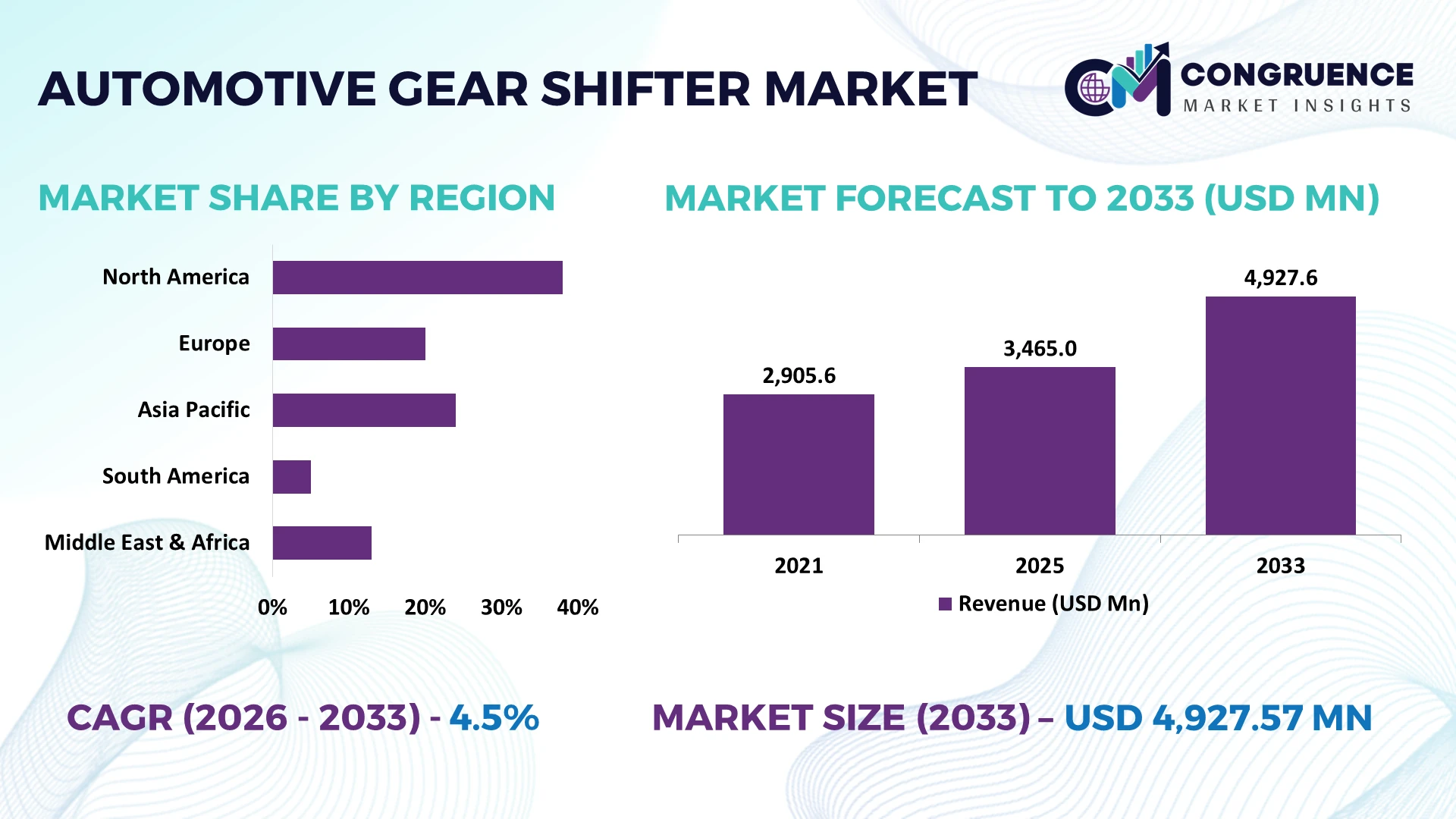
China dominates the global automotive gear shifter industry through its extensive passenger vehicle manufacturing infrastructure and accelerated electrification. In 2025, China produced approximately 34.53 million vehicles, strengthening domestic procurement opportunities for electronic gear selectors, transmission control modules, and integrated cockpit components. New energy vehicles represented approximately 48% of Chinese vehicle sales, accelerating adoption of compact electronic shifting interfaces. China's manufacturing scale substantially exceeds India's automotive production, while European suppliers maintain competitive strengths in precision electromechanical components. China's industrial modernization and automotive localization policies further reinforce domestic supply-chain integration.
Manufacturers prioritizing scalable electronic shifter platforms, localized component sourcing, and software-compatible transmission interfaces are positioned to capture higher-value automotive supply contracts.
Market Size & Growth: USD 3,465 million in 2025, reaching USD 4,927.57 million by 2033 at 4.5% CAGR, supported by electronic gear selector integration.
Top Growth Drivers: China's new energy vehicle sales increased 28.2%, Asian vehicle production expanded 7.6%, and China's automotive manufacturing grew approximately 10.4% in 2025.
Short-Term Forecast: By 2028, lightweight electronic shifter adoption will support component optimization, with Ficosa's established design demonstrating over 75% weight reduction versus conventional automatic shifters.
Emerging Technologies: Three advanced technologies dominate innovation: shift-by-wire, contactless Hall-effect sensing, and software-controlled electromechanical actuators.
Regional Leaders: Asia-Pacific benefits from 59.2 million vehicles manufactured in 2025; Europe advances premium electronic selectors, while North America emphasizes automatic transmission integration.
Consumer/End-User Trends: Electric and plug-in hybrid vehicles represented 47.9% of Chinese automotive sales in 2025, reinforcing demand for compact electronic driving controls.
Pilot/Case Example: Ficosa's Renault Espace electronic Minishifter demonstrated a 0.5 kg selector design, reducing weight by over 75% compared with conventional automatic gearshifts.
Competitive Landscape: ZF, KOSTAL, Ficosa, GHSP, and Tokai Rika compete through electronic controls, OEM integration, compact packaging, and transmission interface reliability.
Regulatory & ESG Impact: ISO 26262 functional safety requirements influence electronic shifter validation, with ASIL C development supporting safety-critical gear selection systems.
Investment & Funding: Ficosa's EUR 34.5 million rotary shift-by-wire contract illustrates investment in integrated selector, electronic control unit, and gearbox actuator production.
Innovation & Future Outlook: Next-generation automotive shifters combine 3D Hall sensors, intelligent park-lock functionality, and modular electronic architectures, shifting supplier competition toward integrated systems.
The global Automotive Gear Shifter Market is undergoing structural transformation as vehicle manufacturers replace mechanical transmission linkages with electronically controlled selector systems. Passenger cars, premium SUVs, hybrid vehicles, and battery electric platforms represent important demand areas for compact rotary, push-button, and steering-column shifters. Contactless position sensors, integrated electronic control units, and automated parking safeguards are improving functional safety and cabin packaging flexibility. Asia-Pacific accounted for over 61% of global vehicle production in 2025, reinforcing its importance for localized component manufacturing. These developments establish the foundation for evaluating technology investments, supplier differentiation, and regional expansion strategies.
The Automotive Gear Shifter Market is becoming strategically important as vehicle manufacturers transition from mechanical transmission interfaces toward software-defined vehicle architectures. Electronic gear selectors now influence cockpit packaging, functional safety, transmission responsiveness, and vehicle platform standardization. China's automotive industry produced approximately 34.53 million vehicles in 2025, establishing substantial manufacturing opportunities for electronic shifting systems. Automakers are restructuring component procurement around integrated electromechanical modules, replacing separate mechanical assemblies with digitally controlled transmission interfaces and reducing dependence on conventional linkage suppliers.
Shift-by-wire technology provides measurable engineering advantages over traditional mechanical gear selectors. Ficosa's compact electronic Minishifter achieved over 75% weight reduction compared with conventional automatic shifters, demonstrating opportunities for vehicle lightweighting and interior space optimization. Germany emphasizes precision engineering, safety-certified electronics, and premium vehicle integration, while India prioritizes cost-efficient automatic transmission components for expanding passenger vehicle production. Renault's deployment of compact electronic shifting technology demonstrates how established automotive manufacturers integrate alternative selector configurations without traditional mechanical linkages.
Between 2026 and 2028, automotive suppliers are expected to prioritize modular selector platforms, contactless position sensing, and standardized electronic control interfaces. Manufacturers are directing engineering investment toward ISO 26262 functional safety compliance, integrated park-lock mechanisms, and compatibility with multiple transmission architectures. Partnerships between transmission specialists, semiconductor suppliers, and cockpit electronics manufacturers will strengthen platform integration. Competitive advantage increasingly depends on delivering validated electronic shifting systems across multiple vehicle models while controlling component complexity and engineering costs.
The transition toward electrified powertrains is accelerating adoption of electronic automotive gear shifters across passenger vehicles. Global electric car sales increased approximately 20% in 2025, while battery electric vehicles represented 65% of electric car purchases. China's electric vehicle penetration approached 55%, encouraging manufacturers to replace mechanical shift linkages with compact electronic selectors and integrated park-lock controls. This transformation supports modular cockpit designs, eliminates mechanical routing constraints, and simplifies vehicle platform engineering. Suppliers including KOSTAL, GHSP, and ZF are advancing shift-by-wire systems, contactless sensors, and integrated transmission electronics. Standardized electronic interfaces also enable manufacturers to reuse selector architectures across different vehicle configurations, reducing engineering duplication and strengthening long-term OEM relationships.
Electronic gear shifter manufacturing faces structural constraints from semiconductor procurement, specialized sensing components, and automotive-grade electronic validation. China's approximately 55% electric car sales penetration contrasts with the United States' electric vehicle share of below 10% in 2025, creating uneven production volumes for standardized electronic selector platforms. European battery electric penetration reached 17.4%, further highlighting regional differences in component procurement requirements. China's restrictions on rare-earth magnet exports also exposed dependencies affecting certain electromechanical actuator supply chains. These pressures complicate inventory planning, sourcing flexibility, and supplier qualification. Manufacturers are responding through alternative sensor designs, geographically diversified electronics procurement, and localized assembly partnerships. Reducing dependence on single-source electronic components is essential for maintaining predictable production schedules and competitive manufacturing costs.
Next-generation automotive gear shifter opportunities are expanding through modular electronic selectors, configurable cockpit controls, and software-defined transmission interfaces. India's electric car sales increased 75% in 2025, while electric vehicle penetration approached 4%, creating opportunities for suppliers targeting affordable electronically controlled driving systems. Electric car model availability expanded from 33 to 45 models, broadening potential applications for standardized selector assemblies. Meanwhile, Germany recorded 43.2% growth in battery electric registrations, supporting demand for advanced cockpit integration. Between 2026 and 2028, suppliers can develop shared electronic selector platforms for electric, hybrid, and automatic combustion-engine vehicles. Partnerships with vehicle electronics manufacturers and transmission specialists will support localization, reduce application-specific engineering requirements, and improve component utilization across multiple vehicle programs.
Scaling electronic automotive gear shifters introduces substantial engineering challenges involving functional safety, embedded software integration, electromagnetic compatibility, and vehicle-level fault management. Global electric car sales expanded 20% in 2025, while Europe's electric vehicle model availability increased nearly 35%, multiplying platform configurations requiring electronic interface validation. Germany's battery electric registrations rose 43.2%, intensifying development requirements for software-compatible transmission controls. Unlike mechanical selectors, electronic systems require coordinated operation between gear-position sensors, transmission controllers, vehicle networks, and electronic parking mechanisms. ISO 26262 compliance demands systematic hazard analysis, diagnostic coverage, and fault-tolerant design. Suppliers must invest in hardware-in-the-loop testing, cybersecurity engineering, and standardized communication architectures. Effective validation determines whether manufacturers can scale production without increasing warranty exposure or compromising vehicle safety.
Automatic Gear Shifters represent the leading category in the global Automotive Gear Shifter Market, supported by widespread integration across passenger cars, premium SUVs, and urban mobility platforms. Their dominance reflects established manufacturing capacity, compatibility with multiple automatic transmission configurations, and consumer preference for simplified vehicle operation. China's electric vehicles accounted for approximately 55% of new car sales in 2025, while hybrid-electric vehicles represented 34.5% of European Union registrations, reinforcing demand for automatic transmission interfaces. Manufacturers including ZF, KOSTAL, and Tokai Rika are refining selector ergonomics, durability, and electronic compatibility to protect established OEM supply relationships.
Electronic Shift-by-Wire Systems represent the fastest-growing technology category, benefiting from simplified mechanical packaging and electronically managed gear selection. Manual Gear Shifters retain relevance in price-sensitive vehicles, particularly where repairability and low component costs influence purchasing decisions. Semi-Automatic Gear Shifters serve applications requiring driver-controlled gear changes alongside automated clutch or transmission functions. Suppliers are increasingly prioritizing modular selector assemblies, advanced sensing technology, and shared electronic architectures to reduce platform-specific development expenditure.
Passenger Cars constitute the largest application segment in the global Automotive Gear Shifter Market, reflecting their substantial production volumes, extensive transmission configurations, and frequent interior technology upgrades. China recorded approximately 30.1 million passenger car sales in 2025, establishing significant demand for automatic selectors, conventional shift levers, and electronically controlled gear interfaces. Passenger vehicle manufacturers increasingly emphasize ergonomic control placement, compact transmission selectors, and compatibility with hybrid powertrains. Companies including GHSP, Ficosa, and KOSTAL are developing integrated selector assemblies that accommodate varying cockpit designs while supporting standardized electronic components across vehicle platforms.
Light Commercial Vehicles represent an increasingly attractive application for automated shifting technologies, particularly in urban delivery operations where frequent gear changes influence driver workload. Heavy Commercial Vehicles prioritize transmission durability, automated gear selection, and compatibility with high-torque drivetrains. Off-Highway Vehicles require ruggedized shifting mechanisms capable of withstanding vibration, contamination, and repetitive operating cycles. India's commercial vehicle sales exceeded 1 million units during fiscal 2025–2026, reinforcing procurement opportunities for specialized transmission components. Suppliers are adapting actuator designs, environmental protection, and electronic diagnostics to address application-specific operating requirements.
OEMs represent the dominant end-user category in the global Automotive Gear Shifter Market because gear selector systems require vehicle-specific engineering, transmission compatibility, functional safety validation, and integration into production platforms. Global automotive manufacturing reached approximately 96.4 million vehicles in 2025, creating extensive original-equipment procurement opportunities. China contributed approximately 35.8% of worldwide vehicle production, demonstrating the importance of high-volume manufacturing contracts and localized component sourcing. Automotive manufacturers increasingly require suppliers to provide validated electronic modules, integrated position sensors, and standardized communication interfaces. Companies including ZF, KOSTAL, and GHSP are strengthening direct manufacturer relationships through customized development programs and platform-compatible selector technologies.
The Automotive Aftermarket serves replacement, repair, and vehicle restoration requirements, particularly for mechanical shift levers, selector cables, bushings, and electronic control assemblies. Increasing electronic complexity is changing aftermarket purchasing behavior toward application-specific replacement modules and diagnostic compatibility. Suppliers are responding through expanded replacement catalogs, distributor partnerships, and improved component traceability. OEM procurement remains concentrated around production integration, while aftermarket competitiveness increasingly depends on replacement availability, technical support, and dependable vehicle fitment.
Asia-Pacific accounted for the largest market share at approximately 48% in 2025 however, Asia-Pacific is expected to register the fastest growth, expanding at a CAGR of approximately 5.8% between 2026 and 2033.

Automatic Transmission Integration and Electronic Cockpit Modernization
North America represents an established automotive gear shifter market, supported by high automatic transmission penetration, premium vehicle manufacturing, and extensive automotive component engineering capabilities. The United States, Mexico, and Canada form an integrated manufacturing network under the USMCA framework, supporting cross-border procurement of electronic selectors, transmission actuators, and precision mechanical components. Mexico manufactured approximately 4 million vehicles in 2025, reinforcing its importance as a production location for transmission-related assemblies. Regional demand increasingly emphasizes rotary selectors, steering-column controls, and electronic park-lock functionality across SUVs and pickup trucks. Suppliers including GHSP, KOSTAL, and ZF compete through platform-specific engineering, component durability, and direct vehicle manufacturer relationships. Automotive manufacturers are also expanding software validation requirements, increasing demand for electronically monitored gear-position systems and integrated transmission safety controls.
United States Market Outlook: The United States remains the region's principal technology and procurement center, supported by General Motors, Ford, Stellantis, and established transmission engineering networks. Domestic light vehicle sales reached approximately 16.2 million units in 2025. High demand for automatic-equipped pickup trucks and SUVs strengthens opportunities for electronic gear selectors, integrated transmission controls, and advanced shift-position sensing technologies.
Premium Vehicle Electronics and Functional Safety Standardization
Europe's automotive gear shifter industry is characterized by precision electromechanical engineering, premium vehicle integration, and stringent electronic system validation requirements. Germany, France, Italy, and the Czech Republic support extensive automotive component production, including selector assemblies, transmission control electronics, and integrated cockpit interfaces. European Union passenger car registrations reached approximately 10.8 million units in 2025, providing a substantial manufacturing and replacement demand base. Battery electric vehicles represented 17.4% of registrations, encouraging manufacturers to adopt compact electronic controls that accommodate alternative powertrain configurations. Suppliers including ZF, KOSTAL, and Ficosa emphasize contactless sensing, functional safety engineering, and modular product architectures. Euro 7 implementation requirements and automotive cybersecurity regulations are influencing electronics development priorities. Manufacturers are strengthening component traceability, software validation, and cross-platform compatibility to maintain long-term supply agreements.
Germany Market Outlook: Germany leads European automotive gear shifter engineering through its established automotive supplier network and concentration of premium vehicle manufacturers. Approximately 4.15 million passenger cars were produced domestically in 2025. BMW, Mercedes-Benz, and Volkswagen support demand for sophisticated electronic selector interfaces, while German component specialists emphasize precision sensing, embedded electronics, and integrated transmission functionality.
Manufacturing Scale and Localized Electronic Component Integration
Asia-Pacific dominates the automotive gear shifter industry through extensive vehicle manufacturing capacity, integrated electronics supply chains, and concentrated transmission component production. China, Japan, India, and South Korea collectively support major automotive assembly and supplier ecosystems, creating substantial procurement opportunities for mechanical and electronic shifting systems. China manufactured approximately 34.53 million vehicles in 2025, while Japan maintained significant production capabilities in automatic transmission and hybrid vehicle technologies. Regional suppliers benefit from proximity to semiconductor packaging, precision plastics manufacturing, and electromechanical actuator production. Japanese manufacturers emphasize durability and compact transmission interfaces, whereas Indian suppliers prioritize cost-efficient localization for high-volume passenger vehicles. Increasing adoption of electronically controlled powertrains is encouraging manufacturers to standardize selector components across vehicle platforms. Investment priorities increasingly favor automated assembly, localized electronics sourcing, and scalable module production.
China Market Outlook: China represents the region's largest automotive gear shifter production and procurement center. New energy vehicle sales reached approximately 16.49 million units in 2025, accelerating demand for electronic driving selectors and integrated parking controls. BYD, Geely, and SAIC are advancing vehicle electronics localization, strengthening opportunities for domestic suppliers specializing in modular shift-by-wire assemblies and compact cockpit interfaces.
Localized Vehicle Assembly and Transmission Component Upgrading
South America's automotive gear shifter market is concentrated around Brazil and Argentina, where passenger vehicle assembly, commercial vehicle manufacturing, and automotive component localization shape procurement activity. Brazil manufactured approximately 2.64 million vehicles in 2025, supporting demand for manual transmission components, automatic selectors, and replacement shifting assemblies. Regional vehicle manufacturers increasingly incorporate automatic transmissions into passenger cars and compact SUVs, encouraging suppliers to expand electronic selector compatibility. Production networks in São Paulo, Minas Gerais, and Córdoba support mechanical component machining, injection molding, and transmission assembly. However, imported automotive electronics, exchange-rate volatility, and uneven supplier specialization influence manufacturing economics. Automotive companies are responding through localized component production, long-term supplier agreements, and selective integration of electronically controlled transmission systems, improving procurement flexibility while maintaining competitive vehicle manufacturing costs.
Brazil Market Outlook: Brazil remains South America's principal automotive manufacturing center, supported by Volkswagen, Stellantis, General Motors, and Toyota production operations. Its established supplier infrastructure provides opportunities for locally manufactured gear selector housings, mechanical linkages, and transmission control assemblies. Expanding automatic transmission availability in compact passenger vehicles is encouraging component suppliers to strengthen domestic engineering and aftermarket distribution capabilities.
Automotive Manufacturing Investment and Vehicle Assembly Localization
The Middle East & Africa automotive gear shifter market reflects contrasting industrial structures, with South Africa and Morocco supporting established vehicle production while Gulf countries prioritize automotive manufacturing diversification. Morocco produced approximately 559,000 vehicles in 2024, demonstrating the importance of export-oriented manufacturing networks connected to European automotive supply chains. South Africa maintains substantial passenger and commercial vehicle assembly operations, supporting demand for automatic and manual transmission selector components. Saudi Arabia is developing domestic vehicle manufacturing capabilities through industrial investment and electric vehicle production initiatives. Regional demand is influenced by imported vehicle platforms, commercial fleet modernization, and localized assembly requirements. Suppliers are targeting automotive industrial zones, distributor networks, and manufacturer partnerships to strengthen component availability. Limited specialized electronics production remains a constraint, increasing the importance of dependable international procurement arrangements.
Morocco Market Outlook: Morocco is strategically positioned through automotive manufacturing clusters around Tangier and Kenitra, supported by Renault and Stellantis production facilities. Stellantis has pursued expansion of its Kenitra manufacturing operations toward 400,000 vehicles annually. The country's proximity to European automotive suppliers supports component localization, export-oriented manufacturing, and integration of transmission selector assemblies into established vehicle production programs.
The global Automotive Gear Shifter Market features competition between established transmission specialists ZF and Kongsberg Automotive, electronic control suppliers KOSTAL and GHSP, and precision interface manufacturers Tokai Rika and Ficosa. The five leading manufacturers collectively account for over 30% of the global market, reflecting fragmented competition and opportunities for specialized suppliers. ZF and KOSTAL previously represented over 10% combined market share, while GHSP, Kongsberg, and KOSTAL collectively exceeded 25% of the shift-by-wire segment in 2024. Competition centers on electronic integration, component miniaturization, functional safety, and OEM platform compatibility. Tokai Rika is standardizing compact steering-column selectors, while Ficosa develops integrated electronic control units and contactless sensing solutions. Kongsberg emphasizes modular actuators compatible with existing automatic transmissions. Increasing software complexity raises engineering validation costs and strengthens established supplier relationships. Winning manufacturers combine proprietary sensing technology, localized production, reliable electronic architectures, and long-term vehicle platform partnerships.
ZF Friedrichshafen AG
KOSTAL Group
Kongsberg Automotive ASA
GHSP
Tokai Rika Co., Ltd.
Ficosa International S.A.
Marquardt Group
Atsumitec Co., Ltd.
Hyundai Mobis Co., Ltd.
Ningbo Gaofa Automotive Control System Co., Ltd.
JOPP Group
Küster Holding GmbH
SL Corporation
UNO Minda Limited
Current automotive gear shifter technologies combine electronic position sensors, shift-by-wire actuators, and integrated transmission control modules. Hall-effect sensing eliminates physical contact wear, while redundant signal channels improve gear-position verification and diagnostic reliability. Ficosa's compact electronic Minishifter demonstrated over 75% weight reduction compared with conventional automatic selectors, establishing measurable packaging advantages. These systems are deployed across production passenger vehicles, particularly premium automatic and electrified platforms. Suppliers benefit from reduced mechanical assembly complexity and improved cockpit design flexibility.
Emerging technologies include three-dimensional magnetic sensing, intelligent park-lock control, and centralized vehicle communication architectures. CAN FD supports transmission data rates reaching 8 Mbps, compared with conventional CAN's 1 Mbps, representing an eightfold improvement in maximum communication bandwidth. Automotive semiconductor manufacturers are integrating programmable sensors with embedded diagnostics, supporting more precise selector monitoring. Modular electronic architectures allow transmission suppliers to share control hardware across multiple vehicle configurations, reducing engineering duplication and strengthening manufacturer relationships.
Between 2026 and 2028, software-defined shifting interfaces and predictive fault diagnostics will reshape product development priorities. Suppliers integrating cybersecurity protection, functional safety validation, and standardized communication protocols will gain competitive advantages. Automotive manufacturers must prioritize electronically validated selector platforms to improve scalability, operational consistency, and long-term component compatibility.
The Automotive Gear Shifter Market Report evaluates industry developments, technology adoption, manufacturing strategies, and competitive positioning between 2026 and 2033. Segmentation covers Manual Gear Shifters, Automatic Gear Shifters, Semi-Automatic Gear Shifters, and Electronic Shift-by-Wire Systems. Application analysis examines Passenger Cars, Light Commercial Vehicles, Heavy Commercial Vehicles, and Off-Highway Vehicles, while end-user coverage distinguishes OEMs from the Automotive Aftermarket. Technology assessment includes contactless sensing, electronic transmission controls, modular actuators, and functional safety integration.
Geographical coverage encompasses North America, Europe, Asia-Pacific, South America, and the Middle East & Africa, emphasizing manufacturing concentration, supplier localization, and vehicle electrification. China's approximately 34.53 million vehicles manufactured in 2025 illustrate the scale of automotive component procurement opportunities. The report supports investment prioritization, supplier benchmarking, production expansion, technology selection, and identification of emerging electronic gear selector applications.
| Report Attribute/Metric | Report Details |
|---|---|
Market Revenue in 2025 | USD 3465 Million |
Market Revenue in 2033 | USD 4927.57 Million |
CAGR (2026 - 2033) | 4.5% |
Base Year | 2025 |
Forecast Period | 2026 - 2033 |
Historic Period | 2021 - 2025 |
Segments Covered | By Type
By Application
By End-User
|
Key Report Deliverable | Revenue Forecast, Growth Trends, Market Dynamics, Segmental Overview, Regional and Country-wise Analysis, Competition Landscape |
Region Covered | North America, Europe, Asia-Pacific, South America, Middle East, Africa |
Key Players Analyzed | ZF Friedrichshafen AG, KOSTAL Group, Kongsberg Automotive ASA, GHSP, Tokai Rika Co., Ltd., Ficosa International S.A., Marquardt Group, Atsumitec Co., Ltd., Hyundai Mobis Co., Ltd., Ningbo Gaofa Automotive Control System Co., Ltd., JOPP Group, Küster Holding GmbH, SL Corporation, UNO Minda Limited |
Customization & Pricing | Available on Request (10% Customization is Free) |




