
Reports
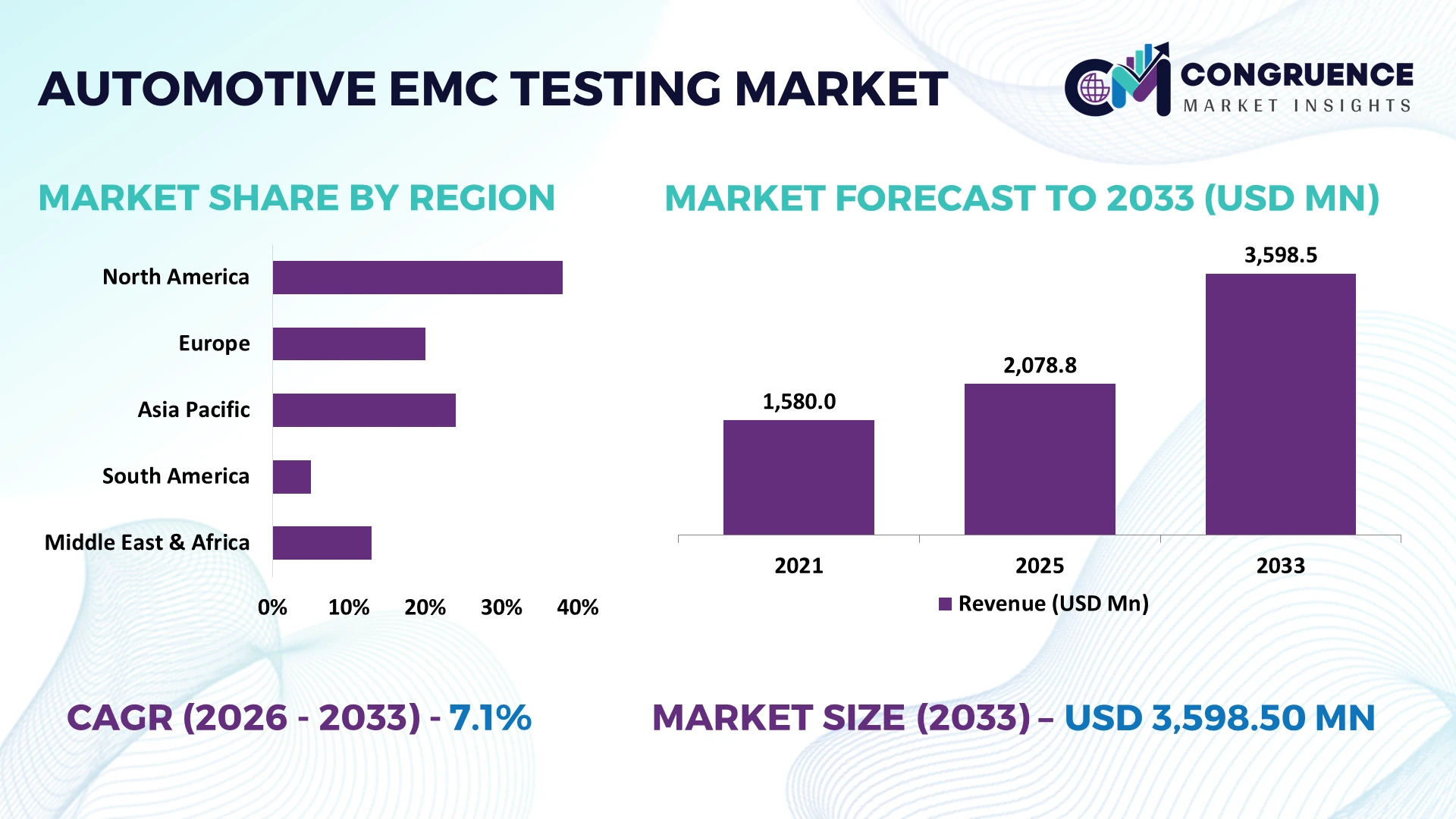
The Global Automotive EMC Testing Market was valued at USD 2078.81 Million in 2025 and is anticipated to reach a value of USD 3598.5 Million by 2033 expanding at a CAGR of 7.1% between 2026 and 2033. Growth is being accelerated by mandatory electromagnetic compatibility compliance for electric vehicles, software-defined vehicles, advanced driver assistance systems, and high-frequency automotive electronics requiring advanced validation across global production programs.
Germany remains the dominant country, accounting for approximately 24% of global automotive EMC testing capacity, supported by over €2.5 billion in automotive R&D investments and strong premium vehicle manufacturing. Compared with China, where EV platform testing adoption exceeds 65% across leading manufacturers, Germany maintains higher certification intensity per vehicle platform. The ongoing European automotive supply chain realignment following regional energy and trade adjustments continues to reinforce advanced testing infrastructure and cross-border validation requirements.
Manufacturers and testing providers expanding accredited laboratories, automation capabilities, and EV-focused validation services will strengthen competitive positioning across global vehicle development programs.
Market Size & Growth: USD 2078.81 Million in 2025, reaching USD 3598.5 Million by 2033 at a CAGR of 7.1%, driven by rapid EV platform validation and advanced electronics integration.
Top Growth Drivers: EV production contributes over 35% of testing demand growth, ADAS integration exceeds 30%, and software-defined vehicle electronics increase validation workloads by nearly 25%.
Short-Term Forecast: By 2028, automated EMC testing workflows improve laboratory efficiency by approximately 20% while reducing testing cycle time by 18%.
Emerging Technologies: AI-assisted signal analysis, robotic test automation, and digital twin validation improve defect detection accuracy by nearly 22% across advanced testing environments.
Regional Leaders: Europe approaches USD 1.15 Billion, Asia Pacific exceeds USD 1.05 Billion, and North America reaches nearly USD 760 Million, supported by EV manufacturing expansion and localized compliance programs.
Consumer/End-User Trends: More than 60% of new EV development programs integrate EMC validation during early-stage vehicle engineering to accelerate certification readiness.
Pilot/Case Example: In 2026, automated vehicle EMC validation projects reduced repeat testing by approximately 17%, improving engineering productivity across multi-platform development.
Competitive Landscape: SGS holds an estimated 12% market share alongside TÜV Rheinland, TÜV SÜD, Intertek, and Bureau Veritas, expanding high-capacity global testing networks.
Regulatory & ESG Impact: Updated vehicle compliance requirements reduce electromagnetic failure risks by nearly 15%, while supporting safer electrified mobility and sustainable product development.
Investment & Funding: More than USD 900 Million supports laboratory expansion, strategic partnerships, and next-generation EMC infrastructure amid global automotive supply chain diversification.
Innovation & Future Outlook: High-frequency EMC validation, AI-driven analytics, and cybersecurity-integrated testing are strengthening next-generation vehicle certification and long-term competitive differentiation.
Automotive EMC Testing Market demand continues to strengthen across electric vehicles, autonomous driving platforms, and connected mobility ecosystems where complex electronic architectures require precise compliance validation. AI-enabled testing platforms and automated chamber technologies improve diagnostic accuracy by approximately 20%, while stricter international regulatory alignment and localized supply-chain strategies are accelerating investment in advanced testing facilities, setting the foundation for the broader strategic market assessment.
Automotive EMC testing has become a strategic requirement as vehicles transition into software-defined, highly connected platforms integrating advanced sensors, high-voltage power electronics, and wireless communication modules. Competitive differentiation increasingly depends on achieving faster certification, reduced redesign cycles, and reliable electronic performance. The ongoing restructuring of automotive supply chains and stricter global EMC compliance frameworks are encouraging manufacturers to expand localized validation capabilities while reducing dependence on cross-border testing infrastructure.
Modern AI-assisted EMC analysis and automated test chambers complete validation sequences approximately 28% faster than conventional manual workflows while lowering engineering rework by nearly 18%. Germany continues to lead in accredited testing infrastructure and premium vehicle certification, whereas China has accelerated deployment through high-volume EV production and integrated testing ecosystems supporting over 65% of new electric vehicle development programs. During the next two to three years, automated validation is expected to exceed 55% adoption across newly commissioned automotive EMC laboratories, improving operational throughput and engineering consistency.
A practical example is the deployment of integrated EMC laboratories within vehicle development centers, allowing design verification before full prototype completion and reducing repeat testing requirements by approximately 20%. Companies are expanding accredited facilities, forming partnerships with semiconductor suppliers, and investing in automated validation platforms to shorten product launch timelines. Organizations combining advanced testing capacity with digital engineering capabilities will secure stronger competitive positioning, operational resilience, and long-term participation in next-generation mobility programs.
The rapid integration of electric powertrains, autonomous functions, and connected vehicle architectures is fundamentally increasing EMC validation requirements across automotive development programs. More than 70% of next-generation vehicle platforms now integrate high-frequency electronic modules, while ADAS installations have expanded by over 32% across new passenger vehicle launches. Germany's accelerated investment in vehicle electronics and compliance infrastructure has strengthened demand for advanced laboratory capacity. This shift improves product reliability but also increases testing complexity, prompting companies to expand accredited laboratories, establish partnerships with semiconductor manufacturers, and deploy AI-enabled testing platforms. Organizations investing in integrated validation ecosystems achieve shorter development cycles, stronger compliance readiness, and improved engineering productivity.
The availability of accredited high-frequency EMC laboratories remains insufficient to match expanding vehicle development pipelines. Testing schedules at major certification facilities often operate above 85% utilization, while specialized chamber construction costs have increased by approximately 20% due to advanced shielding materials and equipment procurement. Japan and several emerging manufacturing hubs continue to face bottlenecks in expanding qualified testing infrastructure. These constraints delay vehicle certification, extend engineering timelines, and reduce operational flexibility. Companies are mitigating these limitations through localized laboratory expansion, multi-year testing agreements, and distributed validation networks that improve scheduling efficiency while reducing dependence on a limited number of large testing facilities.
Digital engineering platforms are creating significant opportunities by combining simulation, virtual validation, and automated EMC testing into unified development workflows. Digital twin-assisted verification can reduce physical prototype dependence by nearly 25%, while automated diagnostics improve anomaly detection accuracy by approximately 22%. South Korea is strengthening investment in intelligent automotive validation facilities supporting advanced semiconductor and EV manufacturing. Companies are expanding R&D collaborations with software providers, automation specialists, and vehicle manufacturers to deliver integrated validation services. A notable strategic opportunity lies in combining cybersecurity verification with EMC compliance, enabling more efficient certification for software-defined vehicles while reducing overall engineering effort.
The greatest long-term challenge is scaling specialized engineering expertise alongside increasingly complex vehicle electronics. Modern vehicle platforms incorporate over 100 electronic control units, while wireless communication interfaces continue expanding by approximately 30% across premium models, increasing validation complexity. The United States is experiencing rising demand for multidisciplinary EMC specialists capable of supporting integrated hardware and software verification. Without skilled personnel and standardized digital workflows, testing consistency and deployment efficiency decline across global programs. Companies must strengthen workforce development, invest in AI-assisted engineering tools, establish technology partnerships, and modernize laboratory infrastructure to maintain reliable certification performance and long-term competitive advantage.
AI-Driven Test Automation Expansion AI-enabled signal analysis and automated test sequencing are becoming standard across advanced automotive EMC laboratories, reducing validation time by nearly 28% and improving fault detection accuracy by approximately 22%. Semiconductor integration and software-defined vehicle complexity are accelerating deployment, while Germany-based engineering centers are expanding automated chambers. Companies are investing in AI platforms, robotic workflows, and digital analytics to increase laboratory throughput, reduce engineering bottlenecks, and support faster certification without compromising compliance quality.
Localized Validation Infrastructure Growth Supply-chain restructuring and stricter certification timelines are encouraging manufacturers to establish testing capabilities closer to production facilities. More than 45% of newly planned automotive validation investments now prioritize domestic laboratory expansion, while cross-border testing requirements have declined by approximately 18% for several global OEM programs. China continues expanding integrated testing campuses near EV manufacturing clusters, enabling faster engineering feedback. Testing providers are responding through regional partnerships, laboratory modernization, and distributed validation networks that shorten logistics cycles and improve operational resilience.
High-Frequency Electronics Verification The rapid adoption of 800V powertrains, high-speed communication modules, and advanced radar systems has increased demand for high-frequency EMC verification. Nearly 60% of premium vehicle development programs now include expanded electromagnetic compatibility validation during early engineering phases, reducing redesign activity by approximately 16%. Companies are upgrading shielded chambers, advanced antenna systems, and real-time monitoring platforms to address increasingly complex electronic architectures while maintaining efficient vehicle development schedules.
Integrated Digital Engineering Workflows Automotive manufacturers are connecting simulation platforms, EMC validation, and product lifecycle management into unified engineering environments. Digital workflow integration has improved engineering collaboration by nearly 24% while reducing documentation processing time by approximately 20%. Regulatory updates for connected vehicles are encouraging standardized digital compliance records, creating a less obvious competitive advantage through audit readiness. Companies are strengthening software partnerships, integrating cloud-based engineering platforms, and restructuring validation processes to improve consistency across global vehicle programs.
Radiated Testing represents the leading segment with an estimated 38% market share, reflecting its critical role in validating increasingly complex wireless communication systems, radar sensors, and connected vehicle electronics. Its dominance is supported by broad applicability across passenger vehicles, electric vehicles, and advanced driver assistance platforms. Emission Testing remains a mature and essential segment for regulatory compliance, while Conducted Testing continues to support powertrain electronics and high-voltage system validation. Manufacturers are expanding chamber capacity and investing in high-frequency instrumentation to improve testing precision and operational efficiency.
Immunity Testing is the fastest-growing segment as software-defined vehicles require greater resilience against electromagnetic interference affecting safety-critical functions. Adoption has increased by approximately 24% across next-generation vehicle development programs, while integrated Radiated and Immunity Testing workflows have reduced repeat engineering validation by nearly 18%. Companies are strengthening strategic partnerships with semiconductor suppliers and laboratory automation providers to deliver comprehensive validation services. Investment priorities increasingly favor integrated testing platforms capable of supporting multiple certification requirements within a single development cycle.
Passenger Vehicles account for approximately 44% of total demand, supported by high production volumes and rapid integration of ADAS, infotainment, and connected electronic systems. Continuous feature expansion increases EMC validation requirements throughout vehicle development. Automotive Components remain strategically important as semiconductor content and electronic control units continue rising, while Infotainment Systems require increasingly rigorous wireless compatibility verification. Companies are expanding validation capacity and integrating automated workflows to support shorter product development cycles.
Electric Vehicles represent the fastest-growing application as high-voltage architectures, battery management systems, and fast-charging technologies introduce more complex electromagnetic interactions. EMC testing requirements for EV programs have expanded by nearly 30%, while integrated platform validation has improved engineering efficiency by approximately 20%. Commercial Vehicles continue adopting advanced telematics and fleet connectivity solutions, creating additional testing demand. Manufacturers are investing in dedicated EV validation laboratories, strengthening supplier collaboration, and expanding digital engineering capabilities to support rapidly evolving vehicle electronics.
Automotive OEMs remain the largest end-user group with an estimated 42% market share because complete vehicle certification, platform integration, and product validation depend on comprehensive EMC testing throughout development. Their large-scale engineering operations require extensive laboratory utilization and advanced compliance capabilities. Certification Bodies continue supporting regulatory approval processes, while Research Institutes contribute specialized validation methods for emerging mobility technologies. Companies are tailoring testing solutions through long-term service agreements, integrated engineering support, and customized validation programs.
Testing Laboratories are the fastest-growing end-user segment as outsourcing increases for specialized EMC expertise and high-frequency testing infrastructure. Laboratory utilization has increased by approximately 26%, while automated testing environments have improved operational productivity by nearly 19%. Automotive Component Manufacturers are expanding independent validation to shorten supplier qualification timelines and reduce downstream redesign costs. Service providers are strengthening competitive positioning through laboratory expansion, technology partnerships, flexible pricing models, and ecosystem collaboration supporting increasingly sophisticated automotive electronics.
Europe accounted for the largest market share at 35.8% in 2025 however, Asia-Pacific is expected to register the fastest growth, expanding at a 8.6% CAGR between 2026 and 2033.

Advanced Vehicle Electronics Accelerate Compliance Investment
North America represents approximately 28.4% of the global Automotive EMC Testing Market, supported by extensive electric vehicle development, semiconductor innovation, and connected mobility programs. The United States and Canada continue expanding accredited EMC laboratories to validate increasingly complex electronic architectures, including ADAS, vehicle connectivity, and high-voltage propulsion systems. More than 58% of premium vehicle development projects in the region integrate EMC verification during early engineering stages, reducing redesign requirements before certification. Strategic collaborations between automotive manufacturers, semiconductor suppliers, and independent testing organizations are improving validation efficiency. Investment in automated EMC chambers and AI-assisted diagnostic platforms has increased by nearly 22%, strengthening testing throughput while supporting shorter product development timelines and improved compliance across advanced vehicle platforms.
United States Market Outlook: The United States remains the regional leader due to its concentration of automotive R&D centers, semiconductor innovation, and software-defined vehicle development. More than 65% of North American EMC validation activity is associated with U.S.-based engineering programs. Automotive manufacturers continue expanding integrated testing facilities near technology clusters while strengthening partnerships with electronics suppliers, enabling faster product verification and greater operational flexibility for connected and autonomous vehicle platforms.
Regulatory Compliance and Premium Manufacturing Leadership
Europe leads the global Automotive EMC Testing Market through its strong automotive manufacturing ecosystem, rigorous electromagnetic compatibility regulations, and concentration of premium vehicle producers. The region contributes around 35.8% of global market activity, supported by continuous investment in accredited laboratories and advanced testing infrastructure. More than 60% of newly introduced premium vehicle platforms undergo integrated EMC validation before final production approval. Accelerated electrification strategies and modernization of automotive engineering facilities continue strengthening demand for high-frequency testing capabilities. Companies are expanding digital engineering workflows and laboratory automation to improve certification efficiency while supporting increasingly complex electronic vehicle architectures.
Germany Market Outlook: Germany remains Europe's most influential automotive EMC testing hub because of its premium vehicle manufacturing base and advanced engineering ecosystem. Approximately 24% of global automotive EMC testing capacity is concentrated within Germany through accredited laboratories and OEM engineering centers. Continuous investment in vehicle electronics, autonomous driving technologies, and semiconductor integration enables manufacturers to accelerate validation processes while maintaining high international compliance standards.
High-Volume EV Manufacturing Expands Testing Capacity
Asia-Pacific has become the fastest-expanding automotive EMC testing region through large-scale vehicle production, electronics manufacturing, and continuous investment in electric mobility infrastructure. The region accounts for approximately 30.6% of global market activity, with automotive manufacturers increasing automated testing deployment across new production facilities. More than 68% of regional electric vehicle development programs integrate comprehensive EMC validation during prototype engineering. Local testing providers continue expanding laboratory capacity and strengthening partnerships with semiconductor companies to support increasing certification demand. Investment in advanced shielding technologies and automated chambers has improved laboratory productivity by approximately 21%, supporting faster product commercialization.
China Market Outlook: China dominates the regional market through its extensive electric vehicle manufacturing ecosystem, advanced electronics supply chain, and large-scale testing infrastructure. More than 65% of domestic EV development programs include integrated EMC validation before production release. Continuous investment in intelligent manufacturing, localized certification capabilities, and high-frequency testing technologies enables manufacturers to accelerate vehicle development while strengthening export readiness for international automotive markets.
Industrial Modernization Supports Validation Demand
South America is gradually strengthening its automotive EMC testing capabilities as vehicle manufacturers modernize production facilities and integrate more electronic systems into regional assembly operations. The region contributes approximately 4.7% of global demand, supported primarily by expanding passenger vehicle manufacturing and increasing regulatory alignment with international compliance standards. Around 35% of new production investments now include upgraded testing and validation equipment to improve product quality. Infrastructure limitations remain a challenge, encouraging manufacturers to combine local testing with selected international certification services. Companies are improving operational resilience through technology partnerships, laboratory modernization, and supplier collaboration.
Brazil Market Outlook: Brazil remains the region's largest automotive production center, supported by established manufacturing facilities and expanding investment in vehicle electronics. Domestic manufacturers continue upgrading validation infrastructure to support connected vehicle technologies and electric mobility initiatives. Increasing deployment of automated engineering systems and stronger supplier collaboration are improving testing efficiency while reducing dependence on overseas certification for selected vehicle development programs.
Infrastructure Investment Strengthens Automotive Validation
The Middle East & Africa market is expanding through industrial diversification, automotive infrastructure development, and increasing localization of vehicle assembly activities. The region contributes nearly 2.5% of global Automotive EMC Testing Market activity, with investment focused on modern engineering facilities and compliance capabilities. More than 30% of newly announced automotive industrial projects include provisions for advanced product testing and quality assurance infrastructure. International partnerships are accelerating knowledge transfer and laboratory development, supporting gradual improvements in certification capability. Companies are aligning investment strategies with industrial modernization initiatives to strengthen long-term operational competitiveness.
United Arab Emirates Market Outlook: The United Arab Emirates has emerged as a regional technology and industrial investment hub supporting advanced automotive engineering services. Continued investment in innovation parks, smart manufacturing initiatives, and technical testing infrastructure is strengthening the country's role in vehicle validation activities. Expansion of engineering partnerships and digital industrial programs is improving technical capability while supporting regional demand for internationally compliant automotive testing services.
Global leaders including SGS, TÜV Rheinland, TÜV SÜD, Intertek, and Bureau Veritas compete directly with specialized regional laboratories and independent automotive testing providers for complex vehicle validation programs. The top five players collectively account for approximately 54% of the market, reflecting moderate consolidation supported by accredited infrastructure and technical expertise. Competition centers on testing speed, automation capability, global laboratory coverage, and engineering customization rather than price alone. AI-enabled testing platforms improve laboratory productivity by nearly 22%, while automated workflows reduce validation cycles by approximately 20%, creating measurable competitive advantages. Companies are expanding accredited facilities, forming partnerships with automotive OEMs and semiconductor manufacturers, and integrating digital engineering services into validation programs. Vertical integration between testing, certification, and engineering consulting is reshaping competitive positioning. High capital investment, accreditation requirements, and specialized engineering talent remain significant entry barriers. Success depends on scalable laboratory capacity, advanced automation, international certification expertise, and strong long-term OEM partnerships.
SGS SA
TÜV Rheinland AG
TÜV SÜD AG
Intertek Group plc
Bureau Veritas SA
DEKRA SE
Eurofins Scientific
UL Solutions Inc.
Applus+ Laboratories
Element Materials Technology
NTS (National Technical Systems)
CSA Group
Keysight Technologies
Rohde & Schwarz GmbH & Co. KG
Automotive EMC testing is transitioning from conventional chamber-based validation toward AI-assisted analytics, automated test orchestration, and digital engineering integration. Automated EMC workflows reduce validation time by approximately 28%, while AI-driven signal classification improves anomaly detection accuracy by nearly 22%. Around 58% of advanced automotive laboratories have deployed automated measurement platforms, enabling faster compliance verification for software-defined vehicles, high-voltage powertrains, and connected mobility systems. These technologies improve laboratory utilization, shorten engineering iterations, and strengthen certification consistency across increasingly complex electronic architectures.
Emerging technologies between 2026 and 2028 include digital twins, virtual EMC simulation, cloud-connected laboratory management, and high-frequency validation for 5G, V2X, and next-generation radar systems. Digital twin-assisted validation reduces physical prototype requirements by nearly 24%, while integrated simulation decreases engineering rework by approximately 18%. Adoption has exceeded 45% among leading global vehicle development programs, enabling manufacturers to identify electromagnetic interference earlier in product development and accelerate multi-platform vehicle launches with greater engineering precision.
Compared with legacy manual validation environments, integrated AI-enabled EMC platforms deliver nearly 30% faster testing throughput while improving repeatability by approximately 20%. Premium automotive OEMs, semiconductor suppliers, and accredited testing providers gain the greatest competitive advantage through scalable automation and integrated compliance engineering. Organizations investing now in intelligent validation infrastructure, digital workflows, and high-frequency testing capabilities will strengthen operational resilience and certification readiness through 2028.
May 2024 SGS expanded its ISO/IEC 17025-accredited EMC laboratory in Puchheim, Germany, adding a 10-meter chamber and larger 5-meter absorber chambers supporting heavy vehicles up to 35 tons. This significantly increased automotive e-mobility testing capability and laboratory flexibility.
August 2025 TÜV Rheinland expanded the EMC and wireless accreditation scope of its Boxborough, Massachusetts laboratory, adding automotive standards including CISPR 25 and ISO 11452-2. The broader capability accelerates compliance services and strengthens international certification support for vehicle manufacturers.
April 2026 Intertek opened its first EMC testing laboratory in India with an 11,000-square-foot facility featuring a three-meter semi-anechoic chamber, wireless testing to 6 GHz, and radiated spurious emission testing to 40 GHz. The expansion strengthens regional testing capacity and reduces certification lead times. Source: Intertek
April 2026 TÜV Rheinland inaugurated its Automotive Component Testing Laboratory in Manesar, India, delivering integrated structural, durability, environmental simulation, and material testing under one roof. The facility enhances local validation capability and supports faster market access for next-generation mobility products. Source: TÜV Rheinland
This report provides a comprehensive assessment of the Automotive EMC Testing Market across Emission Testing, Immunity Testing, Conducted Testing, and Radiated Testing, with detailed evaluation of Passenger Vehicles, Commercial Vehicles, Electric Vehicles, Automotive Components, and Infotainment Systems. It further examines demand across Automotive OEMs, Automotive Component Manufacturers, Testing Laboratories, Certification Bodies, and Research Institutes, covering North America, Europe, Asia-Pacific, South America, and the Middle East & Africa. More than 60% of market activity is linked to advanced electronic vehicle platforms and integrated compliance validation.
The analysis delivers strategic intelligence on automation, AI-enabled testing, digital engineering, high-frequency validation, and software-defined vehicle verification. It evaluates deployment patterns, technology adoption, competitive positioning, laboratory expansion strategies, and evolving regulatory requirements between 2026 and 2033. The report supports investment prioritization, capacity planning, partnership evaluation, market entry decisions, product development strategy, and long-term competitive positioning by identifying operational trends, emerging demand clusters, and technology-led opportunities across the global automotive validation ecosystem.
| Report Attribute/Metric | Report Details |
|---|---|
Market Revenue in 2025 | USD 2078.81 Million |
Market Revenue in 2033 | USD 3598.5 Million |
CAGR (2026 - 2033) | 7.1% |
Base Year | 2025 |
Forecast Period | 2026 - 2033 |
Historic Period | 2021 - 2025 |
Segments Covered | By Type
By Application
By End-User
|
Key Report Deliverable | Revenue Forecast, Growth Trends, Market Dynamics, Segmental Overview, Regional and Country-wise Analysis, Competition Landscape |
Region Covered | North America, Europe, Asia-Pacific, South America, Middle East, Africa |
Key Players Analyzed | SGS SA, TÜV Rheinland AG, TÜV SÜD AG, Intertek Group plc, Bureau Veritas SA, DEKRA SE, Eurofins Scientific, UL Solutions Inc., Applus+ Laboratories, Element Materials Technology, NTS (National Technical Systems), CSA Group, Keysight Technologies, Rohde & Schwarz GmbH & Co. KG |
Customization & Pricing | Available on Request (10% Customization is Free) |




