
Reports
The Global Automotive Electric Motor Market was valued at USD 121255.03 Million in 2025 and is anticipated to reach a value of USD 188929.45 Million by 2033 expanding at a CAGR of 5.7% between 2026 and 2033. Growth is driven by rising traction-motor integration in BEVs and hybrids, wider adoption of integrated e-axles, higher motor efficiency requirements, and OEM efforts to reduce dependence on rare-earth materials.
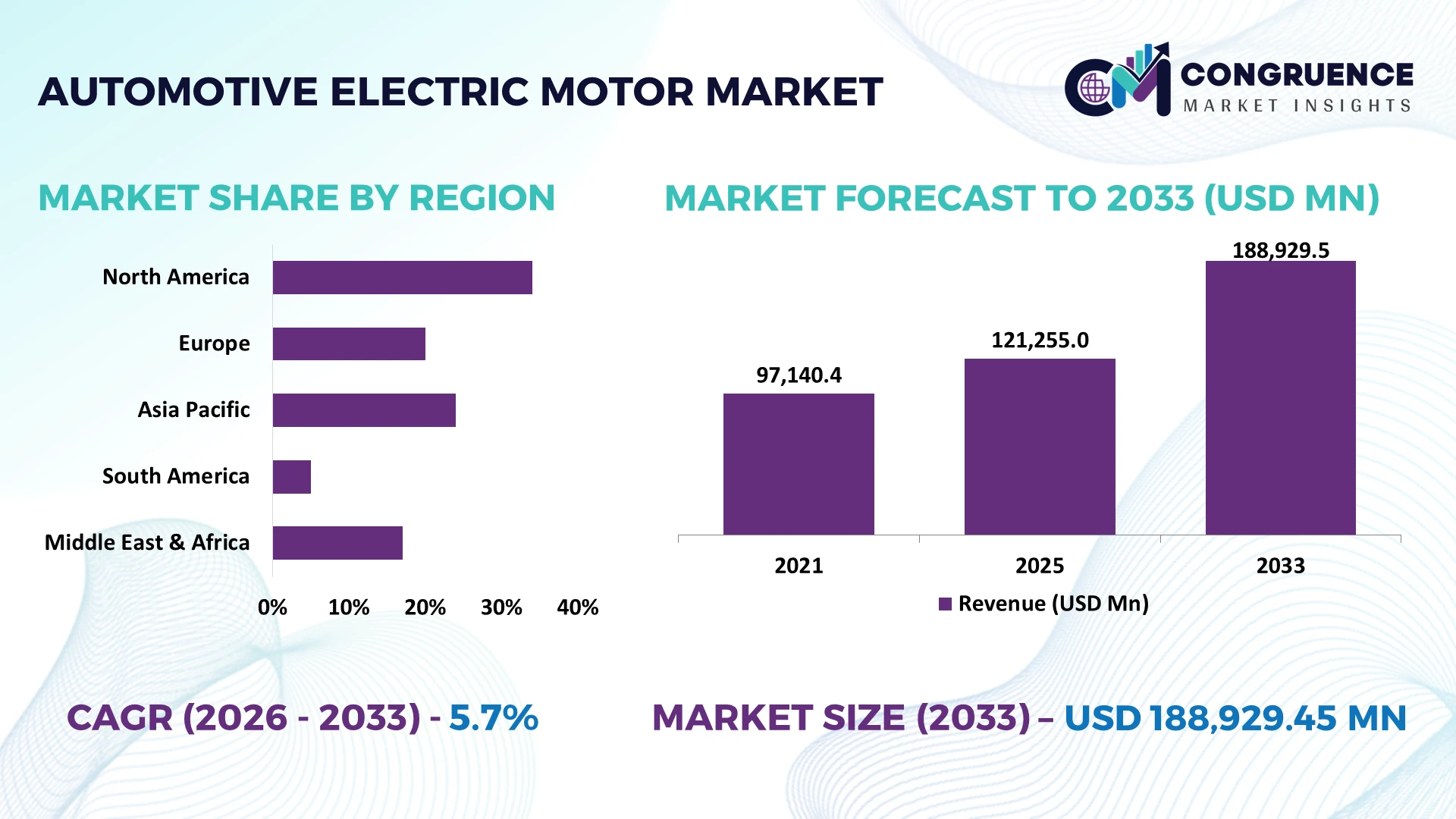
China remains the dominant automotive electric-motor manufacturing hub, supported by its large EV production base, extensive motor supply chain, and high electrified-vehicle adoption; Europe is accelerating localized e-drive production as regional OEMs strengthen supply resilience. China’s NEV penetration exceeded 60% in 2026, while Europe continues expanding hybrid and BEV production capacity, creating a measurable regional gap in electrified powertrain deployment.
Strategically, suppliers should prioritize localized production, high-efficiency traction architectures, and rare-earth-efficient motor technologies to capture growth as automotive powertrain supply chains regionalize.
Market Size & Growth: USD 121.3 billion in 2025 to USD 188.9 billion by 2033 at 5.7% CAGR, driven by electrified powertrain integration.
Top Growth Drivers: BEV adoption 18%, hybrid adoption 12%, e-axle integration 9%.
Short-Term Forecast: By 2028, advanced motor-control systems are targeting 2–4% higher drivetrain efficiency.
Emerging Technologies: Axial-flux motors, silicon-carbide inverters, AI torque control, and rare-earth-free designs are gaining deployment.
Regional Leaders: Asia Pacific holds about 60% share, followed by Europe and North America with accelerating e-drive localization.
Consumer/End-User Trends: More than 60% NEV penetration in China is increasing demand for compact, high-efficiency traction motors.
Pilot/Case Example: 2026 axial-flux programs are targeting 10–15% lower motor weight versus conventional radial-flux designs.
Competitive Landscape: Nidec, Denso, Bosch, BorgWarner, and Valeo remain major global competitors.
Regulatory & ESG Impact: Regional sourcing policies are increasing localized powertrain manufacturing and reducing supply-chain exposure.
Investment & Funding: More than USD 1 billion is flowing into next-generation e-drive, motor, inverter, and localized component capacity.
Innovation & Future Outlook: Software-defined torque control, axial-flux architectures, integrated e-axles, and rare-earth-efficient motors will shape the next competitive cycle.
The Automotive Electric Motor Market is shifting toward high-efficiency traction systems for BEVs, hybrids, e-axles, and commercial vehicles, with advanced architectures reducing weight while improving power density. Axial-flux motors, silicon-carbide power electronics, and rare-earth-efficient designs are strengthening technology differentiation, while integrated motor-inverter-gearbox platforms are simplifying vehicle packaging. Regionalized sourcing is also increasing, with more than 60% NEV penetration in China reinforcing Asia Pacific’s manufacturing advantage and accelerating competition around localized motor production, materials security, and next-generation powertrain efficiency.
Automotive electric motors are becoming a strategic differentiator because motor efficiency directly influences vehicle range, thermal management, acceleration, and battery utilization. The shift from standalone motors toward integrated e-axles is restructuring powertrain engineering, while China’s high electrified-vehicle penetration is accelerating scale advantages in motor manufacturing. Over the next 2–3 years, OEMs are expected to increase integrated drive-unit deployment as packaging efficiency and component consolidation become stronger purchasing criteria.
Advanced permanent-magnet motors typically deliver 3–8% higher operating efficiency than legacy induction architectures, while newer axial-flux designs target substantially higher power density with lower material intensity. China maintains a scale advantage through dense EV and component ecosystems, whereas Germany, Japan, and the United States are emphasizing premium efficiency, localized production, and software-integrated drive systems. This contrast is shifting competition from motor volume toward performance per kilogram and system-level efficiency.
Automakers are expanding partnerships with motor, inverter, and semiconductor suppliers while investing in localized e-drive production. A practical deployment example is the growing use of integrated e-axles combining motor, inverter, and gearbox, reducing assembly complexity and vehicle packaging requirements. Strategically, companies that secure efficient motor architectures, resilient component sourcing, and software-enabled control capabilities will gain stronger cost, range, and platform advantages.
The rapid integration of motors, inverters, and gearboxes is becoming a primary demand catalyst, with e-axle architectures improving drivetrain packaging efficiency by approximately 10–20% and reducing component interfaces by nearly 15%. China’s expanding NEV production base is accelerating deployment, while Japanese and European OEMs are prioritizing compact high-voltage drive units. Silicon-carbide inverter integration can improve power-conversion efficiency by roughly 2–4% compared with conventional silicon systems. This shift directly improves vehicle range and thermal performance while reducing assembly complexity. Suppliers are responding through joint development programs, localized manufacturing, and expanded integrated-drive portfolios, making system-level optimization a stronger competitive differentiator than standalone motor specifications.
Material-cost volatility remains a structural constraint for permanent-magnet motor manufacturers because neodymium, praseodymium, and dysprosium supply remains geographically concentrated. China controls more than 90% of global rare-earth refining capacity, creating procurement exposure for manufacturers outside its supply ecosystem. Rare-earth price movements can increase magnet-related motor costs by 10–20% during supply disruptions, directly affecting drivetrain margins and sourcing stability. Export-control tightening has further encouraged automakers to reassess procurement structures. Companies are responding through multi-country sourcing, long-term supplier contracts, magnet recycling, and development of induction, electrically excited, and switched-reluctance motors. The strategic priority is reducing material concentration without sacrificing torque density or efficiency.
Rare-earth-free and high-power-density motor technologies offer an underexploited opportunity as manufacturers seek material resilience and lower lifecycle costs. Switched-reluctance and electrically excited motors can eliminate permanent magnets, while advanced axial-flux architectures target 20–30% higher power density than conventional radial-flux designs. India is emerging as a strategic manufacturing location as automakers and component suppliers expand localized EV supply chains. Over the next three years, wider adoption of digital motor control, AI-assisted calibration, and silicon-carbide electronics will create additional efficiency gains of approximately 2–5%. Companies investing in proprietary motor-control software and alternative-material platforms can differentiate beyond hardware pricing and strengthen supply-chain independence.
Integrating high-voltage motors with batteries, inverters, thermal systems, braking controls, and vehicle software remains a major execution challenge. System-level calibration can account for 10–15% of development effort in advanced electric powertrain programs, while software-related validation requirements continue increasing as torque control becomes more automated. In the United States and Europe, fragmented charging and vehicle architectures also complicate platform standardization. Cybersecurity requirements add further validation layers to connected drive systems. Automakers must therefore strengthen hardware-software co-development, simulation, functional safety testing, and supplier interoperability. The strongest competitive advantage will come from standardized e-drive platforms that support multiple vehicle models without creating disproportionate calibration, validation, and service complexity.
E-Axle Integration Accelerates: Integrated motor-inverter-gearbox systems are reducing drivetrain interfaces by 15–20% and improving packaging efficiency by 10–15%. Chinese OEMs are scaling these units across multiple vehicle platforms, while Japanese suppliers are expanding modular e-drive partnerships. This consolidation is shortening assembly workflows and reducing calibration complexity.
Rare-Earth Exposure Reshapes Sourcing: Magnet-related supply costs remain vulnerable to material concentration, encouraging manufacturers to shift 10–15% of new development programs toward induction, electrically excited, and switched-reluctance architectures. China’s tighter control over critical-material supply is pushing European and Japanese companies toward dual sourcing, recycling, and regional magnet partnerships.
Software-Controlled Motors Expand: AI-assisted torque management and model-based calibration are improving motor-control efficiency by roughly 2–4% while reducing development iterations by 10–15%. Automakers are integrating motor-control software with vehicle operating systems, shifting competitive value from hardware alone toward software-defined powertrain optimization.
Hybrid Motor Demand Rebalances: U.S. hybrid sales increased nearly 20% year-on-year in July 2026 despite overall auto sales declining 1.5%, prompting manufacturers to rebalance electrification portfolios. Toyota and Hyundai are expanding hybrid production, while suppliers are adapting motor programs toward compact, high-efficiency units that operate without dependence on charging infrastructure.
PMSM Motors remain the leading type, accounting for approximately 45% of automotive electric motor demand, supported by high torque density, compact packaging, and efficiency levels commonly exceeding 90%. Their integration into traction systems and e-axles gives OEMs stronger range and thermal-management performance. BLDC Motors represent roughly 25% and are expanding across auxiliary automotive systems because of their compact construction, controllability, and cost advantages. AC Motors hold about 20%, retaining relevance in applications requiring robustness and reduced dependence on permanent magnets, while DC Motors account for approximately 10% and remain concentrated in mature auxiliary functions.
BLDC Motors are the fastest-growing established architecture as manufacturers increase electronically controlled auxiliary systems and compact actuator deployment. Companies are investing in integrated controllers, improved winding designs, and localized production to reduce component count and improve efficiency by 3–5%. The strategic shift favors PMSM for high-performance traction while BLDC gains share in distributed automotive functions.
Powertrain applications lead the market with approximately 55% share because traction motors directly determine vehicle propulsion, range, acceleration, and regenerative-braking performance. Demand is strongest in China, where electric-car sales reached nearly 50% of total car sales in 2024. HVAC Systems account for roughly 18%, while Power Steering and Electric Pumps represent about 15% and 12%, respectively. These auxiliary applications increasingly require compact, electronically controlled motors to reduce parasitic energy consumption.
Electric Pumps are among the fastest-expanding applications as thermal-management architectures become more sophisticated in EVs and hybrids. Their deployment is increasing by approximately 8–10% across new electrified platforms, supporting battery, inverter, and cabin thermal circuits. Suppliers are responding with integrated pump-motor modules, automated testing, and platform-specific designs. The operational implication is clear: motor suppliers are shifting investment toward distributed auxiliary electrification rather than relying exclusively on traction volumes.
Passenger Vehicles account for approximately 50% of automotive electric motor demand, reflecting their substantially larger production base and increasing electrified powertrain content. Electric Vehicles represent about 30% and are the fastest-growing end-user category as dedicated EV platforms increase motor content per vehicle. Commercial Vehicles contribute nearly 12%, where high-duty-cycle operation makes motor efficiency and thermal durability particularly important, while Automotive OEMs remain the primary procurement channel controlling motor specifications, supplier qualification, and platform integration.
EV-focused demand is expanding fastest in China, India, and selected European markets, with deployment growth of approximately 15–20% in high-adoption programs. OEMs are responding through co-development agreements, localized motor manufacturing, and standardized drive platforms. Commercial-vehicle manufacturers are prioritizing high-torque systems and durable cooling architectures, while passenger-vehicle programs emphasize compactness and efficiency. The competitive shift favors suppliers capable of customizing motors without creating excessive tooling and validation costs.
Asia-Pacific accounted for the largest market share at 58.4% in 2025 however, South America is expected to register the fastest growth, expanding at a CAGR of 7.1% between 2026 and 2033.
Localized e-drive manufacturing strengthens competitive resilience
North America accounted for approximately 18.2% of global automotive electric motor demand in 2025, supported by established passenger-vehicle, commercial-vehicle, hybrid, and EV manufacturing. The United States remains the primary demand center, while Mexico strengthens its position as a cost-efficient production base for motors and vehicle components. More than 40% of recently announced regional electrification investments increasingly target localized powertrain and component manufacturing. OEMs are expanding high-voltage traction systems, 48V architectures, integrated e-axles, and electronically controlled auxiliary motors. Supplier partnerships are also increasing around inverters, motor controls, and thermal-management systems. The region’s competitive position increasingly depends on localized manufacturing, shorter component lead times, and integrated motor-inverter development rather than vehicle assembly capacity alone.
United States Market Outlook: The United States remains North America’s largest automotive electric motor market due to its concentration of OEM engineering centers, manufacturing plants, technology suppliers, and electrified vehicle programs. Hybrid and EV platforms are increasing motor content across traction, steering, HVAC, and pumping systems. The country has surpassed 1 million public charging ports, supporting wider electrification and encouraging OEMs to expand localized e-drive production, supplier partnerships, and advanced motor-control capabilities.
Regulatory pressure accelerates high-efficiency powertrain localization
Europe accounted for approximately 17.5% of global automotive electric motor demand in 2025, with Germany, France, Italy, and the United Kingdom serving as major automotive production and engineering centers. Stricter vehicle-emission requirements are accelerating electrically driven auxiliaries and higher-efficiency traction systems. Germany remains the leading manufacturing hub, while France and Italy are strengthening localized electrified-powertrain production. More than 30% of recent European automotive electrification investments increasingly target localized powertrain components, including motors, inverters, and power electronics. Automakers are also increasing recycled-material usage and supply-chain traceability to address sustainability requirements. The region’s competitive advantage combines premium vehicle manufacturing, advanced engineering capabilities, and regulatory pressure, encouraging suppliers to prioritize high-power-density motors, integrated e-axles, and material-efficient architectures.
Germany Market Outlook: Germany represents Europe’s most strategically important market because of its concentration of premium OEMs, engineering facilities, component suppliers, and advanced powertrain development. German manufacturers are expanding integrated e-axle, PMSM, axial-flux, and high-voltage motor programs across new vehicle platforms. More than 20 major automotive production facilities are undergoing electrification-related modernization, strengthening demand for localized motor manufacturing, precision components, and software-controlled drive systems.
Manufacturing scale reinforces integrated e-powertrain leadership
Asia-Pacific accounted for approximately 58.4% of global automotive electric motor demand in 2025, supported by China, Japan, South Korea, and India. China dominates regional manufacturing through its vertically integrated EV ecosystem spanning motors, batteries, inverters, magnets, and power electronics. More than 60% of new-vehicle sales in China reached electrified categories during several months of 2026, sustaining strong traction-motor demand. Japan retains a competitive advantage in precision motor engineering and hybrid powertrains, while South Korea is expanding high-voltage component production. India is developing into an important localization hub as OEMs increase domestic EV and component manufacturing. The region’s strongest operational advantage is supply-chain density, enabling companies to coordinate motor, inverter, magnet, semiconductor, and gearbox sourcing within closely connected industrial clusters.
China Market Outlook: China remains the dominant country for automotive electric motors because of its large EV production base and vertically integrated component ecosystem. NEV penetration exceeded 60% during several months of 2026, supporting extensive deployment of traction motors, e-axles, and electronically controlled auxiliary motors. Domestic suppliers are increasingly integrating motor, inverter, and gearbox production, allowing OEMs to reduce system complexity while improving packaging, manufacturing efficiency, and supply-chain control.
Hybrid adoption creates a localized electrification pathway
South America accounted for approximately 3.5% of global automotive electric motor demand in 2025, with Brazil representing the region’s largest automotive manufacturing and electrification center. Brazil’s hybrid and flexible-fuel vehicle ecosystem is generating demand for compact electric motors despite comparatively slower full-BEV deployment. More than 10% of new light-vehicle registrations are increasingly associated with electrified powertrain categories, particularly in major urban markets. Automakers are adapting local production strategies toward hybrid-compatible systems that reduce dependence on extensive charging infrastructure. Mexico-style export-oriented manufacturing models are less established in the region, making supplier localization and cost control particularly important. Companies are responding through domestic assembly, technology partnerships, and flexible motor platforms capable of supporting hybrid and electric configurations. Infrastructure limitations continue to favor practical, serviceable architectures over premium high-performance designs.
Brazil Market Outlook: Brazil provides the strongest automotive manufacturing base in South America through its established supplier network, large vehicle fleet, and expanding hybrid production. Local manufacturers are increasing investment in electrified powertrain assembly and component localization. Hybrid systems are particularly attractive because they enable electric-motor deployment without complete dependence on charging infrastructure, creating a practical pathway for broader motor adoption across passenger and commercial vehicles.
Fleet modernization drives targeted electric-motor deployment
The Middle East & Africa accounted for approximately 2.4% of global automotive electric motor demand in 2025, with adoption concentrated in Gulf markets and selected African urban centers. The United Arab Emirates and Saudi Arabia are expanding electric-mobility infrastructure, fleet modernization programs, and domestic automotive manufacturing, creating demand for traction motors and electronically controlled auxiliary systems. EV penetration in leading UAE urban markets has moved into double digits, supported by charging expansion and premium-vehicle adoption. Saudi Arabia is simultaneously developing domestic automotive manufacturing through industrial investments and strategic partnerships. African markets remain more concentrated on electric buses, commercial fleets, and urban mobility because infrastructure and vehicle affordability constrain mass private-EV adoption. Companies are therefore prioritizing fleet partnerships, charging integration, and durable motor platforms rather than relying solely on passenger-vehicle demand.
United Arab Emirates Market Outlook: The UAE is the region’s leading automotive electrification market because of its high purchasing power, advanced charging infrastructure, and strong premium-EV adoption. Dubai and Abu Dhabi are expanding charging networks and fleet-electrification programs, supporting demand for high-efficiency traction motors and electric auxiliary systems. Smart-mobility investments also favor connected motor platforms, giving suppliers opportunities to combine motor control, diagnostics, and fleet-management capabilities.
Nidec, Denso, Bosch, BorgWarner, Valeo, and regional Chinese motor specialists compete across integrated e-axles, traction motors, auxiliary motors, and power electronics. Global Tier-1 suppliers compete with vertically integrated Chinese manufacturers, while OEMs increasingly challenge suppliers through in-house motor and inverter development. The top five players together hold an estimated 30–35% of the market, indicating a fragmented structure despite strong technology leadership.
Competition centers on efficiency, cost, supply security, customization, and development speed. Advanced winding and power-electronics architectures can improve efficiency by 2–5%, while localized production can reduce logistics costs by 5–10%. BorgWarner, Valeo, and Nidec are expanding regional production and OEM partnerships, while Denso is investing in advanced motor-core materials.
The competitive shift is moving toward integrated platforms, rare-earth independence, and supply-chain control. High validation costs, OEM qualification cycles, semiconductor access, and manufacturing scale remain major entry barriers globally. Winning requires proven reliability, localized capacity, platform-level integration, and rapid customization.
Nidec Corporation
DENSO Corporation
Robert Bosch GmbH
BorgWarner Inc.
Valeo SE
MAHLE GmbH
Mitsubishi Electric Corporation
Hitachi Astemo, Ltd.
Johnson Electric Holdings Limited
Aisin Corporation
Magna International Inc.
Continental AG
ZF Friedrichshafen AG
Schaeffler AG
Current automotive electric motors are shifting toward integrated e-axles, high-voltage PMSMs, hairpin windings, and silicon-carbide inverters. SiC-based e-axles can improve energy efficiency by around 2–6% versus conventional silicon power electronics, while integrated architectures reduce packaging complexity by roughly 10–15%. Adoption is strongest in high-volume EV platforms, giving suppliers with scalable manufacturing a direct range and cost advantage.
Emerging technologies include axial-flux motors, electrically excited synchronous motors, iron-based amorphous motor cores, and rare-earth-free architectures. Valeo and MAHLE’s iBEE eliminates permanent magnets and reports more than 40% lower motor-production carbon footprint versus comparable permanent-magnet designs. Denso’s 2026 investment in amorphous-alloy motor cores targets lower iron losses. These technologies remain selective but are moving from demonstration toward platform qualification.
From 2026–2028, software-defined motor control, automated calibration, digital twins, and AI-assisted optimization will increasingly integrate with motor-inverter systems. Simulation-led development can shorten design iterations, while predictive diagnostics target 1–2% efficiency improvements and lower unplanned maintenance. Technology leaders such as Denso, Nidec, Valeo, and BorgWarner benefit most as OEMs prioritize integrated, localized, high-efficiency drive units. Companies should act now because qualification cycles and manufacturing scale increasingly determine access to next-generation vehicle platforms. Integration improves thermal coordination, reducing component stress and supporting extended service intervals consistently.
October 2024 — Nidec partnered with Ashok Leyland to co-develop an electric motor-controller E-Drive for commercial vehicles in India. Orchard Hub was planned for late-2025 production, strengthening localized supply and customized electric drivetrains for Indian commercial fleets at scale. Source: nidec.com
February 2025 — BorgWarner secured four electric-motor projects with three Chinese OEMs, including 200kW hybrid and 150kW electric platforms. Its S-HVH design cuts end size by over 5mm, improving packaging, power density, and manufacturing economics for customers. Source: electrive.com
November 2025 — Valeo and MAHLE presented the iBEE electrically excited synchronous motor for 800V premium platforms. The permanent-magnet-free architecture eliminates rare-earth magnets and reduces motor-production carbon footprint by more than 40%, strengthening material security and sustainability positioning at scale. Source: valeo.com
March 2026 — DENSO invested in Next Core Technologies to develop iron-based amorphous-alloy motor cores for mass production. The collaboration targets significantly lower iron losses, supporting higher motor efficiency, longer driving range, and stronger next-generation electrified powertrain performance for automakers. Source: denso.com
The Automotive Electric Motor Market Report evaluates industry structure across DC Motors, AC Motors, BLDC Motors, and PMSM Motors, with application coverage spanning Powertrain, HVAC Systems, Power Steering, and Electric Pumps. End-user analysis includes Passenger Vehicles, Commercial Vehicles, Electric Vehicles, and Automotive OEMs. The report examines North America, Europe, Asia-Pacific, South America, and the Middle East & Africa, highlighting country-level manufacturing concentration, electrification deployment, supply-chain localization, and emerging opportunities.
The scope also assesses integrated e-axles, axial-flux motors, silicon-carbide power electronics, rare-earth-free architectures, AI-enabled motor controls, and other next-generation technologies influencing performance and sourcing decisions. With PMSM systems representing roughly 45% of demand and powertrain applications accounting for approximately 55%, the analysis identifies investment priorities, expansion opportunities, competitive positioning, technology adoption, and supply-chain strategies. Coverage through 2033 supports manufacturers, OEMs, suppliers, and investors in evaluating capacity decisions and evolving market direction.
| Report Attribute/Metric | Report Details |
|---|---|
Market Revenue in 2025 | USD 121255.03 Million |
Market Revenue in 2033 | USD 188929.45 Million |
CAGR (2026 - 2033) | 5.7% |
Base Year | 2025 |
Forecast Period | 2026 - 2033 |
Historic Period | 2021 - 2025 |
Segments Covered | By Type
By Application
By End-User
|
Key Report Deliverable | Revenue Forecast, Growth Trends, Market Dynamics, Segmental Overview, Regional and Country-wise Analysis, Competition Landscape |
Region Covered | North America, Europe, Asia-Pacific, South America, Middle East, Africa |
Key Players Analyzed | Nidec Corporation, DENSO Corporation, Robert Bosch GmbH, BorgWarner Inc., Valeo SE, MAHLE GmbH, Mitsubishi Electric Corporation, Hitachi Astemo, Ltd., Johnson Electric Holdings Limited, Aisin Corporation, Magna International Inc., Continental AG, ZF Friedrichshafen AG, Schaeffler AG |
Customization & Pricing | Available on Request (10% Customization is Free) |




