Global Automotive Die Casting Lubricants Market Report Overview
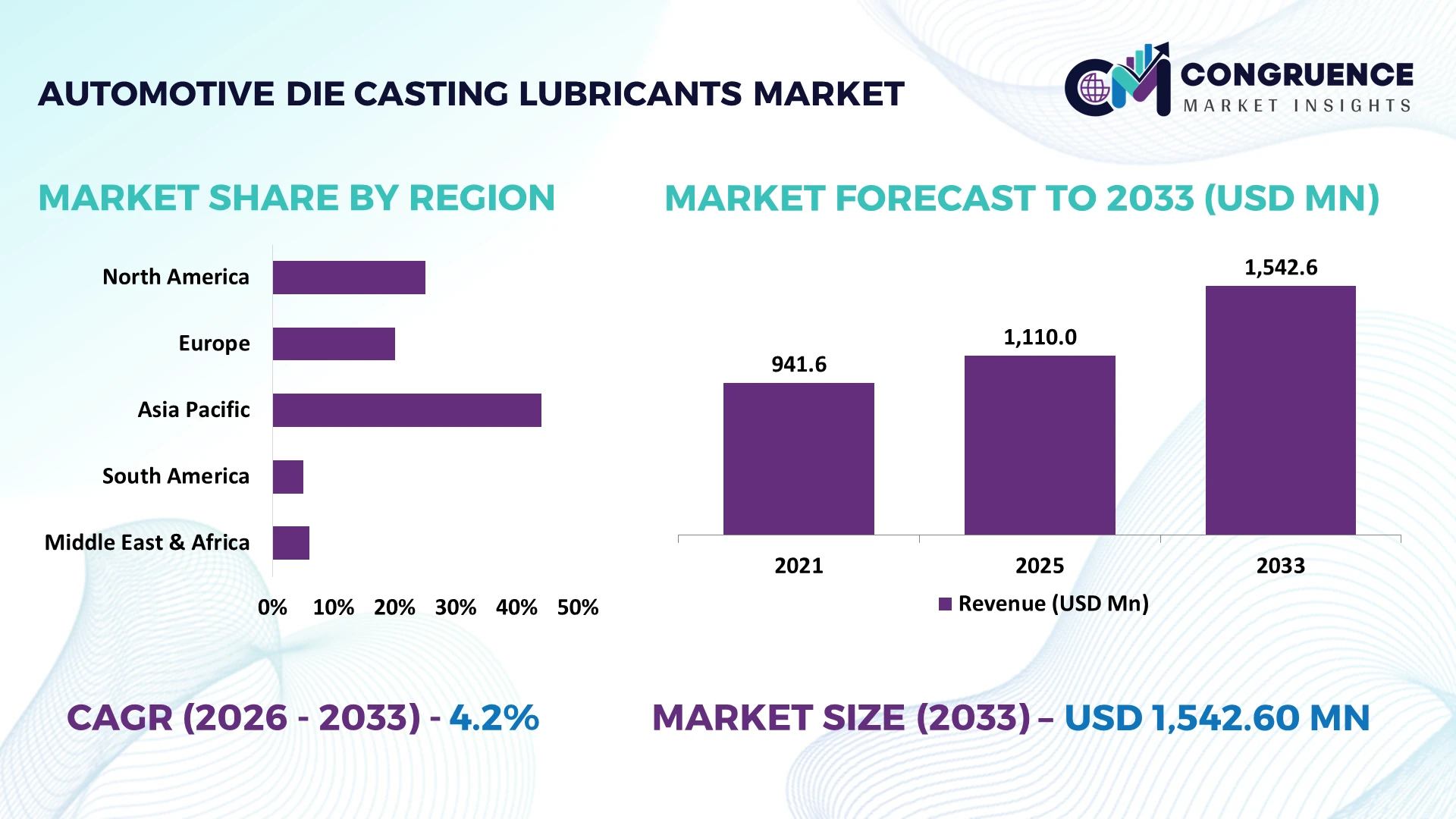
The Global Automotive Die Casting Lubricants Market was valued at USD 1110 Million in 2025 and is anticipated to reach a value of USD 1542.6 Million by 2033 expanding at a CAGR of 4.2% between 2026 and 2033. Growth is driven by aluminum-intensive electric vehicle manufacturing, high-pressure die casting automation, gigacasting adoption, and increasing requirements for thermal stability, die release efficiency, and low-residue lubricant formulations.
China dominates the automotive die casting lubricants demand ecosystem, producing approximately 31.28 million vehicles in 2024, representing nearly 35% of global automotive production. Its automotive manufacturing infrastructure includes expanding aluminum gigacasting installations, integrated electric vehicle supply chains, and automated component manufacturing. Compared with India's approximately 6 million vehicles, China's substantially larger production base supports higher industrial lubricant consumption. The country's 12.87 million new energy vehicle production volume in 2024 further strengthens demand for advanced die release agents and precision lubrication technologies.
Automotive lubricant suppliers should prioritize China's electric vehicle casting clusters and India's expanding automotive component industry, focusing on high-temperature performance, automated spray compatibility, and lower lubricant consumption per casting.
Key Highlights of the Global Automotive Die Casting Lubricants Market
-
Market Size & Growth: USD 1,110 million in 2025, reaching USD 1,542.6 million by 2033 at 4.2% CAGR, supported by aluminum-intensive automotive manufacturing.
-
Top Growth Drivers: China's vehicle production represents approximately 35% of global output; its new energy vehicle production increased 34.4% in 2024; global electric car sales increased 25%.
-
Short-Term Forecast: By 2028, optimized automated die spraying targets 15% lower lubricant consumption and 10% shorter spray cycles under controlled conditions.
-
Emerging Technologies: Three innovations include AI-controlled spray systems, minimum quantity lubrication, and advanced water-based release agents for precision aluminum casting.
-
Regional Leaders: Indicative 2033 values place Asia-Pacific at USD 833.00 million, Europe at USD 354.80 million, and North America at USD 246.82 million, supported by automation, lightweighting, and gigacasting.
-
Consumer/End-User Trends: Electric vehicles accounted for more than 20% of global car sales in 2024, accelerating aluminum structural casting requirements.
-
Pilot/Case Example: A proposed 2027 automated spray optimization pilot targets 20% lower lubricant overspray through programmable nozzles and controlled application cycles.
-
Competitive Landscape: FUCHS, Quaker Houghton, Chem-Trend, CONDAT, and Moresco compete in specialty die casting lubrication; individual market leadership shares require validation.
-
Regulatory & ESG Impact: Water-based formulations support reduced solvent exposure; advanced application systems target 15% lower lubricant waste through precision spraying.
-
Investment & Funding: Hyundai Motor Group announced approximately USD 21 billion in United States investment in 2025, strengthening downstream automotive manufacturing opportunities.
-
Innovation & Future Outlook: Gigacasting, sensor-integrated die lubrication, and high-temperature release coatings are transforming 3 critical areas: casting productivity, surface quality, and tool maintenance.
The Automotive Die Casting Lubricants Market is shifting toward specialized formulations supporting aluminum structural components, electric vehicle battery housings, and integrated automotive castings. Manufacturers are adopting water-based die release agents, automated spraying systems, and temperature-responsive lubrication technologies to improve casting consistency. China's new energy vehicle production increased 34.4% in 2024, intensifying requirements for reliable lubrication across high-volume aluminum casting operations. Growing deployment of large-tonnage casting machines is also changing lubricant performance specifications, particularly thermal stability and residue control. These developments are reshaping supplier qualification, formulation investment, and automotive manufacturing partnerships, establishing the foundation for strategic market evaluation.
What Is the Strategic Relevance and Future Pathways of the Automotive Die Casting Lubricants Market?
Automotive die casting lubricants are becoming strategically important as vehicle manufacturers replace multiple fabricated components with integrated aluminum castings. China's production of 12.87 million new energy vehicles in 2024 reinforces demand for reliable high-pressure die casting operations. This transition changes lubricant qualification requirements because larger dies demand uniform release performance, controlled thermal management, and minimal surface contamination. Suppliers are restructuring technical service networks around automotive casting clusters, where production continuity directly influences manufacturing competitiveness.
Automated spray systems offer operational advantages over conventional manual application through programmable dosing and repeatable coverage. In controlled optimization scenarios, precision spraying targets 15% lower lubricant consumption and 10% shorter application cycles. Chinese manufacturers prioritize high-volume production, while German and Japanese suppliers emphasize process reliability, formulation consistency, and equipment integration. During 2026–2028, increased deployment of sensor-controlled spraying and water-based release agents will strengthen opportunities for suppliers delivering measurable reductions in casting defects and maintenance requirements.
A practical deployment involves integrating die-temperature sensors with robotic spray nozzles on large aluminum casting machines. Manufacturers can adjust lubricant application according to measured thermal conditions rather than fixed spray intervals. Companies are investing in application engineering, localized blending, and equipment partnerships. Competitive advantage increasingly depends on reducing lubricant consumption per acceptable casting while maintaining die life and production stability.
Automotive Die Casting Lubricants Market Dynamics
DRIVER:
Aluminum Gigacasting and Electric Vehicle Manufacturing
Automotive lightweighting and integrated aluminum casting are strengthening demand for advanced die release lubricants. China's new energy vehicle production increased 34.4% in 2024, while electric cars represented more than 20% of global car sales. China also accounted for approximately 35% of global vehicle production, concentrating high-volume casting requirements within established manufacturing clusters. Gigacasting replaces multiple welded components with larger aluminum structures, increasing demands for uniform die coverage, thermal stability, and controlled lubricant residue. Automotive suppliers are expanding automated spray systems and qualifying specialized water-based formulations for large casting equipment. Lubricant manufacturers are strengthening technical partnerships with die casters and equipment suppliers. The strategic priority is maintaining consistent casting quality as component size and production intensity increase.
RESTRAINT:
Formulation Cost Volatility and Supply Concentration
Raw material price fluctuations and dependence on specialized chemical inputs constrain automotive die casting lubricant profitability. Water-based formulations require controlled emulsifier, corrosion inhibitor, and release additive combinations, while conventional products remain exposed to petroleum-derived feedstock costs. China accounts for approximately 35% of global automotive production, concentrating substantial downstream demand within one manufacturing economy. India's vehicle production represents approximately 7% of global output, highlighting differences in local industrial scale. For procurement planning, a modeled 10% increase in specialty additive costs can materially affect formulation margins when customer contracts restrict price adjustments. Manufacturers are diversifying chemical suppliers, establishing regional blending facilities, and negotiating longer procurement agreements. Localized formulation capability reduces shipping exposure and improves response times when automotive casting specifications change.
OPPORTUNITY:
Intelligent Lubrication and Precision Application Systems
Sensor-integrated lubrication creates opportunities to reduce chemical consumption while improving casting process control. Automotive die casting facilities increasingly evaluate programmable spray nozzles, thermal imaging, and automated lubricant dilution systems. Under defined optimization scenarios, closed-loop spraying targets 15% lower lubricant consumption and 10% shorter application cycles, while improved nozzle positioning can reduce overspray by 20%. These performance targets require plant-level validation rather than representing established industry averages. China's expanding gigacasting installations and India's automotive component manufacturing clusters provide opportunities for integrated lubricant and equipment service offerings. Suppliers are developing application-specific formulations, digital monitoring capabilities, and technical partnerships with casting machine manufacturers. The strongest commercial opportunity lies in selling verified process improvements alongside lubricants, creating differentiated service relationships beyond conventional chemical supply contracts.
CHALLENGE:
Large Casting Process Integration and Quality Consistency
Scaling lubricant performance across increasingly complex automotive castings presents significant engineering challenges. Large structural dies contain multiple thermal zones, requiring coordinated spraying, cooling, and release performance across extensive surfaces. China's new energy vehicle production increased 34.4% in 2024, accelerating qualification requirements for advanced aluminum components. Electric vehicles also exceeded 20% of global car sales, increasing pressure to maintain reliable manufacturing throughput. In a modeled production scenario, a 5% increase in casting rejection rates can undermine savings achieved through lower lubricant consumption. Manufacturers must integrate temperature sensors, robotic application controls, and casting defect analytics without disrupting existing production systems. Suppliers are investing in process engineering, operator training, and equipment partnerships. Long-term competitiveness depends on demonstrating repeatable casting quality across different alloys, die geometries, and production conditions.
Automotive Die Casting Lubricants Market Latest Trends
-
Low-Residue Formulations Gain Priority: Automotive foundries are refining release agents to reduce staining and downstream cleaning requirements. In controlled qualification trials, suppliers target 10% lower residue formation and 15% fewer cleaning interventions. German casting manufacturers are incorporating surface cleanliness specifications into lubricant procurement, prompting chemical suppliers to develop low-residue emulsions and improve laboratory testing protocols.
-
Centralized Fluid Management Expands Across Foundries: Die casting facilities are consolidating lubricant mixing, concentration monitoring, and fluid replenishment into centralized management systems. Automated dilution equipment targets concentration variation within ±2 percentage points, while centralized inventory control can reduce manual handling by 20% in optimized installations. Suppliers are expanding on-site fluid management contracts to improve dosing consistency and minimize production interruptions.
-
Large Casting Dies Reshape Thermal Requirements: Automotive manufacturers are qualifying lubricants against increasingly demanding thermal conditions, particularly during repeated high-temperature aluminum casting cycles. Aluminum alloys typically enter die casting operations at approximately 650°C to 720°C, while die surface temperatures vary across individual casting zones. Formulators are developing thermally stable release films and improved wetting characteristics to limit localized soldering and premature die maintenance.
-
Lubricant Recovery Gains Operational Attention: Foundries are improving wastewater segregation, filtration, and lubricant handling to control industrial effluent loads. Germany's water protection requirements and China's industrial wastewater controls encourage better process monitoring. Facilities evaluating recovery systems target 10% lower wastewater generation and 15% reduced chemical disposal volumes. Suppliers are partnering with treatment specialists to improve fluid lifecycle management and environmental compliance.
Segmentation Analysis
By Type
Water-Based Lubricants Lead Industrial Adoption
Water-Based Lubricants represent the leading segment of the Automotive Die Casting Lubricants Market, with an indicative 52% share in 2025. Their dominance reflects effective die cooling, compatibility with automated spraying, and suitability for high-volume aluminum casting operations. Water-based formulations support controlled dilution and consistent application across automotive component production lines. Oil-Based Lubricants maintain an established position in operations requiring persistent lubrication films and specialized release performance, representing an indicative 19% share. However, residue management and cleaning requirements influence their application economics. Solvent-Based Lubricants remain relevant in selected specialized processes where rapid evaporation and surface wetting characteristics are operationally important.
Synthetic Lubricants represent the fastest-growing type, supported by demand for controlled thermal performance, consistent release characteristics, and reduced residue formation. Graphite-Based Lubricants retain importance in applications requiring high-temperature lubrication and protective film formation. Manufacturers including FUCHS and Quaker Houghton are expanding application-specific formulation portfolios and technical service capabilities. Investment increasingly prioritizes water-based processing efficiency and synthetic formulation performance, enabling suppliers to differentiate through lower maintenance requirements and consistent casting quality.
- The International Energy Agency's 2025 Global EV Outlook reported that electric car sales exceeded 17 million units in 2024, reinforcing the importance of advanced aluminum casting processes and compatible lubricant formulations for expanding automotive manufacturing requirements.
By Application
High-Pressure Die Casting Dominates Lubricant Consumption
High-Pressure Die Casting represents the leading application in the Automotive Die Casting Lubricants Market, accounting for an indicative 58% share in 2025. Its dominance reflects extensive use in aluminum automotive components, rapid production cycles, and demanding die release requirements. Large casting machines require consistent lubricant distribution across complex die geometries, increasing the importance of spray coverage and thermal control. Low-Pressure Die Casting maintains an indicative 18% share, supported by applications requiring controlled metal filling and dimensional consistency. Gravity Die Casting remains important for selected components where process flexibility and casting quality take precedence over maximum production speed.
Die Surface Lubrication represents the fastest-growing application, reflecting increasing attention to localized release performance, thermal management, and die maintenance optimization. Manufacturers are improving nozzle placement, lubricant dilution control, and surface wetting characteristics to reduce application variability. Chemical suppliers are collaborating with casting equipment manufacturers to qualify formulations against specific alloys and production conditions. Strategic investment increasingly emphasizes measurable lubricant consumption per acceptable casting, supporting process efficiency and improved manufacturing reliability.
- The International Energy Agency reported in 2025 that global electric car sales exceeded 20% of total car sales during 2024, highlighting the industrial transition toward lightweight vehicle architectures and specialized aluminum casting applications.
By End-User
Automotive Component Manufacturers Anchor Industrial Demand
Automotive Component Manufacturers represent the leading end-user segment of the Automotive Die Casting Lubricants Market, accounting for an indicative 38% share in 2025. Their dominance reflects extensive production of transmission housings, structural brackets, motor enclosures, and other aluminum components supplied to vehicle assembly operations. These manufacturers prioritize lubricant consistency, equipment compatibility, and competitive operating costs across high-volume production facilities. Automotive OEMs maintain substantial demand through integrated casting operations and strict component qualification standards. Die Casting Foundries represent an important independent manufacturing channel, serving multiple automotive customers while managing diverse casting alloys, die geometries, and production schedules.
Electric Vehicle Manufacturers represent the fastest-growing end-user segment, supported by increasing adoption of integrated aluminum structural components and specialized battery-related castings. China's new energy vehicle production increased 34.4% in 2024, intensifying demand for advanced casting processes. Lubricant suppliers are developing customized formulations, application engineering partnerships, and automated fluid management services. Competitive differentiation increasingly depends on validated casting performance, reliable technical support, and reduced total processing costs.
- The International Organization of Motor Vehicle Manufacturers recorded approximately 92.5 million vehicles produced globally in 2024, demonstrating the manufacturing scale supporting automotive component casting and sustained demand for industrial lubrication across established vehicle production networks.
Region-Wise Market Insights
Asia-Pacific accounted for the largest market share at an estimated 54% in 2025 however, Asia-Pacific is expected to register the fastest growth, expanding at an indicative CAGR of 5.1% between 2026 and 2033.
North America Automotive Die Casting Lubricants Market
Automotive Manufacturing Localization Accelerates Casting Modernization
North America represents an estimated 16% of the global Automotive Die Casting Lubricants Market, supported by established automotive manufacturing clusters in the United States, Mexico, and Canada. Aluminum-intensive vehicle architectures are strengthening requirements for specialized die release agents, controlled lubrication, and consistent casting surface quality. Mexico's automotive production exceeded 4 million vehicles in 2024, supporting substantial demand from component manufacturers supplying international vehicle assembly networks. United States manufacturers are expanding advanced casting capabilities, while Canadian suppliers contribute precision automotive components and industrial materials expertise. Regional foundries increasingly prioritize automated lubricant application, thermal stability, and reduced residue formation to maintain production efficiency. Automotive supply-chain localization is encouraging lubricant manufacturers to establish regional technical support and distribution partnerships. Suppliers offering reliable formulation availability and application engineering gain advantages as manufacturers seek shorter qualification cycles and greater production continuity.
United States Market Outlook: The United States remains North America's most strategically important market through its extensive automotive manufacturing infrastructure and advanced casting technology adoption. Domestic vehicle production exceeded 10 million units in 2024, sustaining demand for aluminum automotive components. Manufacturers are investing in large casting equipment, automated spraying, and specialized lubricant formulations. Michigan, Ohio, and Tennessee provide important automotive manufacturing clusters where integrated technical services and consistent chemical supply support casting productivity.
Europe Automotive Die Casting Lubricants Market
Environmental Compliance Reshapes Lubricant Formulation Strategies
Europe accounts for an estimated 23% of the global Automotive Die Casting Lubricants Market, supported by advanced automotive engineering, specialized chemical manufacturing, and established aluminum casting capabilities. Germany, Italy, France, and Spain represent important automotive production and component manufacturing centers. European foundries increasingly prioritize water-based die release formulations, controlled chemical handling, and improved industrial wastewater management. The European Union's REACH framework influences chemical substance registration and industrial formulation compliance, encouraging suppliers to improve ingredient transparency. Germany produced approximately 4.1 million passenger cars in 2024, reinforcing demand for high-performance casting lubricants and precision manufacturing processes. Companies including FUCHS and CONDAT emphasize formulation development, technical support, and process optimization. Manufacturers are investing in automated dilution equipment and consistent application technologies to reduce lubricant variability. Competitive differentiation increasingly depends on regulatory readiness, reliable surface performance, and measurable reductions in industrial processing waste.
Germany Market Outlook: Germany benefits from an established automotive engineering ecosystem, specialized industrial chemical manufacturers, and extensive precision casting expertise. Baden-Württemberg and Bavaria host automotive production and component manufacturing operations requiring consistent die release performance. German suppliers emphasize high-temperature lubricant stability, low-residue formulations, and automated application compatibility. Industrial environmental requirements encourage water-based alternatives and controlled chemical management, supporting continued investment in advanced lubrication systems.
Asia-Pacific Automotive Die Casting Lubricants Market
High-Volume Aluminum Casting Strengthens Regional Leadership
Asia-Pacific dominates the Automotive Die Casting Lubricants Market with an estimated 54% share, supported by extensive automotive manufacturing, aluminum processing, and industrial chemical production. China, Japan, India, and South Korea represent major demand centers, with substantial casting capacity serving conventional and electric vehicle manufacturing. China produced approximately 31.28 million vehicles in 2024, representing nearly 35% of global automotive production. Its new energy vehicle output reached 12.87 million units, strengthening demand for specialized aluminum casting lubricants. Japanese manufacturers emphasize process consistency and advanced die surface engineering, while Indian automotive component suppliers are expanding automated production capabilities. Regional lubricant manufacturers are developing water-based formulations, localized blending operations, and equipment partnerships to support high-volume casting. Extensive manufacturing clusters provide opportunities for application engineering services, shorter supply lead times, and differentiated lubricant performance across increasingly complex automotive components.
China Market Outlook: China leads regional automotive die casting lubricant consumption through extensive vehicle manufacturing and rapidly expanding aluminum structural casting infrastructure. Guangdong, Zhejiang, Jiangsu, and Shanghai support major automotive and industrial production networks. Chinese manufacturers are integrating large-tonnage die casting machines with automated release agent application and thermal monitoring. Domestic chemical suppliers benefit from proximity to automotive customers, enabling customized formulations, technical servicing, and faster qualification of lubricants for demanding casting operations.
South America Automotive Die Casting Lubricants Market
Automotive Component Localization Supports Industrial Lubricant Demand
South America represents an estimated 5% of the global Automotive Die Casting Lubricants Market, supported by established vehicle manufacturing and automotive component production in Brazil and Argentina. Brazil remains the principal regional automotive manufacturing center, producing approximately 2.55 million vehicles in 2024. Automotive suppliers increasingly require specialized lubricants for aluminum engine components, transmission housings, and structural castings. Regional foundries are modernizing production equipment and improving lubricant application consistency to meet international automotive quality specifications. However, imported specialty chemical dependence, currency fluctuations, and uneven industrial automation constrain procurement efficiency. Manufacturers are strengthening regional distribution agreements and evaluating localized blending to improve formulation availability. Industrial lubricant suppliers that combine technical assistance with predictable delivery schedules gain competitive advantages. Production modernization supports opportunities for water-based die release agents and improved chemical handling practices across established automotive manufacturing clusters.
Brazil Market Outlook: Brazil dominates South American automotive die casting lubricant demand through established vehicle manufacturing operations and extensive component supplier networks. São Paulo and Minas Gerais host important automotive and industrial manufacturing clusters. Brazilian foundries increasingly emphasize aluminum casting productivity, equipment modernization, and controlled lubricant application. Domestic chemical blending capabilities and established industrial distribution networks support localized product availability, while technical partnerships help manufacturers improve casting quality and reduce dependence on imported specialty formulations.
Middle East & Africa Automotive Die Casting Lubricants Market
Automotive Industrialization Creates Local Manufacturing Opportunities
The Middle East & Africa accounts for an estimated 2% of the global Automotive Die Casting Lubricants Market, reflecting developing automotive casting infrastructure and concentrated manufacturing activity. South Africa and Morocco represent important automotive production centers, while Saudi Arabia is expanding industrial investment under Vision 2030. Morocco produced approximately 559,000 vehicles in 2024, supporting automotive component manufacturing and related industrial chemical demand. South Africa maintains established automotive assembly and component production networks, creating requirements for specialized die casting lubricants. Regional manufacturers face limitations in specialty chemical availability, application engineering capabilities, and advanced casting equipment deployment. International suppliers are strengthening distribution partnerships and technical support networks to improve industrial lubricant accessibility. Emerging automotive investment programs create opportunities for localized chemical blending, automated application equipment, and higher-performance release agents as regional component manufacturing capabilities develop.
Morocco Market Outlook: Morocco represents a strategically important automotive manufacturing hub through established vehicle assembly operations and integration with European automotive supply chains. Tangier and Kenitra support major production clusters and automotive component suppliers. Industrial development initiatives encourage manufacturing localization and supplier investment. Growing aluminum component production requirements strengthen opportunities for specialized die release lubricants, while proximity to European chemical suppliers supports technology transfer, formulation qualification, and improved industrial supply reliability.
Market Competition Landscape
The Automotive Die Casting Lubricants Market features competition between multinational specialty chemical suppliers and regional industrial lubricant manufacturers. FUCHS, Quaker Houghton, Chem-Trend, CONDAT, and Moresco compete through formulation performance, technical servicing, and automotive casting relationships. Their combined market share is indicatively estimated at 40%, reflecting established supplier networks alongside fragmented regional demand. Water-based lubricants represent an estimated 52% of consumption, while high-pressure die casting accounts for approximately 58% of application demand. Automotive component manufacturers contribute an indicative 38% of end-user purchasing, strengthening competition for long-term supply contracts. Multinational suppliers emphasize advanced release chemistry and automated application compatibility, while regional producers compete through localized blending and responsive delivery. Increasing adoption of large aluminum castings shifts competition toward thermal performance, residue control, and integrated process support. Qualification costs and stringent automotive specifications restrict market entry. Winning requires demonstrable casting reliability, competitive application economics, and dependable technical partnerships.
Companies Profiled in the Automotive Die Casting Lubricants Market Report
-
FUCHS SE
-
Quaker Houghton
-
Chem-Trend L.P.
-
CONDAT Group
-
MORESCO Corporation
-
PETROFER CHEMIE H.R. Fischer GmbH + Co. KG
-
TotalEnergies SE
-
Castrol Limited
-
Henkel AG & Co. KGaA
-
Idemitsu Kosan Co., Ltd.
-
Klüber Lubrication München GmbH & Co. KG
-
MotulTech
-
Houghton International Inc.
-
Afton Chemical Corporation
Technology Insights for the Automotive Die Casting Lubricants Market
Current automotive die casting lubrication technologies emphasize water-based release agents, automated dilution systems, and programmable spray equipment. Water-based formulations provide simultaneous die cooling and release performance, supporting aluminum casting operations. Automated concentration monitoring improves mixture consistency, while robotic spraying reduces operator exposure. Compared with conventional manual application, optimized programmable spraying can target 15% lower lubricant consumption and 10% shorter application cycles. These figures represent engineering improvement targets requiring validation against individual production conditions. Automotive component manufacturers benefit through predictable application costs and improved casting repeatability.
Emerging technologies include thermally responsive release chemistry, precision nozzle arrays, and digitally monitored lubricant circulation. Temperature-sensitive formulations improve surface wetting across complex die geometries, while targeted spraying can reduce overspray by 20% in optimized installations. Sensor-integrated dosing systems coordinate lubricant concentration with operating conditions, supporting consistent release films. Industrial deployment is concentrated in automated high-pressure casting facilities, particularly within Chinese and German automotive manufacturing clusters. Suppliers offering application engineering gain advantages over conventional chemical distributors.
During 2026–2028, AI-assisted spray optimization and predictive die maintenance will reshape lubrication management. Integrated thermal imaging, casting defect analytics, and automated dosing enable earlier identification of application inconsistencies. Manufacturers investing in validated process integration strengthen die reliability, chemical efficiency, and competitiveness.
Recent Developments in the Global Automotive Die Casting Lubricants Market
-
September 2024: Quaker Houghton launched QH FLUID INTELLIGENCE, integrating four elements: process fluids, application expertise, hardware, and software. An automotive customer reported 27% lower lubricant consumption per unit, demonstrating measurable manufacturing efficiency improvements through automated fluid monitoring and control. Source: quakerhoughton.com
-
February 2025: FUCHS Lubricants South Africa highlighted its expanded die casting solutions, covering release agents, plunger lubricants, and auxiliary products. The company identified automotive casting demand within a projected USD 112.14 billion global die casting industry, reinforcing specialized formulation development. Source: fuchs.com
-
May 2025: Quaker Houghton and PETRONAS Lubricants International established a distribution partnership spanning Malaysia and India. Beginning in the second quarter of 2025, the agreement expanded industrial fluid distribution, strengthening customer access, technical support, and manufacturing supply-chain coverage. Source: petronas.com
-
November 2025: Chem-Trend and SurTec detailed integrated aluminum die casting solutions combining release agents with downstream surface treatments. Their collaboration addresses three critical automotive requirements: bonding, painting, and welding, improving process compatibility for structural castings, battery housings, and electric drive components. Source: surtec.com
Scope of the Automotive Die Casting Lubricants Market Report
The Automotive Die Casting Lubricants Market Report evaluates five product categories: Water-Based Lubricants, Oil-Based Lubricants, Solvent-Based Lubricants, Synthetic Lubricants, and Graphite-Based Lubricants. Application coverage includes High-Pressure Die Casting, Low-Pressure Die Casting, Gravity Die Casting, and Die Surface Lubrication. End-user analysis examines Automotive OEMs, Automotive Component Manufacturers, Die Casting Foundries, and Electric Vehicle Manufacturers. Regional assessment covers North America, Europe, Asia-Pacific, South America, and the Middle East & Africa, identifying manufacturing concentration, industrial capabilities, and supplier positioning.
The report examines 14 profiled companies alongside advanced release chemistry, automated spray application, thermal monitoring, and digital fluid management. Strategic evaluation addresses lubricant consumption efficiency, casting quality, regulatory requirements, supply-chain localization, and gigacasting integration. These insights support investment allocation, manufacturing expansion, supplier selection, and competitive positioning throughout 2026–2033.
Automotive Die Casting Lubricants Market Report Summary
| Report Attribute/Metric | Report Details |
|---|
Market Revenue in 2025 | USD 1110 Million |
Market Revenue in 2033 | USD 1542.6 Million |
CAGR (2026 - 2033) | 4.2% |
Base Year | 2025 |
Forecast Period | 2026 - 2033 |
Historic Period | 2021 - 2025 |
Segments Covered | By TypeGraphite-Based Lubricants
By ApplicationHigh-Pressure Die Casting
By End-UserAutomotive Component Manufacturers Electric Vehicle Manufacturers
|
Key Report Deliverable | Revenue Forecast, Growth Trends, Market Dynamics, Segmental Overview, Regional and Country-wise Analysis, Competition Landscape |
Region Covered | North America, Europe, Asia-Pacific, South America, Middle East, Africa |
Key Players Analyzed | FUCHS SE, Quaker Houghton, Chem-Trend L.P., CONDAT Group, MORESCO Corporation, PETROFER CHEMIE H.R. Fischer GmbH + Co. KG, TotalEnergies SE, Castrol Limited, Henkel AG & Co. KGaA, Idemitsu Kosan Co., Ltd., Klüber Lubrication München GmbH & Co. KG, MotulTech, Houghton International Inc., Afton Chemical Corporation |
Customization & Pricing | Available on Request (10% Customization is Free) |





