
Reports
The Global Automotive Chassis Dynamometers Market was valued at USD 268.1 Million in 2025 and is anticipated to reach a value of USD 355.8 Million by 2033 expanding at a CAGR of 3.6% between 2026 and 2033. Growth is driven by rising adoption of vehicle emission testing systems, advanced powertrain validation, and increasing demand for EV performance assessment platforms.
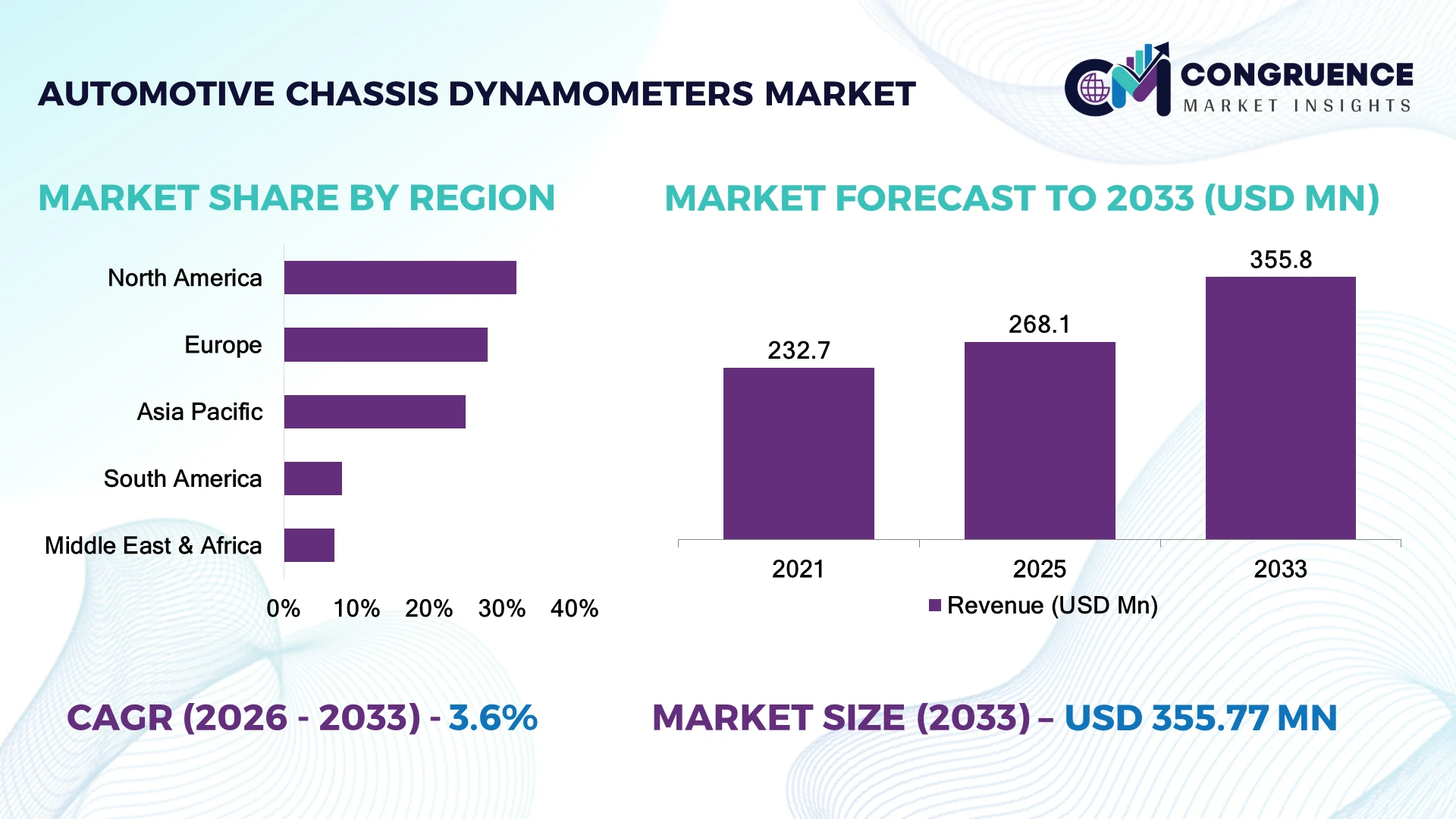
The United States dominates the market with approximately 32% share, supported by automotive R&D facilities, EPA emission compliance programs, and investments in electric vehicle testing infrastructure. Germany follows with around 18% share due to strong automotive engineering capabilities and OEM testing centers. The U.S. operates more than 40% of advanced vehicle testing facilities compared with emerging Asian markets expanding EV validation capacity rapidly.
Strategic investments in digital testing ecosystems and low-emission vehicle development will define competitive advantage.
Market Size & Growth: USD 268.1 Million in 2025 to USD 355.8 Million by 2033 at 3.6% CAGR, driven by EV testing and stricter emission validation requirements.
Top Growth Drivers: EV testing adoption at 35%, emission compliance requirements at 28%, and automotive R&D expansion at 22%.
Short-Term Forecast: By 2028, automated dynamometer systems reduce testing cycles by 25% and improve validation efficiency by 30%.
Emerging Technologies: AI-based diagnostics, automated testing platforms, and high-precision simulation systems are reshaping global chassis dynamometer operations.
Regional Leaders: North America reaches USD 112 Million with EV testing growth; Europe reaches USD 98 Million through emission innovation; Asia Pacific reaches USD 92 Million through automotive manufacturing expansion.
Consumer/End-User Trends: More than 60% of automotive manufacturers integrate advanced testing solutions for vehicle performance and compliance evaluation.
Pilot/Case Example: In 2024, EV validation programs using automated chassis testing achieved approximately 20% reduction in development cycle time.
Competitive Landscape: Bosch leads with around 15% market presence, alongside HORIBA, AVL, Meidensha, and Rototest in advanced vehicle testing solutions.
Regulatory & ESG Impact: Global emission regulations improve adoption of precision testing systems, supporting up to 30% reduction in compliance testing errors.
Investment & Funding: Automotive testing infrastructure investments exceed USD 500 Million globally, focusing on EV labs, automation, and digital validation partnerships.
Innovation & Future Outlook: Next-generation dynamometers emphasize connected testing, real-time analytics, and integrated EV powertrain assessment for competitive positioning.
Automotive Chassis Dynamometers are becoming essential for modern vehicle engineering as manufacturers prioritize accurate performance validation, electrification testing, and compliance readiness. Demand is expanding across OEMs, research centers, and regulatory testing facilities, with advanced systems enabling improved testing accuracy by nearly 25%. Supply-chain localization and regional manufacturing investments are also accelerating adoption as automakers strengthen vehicle development capabilities.
The Automotive Chassis Dynamometers Market is becoming strategically important as automakers transition toward electric mobility, advanced driver technologies, and stricter global emission standards. Vehicle manufacturers are restructuring testing operations to support EV platforms, battery performance evaluation, and faster product development cycles. Regulatory modernization in regions such as Europe under updated emission frameworks and expanding EV policies in Asia is accelerating investments in advanced testing infrastructure.
Digital chassis dynamometers equipped with automation and real-time analytics deliver measurable advantages over conventional systems, reducing manual testing requirements by nearly 30% and improving data accuracy by approximately 20%. North America maintains strong adoption through established automotive laboratories, while Asia Pacific is expanding rapidly due to increasing vehicle production and EV manufacturing investments.
Automotive OEMs are deploying integrated dynamometer systems for electric powertrain testing, thermal management evaluation, and simulation-based validation. Partnerships between testing equipment providers and vehicle manufacturers are increasing as companies prioritize flexible and scalable engineering facilities. Over the next 2–3 years, investment focus will shift toward connected testing platforms, automation, and energy-efficient validation systems, making advanced chassis dynamometers a critical factor in maintaining global automotive competitiveness.
Rising electric vehicle adoption and stricter emission validation standards are accelerating demand for advanced chassis dynamometers. EV testing applications account for nearly 35% of new dynamometer installations, while automated testing systems improve validation efficiency by approximately 30%. The European Union’s tightening vehicle emission regulations and expanded EV development programs in Germany are pushing OEMs to upgrade testing infrastructure. Companies such as Bosch, HORIBA, and AVL are investing in integrated simulation platforms, automation capabilities, and partnerships with automotive manufacturers. A key strategic shift is the movement from conventional power testing toward software-driven vehicle validation, enabling faster development cycles and more accurate performance benchmarking.
High installation costs, maintenance requirements, and advanced calibration needs limit adoption among smaller testing facilities. Large-scale chassis dynamometer systems can require infrastructure investments exceeding USD 1 million, while energy consumption and operational expenses contribute nearly 15–20% of lifecycle costs. Supply dependency for precision sensors, control systems, and specialized components from countries such as Germany, Japan, and the United States creates procurement challenges. These constraints affect scalability for independent laboratories and emerging automotive markets. Companies are reducing exposure through localized manufacturing, long-term supplier agreements, modular dynamometer designs, and alternative component sourcing strategies to improve cost control and deployment flexibility.
The transition toward connected vehicle engineering creates significant opportunities for intelligent chassis dynamometers with AI analytics, cloud integration, and automated diagnostics. Digital testing platforms can reduce manual evaluation activities by nearly 40% and improve testing repeatability by over 25%. Countries including India and China are expanding EV manufacturing ecosystems, creating demand for localized validation facilities and advanced testing centers. Companies are developing software-enabled dynamometer solutions, forming partnerships with EV manufacturers, and expanding R&D capabilities. A unique opportunity lies in battery-electric vehicle simulation, where manufacturers can combine physical testing with virtual modeling to reduce prototype requirements and accelerate vehicle launch timelines.
Increasing vehicle software complexity and evolving powertrain architectures create execution challenges for chassis dynamometer providers. Modern vehicles require testing compatibility across EV systems, hybrid platforms, connected technologies, and autonomous driving functions, increasing integration requirements by more than 30%. Cybersecurity concerns in connected testing environments and shortages of specialized engineering talent affect deployment consistency across automotive hubs. The United States and Japan are increasing investments in advanced vehicle laboratories, but smaller markets face infrastructure limitations. Companies must strengthen software capabilities, develop interoperable platforms, and expand technical training partnerships to maintain competitiveness. The long-term challenge is creating flexible testing ecosystems capable of supporting rapidly changing vehicle architectures.
AI-Enabled Testing Automation Growth Automotive laboratories are shifting toward AI-supported dynamometer platforms, with automated workflows reducing manual calibration activities by around 35% and improving test repeatability by nearly 25%. Vehicle manufacturers in Germany and Japan are integrating machine-learning analytics to optimize powertrain validation and reduce engineering cycle time. Companies are responding by expanding software capabilities, developing connected testing ecosystems, and partnering with OEM engineering centers to improve operational efficiency.
EV Powertrain Validation Expansion The rapid transition toward electric mobility is reshaping dynamometer deployment, with EV-focused testing representing more than 40% of new validation requirements in advanced automotive facilities. Battery simulation, thermal analysis, and regenerative braking evaluation are becoming standard processes as manufacturers address stricter vehicle regulations in Europe and China. Testing companies are restructuring product portfolios toward high-voltage platforms and scalable EV-specific solutions.
Remote Testing Infrastructure Adoption Automotive companies are adopting remote monitoring and cloud-based test management systems, enabling approximately 30% faster data sharing across engineering teams. Supply-chain disruptions and distributed vehicle development programs are encouraging manufacturers in the United States and South Korea to centralize digital testing workflows. Companies are investing in secure data platforms and remote diagnostic capabilities to improve collaboration and reduce facility dependency.
Modular Dynamometer System Deployment Manufacturers are increasingly adopting modular chassis dynamometer configurations that lower installation complexity by nearly 20% and support multiple vehicle platforms. The demand for flexible testing environments is rising as OEMs manage hybrid, electric, and conventional vehicle programs simultaneously. Companies are developing adaptable systems with interchangeable components, allowing laboratories to improve utilization rates and manage evolving automotive technology transitions.
Rolling road chassis dynamometers represent the leading type segment, accounting for approximately 45% of market adoption due to their ability to simulate real-world driving conditions, support multiple vehicle categories, and provide accurate performance measurement. Their scalability across passenger vehicles, commercial vehicles, and EV platforms makes them the preferred choice for OEM testing facilities. Hub-based and engine-integrated dynamometer systems maintain demand in specialized applications, particularly where compact testing environments and controlled measurements are required. Electric vehicle-focused chassis dynamometers are the fastest-growing type segment, expanding as manufacturers prioritize battery efficiency, regenerative braking analysis, and high-voltage powertrain validation. Adoption of EV-oriented systems is increasing by nearly 35% as automakers upgrade testing capabilities. Companies are investing in modular designs, advanced sensors, and software integration to support diverse vehicle architectures. The shifting investment priority is moving toward flexible platforms capable of handling multiple propulsion technologies.
Vehicle performance testing leads the application segment with approximately 50% market share, supported by extensive use in acceleration analysis, power measurement, fuel efficiency evaluation, and drivability assessment. OEMs and testing laboratories rely on these systems to validate vehicle behavior under controlled conditions before commercial launches. Emission testing, durability testing, and research applications continue expanding as regulatory requirements increase, particularly in countries such as Germany, the United States, and Japan. Electric vehicle validation is the fastest-growing application area, with adoption rising by nearly 40% as manufacturers evaluate battery performance, energy consumption, and thermal management. Research institutions and automotive companies are integrating automated testing platforms to improve efficiency and reduce testing time by around 25%. Companies are expanding partnerships with EV manufacturers and developing specialized solutions for next-generation vehicle platforms. Demand is becoming increasingly operationally critical as vehicle software and electrification complexity increases.
Automotive OEMs represent the leading end-user segment with approximately 55% market share due to their large-scale testing requirements, extensive R&D operations, and need for regulatory compliance validation. Major manufacturers in the United States, Germany, Japan, and China are investing in advanced dynamometer facilities to support electric and hybrid vehicle development. Independent testing laboratories and research institutes continue serving specialized validation needs, particularly for certification and third-party evaluation. Research organizations and testing service providers are the fastest-growing end-user group, expanding by nearly 30% as automotive companies outsource specialized testing activities and seek flexible engineering capacity. Commercial vehicle manufacturers are also increasing adoption to improve efficiency analysis and meet evolving emission standards. Companies are responding through customized service models, strategic partnerships, and regional facility expansion. Future demand is shifting toward collaborative testing ecosystems where OEMs, technology providers, and laboratories share advanced validation infrastructure.
North America accounted for the largest market share at 32% in 2025 however, Asia-Pacific is expected to register the fastest growth, expanding at a CAGR of 4.2% between 2026 and 2033.

North America holds a leading position in the Automotive Chassis Dynamometers Market, supported by strong automotive R&D infrastructure, advanced testing laboratories, and high adoption of electrification validation systems. The region contributes approximately 32% of global demand, with the United States representing the majority of installations across OEM facilities and independent testing centers. More than 40% of advanced vehicle testing facilities in the region are equipped for hybrid and EV evaluation. Increasing investments in battery-electric vehicle development and emission compliance testing are encouraging companies to expand automated dynamometer capabilities, integrate real-time analytics, and establish partnerships with automotive technology providers.
United States Market Outlook: The United States remains the regional technology hub due to its large automotive engineering ecosystem, government-supported EV transition initiatives, and extensive testing infrastructure. Major automotive manufacturers operate advanced validation centers, with more than 35% of new vehicle programs incorporating enhanced performance and efficiency testing processes. Growing investment in domestic EV manufacturing is strengthening demand for high-precision dynamometer systems.
Europe maintains strong market positioning due to strict emission regulations, advanced automotive manufacturing capabilities, and established engineering expertise. The region accounts for approximately 28% of global market adoption, supported by Germany, France, and the United Kingdom’s automotive testing ecosystems. Regulatory requirements under European emission frameworks are accelerating investments in accurate vehicle validation systems, particularly for electric and hybrid powertrains. Germany’s automotive industry continues upgrading testing infrastructure, with manufacturers increasing automated testing deployment by nearly 25% to improve development efficiency. Companies are focusing on digital integration, simulation compatibility, and sustainable testing solutions to support next-generation mobility programs.
Germany Market Outlook: Germany leads Europe through its concentration of premium automotive manufacturers, engineering centers, and research facilities. The country operates hundreds of vehicle testing environments, with EV and hybrid validation becoming a priority across OEM development programs. Strong collaboration between automakers and technology providers is improving adoption of advanced chassis testing platforms.
Asia-Pacific is the fastest-expanding market due to large automotive production volumes, accelerating EV manufacturing, and increasing investments in vehicle testing infrastructure. The region contributes nearly 25% of global demand and benefits from strong automotive manufacturing bases in China, Japan, South Korea, and India. China’s EV production expansion is increasing requirements for battery performance and powertrain testing, while Japanese manufacturers continue advancing precision validation technologies. More than 45% of new automotive testing investments in emerging Asian markets are linked to electrification and automation requirements. Companies are expanding local production capabilities, forming technology partnerships, and deploying scalable testing platforms.
China Market Outlook: China dominates Asia-Pacific demand through its extensive EV manufacturing ecosystem and government-supported vehicle electrification strategy. The country produces more than half of global electric vehicles, creating significant demand for advanced dynamometer systems. Automotive companies are expanding testing facilities to support battery optimization, efficiency evaluation, and faster vehicle commercialization.
South America represents an emerging market supported by vehicle manufacturing activity in Brazil and increasing demand for emission compliance testing. The region contributes approximately 8% of global adoption, with Brazil accounting for the largest share due to its established automotive production base. Limited testing infrastructure and dependence on imported equipment remain key constraints, but investments in modernization programs are improving laboratory capabilities. Automotive manufacturers are increasingly adopting dynamometer systems for fuel efficiency analysis and regulatory validation. Companies are addressing market limitations through localized service networks, equipment partnerships, and modular testing solutions designed for cost-sensitive environments.
Brazil Market Outlook: Brazil is the primary automotive testing center in South America due to its vehicle manufacturing scale and industrial infrastructure. The country hosts a significant portion of regional automotive production, with manufacturers increasingly upgrading testing facilities to meet evolving emission standards. Investment in advanced validation systems is improving operational efficiency for domestic vehicle programs.
The Middle East & Africa market is developing through automotive infrastructure upgrades, vehicle testing modernization, and increasing investment in mobility technology. The region contributes approximately 7% of global demand, with adoption concentrated in countries such as the United Arab Emirates, Saudi Arabia, and South Africa. Government initiatives focused on transportation modernization and industrial diversification are encouraging investments in advanced testing facilities. Saudi Arabia’s automotive sector development programs and UAE technology investments are creating opportunities for specialized vehicle validation services. Companies are expanding partnerships with international testing providers and introducing automated systems to improve testing accuracy and operational efficiency.
Saudi Arabia Market Outlook: Saudi Arabia is emerging as a strategic automotive technology hub through industrial diversification initiatives and investments in mobility infrastructure. The country is developing new automotive capabilities, including EV-related projects, increasing demand for advanced testing solutions. More than 20% of regional automotive technology investments are linked to modernization and sustainable transportation initiatives.
The Automotive Chassis Dynamometers Market features competition between global engineering leaders such as HORIBA, AVL, Bosch, and MAHA against specialized testing technology providers including Meidensha and Rototest. The top five companies collectively account for approximately 45% of market presence, with competition centered on precision, automation, customization, and service capability. Technology differentiation drives purchasing decisions, with advanced systems improving testing accuracy by nearly 25% and automated platforms reducing operational workload by around 30%. Global leaders compete through AI-enabled diagnostics, EV testing solutions, and international expansion, while regional players focus on cost optimization and localized support. Companies are strengthening positions through OEM partnerships, modular product development, and vertical integration of hardware and software capabilities. The market is shifting toward connected testing ecosystems, creating pressure on traditional equipment suppliers. High capital requirements, engineering expertise, and compliance knowledge remain major entry barriers. Winning requires superior technology integration, reliable support networks, and adaptable solutions for evolving vehicle architectures.
AVL List GmbH
Robert Bosch GmbH
MAHA Maschinenbau Haldenwang GmbH & Co. KG
Meidensha Corporation
Rototest International AB
Mustang Advanced Engineering
Dynapack International Technology Corporation
Taylor Dynamometer
Power Test LLC
SuperFlow Technologies Group
SAKOR Technologies, Inc.
Automotive chassis dynamometer technology is shifting from conventional mechanical testing toward intelligent, software-driven validation platforms. AI-based diagnostics, automated calibration, and real-time analytics are improving testing efficiency by nearly 30% while reducing manual intervention by approximately 25%. Leading OEMs are integrating connected systems to manage complex EV and hybrid vehicle testing requirements with higher accuracy and faster development cycles.
Electric vehicle-focused dynamometer systems represent the strongest technology transition, supporting battery performance analysis, regenerative braking evaluation, and thermal management testing. Compared with older mechanical testing approaches, advanced EV-compatible systems improve data precision by around 20% and enable broader vehicle simulation capabilities. Global manufacturers benefit most through faster product validation and reduced prototype dependency.
Between 2026 and 2028, cloud-connected testing environments, digital twins, and automated vehicle simulation will reshape competitive positioning. More than 40% of advanced automotive laboratories are moving toward integrated digital workflows. Companies investing in scalable software platforms, cybersecurity, and multi-powertrain compatibility will gain advantages as vehicle architectures become increasingly complex.
April 2025 AVL List GmbH introduced its Active Load Cabinet™ solution for high-voltage inverter testing, expanding electrification validation capabilities. The system supports four-quadrant testing operations and improves EV component development efficiency. The launch strengthens AVL’s position in advanced vehicle testing solutions for next-generation mobility programs. Source: www.prnewswire.com
July 2025 HORIBA Ltd. received UK VCA approval for its MEXAcube compact emissions measurement system under UN Regulation No. 168, expanding regulatory testing capabilities. The certification supports wider deployment of portable emission testing technologies and improves compliance workflows for automotive manufacturers. Source: www.horiba.com
June 2026 HORIBA Ltd. launched a vehicle thermal management system evaluation facility focused on improving EV development efficiency through front-loaded testing. The facility enhances engineering workflows by enabling advanced thermal validation before vehicle production, reducing development complexity for electrified platforms. Source: www.horiba.com
March 2026 Bosch Mobility announced expansion of its India e-mobility ecosystem through a strategic partnership with Tata AutoComp Systems. The collaboration supports electrification technology development and strengthens supply-chain capabilities, targeting faster adoption of advanced automotive solutions.
The Automotive Chassis Dynamometers Market Report covers detailed analysis across major types, applications, end-users, technologies, and geographic markets. The study evaluates rolling road systems, EV-focused testing platforms, performance testing, emission validation, OEM usage, research facilities, and independent testing laboratories. Regional assessment includes North America, Europe, Asia-Pacific, South America, and Middle East & Africa, highlighting manufacturing hubs, deployment patterns, and technology adoption trends.
The report provides strategic insights into automation integration, electric vehicle testing requirements, digital simulation adoption, competitive positioning, and investment priorities. Analysis includes participation from global technology providers and specialized suppliers, with more than 40% of new testing deployments linked to electrification and advanced vehicle validation needs. The report supports business planning, expansion decisions, partnership strategies, and long-term positioning through 2033.
| Report Attribute / Metric | Details |
|---|---|
| Market Revenue (2025) | USD 268.1 Million |
| Market Revenue (2033) | USD 355.8 Million |
| CAGR (2026–2033) | 3.6% |
| Base Year | 2025 |
| Forecast Period | 2026–2033 |
| Historic Period | 2021–2025 |
| Segments Covered |
By Type
By Application
By End-User
|
| Key Deliverables | Revenue Forecast; Market Trends; Growth Drivers & Restraints; Technology Insights; Segmentation Analysis; Regional Insights; Competitive Landscape; Regulatory & ESG Overview; Recent Developments |
| Regions Covered | North America; Europe; Asia-Pacific; South America; Middle East & Africa |
| Companies Profiled | HORIBA Ltd.; AVL List GmbH; Robert Bosch GmbH; MAHA Maschinenbau Haldenwang GmbH & Co. KG; Meidensha Corporation; Rototest International AB; Mustang Advanced Engineering; Dynapack International Technology Corporation; Taylor Dynamometer; Power Test LLC; SuperFlow Technologies Group; SAKOR Technologies, Inc. |
| Customization & Pricing | Available on Request (10% Customization Free) |




