
Reports
The Global Automotive Capless Devices Market was valued at USD 201 Million in 2025 and is anticipated to reach a value of USD 480.16 Million by 2033 expanding at a CAGR of 11.5% between 2026 and 2033. OEM adoption of capless fuel-filler systems, evaporative-emission control requirements, misfueling prevention, and automated fuel-door integration are accelerating replacement of conventional screw-cap assemblies.
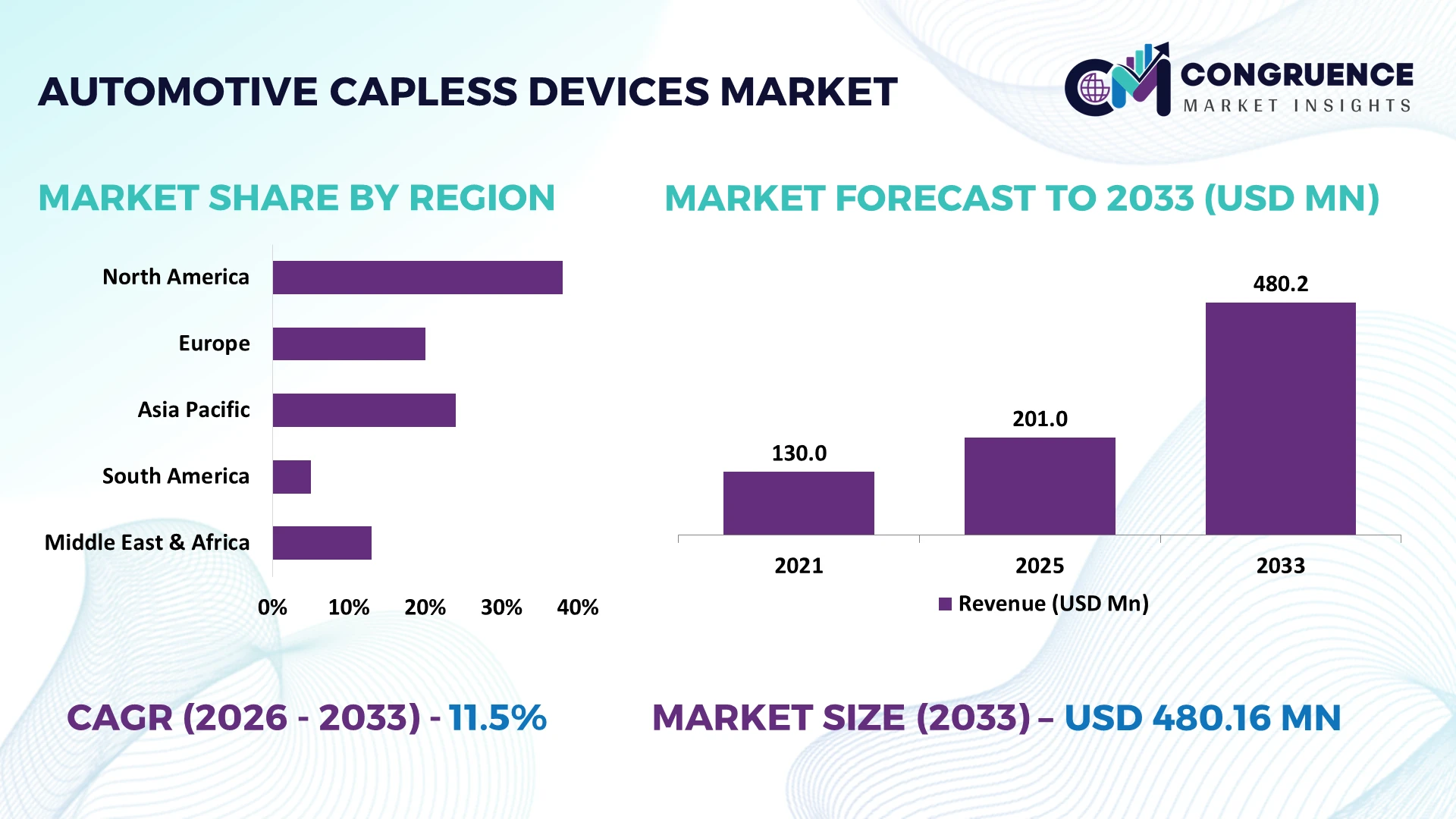
The United States anchors automotive capless-device deployment, supported by roughly 10.6 million light vehicles produced in 2024 and widespread integration across Ford, GM, and Stellantis platforms. North America represents an estimated 35–40% of global capless-system demand, with adoption concentrated in passenger vehicles, SUVs, and pickup trucks. Compared with China, where rapid EV penetration reduces long-term filler-system exposure, the U.S. retains a larger combustion and hybrid vehicle base. U.S.–China automotive supply-chain localization is also increasing pressure for regionally sourced fuel-system components.
Strategically, suppliers should prioritize hybrid-compatible capless modules, emissions-integrated sealing systems, and localized North American production while diversifying toward markets where combustion and hybrid platforms retain long vehicle-production cycles.
Market Size & Growth: USD 201 million in 2025 reaches USD 480.16 million by 2033 at 11.5% CAGR, supported by capless fuel-filler standardization.
Top Growth Drivers: Capless platform penetration above 40%, hybrid production growth above 20%, and sealing-component optimization approaching 15% underpin adoption.
Short-Term Forecast: By 2028, modular filler assemblies can reduce selected installation and assembly operations by approximately 15–20%.
Emerging Technologies: Sensor-integrated fuel doors, advanced elastomers, and electronically controlled locking systems are moving capless assemblies beyond mechanical sealing.
Regional Leaders: By 2033, North America approaches USD 170 million, Europe USD 120 million, and Asia-Pacific USD 150 million as OEM platform integration expands.
Consumer/End-User Trends: Capless systems eliminate 1 removable fuel cap, reducing refueling handling and preventing incorrect cap tightening.
Pilot/Case Example: Ford’s Easy Fuel architecture uses 2 spring-loaded flaps, combining cap elimination with a misfuel-inhibitor mechanism.
Competitive Landscape: ITW holds an estimated 20–25% position, alongside Stant, Röchling, Yachiyo, and Magna-linked automotive component ecosystems.
Regulatory & ESG Impact: U.S. Tier 3 requirements target evaporative emissions approaching near-zero levels, increasing sealing-system engineering requirements.
Investment & Funding: U.S. automotive manufacturing investment exceeds USD 100 billion across electrification and supply-chain localization programs, reshaping component sourcing.
Innovation & Future Outlook: Hybrid platforms retaining 2 propulsion systems strengthen demand for compact, lightweight filler modules integrated with vehicle access electronics.
The Automotive Capless Devices Market is concentrated in passenger cars, SUVs, pickups, and hybrid vehicles where OEMs seek simplified refueling, reliable vapor sealing, and misfueling protection. Advanced designs increasingly combine self-sealing flaps, rollover protection, fuel-type discrimination, and electronically controlled fuel-door locking. North America remains a major deployment center, with capless penetration exceeding 40% across selected vehicle portfolios. Meanwhile, rapid battery-electric adoption in China and Europe is shifting suppliers toward hybrid programs and geographically diversified combustion-platform contracts, establishing a sharper strategic divide between expanding and structurally declining fuel-filler applications.
Automotive capless devices are becoming strategically important as OEMs integrate fuel-filler architecture with evaporative-emission control, misfueling prevention, vehicle security, and simplified assembly. U.S. Tier 3 evaporative-emission requirements and tighter European vapor-control standards increase sealing reliability requirements, while automotive supply-chain localization is shifting sourcing closer to vehicle assembly hubs. Suppliers increasingly compete on complete filler-module engineering rather than standalone mechanical components.
Compared with conventional screw-cap systems requiring separate cap handling, tethering, and sealing validation, capless architectures eliminate one removable component and can reduce filler-related assembly operations by approximately 15–20% in modular designs. North America leads deployment across pickups, SUVs, and passenger vehicles, while China’s faster battery-electric transition limits long-term fuel-filler exposure. India presents expansion potential as combustion and hybrid production remains substantial.
A practical deployment combines spring-loaded sealing flaps, misfueling inhibition, rollover protection, and central-locking integration within one filler assembly. Through 2028, suppliers are prioritizing hybrid-compatible modules, lighter polymers, improved elastomers, automated molding, and localized OEM engineering partnerships. Competitive advantage will depend on achieving near-zero vapor leakage, platform-level standardization, low warranty exposure, and manufacturing flexibility across combustion and hybrid vehicle programs.
Tighter evaporative-emission requirements are pushing OEMs toward precisely engineered filler interfaces that maintain vapor integrity without driver-dependent cap tightening. U.S. Tier 3 rules require increasingly stringent evaporative control, while capless architectures remove 100% of manual fuel-cap fastening actions and one detachable sealing component. Modular filler assemblies can also reduce selected installation operations by approximately 15–20% compared with multi-component architectures. This combination strengthens adoption across U.S.-built pickups, SUVs, passenger cars, and hybrids. Suppliers are responding with multi-lip seals, spring-loaded closures, misfueling inhibitors, and integrated rollover protection. The non-obvious advantage is warranty control: eliminating incorrectly tightened or missing caps reduces one human-variable failure point from the emissions system, making capless technology valuable for compliance consistency rather than convenience alone.
Battery-electric vehicle penetration directly removes the need for liquid-fuel filler assemblies, creating a structural ceiling for capless-device deployment. Battery-electric vehicles represented more than 10% of global new-car sales in 2024, while China’s plug-in vehicle share exceeded 40% during parts of the year. In contrast, combustion and hybrid platforms still dominate U.S. vehicle volumes, preserving near-term component demand. Suppliers heavily exposed to conventional filler systems therefore face declining lifetime volumes on vehicle platforms transitioning fully electric. Companies are reducing concentration risk by prioritizing hybrid programs, diversifying into charging-door mechanisms, access modules, fluid-management components, and thermoplastic assemblies, while localizing production near persistent combustion-platform hubs. The strategic constraint is platform duration: tooling economics weaken when OEM powertrain transitions shorten expected fuel-system production runs.
Hybridization creates a strategically important bridge market because hybrid and plug-in hybrid vehicles retain complete liquid-fuel systems while adding electrified architecture. Global hybrid-electric vehicle demand has expanded at double-digit rates, while U.S. hybrid sales exceeded 10% of light-vehicle sales during 2024. Plug-in hybrids additionally require coordinated fuel-door and charging-port access, creating opportunities for electronically actuated locking and pressure-management systems. Suppliers can combine capless fillers, sensors, actuators, and access electronics into higher-value modules rather than competing solely on mechanical hardware. Companies are expanding R&D around lightweight polymers, integrated vapor management, and platform-standardized door mechanisms. A non-obvious opportunity is component commonality: one modular architecture adapted across several hybrid models can reduce OEM tooling and validation requirements by approximately 10–20%, strengthening supplier lock-in across vehicle families.
Capless devices must maintain sealing, crash safety, misfueling prevention, durability, and user accessibility across thousands of refueling cycles and wide temperature exposure. Modern automotive qualification commonly requires component validation from approximately −40°C to above 80°C, while ethanol-containing fuels can reach blends of 10–15% in major markets, increasing elastomer compatibility requirements. Integrating central locking, pressure management, diagnostic functions, and body-control electronics further expands validation interfaces. U.S., Brazilian, and European fuel specifications also differ, complicating global platform standardization. Suppliers must invest in material testing, accelerated life validation, automated leak testing, simulation, and OEM-specific engineering. The strategic challenge is achieving global commonality without compromising local fuel compatibility; excessive regional customization increases tooling, inventory, and qualification complexity, eroding the cost advantages that modular capless architectures are designed to deliver.
Fuel Doors Gain Electronic Control: OEMs are connecting filler-door locking with central vehicle access systems, replacing mechanically released doors on newer platforms. Electronic actuation removes one manual release operation, while integrated position sensing can identify incomplete closure. U.S. and European automakers increasingly share body-control electronics across multiple vehicle lines, enabling suppliers to standardize actuators and sensors. Component makers are responding with compact motors, integrated switches, and common electrical interfaces that reduce platform-specific engineering and simplify assembly.
Lightweight Polymers Replace Metal Components: Glass-filled engineering polymers and chemically resistant thermoplastics increasingly replace selected metal filler-neck and housing components. Well-designed polymer assemblies can deliver 20–40% component-weight reductions while consolidating 2–3 separate parts into molded structures. OEM lightweighting programs are accelerating this transition across passenger vehicles and pickups. Suppliers are expanding precision molding, material simulation, and automated inspection, reducing secondary assembly operations while improving corrosion resistance around exposed fuel-door environments.
Automated Leak Testing Expands: Fuel-system manufacturers are moving from sample-based inspection toward automated end-of-line pressure and leak testing. Modern production cells can inspect 100% of assembled units, while automated handling can reduce inspection-cycle variability by 20–30%. Tighter evaporative-emission compliance in the United States is reinforcing traceable quality control. Suppliers are integrating pressure-decay testing, serialization, and production analytics, allowing earlier identification of seal, flap, and housing defects before modules reach OEM assembly plants.
Platform Standardization Reshapes Sourcing: Automakers increasingly use common filler architectures across related vehicle platforms to reduce tooling and qualification complexity. Shared modules can eliminate multiple unique components and reduce selected engineering validation workloads by 10–20%. Localization pressure following semiconductor and automotive supply disruptions is simultaneously encouraging production near U.S., Mexican, and European assembly hubs. Suppliers are adopting modular tooling and regional manufacturing; the less obvious benefit is stronger aftermarket consistency through fewer service-part variants.
Mechanical Systems represent the leading type with an estimated 35–40% market share, supported by established vehicle architectures, straightforward manufacturing, lower electronic content, and compatibility with high-volume passenger and commercial platforms. Spring-Loaded Systems form an important subset of modern capless functionality, using automatically closing internal flaps to maintain sealing after nozzle removal. Push-Open Systems simplify driver interaction by eliminating separate release mechanisms, while Sealed Systems prioritize vapor containment and environmental isolation. Mature mechanical configurations remain attractive where OEMs prioritize durability and component simplicity.
Electronic Systems are the fastest-growing type as automakers integrate filler-door access with central locking, body-control modules, and vehicle-status monitoring. Electronic architectures can eliminate one manual release operation and reduce selected mechanical linkages by 20–30% through actuator-based designs. Suppliers are therefore directing engineering investment toward compact actuators, sensors, electronically controlled locks, and modular housings. The investment shift favors systems combining mechanical sealing reliability with electronic access control rather than replacing proven capless mechanisms completely.
Fuel Filling leads application demand with an estimated 40–45% share because the primary function of capless technology remains secure, convenient nozzle insertion without a removable screw cap. The architecture eliminates 100% of fuel-cap handling while reducing risks associated with missing or improperly tightened caps. Refueling Systems extend this functionality through misfueling inhibitors, automatic flap closure, rollover protection, and integrated filler-neck components. These established applications remain concentrated across gasoline, diesel, hybrid, pickup, SUV, and commercial vehicle platforms.
Emission Control is the fastest-growing application as evaporative-emission requirements increase the importance of sealing integrity throughout the complete fuel system. Fuel Vapor Control consequently gains strategic relevance through improved elastomers, multi-stage sealing, and pressure-management integration. Automated production lines increasingly apply 100% end-of-line leak testing rather than sample inspection, strengthening quality traceability. Suppliers are integrating capless closures with vapor-management components and developing platform-specific sealing packages. Business value is shifting from driver convenience toward verifiable emissions performance and lower warranty exposure.
Passenger Cars represent the leading end-user group with an estimated 60–65% share, reflecting their dominant global production volumes and extensive OEM deployment of integrated filler-door assemblies. High-volume passenger platforms benefit most from standardized capless modules because tooling and validation costs can be distributed across hundreds of thousands of vehicles. Commercial Vehicles prioritize durability, contamination resistance, and high-cycle refueling, while Fleet Vehicles value simplified operation because repeated daily refueling increases exposure to lost or incorrectly secured conventional caps. Off-Road Vehicles require additional dust, water, and impact protection.
Electric Vehicles represent the fastest-changing end-user category, but demand is concentrated specifically in plug-in hybrid electric vehicles retaining liquid-fuel systems; battery-only vehicles require no fuel-filler device. Global electric-car sales exceeded 20% of new-car sales in 2024, forcing suppliers to distinguish PHEV opportunity from BEV displacement. Manufacturers are responding with shared fuel-door and charging-door mechanisms, modular actuators, specialized sealing, and vehicle-platform partnerships that extend component relevance during powertrain transition.
North America accounted for the largest market share at 38% in 2025 however, Asia-Pacific is expected to register the fastest growth, expanding at a CAGR of 13.2% between 2026 and 2033.

OEM Standardization Drives High-Volume Deployment
North America accounted for approximately 38% of automotive capless-device demand in 2025, supported by high penetration across pickups, SUVs, passenger cars, and hybrid platforms. U.S. light-vehicle production exceeded 10 million units in 2024, providing substantial scale for standardized filler modules. Ford’s long-established Easy Fuel architecture helped normalize capless refueling, while other OEMs increasingly integrate spring-loaded closures, misfueling protection, rollover sealing, and electronically locked fuel doors. Mexico strengthens the regional supply chain through vehicle and component manufacturing serving U.S. assembly operations. Tier 3 evaporative-emission requirements reinforce precision sealing and leak-testing investments. Suppliers are consequently expanding automated molding, end-of-line testing, localized tooling, and common filler architectures that can serve multiple vehicle nameplates while lowering qualification complexity.
United States Market Outlook: The United States combines high pickup and SUV volumes with established capless-system acceptance and stringent evaporative-emission requirements. Light trucks represent roughly 80% of new light-vehicle sales, concentrating component demand in larger fuel-system architectures. Suppliers benefit from proximity to Detroit-centered engineering operations and Southern manufacturing corridors, where platform standardization and automated quality control increasingly determine sourcing decisions.
Emission Engineering Reshapes Filler Architecture
Europe represented approximately 25% of automotive capless-device demand in 2025, led by Germany, France, Spain, Italy, and the United Kingdom. The region combines stringent evaporative-emission engineering with strong adoption of lightweight plastics, compact filler assemblies, and centralized vehicle-access electronics. European vehicle production exceeds 15 million units annually, sustaining substantial component requirements despite accelerating electrification. Plug-in hybrids remain particularly relevant because they combine charging hardware with complete liquid-fuel systems, increasing pressure to package access mechanisms efficiently. OEM platform consolidation is encouraging common filler-door and sealing architectures across multiple models. Suppliers are responding through lightweight thermoplastics, chemically resistant elastomers, integrated actuators, automated leak detection, and production close to major assembly clusters. Faster battery-electric penetration simultaneously makes flexible tooling essential for protecting asset utilization.
Germany Market Outlook: Germany provides the region’s strongest engineering base through Volkswagen, BMW, Mercedes-Benz, major Tier-1 suppliers, and advanced polymer-processing capabilities. Domestic passenger-car production exceeds 4 million units annually. Premium vehicle platforms increasingly combine central locking, electronically actuated access, and high-quality sealing, favoring suppliers capable of integrating mechanical closures with vehicle electronics and stringent durability validation.
Vehicle Scale Meets Rapid Powertrain Transition
Asia-Pacific represented approximately 28% of automotive capless-device demand in 2025, supported by China, Japan, India, and South Korea. China produces more than 30 million vehicles annually, but rapid battery-electric adoption increasingly separates fuel-filler demand from overall vehicle output. Japan maintains substantial hybrid production, sustaining capless-system relevance, while India provides a larger combustion-engine runway through passenger cars, utility vehicles, and expanding premium models. Component manufacturers are localizing molding, sealing, and assembly operations around major automotive clusters to meet cost and just-in-time requirements. Japanese OEM expertise in hybrid systems also supports integrated filler architectures combining vapor control and secure access. Suppliers are prioritizing modular designs that can be adapted across combustion and hybrid platforms while avoiding excessive tooling exposure to models transitioning toward battery-only propulsion.
China Market Outlook: China combines unmatched vehicle-production scale with the fastest structural shift away from conventional fuel systems. New-energy vehicles exceeded 40% of new vehicle sales during 2024, reducing capless-device applicability on battery-only models. Suppliers therefore concentrate on hybrids, plug-in hybrids, export vehicles, and modular access components transferable between fuel doors and charging-port architectures.
Flex-Fuel Engineering Shapes Component Requirements
South America represented approximately 5% of automotive capless-device demand in 2025, with Brazil dominating regional vehicle production and fuel-system engineering. Brazil manufactures more than 2 million vehicles annually and operates one of the world’s largest flex-fuel fleets, creating specialized requirements for ethanol-compatible seals, polymers, filler necks, and vapor-control components. High ethanol concentrations place greater chemical-resistance demands on capless sealing materials than conventional gasoline applications. Argentina contributes additional passenger and commercial vehicle production, although component localization is less extensive. Currency volatility and imported material costs pressure supplier margins, encouraging localized molding and sourcing. Manufacturers are adapting global capless architectures for Brazilian fuel chemistry while expanding automated leak testing and material validation to maintain durability across gasoline-ethanol operating conditions.
Brazil Market Outlook: Brazil’s flex-fuel ecosystem creates a differentiated engineering opportunity rather than simply a volume market. More than 80% of new light vehicles support flexible-fuel operation, requiring filler components compatible with varying ethanol concentrations. Suppliers with locally validated elastomers, thermoplastics, sealing geometries, and OEM engineering support hold an advantage over imported standardized assemblies designed primarily for gasoline applications.
Localization Expands Automotive Component Potential
Middle East & Africa represented approximately 4% of automotive capless-device demand in 2025, with South Africa, Morocco, Saudi Arabia, and Turkey-linked supply networks shaping deployment. Morocco has developed an export-oriented automotive manufacturing base producing more than 500,000 vehicles annually, creating opportunities for localized filler-system and polymer-component suppliers. South Africa maintains established passenger and commercial vehicle assembly, while Gulf markets remain heavily dependent on imported vehicles. High ambient temperatures increase durability requirements for elastomers, plastics, seals, and fuel-vapor components. Saudi Arabia’s vehicle-manufacturing localization initiatives are gradually creating additional supplier opportunities. Component producers are responding through regional distribution, heat-resistant materials, OEM localization partnerships, and manufacturing near North African export clusters where European supply-chain integration improves production economics.
Morocco Market Outlook: Morocco offers the strongest manufacturing leverage through automotive clusters around Tangier and Kenitra, established export logistics, and integration with European OEM supply chains. Vehicle production exceeds half a million units annually, allowing component suppliers to combine lower-cost manufacturing with proximity to European assembly networks. Localized molding and module assembly can materially shorten logistics lead times.
ITW, Röchling, Yachiyo Industry, Magna, and fuel-system specialists compete for OEM capless programs through integrated filler modules, sealing technology, polymer expertise, and localized production. The top five suppliers collectively represent approximately 50–55% of addressable capless-device activity. ITW competes through proprietary mechanical architectures, while Röchling emphasizes engineered plastics and system integration; Asian suppliers leverage OEM proximity and cost-efficient manufacturing. Competition increasingly centers on weight, validation speed, localization, and module integration: engineered polymers can reduce selected component weight by 20–40%, modular designs can cut assembly operations by 15–20%, and automated testing enables 100% leak inspection. Suppliers are expanding regional molding, OEM engineering partnerships, electronic locking capability, and hybrid-compatible platforms. The competitive shift favors multifunctional modules over standalone closures as electrification reduces conventional filler volumes. Fuel compatibility, evaporative-emission validation, tooling economics, and long OEM qualification cycles remain entry barriers. Winning requires proven sealing durability, adaptable platform architecture, localized supply, competitive tooling, and electronics integration capability.
Illinois Tool Works Inc.
Röchling SE & Co. KG
Magna International Inc.
Toyoda Gosei Co., Ltd.
Yachiyo Industry Co., Ltd.
ABC Technologies Inc.
OPmobility SE
Kautex Textron GmbH & Co. KG
TI Fluid Systems plc
Martinrea International Inc.
Gentex Corporation
A. Raymond Group
Alfmeier Präzision SE
Continental AG
Current capless systems use spring-loaded dual flaps, misfuel inhibitors, pressure regulation, chemical-resistant seals, and molded fuel housings. ITW reports an OEM program where cap-related warranty complaints fell from 30 per 1,000 vehicles to 1 per 1,000 after capless conversion, a 96.7% reduction. Platform-compatible modules increasingly span gasoline and diesel applications, improving tooling utilization and simplifying OEM validation across vehicle generations.
Emerging designs integrate electronically locked fuel doors, pressure-managed PHEV refueling, lightweight engineered polymers, and automated leak testing. Toyoda Gosei demonstrated approximately 10% lower weight and size plus 20% lighter operating force versus comparable products. Compared with legacy screw caps, capless systems eliminate 100% of manual cap removal and tightening. Suppliers combining filler housings, actuators, sealing, and access mechanisms gain stronger platform-level sourcing positions.
Disruptive integration increasingly links refueling and recharging architectures as hybrid platforms require both fuel and electrical access. Automated production enables 100% end-of-line sealing verification, strengthening traceability while reducing defect escape. From 2026–2028, pressure-managed PHEV fillers, recyclable thermoplastics, smarter locking actuators, and common fuel/charge-door components will receive greater engineering attention. Suppliers investing now can preserve content per vehicle despite electrification by transferring expertise from fuel access toward multifunction exterior-access systems across global vehicle platforms.
September 2024 – Ford’s Easy Fuel capless architecture remained standard across multiple 2024 vehicles, including Mustang, Explorer, and Expedition, eliminating one removable fuel cap while maintaining direct-nozzle refueling and strengthening capless technology’s penetration across high-volume passenger and utility platforms. m
November 2025 – VP Racing introduced redesigned additive packaging at SEMA with an integrated funnel spout engineered to open modern capless fillers automatically, extending the solution across its additive portfolio and removing one accessory-funnel requirement during fuel-treatment application.
January 2026 – Honda maintained capless fuel-filler deployment across the 2026 Civic Sedan, using one direct-insertion filler architecture that removes conventional cap handling while retaining a dedicated funnel requirement for nonstandard containers, reinforcing standardized refueling hardware across its passenger-car platform.
August 2026 – Ford documented pressure-managed capless refueling for 2026 plug-in hybrid vehicles, requiring refueling completion within 20 minutes after manual fuel-door override activation, demonstrating how capless hardware is evolving to manage pressurized fuel systems alongside electrified powertrains.
The Automotive Capless Devices Market Report evaluates Mechanical Systems, Electronic Systems, Spring-Loaded Systems, Push-Open Systems, and Sealed Systems across Fuel Filling, Fuel Vapor Control, Refueling Systems, and Emission Control. End-user analysis covers Passenger Cars, Commercial Vehicles, Electric Vehicles, Fleet Vehicles, and Off-Road Vehicles, with passenger cars representing approximately 60–65% of current deployment concentration.
Regional coverage includes North America, Europe, Asia-Pacific, South America, and Middle East & Africa, examining vehicle production, powertrain transition, emission regulation, fuel compatibility, localization, and OEM sourcing. Technology assessment covers dual-flap closures, misfuel inhibitors, pressure regulation, electronic locking, engineered polymers, automated leak testing, and PHEV-compatible systems. The report supports 2026–2033 investment planning, manufacturing localization, supplier selection, platform strategy, technology partnerships, competitive positioning, and diversification toward integrated fuel-door and charging-access architectures.
| Report Attribute/Metric | Report Details |
|---|---|
Market Revenue in 2025 | USD 201 Million |
Market Revenue in 2033 | USD 480.16 Million |
CAGR (2026 - 2033) | 11.5% |
Base Year | 2025 |
Forecast Period | 2026 - 2033 |
Historic Period | 2021 - 2025 |
Segments Covered | By Type
By Application
By End-User
|
Key Report Deliverable | Revenue Forecast, Growth Trends, Market Dynamics, Segmental Overview, Regional and Country-wise Analysis, Competition Landscape |
Region Covered | North America, Europe, Asia-Pacific, South America, Middle East, Africa |
Key Players Analyzed | Illinois Tool Works Inc., Röchling SE & Co. KG, Magna International Inc., Toyoda Gosei Co., Ltd., Yachiyo Industry Co., Ltd., ABC Technologies Inc., OPmobility SE, Kautex Textron GmbH & Co. KG, TI Fluid Systems plc, Martinrea International Inc., Gentex Corporation, A. Raymond Group, Alfmeier Präzision SE, Continental AG |
Customization & Pricing | Available on Request (10% Customization is Free) |




