
Reports
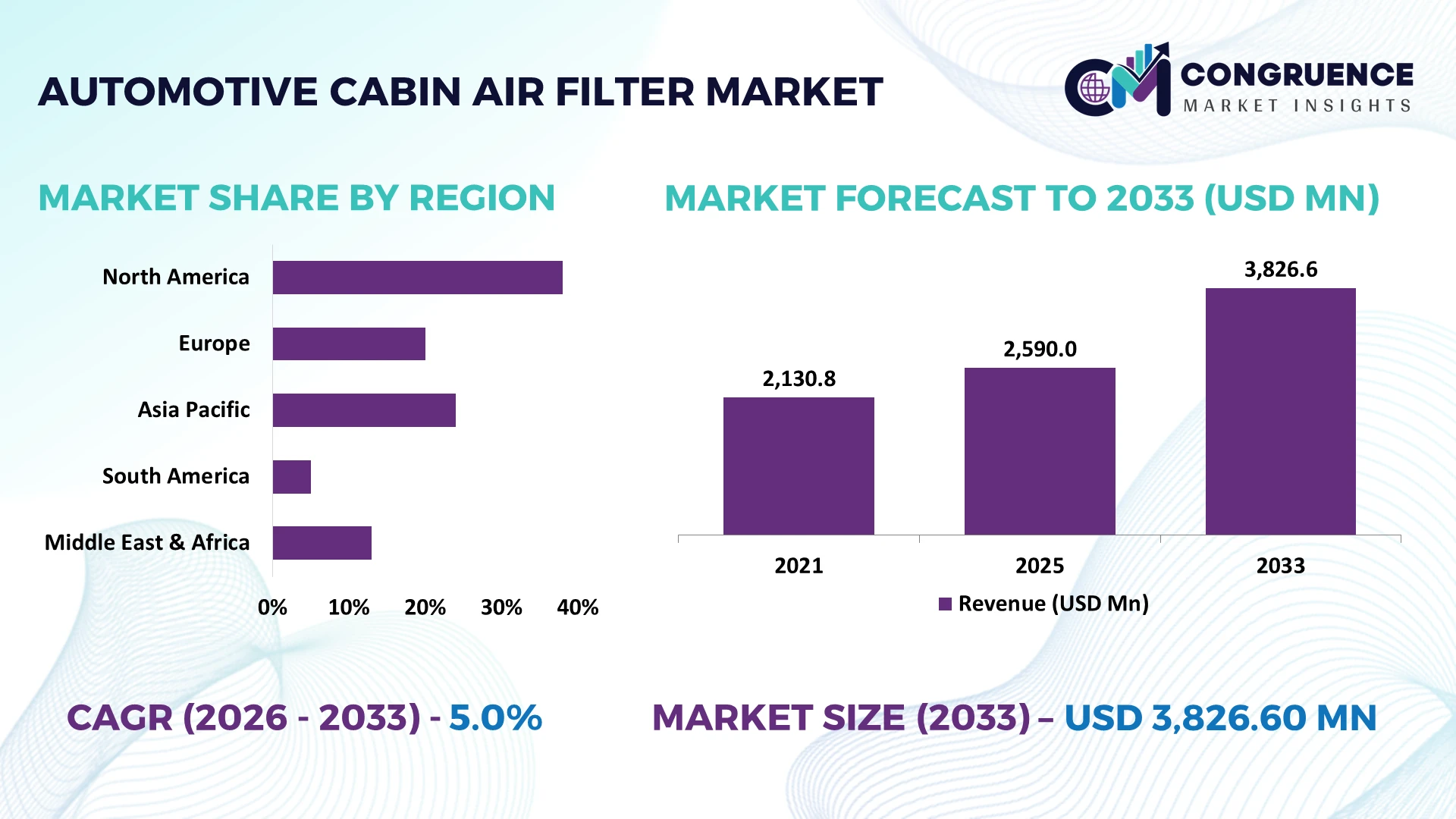
The Global Automotive Cabin Air Filter Market was valued at USD 2590 Million in 2025 and is anticipated to reach a value of USD 3826.6 Million by 2033 expanding at a CAGR of 5% between 2026 and 2033. Growth is driven by expanding vehicle production, recurring cabin filter replacement cycles, and automotive manufacturers integrating activated carbon and high-efficiency particulate filtration into HVAC systems.
China dominates the automotive cabin air filter manufacturing ecosystem, supported by 31.28 million vehicle sales in 2024, compared with approximately 16 million light vehicle sales in the United States. China accounted for nearly 34% of global motor vehicle production, supporting extensive original equipment filtration demand. BYD's electric vehicle expansion and Volkswagen's localized manufacturing strengthen advanced cabin filtration adoption. Suppliers including MANN+HUMMEL and Freudenberg are investing in multilayer filtration media, activated carbon technology, and localized production to serve China's expanding automotive supply chain.
Strategically, filtration manufacturers should prioritize China's 34% vehicle production contribution while strengthening aftermarket distribution and advanced particulate filtration capabilities across major automotive manufacturing hubs.
Market Size & Growth: USD 2,590 million in 2025, reaching USD 3,826.6 million by 2033 at 5% CAGR, supported by recurring replacement cycles and advanced filtration adoption.
Top Growth Drivers: China's vehicle production share approaches 34%, electric vehicle sales represent over 40% of Chinese new car sales, and global vehicle production exceeds 90 million units.
Short-Term Forecast: By 2028, optimized multilayer filtration designs target 10–15% lower airflow resistance compared with conventional high-density filter media.
Emerging Technologies: Three innovations include electrostatic filtration, activated carbon adsorption, and nanofiber media designed to improve fine particulate capture.
Regional Leaders: Illustrative 2033 allocations place Asia-Pacific at USD 1,913.3 million, Europe at USD 956.65 million, and North America at USD 688.79 million, reflecting OEM integration, premium filtration, and aftermarket replacement demand.
Consumer/End-User Trends: Cabin filters commonly require replacement every 12,000–15,000 miles, creating recurring maintenance opportunities for workshops and automotive retailers.
Pilot/Case Example: Tesla's HEPA filtration system demonstrated 99.97% removal efficiency for particles measuring 0.3 micrometers under specified filtration conditions.
Competitive Landscape: MANN+HUMMEL, Freudenberg, MAHLE, DENSO, and Bosch compete through OEM relationships, advanced filter media, and global distribution.
Regulatory & ESG Impact: WHO's 2021 air quality guideline limits annual PM2.5 exposure to 5 micrograms per cubic meter, strengthening interest in high-efficiency cabin filtration.
Investment & Funding: China's automotive production exceeded 31 million vehicles in 2024, encouraging continued filtration manufacturing investment and localized supplier partnerships.
Innovation & Future Outlook: Next-generation cabin filters combine 3-stage particulate, gas adsorption, and antimicrobial filtration with sensor-integrated HVAC controls.
The automotive cabin air filter market supports passenger cars, commercial vehicles, electric vehicles, and automotive aftermarket service networks. Increasing attention to in-cabin particulate exposure is accelerating adoption of multilayer filtration media, activated carbon adsorption, and electrostatic particle capture. High-efficiency filtration systems can achieve 99.97% particle removal under specified laboratory conditions, although actual cabin performance depends on airflow and system sealing. Electric vehicle manufacturers are integrating advanced air purification features into climate control systems, while urban air pollution strengthens replacement demand. These developments place filtration efficiency, manufacturing localization, and aftermarket accessibility at the center of strategic competition.
The automotive cabin air filter market is becoming strategically important as vehicle electrification, urban particulate pollution, and occupant air quality expectations reshape automotive HVAC procurement. China produced more than 31 million vehicles in 2024, establishing a substantial manufacturing base for original equipment filtration. Electric vehicle manufacturers increasingly integrate air quality monitoring with climate control systems, shifting competition from basic replacement components toward validated filtration performance. MANN+HUMMEL, Freudenberg, and MAHLE are strengthening advanced media development and localized automotive supply partnerships.
Technology differentiation centers on particle capture without excessive ventilation resistance. HEPA H13 media achieves at least 99.95% filtration efficiency at the most penetrating particle size under specified testing conditions, compared with lower efficiency conventional particulate filters. However, increased pressure drop requires careful HVAC integration. China emphasizes manufacturing scale and electric vehicle integration, while Germany prioritizes filtration engineering, component validation, and premium automotive applications.
During 2026–2028, manufacturers will focus on electrostatic media, activated carbon adsorption, and sensor-controlled filtration management. Tesla's HEPA-equipped vehicles demonstrate integrated cabin protection using specialized filtration and airflow control. Suppliers combining verified particle removal, low airflow resistance, and scalable production will strengthen OEM positioning while capturing recurring aftermarket replacement opportunities.
China's automotive electrification is accelerating the integration of advanced cabin filtration technologies. New energy vehicles represented approximately 40.9% of Chinese vehicle sales in 2024, compared with 31.6% in 2023, strengthening demand for integrated HVAC filtration systems. Urban particulate exposure and consumer attention to interior air quality are encouraging automakers to adopt activated carbon, electrostatic media, and high-efficiency particulate filters. BYD, Tesla, and premium automotive manufacturers increasingly differentiate vehicle interiors through air purification features. MANN+HUMMEL, Freudenberg, and MAHLE are responding through multilayer media development and OEM partnerships. The operational advantage extends beyond particle removal: low-resistance filter designs support ventilation efficiency, making filtration performance increasingly relevant to electric vehicle energy management.
Advanced filtration materials create cost pressure for automotive cabin air filter manufacturers, particularly in price-sensitive replacement markets. High-efficiency media often require additional fiber processing, electrostatic treatment, or activated carbon layers compared with conventional particulate filters. China accounted for approximately 34% of global vehicle production in 2024, intensifying supplier pricing competition across high-volume automotive programs. HEPA H13 filtration requires at least 99.95% efficiency at the most penetrating particle size, demanding tighter manufacturing controls and specialized testing. Replacement intervals commonly range between 12,000 and 15,000 miles, making consumer affordability important for repeat purchases. Suppliers are localizing filter media procurement, optimizing pleat geometry, and developing tiered product portfolios to balance filtration performance with manufacturing costs.
Sensor-integrated cabin filtration creates opportunities for premium automotive components and differentiated replacement services. China's new energy vehicle sales represented approximately 40.9% of domestic automotive demand in 2024, expanding the installed base of electronically controlled HVAC systems. HEPA H13 media delivers at least 99.95% particle capture at its specified test point, while activated carbon layers provide additional gas adsorption functionality. Combining particulate sensors with automatic recirculation control allows filtration systems to respond to changing outdoor air conditions. MANN+HUMMEL, Bosch, and Freudenberg are developing advanced filtration technologies and integrated automotive solutions. A strategic opportunity lies in linking filter condition monitoring with service scheduling, improving replacement accuracy and supporting higher-value aftermarket product positioning.
Achieving high particulate removal without compromising vehicle ventilation efficiency remains a major engineering challenge. HEPA H13 media requires at least 99.95% filtration efficiency at the most penetrating particle size, but dense filtration structures can increase airflow resistance. Electric vehicles introduce additional pressure to minimize HVAC energy consumption, particularly during temperature extremes. China's new energy vehicles accounted for approximately 40.9% of domestic automotive sales in 2024, increasing the commercial relevance of energy-efficient cabin air systems. Manufacturers must balance filtration efficiency, pressure drop, acoustic performance, and filter service life through advanced media engineering. Freudenberg, MAHLE, and MANN+HUMMEL are strengthening testing and product development capabilities. Long-term competitiveness depends on validated system-level performance rather than isolated laboratory filtration ratings.
Automated Pleating Improves Manufacturing Consistency: Filter manufacturers are integrating servo-controlled pleating, machine vision, and automated adhesive dispensing into production lines. Pleat spacing tolerances of ±1 mm provide a measurable quality-control target, while 100% inline visual inspection reduces dependence on manual sampling. MANN+HUMMEL and MAHLE are emphasizing process standardization to improve dimensional consistency and reduce OEM rejection risks.
Activated Carbon Targets Urban Pollutants: Multilayer cabin filters increasingly combine particulate media with activated carbon for gaseous pollutant adsorption. Filter designs incorporate two functional filtration layers, while laboratory performance is evaluated against gases including nitrogen dioxide and ozone. Freudenberg and Bosch are expanding premium replacement assortments, using pollutant-specific performance differentiation to support higher-value aftermarket sales.
Replacement Distribution Shifts Toward Digital Catalogues: Automotive parts distributors are improving vehicle identification, fitment matching, and inventory visibility through digital product catalogues. Replacement intervals commonly range from 12,000 to 15,000 miles, creating recurring inventory requirements. Suppliers are integrating electronic fitment databases and regional fulfillment systems, reducing incorrect part selection and improving workshop replenishment efficiency across fragmented service networks.
Recycled Materials Enter Filter Production: European automotive suppliers are evaluating recycled polymer components and lower-impact filtration media as procurement requirements evolve. The EU End-of-Life Vehicles framework establishes an 85% reuse and recycling target by vehicle weight, influencing broader component material strategies. Manufacturers are developing recyclable filter frames and optimized material combinations while maintaining airflow resistance, mechanical stability, and filtration performance.
Particulate Filters Maintain Volume Leadership
Particulate Filters represent the leading product category, with an indicative 40% share of the global automotive cabin air filter market, supported by established vehicle fitment, economical manufacturing, and widespread aftermarket availability. Conventional particulate media capture dust, pollen, and airborne debris while maintaining airflow through automotive HVAC systems. Their standardized construction supports high-volume manufacturing and competitive replacement pricing. Activated Carbon Filters occupy a premium position by combining particulate filtration with adsorption of selected gaseous pollutants and odors. MANN+HUMMEL, Bosch, and MAHLE maintain diversified portfolios covering conventional and advanced filtration requirements.
HEPA Filters represent the fastest-expanding specialized category, supported by premium vehicle applications and increased emphasis on fine particulate capture. HEPA H13 media achieves at least 99.95% efficiency at the most penetrating particle size under specified laboratory conditions. Electrostatic Filters provide an alternative approach using charged fibers to enhance particle capture without relying exclusively on dense mechanical media. Manufacturers are investing in multilayer constructions, optimized pleat geometry, and advanced testing capabilities to balance filtration efficiency, airflow resistance, and production scalability.
Passenger Cars Anchor Cabin Filter Demand
Passenger Cars represent the leading application category, with an indicative 65% share of global automotive cabin air filter demand, supported by extensive vehicle ownership, high production volumes, and recurring replacement requirements. China produced more than 31 million motor vehicles in 2024, strengthening original equipment filtration demand across passenger vehicle platforms. Established automotive HVAC architectures support standardized particulate and activated carbon filter integration, enabling efficient production and broad aftermarket compatibility. MANN+HUMMEL, DENSO, and Bosch prioritize high-volume passenger car filtration programs and replacement product distribution.
Electric Vehicles represent the fastest-expanding application category, supported by growing adoption of advanced climate control systems and differentiated cabin air purification features. Electric cars accounted for more than 20% of global new car sales in 2024, increasing demand for energy-efficient filtration solutions. Light Commercial Vehicles require durable filters suited to frequent urban operation, while Heavy Commercial Vehicles prioritize sustained airflow and reliable filtration under demanding operating conditions. Suppliers are adjusting product development and OEM partnerships to accommodate application-specific ventilation requirements and emerging electric vehicle platforms.
Automotive Aftermarket Leads Recurring Replacement Demand
Automotive Aftermarket represents the leading end-user category, with an indicative 55% share of global cabin air filter demand, supported by recurring maintenance cycles and extensive independent repair distribution. Cabin filters commonly require replacement every 12,000–15,000 miles, creating predictable demand across passenger and commercial vehicle populations. The United States maintains an average light vehicle age of 12.8 years, reinforcing aftermarket servicing requirements. Bosch, MANN+HUMMEL, and MAHLE compete through broad vehicle coverage, standardized fitment catalogues, and premium activated carbon product portfolios. Automotive Service Centers remain important installation and maintenance channels, particularly for consumers relying on scheduled vehicle servicing.
Automotive OEMs represent a rapidly advancing technology adoption segment as vehicle manufacturers integrate specialized filtration systems into new platforms. China's new energy vehicles accounted for approximately 40.9% of domestic automotive sales in 2024, strengthening requirements for integrated HVAC filtration. Fleet Operators prioritize predictable replacement intervals and durable filter construction to control maintenance interruptions. Suppliers are expanding OEM engineering partnerships, digital aftermarket catalogues, and application-specific filtration portfolios to strengthen long-term customer relationships.
Asia-Pacific accounted for the largest market share at an indicative 50% in 2025 however, Asia-Pacific is expected to register the fastest growth, expanding at a CAGR of an indicative 6.2% between 2026 and 2033.

Aging Vehicle Fleets Strengthen Advanced Aftermarket Filtration
North America represents an indicative 18% of the global automotive cabin air filter market, supported by extensive vehicle ownership, established automotive service networks, and recurring filter replacement requirements. The United States dominates regional consumption, while Mexico contributes automotive manufacturing and component supply capabilities. The average US light vehicle age reached 12.8 years in 2025, reinforcing demand for scheduled filtration maintenance. Bosch, MANN+HUMMEL, and DENSO compete through extensive aftermarket catalogues, activated carbon filters, and vehicle-specific fitment coverage. Automotive retailers increasingly integrate digital inventory systems to improve replacement availability. Mexico's established automotive manufacturing clusters support localized filtration component production and North American supply-chain integration. Manufacturers are strengthening regional warehousing and distribution partnerships, improving delivery efficiency while addressing diverse vehicle applications and consumer preferences for premium cabin air filtration products.
United States Market Outlook: The United States maintains approximately 289 million registered motor vehicles, creating an extensive installed base for cabin air filter replacement. Automotive service centers commonly recommend replacement every 12,000–15,000 miles, depending on operating conditions and manufacturer guidance. Advanced particulate and activated carbon products are gaining prominence through retail distribution, while digital fitment catalogues improve installation accuracy and inventory management.
Premium Filtration Engineering and Sustainable Material Integration
Europe represents an indicative 25% of global automotive cabin air filter demand, supported by advanced automotive manufacturing, premium vehicle production, and established filtration engineering capabilities. Germany, France, Italy, and the United Kingdom maintain substantial automotive manufacturing and aftermarket infrastructure. European suppliers emphasize multilayer filter media, activated carbon adsorption, and low-resistance particulate filtration. MANN+HUMMEL, Freudenberg, MAHLE, and Bosch maintain established product development and OEM supply relationships. European Union battery and vehicle sustainability initiatives are encouraging broader material traceability and component lifecycle management. Automotive manufacturers increasingly integrate cabin air quality features into premium vehicle platforms, strengthening demand for specialized filtration products. Suppliers are optimizing pleat geometry, recyclable component materials, and production automation. Competitive differentiation centers on filtration performance, product validation, and dependable distribution across diverse European automotive service markets.
Germany Market Outlook: Germany maintains approximately 49 million registered passenger cars, supporting extensive cabin filter replacement activity. Stuttgart, Munich, and Wolfsburg concentrate major automotive engineering and manufacturing operations. MANN+HUMMEL, MAHLE, and Bosch benefit from established technical capabilities and OEM relationships. Investment priorities include advanced filtration media, low-pressure-drop designs, and standardized product testing for premium passenger vehicles.
Vehicle Production Scale and Integrated Filtration Supply Chains
Asia-Pacific dominates the automotive cabin air filter market with an indicative 50% share, supported by extensive vehicle manufacturing, component production, and replacement consumption. China, Japan, India, and South Korea maintain substantial automotive manufacturing ecosystems and established filtration supply chains. China produced more than 31 million vehicles in 2024, strengthening original equipment filtration demand. Japan contributes precision filtration technology and established automotive supplier relationships, while India supports expanding passenger vehicle ownership and aftermarket servicing. DENSO, MANN+HUMMEL, Bosch, and regional suppliers compete through localized production, filtration performance, and manufacturing efficiency. China's electric vehicle expansion is encouraging integration of advanced cabin air purification systems. Manufacturers are expanding automated filter production, activated carbon media capabilities, and OEM engineering partnerships to support high-volume vehicle programs and differentiated replacement product requirements.
China Market Outlook: China maintains the world's largest automotive manufacturing ecosystem, supported by integrated component supply chains and extensive electric vehicle production. New energy vehicles represented approximately 40.9% of domestic vehicle sales in 2024, strengthening opportunities for advanced cabin filtration integration. BYD, Tesla, and other manufacturers are expanding electronically controlled HVAC applications, while filtration suppliers prioritize localized production and specialized media development.
Vehicle Maintenance Demand and Localized Component Distribution
South America represents an indicative 4% of global automotive cabin air filter demand, with Brazil and Argentina maintaining the region's principal automotive manufacturing and service ecosystems. Brazil supports substantial passenger vehicle production, established automotive component suppliers, and extensive independent repair networks. Automotive cabin filter demand is influenced by urban vehicle utilization, road dust exposure, and recurring maintenance requirements. São Paulo and surrounding industrial centers concentrate vehicle manufacturing and aftermarket distribution activities. Bosch, MAHLE, and regional component suppliers compete through conventional particulate filters, activated carbon products, and broad vehicle fitment coverage. Imported filter media and exchange-rate volatility influence procurement costs, encouraging localized sourcing and inventory management. Manufacturers are strengthening distributor relationships and expanding product catalogues to improve replacement availability across passenger and commercial vehicle applications.
Brazil Market Outlook: Brazil produced approximately 2.55 million motor vehicles in 2024, supporting substantial original equipment component requirements. São Paulo maintains concentrated automotive manufacturing, engineering, and distribution infrastructure. Established aftermarket suppliers prioritize affordable particulate filters and premium activated carbon alternatives. Localized manufacturing and established service networks strengthen replacement availability, while urban air pollution supports differentiated filtration product positioning.
Dust Exposure and Commercial Vehicle Filtration Requirements
The Middle East & Africa represents an indicative 3% of global automotive cabin air filter demand, supported by passenger vehicle ownership, commercial transportation, and challenging environmental operating conditions. Saudi Arabia, the United Arab Emirates, South Africa, and Egypt maintain established automotive service networks and substantial imported vehicle populations. Desert dust exposure increases the operational importance of particulate filtration, while high ambient temperatures intensify HVAC utilization. Regional distributors prioritize durable filter media, consistent airflow, and reliable replacement availability. Bosch, MANN+HUMMEL, and other international suppliers compete through established aftermarket partnerships and vehicle-specific product catalogues. Automotive component imports remain important across several markets, increasing exposure to shipping costs and inventory constraints. Manufacturers are strengthening regional warehousing, distributor training, and filtration products suited to dusty operating environments.
Saudi Arabia Market Outlook: Saudi Arabia's automotive aftermarket is influenced by extensive road transportation, high air-conditioning utilization, and desert operating conditions. Summer temperatures frequently exceed 40°C, increasing the importance of dependable HVAC performance. Cabin filtration suppliers emphasize dust retention, airflow consistency, and appropriate replacement intervals. Regional service networks and automotive distributors support imported filtration products across passenger and commercial vehicle applications.
MANN+HUMMEL, Freudenberg, MAHLE, Bosch, and DENSO compete through automotive OEM relationships, filtration media engineering, and aftermarket distribution. Their combined global share is modeled at approximately 45%, an indicative concentration estimate rather than audited manufacturer data. MANN+HUMMEL and Freudenberg emphasize advanced particulate and activated carbon technologies, while Bosch and DENSO leverage extensive vehicle coverage and established service networks. HEPA H13 media achieves at least 99.95% particle capture under specified testing conditions, supporting premium product differentiation. China's approximately 34% contribution to global vehicle production strengthens localized supplier competition, while electric vehicles represented 40.9% of Chinese automotive sales in 2024. Manufacturers are investing in automated production, low-resistance media, and integrated HVAC development. Material qualification, OEM validation, and distribution access create entry barriers. Competitive leadership requires verified filtration performance, efficient manufacturing, reliable fitment coverage, and scalable partnerships across original equipment and replacement channels worldwide.
MANN+HUMMEL Group
Freudenberg Group
MAHLE GmbH
Robert Bosch GmbH
DENSO Corporation
Donaldson Company, Inc.
Ahlstrom Oyj
Sogefi S.p.A.
Hengst SE
K&N Engineering, Inc.
UFI Filters S.p.A.
Parker Hannifin Corporation
Valeo SA
ACDelco
Current cabin filtration technologies combine pleated particulate media, activated carbon layers, and electrostatic fibers to capture airborne particles and gaseous contaminants. HEPA H13 media achieves at least 99.95% efficiency at the most penetrating particle size, compared with conventional filters lacking equivalent certification. Automated pleating and optical inspection improve dimensional consistency across high-volume production. MANN+HUMMEL, Freudenberg, and MAHLE compete through filtration efficiency, pressure drop management, and established original equipment validation capabilities.
Emerging technologies include nanofiber membranes, multifunctional adsorption media, and sensor-controlled ventilation. Electrospun nanofibers increase available filtration surface area, supporting fine particle capture without proportionally increasing media thickness. China's new energy vehicles represented 40.9% of domestic automotive sales in 2024, establishing a substantial deployment base for advanced climate control integration. Manufacturers are combining particulate sensors with automatic recirculation systems, while activated carbon media targets ozone and selected volatile organic compounds. Competitive differentiation increasingly depends on system performance rather than standalone filter ratings.
Disruptive development focuses on recyclable filter structures, predictive replacement monitoring, and digitally optimized airflow management. During 2026–2028, suppliers will prioritize validated particle removal, lower ventilation resistance, and scalable manufacturing. Companies integrating filtration engineering with HVAC controls will improve vehicle efficiency, strengthen OEM partnerships, and expand premium aftermarket opportunities.
March 2026: Freudenberg launched micronAir neo for automotive original equipment applications, targeting particles as small as PM0.1. Its construction incorporates up to 60% recycled or renewable materials, combining fine particulate protection with lower material dependence and improved environmental positioning. Source: freudenberg-filter.com
September 2026: MANN+HUMMEL introduced recycled activated carbon into FreciousPlus cabin filters, covering more than 100 products. The process reduces virgin coconut shell requirements by approximately 20%, strengthening resource efficiency while maintaining existing workshop fitment and distribution arrangements. Source: mann-filter.com
February 2026: DENSO introduced ClearAir+ cabin filters using five filtration layers, with 45 part numbers covering approximately 150 million European vehicles. The expanded premium range strengthens aftermarket coverage and offers workshops differentiated filtration against airborne contaminants, odors, and microorganisms. Source: autotrade.ie
April 2025: Bosch detailed its expanded hybrid and electric vehicle cabin filter offering, reporting coverage exceeding 97% of relevant European models. The program strengthens replacement accessibility and supports workshops servicing electrified vehicles through established fitment catalogues and premium filtration options. Source: boschaftermarket.com
The Automotive Cabin Air Filter Market Report examines product technologies, manufacturing capabilities, distribution structures, and competitive positioning between 2026 and 2033. Type segmentation covers Particulate Filters, Activated Carbon Filters, Electrostatic Filters, and HEPA Filters. Application analysis includes Passenger Cars, Light Commercial Vehicles, Heavy Commercial Vehicles, and Electric Vehicles, while end-user coverage evaluates Automotive OEMs, Automotive Aftermarket, Fleet Operators, and Automotive Service Centers. Geographic analysis spans North America, Europe, Asia-Pacific, South America, and the Middle East & Africa.
The report evaluates multilayer filtration media, activated carbon recycling, automated manufacturing, and integrated HVAC purification systems. China's automotive production exceeded 31 million vehicles in 2024, illustrating original equipment supply opportunities. Strategic assessment covers replacement demand, filtration performance, supplier localization, premium product differentiation, and emerging electric vehicle applications, supporting investment planning, geographic expansion, and competitive decision-making through 2033.
| Report Attribute/Metric | Report Details |
|---|---|
Market Revenue in 2025 | USD 2590 Million |
Market Revenue in 2033 | USD 3826.6 Million |
CAGR (2026 - 2033) | 5% |
Base Year | 2025 |
Forecast Period | 2026 - 2033 |
Historic Period | 2021 - 2025 |
Segments Covered | By Type
By Application
By End-User
|
Key Report Deliverable | Revenue Forecast, Growth Trends, Market Dynamics, Segmental Overview, Regional and Country-wise Analysis, Competition Landscape |
Region Covered | North America, Europe, Asia-Pacific, South America, Middle East, Africa |
Key Players Analyzed | MANN+HUMMEL Group, Freudenberg Group, MAHLE GmbH, Robert Bosch GmbH, DENSO Corporation, Donaldson Company, Inc., Ahlstrom Oyj, Sogefi S.p.A., Hengst SE, K&N Engineering, Inc., UFI Filters S.p.A., Parker Hannifin Corporation, Valeo SA, ACDelco |
Customization & Pricing | Available on Request (10% Customization is Free) |




