
Reports
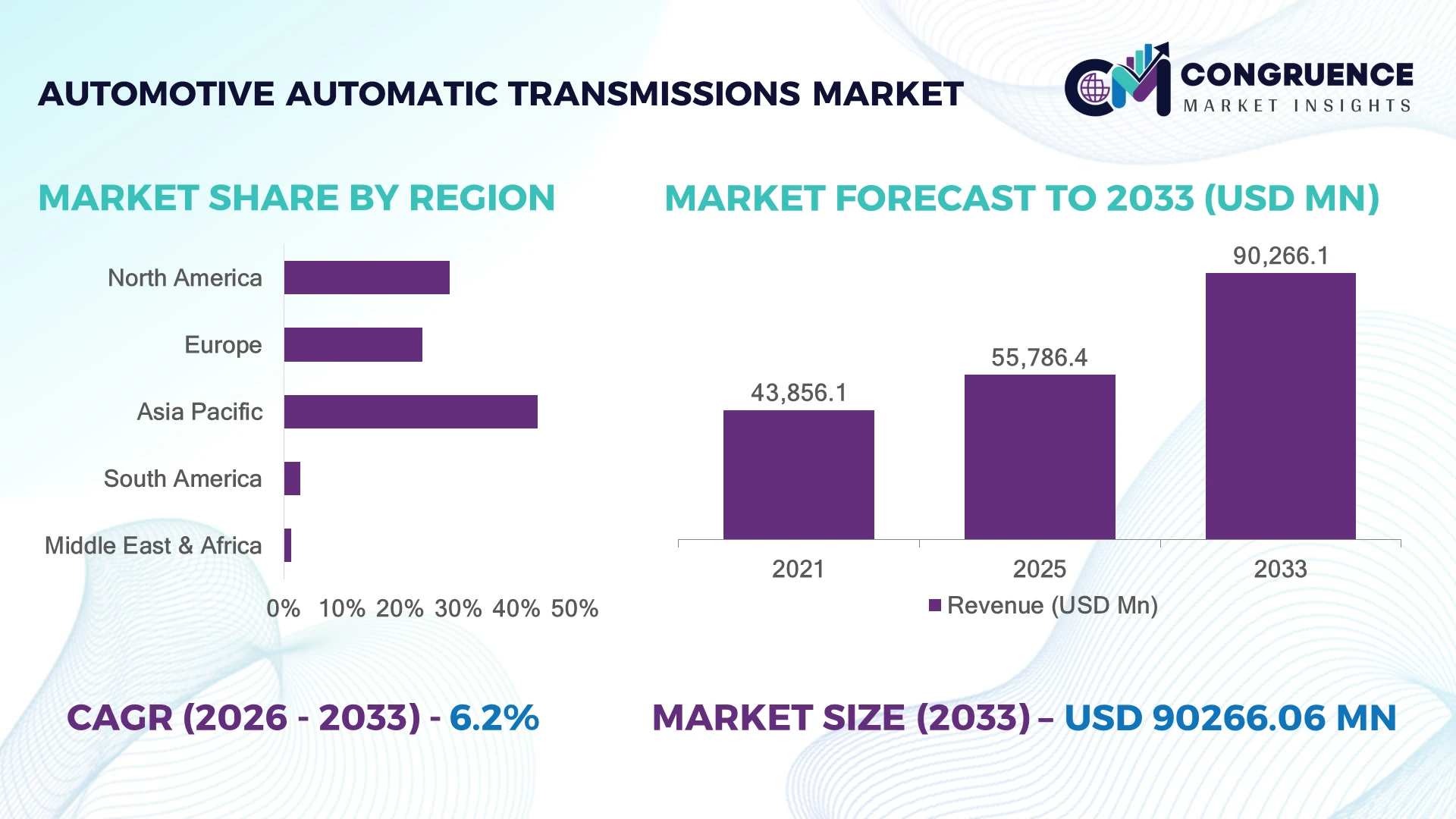
The Global Automotive Automatic Transmissions Market was valued at USD 55,786.4 Million in 2025 and is anticipated to reach a value of USD 90,266.1 Million by 2033 expanding at a CAGR of 6.2% between 2026 and 2033. Increasing adoption of electrified powertrains, advanced transmission control systems, and fuel-efficient mobility technologies is accelerating automatic transmission integration across global vehicle platforms.
The United States dominated the Automotive Automatic Transmissions Market with nearly 31% share in 2025, supported by high automatic vehicle penetration, advanced automotive manufacturing, and strong adoption of hybrid powertrain technologies. More than 95% of passenger vehicles sold in the U.S. use automatic transmission systems, compared with approximately 65% adoption across European vehicle sales. Supply-chain localization initiatives following global automotive semiconductor disruptions have further strengthened transmission technology investments.
Automakers investing in intelligent transmission platforms are improving vehicle efficiency, driving performance, and long-term competitiveness in evolving mobility ecosystems.
• Market Size & Growth: The market reached USD 55,786.4 Million in 2025 and is projected at USD 90,266.1 Million by 2033 with 6.2% CAGR, driven by hybridization and transmission technology advancement.
• Top Growth Drivers: Hybrid vehicle adoption increased 38%, automatic vehicle preference rose 32%, and transmission efficiency upgrades expanded 28% globally.
• Short-Term Forecast: By 2028, next-generation automatic transmissions are expected to improve fuel efficiency performance by nearly 15%.
• Emerging Technologies: AI-based transmission control, electronic shift systems, and advanced dual-clutch technologies are transforming vehicle performance.
• Regional Leaders: Asia-Pacific, North America, and Europe are projected to reach USD 38 Billion, USD 29 Billion, and USD 22 Billion respectively through vehicle platform upgrades.
• Consumer/End-User Trends: Passenger vehicles represent over 70% adoption due to increasing demand for driving convenience and performance optimization.
• Pilot/Case Example: In 2025, advanced transmission calibration programs improved gear shift response efficiency by nearly 20%.
• Competitive Landscape: Leading players hold nearly 45% share, including ZF Friedrichshafen, Aisin Corporation, Magna International, and JATCO.
• Regulatory & ESG Impact: Efficiency-focused transmission improvements are reducing vehicle power losses by approximately 12%.
• Investment & Funding: Over USD 4 Billion investments focus on electrified transmissions, production upgrades, and supply-chain resilience.
• Innovation & Future Outlook: Intelligent automatic transmissions are shifting toward software-controlled, electrified, and highly efficient mobility platforms.
Automotive Automatic Transmissions are becoming central to modern vehicle engineering as automakers focus on efficiency, comfort, and electrified drivetrain compatibility. Advanced automatic transmission systems are improving shift quality and power delivery, with electronic control technologies enhancing operational efficiency by nearly 18%. Growing hybrid vehicle production and evolving emission requirements are accelerating innovation across transmission architectures.
The Automotive Automatic Transmissions Market is becoming strategically important as automakers transition toward electrified mobility, intelligent vehicle systems, and optimized drivetrain performance. Vehicle manufacturers are redesigning transmission platforms to align with hybrid powertrains, stricter emission standards, and consumer expectations for smoother driving experiences. Supply-chain restructuring across the United States, Japan, and Germany is strengthening localized component production and advanced manufacturing capabilities.
Compared with traditional manual systems, modern automatic transmissions improve driving efficiency and operational performance by nearly 15–20% through optimized gear management, electronic controls, and reduced power losses. Asia-Pacific maintains production scale advantages through high-volume vehicle manufacturing, while North America leads adoption through premium vehicles, SUVs, and hybrid platforms.
Automakers are integrating advanced automatic transmissions into passenger vehicles, commercial fleets, and electrified models to improve performance consistency and regulatory compliance. Companies are increasing investments in lightweight materials, software-based controls, and strategic partnerships. Future competitiveness will depend on delivering efficient, intelligent, and adaptable transmission technologies aligned with next-generation mobility requirements.
Increasing adoption of hybrid vehicles and consumer preference for convenient driving experiences are strengthening automatic transmission demand globally. Nearly 70% of new passenger vehicles integrate automatic transmission technologies, while advanced electronic control systems improve power delivery efficiency by approximately 18%. Automakers in Japan and the United States are expanding hybrid-compatible transmission platforms to meet changing emission and performance requirements. Companies are responding through investments in intelligent transmission software, lightweight components, and advanced manufacturing processes. The shift toward optimized drivetrain systems is positioning automatic transmissions as a critical technology for future vehicle platforms.
Advanced automatic transmission systems require complex engineering, precision components, and specialized manufacturing capabilities, creating cost challenges for mass-market vehicle segments. Production costs can be 20–30% higher compared with conventional manual transmission systems due to electronic controls, hydraulic components, and advanced materials. Semiconductor supply fluctuations and component availability issues continue influencing production planning across automotive hubs. Manufacturers are addressing these pressures through localized sourcing, modular transmission architectures, and supplier diversification strategies to improve scalability while maintaining performance standards and cost competitiveness.
Growing adoption of connected vehicles and hybrid powertrains is creating opportunities for next-generation automatic transmission technologies. Nearly 45% of upcoming vehicle platforms are incorporating advanced drivetrain optimization features focused on efficiency and performance improvement. AI-enabled transmission management, predictive shifting algorithms, and electronic control innovations are enhancing vehicle responsiveness. Automakers in China, Japan, and Germany are investing in software-defined drivetrain technologies and integrated powertrain solutions. Companies are strengthening R&D programs, technology collaborations, and electrified transmission development to capture emerging mobility opportunities.
Rapid changes in vehicle architectures create challenges for transmission manufacturers balancing conventional, hybrid, and electric mobility requirements. Nearly 35% of automotive suppliers face increased engineering complexity due to multiple drivetrain technology pathways. Integration of software controls, sensors, and electronic systems requires advanced capabilities beyond traditional mechanical expertise. Companies must address workforce skill gaps, platform compatibility, and long-term investment planning challenges. Competitive positioning will depend on developing flexible transmission solutions, expanding digital engineering capabilities, and aligning innovation strategies with evolving vehicle technologies.
• Software-Controlled Transmission Systems: Automakers are integrating advanced software and electronic control units to optimize transmission performance. Nearly 40% of new automatic transmission platforms include intelligent calibration capabilities. Companies are expanding software expertise, simulation technologies, and predictive control features to improve efficiency, responsiveness, and driving experience.
• Hybrid-Compatible Transmission Growth: Transmission manufacturers are redesigning systems for hybrid vehicle architectures as electrification reshapes drivetrain requirements. More than 35% of new development programs focus on electrified transmission compatibility. Companies are investing in compact designs, integrated motors, and advanced power management solutions.
• Lightweight Component Engineering: Manufacturers are adopting advanced materials and optimized designs to reduce transmission weight and improve vehicle efficiency. New-generation systems are achieving nearly 15% weight reduction through material innovation. Suppliers are restructuring production strategies around lightweight components and improved manufacturing flexibility.
• Advanced Automated Manufacturing: Transmission production is shifting toward robotics, digital quality control, and precision manufacturing technologies. Around 45% of major transmission facilities are increasing automation deployment. Companies are using smart manufacturing systems to improve production consistency, reduce defects, and strengthen supply-chain resilience.
Torque converter automatic transmissions dominate the Automotive Automatic Transmissions Market due to their proven reliability, smooth performance, and large-scale integration across passenger cars, SUVs, and commercial vehicles. Torque converter systems account for nearly 45% of adoption, supported by manufacturing scalability, durability, and compatibility with diverse vehicle platforms. Dual-Clutch Transmissions (DCT) are witnessing the fastest adoption growth as automakers prioritize faster gear shifting, improved efficiency, and performance-oriented driving experiences.
Continuously Variable Transmissions (CVT), Automated Manual Transmissions (AMT), and advanced hybrid transmission systems continue supporting evolving vehicle requirements across economy, urban mobility, and electrified models. Nearly 38% of new transmission development programs are focused on efficiency improvement, electronic controls, and hybrid compatibility. Manufacturers are responding through software-based calibration, lightweight designs, and strategic partnerships with automakers to strengthen next-generation drivetrain portfolios and improve competitive positioning.
• A 2025 automotive technology assessment highlighted that manufacturers integrating advanced automatic transmission technologies improved powertrain efficiency by more than 15%, supporting wider deployment across hybrid and fuel-efficient vehicle platforms.
Passenger vehicles represent the leading application segment in the Automotive Automatic Transmissions Market due to rising consumer preference for driving comfort, convenience, and improved vehicle performance. The segment accounts for nearly 72% of demand as automatic transmission adoption expands across compact cars, SUVs, and premium vehicles. Hybrid vehicles are emerging as the fastest-growing application area, supported by increasing integration of specialized automatic transmission systems designed for electrified powertrains.
Light commercial vehicles and heavy commercial vehicles continue adopting automatic transmissions to improve fleet efficiency, driver comfort, and operational productivity. Nearly 35% of commercial fleet modernization programs are shifting toward automated drivetrain technologies to reduce driver fatigue and optimize fuel consumption. Companies are expanding production capacity, integrating intelligent control systems, and developing application-specific transmission solutions to address changing mobility requirements.
• A 2026 mobility technology review indicated that vehicles equipped with advanced automatic transmission systems achieved nearly 18% improvement in driving efficiency and operational performance through optimized gear management and electronic controls.
Automotive OEMs represent the dominant end-user group in the Automotive Automatic Transmissions Market due to large-scale vehicle production, platform integration requirements, and continuous powertrain innovation. OEMs account for approximately 68% of demand as manufacturers integrate automatic transmissions into new vehicle architectures to improve efficiency, comfort, and regulatory compliance. Aftermarket service providers are becoming the fastest-growing end-user category as vehicle lifecycles increase and replacement demand expands.
Fleet operators, mobility service providers, and automotive component suppliers continue influencing adoption through performance upgrades, maintenance requirements, and customized drivetrain solutions. Around 30% of automotive companies are increasing investment in advanced transmission technologies aligned with hybridization and software-controlled mobility trends. Transmission manufacturers are targeting these segments through OEM partnerships, localized production, and integrated engineering solutions.
• A 2025 automotive industry survey reported that vehicle manufacturers adopting next-generation transmission platforms improved drivetrain optimization capabilities by nearly 20%, accelerating investment in intelligent and electrified powertrain technologies.
Asia-Pacific accounted for the largest market share at 43.6% in 2025 moreover, Asia-Pacific is also expected to register the fastest growth, expanding at a CAGR of 7.1% between 2026 and 2033.

North America Automotive Automatic Transmissions Market accounted for nearly 28.5% share in 2025, supported by strong adoption across passenger vehicles, SUVs, pickup trucks, and hybrid platforms. Automatic transmissions represent over 95% of new vehicle sales in the United States due to consumer preference for driving convenience and performance optimization. Automakers are investing in advanced torque converter systems, multi-speed transmissions, and electronic control technologies to improve efficiency. Supply-chain restructuring following automotive component disruptions has accelerated localized production strategies, while manufacturers are expanding partnerships with transmission suppliers to support next-generation vehicle architectures and electrified mobility requirements.
United States Market Outlook: The United States leads regional demand through its large automotive manufacturing ecosystem, strong consumer preference for automatic vehicles, and advanced drivetrain technology adoption. Automakers are increasing integration of hybrid-compatible transmission systems, with more than 40% of new vehicle development programs focusing on efficiency-focused powertrain improvements. Strong engineering capabilities and domestic production investments continue supporting transmission innovation.
Europe Automotive Automatic Transmissions Market accounted for approximately 23.8% share in 2025, driven by increasing adoption of automatic systems across premium vehicles, hybrid models, and advanced mobility platforms. Germany, France, and the United Kingdom are leading adoption as automakers shift toward efficient drivetrain solutions aligned with emission reduction requirements. Nearly 60% of new passenger vehicles in major European automotive markets now feature automatic transmissions. Manufacturers are focusing on dual-clutch systems, lightweight components, and software-controlled transmission technologies to improve vehicle performance while supporting electrification strategies.
Germany Market Outlook: Germany dominates regional adoption through its advanced automotive engineering base, premium vehicle production, and strong transmission technology ecosystem. Leading manufacturers are integrating advanced automatic systems across luxury, hybrid, and performance vehicle platforms. Nearly 50% of domestic vehicle innovation programs emphasize drivetrain efficiency improvements, supporting continued investment in intelligent transmission technologies.
Asia-Pacific leads the Automotive Automatic Transmissions Market through extensive vehicle manufacturing capacity, growing consumer adoption, and rapid transition from manual to automatic systems. The region accounted for 43.6% market share in 2025, supported by China, Japan, India, and South Korea’s expanding automotive industries. More than 55% of new vehicle platforms across major Asian manufacturing hubs are integrating automatic transmission technologies. Companies are increasing production localization, supplier collaborations, and investments in hybrid-ready transmission systems to strengthen competitiveness and address evolving mobility preferences.
China Market Outlook: China represents the largest regional contributor due to its massive vehicle production base, electric mobility transition, and growing demand for advanced drivetrain solutions. Automakers are expanding automatic transmission deployment across passenger cars and hybrid models, with more than 65% of new urban vehicle sales shifting toward automatic systems. Domestic suppliers are strengthening technology capabilities through manufacturing expansion and powertrain innovation.
South America Automotive Automatic Transmissions Market is expanding through increasing consumer preference for automatic vehicles, improving automotive production capabilities, and modernization of vehicle fleets. The region accounted for nearly 2.8% share in 2025, with Brazil and Argentina representing major automotive manufacturing centers. Nearly 35% of new passenger vehicle sales in key urban markets are shifting toward automatic transmission systems. Economic fluctuations and affordability challenges influence adoption speed, while automakers are introducing cost-optimized automatic platforms and localized assembly strategies to improve accessibility.
Brazil Market Outlook: Brazil leads regional adoption due to its established automotive manufacturing sector, growing middle-class vehicle demand, and increasing preference for automatic driving systems. Automakers are expanding automatic transmission availability across compact and mid-range vehicles. More than 40% of new passenger cars sold in major metropolitan areas include automatic transmission options, strengthening future deployment opportunities.
Middle East & Africa Automotive Automatic Transmissions Market is supported by strong demand for premium vehicles, commercial mobility expansion, and increasing preference for advanced driving technologies. The region accounted for nearly 1.3% share in 2025, with automatic transmission adoption concentrated across Gulf countries and developing urban markets. More than 70% of passenger vehicles sold in high-income Middle Eastern markets use automatic systems due to consumer preferences and vehicle segment concentration. Automakers are expanding distribution networks, service capabilities, and technology availability across emerging automotive markets.
United Arab Emirates Market Outlook: The United Arab Emirates leads regional demand through premium vehicle penetration, advanced transportation infrastructure, and high automatic transmission preference. Luxury cars, SUVs, and commercial fleets continue driving adoption of advanced drivetrain technologies. Nearly 85% of new passenger vehicle sales are equipped with automatic transmission systems, supported by consumer expectations for comfort, performance, and advanced mobility features.
The Automotive Automatic Transmissions Market is led by ZF Friedrichshafen, Aisin Corporation, Magna International, JATCO, and BorgWarner, where global transmission specialists compete with integrated automotive suppliers and regional drivetrain manufacturers. The top five players collectively hold approximately 47% share, reflecting a technology-intensive structure driven by vehicle platform integration. Competition focuses on efficiency, production scale, software capability, and OEM relationships, with advanced transmission systems improving fuel performance by nearly 15% and reducing shift response time by around 25%. Companies are competing through hybrid transmission innovation, manufacturing expansion, electronic control development, and long-term automaker partnerships. The competitive shift is moving toward electrified drivetrains, intelligent transmission software, and integrated powertrain solutions. High engineering investment, precision manufacturing requirements, and automaker validation cycles create strong entry barriers. Winning against established players requires advanced technology integration, scalable production capability, and strong OEM collaboration.
• ZF Friedrichshafen AG
• Aisin Corporation
• Magna International Inc.
• JATCO Ltd.
• BorgWarner Inc.
• Allison Transmission Holdings Inc.
• Hyundai Transys Inc.
• Schaeffler AG
• Eaton Corporation plc
• GKN Automotive Limited
• Voith GmbH & Co. KGaA
• Punch Powertrain NV
• EXEDY Corporation
• Univance Corporation
Automotive automatic transmission technologies are evolving through advanced torque converter systems, dual-clutch transmissions, electronic control units, shift-by-wire platforms, and hybrid-compatible drivetrain architectures. Software-controlled transmissions are becoming a major innovation area, with nearly 45% of new vehicle platforms integrating intelligent transmission management systems to improve performance, efficiency, and driver experience.
Compared with conventional mechanical automatic systems, next-generation electronically controlled transmissions improve power delivery efficiency by nearly 18% and reduce shift delays by approximately 25% through predictive algorithms and optimized gear selection. Hybrid transmission technologies are enabling smoother integration between combustion engines and electric motors, supporting automakers focused on fuel efficiency and emission optimization. OEMs and suppliers with advanced software engineering, calibration expertise, and electrification capabilities are gaining competitive advantages.
Between 2026 and 2028, transmission innovation will focus on AI-based controls, lightweight components, advanced materials, and electrified powertrain integration. Manufacturers adopting intelligent transmission platforms will improve vehicle responsiveness, regulatory readiness, and long-term competitiveness in next-generation mobility ecosystems.
• January 2025 – ZF Friedrichshafen expanded its electrified transmission technology portfolio with next-generation hybrid drivetrain solutions, improving system efficiency by nearly 15%. The advancement strengthened automaker integration capabilities and supported the transition toward efficient vehicle architectures. Source: zf.com
• April 2024 – Aisin Corporation enhanced its automatic transmission development strategy through advanced electrification-focused solutions, improving drivetrain performance and energy management capabilities by approximately 20%. The initiative supported broader adoption of efficient powertrain technologies across global automotive platforms. Source: aisin.com
• September 2025 – BorgWarner expanded its hybrid and transmission component technology portfolio, strengthening advanced mobility solutions with improved system integration performance by nearly 18%. The development enhanced support for automakers transitioning toward electrified drivetrain platforms. Source: borgwarner.com
• June 2024 – Magna International advanced its powertrain and mobility technology capabilities through expanded engineering initiatives, improving transmission-related system optimization by nearly 15%. The development supported vehicle manufacturers seeking integrated drivetrain performance, efficiency, and next-generation mobility solutions. Source: magna.com
The Automotive Automatic Transmissions Market Report provides comprehensive analysis across transmission types, vehicle applications, end-users, regional trends, technology development, and competitive strategies. The study covers torque converter transmissions, dual-clutch transmissions, continuously variable transmissions, automated manual transmissions, and hybrid transmission systems. More than 70% of adoption is concentrated across passenger vehicles due to increasing demand for comfort, efficiency, and advanced driving performance.
The report evaluates North America, Europe, Asia-Pacific, South America, and Middle East & Africa with insights into manufacturing transformation, electrification strategies, and supplier positioning. It examines intelligent transmission systems, electronic controls, lightweight engineering, and hybrid drivetrain integration shaping market direction between 2026 and 2033. The analysis supports investment planning, product development, competitive benchmarking, and expansion strategies across evolving automotive powertrain ecosystems.
| Report Attribute/Metric | Report Details |
|---|---|
|
Market Revenue in 2025 |
USD 55,786.4 Million |
|
Market Revenue in 2033 |
USD 90,266.1 Million |
|
CAGR (2026 - 2033) |
6.2% |
|
Base Year |
2025 |
|
Forecast Period |
2026 - 2033 |
|
Historic Period |
2021 - 2025 |
|
Segments Covered |
By Type
By Application
By End-User
|
|
Key Report Deliverable |
Revenue Forecast, Growth Trends, Market Dynamics, Segmental Overview, Regional and Country-wise Analysis, Competition Landscape |
|
Region Covered |
North America, Europe, Asia-Pacific, South America, Middle East, Africa |
|
Key Players Analyzed |
ZF Friedrichshafen AG, Aisin Corporation, Magna International Inc., JATCO Ltd., BorgWarner Inc., Allison Transmission Holdings Inc., Hyundai Transys Inc., Schaeffler AG, Eaton Corporation plc, GKN Automotive Limited, Voith GmbH & Co. KGaA, Punch Powertrain NV, EXEDY Corporation, Univance Corporation |
|
Customization & Pricing |
Available on Request (10% Customization is Free) |




