
Reports
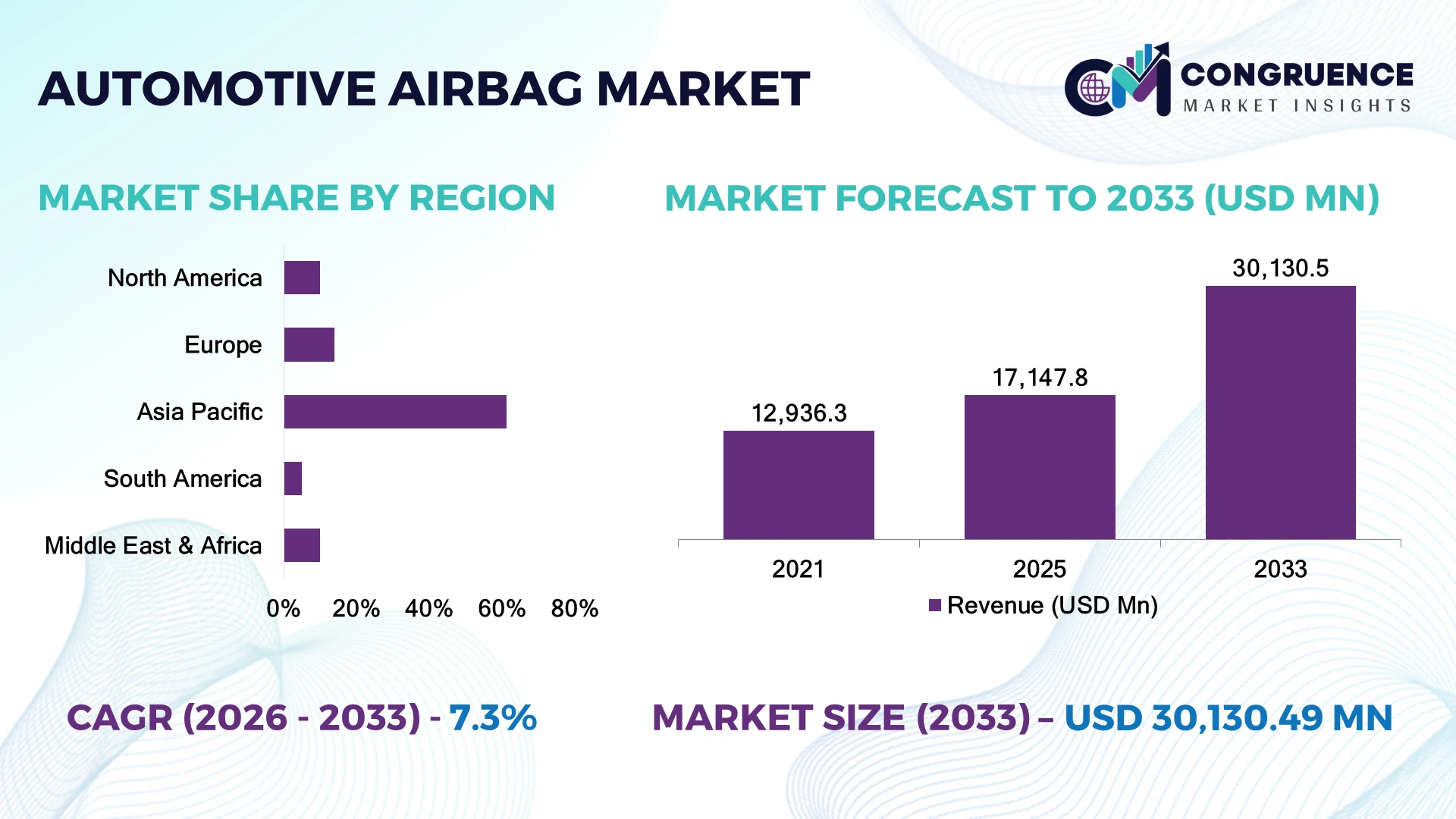
The Global Automotive Airbag Market was valued at USD 17,147.8 Million in 2025 and is anticipated to reach a value of USD 30,130.5 Million by 2033 expanding at a CAGR of 7.3% between 2026 and 2033. Growth is being driven by mandatory crash-safety requirements, expansion of side and curtain airbag fitment, and OEM migration toward integrated occupant-protection systems.
China holds the strongest production and vehicle-manufacturing position, accounting for approximately 32% of global passenger-vehicle output, while Japan contributes about 8% and maintains advanced restraint-system engineering capacity. Chinese OEMs are increasing localized sourcing as geopolitical trade friction accelerates regional supply-chain diversification, while India is expanding airbag fitment across mass-market vehicles. Approximately 75% of new vehicles globally incorporate multiple airbag configurations beyond the traditional frontal pair.
Strategically, suppliers that combine localized production, multi-airbag architectures, and sensor-integrated restraint electronics are best positioned for 2026–2033 procurement shifts.
Market Size & Growth: USD 17.15 billion in 2025 to USD 30.13 billion by 2033 at 7.3% CAGR, driven by higher multi-airbag fitment and safety regulation.
Top Growth Drivers: Approximately 32% China production exposure, 24% side-airbag expansion, and 19% electronic-safety integration influence demand.
Short-Term Forecast: By 2028, automated airbag assembly can reduce manufacturing labor requirements by 10–15% while improving production consistency.
Emerging Technologies: Smart restraint sensors, zonal occupant detection, and adaptive airbags are targeting 5–10% improvements in deployment precision.
Regional Leaders: Asia-Pacific is projected at approximately USD 13.4 billion, North America at USD 7.2 billion, and Europe at USD 6.1 billion by 2033.
Consumer/End-User Trends: Multi-airbag configurations are approaching 75% penetration across newly produced global vehicles, particularly in higher-safety vehicle segments.
Pilot/Case Example: In 2025, advanced restraint integration programs demonstrated approximately 8% faster deployment-response calibration through improved sensor synchronization.
Competitive Landscape: Autoliv leads with an estimated 20% share, competing closely with ZF, Joyson Safety Systems, Toyoda Gosei, and Hyundai Mobis.
Regulatory & ESG Impact: Updated crash-safety requirements are increasing mandatory restraint coverage, while lightweight textile systems can reduce component material use by approximately 5%.
Investment & Funding: More than USD 2 billion in cumulative recent capacity and technology investments are directed toward localized restraint manufacturing and next-generation safety electronics.
Innovation & Future Outlook: By 2028, adaptive inflation, occupant-position sensing, and software-controlled deployment will shift competition from airbags alone toward integrated restraint architectures.
The automotive airbag market is increasingly shaped by OEM demand for scalable safety architectures covering frontal, side, curtain, knee, and pedestrian protection. Approximately 40% of new airbag development activity is moving toward electronically coordinated systems integrating crash sensors, occupant classification, and restraint control. Recent supply-chain localization across China, India, Mexico, and Eastern Europe is also changing sourcing priorities, particularly as automakers seek shorter lead times and greater control over critical safety components. These shifts establish a stronger foundation for the market's strategic evolution.
Automotive airbags are becoming a strategic component of vehicle-platform differentiation because safety ratings, regulatory compliance, and electronic restraint integration increasingly influence OEM architecture decisions. The transition from basic frontal systems toward coordinated frontal, side, curtain, knee, and pedestrian protection is increasing component complexity while creating higher-value opportunities for restraint suppliers.
Technology is reshaping manufacturing economics. Automated cutting, sewing, folding, and inspection systems can reduce manual processing requirements by roughly 15% compared with conventional production lines, while sensor-integrated deployment logic improves response consistency by approximately 5–8%. Japan and Germany remain important engineering centers for advanced restraint systems, whereas China and India are gaining importance through high-volume vehicle production and localized component sourcing.
Over the next 2–3 years, OEMs are expected to prioritize scalable airbag platforms that support multiple vehicle variants without extensive redesign. A practical deployment model combines centralized electronic control with distributed crash and occupant sensors, enabling manufacturers to standardize safety architecture across sedans, SUVs, and electric vehicles. Suppliers are therefore increasing investment in localized plants, software-enabled restraint systems, and OEM partnerships. Competitive advantage will increasingly depend on combining crash performance, manufacturing scale, electronics integration, and rapid platform customization.
Mandatory safety requirements and higher crash-test expectations are accelerating multi-airbag configurations across global vehicle platforms. Side, curtain, knee, and pedestrian airbags now account for an estimated 35% of incremental airbag content in newly engineered platforms, while electronic occupant sensing is expanding at approximately 12% annually. India’s strengthened vehicle-safety framework and China’s rapid adoption of advanced driver-assistance systems are pushing OEMs toward integrated restraint architectures. This shift increases component volumes while raising calibration and validation requirements. Suppliers are responding through localized manufacturing, modular restraint platforms, and OEM co-development. The strategic advantage is moving toward suppliers capable of integrating inflators, sensors, electronic control units, and textile modules within standardized vehicle architectures, reducing platform engineering complexity and accelerating model launches.
Automotive airbag profitability remains exposed to volatility in propellant chemicals, nylon yarn, electronic sensors, and metal inflator components. Raw-material inputs can represent roughly 30–35% of airbag-system manufacturing costs, while electronic content has increased by approximately 15% as sensing architectures become more sophisticated. Supply disruptions affecting specialized chemicals and semiconductor components can extend procurement cycles by 8–12%. China-based production remains particularly important for selected textile and component inputs, creating localization pressure among global OEMs. Companies are reducing exposure through dual sourcing, regional supplier qualification, longer-term contracts, and vertical integration of critical modules. The strongest operational response is regionalizing component ecosystems without sacrificing standardized safety specifications across vehicle platforms.
Adaptive airbags create a high-value opportunity as vehicle architectures incorporate occupant classification, seat-position sensing, and predictive crash information. Intelligent restraint systems can improve deployment precision by approximately 8–12% compared with fixed-threshold configurations, while advanced textile designs can reduce package volume by nearly 10%. Electric vehicles provide another opportunity because altered cabin layouts require different occupant-protection strategies. Germany and South Korea are advancing sensor-integrated restraint engineering, while India offers substantial scope for localized production of cost-optimized systems. Suppliers are increasing R&D investment in multi-stage inflators, smart sensing, and software-controlled deployment. The non-obvious opportunity lies in developing common electronic restraint platforms adaptable across multiple vehicle sizes, enabling OEMs to reduce engineering duplication while expanding safety functionality.
The integration of airbags with occupant sensing, ADAS, and centralized vehicle electronics introduces validation and cybersecurity complexity that traditional mechanical restraint systems did not face. Software-controlled deployment logic can increase calibration workloads by 20–25%, while sensor-network dependencies create additional failure-mode testing requirements. Electric and software-defined vehicles further complicate restraint architecture because seating configurations, battery packaging, and electronic control networks differ from conventional platforms. India and China are rapidly expanding local vehicle development, increasing demand for engineering capabilities capable of validating complete restraint ecosystems rather than individual components. Companies must invest in functional-safety engineering, simulation, cybersecurity controls, and cross-domain testing. Competitive sustainability will depend on reducing validation cycles without compromising crash-performance certification or electronic-system reliability.
Smart Occupant Detection Expands: Occupant classification and position sensing are increasingly integrated into restraint control, improving deployment accuracy by approximately 5–8% and reducing unnecessary inflation events. OEMs are combining seat sensors with electronic restraint controllers, while suppliers are developing software-calibrated systems that support multiple seating configurations and faster vehicle-platform adaptation.
Localized Sourcing Gains Momentum: Geopolitical supply-chain restructuring is pushing manufacturers toward regional airbag production, with localized component sourcing increasing by roughly 10–15% across major Asian manufacturing hubs. Suppliers are qualifying secondary textile, inflator, and electronics sources to shorten lead times, reduce logistics exposure, and maintain production continuity during material disruptions.
Automated Assembly Raises Consistency: Robotic sewing, folding, inspection, and inflator integration are expanding across high-volume production facilities, reducing manual processing requirements by approximately 15% and improving dimensional consistency by 5–7%. Manufacturers are investing in machine vision and automated quality control to reduce defect escape rates while supporting higher multi-airbag production volumes.
EV Platforms Reshape Restraints: Electric-vehicle cabin layouts are driving new side, curtain, and far-side protection configurations, with approximately 20% more restraint-design engineering activity focused on non-traditional seating and battery-packaging requirements. Suppliers are responding with compact modules, adaptive inflation strategies, and co-development programs that allow OEMs to integrate advanced safety without major cabin redesigns.
Frontal Airbags Retain Scale While Curtain Systems Gain Priority
Frontal airbags remained the leading type, accounting for approximately 39% of the global Automotive Airbag Market in 2025, supported by mandatory fitment, mature production processes, standardized inflator architectures, and broad compatibility across passenger and commercial vehicles. Side airbags represented roughly 25%, while curtain airbags accounted for about 20%, reflecting increasing emphasis on lateral-impact and rollover protection. Knee airbags and emerging far-side systems remain smaller but strategically important as automakers expand occupant-protection coverage. Frontal systems retain cost and manufacturing advantages, whereas curtain and far-side configurations require more sophisticated packaging, sensing, and deployment calibration.
Curtain airbags represent the fastest-growing established type, driven by stronger side-impact safety requirements and increasing SUV penetration. Industry estimates indicate curtain-airbag adoption is advancing materially faster than frontal systems, with some vehicle programs extending protection across three seating rows. Companies are therefore investing in lightweight fabrics, compact folding architectures, multi-stage inflators, and integrated sensing. This is shifting investment from high-volume standardized modules toward higher-value restraint architectures that improve safety performance without significantly increasing vehicle packaging complexity.
The National Highway Traffic Safety Administration reports that frontal airbags have saved more than 50,000 lives over a 30-year period, reinforcing their continuing importance within modern occupant-protection systems.
Passenger Vehicles Drive Volume and Safety Content
Passenger vehicles represented approximately 72% of global Automotive Airbag Market demand in 2025, supported by substantially higher production volumes, mandatory safety fitment, and increasing integration of frontal, side, curtain, and knee systems. Commercial vehicles accounted for the remaining approximately 28%, with adoption influenced by fleet safety requirements, vehicle architecture, and regulatory compliance. Passenger-vehicle platforms therefore remain the primary volume opportunity, while commercial applications provide additional expansion potential as safety specifications become more standardized.
SUVs and electric passenger vehicles are driving the fastest shift in airbag deployment because their higher seating positions, altered cabin layouts, and evolving crash architectures require broader occupant coverage. Side and curtain systems are gaining greater specification priority, particularly in premium and safety-focused models. Companies are responding with modular restraint platforms that support multiple vehicle programs, reducing engineering duplication while accelerating validation. The strategic implication is clear: suppliers with scalable multi-position systems are better positioned than those dependent primarily on conventional frontal modules.
Industry market analysis indicates passenger vehicles accounted for about 72% of automotive airbag installations, while side and curtain systems captured approximately 35% of incremental installations as vehicle safety specifications expanded.
OEM Integration Dominates Purchasing and Product Development
Automotive OEMs remained the dominant end-user group, representing approximately 91% of airbag installations in 2025. Their purchasing concentration reflects direct integration of restraint systems into vehicle engineering, crash-validation programs, electronic architectures, and assembly operations. The aftermarket represents roughly 9% but is gaining strategic relevance through replacement demand, accident repairs, and certified retrofit activity. OEM procurement emphasizes validated performance, cost control, platform compatibility, and long-term supply assurance, while aftermarket purchasing places greater weight on availability, authentication, and installation speed.
The aftermarket is becoming the faster-shifting end-user channel as replacement requirements and safety compliance strengthen, with some industry estimates placing aftermarket growth above OEM installation growth. Companies are responding by localizing replacement inventories, strengthening workshop relationships, and developing authenticated modules to reduce counterfeit exposure. Meanwhile, OEM-focused suppliers are increasing vertical integration across inflators, cushions, sensors, and electronic control systems. This creates a two-track competitive model: scale and engineering integration dominate OEM contracts, while responsiveness and product authenticity determine aftermarket competitiveness.
Market estimates place OEM installations at approximately 90.75% of total airbag demand in 2025, while aftermarket activity is expanding as replacement and retrofit requirements become more commercially relevant.
Asia-Pacific accounted for the largest market share at 61.2% in 2025 however, Middle East & Africa is expected to register the fastest growth, expanding at a CAGR of 8.1% between 2026 and 2033.

Advanced restraint integration is shifting procurement toward multi-zone protection
North America represents a mature but technologically intensive Automotive Airbag Market, supported by high vehicle safety content, established Tier-1 supplier networks, and stringent occupant-protection requirements. The region accounted for approximately 10% of global demand in 2025, with the U.S. representing the overwhelming share of regional vehicle production and airbag installations. Automakers are increasingly integrating side, curtain, knee, and far-side systems with electronic restraint-control architectures rather than treating airbags as standalone components. EV platform development is also changing packaging requirements, particularly around seating position, battery structures, and cabin geometry. Suppliers are responding through modular restraint platforms, localized manufacturing, and joint validation programs. The key operational shift is toward software-coordinated deployment, enabling differentiated protection without completely redesigning hardware architectures.
U.S. Market Outlook: The U.S. remains the region's principal demand center because of its large light-vehicle production base, mature safety ecosystem, and established regulatory framework. Frontal airbags remain mandatory, while advanced restraint configurations are increasingly incorporated into higher-rated vehicle platforms. Automakers are also expanding side and curtain coverage as safety ratings influence purchasing decisions, strengthening demand for integrated sensing and restraint-control systems.
Regulatory intensification is accelerating integrated occupant protection
Europe accounted for approximately 13.9% of global Automotive Airbag Market demand in 2025, with Germany, France, Italy, and Spain forming the principal manufacturing base. The market is shifting toward integrated restraint architectures as automakers respond to increasingly demanding vehicle-safety assessments and electronic vehicle platforms. The EU General Safety Regulation has applied additional mandatory safety requirements to new vehicles since July 2024, strengthening the technology environment surrounding airbags and electronic restraint systems. Suppliers are consequently emphasizing compact modules, advanced sensing, and coordinated deployment logic. Germany remains particularly influential because of its concentration of premium OEM engineering and component manufacturing, creating a strong launch environment for higher-content restraint technologies.
Germany Market Outlook: Germany remains Europe's strongest automotive airbag demand center through its concentration of premium vehicle manufacturing, engineering facilities, and Tier-1 suppliers. The country's vehicle-development ecosystem supports early integration of advanced restraint technologies, including curtain and far-side protection. Approximately 15% of global automotive airbag demand is linked to European vehicle production, giving German OEM programs significant influence over supplier specifications and validation requirements.
Manufacturing scale is driving rapid expansion of safety content
Asia-Pacific dominated the global Automotive Airbag Market with approximately 61.2% share in 2025, reflecting its concentration of vehicle manufacturing, component production, and large-scale OEM programs. China, Japan, South Korea, and India represent the principal production and deployment centers, with China alone projected to account for a substantial portion of regional demand. Increasing six-airbag fitment, SUV production, and electric-vehicle manufacturing are raising airbag content per vehicle. Suppliers are expanding localized production to reduce logistics exposure and meet OEM cost targets. The region's competitive advantage increasingly combines manufacturing scale with rapid technology localization, allowing restraint suppliers to commercialize curtain, side, and electronically coordinated systems faster than in lower-volume markets.
China Market Outlook: China is the region's largest automotive manufacturing hub and therefore the most strategically important country for airbag suppliers. Its extensive passenger-vehicle and EV production ecosystem creates high-volume demand for standardized frontal systems alongside increasingly sophisticated side and curtain configurations. China accounted for roughly 29% of global vehicle production in recent industry estimates, strengthening its importance for supplier localization, capacity expansion, and next-generation restraint development.
Safety-content expansion is broadening beyond premium vehicle segments
South America remains a smaller but increasingly structured Automotive Airbag Market, with Brazil representing the principal production and consumption center. Passenger vehicles dominate demand, while rising incorporation of side and curtain airbags is gradually increasing the value of restraint content per vehicle. Brazil's established automotive manufacturing base supports localized assembly and supplier relationships, although currency volatility and imported component exposure continue to influence procurement economics. Approximately 5% of regional vehicle programs increasingly emphasize expanded occupant protection beyond basic frontal systems. Automakers and suppliers are therefore balancing cost-sensitive platforms with higher safety specifications by using modular airbag assemblies and common inflator architectures. The commercial opportunity is strongest where localized manufacturing can reduce import dependency without compromising validation requirements.
Brazil Market Outlook: Brazil provides the strongest manufacturing platform in South America, supported by established OEM plants, component suppliers, and a large passenger-vehicle fleet. Its automotive ecosystem gives suppliers an operational base for localized airbag production and replacement-module distribution. Vehicle safety requirements are progressively broadening, encouraging manufacturers to integrate additional restraint coverage while maintaining cost discipline across compact and mid-market vehicle platforms.
Vehicle modernization is creating new demand for advanced restraint content
Middle East & Africa represents a comparatively underpenetrated Automotive Airbag Market, with demand concentrated in Saudi Arabia, the UAE, South Africa, and other countries with substantial vehicle-import and distribution networks. The region is transitioning from basic frontal protection toward greater adoption of side and curtain systems as newer vehicle fleets increasingly incorporate global safety specifications. Approximately 10% of newly introduced vehicle programs in the region are positioned around higher safety-content configurations, particularly SUVs and premium vehicles. Saudi Arabia's automotive industrial development and localization agenda are strengthening the business case for regional component supply. Suppliers are responding through distributor partnerships, localized technical support, and closer alignment with global OEM platforms rather than establishing highly fragmented product architectures.
Saudi Arabia Market Outlook: Saudi Arabia is the region's strongest strategic market because of its large SUV-oriented vehicle base, premium vehicle penetration, and expanding automotive industrial ecosystem. The country's localization agenda is encouraging greater participation in vehicle and component manufacturing, while new vehicle programs increasingly incorporate internationally standardized restraint configurations. This creates opportunities for suppliers offering modular airbag systems, localized technical support, and scalable distribution infrastructure.
Autoliv, ZF Friedrichshafen, Joyson Safety Systems, Toyoda Gosei, and Hyundai Mobis compete as global restraint-system leaders, while Daicel and regional Asian suppliers pressure them on inflators and cost. The top five players collectively control approximately 30% of the global market, indicating a moderately concentrated structure. Competition centers on technology, OEM integration, supply reliability, and cost: advanced restraint content commands roughly 10–15% higher system value, while localized production can reduce logistics exposure by 5–8%. Autoliv emphasizes global OEM relationships and advanced airbags; ZF integrates restraint electronics with sensing; Joyson competes through manufacturing scale and localization; Hyundai Mobis targets EV-specific architectures; Toyoda Gosei differentiates through compact modules. Players are expanding regional capacity, forming OEM partnerships, and integrating inflators, textiles, electronics, and cushions. The competitive shift is toward adaptive, software-coordinated restraints. High validation costs, stringent certification, and OEM qualification cycles remain major entry barriers. Winning requires proven safety performance, localized supply, scalable engineering, and rapid OEM integration.
Autoliv Inc.
ZF Friedrichshafen AG
Joyson Safety Systems
Toyoda Gosei Co., Ltd.
Hyundai Mobis Co., Ltd.
Daicel Corporation
Continental AG
Denso Corporation
Nippon Plast Co., Ltd.
Ashimori Industry Co., Ltd.
ITW Automotive
Robert Bosch GmbH
Adaptive restraint technology is moving airbags from fixed deployment toward occupant-specific protection. Camera, seat, and crash-sensor fusion enables systems to classify occupant position and posture before deployment, while dual-stage inflators adjust cushion volume. These architectures can improve deployment precision by approximately 10–15% and reduce unnecessary inflation loads by 5–8%. Adoption is concentrated in premium and advanced EV platforms, but integration is moving downward as electronic restraint controllers become more modular.
Lightweight and space-efficient airbag construction is becoming equally important. Hyundai Mobis developed EV-oriented airbags up to 40% thinner than conventional designs, while ZF introduced large-volume and dual-contour concepts for flexible seating architectures. Compared with legacy fixed-volume modules, these designs improve packaging efficiency by up to 20% and enable greater cabin-design freedom. EV manufacturers and premium OEMs benefit most because altered seating geometry demands protection without consuming additional interior space.
Between 2026 and 2028, sensor-fusion restraints, far-side airbags, center airbags, smart inflators, and recycled-material cushions will move from selective innovation toward broader platform integration. Suppliers with software capability, validated sensing interfaces, and modular hardware gain an advantage because they can serve multiple vehicle architectures without rebuilding complete restraint systems.
June 2024 Autoliv introduced airbag cushions made from 100% recycled polyester, maintaining safety functionality while cutting polymer-level greenhouse-gas emissions by approximately 50%. The development strengthens sustainable material adoption across global airbag programs. Source: autoliv.com (Cision News)
July 2024 Hyundai Mobis unveiled door-installed curtain and self-supporting passenger airbags for purpose-built vehicles, with the curtain system deploying vertically within 0.03 seconds. The innovation expands restraint integration into flexible PBV interiors. Source: mobis.com (Mobis)
February 2025 ZF LIFETEC introduced its Active Heel Airbag, designed to stabilize occupant foot positioning during reclined seating. The system integrates beneath the floor carpet without additional cabin space, supporting next-generation comfort-oriented vehicle architectures. Source: zf.com (ZF Press Center)
September 2024 Joyson Safety Systems formed a global strategic partnership with GAC AION, using its network across 25 countries to support localized research and production integration. The agreement strengthens safety-system localization for GAC AION’s international expansion. Source: joysonsafety.com (Joyson Safety)
The Automotive Airbag Market Report covers the industry across airbag types including frontal, side, curtain, knee, center, and emerging far-side systems, with application analysis spanning passenger vehicles, commercial vehicles, electric vehicles, and specialty mobility platforms. End-user coverage evaluates OEMs, Tier-1 restraint suppliers, and aftermarket participants. Regional assessment includes North America, Europe, Asia-Pacific, South America, and Middle East & Africa, with country-level analysis of major automotive manufacturing hubs.
The report evaluates deployment patterns, safety-content penetration, lightweight materials, adaptive restraint systems, smart sensing, electronic control integration, and next-generation occupant-protection technologies. Approximately 10–15% higher system value is associated with advanced restraint configurations, while modular architectures increasingly support multi-platform deployment. Strategic analysis supports capacity planning, localization decisions, OEM partnership development, technology investment, competitive positioning, and expansion priorities through 2033.
| Report Attribute/Metric | Report Details |
|---|---|
|
Market Revenue in 2025 |
USD 17,147.8 Million |
|
Market Revenue in 2033 |
USD 30,130.5 Million |
|
CAGR (2026 - 2033) |
7.3% |
|
Base Year |
2025 |
|
Forecast Period |
2026 - 2033 |
|
Historic Period |
2021 - 2025 |
|
Segments Covered |
By Type
By Application
By End-User
|
|
Key Report Deliverable |
Revenue Forecast, Growth Trends, Market Dynamics, Segmental Overview, Regional and Country-wise Analysis, Competition Landscape |
|
Region Covered |
North America, Europe, Asia-Pacific, South America, Middle East, Africa |
|
Key Players Analyzed |
Autoliv Inc., ZF Friedrichshafen AG, Joyson Safety Systems, Toyoda Gosei Co., Ltd., Hyundai Mobis Co., Ltd., Daicel Corporation, Continental AG, Denso Corporation, Nippon Plast Co., Ltd., Ashimori Industry Co., Ltd., ITW Automotive, Robert Bosch GmbH |
|
Customization & Pricing |
Available on Request (10% Customization is Free) |




