
Reports
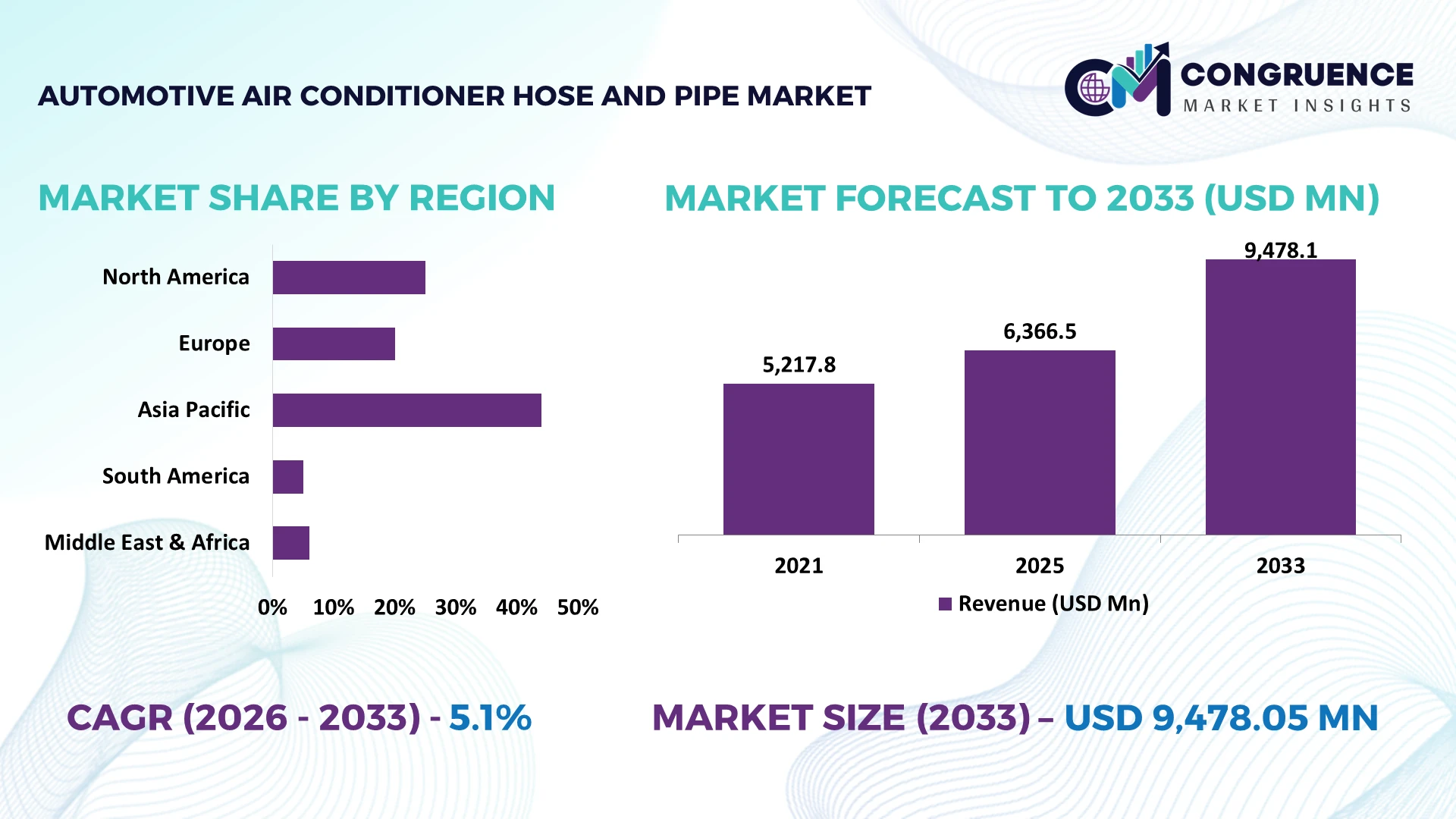
The Global Automotive Air Conditioner Hose and Pipe Market was valued at USD 6366.45 Million in 2025 and is anticipated to reach a value of USD 9478.05 Million by 2033 expanding at a CAGR of 5.1% between 2026 and 2033. Growth is driven by higher vehicle air conditioning penetration, EV thermal management circuits, low GWP refrigerant transitions, and lightweight multilayer hose assemblies engineered for tighter refrigerant permeation control.
China anchors global demand through production exceeding 31 million vehicles annually and approximately 70% penetration of new energy vehicles in recent monthly sales, creating substantial requirements for refrigerant lines, battery cooling interfaces, and compressor connections. Japan provides a technology contrast through advanced fluoropolymer and barrier hose engineering, while Mexico strengthens North American supply through export oriented vehicle assembly. U.S. tariffs and localization policies are simultaneously restructuring automotive component sourcing, increasing the strategic value of manufacturing capacity positioned near vehicle assembly clusters.
Suppliers combining low permeation materials, EV compatible thermal lines, and localized OEM production will secure stronger platform nominations as refrigerant and propulsion architectures change.
Market Size & Growth: USD 6,366.45 million in 2025 reaches USD 9,478.05 million by 2033 at 5.1% CAGR, driven by EV thermal systems.
Top Growth Drivers: EV adoption above 20%, refrigerant leakage reductions exceeding 30%, and vehicle AC penetration above 90% strengthen component demand.
Short-Term Forecast: By 2028, optimized lightweight hose assemblies can reduce refrigerant-line weight approximately 10–15%, supporting vehicle efficiency and packaging improvements.
Emerging Technologies: Multilayer thermoplastics, low-permeation barrier materials, and automated tube forming are targeting 20–40% lower refrigerant permeation.
Regional Leaders: Asia-Pacific approaches USD 4.4 billion by 2033, North America USD 2.3 billion, and Europe USD 1.9 billion as electrification reshapes thermal architectures.
Consumer/End-User Trends: More than 90% of new passenger vehicles in major automotive markets incorporate air conditioning, sustaining high OEM hose and pipe installation volumes.
Pilot/Case Example: In 2025, next-generation EV heat-pump architectures consolidated heating and cooling circuits, targeting approximately 10–20% winter-range improvement versus resistive heating.
Competitive Landscape: ContiTech holds an estimated 10% share, competing with Hutchinson, TI Fluid Systems, Gates, and Sumitomo Riko on materials, integration, and OEM localization.
Regulatory & ESG Impact: R1234yf delivers over 99% lower global-warming potential than R134a, accelerating redesign of compatible refrigerant hoses, seals, and fittings.
Investment & Funding: Automotive suppliers are directing multi-billion-dollar global electrification investment toward thermal systems as EV sales exceed 20% of worldwide new-car sales.
Innovation & Future Outlook: Integrated thermal management can consolidate 3 or more cooling functions, shifting hose suppliers toward modular assemblies, quick connectors, sensors, and engineered fluid-routing systems.
The Automotive Air Conditioner Hose and Pipe Market is shifting from conventional refrigerant conveyance toward integrated thermal management for passenger vehicles, commercial fleets, hybrids, and battery electric platforms. EV architectures increase demand for compact routing, lightweight tubing, low permeation barriers, and assemblies compatible with heat pumps and multiple cooling loops. Battery electric vehicles now represent more than 20% of global new-car sales, strengthening engineering requirements beyond cabin cooling. Refrigerant regulation and automotive supply-chain localization are simultaneously pushing manufacturers toward advanced materials and regional production, establishing the strategic priorities shaping competition.
Automotive air conditioner hoses and pipes are becoming strategically important as electrification transforms thermal routing from a cabin cooling function into a vehicle wide temperature management architecture. Electric cars exceeded 20% of global new car sales, while refrigerant regulation is accelerating R1234yf compatible component redesign. Simultaneously, OEM localization strategies are moving fluid line capacity closer to vehicle assembly hubs, increasing the value of platform specific engineering and regional production.
Multilayer thermoplastic hoses can reduce line weight by roughly 10–15% versus conventional reinforced rubber designs while delivering tighter permeation control. China provides unmatched production scale, exceeding 31 million vehicles annually, whereas Germany and Japan emphasize advanced heat pump integration and high specification materials. Modern EV platforms increasingly connect cabin conditioning with battery and power electronics cooling, multiplying routing complexity and component qualification requirements.
Through 2028, heat pumps, modular thermal manifolds, quick connectors, and low permeation materials will gain platform penetration. Suppliers are investing in automated tube forming, localized assembly, and OEM engineering partnerships; integrated EV thermal modules provide a practical deployment model. Competitive advantage will concentrate among manufacturers combining materials expertise, leak integrity, packaging flexibility, and proximity to vehicle programs.
Electric vehicle adoption is restructuring air conditioning fluid architecture because battery packs, power electronics, motors, and cabins require coordinated temperature control. Electric cars now exceed 20% of global new car sales, while China accounts for more than 60% of worldwide EV registrations and electrified models represent over 45% of Chinese new car sales. Unlike conventional vehicles, heat pump equipped EVs require additional refrigerant routing, valves, connectors, and thermal interfaces. This increases engineered line content per platform even when vehicle packaging becomes more compact. Chinese and European OEMs are consequently integrating HVAC with battery thermal management rather than specifying isolated cabin systems. Hose and pipe suppliers are responding through lightweight multilayer products, formed aluminum assemblies, modular connectors, and co-development programs positioned earlier in vehicle design cycles.
Aluminum, synthetic rubber, engineering polymers, and fluorinated barrier materials expose hose and pipe manufacturers to persistent input cost variability. Aluminum prices can move more than 15% within annual procurement cycles, while specialty polymer fluctuations of 10–20% can materially alter component economics under fixed-price OEM contracts. China dominates several upstream automotive material and component supply chains, creating additional exposure as U.S. tariff measures and localization requirements reshape procurement flows. Frequent refrigerant specification changes also require new seals, barrier layers, validation procedures, and production tooling before suppliers recover development expenditure. Manufacturers are mitigating pressure through indexed material contracts, dual sourcing, regional extrusion and tube-forming capacity, and increased aluminum recycling. The strategic constraint is therefore margin recovery speed, not underlying component demand, particularly for suppliers locked into multi-year vehicle programs.
Heat pump adoption creates a higher-value opportunity because one thermal circuit can support cabin heating, cooling, battery conditioning, and power electronics management. Compared with resistive cabin heating, advanced heat pumps can improve cold-weather EV driving range by approximately 10–20%, while optimized thermal architectures can reduce overall energy consumption by 5–15% under relevant conditions. Norway, where battery electric vehicles represent more than 85% of new passenger car registrations, provides a mature deployment environment for cold-climate thermal technology. Future systems will increasingly combine low-permeation hoses, formed pipes, sensors, electronic valves, and compact manifolds. Suppliers are expanding R&D around refrigerant compatibility and modular assemblies while partnering with thermal-system integrators. The non-obvious opportunity is content consolidation: fewer interfaces can increase supplier value when manufacturers deliver complete validated routing modules rather than individual hoses.
EV thermal architectures create an execution challenge because refrigerant circuits must operate reliably across wider pressure, temperature, vibration, and packaging conditions while interacting with battery and power electronics cooling. Modern heat pump systems can incorporate 20 or more valves, connectors, sensors, and fluid interfaces, multiplying potential leak and assembly points. Refrigerant leakage reductions exceeding 30% increasingly depend on joint quality, permeation control, and automated end-of-line testing rather than hose material alone. Germany's premium vehicle programs illustrate the engineering pressure as compact platforms integrate increasingly complex thermal hardware without expanding available packaging space. Suppliers must invest in robotic forming, helium leak detection, digital quality traceability, simulation, and skilled thermal engineering. Long-term competitiveness depends on validating complete assemblies consistently at automotive scale while shortening OEM development cycles by roughly 15–20%.
Low Permeation Designs Gain Priority: R1234yf’s global warming potential below 1 versus 1,430 for R134a is tightening attention on refrigerant containment. Multilayer barrier constructions can reduce permeation by over 30% compared with conventional elastomer designs. European vehicle programs are accelerating qualification of compatible materials, pushing suppliers toward improved liners, crimping processes, and automated leak testing while increasing engineering value per assembly.
Lightweight Aluminum Routing Expands: Vehicle manufacturers are replacing selected heavy fluid-routing components with thin-wall aluminum structures capable of delivering approximately 20–40% weight savings against comparable steel configurations. Automated bending and brazing are simultaneously improving repeatability across complex routing geometries. Japanese and Chinese suppliers are expanding precision tube-forming capacity, helping OEMs reduce vehicle mass while creating demand for tighter dimensional control and higher-value fabricated assemblies.
Manufacturing Automation Raises Quality Control: Robotic tube bending, vision inspection, automated crimping, and digital leak testing are replacing labor-intensive production stages. Automated cells can improve cycle efficiency by roughly 15–25% while cutting selected assembly defects by 20–30%. Automotive labor pressure and stricter OEM traceability requirements reinforce adoption. Manufacturers are connecting process data with serial-level quality records, reducing rework while strengthening eligibility for globally standardized vehicle platforms.
Localized Supply Networks Reshape Sourcing: OEM sourcing strategies increasingly favor hose and pipe capacity positioned near vehicle assembly hubs as tariffs and logistics volatility expose long-distance supply chains. Localization can shorten component lead times by 20–40% and reduce logistics exposure by 10–20% for suitable programs. Mexico, China, and Central Europe remain important production clusters. Suppliers are adding regional forming, extrusion, and assembly capacity while dual-sourcing critical fittings and polymers.
Rubber Hoses lead the type segment with an estimated 34% share, supported by established OEM specifications, vibration absorption, routing flexibility, and competitive manufacturing economics. Their mature extrusion and reinforcement processes support high-volume passenger and commercial vehicle programs. Flexible Hoses complement installations requiring movement around compressors and powertrains, while Aluminum Pipes provide lightweight rigid routing across condenser and evaporator circuits. Steel Pipes retain relevance where mechanical strength and temperature resistance outweigh mass reduction priorities.
Barrier Hoses are the fastest-growing type as tighter refrigerant containment requirements increase demand for multilayer constructions with lower permeation. Advanced barriers can reduce refrigerant permeation by more than 30% compared with conventional hose structures, while Aluminum Pipes can deliver approximately 20–40% weight savings versus comparable steel routing. Rigid Pipes remain important where dimensional stability and packaging precision dominate. Suppliers are consequently reallocating development toward barrier polymers, optimized rubber compounds, lightweight metals, and automated forming, shifting competitive advantage from commodity hose capacity toward application-specific materials engineering.
Refrigerant Circulation represents the leading application with an estimated 31% share because every automotive air-conditioning architecture requires reliable fluid transfer throughout the cooling loop. Compressor Lines command substantial engineering attention because pressure pulsation and vibration require durable connections, while Condenser Lines emphasize thermal stability and packaging efficiency. Evaporator Lines remain closely tied to cabin cooling performance. Across mature architectures, optimized line routing can reduce pressure losses by approximately 5–10%, improving system efficiency without increasing compressor capacity.
Discharge Lines are the fastest-growing application as higher-performance thermal architectures place greater demands on high-pressure refrigerant routing and temperature resistance. Suction Lines require larger internal diameters and insulation control to maintain compressor inlet conditions. Heat-pump-equipped platforms increasingly require additional routing states, valves, and connections, increasing functional complexity by more than 20% compared with simpler cooling-only layouts. Suppliers are responding through automated tube forming, engineered fittings, integrated assemblies, and platform-specific line packages that reduce OEM installation complexity while strengthening component content per vehicle.
Passenger Cars represent the leading end-user segment with an estimated 65% share, reflecting global production scale and air-conditioning penetration exceeding 90% across major automotive markets. High-volume platforms generate recurring requirements for compressor, condenser, evaporator, suction, and discharge routing. Commercial Vehicles and Heavy Trucks demand more durable assemblies because longer operating hours increase vibration and thermal cycling exposure. Buses require higher-capacity climate systems, while Off-Highway Vehicles emphasize ruggedized components capable of operating under dust, vibration, and severe temperature conditions.
Electric Vehicles are the fastest-growing end-user segment as thermal systems expand beyond passenger comfort into battery, motor, and electronics temperature management. Electric cars exceeded 20% of global new-car sales in 2024, while China recorded EV penetration above 40%, concentrating advanced thermal-component demand within its automotive supply chain. Hose and pipe manufacturers are developing lightweight routing, low-permeation barriers, modular connections, and platform-specific assemblies. Suppliers securing early EV engineering nominations gain stronger positioning because thermal routing becomes embedded deeper within vehicle architecture.
Asia-Pacific accounted for the largest market share at 46% in 2025 however, Asia-Pacific is expected to register the fastest growth, expanding at a CAGR of 6.4% between 2026 and 2033.
Localization Reshapes Thermal Component Sourcing
North America represents approximately 23% of global demand, anchored by vehicle assembly in the United States and Mexico and increasingly localized thermal-system supply chains. High air-conditioning penetration across passenger cars, pickups, commercial vehicles, and heavy trucks creates a broad installed base for refrigerant hoses, aluminum pipes, suction lines, and discharge assemblies. Mexico produced more than 3.9 million light vehicles in 2024, reinforcing its importance as a nearshore manufacturing base for components supplied into U.S. vehicle programs. Electrified platforms are simultaneously increasing engineering requirements for low-permeation routing and compact heat-pump circuits. U.S. trade measures and OEM localization strategies are encouraging suppliers to position extrusion, tube forming, crimping, and final assembly closer to production hubs, reducing logistics exposure and improving responsiveness during vehicle launches.
United States Market Outlook: The United States remains the region's highest-value engineering market because pickups, SUVs, commercial fleets, and EV platforms require diverse HVAC configurations. Light-vehicle production exceeds 10 million units annually, while strict refrigerant management requirements support low-permeation components. Suppliers with local validation laboratories and automated leak-testing capability gain an advantage in securing platform nominations and responding rapidly to OEM engineering changes.
Refrigerant Rules Accelerate System Redesign
Europe holds approximately 20% of global demand, with component specifications increasingly influenced by refrigerant regulation, vehicle electrification, lightweighting, and stringent lifecycle performance requirements. Germany, Spain, France, Czechia, and Slovakia concentrate major vehicle assembly activity, creating dense supply networks for formed aluminum lines, barrier hoses, fittings, and thermal modules. Battery electric vehicles represented roughly 14% of EU new-car registrations in 2024, increasing the number of platforms requiring integrated cabin and battery thermal management. R1234yf, with global warming potential below 1 compared with 1,430 for R134a, has materially changed permeation, sealing, and validation priorities. Suppliers are responding with multilayer hose constructions, automated brazing, lightweight tubing, and integrated routing modules while placing engineering resources close to OEM development centers to shorten qualification cycles.
Germany Market Outlook: Germany provides the region's strongest combination of premium vehicle engineering, thermal-system innovation, and supplier R&D infrastructure. Domestic manufacturers produced more than 4 million passenger cars in 2024, supporting substantial demand for high-specification refrigerant routing. Premium EV programs particularly reward suppliers capable of delivering complex formed lines, tight packaging tolerances, automated traceability, and validated heat-pump-compatible assemblies.
Vehicle Scale Concentrates Thermal Supply Chains
Asia-Pacific commands approximately 46% of global demand, reflecting unmatched vehicle production, expanding electrification, established polymer processing, and extensive automotive component manufacturing. China alone produced more than 31 million vehicles in 2024, creating exceptional scale for rubber hoses, barrier constructions, aluminum piping, connectors, and integrated thermal assemblies. Japan and South Korea provide advanced materials and heat-pump engineering, while India adds volume through rapidly expanding passenger and utility vehicle manufacturing. China's new-energy vehicle output surpassed 12 million units in 2024, accelerating investment in compact refrigerant circuits and automated tube fabrication. Suppliers are increasing local extrusion, bending, brazing, and testing capacity while integrating operations with domestic OEM development programs. The region's advantage increasingly extends beyond production cost toward vertically coordinated materials, electronics, thermal engineering, and vehicle manufacturing ecosystems.
China Market Outlook: China is the pivotal country because its automotive industry combines the world's largest production base with rapid electric-platform deployment. New-energy vehicles exceeded 40% of domestic new-car sales in 2024, intensifying demand for heat-pump routing and specialized thermal interfaces. Domestic OEM development speed rewards suppliers offering local tooling, rapid prototyping, automated manufacturing, and engineering support rather than relying on imported standardized assemblies.
Brazil Anchors Localized Component Demand
South America represents approximately 6% of global demand, with Brazil and Argentina providing the principal automotive production base. Brazil produced approximately 2.5 million vehicles in 2024, sustaining requirements for refrigerant hoses and pipes across passenger cars, light commercial vehicles, trucks, and buses. High ambient temperatures make air conditioning operationally important, while flex-fuel powertrains and increasingly diversified vehicle platforms require locally adapted component routing. Imported specialty polymers and advanced barrier materials still expose manufacturers to currency and logistics volatility, limiting complete supply-chain localization. Automakers are nevertheless increasing local sourcing to control lead times and foreign-exchange exposure. Component suppliers are concentrating extrusion, crimping, forming, and aftermarket distribution around Brazilian automotive clusters while retaining imported high-specification materials where domestic production economics remain insufficient.
Brazil Market Outlook: Brazil dominates regional automotive manufacturing and combines large domestic vehicle demand with established assembly clusters in São Paulo, Minas Gerais, Paraná, and Bahia. Passenger vehicles exceed 90% air-conditioning penetration in major new-model categories, sustaining broad component requirements. Suppliers with domestic forming and assembly operations can reduce import dependence while adapting refrigerant lines to local vehicle platforms and climatic operating conditions.
Extreme Climate Elevates HVAC Durability
Middle East & Africa accounts for approximately 5% of global demand, but unusually severe operating temperatures make air-conditioning reliability strategically important across passenger vehicles, buses, trucks, and off-highway fleets. Gulf markets routinely experience temperatures above 45°C, increasing thermal loads on compressors, discharge lines, seals, and refrigerant circuits. South Africa and Morocco provide important automotive manufacturing bases, while Saudi Arabia is building domestic vehicle and EV production capability. Morocco now produces more than 500,000 vehicles annually, supporting a growing localized component ecosystem linked with European supply chains. Manufacturers are emphasizing heat-resistant elastomers, corrosion protection, reinforced fittings, and high-pressure durability. New industrial investments are also creating opportunities for suppliers to establish local assembly and distribution rather than serving vehicle manufacturers exclusively through imported finished components.
Morocco Market Outlook: Morocco offers the strongest established manufacturing proposition, combining Renault and Stellantis production with export-oriented automotive supplier clusters around Tangier and Kenitra. Vehicle manufacturing capacity exceeds 700,000 units annually, providing scale for localized thermal components. Its proximity to European assembly networks gives hose and pipe suppliers a strategically efficient base for labor-intensive fabrication, final assembly, and cross-Mediterranean logistics.
ContiTech, Hutchinson, TI Fluid Systems, Gates, and Sumitomo Riko compete for OEM platform nominations against specialized regional hose and formed-tube suppliers. The top five account for approximately 38% of market activity, reflecting advantages in materials engineering, validation infrastructure, and global manufacturing footprints. Competition increasingly centers on low-permeation performance, lightweight routing, localization, and integration: advanced barrier constructions can cut refrigerant permeation above 30%, while aluminum substitution can reduce selected line weight by 20–40%. Global suppliers are expanding near OEM plants, co-developing heat-pump assemblies, automating bending and crimping, and integrating connectors with complete fluid-routing modules. The competitive shift favors engineered systems over commodity hoses as electrified vehicles require tighter packaging and additional thermal interfaces. Entry barriers include multi-year OEM qualification, refrigerant compatibility testing, leak validation, tooling investment, and production traceability. Winning requires early vehicle-program involvement, localized manufacturing, repeatable zero-leak quality, and differentiated materials capable of meeting evolving thermal architectures profitably.
ContiTech
Hutchinson
TI Fluid Systems
Gates Corporation
Sumitomo Riko Company Limited
Parker Hannifin Corporation
Cooper Standard
Nichirin Co., Ltd.
Sanoh Industrial Co., Ltd.
Imperial Auto Industries Limited
Dayco
Maflow Group
Codan Rubber A/S
Kongsberg Automotive
Current automotive air-conditioning lines are shifting toward multilayer thermoplastics, optimized aluminum tubing, low-permeation elastomers, and automated joining. Nylon-based fluid lines can reduce weight by approximately 30–60% versus traditional rubber and aluminum designs, lowering vehicle mass while improving routing flexibility. R1234yf-compatible hoses are already standard across major new passenger-vehicle platforms, making permeation control, crimp integrity, and automated leak testing core supplier capabilities.
Emerging architectures integrate refrigerant lines with heat exchangers, sensors, quick connectors, valves, and compact thermal modules. EVs can require 2–4 times more coolant lines and 4–5 times more connectors than comparable combustion vehicles, increasing engineered content per platform. Heat-pump circuits also connect cabin conditioning with battery and power-electronics temperature control. Suppliers offering integrated assemblies benefit through fewer OEM interfaces, faster installation, and greater platform-level design responsibility.
Disruptive development centers on R744 carbon-dioxide refrigerant circuits, thermoplastic refrigerant lines, integrated manifolds, and digitally traceable manufacturing. R744 systems operate at substantially higher pressures than R1234yf, demanding advanced sealing and connection engineering. Between 2026 and 2028, integrated thermal modules and multi-material routing will move deeper into serial EV production. Manufacturers investing now in materials science, automated forming, validation, and localized engineering gain stronger nomination prospects across global programs as OEMs consolidate thermal functions.
November 2024 Continental highlighted R744 refrigerant lines in its investor presentation, with volume production spanning five OEM brands and projected product sales increasing tenfold by 2029. The technology strengthens high-pressure, heat-pump-compatible air-conditioning routing for electric vehicles at scale.
March 2025 TI Fluid Systems reported 66 vehicle-program launches during 2024, nearly two-thirds involving Chinese local OEMs, while opening its fifth e-Mobility Innovation Centre. The expansion strengthens localized development of EV thermal lines, connectors, and integrated modules globally.
April 2025 ABC Technologies completed its acquisition of TI Fluid Systems for over £1.8 billion, creating TI Automotive with 34,600 employees across 26 countries. The combination expands global scale for engineered fluid-carrying, refrigerant-routing, and thermal-management systems.
June 2026 TI Automotive Systems Shanghai received publication of a thermal-management design using multi-port proportional valves and bypass piping. The architecture reduces failure points and system complexity while integrating refrigerant and coolant routing across electrified vehicle thermal circuits.
The Automotive Air Conditioner Hose and Pipe Market Report covers six product types: Rubber Hoses, Aluminum Pipes, Steel Pipes, Barrier Hoses, Flexible Hoses, and Rigid Pipes. Application analysis spans Refrigerant Circulation, Compressor Lines, Condenser Lines, Evaporator Lines, Suction Lines, and Discharge Lines, while end-user coverage evaluates Passenger Cars, Commercial Vehicles, Heavy Trucks, Buses, Off-Highway Vehicles, and Electric Vehicles across five major regions.
Technology assessment examines low-permeation materials, multilayer thermoplastics, lightweight aluminum routing, R1234yf and R744 compatibility, heat-pump circuits, automated forming, and integrated thermal modules. Asia-Pacific represents approximately 46% of current demand, while Passenger Cars account for about 65% of end-user deployment. The 2026–2033 framework evaluates OEM localization, electrification, refrigerant transitions, supplier positioning, manufacturing investment, and thermal-system integration, supporting capacity planning, partnership selection, geographic expansion, product development, and competitive benchmarking.
| Report Attribute/Metric | Report Details |
|---|---|
Market Revenue in 2025 | USD 6366.45 Million |
Market Revenue in 2033 | USD 9478.05 Million |
CAGR (2026 - 2033) | 5.1% |
Base Year | 2025 |
Forecast Period | 2026 - 2033 |
Historic Period | 2021 - 2025 |
Segments Covered | By Type
By Application
By End-User
|
Key Report Deliverable | Revenue Forecast, Growth Trends, Market Dynamics, Segmental Overview, Regional and Country-wise Analysis, Competition Landscape |
Region Covered | North America, Europe, Asia-Pacific, South America, Middle East, Africa |
Key Players Analyzed | ContiTech, Hutchinson, TI Fluid Systems, Gates Corporation, Sumitomo Riko Company Limited, Parker Hannifin Corporation, Cooper Standard, Nichirin Co., Ltd., Sanoh Industrial Co., Ltd., Imperial Auto Industries Limited, Dayco, Maflow Group, Codan Rubber A/S, Kongsberg Automotive |
Customization & Pricing | Available on Request (10% Customization is Free) |




