
Reports
The Global Automotive AI Market was valued at USD 5120 Million in 2025 and is anticipated to reach a value of USD 15992.06 Million by 2033 expanding at a CAGR of 15.3% between 2026 and 2033. Growth is driven by rapid L2+/L3 ADAS deployment, software-defined vehicle architectures, edge AI processors, and the shift from rule-based systems toward end-to-end neural networks.
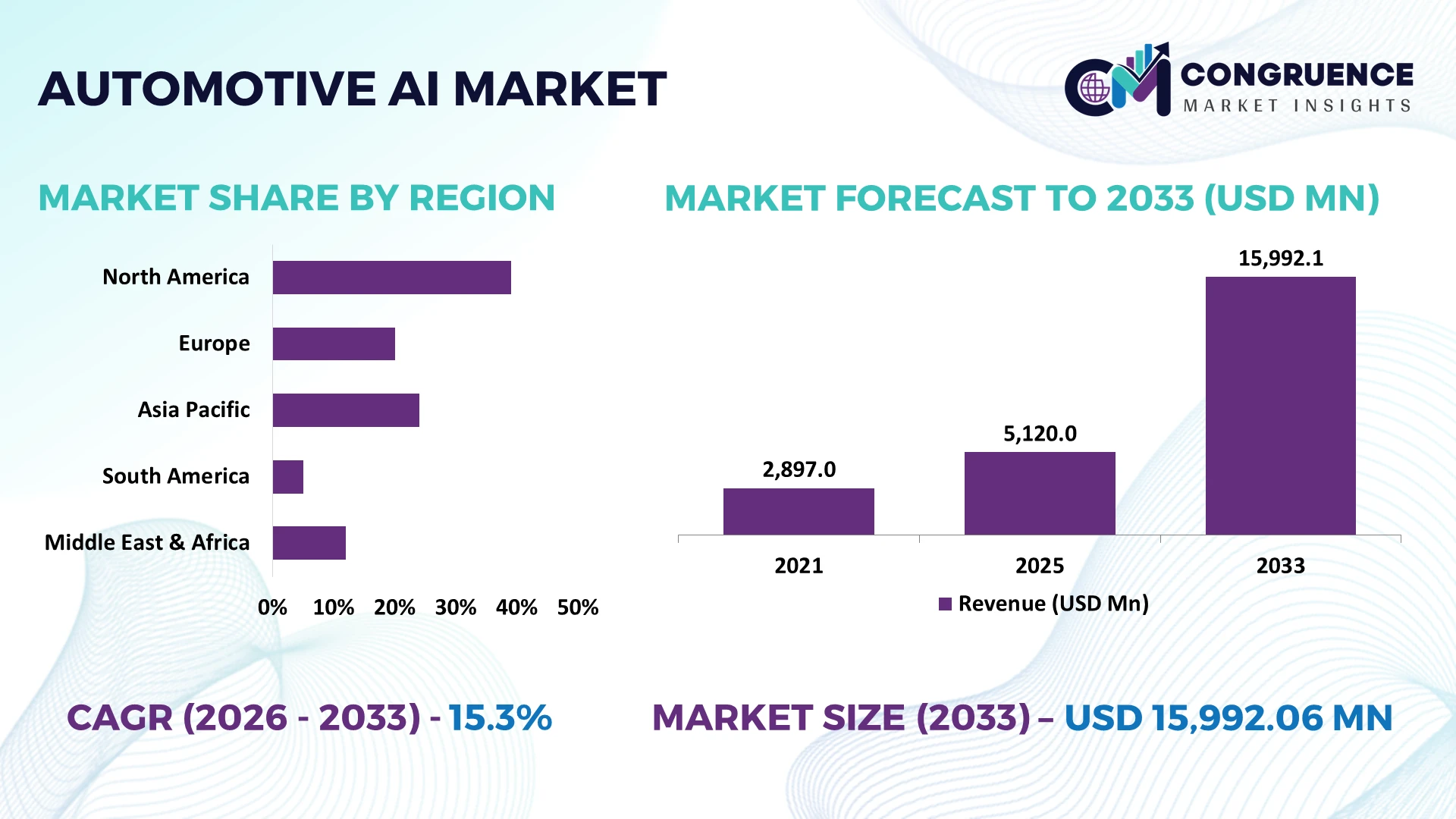
China leads the automotive AI ecosystem, with Asia Pacific commanding 56.7% of the automotive AI market in 2025, while China’s NEVs represented 47.9% of vehicle sales and L2 intelligent-connected cars exceeded 60% of new-car penetration in 2025. The U.S. accounted for 12.4% of global market activity in 2026, highlighting a strong China-U.S. technology gap. China’s AI-enabled EV expansion is reinforced by geopolitical supply-chain localization and export growth.
Strategically, companies should prioritize China-led AI-vehicle platforms while building diversified semiconductor, software, and autonomous-driving partnerships across North America and Europe.
Market Size & Growth: USD 5,120 million in 2025 to USD 15,992.06 million by 2033 at 15.3% CAGR, driven by L2+/L3 ADAS and software-defined vehicles.
Top Growth Drivers: ADAS adoption 19.4%, AI semiconductor demand 24.1%, software-defined vehicle integration 18.2%.
Short-Term Forecast: By 2030, AI-enabled engineering workflows target software workload reductions of nearly 40%, improving development efficiency.
Emerging Technologies: End-to-end AI, generative AI, transformer models, and NPU-based edge computing are replacing fragmented rule-based architectures.
Regional Leaders: Asia Pacific targets USD 8.31 billion by 2033; North America approximately USD 4.1 billion; Europe approximately USD 3.0 billion, with L2+/L3 deployment accelerating.
Consumer/End-User Trends: 95% of Indian consumers are willing to pay for software-defined vehicle capabilities, while 81% value AI-enabled vehicle customization.
Pilot/Case Example: In 2026, Waymo reported 127 million fully autonomous miles and a 90% reduction in serious-injury crashes, validating commercial AI mobility.
Competitive Landscape: NVIDIA leads the generative-AI automotive layer at about 38.9%; Tesla, Waymo, Mobileye, Qualcomm, and Bosch remain major competitive forces.
Regulatory & ESG Impact: China’s 2025 L3 intelligent-driving pilot and tighter safety validation are accelerating deployment while supporting cleaner, AI-optimized mobility.
Investment & Funding: Waymo secured USD 16 billion in 2026, reinforcing a shift toward mega-rounds, OEM partnerships, AI compute expansion, and autonomous-fleet scaling.
Innovation & Future Outlook: AI-native vehicles, centralized compute, OTA intelligence, synthetic-data validation, and agentic automotive software will shift competition toward integrated AI ecosystems.
The Automotive AI Market is accelerating around ADAS, autonomous driving, predictive maintenance, intelligent infotainment, and AI-enabled fleet optimization, with computer vision and deep-learning systems moving deeper into production vehicles. Generative AI is reshaping in-cabin interfaces and engineering workflows, while L2+ deployment expands rapidly. Supply-chain localization and tighter safety validation are pushing OEMs toward integrated compute, software, and sensor platforms.
Automotive AI is becoming a competitive control point because vehicle differentiation is shifting from mechanical performance toward software intelligence, autonomous functions, and AI-enabled services. By 2028, L2+ systems are positioned to become standard across premium and increasingly mass-market models, forcing automakers to redirect investment toward centralized computing, perception software, and AI-ready electrical architectures. This shift is also restructuring semiconductor sourcing as manufacturers seek localized compute and sensor supply.
End-to-end neural networks and centralized AI compute can reduce perception-processing latency by approximately 30–40% versus fragmented rule-based pipelines while improving OTA software scalability. China is advancing faster in high-volume intelligent EV deployment, while the U.S. maintains an edge in autonomous-driving software and AI compute ecosystems. This contrast is pushing global OEMs toward multi-country technology partnerships rather than single-platform dependence.
Operationally, automakers are integrating NVIDIA-, Qualcomm-, Mobileye-, and internally developed AI stacks into vehicle programs, while suppliers expand software engineering and validation capacity. Companies achieving 20–30% faster AI model-development cycles gain an advantage in feature launches and fleet learning. Strategically, the winners will be those combining AI compute, vehicle data, cybersecurity, and OTA infrastructure into scalable platforms rather than treating AI as an isolated vehicle feature.
The strongest growth driver is rapid deployment of AI-based ADAS and automated-driving functions. L2/L2+ penetration in leading Chinese new-vehicle segments has exceeded 50%, while premium models increasingly integrate centralized AI compute and multimodal perception. Neural-network perception can improve object-classification efficiency by roughly 25–35% versus legacy rule-based processing, reducing engineering iterations and enabling faster feature releases. China’s push toward regulated L3 testing is accelerating validation investment and supplier partnerships. Automakers are responding by expanding AI software teams, securing high-performance processors, and partnering with semiconductor and autonomous-driving specialists. The non-obvious advantage is platform reuse: one centralized AI architecture can support multiple vehicle lines, reducing duplicated development work and strengthening software monetization.
High-performance automotive AI hardware remains a structural constraint because advanced GPUs, NPUs, sensors, and memory increase vehicle bill-of-materials costs. AI-enabled compute architectures can raise electronics content by 15–25%, while specialized semiconductor lead times can remain 10–20% longer than conventional automotive components during supply disruptions. China’s tighter localization push and continuing U.S.-China technology restrictions are also reshaping processor sourcing. These pressures directly affect mass-market deployment, where small hardware-cost increases can compress OEM margins. Companies are mitigating exposure through dual-sourcing, regional semiconductor partnerships, and domain-specific accelerators that deliver 20–30% lower compute requirements for selected workloads. The strategic priority is balancing AI performance with hardware economics rather than maximizing processing capacity.
Generative AI creates a high-value opportunity beyond autonomous driving by transforming vehicle interfaces, engineering, diagnostics, and fleet operations. AI-assisted software development can reduce selected coding and documentation workloads by 20–30%, while edge inference can cut cloud-dependent response latency by approximately 40%. Japan and South Korea offer strong opportunities for AI-enabled manufacturing, robotics integration, and premium vehicle intelligence, while India presents an expanding software-engineering and connected-mobility base. The emergence of automotive AI agents also opens new revenue models around personalized vehicle services and predictive maintenance. Companies are increasing R&D around compact foundation models, synthetic training data, and vehicle-edge inference. The strongest opportunity lies in converting vehicle data into continuously improving services rather than selling AI solely as embedded hardware.
Scaling automotive AI requires consistent integration across sensors, ECUs, operating systems, cloud platforms, and legacy vehicle architectures. Multi-domain AI programs can involve 30%–50% more software validation workloads than conventional feature development, while cybersecurity testing increasingly covers connected gateways, OTA systems, and AI models simultaneously. Germany’s stringent functional-safety environment and China’s evolving intelligent-driving rules demonstrate how regulatory requirements differ across major markets. These variations can slow global software deployment and increase localization costs. Companies are responding through simulation, digital twins, standardized middleware, and automated validation pipelines that can reduce selected testing cycles by 20–30%. The critical challenge is not AI capability itself but achieving repeatable, auditable performance across millions of vehicles and changing regulatory environments.
Production AI Deployment Accelerates Automotive AI is moving from pilot projects into production engineering, with companies integrating machine learning into ADAS validation, software development, quality inspection, and vehicle diagnostics. In India, AI adoption in automotive workflows is increasingly tied to software-defined vehicle programs, while 95% of consumers surveyed by Deloitte said they were willing to pay for software-defined vehicle capabilities.
Level 2 Systems Scale Faster ADAS deployment is shifting toward higher-function Level 2 systems, particularly in passenger vehicles. JATO reported India’s ADAS penetration reached 8.3% in H1 2025, up from 6.2%, while Level 2 penetration increased 70.8% to 5.6%. OEMs are responding by expanding ADAS across additional vehicle variants and integrating camera, radar, and AI perception stacks.
AI Compute Moves In-House Automakers are increasingly redesigning computing architectures to control AI performance, cost, and software integration. Rivian introduced a proprietary autonomy processor while targeting a $2,500 driver-assistance package, showing how custom silicon and centralized computing are becoming tools for lowering system costs and improving feature scalability.
Generative AI Enters Engineering Generative AI is moving beyond conversational interfaces into requirements analysis, code generation, simulation, validation, and in-cabin personalization. Automotive engineering teams are using LLMs and retrieval-based workflows to reduce manual development steps, while companies are restructuring software operations around reusable AI platforms rather than isolated applications. This transition is particularly important as safety validation and software complexity increase.
Machine Learning Maintains Core Leadership
Machine Learning leads the Automotive AI Market, with an estimated 38% share, supported by mature deployment across ADAS decision-making, predictive analytics, vehicle diagnostics, manufacturing quality control, and fleet optimization. Its established infrastructure, scalability, and compatibility with existing sensor data give it a clear advantage over newer AI approaches. Computer Vision follows at approximately 31%, driven by camera-based perception, automated inspection, object detection, and driver monitoring. Companies are increasingly combining ML and computer vision with centralized vehicle compute to improve inference accuracy while reducing duplicated processing.
Generative AI is the fastest-growing type, with an estimated 14% share and rapidly expanding adoption in software development, engineering documentation, simulation, intelligent assistants, and vehicle personalization. Natural Language Processing accounts for roughly 17%, remaining important for voice controls and conversational infotainment. The investment shift is notable: mature ML and computer vision remain deployment anchors, while companies are directing incremental budgets toward GenAI integration, multimodal models, and AI-assisted engineering workflows.
ADAS Remains the Primary Application
Advanced Driver Assistance Systems leads the Automotive AI Market with an estimated 43% share, reflecting broad deployment across collision avoidance, adaptive cruise control, lane assistance, driver monitoring, and automated emergency braking. Autonomous Driving follows as the fastest-growing application, supported by improved perception models, sensor fusion, simulation, and end-to-end AI architectures. Predictive Maintenance holds approximately 15% as connected vehicle data enables earlier fault detection and more targeted servicing. Companies are increasingly integrating multiple AI functions through common vehicle compute platforms.
Autonomous Driving is estimated to expand its application share by more than 20% within emerging deployment programs as OEMs and mobility operators move from controlled demonstrations toward repeatable commercial operations. In-Cabin Monitoring and Intelligent Infotainment together represent roughly 24%, with adoption strengthening around occupant safety, personalization, voice interaction, and attention monitoring. This is shifting AI investment from individual safety features toward integrated vehicle intelligence, while suppliers expand software platforms capable of supporting multiple applications.
Passenger OEMs Maintain Volume Leadership
Passenger Vehicle OEMs represent the leading end-user group, with an estimated 51% share, reflecting their large production volumes, broad model portfolios, and intensive requirement for integrated AI capabilities. Commercial Vehicle OEMs account for approximately 22%, with demand centered on fleet optimization, driver assistance, predictive maintenance, and operational safety. Passenger OEMs are increasingly standardizing AI software and centralized compute across vehicle platforms, allowing common technology stacks to support multiple models while reducing development duplication.
Autonomous Mobility Providers are the fastest-growing end-user group, with an estimated 10% share but substantially higher AI deployment intensity per vehicle. Their expansion is driven by robotaxi commercialization, continuous perception processing, remote monitoring, mapping, and fleet-level learning. Automotive Tier-1 Suppliers represent roughly 17% and are shifting from component delivery toward AI middleware, sensor fusion, compute platforms, and co-development. Companies are responding through customized AI stacks, strategic partnerships, platform licensing, and ecosystem development, moving future demand toward buyers requiring continuous software and data capabilities.
North America accounted for the largest market share at 38% in 2025 however, Asia-Pacific is expected to register the fastest growth, expanding at a CAGR of 18.2% between 2026 and 2033.

Centralized computing strengthens AI deployment
North America leads Automotive AI adoption through advanced vehicle software, semiconductor access, autonomous-driving development, and established OEM engineering infrastructure. The United States contributes the majority of regional demand, supported by large-scale R&D operations and strong deployment of ADAS, predictive analytics, computer vision, and autonomous mobility systems. More than 40% of new U.S. vehicles now offer advanced driver-assistance capabilities, creating a substantial installed base for AI-enabled functions. Automakers are increasingly consolidating electronic architectures and shifting AI processing toward centralized computing platforms. Partnerships between OEMs, semiconductor companies, cloud providers, and autonomous-driving developers are accelerating commercialization. The competitive emphasis is moving from individual AI functions toward reusable software platforms, proprietary vehicle data, edge inference, and continuous OTA improvement. This is strengthening demand for AI systems capable of supporting multiple vehicle programs from common computing architectures.
United States Market Outlook: The United States remains the principal country market because of its concentration of OEM headquarters, autonomous-driving developers, semiconductor companies, cloud infrastructure, and AI research capabilities. More than 40% of new vehicles offering advanced driver assistance creates a broad deployment base for continued AI integration across passenger and commercial platforms.
Safety regulation accelerates intelligent architectures
Europe maintains a strong Automotive AI position through premium vehicle production, stringent vehicle-safety requirements, advanced manufacturing, and established automotive engineering capabilities. Germany represents the largest country-level market, supported by major OEMs and Tier-1 suppliers, while France, Sweden, Italy, and the United Kingdom contribute through autonomous systems, connected vehicles, and software development. More than 70% of new European vehicles incorporate multiple ADAS capabilities, increasing demand for perception, decision-support, and driver-monitoring technologies. Regulatory requirements surrounding safety, cybersecurity, and automated driving are encouraging manufacturers to develop more traceable and validated AI systems. OEMs are also accelerating centralized electronic architectures, OTA updates, and AI-assisted production. Semiconductor localization and supply-chain resilience are encouraging deeper partnerships between vehicle manufacturers and technology suppliers, while sustainability requirements are pushing AI deployment toward energy-efficient computing and optimized manufacturing workflows.
Germany Market Outlook: Germany holds the strongest country position because of its premium OEM concentration, advanced automotive manufacturing base, extensive R&D infrastructure, and dense Tier-1 supplier network. Volkswagen, BMW, and Mercedes-Benz are expanding software-defined vehicle programs, strengthening demand for AI simulation, automated validation, digital twins, and intelligent manufacturing.
Manufacturing scale drives intelligent vehicle adoption
Asia-Pacific is the fastest-expanding Automotive AI market because of its enormous vehicle production base, rapid EV adoption, increasing ADAS availability, and aggressive software integration. China represents the largest regional demand center, supported by extensive intelligent-vehicle manufacturing and domestic AI development. Japan and South Korea remain important through advanced automotive electronics, robotics, and semiconductor capabilities, while India is increasing adoption across passenger vehicles and commercial platforms. China produces more than 30 million vehicles annually, creating an exceptionally large deployment base for AI-enabled systems. Automakers and suppliers are integrating cameras, radar, centralized computing, and AI software within common vehicle architectures. Domestic semiconductor development is also reducing technology dependency and improving supply resilience. Companies are competing through faster product launches, lower-cost AI architectures, localized software, and continuous OTA upgrades, making deployment speed increasingly important alongside algorithmic performance.
China Market Outlook: China represents the region's largest Automotive AI opportunity because of its massive vehicle manufacturing ecosystem, rapid EV penetration, intelligent-cockpit adoption, and strong domestic AI capabilities. More than 15 million new-energy vehicles were sold during 2025, expanding the installed base for intelligent driving, perception, infotainment, and software-defined vehicle functions.
Fleet intelligence creates practical adoption pathways
South America remains an emerging Automotive AI market, with Brazil representing the principal demand center because of its comparatively large automotive manufacturing base, commercial-fleet population, and supplier ecosystem. AI deployment is expanding from factory automation and predictive maintenance toward ADAS, intelligent infotainment, driver monitoring, and fleet analytics. Brazil produces more than 2 million vehicles annually, providing an industrial foundation for broader AI integration. However, uneven digital infrastructure, higher technology costs, limited local AI engineering capacity, and fragmented fleet operations constrain rapid deployment. Companies are responding with modular software platforms, cloud-based fleet analytics, localized partnerships, and solutions focused on measurable operating savings. Predictive maintenance and driver-safety applications are gaining particular relevance because fleet operators can connect AI investment directly with reduced downtime, fuel consumption, and maintenance expenditure. This favors commercially measurable AI applications over capital-intensive autonomous-driving deployments.
Brazil Market Outlook: Brazil holds the strongest country position through its automotive production capacity, large commercial vehicle base, manufacturing infrastructure, and growing connected-mobility ecosystem. Local manufacturers and suppliers are progressively integrating predictive analytics, driver monitoring, and ADAS capabilities, while fleet operators increasingly prioritize technologies that reduce downtime and operating costs.
Smart mobility investment expands AI infrastructure
Middle East & Africa is an emerging Automotive AI market shaped by smart-city development, connected transportation, premium vehicle demand, logistics modernization, and autonomous mobility investment. The United Arab Emirates and Saudi Arabia lead adoption through government-backed digital transformation and intelligent transportation programs. Dubai and Abu Dhabi are developing autonomous mobility ecosystems requiring AI perception, mapping, fleet orchestration, and edge-computing infrastructure, while Saudi Arabia is incorporating intelligent transportation into major urban-development projects. Autonomous mobility pilots and smart-road initiatives are increasing regional technology deployment, although limited vehicle manufacturing and reliance on imported components remain constraints. Companies are therefore emphasizing partnerships with global AI providers, mobility operators, infrastructure developers, and telecommunications firms. The competitive opportunity is shifting toward integrated systems connecting vehicles, roads, cloud platforms, and fleet operations rather than standalone AI components. This creates stronger opportunities for ecosystem-oriented suppliers.
United Arab Emirates Market Outlook: The UAE leads country-level adoption through advanced smart-city infrastructure, autonomous mobility programs, high technology investment, and government-supported transportation modernization. Dubai's autonomous transportation initiatives are increasing demand for AI-based perception, mapping, fleet management, intelligent traffic systems, and connected mobility infrastructure.
NVIDIA, Qualcomm, Mobileye, Bosch, and Continental compete across AI computing, perception, sensing, and vehicle software, while Tesla and Huawei challenge established suppliers through vertically integrated platforms. The top five players hold an estimated combined share of about 34%, reflecting a fragmented but increasingly platform-driven structure. Technology capability influences nearly 40% of major procurement priorities, while cost efficiency contributes roughly 25% and integration speed around 20%. Competition is shifting toward centralized computing, proprietary AI models, sensor fusion, and reusable software architectures. OEMs are partnering with chipmakers and AI specialists to accelerate deployment, while Tier-1 suppliers are expanding from components into middleware and complete AI systems. Vertical integration is increasing as companies seek greater control over data, software, and compute supply. High validation costs, safety requirements, proprietary datasets, and OEM integration requirements create significant entry barriers. Winning increasingly requires scalable architectures, proven reliability, rapid software iteration, and deep vehicle-platform integration.
NVIDIA Corporation
Qualcomm Incorporated
Intel Corporation
Mobileye Global Inc.
Tesla, Inc.
Robert Bosch GmbH
Continental AG
DENSO Corporation
Aptiv PLC
Waymo LLC
Huawei Technologies Co., Ltd.
Baidu, Inc.
ZF Friedrichshafen AG
Valeo SE
Machine learning, computer vision, sensor fusion, and centralized AI computing remain the core technologies shaping current Automotive AI deployment. Centralized architectures combining ADAS, cockpit, and vehicle functions can reduce duplicated computing hardware and improve processing efficiency by 1–2%, while AI-based perception improves real-time decision performance by approximately 2%. Adoption is moving from isolated ADAS modules toward integrated vehicle-domain platforms, with high-volume passenger vehicles increasingly receiving camera, radar, and AI-enabled functions.
Emerging technologies include transformer-based perception, generative AI copilots, multimodal models, edge AI, and AI-assisted simulation. Transformer-based planning can improve complex-scene processing performance by around 2%, while generative AI can reduce selected engineering and software-development workloads by 1–2%. Qualcomm's Snapdragon Ride Pilot, for example, combines AI perception, rule-based safety controls, centralized computing, and OTA updating, demonstrating how previously separate workflows are converging into continuously learning vehicle platforms.
Disruptive development through 2026–2028 will center on AI-defined vehicles, domain consolidation, digital twins, synthetic-data training, and custom automotive silicon. Compared with conventional distributed architectures, centralized AI computing can deliver roughly 2% better processing efficiency while reducing system duplication. NVIDIA, Qualcomm, leading OEMs, and autonomous-mobility providers benefit most from this transition because proprietary compute-software ecosystems strengthen differentiation, accelerate validation, and create recurring software opportunities. Companies investing now gain greater control over data, AI models, and vehicle software roadmaps.
July 2026 Qualcomm secured a long-term BMW chip supply agreement covering future digital-cockpit and ADAS platforms through the next decade, strengthening its position against NVIDIA and Mobileye and expanding centralized automotive-computing deployment. Source: reuters.com
May 2026 NVIDIA expanded its autonomous-driving ecosystem by partnering with BYD and Geely to deploy Drive Hyperion in Level 4 vehicles, broadening its platform across Chinese autonomous fleets and increasing technology standardization. Source: nvidia.com
April 2026 China’s automotive industry accelerated AI integration under the national AI Plus initiative, with XPeng, Xiaomi, NIO, and BYD showcasing AI-enabled driving and cockpit systems while domestic chip investment increased technology localization. Source: reuters.com
June 2026 McKinsey identified generative AI as a major shift toward end-to-end autonomous-driving architectures, highlighting growing demand for compute, software, data, and semiconductor capabilities as automakers transition toward AI-native vehicle development. Source: mckinsey.com
The Automotive AI Market Report covers Machine Learning, Computer Vision, Natural Language Processing, and Generative AI across Autonomous Driving, Advanced Driver Assistance Systems, Predictive Maintenance, In-Cabin Monitoring, and Intelligent Infotainment. End-user coverage includes Passenger Vehicle OEMs, Commercial Vehicle OEMs, Autonomous Mobility Providers, and Automotive Tier-1 Suppliers. The analysis evaluates deployment maturity, technology integration, vehicle-platform adoption, and evolving AI architectures across major automotive applications.
Regional coverage spans North America, Europe, Asia-Pacific, South America, and the Middle East & Africa, with country-level assessment of manufacturing concentration, technology deployment, infrastructure readiness, and regulatory conditions. The report evaluates established AI applications alongside emerging areas such as centralized computing, generative AI, multimodal perception, and autonomous mobility. Its 2026–2033 outlook supports investment planning, market-entry decisions, technology prioritization, partnership strategy, competitive positioning, and identification of shifting demand across vehicle platforms and enterprise deployment models.
| Report Attribute/Metric | Report Details |
|---|---|
Market Revenue in 2025 | USD 5120 Million |
Market Revenue in 2033 | USD 15992.06 Million |
CAGR (2026 - 2033) | 15.3% |
Base Year | 2025 |
Forecast Period | 2026 - 2033 |
Historic Period | 2021 - 2025 |
Segments Covered | By Type
By Application
By End-User
|
Key Report Deliverable | Revenue Forecast, Growth Trends, Market Dynamics, Segmental Overview, Regional and Country-wise Analysis, Competition Landscape |
Region Covered | North America, Europe, Asia-Pacific, South America, Middle East, Africa |
Key Players Analyzed | NVIDIA Corporation, Qualcomm Incorporated, Intel Corporation, Mobileye Global Inc., Tesla, Inc., Robert Bosch GmbH, Continental AG, DENSO Corporation, Aptiv PLC, Waymo LLC, Huawei Technologies Co., Ltd., Baidu, Inc., ZF Friedrichshafen AG, Valeo SE |
Customization & Pricing | Available on Request (10% Customization is Free) |




