
Reports
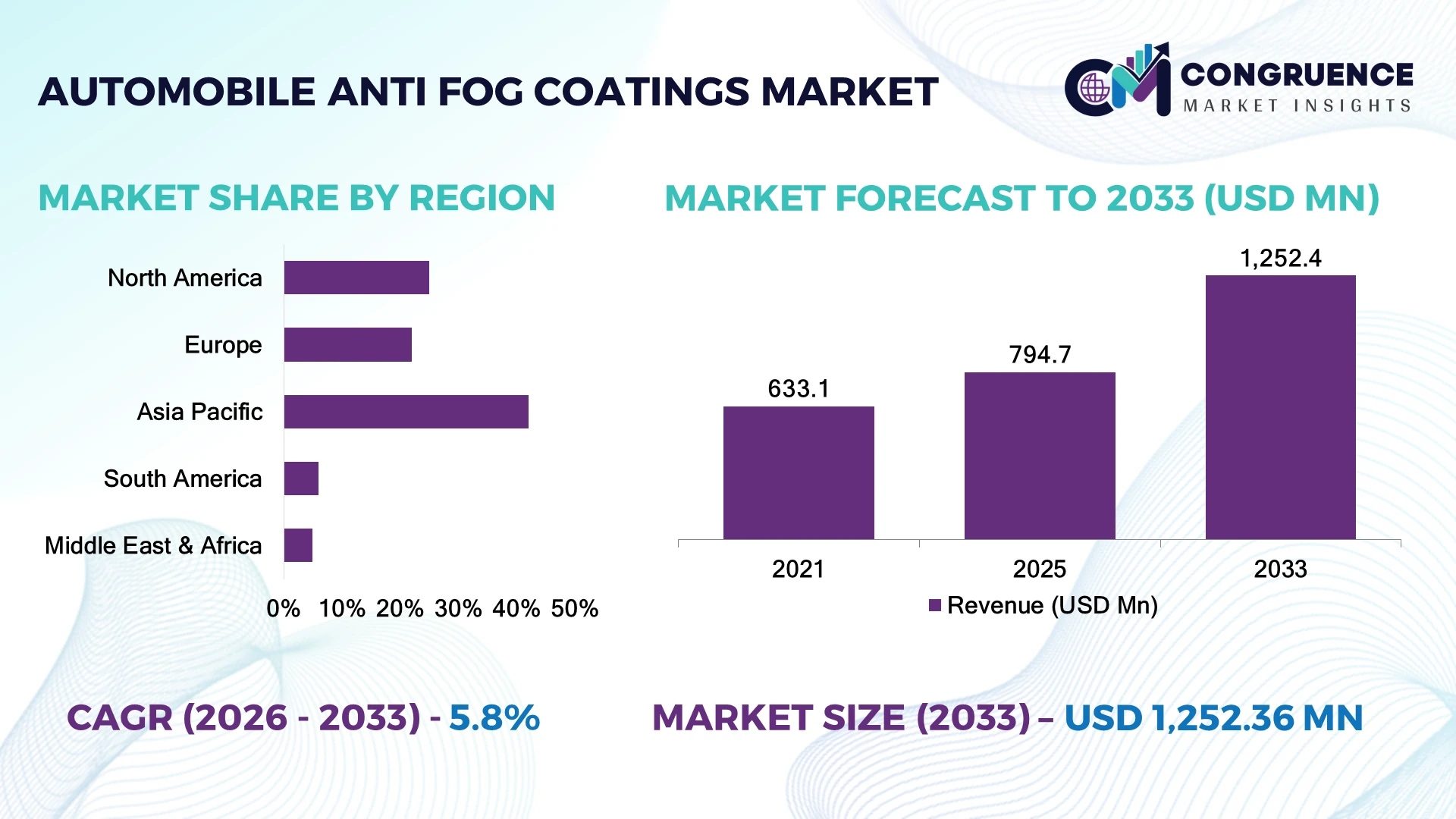
The Global Automobile Anti-Fog Coatings Market was valued at USD 794.7 Million in 2025 and is anticipated to reach a value of USD 1,252.4 Million by 2033 expanding at a CAGR of 5.85% between 2026 and 2033. Growth is driven by rising adoption of smart automotive glazing, advanced hydrophilic coating technologies, and increasing demand for safer visibility systems in electric vehicles and premium automobiles.
China dominates the automobile anti-fog coatings landscape, accounting for nearly 32% market share in 2025, supported by large-scale EV production, automotive glass manufacturing clusters, and government-backed intelligent vehicle investments. Japan and South Korea collectively contribute over 20% through advanced materials innovation and OEM partnerships. China’s automotive output exceeded 30 million units annually, compared with Japan’s approximately 8 million units, highlighting manufacturing scale advantages. The European Union’s evolving vehicle safety regulations are accelerating adoption of advanced visibility solutions across passenger vehicles.
Strategic implication Automakers and coating suppliers prioritizing localized production, smart materials integration, and OEM alliances will secure stronger competitive positioning.
Market Size & Growth: Valued at USD 794.7 Million in 2025 and projected toward USD 1,252.4 Million by 2033 at a 5.85% CAGR, driven by advanced automotive glazing adoption and EV safety requirements.
Top Growth Drivers: EV penetration (+20% annual global sales growth), smart glass adoption (+15% OEM integration), and premium vehicle demand (+12% technology adoption).
Short-Term Forecast: By 2028, coating automation is expected to reduce application defects by 25% and improve production consistency by 30%.
Emerging Technologies: AI-assisted coating inspection, nano-hydrophilic materials, and self-cleaning anti-fog surfaces are reshaping automotive visibility systems.
Regional Leaders: Asia-Pacific approaches USD 600 Million by 2033 with EV manufacturing growth; Europe exceeds USD 350 Million with safety regulations; North America expands through connected vehicle adoption.
Consumer/End-User Trends: More than 35% of premium vehicles integrate advanced visibility technologies, increasing demand for durable windshield and sensor protection coatings.
Pilot/Case Example: In 2024, automotive glass manufacturers implementing automated coating systems achieved approximately 20% reduction in coating wastage during production trials.
Competitive Landscape: Leading suppliers include companies holding approximately 10–15% combined market influence, with key players including PPG Industries, 3M, Nippon Paint, AkzoNobel, and BASF.
Regulatory & ESG Impact: New vehicle safety initiatives in Europe and Asia are increasing adoption of low-VOC coatings, reducing chemical emissions by nearly 30% in manufacturing processes.
Investment & Funding: More than USD 1 Billion is being directed into advanced automotive materials, EV supply chains, and smart coating partnerships globally.
Innovation & Future Outlook: Next-generation coatings integrating nanotechnology, durability enhancement, and sensor compatibility are driving the shift toward intelligent automotive surfaces.
Automobile anti-fog coatings are becoming essential components in modern vehicle safety systems, particularly across electric vehicles, autonomous driving platforms, and advanced driver assistance systems. Demand is increasing for coatings that improve windshield clarity, camera visibility, and sensor reliability, with manufacturers reporting durability improvements of more than 25% through nano-engineered formulations. Supply-chain localization in China, India, and Southeast Asia is accelerating as automakers reduce dependency on imported specialty materials amid global manufacturing restructuring.
Automobile anti-fog coatings are becoming strategically important as vehicle manufacturers prioritize visibility, safety, and intelligent surface technologies within next-generation mobility platforms. The transition toward electric and autonomous vehicles is increasing demand for coatings that support cameras, sensors, and windshield systems under diverse weather conditions. Global automotive supply chains are also undergoing restructuring, with manufacturers expanding regional sourcing networks to improve material availability and production resilience.
Advanced nano-hydrophilic coatings deliver measurable advantages over traditional chemical treatments, improving fog resistance durability by approximately 30% while reducing maintenance requirements compared with conventional solutions. Japan and Germany lead in precision coating innovation, while China and India are scaling production through expanding automotive manufacturing ecosystems and EV investments.
Over the next 2–3 years, OEMs are expected to increase integration of anti-fog solutions across mid-range and premium vehicles as automated inspection systems improve manufacturing efficiency. For example, automotive glass suppliers are partnering with coating technology firms to develop multifunctional surfaces combining anti-fog, anti-glare, and self-cleaning capabilities. Companies strengthening material partnerships, localized manufacturing, and R&D capabilities will achieve stronger operational advantages and long-term market relevance.
Rising adoption of advanced driver assistance systems and electric vehicles is accelerating demand for high-performance anti-fog coatings. More than 40% of new premium vehicles now incorporate enhanced visibility technologies, while EV production growth exceeding 20% annually is expanding coating applications. Regulatory focus on vehicle safety in markets such as China and the European Union is pushing manufacturers toward durable windshield and sensor-protection solutions. Companies including automotive glass suppliers and coating manufacturers are investing in nano-material research, automated application systems, and OEM partnerships. The strategic shift is moving anti-fog coatings from optional comfort features into essential safety components for intelligent vehicles.
High production costs for advanced polymers, nanoparticles, and specialty chemical formulations remain a major limitation for widespread adoption. Raw material price volatility has increased manufacturing expenses by nearly 10–15% in recent supply cycles, affecting supplier margins and pricing strategies. Dependence on specialized chemical suppliers in countries such as Germany, Japan, and South Korea creates supply-chain vulnerability. Automotive manufacturers are responding through supplier diversification, localized sourcing agreements, and long-term procurement contracts. The key operational challenge is balancing premium coating performance with cost competitiveness in mass-market vehicle segments where price sensitivity remains high.
Growing demand for multifunctional automotive surfaces creates opportunities for next-generation anti-fog coating solutions. Smart coatings combining anti-fog, anti-scratch, and self-cleaning properties can improve surface performance by more than 25% compared with conventional solutions. India, China, and Southeast Asian automotive hubs are emerging as attractive expansion markets due to increasing vehicle production and technology investments. Companies are accelerating R&D partnerships to develop sensor-compatible coatings for autonomous vehicles. The integration of AI-based quality monitoring and automated coating systems provides additional efficiency advantages, creating opportunities for suppliers to move into higher-value automotive material applications.
Integrating anti-fog coatings with advanced automotive electronics and sensor systems presents significant execution challenges. More than 30% of autonomous vehicle testing programs require improved optical reliability under varying environmental conditions, increasing coating performance requirements. Differences in glass composition, manufacturing processes, and regional climate conditions create compatibility issues for global deployment. Companies must invest in testing infrastructure, material engineering, and collaboration with automotive OEMs to ensure consistent performance. Long-term competitiveness depends on developing scalable coating technologies capable of supporting connected vehicles, autonomous platforms, and evolving safety standards across multiple markets.
Smart Surface Integration: Automotive suppliers are shifting toward multifunctional coatings combining anti-fog, anti-glare, and self-cleaning properties, with adoption increasing by around 20% in premium vehicle programs. Companies are investing in nanotechnology partnerships to improve durability, reduce maintenance cycles, and support advanced driver assistance systems.
Automated Coating Production: Manufacturers in China, Japan, and Germany are deploying robotic coating systems that improve application consistency by 25% and reduce material wastage by nearly 15%. Rising labor constraints and tighter quality standards are accelerating automation, enabling suppliers to scale production while maintaining automotive-grade precision.
EV Visibility Enhancement: Electric vehicle manufacturers are increasing demand for advanced windshield and camera protection coatings, with EV-related coating applications growing by more than 30% in major automotive manufacturing hubs. Companies are redesigning product portfolios to support sensor-heavy vehicle architectures and connected mobility platforms.
Localized Supply Networks: Automotive coating suppliers are restructuring sourcing strategies as specialty chemical supply chains face geopolitical pressure and logistics disruptions. Regional manufacturing investments have increased by approximately 18%, particularly in India and Southeast Asia, helping companies shorten delivery cycles, improve inventory control, and reduce dependency on imported materials.
Hydrophilic coatings represent the leading segment, accounting for approximately 55% of the automobile anti-fog coatings market due to superior water dispersion capability, durability, and compatibility with automotive glass surfaces. Their ability to maintain visibility under humidity fluctuations makes them preferred for passenger vehicles and premium automotive applications. Hydrophobic and polymer-based coatings collectively capture around 35% share, serving specialized applications where water resistance and surface protection are prioritized. Nano-engineered coatings are the fastest-growing type, expanding adoption as manufacturers seek lightweight, durable, and multifunctional solutions. Demand for nano coatings is increasing by nearly 25% as EV manufacturers integrate advanced optical systems and sensor technologies. Companies are increasing R&D investments, forming material science partnerships, and expanding production capacity to address evolving OEM requirements.
Windshield applications dominate automobile anti-fog coatings adoption, representing approximately 60% market share due to their direct impact on driver visibility and safety performance. Passenger vehicles account for the majority of installations, while commercial vehicles increasingly adopt these solutions to improve operational reliability in challenging weather conditions. Headlamp and camera lens applications represent emerging segments, growing at nearly 20% as vehicles incorporate more advanced sensing systems. The fastest-growing application area is sensor and camera protection, driven by autonomous driving development and increased ADAS integration. More than 30% of new technology-focused vehicle platforms require enhanced optical performance for cameras and detection systems. Companies are adapting through OEM collaborations, customized coating formulations, and automated application processes to support next-generation mobility platforms.
Passenger vehicle manufacturers represent the leading end-user segment with approximately 65% market share, supported by high production volumes, premium feature integration, and increasing consumer expectations for safety technologies. Automotive OEMs in China, Germany, Japan, and South Korea are incorporating anti-fog solutions into new vehicle platforms to improve comfort and visibility performance. Commercial vehicle operators and electric vehicle manufacturers are emerging as the fastest-growing users, with adoption increasing by around 25% due to operational safety requirements and sensor-intensive designs. Fleet operators are prioritizing coatings that reduce maintenance interruptions and improve vehicle availability. Companies are responding through customized solutions, long-term OEM contracts, and expanded regional production networks.
Asia-Pacific accounted for the largest market share at 42% in 2025 however, North America is expected to register the fastest growth, expanding at a CAGR of 6.4% between 2026 and 2033.
North America holds a significant position in automobile anti-fog coatings adoption, supported by strong premium vehicle production, EV expansion, and advanced driver assistance system deployment. The region contributes approximately 25% of global demand, with the United States representing the majority share through automotive manufacturing hubs in Michigan, Ohio, and Tennessee. Increasing integration of camera-based safety systems has accelerated demand for optical surface protection technologies. More than 35% of newly launched premium vehicles incorporate enhanced visibility features, encouraging suppliers to expand coating partnerships with OEMs. Companies are investing in automated application technologies and localized manufacturing to improve production efficiency and supply reliability.
United States Market Outlook: The United States remains the regional leader due to its advanced automotive ecosystem and strong EV manufacturing investments. The country produces over 10 million vehicles annually and has increased adoption of sensor-enabled vehicle platforms. Automotive suppliers are expanding partnerships with glass manufacturers and technology providers to support next-generation visibility systems.
Europe maintains a strong position in automobile anti-fog coatings due to stringent vehicle safety standards, advanced automotive engineering capabilities, and growing demand for sustainable coating solutions. The region accounts for nearly 22% of global adoption, supported by Germany, France, and Italy’s automotive manufacturing networks. Increasing emphasis on vehicle safety regulations and low-emission manufacturing is encouraging OEMs to integrate durable, low-VOC coating technologies. European automotive suppliers are improving production efficiency through automated coating systems, with manufacturing optimization initiatives reducing material waste by approximately 20%. Partnerships between coating developers and vehicle manufacturers are increasing as companies prioritize environmentally responsible surface technologies.
Germany Market Outlook: Germany leads Europe’s automotive coating innovation landscape through its strong OEM base and advanced engineering infrastructure. The country manufactures more than 3 million passenger vehicles annually and continues investing in intelligent vehicle technologies. Automotive companies are expanding R&D programs focused on sustainable materials, precision coating processes, and sensor-compatible solutions.
Asia-Pacific dominates the automobile anti-fog coatings market with approximately 42% share, driven by large-scale vehicle production, electric mobility expansion, and automotive glass manufacturing capacity. China, Japan, South Korea, and India represent major deployment centers, supported by extensive OEM networks and component ecosystems. China’s automotive industry produces over 30 million vehicles annually, creating substantial demand for visibility-enhancing technologies. EV manufacturers are increasingly adopting advanced coatings to support camera systems and intelligent vehicle functions. Companies are expanding regional production facilities, forming supplier alliances, and investing in localized material development to strengthen supply-chain resilience.
China Market Outlook: China remains the largest country market due to its dominant automotive manufacturing base and rapid EV deployment. The country accounts for more than 60% of global EV sales and has extensive automotive glass production capabilities. Manufacturers are accelerating adoption of advanced coatings through partnerships with domestic material suppliers and technology companies.
South America represents an emerging market for automobile anti-fog coatings, supported by automotive manufacturing activity in Brazil and increasing demand for improved vehicle safety features. The region contributes approximately 6% of global demand, with passenger vehicles accounting for the majority of applications. Brazil’s automotive production base and expanding aftermarket sector are supporting gradual adoption of advanced coating technologies. However, economic volatility and dependence on imported specialty materials influence procurement strategies. Companies are responding through regional distribution partnerships, localized supply agreements, and targeted product offerings for commercial and passenger vehicle segments.
Brazil Market Outlook: Brazil is the leading automotive market in South America, producing more than 2 million vehicles annually and supporting a large vehicle fleet requiring visibility enhancement solutions. Automotive suppliers are focusing on cost-effective coating technologies and partnerships with local distributors to expand penetration across passenger and commercial vehicle markets.
Middle East & Africa is witnessing gradual adoption of automobile anti-fog coatings due to rising premium vehicle demand, harsh climate conditions, and modernization of automotive infrastructure. The region contributes around 5% of global market demand, with stronger adoption in the Gulf countries where luxury vehicles and advanced mobility technologies are expanding. Increasing vehicle imports equipped with safety technologies are supporting demand for high-performance visibility coatings. Automotive distributors and technology suppliers are developing regional partnerships to improve product availability. Infrastructure investments in Saudi Arabia and the UAE are also supporting the adoption of advanced automotive technologies.
Saudi Arabia Market Outlook: Saudi Arabia represents the most strategically important market due to automotive modernization programs and rising technology investments. The country’s vehicle fleet exceeds 10 million units, creating opportunities for advanced aftermarket coating solutions. Companies are targeting partnerships with automotive service providers and mobility technology firms to expand adoption.
The automobile anti-fog coatings market features competition between global chemical leaders such as PPG Industries, 3M, BASF, and AkzoNobel against specialized regional coating developers and automotive glass technology suppliers. The top five players collectively account for approximately 35% of market influence, creating a moderately consolidated structure. Competition centers on coating durability, optical performance, customization, and supply reliability, with premium formulations achieving 20–30% higher lifecycle performance than conventional solutions. Companies are expanding through OEM partnerships, localized manufacturing, and nanotechnology investments. Technology innovators compete through advanced hydrophilic materials, while cost-focused suppliers target mass vehicle segments through scalable production. The market is shifting toward intelligent coatings compatible with cameras and sensors, increasing entry barriers around material expertise and automotive qualification standards. Winning players will require strong OEM relationships, continuous material innovation, and efficient global supply networks.
3M
BASF SE
AkzoNobel N.V.
Nippon Paint Holdings Co., Ltd.
Kansai Paint Co., Ltd.
Axalta Coating Systems
Sherwin-Williams Company
Henkel AG & Co. KGaA
Covestro AG
Saint-Gobain
AGC Inc.
Eastman Chemical Company
Automobile anti-fog coatings are advancing through nano-engineered hydrophilic materials, smart surface technologies, and multifunctional coating systems. Nano coatings improve water dispersion performance by nearly 30% compared with traditional chemical treatments, while automated inspection systems enhance production accuracy by approximately 25%. Adoption is increasing among premium vehicle manufacturers integrating advanced visibility systems.
New-generation coatings are replacing conventional anti-fog films through improved durability, thinner application layers, and compatibility with sensors. Advanced formulations deliver around 20% longer operational performance and reduce maintenance requirements compared with older solutions. Companies developing multifunctional coatings combining anti-fog, anti-glare, and self-cleaning properties are gaining competitive advantages in EV and autonomous vehicle segments.
Between 2026 and 2028, integration of AI-based quality monitoring, automated coating application, and sensor-compatible materials will reshape production strategies. Technology leaders, automotive glass suppliers, and EV manufacturers benefit from improved reliability, reduced defects, and faster manufacturing cycles. Companies acting early on intelligent coating platforms will strengthen their position in next-generation mobility applications.
March 2025 PPG Industries started operations at its new waterborne automotive coatings plant in Thailand to support Southeast Asian vehicle manufacturers. The facility provides 2,000 tons annual production capacity with automated spray technology, strengthening localized supply and sustainable coating delivery. Source: www.investor.ppg.com
March 2025 PPG Industries opened an automotive coatings color innovation studio in Tianjin, China, enhancing collaboration with regional OEMs and new energy vehicle manufacturers. The facility uses advanced digital tools and supports a database exceeding 3,000 automotive color samples for faster customization. Source: www.news.ppg.com
May 2025 BASF Coatings expanded its biomass-balanced automotive coating portfolio into North America, adding sustainable solutions designed to reduce environmental impact. The company reported approximately 8 million kilograms of CO₂ reduction from biomass-balanced products in 2024, supporting low-emission automotive manufacturing strategies. Source: www.basf.com
June 2025 BASF Coatings signed a strategic partnership with Toyota Motor Europe to develop its Body&Paint program, combining premium refinish solutions with digital platforms. The collaboration strengthens automotive repair networks and improves operational consistency through standardized processes and technology integration.
The Automobile Anti-Fog Coatings Market Report covers comprehensive analysis across coating types, including hydrophilic, hydrophobic, polymer-based, and nano-engineered solutions. The report evaluates applications such as windshields, headlamps, camera lenses, and sensor protection systems, along with end-users including passenger vehicles, commercial vehicles, and electric vehicle manufacturers. Regional assessment includes North America, Europe, Asia-Pacific, South America, and Middle East & Africa.
The report provides strategic insights into technology adoption, competitive positioning, supply-chain developments, and emerging opportunities between 2026 and 2033. It analyzes deployment patterns, OEM integration trends, material innovation, and supplier strategies, supporting investment decisions, expansion planning, and competitive benchmarking. The study also highlights niche opportunities in smart coatings, autonomous mobility systems, and advanced automotive glazing applications.
| Report Attribute / Metric | Details |
|---|---|
| Market Revenue (2025) | USD 794.7 Million |
| Market Revenue (2033) | USD 1,252.4 Million |
| CAGR (2026–2033) | 5.85% |
| Base Year | 2025 |
| Forecast Period | 2026–2033 |
| Historic Period | 2021–2025 |
| Segments Covered |
By Type
By Application
By End-User
|
| Key Deliverables | Revenue Forecast; Market Trends; Growth Drivers & Restraints; Technology Insights; Segmentation Analysis; Regional Insights; Competitive Landscape; Regulatory & ESG Overview; Recent Developments |
| Regions Covered | North America; Europe; Asia-Pacific; South America; Middle East & Africa |
| Companies Profiled | PPG Industries; 3M; BASF SE; AkzoNobel N.V.; Nippon Paint Holdings Co., Ltd.; Kansai Paint Co., Ltd.; Axalta Coating Systems; Sherwin-Williams Company; Henkel AG & Co. KGaA; Covestro AG; Saint-Gobain; AGC Inc.; Eastman Chemical Company |
| Customization & Pricing | Available on Request (10% Customization Free) |




