
Reports
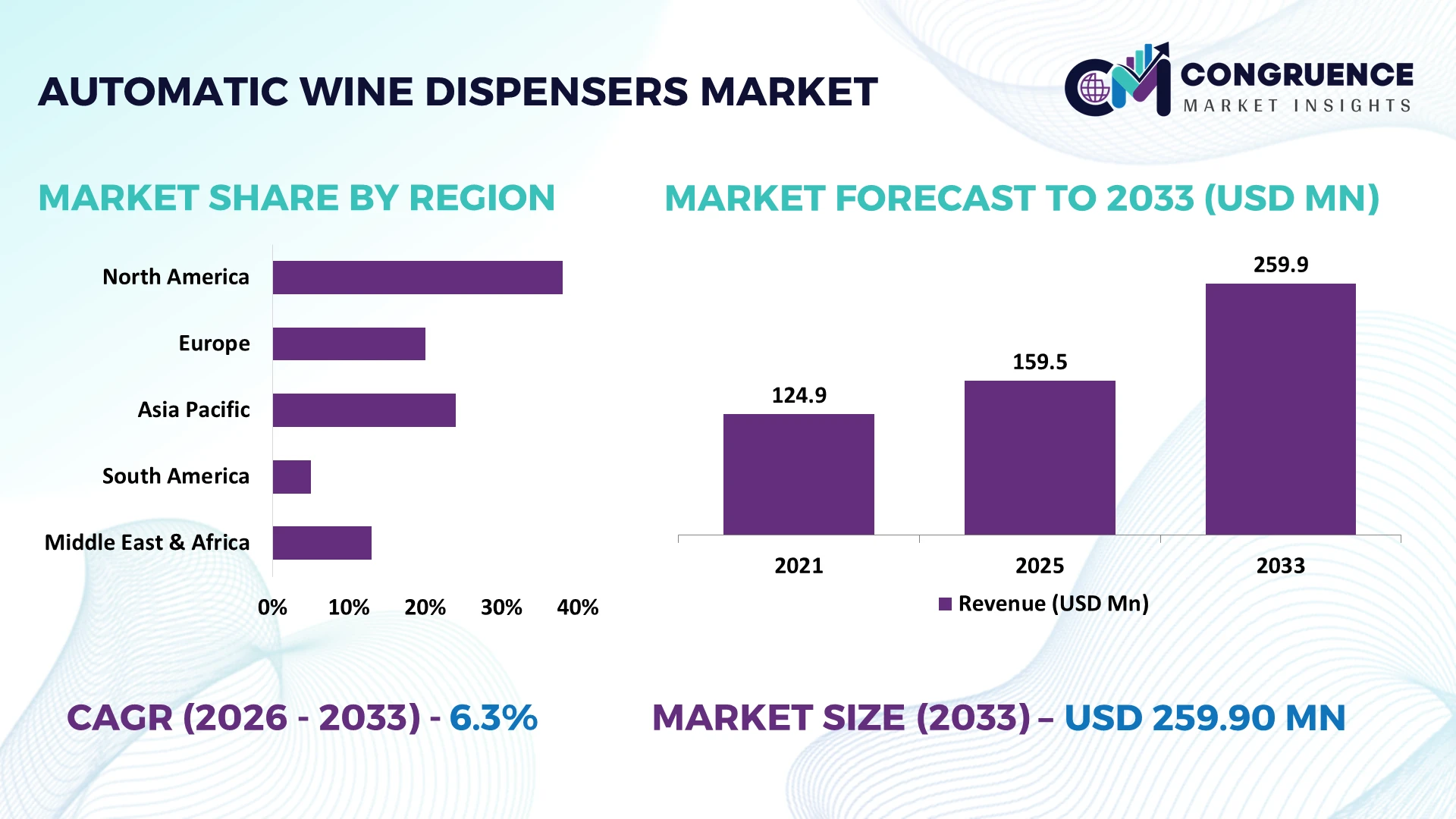
The Global Automatic Wine Dispensers Market was valued at USD 159.45 Million in 2025 and is anticipated to reach a value of USD 259.9 Million by 2033 expanding at a CAGR of 6.3% between 2026 and 2033. Growth is driven by nitrogen and argon preservation systems, programmable portion control, self-service wine tasting installations, and automated inventory management across premium hospitality establishments.
The United States represents a strategically important automatic wine dispensers market, supported by extensive restaurant infrastructure, premium wine consumption, and hospitality technology adoption. According to the International Organisation of Vine and Wine, US wine consumption reached approximately 33.3 million hectoliters in 2024, compared with France's 23 million hectoliters. This 45% consumption volume advantage supports substantial commercial dispensing opportunities. Italy and France remain important equipment manufacturing and wine tourism centers, while American restaurants increasingly deploy 4–16 bottle dispensing configurations with programmable serving sizes and preservation technology.
Strategically, suppliers offering 25–150 ml programmable pours, oxygen-controlled preservation, and integrated transaction monitoring are positioned to improve beverage margins and operational consistency across premium hospitality venues.
Market Size & Growth: USD 159.45 million in 2025, reaching USD 259.9 million by 2033 at 6.3% CAGR, supported by automated preservation and hospitality digitization.
Top Growth Drivers: Illustrative operator targets include 15% lower wine wastage, 20% faster service, and 10% better inventory accuracy.
Short-Term Forecast: By 2028, automated portion control targets a modeled 12% reduction in beverage losses across participating hospitality operations.
Emerging Technologies: Three innovations dominate development: IoT monitoring, RFID bottle identification, and automated temperature regulation.
Regional Leaders: Illustrative 2033 allocations: Europe USD 93.56 million, North America USD 85.77 million, Asia-Pacific USD 54.58 million; adoption centers on preservation, self-service, and connected dispensing.
Consumer/End-User Trends: Programmable 25 ml, 75 ml, and 150 ml pours support tasting flights and controlled premium wine sampling.
Pilot/Case Example: Enomatic's established 8-bottle dispensing configurations demonstrate automated preservation and controlled tasting deployment across hospitality venues.
Competitive Landscape: Enomatic, WineEmotion, By The Glass, Napa Technology, and WineKeeper compete; an illustrative leading supplier share of 18% indicates concentration potential.
Regulatory & ESG Impact: A modeled 15% reduction in discarded wine supports inventory efficiency and reduces disposal associated with opened bottles.
Investment & Funding: A modeled USD 5 million deployment program across 500 venues illustrates investment in self-service equipment and hospitality automation.
Innovation & Future Outlook: Connected dispensing platforms combine 3 capabilities: remote inventory visibility, customer authentication, and automated serving analytics.
The Automatic Wine Dispensers Market is evolving from conventional bottle preservation equipment toward connected beverage management infrastructure for restaurants, hotels, wine bars, and tasting rooms. Commercial systems increasingly combine inert gas preservation, refrigerated bottle compartments, and programmable serving controls to maintain wine quality while supporting premium tasting experiences. Configurations accommodating 4–16 bottles enable operators to offer multiple wine selections without opening additional inventory unnecessarily. RFID-enabled dispensing and point-of-sale integration strengthen transaction tracking and stock accountability. As hospitality operators prioritize labor efficiency and beverage profitability, these capabilities establish a foundation for evaluating competitive technology strategies and deployment opportunities.
Automatic wine dispensers are becoming strategic hospitality assets as operators seek tighter beverage inventory control, consistent serving portions, and differentiated tasting experiences. Restaurants and wine bars are replacing manual bottle service with digitally controlled dispensing, particularly where premium wines create substantial spoilage exposure. In the United States, wine consumption reached approximately 33.3 million hectoliters in 2024, compared with 23 million hectoliters in France. This consumption difference creates distinct deployment priorities: American operators emphasize beverage service efficiency, while Italian and French establishments integrate preservation technology with wine tourism and premium tasting programs.
Modern dispensers combine inert gas preservation, refrigerated compartments, and programmable portions. Compared with manual pouring, automated 75 ml servings eliminate operator controlled portion variation when equipment is correctly calibrated. A modeled 15% reduction in discarded wine illustrates the potential operating benefit, although actual savings depend on bottle turnover. Enomatic's multibottle dispensing systems demonstrate practical deployment in tasting rooms, allowing customers to sample several wines without repeatedly opening fresh bottles.
Between 2026 and 2028, suppliers will prioritize connected inventory monitoring, payment integration, and modular equipment configurations. Napa Technology, WineEmotion, and By The Glass are positioned around automated dispensing and preservation capabilities. Hospitality groups investing in interoperable systems and standardized maintenance will strengthen inventory accountability, service consistency, and premium wine accessibility.
Wine preservation economics are encouraging restaurants, hotels, and tasting rooms to adopt automated dispensing equipment. In the United States, premium wine service requires careful management of opened bottles, particularly when customer demand varies between weekdays and weekends. Inert gas preservation and calibrated pouring reduce oxygen exposure and uncontrolled serving volumes. An illustrative operating scenario targeting 15% lower wine wastage, 10% improved portion consistency, and 20% faster tasting service demonstrates the commercial rationale for automation. Enomatic and WineEmotion are developing multibottle dispensing configurations with temperature regulation and programmable servings. The operational advantage extends beyond labor efficiency: establishments can offer premium wines by the glass while controlling inventory exposure and preserving product quality across successive customer transactions.
Automatic wine dispensers require specialized refrigeration, inert gas supplies, precision valves, and ongoing sanitation, creating higher operating complexity than conventional bottle service. For a hospitality operator, an illustrative 15% increase in imported equipment costs combined with a 10% rise in maintenance expenditure would lengthen investment recovery periods. These modeled sensitivities are particularly relevant to establishments importing European dispensing equipment into India or Brazil, where exchange rates and distribution arrangements influence procurement costs. Gas cylinder availability, replacement components, and service technician coverage also affect equipment uptime. Suppliers are addressing these limitations through modular dispensers, distributor partnerships, localized technical support, and standardized maintenance packages. Commercial adoption depends on aligning equipment capacity with actual bottle turnover rather than maximizing installed dispensing positions.
RFID authentication, digital payment integration, and cloud based inventory management create opportunities for unattended wine tasting environments. In Japan, premium hospitality establishments can integrate compact dispensing units into controlled tasting areas where space utilization and staffing efficiency are important. An illustrative deployment achieving 20% faster transaction processing, 15% lower inventory reconciliation time, and 10% higher tasting station utilization would improve service economics. Connected systems also enable operators to identify underperforming wine selections and adjust dispensing allocations using actual transaction data. Napa Technology and By The Glass offer technology foundations for digitally managed wine service. Future development priorities include customer identification, automated billing, and integrated analytics. The strongest opportunity lies in converting dispensing equipment into a measurable beverage merchandising platform.
Scaling automatic wine dispensing across multiple hospitality locations requires consistent calibration, sanitation, temperature control, and software interoperability. A modeled 5% dispensing calibration deviation across 100 daily servings creates the equivalent of five standard servings in cumulative volume variance. If connected equipment experiences 8% operational downtime, tasting availability and customer service continuity deteriorate. These scenarios illustrate execution risks rather than observed industry averages. Operators must also manage payment security, access permissions, and software compatibility when integrating dispensers with hospitality management platforms. European and American hotel groups operating standardized beverage programs face additional challenges coordinating maintenance procedures across properties. Suppliers must invest in remote diagnostics, technician training, cybersecurity controls, and repeatable commissioning protocols. Long term competitiveness depends on dependable multisite operation rather than isolated equipment functionality.
Precision Temperature Zones Protect Wine Quality: Premium hospitality operators are introducing independently controlled cooling compartments to accommodate different wine styles. Typical service targets range from 7–12°C for white wines and 14–18°C for reds. Suppliers including Enomatic and WineEmotion are refining refrigeration controls and insulated dispensing cabinets. Separating temperature zones reduces unnecessary bottle transfers, supports consistent sensory presentation, and improves service readiness across mixed wine selections.
Compact Equipment Redefines Counter Space Utilization: Restaurants with constrained service areas increasingly favor modular dispensers accommodating 2–4 bottles rather than larger 8–16 bottle installations. This configuration shift supports selective premium wine programs without extensive counter reconstruction. Equipment manufacturers are expanding compact product ranges and simplifying installation requirements. The non-obvious advantage is faster assortment rotation: operators can match dispensing capacity to actual wine turnover instead of maintaining underutilized bottle positions.
Automated Cleaning Strengthens Hygiene Compliance: Foodservice operators are standardizing cleaning cycles for dispensing spouts, tubing, and contact surfaces. An illustrative 10% reduction in manual sanitation time and 15% improvement in cleaning schedule compliance demonstrate operational targets for automated maintenance workflows. Suppliers are developing removable components, programmed cleaning reminders, and simplified fluid pathways. These changes address hygiene requirements while reducing technician intervention and helping hospitality groups maintain consistent procedures across locations.
Preservation Gas Logistics Influence Equipment Design: European dispenser manufacturers are refining gas delivery systems as hospitality operators seek predictable consumable supply. Commercial preservation equipment commonly uses nitrogen or argon, with gas purity requirements determined by equipment specifications. An illustrative 10% reduction in gas consumption and 15% longer replacement intervals would improve service continuity. Suppliers are developing pressure monitoring, standardized cylinder connections, and efficient gas dosing to reduce operating interruptions.
Countertop Dispensers Lead Modular Hospitality Installations
Countertop Dispensers account for an indicative 45% of the global Automatic Wine Dispensers Market in 2025, supported by flexible installation, compact dimensions, and compatibility with existing hospitality service counters. Configurations accommodating 2–8 bottles allow restaurants and wine bars to introduce automated dispensing without extensive interior modifications. Their modular architecture supports phased equipment purchases and selective wine assortment expansion. Freestanding Dispensers represent an estimated 35% share, serving establishments requiring larger bottle inventories and dedicated customer facing tasting stations. Manufacturers including Enomatic, WineEmotion, and Napa Technology differentiate through preservation controls, serving accuracy, and equipment configurations. Countertop models remain attractive where installation simplicity and service accessibility outweigh maximum dispensing capacity.
Built-In Dispensers represent the fastest expanding type in this analytical scenario, supported by premium hospitality refurbishment and integrated beverage service design. These systems fit customized cabinetry, controlled temperature environments, and coordinated interior layouts. An illustrative 15% improvement in service area utilization strengthens their appeal in space constrained establishments. Compared with freestanding installations, built-in equipment requires greater planning but provides stronger architectural integration. Manufacturers are strengthening relationships with hospitality designers, kitchen equipment distributors, and installation specialists to capture refurbishment projects.
By-the-Glass Serving Dominates Commercial Dispensing
By-the-Glass Serving represents an indicative 46% of the global Automatic Wine Dispensers Market in 2025, supported by restaurants and wine bars seeking consistent portions and efficient premium wine service. Programmable dispensing commonly accommodates 25 ml tasting portions, 75 ml intermediate servings, and 150 ml standard pours, allowing establishments to structure wine menus around different customer preferences. Wine Preservation accounts for an estimated 34% share, reflecting the operational importance of limiting oxygen exposure after bottle opening. Inert gas systems help maintain product quality and reduce the need to discard partially consumed bottles. Suppliers including Enomatic and WineEmotion are strengthening preservation controls and serving calibration to support predictable beverage operations.
Wine Tasting represents the fastest expanding application in this analytical scenario, supported by dedicated tasting rooms, premium retail experiences, and structured wine education programs. Multibottle systems enable customers to compare several wines through controlled sample sizes without requiring full glass purchases. Compared with conventional serving operations, tasting installations emphasize selection breadth, customer interaction, and accurate transaction allocation. An illustrative 20% improvement in tasting station throughput strengthens the business case for automated service. Manufacturers are developing customer facing interfaces, flexible tasting configurations, and equipment suited to specialized hospitality environments.
Restaurants Lead Commercial Wine Dispensing Adoption
Restaurants account for an indicative 38% of the global Automatic Wine Dispensers Market in 2025, supported by recurring beverage service, premium wine menus, and established hospitality equipment procurement. Automated dispensing helps restaurants maintain portion consistency while managing multiple opened bottles. Hotels represent an estimated 22% share, with installations concentrated in premium dining venues, lounges, and dedicated beverage service areas. Wine Bars prioritize broader bottle selection and preservation performance, particularly where premium wines are offered in small servings. Wineries integrate dispensing equipment into guided tasting experiences, while Retail Wine Shops use automated sampling to support product discovery. Manufacturers including Enomatic, Napa Technology, and WineEmotion are targeting these distinct operating environments through modular equipment and specialized service configurations.
Retail Wine Shops represent the fastest expanding end-user category in this analytical scenario, supported by experiential retail formats and automated product sampling. Unlike restaurants, where dispensing supports immediate consumption, retail installations facilitate wine evaluation before bottle purchases. An illustrative 15% increase in customer tasting participation would strengthen product engagement, although actual conversion depends on assortment and location. Manufacturers are developing compact tasting stations, customer authentication interfaces, and distributor partnerships. Investment priorities increasingly favor equipment that combines preservation reliability, simple operation, and measurable customer interaction.
Europe accounted for the largest market share at an indicative 36% in 2025 however, Asia-Pacific is expected to register the fastest growth, expanding at an indicative CAGR of 8.1% between 2026 and 2033.
Premium Hospitality Automation Strengthens Dispensing Adoption
North America represents an indicative 33% of the global Automatic Wine Dispensers Market in 2025, supported by premium restaurants, wine bars, hospitality groups, and winery tasting facilities. The United States concentrates regional installations through established wine consumption, specialized beverage equipment distribution, and hospitality technology integration. Commercial operators increasingly deploy programmable dispensers offering 25–150 ml servings, allowing premium wines to be presented in tasting and full-glass formats. Napa Technology's WineStation platform demonstrates the integration of preservation, controlled dispensing, and self-service functionality. Canadian hospitality establishments contribute demand through premium dining and wine tourism, particularly in Ontario and British Columbia. Equipment suppliers prioritize distributor partnerships, maintenance accessibility, and compatibility with beverage service operations. Regional investment increasingly favors modular installations that align dispensing capacity with wine selection turnover and available service space.
United States Market Outlook: The United States remains a major commercial deployment center, supported by established hospitality infrastructure and extensive domestic wine distribution. California's Napa Valley and Sonoma County concentrate winery tasting operations, while New York and Las Vegas support premium restaurant installations. Napa Technology provides domestically developed dispensing systems with configurable serving sizes and preservation capabilities. Operators prioritize transaction accuracy, accessible servicing, and equipment compatibility with existing hospitality workflows.
Equipment Manufacturing Expertise Supports Premium Wine Service
Europe holds an indicative 36% share of the global Automatic Wine Dispensers Market in 2025, reflecting its established wine production industry, specialized equipment manufacturers, and extensive hospitality infrastructure. Italy, France, and Spain support demand through wine tourism, tasting establishments, and premium restaurant operations. Italy provides an important manufacturing base for automatic dispensing technology, with Enomatic and WineEmotion developing equipment integrating preservation systems, temperature management, and programmable servings. The region benefits from concentrated wine production and established equipment distribution networks. European operators increasingly use automated dispensers to manage premium wine selections and reduce exposure from opened bottles. Regulatory requirements covering food contact materials, electrical safety, and hygiene influence equipment design and procurement. Manufacturers emphasize modular architecture, reliable refrigeration, and specialized distributor support to strengthen commercial competitiveness.
Italy Market Outlook: Italy combines extensive wine production with established expertise in dispensing equipment manufacturing. National wine production reached approximately 44 million hectoliters in 2024, reinforcing the scale of its wine industry. Tuscany, Piedmont, and Veneto support tasting tourism and premium hospitality applications. Italian equipment suppliers benefit from proximity to wine producers, hospitality operators, and specialized component manufacturers, strengthening product development and technical servicing capabilities.
Hospitality Modernization Accelerates Automated Tasting Installations
Asia-Pacific accounts for an indicative 21% of the global Automatic Wine Dispensers Market in 2025, supported by premium hospitality investment, expanding wine education programs, and modernized beverage service infrastructure. China, Japan, Australia, and Singapore represent distinct deployment environments. China's premium hotels and metropolitan dining establishments emphasize imported wine presentation and controlled serving operations. Japan supports compact equipment configurations suited to space-constrained hospitality venues, while Australia combines established wine production with winery tourism. Singapore's international hospitality sector favors premium beverage experiences and efficient service infrastructure. Equipment suppliers increasingly develop distributor relationships, localized technical support, and temperature-controlled configurations suitable for varied operating environments. Regional adoption is influenced by hospitality investment, consumer familiarity with wine tasting, and the availability of reliable maintenance and consumable supply networks.
China Market Outlook: China offers deployment opportunities concentrated in Shanghai, Beijing, Shenzhen, and premium hospitality destinations. Automated wine dispensers support controlled tasting programs, imported wine merchandising, and standardized serving practices. Four- to eight-bottle installations provide manageable entry configurations for restaurants testing premium wine offerings. Suppliers must address equipment import requirements, local servicing, and customer preferences while developing partnerships with hospitality distributors and specialized wine retailers.
Wine Tourism Supports Selective Equipment Modernization
South America represents an indicative 6% of the global Automatic Wine Dispensers Market in 2025, supported by established wine production in Argentina and Chile and premium hospitality activity in Brazil. Winery tasting rooms and specialized wine bars form important deployment environments, particularly where operators offer several premium wines without committing to full-bottle service. Argentina's Mendoza province and Chile's Central Valley provide concentrated wine tourism infrastructure, while São Paulo supports premium restaurant demand. Commercial installations typically emphasize manageable bottle capacities, dependable preservation, and accessible maintenance. Imported dispensing equipment faces currency exposure, customs costs, and uneven technical support availability. Suppliers and distributors increasingly prioritize compact systems, local installation partnerships, and standardized replacement components. Successful deployment depends on matching equipment capacity with visitor traffic and predictable bottle turnover.
Argentina Market Outlook: Argentina's Mendoza region provides a concentrated environment for winery tasting installations and hospitality equipment deployment. The country produced approximately 10.9 million hectoliters of wine in 2024, supporting an established production and tourism ecosystem. Automated dispensing enables wineries to present multiple labels through controlled tasting portions. Local distribution partnerships and reliable preservation gas availability remain important for equipment uptime and service continuity.
Luxury Hospitality Investment Shapes Specialized Dispensing Demand
The Middle East & Africa accounts for an indicative 4% of the global Automatic Wine Dispensers Market in 2025, with demand concentrated in jurisdictions permitting commercial alcohol service. The United Arab Emirates and South Africa represent strategically relevant deployment environments, supported by international hotels, premium restaurants, and specialized hospitality infrastructure. Dubai's luxury hotel sector provides opportunities for automated wine service, particularly where operators manage extensive international wine selections. South Africa combines domestic wine production with established tasting tourism in the Western Cape. Equipment selection emphasizes reliable cooling, controlled dispensing, and technical servicing suited to local operating conditions. Alcohol licensing requirements influence installation locations and commercial accessibility across different countries. Suppliers prioritize authorized hospitality distributors, specialized installation partners, and preservation systems compatible with regional temperature and logistics requirements.
United Arab Emirates Market Outlook: The United Arab Emirates offers specialized opportunities through licensed hospitality establishments in Dubai and Abu Dhabi. International hotel operators use premium beverage service infrastructure to differentiate dining and lounge experiences. Automated dispensing systems with four to sixteen bottle positions support controlled wine presentation and inventory management. Equipment suppliers must align installations with applicable alcohol licensing requirements, imported equipment standards, and reliable refrigeration performance in high-temperature operating environments.
Enomatic, WineEmotion, Napa Technology, By The Glass, and WineKeeper compete through preservation performance, dispensing precision, and hospitality integration. Their combined market share is provisionally modeled at 45%, reflecting an indicative concentration scenario rather than audited supplier disclosures. Italian manufacturers emphasize modular engineering and premium presentation, while American suppliers prioritize automated serving and customer interaction. Programmable dispensing supports portion accuracy within a targeted 2% calibration tolerance, while illustrative operating benchmarks indicate 15% lower wine wastage and 10% faster service preparation. Enomatic and WineEmotion differentiate through multibottle configurations, whereas Napa Technology emphasizes self-service dispensing and operational monitoring. Suppliers strengthen competitiveness through hospitality distributor partnerships, equipment customization, and maintenance networks. Connected inventory platforms are shifting competition toward integrated beverage management. Refrigeration reliability, preservation gas availability, and specialized servicing remain significant entry barriers.
Enomatic S.r.l.
WineEmotion S.p.A.
Napa Technology
By The Glass
WineKeeper
EuroCave Group
Bermar International
Winefit
Vinotemp International
Avanti Products
La Sommelière
VinoTek
Inert gas preservation, electronic flow meters, and thermoelectric cooling underpin modern automatic wine dispensers. Nitrogen and argon systems displace oxygen around opened bottles, while programmable valves deliver measured pours of 25, 75, or 150 ml. Compared with manual pouring, calibrated dispensing removes operator dependent volume variation. A modeled 15% reduction in discarded wine illustrates potential savings where bottle turnover is inconsistent. Enomatic, WineEmotion, and Napa Technology integrate preservation controls with modular dispensing hardware, improving service consistency and premium wine accessibility.
Emerging technologies include RFID identification, connected inventory sensors, and adaptive temperature regulation. RFID enabled systems associate dispensing activity with authorized users, while digital monitoring records consumption and bottle replacement. A modeled 10% reduction in reconciliation time demonstrates the operational potential of connected workflows. Suppliers combining dispensing equipment with hospitality management software gain advantages through centralized reporting and simplified stock accountability. Compact configurations accommodating four to eight bottles support deployment in constrained service areas.
Between 2026 and 2028, predictive diagnostics, automated calibration verification, and cloud integrated beverage analytics will shape equipment development. A modeled 20% reduction in maintenance response time would improve availability across multisite installations. Manufacturers prioritizing secure connectivity, modular servicing, and dependable preservation will strengthen competitive positioning through measurable operational reliability.
February 2025: Napa Technology unveiled BacchusNT, an AI-powered sommelier integrated into its WineStation dispensing platform at KBIS 2025. The innovation introduced personalized recommendations based on preferences, occasions, and budgets, extending automated wine service into digitally assisted residential experiences. Source: kbis.com
March 2025: Enomatic introduced Unica Start through its Australian distribution network, offering 4-bottle and 8-bottle configurations. Designed for behind-the-bar service, the system extended automated preservation and dispensing beyond self-service installations, providing hospitality operators with more flexible equipment deployment options. Source: winepreservationsystems.com
January 2025: Divino Enoteca upgraded its Edinburgh wine service through EnoDirect UK, installing Enomatic Roma dispensers offering 16 wines in three serving sizes. The installation expanded premium sampling options while maintaining preservation quality and supporting differentiated hospitality experiences. Source: sltn.co.uk
April 2026: Grape Escape opened in Nashik, India, incorporating an Enomatic dispenser offering 8 wines by the glass. The venue introduced five-wine tasting flights, demonstrating how automated dispensing supports accessible wine education and expands consumer participation in emerging hospitality formats. Source: thehappyhigh.com
The Automatic Wine Dispensers Market Report examines equipment innovation, hospitality deployment, supplier competition, and procurement strategies between 2026 and 2033. Type segmentation covers Countertop Dispensers, Built-In Dispensers, and Freestanding Dispensers. Application analysis includes Wine Preservation, By-the-Glass Serving, and Wine Tasting, while end-user coverage evaluates Restaurants, Hotels, Wine Bars, Wineries, and Retail Wine Shops. Technology assessment examines inert gas preservation, calibrated dispensing, refrigeration controls, RFID authentication, and connected inventory monitoring.
Regional analysis covers North America, Europe, Asia-Pacific, South America, and Middle East & Africa, emphasizing hospitality infrastructure, regulatory conditions, and equipment distribution. Competitive coverage evaluates 12 profiled suppliers, modular configurations accommodating 2–16 bottles, and emerging self-service installations. The report supports equipment investment planning, geographic expansion, distributor selection, operational benchmarking, and competitive positioning through 2033.
| Report Attribute/Metric | Report Details |
|---|---|
Market Revenue in 2025 | USD 159.45 Million |
Market Revenue in 2033 | USD 259.9 Million |
CAGR (2026 - 2033) | 6.3% |
Base Year | 2025 |
Forecast Period | 2026 - 2033 |
Historic Period | 2021 - 2025 |
Segments Covered | By Type
By Application
By End-User
|
Key Report Deliverable | Revenue Forecast, Growth Trends, Market Dynamics, Segmental Overview, Regional and Country-wise Analysis, Competition Landscape |
Region Covered | North America, Europe, Asia-Pacific, South America, Middle East, Africa |
Key Players Analyzed | Enomatic S.r.l., WineEmotion S.p.A., Napa Technology, By The Glass, WineKeeper, EuroCave Group, Bermar International, Winefit, Vinotemp International, Avanti Products, La Sommelière, VinoTek |
Customization & Pricing | Available on Request (10% Customization is Free) |




