
Reports
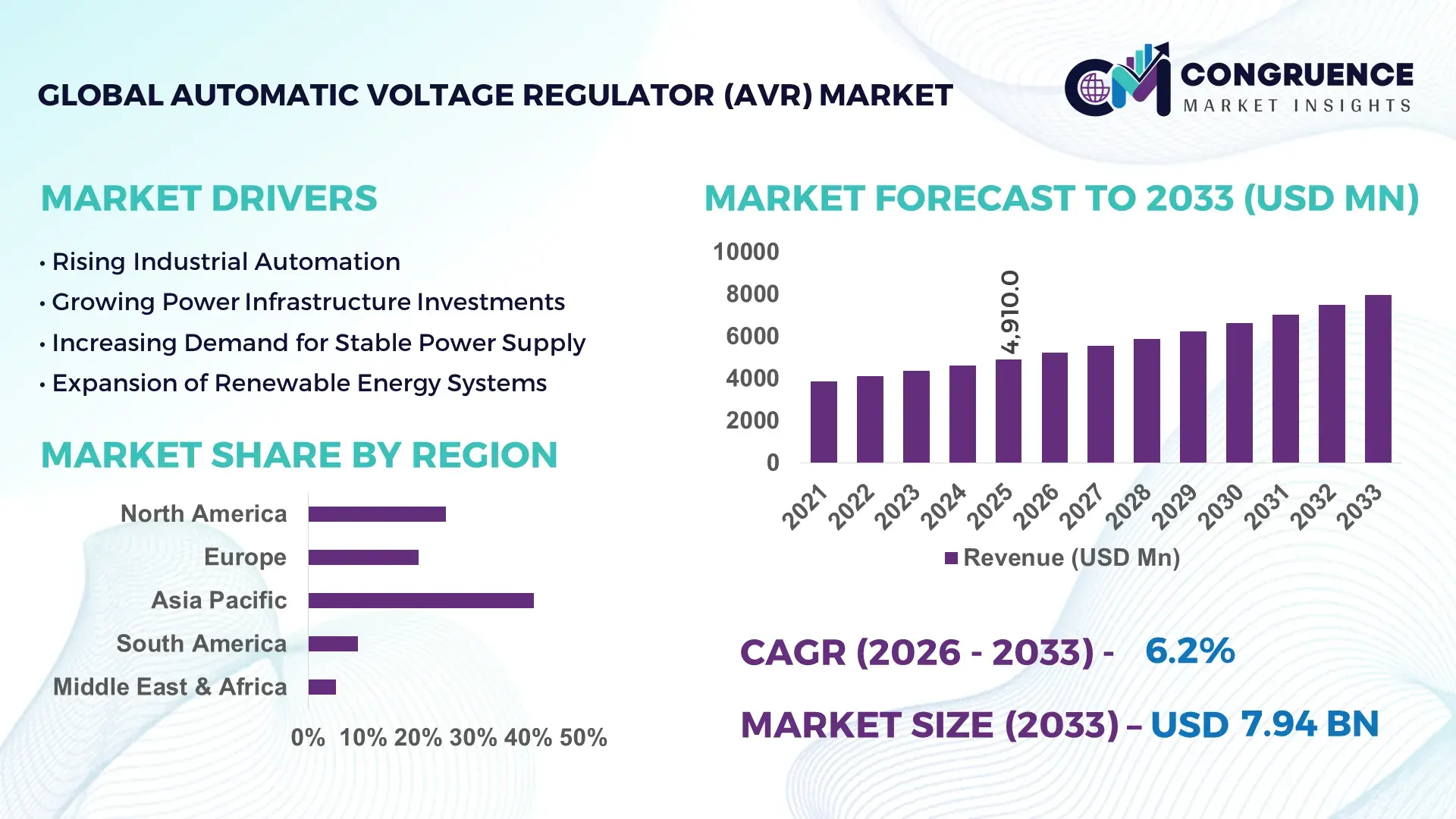
The Global Automatic Voltage Regulator (AVR) Market was valued at USD 4910 Million in 2025 and is anticipated to reach a value of USD 7944.7 Million by 2033 expanding at a CAGR of 6.2% between 2026 and 2033.
Rising deployment of advanced AVR systems across renewable power plants, industrial automation networks, and data center infrastructure is accelerating replacement demand, with digital AVR integration improving voltage stability efficiency by over 28% compared to conventional electromechanical systems. Between 2024 and 2026, global grid modernization programs, semiconductor supply normalization after Red Sea shipping disruptions, and stricter industrial power-quality regulations across Asia and Europe strengthened procurement activity for intelligent voltage regulation equipment.
China remains the dominant country in the global Automatic Voltage Regulator (AVR) market, accounting for nearly 34% of total manufacturing capacity in 2026 due to large-scale investments in power transmission, industrial automation, and renewable energy integration. The country added more than 210 GW of renewable energy capacity over the last two years, increasing demand for high-precision AVR systems in utility-scale solar and wind infrastructure. Compared with legacy analog regulators, smart digital AVR deployments in China’s manufacturing sector improved equipment uptime by approximately 22% while reducing voltage fluctuation losses by nearly 18%. Strong adoption across heavy industries, rail infrastructure, and hyperscale data centers continues to position China ahead of India and Germany in high-volume AVR deployment.
Manufacturers prioritizing digital AVR platforms, localized component sourcing, and grid-compatible smart regulation technologies are positioned to secure stronger long-term contracts across industrial and utility-scale power applications.
Market Size & Growth: USD 4910 million in 2025 to USD 7944.7 million by 2033, driven by smart grid expansion and industrial automation upgrades.
Top Growth Drivers: Renewable integration demand up 31%, data center power infrastructure spending up 26%, and industrial voltage protection installations up 22%.
Short-Term Forecast: By 2028, advanced digital AVR systems reduce power fluctuation losses by 19% and improve operational efficiency by 24%.
Emerging Technologies: AI-enabled voltage monitoring, IoT-connected AVR systems, and silicon carbide power modules improve response speed by over 27%.
Regional Leaders: Asia-Pacific exceeds USD 3.1 billion with renewable deployment growth; Europe crosses USD 1.8 billion through grid modernization; North America surpasses USD 1.5 billion from hyperscale facility expansion.
Consumer/End-User Trends: Over 58% of industrial facilities prioritize automated voltage correction to reduce downtime and equipment damage risks.
Pilot/Case Example: In 2025, a large industrial grid upgrade project improved voltage stability by 21% and reduced maintenance costs by 17%.
Competitive Landscape: Top manufacturers control nearly 42% market share, led by global power equipment suppliers and industrial automation specialists.
Regulatory & ESG Impact: Energy-efficiency compliance standards improved regulated AVR adoption by 23% across manufacturing and utility sectors.
Investment & Funding: More than USD 2.4 billion invested globally in smart power infrastructure, regional manufacturing expansion, and digital grid partnerships.
Innovation & Future Outlook: Hybrid AVR architectures, predictive diagnostics, and decentralized energy integration are reshaping high-growth industrial power management strategies.
Industrial manufacturing, utilities, and commercial infrastructure collectively contribute over 68% of global Automatic Voltage Regulator (AVR) demand, supported by rapid expansion of automated production systems and renewable energy integration. Digital AVR platforms with AI-assisted fault detection improved voltage correction accuracy by nearly 25% in 2026 deployments, while compact solid-state designs reduced maintenance cycles by 18%. Asia-Pacific continues to dominate demand due to grid expansion and industrial electrification, while Europe accelerates adoption through stricter power-efficiency regulations. Increasing localization of component sourcing and smart-grid compatibility is positioning advanced AVR technologies for broader strategic adoption across resilient energy infrastructure networks.
The Automatic Voltage Regulator (AVR) market is rapidly transforming into a strategic infrastructure segment as industrial electrification, renewable integration, and hyperscale digital facilities intensify power-quality requirements worldwide. Utilities, manufacturers, and data center operators are accelerating investments in advanced AVR systems to reduce equipment failure, optimize voltage stability, and secure uninterrupted operations under increasingly volatile grid conditions. Between 2024 and 2026, stricter industrial efficiency mandates and regional energy-security initiatives reshaped procurement priorities, forcing companies to localize supply chains and strengthen component resilience amid semiconductor allocation pressure and geopolitical trade realignment.
Digital solid-state AVR technology improves voltage response efficiency by 32% while reducing maintenance cost by 21% compared to legacy electromechanical systems. Asia-Pacific leads in manufacturing volume due to large-scale grid expansion and industrial automation demand, while Europe leads in smart-grid adoption and energy-efficient AVR deployment with nearly 44% penetration across regulated industrial facilities. Over the next three years, predictive monitoring integration and AI-enabled diagnostics are projected to reduce unplanned industrial downtime by 26% while improving grid reliability performance by 19%. ESG-driven infrastructure modernization is also becoming a competitive advantage, with energy-efficient AVR systems lowering transmission losses by approximately 14% and improving compliance access across regulated power-intensive industries.
In 2025, a multinational manufacturing facility modernization program integrating intelligent AVR systems improved production-line uptime by 18% and reduced voltage-related equipment failure incidents by 23%. Leading companies are shifting capital allocation toward digital AVR portfolios, regional manufacturing expansion, and software-integrated power management ecosystems to secure long-term infrastructure contracts. The competitive landscape is increasingly rewarding manufacturers capable of combining high-speed voltage regulation, localized sourcing, and intelligent energy optimization into scalable industrial solutions that strengthen long-term operational resilience.
Rapid renewable energy integration and industrial electrification are accelerating demand for advanced Automatic Voltage Regulator systems capable of stabilizing fluctuating power loads across utility and manufacturing networks. More than 37% of newly commissioned industrial facilities in 2026 integrated digital AVR infrastructure to improve voltage reliability and reduce operational disruption. Rising hyperscale data center deployment increased demand for precision voltage management equipment by nearly 29%, particularly across Asia-Pacific and North America. Simultaneously, global supply chain restructuring after Red Sea logistics disruptions forced manufacturers to regionalize production and strengthen component sourcing resilience. In response, leading companies are expanding transformer-compatible AVR capacity, accelerating automation investments, and forming strategic partnerships with renewable energy developers to secure long-term infrastructure contracts globally.
The Automatic Voltage Regulator market faces increasing pressure from semiconductor dependency, copper price volatility, and inconsistent grid infrastructure across emerging economies. Power electronics component costs increased nearly 18% between 2024 and 2026, while lead times for industrial-grade semiconductors remained 22% above pre-disruption levels. More than 31% of utilities in developing regions continue operating aging transmission infrastructure incompatible with advanced digital AVR integration, limiting deployment scalability and delaying modernization cycles. These constraints directly increase project costs, extend commissioning timelines, and reduce procurement flexibility for industrial operators. To mitigate exposure, manufacturers are diversifying supplier networks, negotiating long-term sourcing agreements, and investing in hybrid AVR architectures designed to operate efficiently across unstable and lower-capacity electrical environments globally.
The transition toward smart grids and decentralized energy systems is creating high-value growth opportunities for intelligent Automatic Voltage Regulator platforms with predictive monitoring and adaptive control capabilities. AI-enabled AVR systems improved voltage correction precision by 27% and reduced maintenance intervention frequency by 24% across industrial deployments in 2026. Emerging economies in Southeast Asia, the Middle East, and Africa increased grid modernization spending by nearly 33%, creating new demand pockets for scalable and remotely managed AVR infrastructure. A significant innovation shift is accelerating toward cloud-connected voltage management ecosystems supporting real-time diagnostics and automated fault response. Companies are responding through aggressive R&D investment, software integration partnerships, and regional manufacturing expansion to secure early leadership in digitally optimized power management ecosystems globally.
Execution complexity, interoperability limitations, and uneven grid modernization remain critical challenges constraining long-term Automatic Voltage Regulator deployment consistency. Nearly 35% of industrial operators report integration difficulties between advanced digital AVR platforms and legacy electrical infrastructure, increasing commissioning delays and operational recalibration costs. In parallel, grid instability and transmission overload incidents across high-growth economies increased voltage fluctuation exposure by approximately 21% during peak industrial demand cycles. These pressures are reducing infrastructure reliability and complicating large-scale deployment planning for utilities and manufacturing operators. To remain competitive, companies must accelerate investment in adaptive software architectures, strengthen engineering partnerships, and develop modular AVR platforms capable of supporting diverse grid environments while maintaining performance efficiency and long-term operational stability.
Digital AVR deployments increased 34% across industrial facilities in 2026, reshaping voltage management execution models. Manufacturers are replacing analog control units with programmable digital AVR systems that reduce response latency by 26% and maintenance intervention frequency by 19%. This transition is optimizing power stability in automated production environments while forcing suppliers to expand embedded software capabilities and remote diagnostics integration. Companies are restructuring product portfolios toward intelligent control architecture and modular upgrade compatibility.
AI-enabled predictive monitoring adoption rose 29%, redefining operational maintenance strategies across utilities and data centers. Real-time diagnostics platforms reduced unplanned power disruption incidents by 21% while improving equipment utilization efficiency by 17%. Labor shortages in electrical maintenance and stricter uptime compliance standards accelerated deployment of automated monitoring systems. In response, AVR manufacturers are forming software partnerships and integrating cloud-based analytics into high-capacity industrial voltage regulation platforms to strengthen long-term service contracts.
Asia-Pacific localized component sourcing expanded 31%, shifting global AVR manufacturing operations. Persistent logistics disruptions and semiconductor allocation pressure forced companies to regionalize transformer and controller production closer to demand centers. India and Southeast Asia recorded nearly 24% growth in localized AVR assembly capacity, reducing procurement lead times by approximately 18%. This operational shift is optimizing supply continuity while intensifying competition among regional manufacturers offering faster delivery and lower integration costs.
Energy-efficient static and servo-controlled AVR installations improved 27% in commercial infrastructure projects, accelerating demand realignment. Commercial buildings and telecom operators are prioritizing compact, low-loss systems capable of reducing electricity waste by nearly 14%. A non-obvious shift is emerging toward hybrid AVR configurations combining digital monitoring with servo stabilization to balance cost and performance. Companies are responding through targeted retrofit programs, distributor expansion, and customized energy-efficiency packages aligned with tightening electrical compliance standards globally.
The Automatic Voltage Regulator (AVR) market is segmented by type, application, and end-user, with demand increasingly shifting toward digitally integrated and energy-efficient systems. Digital and static AVR types collectively account for over 46% of industrial deployments due to faster response accuracy and smart-grid compatibility. Power generation and industrial equipment protection remain dominant applications, contributing nearly 52% of overall demand as utilities and manufacturers prioritize voltage stability and operational continuity. Manufacturing and energy utilities lead end-user adoption, while IT infrastructure and telecom segments are accelerating procurement due to rising hyperscale facility expansion. Companies are strategically repositioning portfolios toward intelligent, compact, and software-enabled AVR solutions to capture high-efficiency infrastructure modernization demand globally.
Digital Automatic Voltage Regulators dominate the market with nearly 32% share due to superior voltage precision, faster response speed, and seamless integration with smart-grid and industrial automation systems. Their adoption is accelerating across data centers, renewable energy infrastructure, and advanced manufacturing facilities where real-time monitoring and predictive diagnostics are becoming operational priorities. Static AVR systems represent the fastest-growing segment, expanding by approximately 24% as industries prioritize compact architecture, lower maintenance requirements, and high-load stability. Compared with electromechanical regulators, static and digital AVR technologies improve correction efficiency by over 28% while reducing servicing downtime by nearly 20%, redefining procurement priorities across power-intensive operations.
Servo-controlled, ferroresonant, and electromechanical AVR systems collectively account for roughly 41% of installations, maintaining relevance in cost-sensitive industrial environments and legacy infrastructure networks. Servo-controlled variants continue gaining traction in precision manufacturing applications requiring stable voltage correction under fluctuating loads, while ferroresonant systems remain strategically important in rugged environments with unstable grids. Electromechanical AVR demand is gradually declining as industries shift toward digitally optimized infrastructure. Manufacturers are increasing investments in software-enabled AVR platforms, expanding static AVR production capacity, and prioritizing hybrid voltage regulation systems that combine energy efficiency with adaptive load management capabilities.
Power Generation remains the leading application segment, accounting for approximately 29% of total AVR demand due to the critical requirement for voltage stability across utility grids, thermal plants, and renewable integration networks. Utilities are deploying advanced AVR systems to manage fluctuating load conditions, improve transmission reliability, and reduce operational interruptions. Renewable Energy Systems represent the fastest-growing application area, expanding by nearly 27% as solar and wind infrastructure deployments intensify worldwide. Grid variability from renewable sources is forcing operators to adopt intelligent AVR platforms capable of high-speed voltage correction and adaptive load balancing.
Industrial Equipment Protection continues holding significant market share as manufacturers prioritize uninterrupted production cycles and equipment safety under unstable power conditions. In contrast, Data Center Power Management is rapidly redefining deployment patterns, with hyperscale operators increasing AVR integration to improve uptime reliability and reduce power-quality disruptions. Telecommunications Systems and Home Appliances collectively contribute nearly 33% of demand, supported by expanding digital infrastructure and rising demand for compact voltage stabilization solutions. Companies are strategically scaling product customization, strengthening utility partnerships, and repositioning AVR portfolios toward high-efficiency applications requiring intelligent monitoring, rapid response capability, and energy optimization under increasingly dynamic electrical environments.
Manufacturing dominates the Automatic Voltage Regulator market with nearly 34% share due to continuous-process operations, automation dependency, and high sensitivity to voltage fluctuation risks. Large industrial facilities increasingly deploy digital and static AVR systems to reduce equipment downtime and stabilize automated production lines. Energy and Utilities represent the fastest-growing end-user segment, expanding by approximately 26% as grid modernization, renewable integration, and transmission reliability initiatives intensify globally. Compared with traditional manufacturing demand focused on equipment protection, utilities are prioritizing intelligent AVR platforms with predictive monitoring and adaptive voltage control to support increasingly decentralized energy systems.
IT and Telecom sectors are rapidly increasing adoption as hyperscale data centers and telecom infrastructure require uninterrupted voltage regulation for high-density computing environments. Healthcare, Commercial Buildings, and Residential Sector applications collectively account for nearly 39% of installations, driven by rising demand for energy-efficient power management and stable electrical performance. Buying behavior is shifting toward long-term service agreements, software-integrated AVR systems, and customized deployment packages. Companies are responding through flexible pricing strategies, regional distribution expansion, and strategic partnerships with infrastructure developers to capture emerging demand from digitally connected and power-sensitive operational environments.
Asia-Pacific accounted for the largest market share at 41% in 2025 however, Middle East & Africa is expected to register the fastest growth, expanding at a CAGR of 7.4% between 2026 and 2033.

Asia-Pacific dominates global Automatic Voltage Regulator (AVR) demand through large-scale manufacturing capacity, renewable infrastructure expansion, and aggressive industrial electrification programs across China, India, and Southeast Asia. North America contributes nearly 24% of market demand, leading in digital AVR adoption and AI-integrated voltage management systems for hyperscale data centers and automated industrial facilities. Europe holds approximately 22% share, driven by energy-efficiency regulations and grid modernization investments accelerating deployment of intelligent power stabilization systems. Meanwhile, Middle East & Africa is rapidly expanding through infrastructure-led utility projects and industrial diversification initiatives. Ongoing supply chain regionalization and localized electronics manufacturing are reshaping competitive positioning, forcing companies to prioritize Asia-Pacific for scale, Europe for innovation alignment, and Middle East & Africa for long-term infrastructure expansion opportunities.
North America accounts for nearly 24% of global Automatic Voltage Regulator demand, supported by rapid expansion of hyperscale data centers, advanced manufacturing automation, and utility grid modernization programs. Industrial operators increasingly prioritize digital AVR systems capable of reducing power disruption incidents by approximately 21% while improving equipment uptime efficiency by 18%. Stricter grid reliability standards and rising electrification investments are forcing utilities to accelerate deployment of intelligent voltage stabilization infrastructure. In 2026, regional manufacturers expanded localized controller production capacity by nearly 16% to reduce semiconductor sourcing risks and shorten lead times. Enterprise buyers increasingly favor software-integrated AVR platforms with predictive diagnostics, positioning North America as a critical region for high-value, technology-driven power infrastructure investment and operational optimization.
Europe represents approximately 22% of the global Automatic Voltage Regulator market, with Germany, France, and Italy leading industrial deployment of energy-efficient voltage stabilization systems. Tightened carbon-reduction frameworks and industrial power-efficiency directives are accelerating replacement of legacy electromechanical regulators with digital AVR platforms that improve voltage correction efficiency by nearly 24%. More than 46% of regulated industrial facilities now prioritize intelligent energy monitoring and low-loss electrical infrastructure to strengthen compliance performance and reduce operational waste. Companies are increasingly integrating AI-enabled diagnostics and adaptive load balancing into AVR systems to align with smart-grid modernization targets. European enterprises remain quality-focused and compliance-driven, forcing manufacturers to prioritize advanced engineering, compact high-efficiency designs, and sustainable component sourcing strategies to remain competitive.
Asia-Pacific leads the Automatic Voltage Regulator market with nearly 41% of global demand, driven by high-volume manufacturing activity, renewable energy expansion, and large-scale industrial electrification across China, India, Japan, and South Korea. The region accounts for over 38% of global AVR production capacity due to strong electronics supply chains and cost-efficient manufacturing ecosystems. Localized AVR assembly operations increased by approximately 27% in 2026 as companies shifted production closer to infrastructure growth corridors and export hubs. Enterprises increasingly prioritize scalable, fast-deployment voltage regulation systems capable of supporting automated factories and expanding utility networks. Manufacturers are expanding regional partnerships, increasing digital AVR production, and optimizing localized sourcing strategies, making Asia-Pacific the most critical region for scale-driven expansion and competitive manufacturing advantage.
South America contributes nearly 8% of global Automatic Voltage Regulator demand, with Brazil and Argentina driving deployment across industrial processing, mining, and utility infrastructure applications. Aging transmission networks and inconsistent power quality are increasing demand for industrial-grade AVR systems capable of reducing voltage fluctuation risks by approximately 19%. However, import dependency and foreign exchange pressure continue constraining procurement flexibility and slowing modernization timelines across several markets. In response, localized industrial facilities increased adoption of mid-range servo-controlled AVR systems by nearly 17% to balance performance and cost efficiency. Enterprise buyers remain highly price-sensitive while prioritizing operational durability and maintenance simplicity, positioning South America as a strategically attractive but execution-sensitive region for manufacturers targeting infrastructure modernization opportunities.
Middle East & Africa accounts for approximately 11% of global Automatic Voltage Regulator demand, driven by large-scale infrastructure modernization, industrial diversification, and utility expansion projects across Saudi Arabia, the UAE, and South Africa. Oil and gas facilities, commercial infrastructure, and renewable energy projects are increasing deployment of intelligent AVR systems to improve grid reliability and stabilize high-load electrical environments. Regional utility modernization investments increased by nearly 23% in 2026, accelerating adoption of digitally monitored voltage regulation platforms. Enterprises increasingly favor scalable and rugged AVR systems capable of operating efficiently under unstable grid conditions and extreme climates. Global manufacturers are strengthening regional partnerships and localized project support capabilities, positioning Middle East & Africa as a high-potential infrastructure transformation market with expanding long-term deployment opportunities.
China – 34% market share: China dominates the Automatic Voltage Regulator (AVR) market through massive industrial manufacturing capacity, renewable energy expansion, and large-scale grid modernization investments.
United States – 19% market share: The United States leads advanced Automatic Voltage Regulator (AVR) adoption due to hyperscale data center expansion, utility digitalization, and strong demand for intelligent power management systems.
The Automatic Voltage Regulator market is defined by competition between global electrical infrastructure leaders, regional cost-focused manufacturers, and digital power management innovators including Siemens, ABB, Schneider Electric, General Electric, and Eaton. The top five players collectively control nearly 48% of market activity through strong utility relationships, vertically integrated supply chains, and advanced engineering capabilities. Competition is increasingly shifting from price-led differentiation toward intelligent voltage management, predictive diagnostics, and fast deployment capability, with digital AVR platforms improving operational response efficiency by over 30%. Regional manufacturers are competing aggressively through localized production and lower integration costs, particularly across Asia-Pacific. Major players are expanding manufacturing capacity, forming smart-grid partnerships, and integrating AI-enabled monitoring into AVR portfolios to secure infrastructure modernization contracts. Semiconductor dependency and certification requirements remain major entry barriers. Winning requires scalable production, software-integrated systems, resilient sourcing networks, and rapid customization for increasingly complex industrial power environments.
Siemens AG
ABB Ltd.
Schneider Electric SE
General Electric Company
Eaton Corporation plc
Basler Electric Company
Mitsubishi Electric Corporation
Toshiba Corporation
Fuji Electric Co., Ltd.
Leroy-Somer
Emerson Electric Co.
Stamford AVK
Crompton Greaves Consumer Electricals Ltd.
Schweitzer Engineering Laboratories, Inc.
Digital AVR platforms integrated with AI-enabled monitoring systems are reshaping industrial power stabilization across utilities, manufacturing, and data centers. More than 48% of newly deployed AVR systems in 2026 incorporated real-time diagnostics and adaptive load-balancing capabilities to improve voltage correction precision by nearly 26%. Compared with legacy electromechanical systems, intelligent digital AVR technology reduces maintenance intervention by 21% while improving response speed by approximately 32%. This shift is optimizing uptime performance and lowering operational disruption risks for power-intensive industries. Companies with advanced software-integrated AVR portfolios are securing stronger utility modernization and infrastructure contracts due to higher efficiency and predictive maintenance advantages.
Emerging technologies between 2026 and 2028 are accelerating adoption of silicon carbide power modules, IoT-connected controllers, and cloud-based remote monitoring architectures. Static AVR systems using high-speed semiconductor switching improved energy efficiency by nearly 18% while reducing thermal losses by 14% in high-load applications. Approximately 37% of industrial operators are transitioning toward remotely managed voltage regulation ecosystems to improve operational visibility and reduce manual inspection cycles. Manufacturers are responding by expanding digital engineering capabilities and integrating cybersecurity-enabled communication frameworks into advanced AVR infrastructure.
Disruptive innovation is increasingly centered on hybrid AVR configurations combining digital intelligence with servo-controlled stabilization for unstable grid environments. These systems improve fluctuation handling efficiency by approximately 24% under variable industrial loads while reducing recalibration downtime by 16%. Asia-Pacific manufacturers are accelerating localized production and AI-driven automation integration to capture scale-driven demand, while North American and European players focus on premium intelligent AVR systems with predictive analytics and grid synchronization capabilities. Businesses delaying technology upgrades face rising operational inefficiency, slower grid compatibility, and reduced competitiveness as intelligent voltage regulation rapidly becomes a baseline infrastructure requirement.
May 2026 – ABB announced a $200 million investment program to expand medium-voltage equipment manufacturing across Europe, increasing production capacity between 50% and 300% depending on product line. The expansion strengthens supply continuity for utilities, industrial electrification, and data center infrastructure projects. [Grid Capacity Push] Source: Reuters Reuters
March 2026 – ABB expanded its India manufacturing and R&D footprint with a $75 million investment targeting electrification and automation solutions across five locations. The initiative supports renewable energy, metro rail, and data center demand while creating over 300 skilled jobs and strengthening localized production capabilities. [Localization Expansion Drive]
October 2025 – Siemens launched the Sinamics S220 high-performance drive system with advanced connectivity and integrated simulation capabilities, improving industrial automation flexibility and digital workflow integration. The new CU320-3 control unit enhanced system-level operational performance while supporting higher cybersecurity and safety compliance standards. [Digital Drive Integration] Source: Siemens Press Siemens Press
February 2025 – Siemens India showcased integrated grid and electrification technologies focused on smart infrastructure modernization, including Gridscale X and advanced digital distribution systems. The initiative accelerated industrial digitalization deployment and optimized resource-efficiency management across large-scale infrastructure environments. [Smart Grid Deployment] Source: Siemens Press India Siemens Press India
The Automatic Voltage Regulator (AVR) Market Report delivers comprehensive analysis across five major product types, six core applications, and six end-user industries, providing a structured assessment of demand concentration, technology adoption, and operational transformation trends. The report evaluates electromechanical, static, servo-controlled, ferroresonant, and digital AVR systems across industrial equipment protection, renewable energy systems, power generation, telecommunications infrastructure, and data center power management environments. Regional coverage spans North America, Europe, Asia-Pacific, South America, and Middle East & Africa, highlighting localized manufacturing expansion, grid modernization trends, and infrastructure investment patterns shaping deployment priorities through 2033.
The study profiles leading technology providers, infrastructure manufacturers, and industrial automation companies competing across intelligent voltage regulation ecosystems. More than 48% of analyzed industrial deployments now prioritize digital AVR integration with predictive monitoring and AI-enabled diagnostics, while static and software-integrated systems account for over 46% of advanced infrastructure installations. The report also examines emerging opportunities linked to smart-grid compatibility, cloud-connected voltage management, silicon carbide power modules, and decentralized energy infrastructure. Strategic insights support investment planning, regional expansion, sourcing optimization, product positioning, and competitive benchmarking for stakeholders targeting scalable growth within rapidly transforming industrial power management environments.
| Report Attribute/Metric | Report Details |
|---|---|
|
Market Revenue in 2025 |
USD 4910 Million |
|
Market Revenue in 2033 |
USD 7944.7 Million |
|
CAGR (2026 - 2033) |
6.2% |
|
Base Year |
2025 |
|
Forecast Period |
2026 - 2033 |
|
Historic Period |
2021 - 2025 |
|
Segments Covered |
By Type
By Application
By End-User
|
|
Key Report Deliverable |
Revenue Forecast, Growth Trends, Market Dynamics, Segmental Overview, Regional and Country-wise Analysis, Competition Landscape |
|
Region Covered |
North America, Europe, Asia-Pacific, South America, Middle East, Africa |
|
Key Players Analyzed |
Siemens AG, ABB Ltd., Schneider Electric SE, General Electric Company, Eaton Corporation plc, Basler Electric Company, Mitsubishi Electric Corporation, Toshiba Corporation, Fuji Electric Co., Ltd., Leroy-Somer, Emerson Electric Co., Stamford AVK, Crompton Greaves Consumer Electricals Ltd., Schweitzer Engineering Laboratories, Inc. |
|
Customization & Pricing |
Available on Request (10% Customization is Free) |




