
Reports
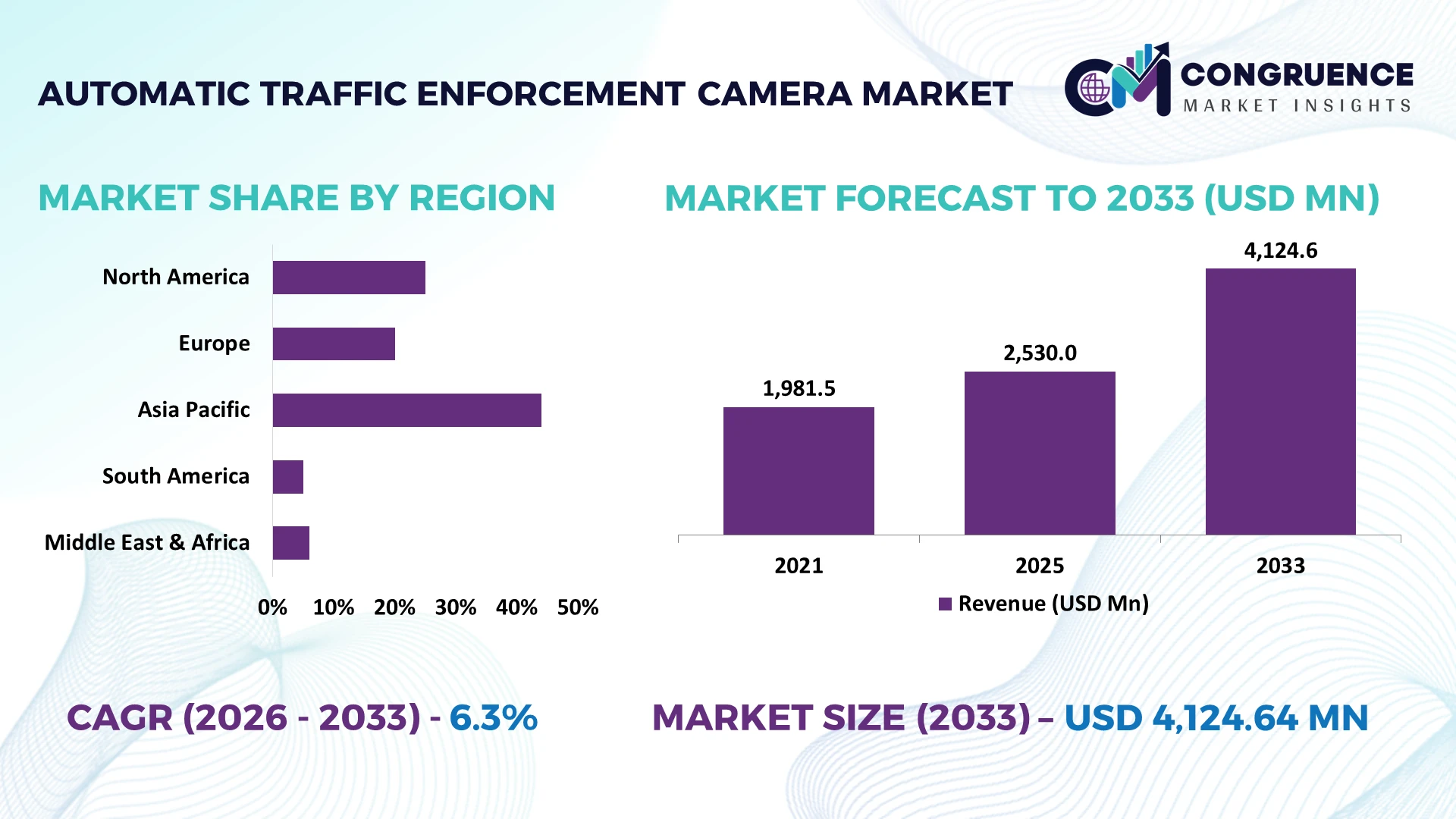
The Global Automatic Traffic Enforcement Camera Market was valued at USD 2530 Million in 2025 and is anticipated to reach a value of USD 4124.64 Million by 2033 expanding at a CAGR of 6.3% between 2026 and 2033. Growth is driven by AI-based speed and red-light violation detection, automated number-plate recognition, and wider legalization of camera enforcement across U.S. cities and states.
The United States holds a dominant position, with automated speed-camera programs operating across more than 360 communities in 26 states and deployments exceeding 2,400 cameras in New York City. Municipal agencies are increasing investment in AI video analytics, radar-camera fusion and automated evidence processing, particularly across urban corridors, school zones and highways. By comparison, France operates more than 4,000 enforcement cameras nationally, reflecting stronger centralized deployment. The U.S. market therefore combines high municipal spending with rapid technology adoption, while North American deployments continue expanding alongside road-safety legislation.
Strategic implication: Vendors with AI accuracy, multi-violation detection and compliant evidence-management capabilities are best positioned for expanding municipal and highway procurement.
Market Size & Growth: USD 2.53 billion in 2025 to USD 4.12 billion by 2033 at 6.3% CAGR, supported by AI-enabled violation detection and automated enforcement.
Top Growth Drivers: AI video analytics 31%, ANPR integration 27%, automated speed enforcement 22%.
Short-Term Forecast: By 2028, AI-based processing is expected to reduce manual evidence review by 35% and increase screening efficiency by 40%.
Emerging Technologies: Edge AI, 4K imaging and radar-camera fusion are accelerating automated identification of speed, red-light and lane violations.
Regional Leaders: North America reaches approximately USD 1.44 billion, Europe USD 1.24 billion and Asia Pacific USD 1.03 billion, supported by smart-city and highway deployments.
Consumer/End-User Trends: More than 50% of automated speed violations in major urban programs involve vehicles registered outside the enforcement jurisdiction, increasing demand for interconnected camera networks.
Pilot/Case Example: Kerala’s AI-camera enforcement program reduced detected daily violations from approximately 450,000 to 44,600, representing nearly 90% reduction after implementation.
Competitive Landscape: The market features established leaders including Verra Mobility, Jenoptik, Kapsch TrafficCom, Siemens and Sensys Gatso, with leading suppliers collectively strengthening AI and ANPR portfolios.
Regulatory & ESG Impact: U.S. communities operating automated speed-camera programs increased 16% year over year, while privacy requirements are driving stronger evidence-retention and audit controls.
Investment & Funding: A USD 6 million Indianapolis camera contract demonstrates the shift toward multi-year municipal procurement, infrastructure expansion and integrated enforcement platforms.
Innovation & Future Outlook: Next-generation systems combine AI, radar, ANPR, edge computing and cloud evidence management, shifting competition toward detection accuracy, cybersecurity and regulatory compliance.
The Automatic Traffic Enforcement Camera Market is being reshaped by AI video analytics, multi-lane radar, ANPR and edge computing, enabling faster identification and validation of speed, red-light, bus-lane and vehicle-class violations. Demand is strongest across dense urban corridors, school zones, highways and smart-city command centers where authorities require continuous enforcement with lower manual intervention. U.S. automated speed-camera programs now cover more than 360 communities, representing a 16% increase from early 2025. Privacy regulation and procurement standards are simultaneously increasing the importance of detection accuracy, secure evidence storage and auditable enforcement workflows, creating a technology-led shift in purchasing priorities.
Automatic traffic enforcement cameras are becoming strategic infrastructure because cities increasingly use machine-vision systems to improve road safety, automate evidence processing, and manage expanding vehicle volumes without proportional increases in enforcement personnel. The shift from standalone cameras toward AI-enabled platforms is also changing procurement from hardware purchases to integrated traffic-management contracts. In the U.S., automated speed enforcement now operates across more than 360 communities, while New York City has deployed more than 2,400 speed cameras. Over the next 2–3 years, demand will increasingly favor systems capable of multi-violation detection, edge processing and centralized evidence management.
Technology economics are reinforcing this transition. AI-enabled camera platforms can reduce manual video-review requirements by roughly 30–40% compared with legacy operator-dependent workflows, while automated number-plate recognition accelerates vehicle identification from minutes to seconds. The U.S. is prioritizing decentralized municipal deployments, whereas France relies more heavily on nationally coordinated enforcement infrastructure. India is moving toward AI-based corridor monitoring, creating a different pathway centered on high-volume deployment and centralized analytics.
Companies are responding by expanding AI capabilities, forming technology partnerships and integrating radar, ANPR and cloud platforms into single enforcement architectures. Competitive advantage will increasingly depend on detection accuracy, interoperability and regulatory compliance rather than camera hardware alone.
AI-based traffic analytics is accelerating adoption as authorities seek higher enforcement coverage without equivalent increases in personnel. Automated systems can reduce manual evidence-review workloads by approximately 30–40% and process vehicle identifiers within seconds, while multi-violation platforms increase usable enforcement data by more than 20%. In the U.S., expansion across more than 360 automated speed-camera communities demonstrates a structural shift toward technology-assisted policing. Companies are responding through AI software upgrades, radar-camera integration and municipal partnerships. A non-obvious advantage is recurring software and analytics revenue generated after camera installation, making algorithm accuracy and evidence processing increasingly important to vendor profitability and contract retention.
Deployment economics remain constrained by installation requirements, network connectivity and fragmented municipal procurement. Hardware, poles, power systems and communications infrastructure can represent 30–40% of initial deployment complexity, while incompatible legacy traffic systems can add 15–25% to integration workloads. In the U.S., differing state authorization frameworks create uneven procurement cycles, forcing suppliers to maintain jurisdiction-specific compliance capabilities. Companies are mitigating these constraints through modular camera platforms, standardized APIs, multi-year service agreements and localized installation partnerships. The key operational insight is that winning hardware specifications alone does not guarantee scale; suppliers with interoperability and deployment support can convert fragmented municipal demand into repeatable contract models.
Edge AI creates a high-value opportunity by allowing cameras to classify violations locally, reducing dependence on continuous centralized video transmission and potentially lowering bandwidth requirements by 40–60%. India’s rapid deployment of AI-enabled traffic monitoring demonstrates demand for high-volume automated enforcement, while U.S. cities are expanding speed and red-light applications. Next-generation platforms combining radar, ANPR, thermal imaging and machine vision can support multiple violation categories through one roadside installation, improving infrastructure utilization by 20–30%. Companies are therefore prioritizing modular sensor architectures, software partnerships and analytics ecosystems. The strongest opportunity lies in converting single-purpose enforcement equipment into multi-application intelligent roadside infrastructure.
Long-term deployment faces increasing cybersecurity, interoperability and system-maintenance pressure as cameras become connected components of municipal digital infrastructure. Networked enforcement platforms can involve multiple data interfaces, with integration projects frequently requiring 20–30% additional engineering effort when legacy traffic-control systems lack standardized protocols. Data-protection requirements also increase operational complexity, particularly where automated evidence contains vehicle identifiers and location information. Companies must invest in encrypted communications, secure edge processing, continuous firmware updates and standardized integration frameworks. The non-obvious competitive risk is system downtime: even a 5% reduction in camera availability can materially weaken enforcement coverage and contract performance, making predictive maintenance and resilient network architecture essential to sustainable deployment.
AI Evidence Processing Accelerates: Edge-based AI is reducing manual violation review by 30–40% and shortening evidence validation times by more than 50%. U.S. municipalities are shifting from standalone capture units to automated workflows, while vendors scale AI partnerships and centralized evidence platforms.
Multi-Sensor Systems Expand: Radar-camera fusion and ANPR integration are increasing detection coverage by 20–30% while reducing duplicate roadside equipment requirements by roughly 15%. Suppliers are bundling sensors, analytics and communications into unified platforms as agencies modernize legacy enforcement infrastructure.
Connected Enforcement Networks Grow: New deployments increasingly connect cameras with traffic-control centers, with networked systems improving incident-response speed by approximately 25% and operational visibility by 30%. U.S. and Indian operators are prioritizing interoperable platforms, cybersecurity upgrades and remote equipment management.
Privacy Controls Reshape Deployment: Regulatory scrutiny is increasing demand for encrypted storage, configurable retention and automated data controls, adding roughly 10–15% to system-compliance requirements. Vendors are redesigning architectures around privacy-by-design, localized processing and auditable workflows rather than maximizing raw data collection.
Speed Cameras represent the leading type, accounting for approximately 31% of deployments, supported by straightforward installation, established enforcement procedures and strong applicability across highways and urban corridors. Their operational maturity gives suppliers predictable replacement and service opportunities. ANPR Cameras are the fastest-growing type, with adoption expanding approximately 12–15% annually as authorities move toward vehicle identification, stolen-vehicle detection and automated evidence matching. Red-Light Cameras remain strategically important in high-risk intersections, while Average-Speed Cameras are gaining traction on long corridors where point-based enforcement is less effective. Bus-Lane Cameras and Combined Enforcement Cameras remain smaller segments but offer higher integration value by supporting multiple enforcement functions from shared roadside infrastructure.
Companies are increasingly shifting investment toward ANPR and combined platforms because multi-purpose architectures can reduce equipment duplication by approximately 15–20%. This changes procurement priorities from individual camera specifications toward sensor integration, analytics compatibility and lifecycle service capability.
Speed Enforcement leads applications at approximately 34% share because speeding remains one of the most persistent and measurable traffic violations across highways, school zones and urban corridors. Red-Light Enforcement follows as a mature use case, while Lane Enforcement is expanding as cities introduce automated monitoring for restricted lanes. Illegal Parking and Toll Enforcement remain specialized applications, generally requiring more location-specific infrastructure and integration.
Traffic Monitoring is the fastest-growing application, with deployment intensity increasing approximately 14–16% as agencies connect enforcement cameras with intelligent transportation systems and command centers. Bus-Lane Enforcement is also strengthening in congested cities, where automated identification improves enforcement consistency by approximately 25%. Companies are responding by developing software-defined platforms capable of supporting multiple applications through shared sensors, improving infrastructure utilization by 20–30% and creating stronger recurring service opportunities.
Police Departments represent the leading end-user group at approximately 32% share because they require continuous violation detection, evidence generation and integration with enforcement workflows. Traffic Authorities and Municipal Governments form substantial secondary demand, particularly where automated systems support congestion management and urban safety programs. Highway Agencies remain important buyers for corridor enforcement, while Toll Operators and Public Transport Authorities pursue more specialized deployments.
Municipal Governments are the fastest-growing end-user group, with adoption expanding approximately 13–15% as cities modernize traffic infrastructure and deploy automated enforcement across multiple zones. Public Transport Authorities are also increasing investment in Bus-Lane and lane-monitoring systems, while Toll Operators prioritize ANPR integration. Companies are responding with modular pricing, managed-service contracts and customized analytics, allowing municipalities to expand coverage without rebuilding entire enforcement networks. The strongest competitive opportunity is shifting toward suppliers capable of serving multiple public-sector workflows through one interoperable platform.
North America accounted for the largest market share at 38% in 2025 however, Asia-Pacific is expected to register the fastest growth, expanding at a CAGR of 7.8% between 2026 and 2033.

Municipal AI enforcement and connected infrastructure accelerate deployment
North America maintains market leadership through extensive municipal enforcement programs, mature road infrastructure, and high adoption of automated speed and red-light systems. The United States represents the dominant deployment base, with automated speed-camera programs operating across more than 360 communities. New York City has deployed over 2,400 speed cameras, creating sustained demand for maintenance, connectivity, analytics, and system upgrades. Canada is also expanding automated traffic monitoring across high-risk corridors. Vendors are shifting toward integrated radar, ANPR and cloud-based evidence platforms, while multi-year service contracts increasingly replace standalone equipment procurement. This favors suppliers capable of combining hardware reliability with software analytics, cybersecurity and regulatory compliance.
United States Market Outlook: The United States remains the primary North American deployment market because of extensive municipal infrastructure and expanding authorization for automated enforcement. More than 360 communities operate automated speed-camera programs, supporting recurring demand for replacement hardware, analytics, connectivity and managed enforcement services.
Mature enforcement infrastructure shifts toward intelligent modernization
Europe benefits from established traffic-enforcement frameworks, extensive highway infrastructure and strong adoption of automated speed and red-light monitoring. France, Germany, Italy and the United Kingdom represent major deployment markets, while France operates more than 4,000 enforcement cameras. European authorities are increasingly upgrading legacy equipment with ANPR, average-speed monitoring, higher-resolution imaging and centralized evidence processing. Data-protection requirements are also influencing procurement specifications, particularly around secure storage and controlled access. Suppliers are responding through retrofit solutions, software upgrades and integrated roadside platforms. The strategic opportunity is concentrated in modernization of installed infrastructure rather than simple unit expansion, supporting longer technology lifecycles and recurring upgrade contracts.
France Market Outlook: France has one of Europe's largest installed enforcement-camera bases, with more than 4,000 systems supporting automated road-safety enforcement. Its mature infrastructure creates sustained demand for upgraded imaging, ANPR, connectivity and evidence-management capabilities, particularly where suppliers can modernize existing installations without full replacement.
High-volume urban deployment strengthens AI-led enforcement
Asia-Pacific is moving toward large-scale automated enforcement as China, India, Japan and South Korea modernize traffic infrastructure and smart-city systems. The region accounted for approximately 21% of global demand in 2025, with China and India providing substantial deployment opportunities. India is expanding AI-enabled monitoring across urban corridors, while China combines advanced machine vision with extensive connected surveillance infrastructure. Automated analytics can reduce manual evidence-review requirements by approximately 30–40%, improving scalability for high-volume environments. Manufacturers are strengthening local production and software capabilities, while global suppliers are forming partnerships with domestic integrators. The strongest commercial advantage lies in modular systems that can be deployed across large intersection and highway networks without extensive redesign.
China Market Outlook: China combines large-scale urban deployment with strong domestic capabilities in imaging, AI processors and traffic analytics. Extensive smart-city infrastructure supports integrated enforcement platforms, while domestic manufacturing strengthens supply availability and customization. Suppliers with advanced machine vision and centralized traffic-management capabilities have strong positioning across large municipal projects.
Targeted urban modernization drives selective adoption
South America is developing through focused investments in urban safety, highway enforcement and electronic traffic management, with Brazil serving as the principal demand center. Brazil contributes more than 60% of regional deployment activity, supported by large metropolitan road networks and established automated enforcement programs. Speed and red-light cameras remain the core applications, while ANPR is gaining importance for integrated traffic monitoring. Uneven connectivity and municipal budget constraints can increase deployment timelines by 10–20%, encouraging phased installations and managed-service models. Companies are strengthening local partnerships for installation, maintenance and system integration. The key opportunity is not broad infrastructure replacement but targeted modernization of high-risk corridors where automated enforcement delivers measurable operational value.
Brazil Market Outlook: Brazil represents the strongest South American opportunity because of its extensive urban road network and established electronic enforcement infrastructure. Municipal and highway authorities are increasingly adopting digital evidence processing and remotely managed systems, encouraging suppliers to build localized service partnerships and scalable maintenance capabilities.
Smart-city investment accelerates connected enforcement systems
The Middle East & Africa market is increasingly driven by smart-city programs, highway modernization and government investment in automated road-safety infrastructure. The Gulf states account for the largest concentration of advanced deployments, with Saudi Arabia and the United Arab Emirates leading adoption of AI-enabled traffic monitoring and ANPR. The region represented approximately 4% of global demand in 2025, while Dubai's connected traffic infrastructure demonstrates the shift toward centralized enforcement management. Extreme temperatures, long highway corridors and dispersed infrastructure increase demand for ruggedized equipment and remote diagnostics. Suppliers are responding through turnkey partnerships combining cameras, radar, analytics and command-center integration, creating higher-value contracts than conventional camera-only installations.
Saudi Arabia Market Outlook: Saudi Arabia is becoming a major deployment market through transportation modernization, smart-city projects and highway infrastructure investment. Extensive road networks support demand for ANPR, connected enforcement and centralized analytics, while harsh operating environments favor ruggedized equipment, remote monitoring and predictive-maintenance capabilities.
The market features global leaders such as Jenoptik, Kapsch TrafficCom and Sensys Gatso competing with Verra Mobility and regional technology integrators. The top five players collectively hold approximately 35–40% share, leaving room for specialized suppliers. Competition centers on AI accuracy, interoperability, deployment speed and lifecycle cost, with automated analytics reducing manual processing by 30–40% and integrated systems lowering equipment duplication by 15–20%. Leading companies are expanding through municipal contracts, sensor partnerships, software integration and managed-service agreements. The competitive shift is moving from standalone camera hardware toward software-defined, multi-violation enforcement platforms. Regulatory certification, installed infrastructure and validated detection algorithms create significant entry barriers. Regional players counter global scale through customization, localized support and pricing flexibility. Suppliers that combine reliable detection, cybersecurity, rapid deployment and recurring service capabilities hold the strongest competitive position.
Jenoptik AG
Kapsch TrafficCom AG
Sensys Gatso Group AB
Verra Mobility Corporation
Siemens Mobility
Motorola Solutions
Hikvision
Dahua Technology
Axis Communications
Q-Free ASA
Vitronic GmbH
Redflex Traffic Systems
NDI Recognition Systems
Current automatic enforcement systems increasingly combine high-resolution imaging, radar and ANPR rather than relying on standalone speed cameras. AI-assisted evidence classification improves review efficiency by 30–40%, while radar-camera fusion raises multi-lane detection performance by roughly 15–20%. More than 9,000 road-safety cameras are operated across the U.S. and Canada by leading providers, signaling substantial installed-base adoption. This favors suppliers with interoperable hardware, secure connectivity and software-led upgrades.
Emerging platforms are shifting processing toward edge AI, enabling violations to be identified locally before evidence is transmitted to centralized systems. Compared with operator-dependent legacy workflows, automated classification can reduce manual review requirements by approximately 35% and accelerate evidence processing by 50%. ANPR-linked systems also support simultaneous vehicle identification and violation detection, improving enforcement coverage without equivalent staffing increases. Vendors with established analytics ecosystems and municipal integrations gain the strongest competitive advantage.
From 2026 to 2028, disruptive deployment will center on multi-sensor roadside units, predictive analytics, privacy-preserving processing and connected-vehicle integration. Combined systems can reduce duplicated roadside equipment by 15–20% while increasing application coverage across speed, red-light and lane enforcement. Companies investing now in AI validation, cybersecurity and open APIs will be better positioned for scalable contracts, faster modernization cycles and differentiated lifecycle-service offerings.
February 2026 Verra Mobility finalized a five-year New York City automated enforcement contract covering red-light, speed, bus-lane and weight-limit cameras citywide. The program expands red-light coverage to 600 intersections, strengthening Verra’s long-term municipal position and creating recurring technology-management demand.
Source: nyc.gov
May 2026 Kapsch TrafficCom launched India’s first C-ITS highway project near New Delhi with SCAIL. The deployment introduces real-time connectivity and AI-powered situational awareness, establishing a national technology reference that strengthens Kapsch’s position in India’s intelligent-road infrastructure and safety market.
Source: kapsch.net
July 2024 Sensys Gatso signed an SEK 84 million Dutch Public Prosecution Services procurement contract for average-speed enforcement. The six-year program includes deployment through 2026, while 57% of contract value covers service, maintenance and operations, reinforcing recurring enforcement service demand.
Source: sensysgatso.com
October 2025 Jenoptik partnered with TrafficTech Middle East to deploy 41 red-light and speed cameras plus nine section-control systems in Amman. The project integrates all violations into FlowTris, expanding centralized enforcement capabilities and strengthening Jenoptik’s Middle East smart-mobility footprint citywide.
Source: jenoptik.com
The report assesses the Automatic Traffic Enforcement Camera Market across Red-Light Cameras, Speed Cameras, ANPR Cameras, Average-Speed Cameras, Bus-Lane Cameras and Combined Enforcement Cameras. Application coverage includes Speed Enforcement, Red-Light Enforcement, Lane Enforcement, Bus-Lane Enforcement, Illegal Parking, Toll Enforcement and Traffic Monitoring, while end-user analysis covers Police Departments, Traffic Authorities, Municipal Governments, Highway Agencies, Toll Operators and Public Transport Authorities. The assessment compares adoption, deployment intensity, technology integration and buyer priorities.
Regional coverage spans North America, Europe, Asia-Pacific, South America, and Middle East & Africa, with country-level analysis focused on major deployment and technology hubs. Key technologies include AI analytics, radar-camera fusion, ANPR, edge processing, connected infrastructure and cybersecurity. Segment indicators and company participation patterns support investment planning, expansion strategy and competitive positioning, while the 2026–2033 outlook identifies technology shifts, procurement priorities and emerging deployment pathways.
| Report Attribute/Metric | Report Details |
|---|---|
Market Revenue in 2025 | USD 2530 Million |
Market Revenue in 2033 | USD 4124.64 Million |
CAGR (2026 - 2033) | 6.3% |
Base Year | 2025 |
Forecast Period | 2026 - 2033 |
Historic Period | 2021 - 2025 |
Segments Covered | By Type
By Application
By End-User
|
Key Report Deliverable | Revenue Forecast, Growth Trends, Market Dynamics, Segmental Overview, Regional and Country-wise Analysis, Competition Landscape |
Region Covered | North America, Europe, Asia-Pacific, South America, Middle East, Africa |
Key Players Analyzed | Jenoptik AG, Kapsch TrafficCom AG, Sensys Gatso Group AB, Verra Mobility Corporation, Siemens Mobility, Motorola Solutions, Hikvision, Dahua Technology, Axis Communications, Q-Free ASA, Vitronic GmbH, Redflex Traffic Systems, NDI Recognition Systems |
Customization & Pricing | Available on Request (10% Customization is Free) |




