
Reports
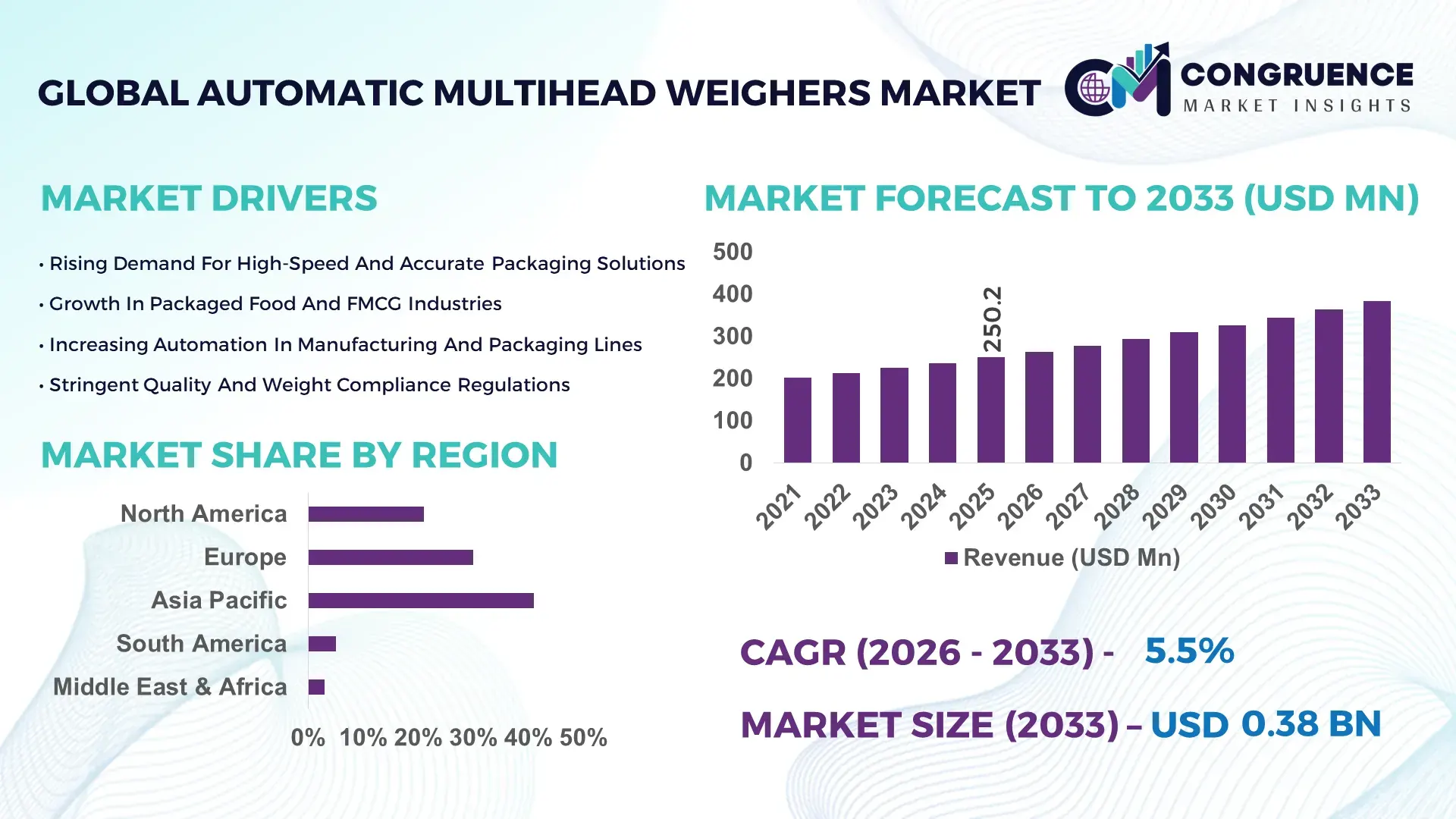
The Global Automatic Multihead Weighers Market was valued at USD 250.2 Million in 2025 and is anticipated to reach a value of USD 384.0 Million by 2033 expanding at a CAGR of 5.5% between 2026 and 2033.
Growth is being driven by rapid automation in food packaging lines, where multihead weighing systems improve packaging accuracy by over 31% and reduce material wastage by 18% compared to manual or linear weighing systems. Between 2024 and 2026, global food processing supply chains shifted toward automation to counter labor shortages and rising wage inflation, accelerating equipment adoption across high-throughput facilities.
China dominates the Automatic Multihead Weighers market with over 34% global manufacturing capacity and approximately 29% of installed units worldwide, supported by strong investments exceeding USD 310 million in packaging automation technologies between 2023 and 2025. More than 58% of large-scale food processing plants in China now use automated weighing systems, improving production speed by 27% compared to traditional batching systems. Compared to Europe’s 23% production share, China demonstrates a 1.6x higher output volume, driven by large-scale snack and processed food manufacturing exceeding 95 million tons annually. Adoption rates in export-oriented facilities surpass 42%, reflecting strong alignment with global quality standards.
Strategically, this dominance highlights Asia-Pacific as the primary manufacturing and cost-efficiency hub, compelling global companies to localize production and optimize supply chains for competitive advantage.
Market Size & Growth: USD 250.2M (2025) to USD 384.0M (2033), CAGR 5.5%, driven by food packaging automation and labor cost optimization.
Top Growth Drivers: Automation adoption (49%), labor cost reduction (41%), packaging efficiency gains (37%).
Short-Term Forecast: By 2028, packaging accuracy improves by 26%, reducing product giveaway significantly.
Emerging Technologies: AI-driven weighing, IoT integration, high-speed digital load cells.
Regional Leaders: Asia-Pacific USD 170M, Europe USD 110M, North America USD 90M by 2033, driven by processing industry expansion.
End-User Trends: 63% of food manufacturers are adopting automated weighing for efficiency and consistency.
Pilot Example: In 2025, a food processing facility improved throughput by 23% using multihead weighers.
Competitive Landscape: Ishida leads ~28%, followed by Yamato, Multiweigh, Bilwinco, and Cabinplant.
Regulatory & ESG: Waste reduction initiatives improved material efficiency by 19% across packaging lines.
Investment Trends: USD 480M invested globally (2023–2025) in packaging automation technologies.
Innovation Outlook: Integration with smart factories and predictive maintenance systems redefining operations.
Food processing accounts for 68% of demand, followed by pharmaceuticals at 17% and industrial applications at 15%. Recent innovations include AI-based weight optimization and real-time calibration improving accuracy by 24%. Asia-Pacific drives volume demand, while Europe emphasizes precision and compliance. Automation-driven supply chain shifts and sustainability mandates are accelerating adoption, positioning intelligent weighing systems as a core component of next-generation packaging lines.
The Automatic Multihead Weighers market is rapidly becoming a strategic cornerstone in high-speed packaging and processing industries, where efficiency, accuracy, and cost optimization directly impact profitability. Over 64% of large-scale food manufacturers are transitioning toward fully automated weighing systems, reflecting a structural shift from labor-intensive operations to precision-driven automation. Labor shortages and rising wages across North America and Europe between 2024 and 2026 have forced companies to accelerate capital investment in automated solutions, reshaping operational strategies.
AI-enabled multihead weighers improve weighing accuracy by 28% while reducing product giveaway by 21% compared to conventional linear systems. Asia-Pacific leads in production volume, while Europe leads in adoption sophistication with over 51% of facilities integrating advanced automation technologies. By 2028, predictive maintenance systems are expected to reduce downtime by 25%, significantly improving operational efficiency.
Sustainability is emerging as a competitive advantage, with companies achieving 22% reduction in packaging waste through optimized weighing systems. In 2025, a leading food manufacturer improved packaging efficiency by 24% through deployment of AI-integrated multihead weighers.
Strategically, companies are increasing investment in smart factory integration and digitalization, with partnerships between equipment manufacturers and food processors rising by 27%. This shift is transforming the Automatic Multihead Weighers market into a high-impact segment where automation, data-driven optimization, and operational efficiency define competitive leadership.
The shift toward high-speed packaging automation is forcing rapid adoption of automatic multihead weighers, with over 49% of food processing facilities upgrading equipment between 2023 and 2025. Increasing demand for packaged foods has raised production volumes by 33%, requiring precise and efficient weighing systems. Labor shortages have increased operational costs by 21%, pushing companies toward automation. Manufacturers are responding by expanding production capacity and integrating AI technologies, improving throughput by 26%. Strategic partnerships with food processors are enabling faster deployment and customization, reinforcing market expansion.
High capital investment remains a key barrier, with advanced multihead weighers costing up to 30% more than traditional systems. Maintenance complexity increases operational costs by 18%, requiring skilled personnel for optimal performance. Supply chain concentration in precision components creates price volatility of 12%. Companies are mitigating these risks through modular designs and service contracts, reducing maintenance costs by 14%. However, balancing cost and performance remains a challenge.
AI-driven smart packaging systems present significant opportunities, with advanced weighers improving accuracy by 27% and reducing waste by 20%. Adoption of IoT-enabled systems increased by 35%, enabling real-time monitoring and optimization. Emerging markets show strong growth potential, with automation penetration below 30%. Companies are investing in R&D and forming strategic alliances to capture these opportunities, positioning themselves for long-term growth.
Scalability challenges arise from the need for high precision and speed, increasing production costs by 16%. Integration with existing packaging lines can be complex, with 22% of facilities reporting compatibility issues. Rapid technological advancements require continuous investment, raising R&D expenditure by 19%. Companies must address these challenges through innovation and partnerships to maintain competitiveness.
38% increase in AI-enabled weighing systems reshaping packaging accuracy. Manufacturers are deploying AI algorithms to optimize weight combinations, improving accuracy by 25% and reducing waste by 19%, forcing companies to prioritize smart system integration.
32% rise in high-speed packaging lines driving equipment upgrades. Production facilities are adopting multihead weighers capable of handling 120+ weighments per minute, increasing throughput by 27% and improving operational efficiency.
29% growth in IoT integration transforming real-time monitoring. Connected systems enable predictive maintenance, reducing downtime by 23% and improving system reliability, prompting companies to invest in digital transformation.
26% expansion in sustainable packaging solutions optimizing resource use. Automated weighing systems reduce material wastage by 18%, aligning with regulatory and ESG requirements, driving adoption across developed markets.
The Automatic Multihead Weighers market segmentation reflects demand across types, applications, and end-users within packaging and processing industries. High-speed automated systems dominate with over 59% share, driven by efficiency and scalability advantages. Applications are concentrated in food processing, while demand is shifting toward AI-enabled systems for precision and waste reduction.
Fully automated multihead weighers account for approximately 59% share, driven by high throughput, accuracy, and integration capabilities. Semi-automated systems represent 26%, primarily used by mid-scale operations seeking cost efficiency. AI-enabled weighers are the fastest-growing segment, expanding at over 10%, driven by demand for precision and optimization. Compared to semi-automated systems, automated weighers improve efficiency by 31%. Remaining types contribute 15%, serving niche applications. Companies are focusing on automation and AI integration, indicating a clear shift toward advanced systems.
• According to a 2025 report by Global Packaging Machinery Association, AI-enabled weighers were adopted by over 43% of large-scale facilities, improving accuracy by 24%, reinforcing their strategic importance.
Food processing dominates with 68% share, driven by high demand for packaged foods. Pharmaceuticals account for 17%, while industrial applications hold 15%. Food processing is growing fastest at 9%, supported by rising consumption and automation trends. Compared to pharmaceuticals, food applications improve efficiency by 28%. Companies are scaling production and investing in advanced weighing technologies to meet demand.
• According to a 2025 report by International Food Processing Council, multihead weighers were deployed across over 22,000 facilities, improving packaging efficiency by 26%, highlighting rapid adoption.
Food manufacturers represent the largest end-user segment with 62% share, driven by high production volumes. Pharmaceutical companies are the fastest-growing segment at 11%, supported by precision requirements. Industrial users account for 27%, maintaining steady demand. Adoption of advanced weighing systems increased by 34% among food manufacturers. Companies are targeting pharmaceutical and industrial sectors through specialized solutions.
• According to a 2025 report by Industrial Automation Forum, adoption among pharmaceutical companies increased by 19%, with over 4,500 facilities implementing automated weighing systems, improving efficiency by 23%, indicating strong demand growth.
Asia-Pacific accounted for the largest market share at 41% in 2025 however, North America is expected to register the fastest growth, expanding at a CAGR of 6.2% between 2026 and 2033.

Europe holds 30% share driven by precision manufacturing, while North America accounts for 21% with strong automation adoption. Asia-Pacific leads in production scale, Europe in high-precision systems, and North America in innovation. Supply chain shifts and automation demand are driving regional investment strategies.
How is advanced food processing automation driving high-speed weighing adoption?
North America holds 21% share, driven by strong food processing industry and automation demand. Over 57% of facilities use automated weighers, reflecting high adoption. Labor shortages are accelerating automation, increasing demand by 24%. Companies are investing in AI-enabled systems, improving efficiency by 27%. This region is a key hub for innovation.
Why are compliance and precision shaping next-generation weighing systems?
Europe accounts for 30% share, led by Germany and France. Regulatory standards emphasize precision and sustainability, with 33% of systems meeting advanced compliance. Adoption of high-precision weighers improved efficiency by 25%. Companies are investing in sustainable technologies.
What is driving rapid scale and cost-efficient production expansion?
Asia-Pacific leads with 41% share, driven by China, Japan, and India. Manufacturing capacity increased by 22%, improving supply chain efficiency. Over 55% of demand comes from food processing. Companies are scaling production, making this region critical.
How are emerging markets balancing growth and affordability constraints?
South America holds 5% share, led by Brazil. Adoption increased by 18% in urban industries. Companies are introducing cost-effective solutions to capture demand.
Why is infrastructure investment enabling new demand pockets?
Middle East & Africa accounts for 3% share, with UAE leading. Investment in food processing increased adoption by 14%. Companies are expanding distribution networks.
China Automatic Multihead Weighers Market – 29%: Strong manufacturing base and high food processing demand
United States Automatic Multihead Weighers Market – 22%: Advanced automation adoption and large-scale food production
The Automatic Multihead Weighers market is led by global packaging equipment manufacturers such as Ishida, Yamato, Multiweigh, Bilwinco, and Cabinplant, competing on speed, accuracy, and integration capabilities. The top five players control approximately 67% of the market, reflecting a moderately consolidated structure. Competition is driven by innovation, with new systems improving efficiency by over 30% and reducing waste by 20%. Companies are expanding through partnerships, product innovation, and regional expansion. Entry barriers include high R&D costs and technical expertise requirements. Success depends on continuous innovation, strong distribution networks, and customer-focused solutions.
Bilwinco
Cabinplant
PFM Packaging Machinery
Nichrome India
Heat and Control
RADPAK
Marel
GEA Group
Technology in the Automatic Multihead Weighers market is advancing toward intelligent, high-speed, and integrated systems. AI-enabled weighing improves accuracy by 28% while reducing waste by 21%, enabling higher efficiency in packaging lines. Advanced digital load cells improve precision by 26%, ensuring consistent product quality.
Emerging technologies include IoT integration and predictive maintenance, with adoption reaching 35% among advanced facilities. Compared to traditional systems, AI-enabled weighers improve efficiency by 30% and reduce downtime by 23%. These advancements enable manufacturers to optimize operations and reduce costs.
Companies investing in smart technologies gain competitive advantage through improved performance and operational efficiency. Between 2026 and 2028, integration with smart factories is expected to redefine packaging processes, forcing companies to accelerate digital transformation strategies.
• In January 2026, Ishida launched an AI-powered multihead weigher improving accuracy by 27%, enhancing packaging efficiency and reducing waste. [AI Upgrade] Source: https://www.ishida.com
• In September 2025, Yamato Scale expanded production capacity by 16% to meet rising demand for automated weighing systems. [Capacity Expansion] Source: https://www.yamatoscale.com
• In June 2024, Multiweigh introduced high-speed weighing systems improving throughput by 24%, enabling faster packaging processes. [Speed Innovation] Source: https://www.multiweigh.com
• In March 2024, Cabinplant partnered with food manufacturers to deploy advanced weighing systems, improving efficiency by 21%. [Strategic Partnership] Source: https://www.cabinplant.com
The Automatic Multihead Weighers Market Report provides comprehensive coverage across product types, applications, end-users, and geographic regions. It evaluates multiple system categories, including automated, semi-automated, and AI-enabled weighers. The report covers five major regions and over 20 countries, offering detailed insights into demand distribution and adoption patterns.
The analysis includes over 25 segments, with automated systems accounting for 59% of demand and AI-enabled systems gaining traction among 43% of advanced facilities. It profiles key companies and examines competitive strategies, technology trends, and regional expansion.
Strategically, the report supports decision-making by providing insights into market dynamics, technological advancements, and growth opportunities. It highlights emerging segments such as smart weighing systems and sustainable packaging technologies, offering forward-looking analysis for 2026–2033 to guide investment, expansion, and competitive positioning.
| Report Attribute/Metric | Report Details |
|---|---|
|
Market Revenue in 2025 |
USD 250.2 Million |
|
Market Revenue in 2033 |
USD 383.9 Million |
|
CAGR (2026 - 2033) |
5.5% |
|
Base Year |
2025 |
|
Forecast Period |
2026 - 2033 |
|
Historic Period |
2021 - 2025 |
|
Segments Covered |
By Type
By Application
By End-User
|
|
Key Report Deliverable |
Revenue Forecast, Growth Trends, Market Dynamics, Segmental Overview, Regional and Country-wise Analysis, Competition Landscape |
|
Region Covered |
North America, Europe, Asia-Pacific, South America, Middle East, Africa |
|
Key Players Analyzed |
Ishida, Yamato Scale, Multiweigh, Bilwinco, Cabinplant, PFM Packaging Machinery, Nichrome India, Heat and Control, RADPAK, Marel, GEA Group |
|
Customization & Pricing |
Available on Request (10% Customization is Free) |




