
Reports
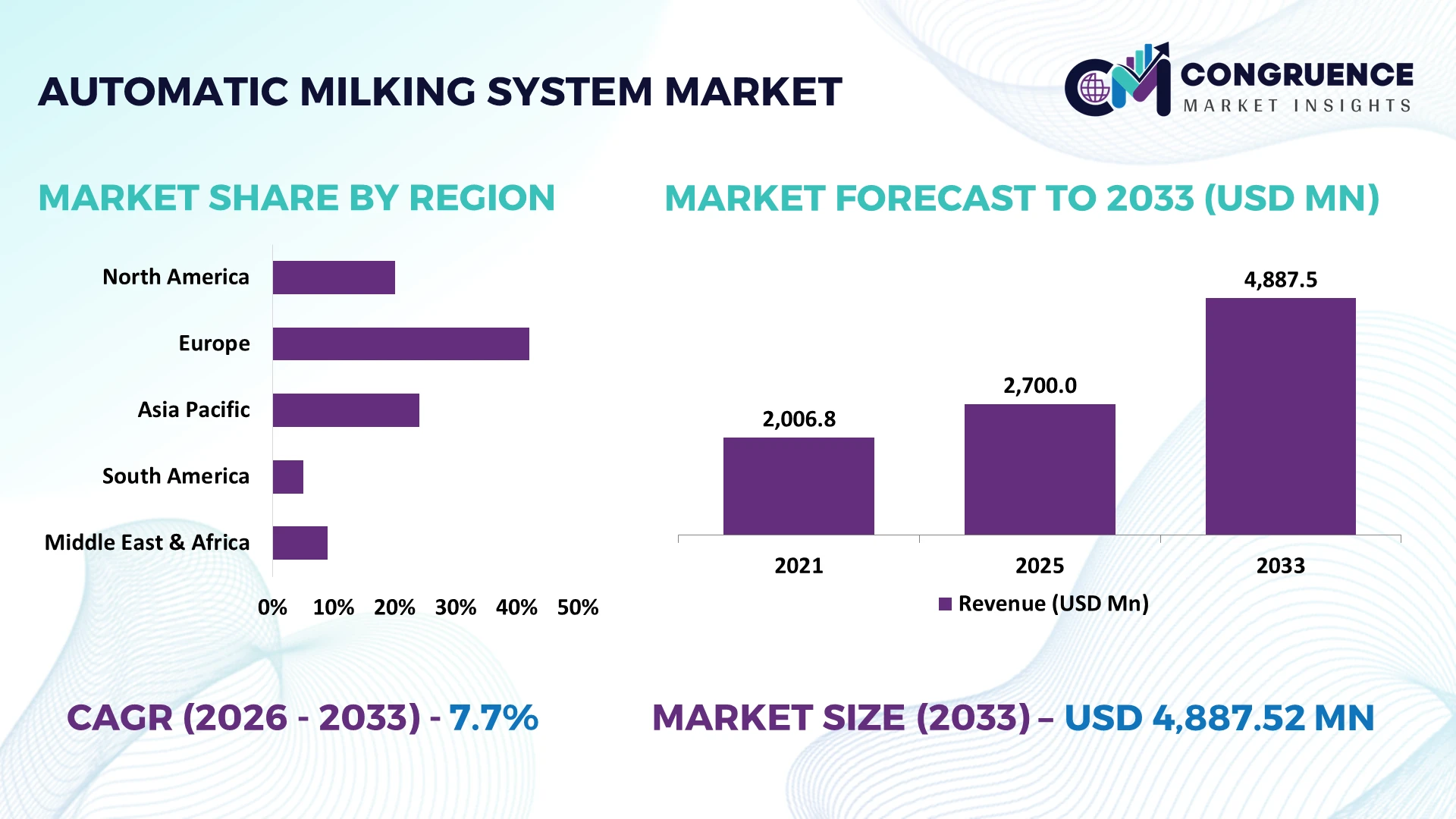
The Global Automatic Milking System Market was valued at USD 2700 Million in 2025 and is anticipated to reach a value of USD 4887.52 Million by 2033 expanding at a CAGR of 7.7% between 2026 and 2033. Growth is driven by dairy labor shortages, robotic milking adoption, automated teat detection, herd analytics, and precision feeding integration that reduce repetitive labor while increasing milking frequency.
The Netherlands is a leading automatic milking technology hub, supported by intensive dairy farming, high labor costs, and strong domestic equipment expertise. Robotic systems are installed on more than 30% of Dutch dairy farms, while individual robots typically manage 50 to 70 cows and enable 2.5 to 3 milkings per cow daily. Compared with the United States, Dutch farms operate at smaller herd scale but higher automation density. European labor constraints and post Brexit agricultural workforce pressures are reinforcing investment in autonomous dairy operations.
Dairy equipment suppliers should prioritize scalable robotics, service coverage, and herd data integration in countries where labor economics make automation financially decisive.
Market Size & Growth: USD 2.70 billion in 2025 reaches USD 4.89 billion by 2033 at 7.7% CAGR, driven by robotic dairy modernization and labor substitution.
Top Growth Drivers: Labor optimization contributes 34%, precision herd management 28%, and higher milking frequency 23% to adoption momentum.
Short Term Forecast: By 2028, optimized robotic workflows can reduce direct milking labor requirements by 20% to 30% on suitable dairy farms.
Emerging Technologies: AI vision, automated teat detection, and predictive herd analytics are pushing attachment accuracy above 95% in advanced robotic platforms.
Regional Leaders: By 2033, Europe approaches USD 2.05 billion, North America USD 1.32 billion, and Asia Pacific USD 1.03 billion as automation intensity expands.
Consumer and End User Trends: Advanced robotic installations support 2.5 to 3 daily milkings per cow, shifting dairy management toward voluntary milking behavior.
Pilot and Case Example: A 2025 robotic dairy configuration supporting roughly 60 cows per unit demonstrated continuous automated milking with substantially lower manual attachment requirements.
Competitive Landscape: Lely holds an estimated 25% global position, competing with DeLaval, GEA, BouMatic, and Fullwood JOZ across robotic dairy platforms.
Regulatory & ESG Impact: Automated monitoring can identify conductivity and milk quality deviations at every milking, strengthening traceability across 100% of robot processed sessions.
Investment & Funding: Modern multi robot dairy projects regularly require more than USD 500,000 in equipment investment, increasing demand for financing, service contracts, and phased automation.
Innovation & Future Outlook: Robots managing 50 to 70 cows each are evolving into connected platforms integrating milking, feeding, health monitoring, and predictive maintenance.
The Automatic Milking System Market is shifting dairy operations from scheduled group milking toward continuous, cow initiated workflows supported by robotics and herd intelligence. Demand is strongest among labor constrained dairy farms requiring automated attachment, milk quality monitoring, animal identification, and integrated feeding data. Modern robotic units commonly support 50 to 70 cows and generate individual animal information during every milking event. AI enabled vision and predictive health analytics are strengthening early intervention capabilities, while agricultural labor constraints across Europe are making service reliability and automation uptime increasingly important purchasing criteria, establishing the foundation for strategic market analysis.
Automatic milking systems are becoming strategically important as dairy farms restructure around labor productivity, animal level data, and continuous operations. A single robot typically serves 50 to 70 cows, enabling 2.5 to 3 daily milkings while replacing fixed parlor schedules with voluntary access. Digital adoption is shifting investment toward connected herd management platforms that combine identification, milk quality, feeding, and health information.
Compared with conventional parlors, robotic systems can reduce direct milking labor requirements by 20% to 30% on suitable farms while increasing milking frequency from roughly twice daily toward three sessions. The Netherlands combines high automation density with smaller herds, whereas US dairies emphasize multi robot configurations for larger operations. Through 2028, vision systems, predictive analytics, and automated health alerts will increasingly determine system productivity and uptime.
A 300 cow dairy can deploy multiple robotic units to distribute milking continuously instead of staffing several scheduled shifts. Equipment manufacturers are expanding remote diagnostics, dealer service networks, software integration, and automated feeding partnerships. Competitive positioning will depend on maximizing robot utilization, minimizing intervention time, and converting continuous animal data into measurable herd productivity improvements.
Persistent dairy labor constraints are accelerating robotic milking investment because conventional parlors require repetitive skilled labor across multiple daily shifts. Automatic systems can reduce direct milking labor requirements by 20% to 30%, while voluntary access supports 2.5 to 3 milkings per cow daily and individual robots typically serve 50 to 70 animals. In the Netherlands, robotic milking is already installed on more than 30% of dairy farms, demonstrating commercial maturity where labor costs are high. Producers are redesigning barns around automated cow traffic, identification, and milking access rather than simply replacing parlor equipment. Suppliers are expanding installation teams, remote service, and herd management integration. The strategic benefit is labor reallocation: farms can redirect scarce workers toward animal health, reproduction, and operational supervision instead of repetitive attachment tasks.
High initial investment remains a structural constraint, particularly for smaller dairies where robot utilization cannot be spread across sufficient cow numbers. A robotic unit generally supports 50 to 70 cows, meaning a 300 cow operation can require four to six units plus barn modification, networking, cooling, and milk handling infrastructure. Installation and building adaptation can add 15% to 30% beyond equipment expenditure depending on existing facilities. US farms with larger herds can distribute fixed infrastructure costs across more animals, while smaller European farms face tighter utilization economics. Suppliers are addressing affordability through leasing, phased installation, service contracts, and modular barn conversion. The critical purchasing metric is therefore not robot price alone but productive milkings per installed unit, because underutilized capacity directly weakens payback and limits automation scalability.
The next opportunity lies in converting automatic milking systems from labor replacement equipment into continuous animal intelligence platforms. Every robotic visit can capture milk yield, conductivity, milking duration, cow identification, and quarter level performance, providing data across 100% of completed sessions. Advanced farms already achieve 2.5 to 3 voluntary milkings daily, creating substantially more decision points than conventional twice daily routines. The Netherlands provides a strong environment for integrating these datasets with feeding, reproduction, and health management software. Through 2028, AI based anomaly detection and computer vision will increasingly identify mastitis indicators, mobility changes, and attachment problems before manual observation. Suppliers are investing in cloud analytics, application programming interfaces, and sensor partnerships. The strategic opportunity is recurring software value built around each robot rather than dependence solely on equipment sales.
Automation increases dependence on uninterrupted hardware, software, connectivity, and technical service because milking cannot simply stop when a robotic unit fails. A robot serving 60 cows at 2.7 milkings daily can process more than 160 cow visits every 24 hours, making even 5% downtime operationally significant. Attachment failures, sensor contamination, network interruptions, and delayed maintenance can rapidly create cow queues and disrupt established milking behavior. Remote dairies in the United States and Australia face additional pressure where specialist technicians travel substantial distances. Manufacturers must strengthen predictive maintenance, redundant connectivity, spare parts availability, cybersecurity, and dealer technician training. The non obvious competitive issue is service density: superior hardware provides limited advantage if restoration times remain long. Sustainable deployment therefore requires manufacturers to treat local technical coverage as core infrastructure rather than aftermarket support.
Multi Robot Barns Gain Scale: Large dairies are moving from single robot installations toward coordinated robot clusters supporting 300 to 1,000 plus cows. With individual units handling roughly 50 to 70 cows and 150 plus daily visits, suppliers are redesigning layouts around shared milk lines, automated gates, and centralized supervision. Companies are scaling modular configurations that allow capacity additions without rebuilding complete milking infrastructure.
Vision Guided Attachment Advances: Three dimensional cameras, machine vision, and robotic arm control are improving teat localization under variable cow positioning. Advanced attachment systems target success rates above 95%, while automated cleaning handles four teats during every cycle. Equipment developers are refining cameras, algorithms, and arm trajectories to shorten attachment time, reduce failed attempts, and improve throughput per robot without increasing barn labor.
Milk Quality Sensing Deepens: Automated platforms increasingly measure conductivity, color, flow, temperature, and quarter level yield during each milking rather than relying solely on periodic testing. A cow completing 2.7 daily visits generates nearly 1,000 annual milking records. Manufacturers are integrating inline sensors and exception dashboards, enabling operators to isolate abnormal milk faster while reducing dependence on manual inspection.
Automated Cow Traffic Expands: Smart gates and identification systems are restructuring barn movement around individual milking permissions instead of group schedules. Farms targeting 2.5 to 3 daily milkings increasingly coordinate sorting, feeding, and milking access electronically. Suppliers are connecting gates, collars, robots, and management software, creating operational value through smoother cow flow and fewer unnecessary robot visits.
Robotic Milking Systems represent the leading type with an estimated 47% share, reflecting their ability to automate teat preparation, attachment, milking, detachment, and data collection within one platform. Typical installations handle 50 to 70 cows per robot and support around 2.5 to 3 milkings per cow daily, giving farms measurable labor and utilization benefits. Automated Milking Parlors remain relevant for larger herds requiring structured throughput, particularly where existing parlor infrastructure supports centralized cow movement and scheduled milking.
Voluntary Milking Systems are the fastest developing type as farms shift from operator controlled schedules toward cow initiated access supported by electronic identification and traffic management. Automatic Milking Units provide modular capacity for farms adding automation incrementally rather than replacing complete facilities. Equipment manufacturers are expanding modular robot configurations, automated gates, remote diagnostics, and software interoperability. Investment priorities are consequently moving toward systems that maximize successful visits and productive milkings per installed unit rather than simply increasing mechanical milking capacity.
Dairy Cattle Milking is the leading application, representing an estimated 52% of system utilization because attachment, teat preparation, milk extraction, and detachment constitute the core automated workflow. A robot serving 60 cows at 2.7 visits daily can process more than 160 milking events every 24 hours. Milk Yield Monitoring has consequently become tightly integrated with the core process, recording individual production during each successful visit and enabling faster identification of output deviations.
Livestock Monitoring is the fastest developing application as operators combine milking information with activity, rumination, mobility, and health indicators. Herd Management converts these data streams into sorting, reproduction, and intervention decisions, while Automated Feeding links nutrition with individual production performance. Suppliers are integrating sensors, identification systems, feeding interfaces, and management dashboards rather than selling isolated milking functions. The business implication is significant: system value increasingly depends on converting each automated milking into an actionable animal record, strengthening demand for interoperable farm management ecosystems.
Dairy Farms constitute the leading end user with an estimated 48% share because automatic milking equipment is installed directly around herd housing, cow traffic, milk collection, and farm labor workflows. Farms operating 120 cows can typically require two robotic units, while 300 cow operations can require four to six depending on throughput and milking frequency. Commercial Dairy Operations increasingly favor multi robot layouts because larger herds improve utilization of supporting infrastructure, maintenance contracts, cooling equipment, and centralized management software.
Commercial Dairy Operations are the fastest developing buyer group as larger enterprises standardize automation across barns and expand capacity through modular robot additions. Agricultural Cooperatives can support purchasing, technical services, and shared knowledge, while Livestock Farms adopt systems where dairy production represents a core activity. Dairy Processing Companies influence automation indirectly through milk quality and traceability requirements. Suppliers are responding with fleet management software, financing structures, service agreements, and scalable configurations. Competitive advantage increasingly depends on supporting expansion without forcing customers to redesign complete dairy infrastructure.
Europe accounted for the largest market share at 38.6% in 2025 however, Asia Pacific is expected to register the fastest growth, expanding at a CAGR of 9.2% between 2026 and 2033.

Large Herds Accelerate Multi Robot Deployment
North America accounted for an estimated 29.4% market share in 2025, supported by large commercial dairies, rising herd concentration, advanced farm connectivity, and established precision livestock infrastructure. The United States maintains more than 9 million milk cows, creating substantial operating scale for robotic systems, automated cow identification, milk quality monitoring, and centralized herd software. Canadian dairies provide another concentrated automation base, particularly where labor availability and controlled barn environments support voluntary milking. Larger farms increasingly configure several robots around common milk handling, cooling, sorting, and data infrastructure rather than treating each unit independently. Equipment manufacturers are strengthening dealer networks, remote diagnostics, financing arrangements, and fleet management capabilities. This operating model improves utilization of supporting infrastructure and makes technical service coverage increasingly important when dairies deploy multiple interconnected robotic units.
United States Market Outlook: The United States provides the strongest regional opportunity through dairy consolidation and large herd economics. Farms with 300 cows can require four to six robotic units depending on utilization and milking frequency. Wisconsin, California, Idaho, Texas, and New York provide substantial dairy concentration, supporting demand for scalable installations, automated sorting, centralized monitoring, and responsive technical service.
Robotic Milking Reaches Operational Maturity
Europe held an estimated 38.6% market share in 2025, reflecting established robotic milking deployment, high agricultural labor costs, strong dairy technology manufacturing, and intensive herd management. The Netherlands, Denmark, Germany, France, and Scandinavian dairy economies increasingly integrate robots with feeding, identification, activity monitoring, and milk quality systems. Dutch robotic penetration exceeds 30% of dairy farms, demonstrating that automation has moved beyond experimental deployment into mainstream operating infrastructure. European manufacturers are consequently competing around robot utilization, attachment consistency, software interoperability, service response, and animal welfare rather than basic mechanical automation. Labor availability remains a structural catalyst, while environmental regulation increases pressure to manage feed, animal performance, and resource use more precisely. Suppliers are expanding connected herd platforms and automated barn ecosystems that coordinate milking with cow traffic and individual animal management.
Netherlands Market Outlook: The Netherlands combines dense dairy production with one of the world's most established robotic milking ecosystems. Dutch farms increasingly operate around voluntary cow traffic and continuous animal data rather than fixed milking shifts. More than 30% robotic farm penetration creates a mature replacement and upgrade market where software capability, sensor accuracy, service quality, and interoperability influence purchasing decisions.
Dairy Modernization Expands Automation Scale
Asia Pacific represented an estimated 22.1% market share in 2025, with adoption shaped by large dairy modernization programs in China, advanced automation in Japan, and emerging commercial farm investment in Australia and India. China is particularly important as large dairy enterprises consolidate cows into technology intensive operations using electronic identification, automated feeding, environmental monitoring, and centralized herd management. Australia presents a different operating model, where pasture based systems require flexible cow traffic and automation configurations capable of handling longer walking distances. India possesses the world's largest dairy animal base but remains fragmented, making conventional robotic economics difficult outside organized commercial farms. Suppliers are responding with modular equipment, localized service partnerships, digital herd platforms, and configurations designed for differing barn structures. Investment is shifting toward integrated automation that connects milking equipment with feeding, health monitoring, and farm management systems.
China Market Outlook: China offers the strongest regional scaling environment because industrial dairy farms combine large herds with increasing investment in precision livestock technology. Major operations can house several thousand cows, supporting centralized robotic infrastructure and data intensive herd management. Suppliers targeting China increasingly emphasize multi unit scalability, local technical support, automated feeding integration, and reliable equipment operation across continuously managed commercial facilities.
Commercial Dairies Modernize Selectively
South America accounted for an estimated 5.7% market share in 2025, with Brazil, Argentina, Uruguay, and Chile providing the principal dairy automation opportunities. Brazil combines a large milk producing base with substantial variation in herd scale, infrastructure quality, and capital availability, making robotic deployment concentrated among technologically advanced commercial farms. Automated milking gains strongest economic relevance where operators can maintain high robot utilization and dependable electricity, connectivity, cooling, and technical support. Pasture based production in parts of the region also requires different cow traffic design than enclosed European barns. Equipment suppliers are therefore emphasizing selective deployment, dealer training, remote monitoring, and adaptable barn configurations rather than uniform installation models. The strategic constraint remains service infrastructure: automation economics weaken rapidly when specialist maintenance, replacement components, or reliable connectivity are unavailable near dairy production clusters.
Brazil Market Outlook: Brazil provides the largest addressable dairy base in South America, producing more than 30 billion liters of milk annually. Minas Gerais concentrates a substantial portion of national production, creating a logical automation corridor. Suppliers can improve deployment economics by locating technicians, spare parts, training, and digital support near high density commercial dairy clusters rather than serving farms through dispersed national coverage.
Controlled Dairy Infrastructure Supports Automation
Middle East and Africa represented an estimated 4.2% market share in 2025, with adoption concentrated in capital intensive dairy operations capable of supporting climate control, automated feeding, cooling, water management, and continuous technical supervision. Saudi Arabia, the United Arab Emirates, Israel, and South Africa provide the strongest technology oriented dairy environments. Extreme heat creates unusual operating requirements because milking automation must function alongside ventilation, cooling, hydration, and animal comfort systems. Large Gulf dairy enterprises can manage thousands of cows within centralized facilities, allowing automation investments to integrate with existing herd management infrastructure. Suppliers are adapting equipment for high temperature conditions, expanding preventive maintenance programs, and connecting milking data with feeding and environmental controls. The non obvious opportunity is infrastructure integration, since robot performance depends directly on cooling effectiveness and stable utility availability in intensive desert dairy operations.
Saudi Arabia Market Outlook: Saudi Arabia combines large commercial dairy enterprises with controlled housing, automated feeding, cooling infrastructure, and sophisticated herd management. Summer temperatures exceeding 40°C make thermal management operationally critical. Automatic milking suppliers targeting Saudi farms therefore compete not only on milking performance but also on equipment durability, remote diagnostics, preventive servicing, and integration with climate controlled dairy infrastructure.
Lely, DeLaval, GEA, BouMatic, and Fullwood JOZ compete for large dairy automation programs, while SAC and Hokofarm challenge through flexible installations and localized service. The five leading suppliers control an estimated 70% of market activity, reflecting high concentration around installed fleets, dealer coverage, and proprietary herd software. Competition increasingly centers on robot utilization, attachment accuracy, service response, and lifetime operating cost. Advanced platforms target attachment success above 95%, while optimized robotic workflows can reduce direct milking labor requirements by 20% to 30%. Suppliers are expanding dealer networks, integrating feeding and animal monitoring, forming technology partnerships, and using remote diagnostics to protect uptime. Competition is shifting from standalone milking hardware toward connected dairy ecosystems combining robotics, sensors, analytics, and service contracts. High capital requirements, biological process expertise, and dependable field maintenance create formidable entry barriers. Winning requires proven uptime, scalable automation, interoperable herd data, and dense technical support near dairy clusters.
Lely
DeLaval
GEA Group
BouMatic
Fullwood JOZ
SAC
Hokofarm Group
Waikato Milking Systems
Dairymaster
Milkomax
System Happel
AMS Galaxy
Current automatic milking technology combines robotic arms, electronic identification, teat detection, inline milk sensing, and herd management software. Vision guided attachment systems can achieve above 95% successful attachment under optimized conditions, while voluntary milking commonly supports 2.5 to 3 visits per cow daily. Compared with conventional twice daily milking, robotic workflows can increase milking frequency by 25% to 50%, improving equipment utilization and reducing dependence on scheduled labor.
Emerging systems integrate cameras, activity collars, conductivity sensors, automated sorting, and cloud analytics. Predictive algorithms flag deviations in yield, milking duration, rumination, and milk conductivity before manual inspection. Remote diagnostics can reduce technician interventions by 10% to 20% where faults are resolved through software or configuration changes. Farms and service providers benefit from faster exception management, while equipment manufacturers gain recurring software and monitoring relationships beyond hardware installation.
Between 2026 and 2028, disruptive platforms will connect milking, feeding, health monitoring, cow traffic, and environmental controls through unified decision engines. AI based vision should reduce failed attachment events by 5% to 10% on challenging cows as training datasets improve. Companies integrating interoperable data, predictive maintenance, and automated decision support will gain retention because operational value shifts from robot ownership toward measurable herd performance.
September 2024 Hartpury University installed two DeLaval VMS V300 robots at Home Farm. The 110 robot milked cows achieved over 15% higher yields and 3.2 daily milkings versus two previously, demonstrating measurable productivity gains from robotic workflow modernization and efficiency. Source: DeLaval DeLaval
June 2025 Lely launched Astronaut A5 Next and Astronaut Max for automated dairy operations. Astronaut Max connects up to 18 robots and supports farms with 500 to 1,100 cows, centralizing utilities and cleaning to increase uptime and large herd scalability. Source: Lely Lely
May 2025 BouMatic integrated MilkGenius into Gemini UP through its BROLIS partnership. The inline analyzer measures milk composition from every cow during milking, converting 100% of sampled robot sessions into individual metabolic information and enabling earlier, automated herd health intervention. Source: BouMatic BouMatic
September 2026 GEA unveiled the redesigned DairyRobot R9500 for EuroTier, adding AMS Software 2.0, AI powered CattleEye integration, and an 18.5 inch Full HD control screen. The upgrade strengthens automated health monitoring, system stability, and multi farm digital management capabilities. Source: GEA GEA
The report evaluates Robotic Milking Systems, Automated Milking Parlors, Voluntary Milking Systems, and Automatic Milking Units across Dairy Cattle Milking, Herd Management, Milk Yield Monitoring, Automated Feeding, and Livestock Monitoring. End user coverage includes Dairy Farms, Commercial Dairy Operations, Agricultural Cooperatives, Livestock Farms, and Dairy Processing Companies. Robotic systems account for an estimated 47% share, while individual units commonly support 50 to 70 cows.
Geographic analysis covers North America, Europe, Asia Pacific, South America, and Middle East and Africa, examining dairy concentration, automation readiness, service infrastructure, and farm modernization. Technology coverage includes robotic attachment, inline milk analysis, computer vision, automated cow traffic, predictive herd analytics, and connected feeding. The 2026 to 2033 assessment supports investment prioritization, geographic expansion, supplier positioning, partnership planning, and identification of scalable automation opportunities.
| Report Attribute/Metric | Report Details |
|---|---|
Market Revenue in 2025 | USD 2700 Million |
Market Revenue in 2033 | USD 4887.52 Million |
CAGR (2026 - 2033) | 7.7% |
Base Year | 2025 |
Forecast Period | 2026 - 2033 |
Historic Period | 2021 - 2025 |
Segments Covered | By Type
By Application
By End-User
|
Key Report Deliverable | Revenue Forecast, Growth Trends, Market Dynamics, Segmental Overview, Regional and Country-wise Analysis, Competition Landscape |
Region Covered | North America, Europe, Asia-Pacific, South America, Middle East, Africa |
Key Players Analyzed | Lely, DeLaval, GEA Group, BouMatic, Fullwood JOZ, SAC, Hokofarm Group, Waikato Milking Systems, Dairymaster, Milkomax, System Happel, AMS Galaxy |
Customization & Pricing | Available on Request (10% Customization is Free) |




