
Reports
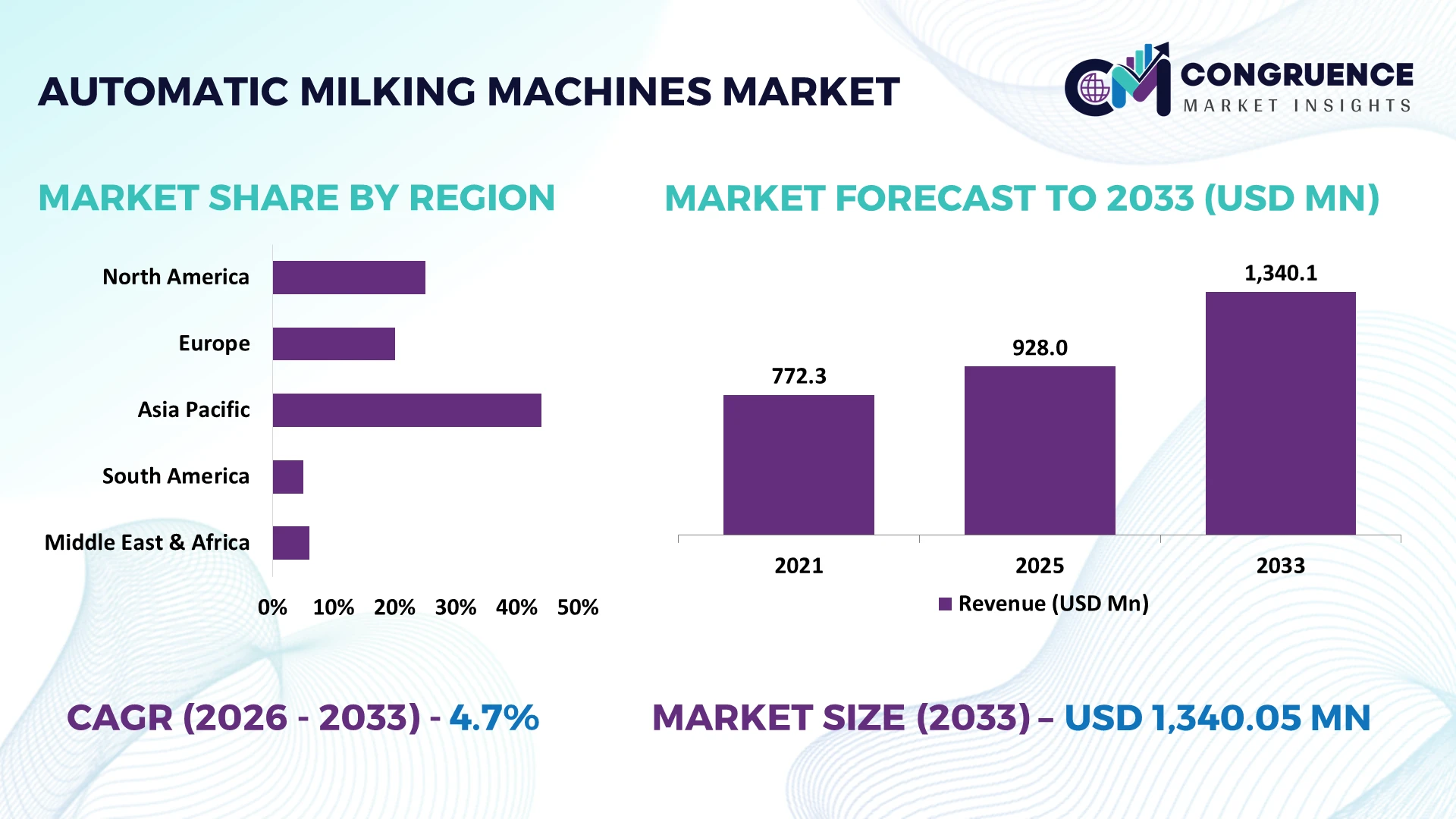
The Global Automatic Milking Machines Market was valued at USD 928 Million in 2025 and is anticipated to reach a value of USD 1340.05 Million by 2033 expanding at a CAGR of 4.7% between 2026 and 2033. Growth is driven by dairy labor shortages, larger herd sizes, precision livestock management, and automated systems that enable 2.5 to 3.0 voluntary milkings per cow daily while reducing dependence on fixed milking shifts.
The Netherlands represents a dominant automation hub, with robotic milking established across an estimated 30% to 35% of dairy farms and supported by advanced dairy equipment manufacturing, sensor integration, and highly productive commercial herds. Dutch milk yields exceed 9,000 kilograms per cow annually, strengthening returns from automated milking investment. Adoption remains substantially higher than in India, where smaller herd structures constrain robotic deployment despite rapid dairy modernization. European labor scarcity and tighter animal welfare requirements continue accelerating automated barn investment.
Suppliers should prioritize high labor cost dairy economies while developing modular, lower capacity systems for fragmented Asian dairy operations.
Market Size & Growth: USD 928 million in 2025 advances to USD 1,340.05 million by 2033 at 4.7% CAGR, supported by dairy labor substitution and precision herd automation.
Top Growth Drivers: Labor optimization can reduce routine milking labor requirements by 20% to 30%; voluntary milking supports 2.5 to 3.0 visits daily; sensor based monitoring improves intervention speed by over 15%.
Short Term Forecast: By 2028, advanced robotic installations are positioned to lower direct milking labor requirements by approximately 20% while increasing cows handled per worker.
Emerging Technologies: AI based cow identification, machine vision, automated teat attachment, and inline milk sensors increasingly combine 3 or more data streams for individual animal decisions.
Regional Leaders: Europe approaches USD 500 million by 2033, North America approximately USD 340 million, and Asia Pacific around USD 300 million as robotic barn installations expand.
Consumer/End User Trends: Large dairy farms increasingly target 2.5 to 3.0 milkings per cow daily, making automated systems attractive where 24 hour voluntary access improves equipment utilization.
Pilot/Case Example: Commercial robotic dairy deployments report around 5% to 10% milk yield improvement when higher milking frequency is combined with optimized feeding and cow traffic management.
Competitive Landscape: Leading suppliers collectively command a substantial global installed base, with Lely, DeLaval, GEA, BouMatic, and Fullwood JOZ competing through robotics, analytics, service coverage, and herd integration.
Regulatory & ESG Impact: Automated monitoring can identify conductivity, activity, and milk abnormalities at every milking, enabling 100% cow level screening rather than periodic manual observation.
Investment & Funding: Individual robotic milking units commonly require investment above USD 150,000, shifting purchasing toward lifecycle service contracts, financing packages, barn redesign partnerships, and phased automation.
Innovation & Future Outlook: Next generation platforms combine 24 hour robotic milking with AI analytics and automated feeding, moving competition from standalone machinery toward integrated precision dairy ecosystems.
Automatic milking machines are becoming central to precision dairy operations where labor availability, herd productivity, animal monitoring, and consistent milking schedules determine farm economics. Demand is strongest across commercial dairy farms investing in robotic milking, automated teat detection, milk quality sensors, and integrated herd management software. Modern systems support roughly 2.5 to 3.0 voluntary milkings per cow daily while generating individual animal data continuously. European labor constraints are reinforcing automation, while modular robotic configurations are gaining relevance across expanding Asian dairy operations, setting the foundation for the market’s strategic technology and regional analysis.
Automatic milking machines are becoming strategically important as dairy operators shift from labor intensive milking toward data driven herd management. Persistent farm labor constraints in the Netherlands, Germany, and the United States are accelerating digital adoption, while larger herds require continuous throughput without proportional workforce expansion. Robotic platforms combining identification, milk sensing, and automated attachment allow farms to restructure daily operations around individual cow productivity rather than fixed milking schedules.
Compared with conventional parlors, robotic systems can reduce direct milking labor requirements by roughly 20% to 30% while supporting 2.5 to 3.0 voluntary milkings per cow daily. Northern European farms lead deployment because higher wages and concentrated dairy infrastructure improve automation economics, whereas India and China offer greater herd scale but remain constrained by fragmented farm structures. Through 2028, sensor integration, predictive maintenance, and automated cow traffic management will increasingly determine system differentiation.
A 120 cow dairy operating two robotic units can redirect several daily labor hours from repetitive milking toward feeding, health monitoring, and reproduction management. Manufacturers are consequently expanding software capabilities, dealer service networks, financing models, and partnerships with herd management providers. Competitive advantage will increasingly depend on combining reliable robotics with actionable animal data and lifecycle support.
Dairy labor scarcity is the primary structural driver for automatic milking machine adoption, particularly in the Netherlands, Germany, and the United States. Robotic systems can reduce direct milking labor requirements by approximately 20% to 30%, while voluntary access enables 2.5 to 3.0 milkings per cow daily and can lift milk output by roughly 5% to 10% under optimized herd management. Rising agricultural wages are shifting automation economics from labor substitution toward continuous productivity management. Farms can redirect workers toward feeding, reproduction, and animal health rather than repetitive milking routines. Manufacturers including Lely, DeLaval, and GEA are responding through robotic capacity expansion, remote diagnostics, sensor integration, and stronger dealer support. The strategic advantage lies in increasing milk handled per employee without proportionally expanding the workforce.
High upfront investment restricts robotic milking deployment among smaller and structurally fragmented dairy farms. A single robotic unit commonly supports approximately 50 to 70 cows, while complete installations can require capital exceeding USD 150,000 before barn modification, electrical infrastructure, and maintenance expenses. Farms operating below efficient herd thresholds therefore face longer investment recovery periods, particularly in India, where more than 70% of dairy households manage very small cattle holdings. Retrofitting older barns can add approximately 10% to 20% to project costs depending on cow traffic configuration and utility requirements. Equipment suppliers are addressing affordability through leasing, financing, modular installations, and service contracts. The operational constraint is not simply equipment pricing: herd concentration and barn compatibility determine whether automation achieves sufficient utilization to justify capital deployment.
The strongest emerging opportunity extends beyond automated milking into integrated precision dairy management. Modern platforms combine milk conductivity, yield, activity, rumination, identification, and reproductive data, allowing nearly 100% of milking events to generate individual cow records. Predictive analytics can reduce health intervention delays by approximately 15% to 25%, while automated exception management enables operators to supervise larger herds with fewer routine inspections. China presents a significant opportunity because industrial dairy farms increasingly operate herds exceeding 1,000 cows, creating favorable economics for connected automation. Through 2028, AI assisted teat detection, machine vision, predictive maintenance, and cloud based herd analytics will expand system value. Manufacturers are investing in software ecosystems and technology partnerships. Owning the farm data layer creates recurring service opportunities beyond the initial equipment sale.
Scaling robotic milking across increasingly connected dairy farms creates execution challenges involving uptime, software interoperability, technical skills, and cybersecurity. A robotic unit serving 60 cows can process more than 150 milking visits daily, making even 2% downtime operationally significant when cows depend on continuous voluntary access. Connected platforms can integrate 5 or more data categories, including milk quality, activity, feeding, reproduction, and equipment status, increasing software management complexity. In the United States, geographically dispersed dairy operations also require dependable remote diagnostics and rapid technician availability because prolonged equipment interruption directly disrupts herd routines. Manufacturers must strengthen predictive maintenance, cybersecurity controls, technician training, spare parts networks, and open data integration. Long term competitiveness will depend on delivering near continuous system availability while converting expanding data volumes into reliable farm decisions.
Robotics Shifting Toward Multi Box Systems: Dairy operators are moving from isolated robots toward coordinated multi box installations, particularly on larger Dutch and German farms. Configurations serving 120 to 250 cows are becoming more common, with centralized routing cutting cow waiting time by roughly 10% to 15%. Manufacturers are standardizing modular layouts, automated gates, and shared management software, allowing farms to expand capacity incrementally without rebuilding complete milking infrastructure.
Milk Analytics Moving Into Workflow: Inline sensing is increasingly embedded directly into each milking cycle rather than performed through periodic sampling. Advanced systems now capture 4 to 6 parameters, including conductivity, color, flow, temperature, and yield, with abnormal milk automatically diverted within seconds. Stricter European milk quality requirements reinforce this transition. Equipment companies are integrating sensor suites with automated separation workflows, reducing manual screening and accelerating treatment decisions.
Energy Optimization Reshaping Equipment Design: Electricity consumption is becoming a procurement metric as farms manage higher utility costs and sustainability requirements. Variable speed vacuum pumps, heat recovery, and intelligent cleaning controls can reduce milking related electricity consumption by approximately 15% to 30%, while optimized wash cycles lower hot water requirements by around 20%. Suppliers are redesigning vacuum, cooling, and cleaning subsystems together rather than independently, improving lifecycle economics for energy intensive dairy operations.
Service Models Becoming More Predictive: Maintenance is shifting from scheduled technician visits toward connected condition monitoring. Modern platforms can continuously track more than 10 equipment parameters, while remote diagnostics can resolve or identify selected faults before onsite intervention. This reduces unplanned service visits by approximately 15% to 25%. Lely, DeLaval, GEA, and other suppliers are expanding remote support, software updates, and performance based service packages, making aftermarket capability increasingly influential in equipment selection.
Robotic Milking represents the leading type, accounting for approximately 42% of market demand as dairy operators prioritize autonomous teat detection, attachment, individual cow identification, and integrated milk monitoring. A typical robotic unit supports roughly 50 to 70 cows, giving medium and large farms a scalable alternative to labor intensive milking infrastructure. Automated Milking Parlors retain strategic relevance for high throughput herds where centralized batch movement remains operationally efficient. Pipeline Milkers continue serving established farms seeking mechanization without full robotic conversion.
Voluntary Milking Systems are the fastest advancing type as operators reorganize barns around unrestricted cow movement and individualized milking frequency. Well managed installations enable approximately 2.5 to 3.0 milkings per cow daily, compared with conventional fixed schedules commonly centered on two sessions. Bucket Milkers remain relevant primarily for small herds and cost sensitive operations. Manufacturers are consequently concentrating investment on modular robots, intelligent cow traffic controls, interoperable software, and retrofit configurations that enable farms to migrate gradually from conventional equipment toward autonomous milking.
Dairy Cow Milking remains the dominant application, representing approximately 55% of system utilization because automated attachment, detachment, cleaning, and milk transfer constitute the core economic justification for robotic investment. Systems capable of supporting 2.5 to 3.0 voluntary milkings per cow daily improve equipment utilization while eliminating rigid milking sessions. Milk Yield Monitoring has become closely integrated with this workflow, providing individual production records after virtually every robotic visit. Milk Quality Control increasingly uses inline conductivity, color, temperature, and flow measurements to identify abnormal output immediately.
Herd Management is the fastest expanding application as farms connect milking records with activity, feeding, reproduction, and behavioral information. Integrated platforms can combine 5 or more animal data streams, shifting management from retrospective records toward exception based decision making. Udder Health Monitoring is becoming operationally critical because conductivity and milk flow deviations can flag potential problems earlier than visual inspection. Suppliers are integrating dashboards, automated alerts, sorting gates, and cloud analytics, positioning software functionality as an increasingly important differentiator alongside mechanical milking performance.
Dairy Farms constitute the dominant end user group, representing approximately 48% of demand because milking frequency, herd supervision, and equipment utilization directly influence daily farm economics. Farms operating 100 to 500 cows increasingly deploy modular robotic configurations that permit capacity additions without constructing entirely new parlors. Commercial Farms form another established buyer group, particularly where large herds justify centralized automation and professional technical support. Cooperative Dairies remain strategically relevant where members share procurement, servicing, training, or milk handling infrastructure.
Agricultural Enterprises are the fastest expanding end user category as professionally managed livestock businesses combine automation with centralized analytics and standardized operating procedures across multiple facilities. Deployments exceeding 500 cows strengthen demand for connected fleet management, remote diagnostics, and standardized maintenance. Livestock Farms with diversified animal operations adopt selectively where dairy throughput supports dedicated infrastructure. Manufacturers are responding with herd specific system configurations, financing programs, dealer partnerships, software subscriptions, and multi site service arrangements. Future purchasing power is therefore shifting toward operators capable of evaluating automation through total labor productivity and lifecycle performance.
Europe accounted for the largest market share at 41% in 2025 however, Asia Pacific is expected to register the fastest growth, expanding at a CAGR of 6.2% between 2026 and 2033.

Precision Dairy Investment Shifts Toward Mid Sized Herds
North America accounted for approximately 27% of automatic milking machine demand in 2025, supported primarily by technology intensive dairy operations in the United States and Canada. Deployment is increasingly concentrated among farms seeking to restructure labor rather than simply increase milking capacity. Robotic milking produced approximately 6% of United States milk in 2021, while adoption reached 13% among farms operating 150 to 499 cows, demonstrating particularly favorable economics for mid sized herds. Recent precision dairy investment combines robotic boxes with activity monitoring, milk sensing, automated feeding, and cow level analytics. Canadian producers are similarly integrating robotics into free stall barns where year round indoor management supports consistent utilization. Equipment manufacturers are strengthening remote diagnostics, dealer coverage, financing, and barn design support as lifecycle service capability becomes central to procurement.
United States Market Outlook: United States dairy operators provide the region’s strongest scale opportunity because herd consolidation is increasing the value of automation. Approximately 8% of dairy farms currently use automated milking systems, while another 18% have considered adoption. Robotic milking has also generated average net return improvements of roughly 13% in recent USDA analysis, strengthening investment justification for appropriately configured farms.
Robotic Milking Becomes Mainstream Replacement Infrastructure
Europe held approximately 41% of global demand in 2025, reflecting deep robotic milking penetration, established dairy equipment manufacturing, and accelerated replacement of conventional parlors. The Netherlands, Denmark, Sweden, Germany, and France anchor deployment, although adoption intensity differs substantially by country. Dutch dairy operations demonstrate the strongest transition: automatic systems were installed in more than 5,100 farms by late 2024, while robots represented approximately 85% of newly delivered or renovated milking systems. Farm labor constraints, animal monitoring requirements, and precision livestock management are pushing investment toward integrated robots rather than standalone mechanical equipment. European manufacturers are consequently connecting milking, feeding, manure handling, cow traffic, and herd analytics within unified platforms. This ecosystem advantage strengthens aftermarket service and software relationships while raising switching costs for established dairy customers.
Netherlands Market Outlook: The Netherlands remains a critical technology and deployment hub, with approximately 36% of dairy farms using automatic milking by late 2024. Its combination of high milk productivity, concentrated dairy infrastructure, specialist technicians, and domestic technology leadership provides an effective commercialization environment for next generation robotics, sensors, automated cow routing, and connected farm management platforms.
Industrial Dairy Scale Accelerates Automation Deployment
Asia Pacific represented approximately 20% of global demand in 2025, with adoption shifting toward large herd automation in China, Japan, South Korea, Australia, and New Zealand. China provides the principal scale advantage as industrial dairy operators consolidate cows into professionally managed facilities where centralized data, standardized milking routines, and automated animal identification become economically valuable. Japan and South Korea emphasize labor substitution because agricultural workforce constraints increase the value of autonomous equipment. Australia and New Zealand present a different operating model, requiring automation compatible with pasture based cow movement and seasonal production patterns. Across the region, investment is shifting from basic milking mechanization toward integrated sensors, automated sorting, cloud herd management, and predictive health monitoring. Suppliers are responding through localized technical service, distributor partnerships, flexible barn configurations, and systems designed for substantially different herd structures.
China Market Outlook: China offers the strongest large herd deployment pathway, with major dairy enterprises operating farms containing several thousand cows. This scale favors automated parlors, robotic monitoring, individual identification, and centralized herd analytics. Suppliers able to integrate milking hardware with locally supported software, maintenance, and farm management infrastructure can address installations considerably larger than typical European family dairy operations.
Commercial Dairy Modernization Expands Selective Adoption
South America represented approximately 7% of global automatic milking machine demand in 2025, with Brazil, Argentina, Chile, and Uruguay providing the principal modernization opportunities. Adoption remains concentrated among technologically advanced commercial farms because herd dispersion, financing conditions, uneven technical support, and infrastructure quality constrain broader robotic deployment. Brazil is increasingly important as producers modernize milk handling and use automated systems to improve milking consistency, individual cow monitoring, and workforce allocation. Global suppliers are introducing newer robotic platforms while strengthening local distributors and technical training. Automation investment is particularly attractive in intensive dairy clusters where higher equipment utilization supports stronger capital economics. However, reliable electricity, broadband connectivity, spare parts availability, and specialized technicians remain decisive deployment requirements, creating a competitive advantage for vendors capable of building dependable local service networks.
Brazil Market Outlook: Brazil combines substantial dairy production with expanding precision livestock adoption and represents the region’s primary automation target. Robotic systems from international suppliers are increasingly positioned for commercial farms seeking continuous milking and digital herd supervision. Local demonstrations, dealer training, financing availability, and equipment adapted to Brazilian housing and climate conditions will determine conversion from conventional systems.
Large Dairy Complexes Drive Technology Intensive Investment
Middle East and Africa accounted for approximately 5% of global demand in 2025, but deployment is unusually concentrated within large, capital intensive dairy enterprises. Saudi Arabia, the United Arab Emirates, Israel, and South Africa lead modernization because controlled housing, heat management, automated feeding, and centralized herd supervision are already essential operating requirements. Large desert dairy facilities create favorable conditions for integrated milking automation because individual cow productivity must be maintained despite extreme temperatures and resource constraints. Automated identification, milk monitoring, cooling integration, and preventive health analytics therefore deliver value beyond labor replacement. Equipment suppliers increasingly compete through complete dairy infrastructure packages, local maintenance capability, and remote technical support. Expansion remains constrained across lower income African markets where fragmented herds, financing limitations, unreliable electricity, and limited service infrastructure reduce the economic viability of sophisticated robotic installations.
Saudi Arabia Market Outlook: Saudi Arabia provides the strongest enterprise scale opportunity because industrial dairy production relies on controlled environments and highly standardized herd management. Large farms handling thousands of cows create high equipment utilization, while temperatures frequently exceeding 40°C increase the importance of integrated cooling and animal monitoring. Suppliers offering resilient automation and rapid maintenance gain a decisive operational advantage.
Lely, DeLaval, GEA, BouMatic, and Fullwood JOZ compete at the premium automation layer, while regional equipment specialists challenge through pricing, retrofit flexibility, and localized service. The top five suppliers account for approximately 65% of automatic milking system demand, reflecting strong technology, dealer, and installed base advantages. Competition increasingly centers on attachment accuracy, uptime, herd analytics, and lifecycle cost rather than machine price alone. Advanced robots can reduce direct milking labor requirements by over 20%, while connected diagnostics can lower unplanned service interventions by approximately 15%. Leading vendors are expanding software ecosystems, automated feeding integration, technician networks, and farm management partnerships to increase customer retention. Competition is shifting from standalone robots toward vertically connected dairy platforms combining milking, animal identification, health monitoring, and data analytics. High capital requirements, specialized servicing, biological workflow expertise, and established dealer relationships remain substantial entry barriers. Winning requires reliable hardware, actionable data, scalable service infrastructure, and measurable whole farm productivity gains.
Lely
DeLaval
GEA Group
BouMatic
Fullwood JOZ
Dairymaster
SAC
Hokofarm Group
Waikato Milking Systems
Milkomax
System Happel
AMS Galaxy
Milkplan
Prompt DairyTech
Current automatic milking technology combines robotic attachment, individual cow identification, inline milk sensing, and cloud herd management. Modern systems typically support 50 to 70 cows per robot and enable 2.5 to 3.0 milkings daily. Compared with conventional parlors, robotics can reduce direct milking labor requirements by 20% to 30%, improving workforce allocation and extending operating flexibility.
Emerging platforms integrate artificial intelligence, near infrared spectroscopy, machine vision, predictive maintenance, and automated cow traffic controls. Continuous milk composition sensing removes periodic sampling from decisions, while attachment algorithms can improve connection speed by roughly 10% to 15%. Adoption is moving beyond family farms: large herd architectures now coordinate up to 18 robots, allowing centralized utilities, cleaning, milk transport, and monitoring across 500 to 1,100 cows.
Disruptive development is shifting toward autonomous dairy ecosystems linking milking robots with feeding, health sensors, sorting gates, manure handling, and farm data platforms. Between 2026 and 2028, remote software updates and predictive diagnostics should reduce unplanned service intervention by approximately 15% while strengthening uptime. Large dairies benefit from centralized automation, while robot owners gain through upgradeable software and sensors. Acting now secures operational data, service capability, and scalable infrastructure before integrated platforms become the competitive benchmark for operators.
February 2024 GreenCon completed a 113 hectare Victorian robotic dairy incorporating five Lely Astronaut A5 robots, with infrastructure reserved for a sixth unit. The scalable greenfield design demonstrates how Australian farms are embedding future capacity directly into automated dairy construction.
January 2025 Farmers Weekly reported Bromfield Farm deployed seven GEA robotic milking systems across its 315 cow dairy. The installation replaced aging herringbone infrastructure, eased workloads, and combined free access with guided exit workflows to improve production and cow health.
June 2025 Lely launched Astronaut Max for farms with 500 to 1,100 cows, connecting up to 18 Astronaut robots through one control room. Centralized vacuum, cleaning, compressed air, udder care, and milk transport increase uptime and support larger automated dairies.
May 2026 DeLaval announced Milk Solids Analysis for VMS V300 robots, using near infrared spectroscopy to measure fat, protein, and lactose at every milking without chemicals or test reagents. Continuous composition data strengthens feeding decisions while eliminating manual sampling requirements.
The report evaluates Automatic Milking Machines across Robotic Milking, Automated Milking Parlors, Voluntary Milking Systems, Bucket Milkers, and Pipeline Milkers. Application coverage includes Dairy Cow Milking, Milk Yield Monitoring, Herd Management, Udder Health Monitoring, and Milk Quality Control, while end user analysis examines Dairy Farms, Commercial Farms, Cooperative Dairies, Livestock Farms, and Agricultural Enterprises. Robotic systems typically serve approximately 50 to 70 cows per unit, providing a measurable deployment benchmark.
Regional coverage spans North America, Europe, Asia Pacific, South America, and Middle East and Africa, with country level assessment of automation intensity and dairy infrastructure. Technology analysis examines AI, machine vision, biosensors, predictive maintenance, automated cow traffic, and connected herd platforms. The 2026 to 2033 framework supports investment planning, geographic expansion, product positioning, partnership decisions, and evaluation of emerging large herd automation opportunities.
| Report Attribute/Metric | Report Details |
|---|---|
Market Revenue in 2025 | USD 928 Million |
Market Revenue in 2033 | USD 1340.05 Million |
CAGR (2026 - 2033) | 4.7% |
Base Year | 2025 |
Forecast Period | 2026 - 2033 |
Historic Period | 2021 - 2025 |
Segments Covered | By Type
By Application
By End-User
|
Key Report Deliverable | Revenue Forecast, Growth Trends, Market Dynamics, Segmental Overview, Regional and Country-wise Analysis, Competition Landscape |
Region Covered | North America, Europe, Asia-Pacific, South America, Middle East, Africa |
Key Players Analyzed | Lely, DeLaval, GEA Group, BouMatic, Fullwood JOZ, Dairymaster, SAC, Hokofarm Group, Waikato Milking Systems, Milkomax, System Happel, AMS Galaxy, Milkplan, Prompt DairyTech |
Customization & Pricing | Available on Request (10% Customization is Free) |




