
Reports
The Global Automatic Lubrication System Market was valued at USD 105.0 Million in 2025 and is anticipated to reach a value of USD 154.5 Million by 2033 expanding at a CAGR of 4.95% between 2026 and 2033. Industrial automation, predictive maintenance, and the integration of centralized lubrication with condition-monitoring systems are strengthening adoption across mining, construction, steel, cement, and heavy manufacturing operations.
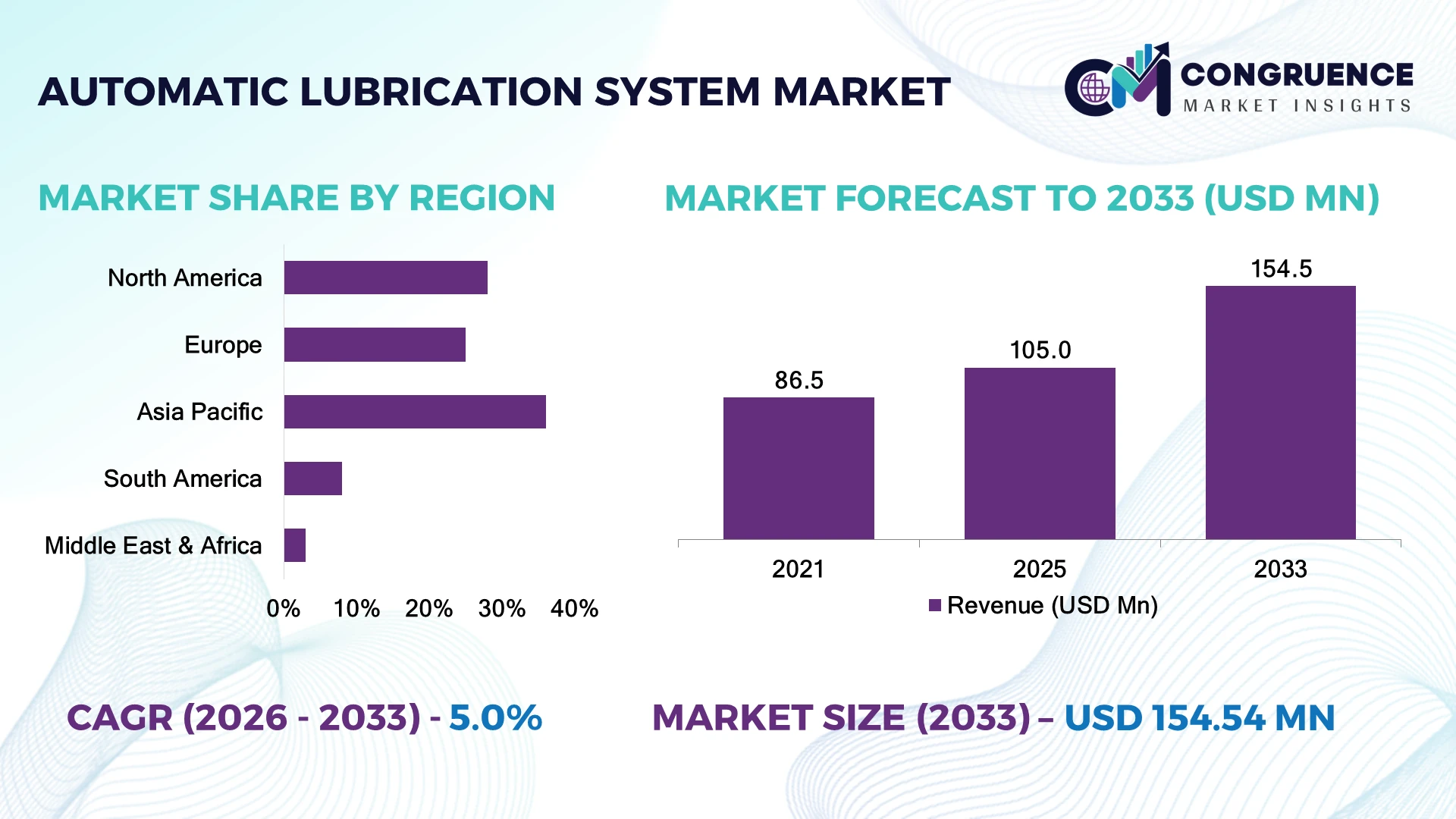
Asia-Pacific holds the leading position, accounting for approximately 36% of the global automatic lubricators market in 2025, supported by manufacturing concentration across China, Japan, and South Korea. China alone represents about 24% of global demand, while North America follows at approximately 28%, driven by mature maintenance programs and asset-intensive industries. Industrial automation adoption above 65% in advanced manufacturing is accelerating smart lubrication deployment.
Companies should prioritize Asia-Pacific manufacturing hubs for capacity expansion while maintaining North American technology and service partnerships to capture high-value industrial applications.
Market Size & Growth: USD 105.0 Million in 2025 to USD 154.5 Million by 2033 at 4.95% CAGR, driven by predictive maintenance and automated lubrication of heavy machinery.
Top Growth Drivers: Predictive maintenance 31%; industrial automation 27%; equipment uptime optimization 24%.
Short-Term Forecast: By 2028, automated lubrication can reduce lubricant consumption by 15% and maintenance intervention time by 20%.
Emerging Technologies: IoT sensors, AI-based condition monitoring, remote lubrication control, and smart metering improve maintenance precision.
Regional Leaders: Asia-Pacific projected at ~USD 50 Million, North America ~USD 45 Million, and Europe ~USD 35 Million, with smart-system adoption accelerating across industrial facilities.
Consumer/End-User Trends: More than 60% of large industrial facilities increasingly prioritize automated lubrication for high-load equipment and inaccessible lubrication points.
Pilot/Case Example: 2024 smart-lubrication deployments demonstrated approximately 20% lower lubricant consumption and 15% fewer unplanned maintenance interventions.
Competitive Landscape: SKF leads with approximately 18% share, competing closely with Graco, Timken, Bijur Delimon, and Dropsa across industrial and mobile-equipment applications.
Regulatory & ESG Impact: Automated dosing can reduce lubricant waste by approximately 15%, supporting environmental compliance and safer maintenance practices.
Investment & Funding: More than USD 300 Million in cumulative industrial automation and predictive-maintenance investments is accelerating smart lubrication integration and connected equipment services.
Innovation & Future Outlook: AI-enabled lubrication monitoring, wireless sensors, and automated replenishment are shifting competition toward predictive service models and integrated asset-management platforms.
The Automatic Lubrication System Market is increasingly concentrated in mining, construction machinery, steel, cement, automotive manufacturing, and material-handling operations where automated dosing directly improves equipment reliability. Approximately 65% of advanced manufacturing environments are adopting industrial automation technologies, creating stronger integration opportunities for connected lubrication controllers, sensors, and predictive maintenance platforms. Asia-Pacific's manufacturing expansion is shifting equipment procurement toward localized suppliers and service networks, making system compatibility and maintenance responsiveness increasingly important for strategic positioning.
Automatic lubrication systems are becoming strategically important because manufacturers are shifting from scheduled maintenance toward condition-based asset management. The technology reduces manual lubrication exposure, improves dosing consistency, and protects high-value bearings and moving components. Asia-Pacific's large manufacturing base creates scale advantages, while North America's mature mining, construction, and industrial maintenance ecosystem favors higher-value connected systems. Supply-chain localization is also increasing demand for regional service capabilities and component availability.
Compared with manual lubrication, centralized automated systems can reduce lubricant over-application by approximately 15% while cutting lubrication-related labor requirements by nearly 20%. Over the next two to three years, industrial operators are expected to increase deployment of wireless sensors, remote monitoring, and automated metering across high-load equipment. The strongest adoption will remain concentrated where equipment downtime creates significant production losses.
Mining operations in Australia and China, for example, increasingly use automated lubrication on heavy mobile equipment operating in difficult-access environments. Suppliers are responding through sensor integration, OEM partnerships, regional service expansion, and predictive-maintenance platforms. Competitive advantage will increasingly depend on combining accurate lubricant delivery with connected monitoring, localized support, and measurable equipment-performance improvements.
The shift toward predictive maintenance is strengthening automatic lubrication adoption across heavy industrial equipment. More than 60% of advanced manufacturing facilities are increasing use of automated maintenance technologies, while connected lubrication systems can reduce lubricant consumption by approximately 15% through precision dosing. In China, Japan, and South Korea, expanding automated production lines are creating greater requirements for continuous lubrication of bearings, conveyors, and high-speed machinery. The growing deployment of IoT-enabled condition monitoring is transforming lubrication from a periodic task into a data-driven maintenance function. Companies are responding by integrating sensors, wireless controllers, and automated metering with existing maintenance platforms. The non-obvious advantage is reduced human exposure to inaccessible lubrication points, strengthening both worker safety and equipment availability.
High retrofit costs and system-integration requirements remain significant constraints for smaller industrial operators. Installation expenses can increase total maintenance-system investment by approximately 20% to 30% compared with conventional manual lubrication, while nearly 35% of older industrial machines lack standardized interfaces for connected monitoring equipment. In India and Southeast Asia, fragmented equipment fleets further complicate system compatibility and installation planning. These limitations can delay deployment, increase engineering costs, and reduce adoption among price-sensitive facilities. Manufacturers are addressing the constraint through modular pump configurations, standardized metering components, localized assembly, and distributor-led installation services. The strongest operational strategy is to target high-maintenance assets first, where measurable lubricant savings and downtime reduction justify retrofit expenditure.
Connected lubrication platforms create opportunities beyond hardware sales by linking lubricant consumption, equipment condition, and maintenance scheduling into recurring service models. Approximately 40% of newly developed industrial lubrication systems now incorporate some form of digital monitoring, while remote diagnostics can reduce routine inspection requirements by nearly 25%. Germany and Japan are particularly attractive for smart-factory integration because automated production environments require continuous asset-performance visibility. Companies are investing in wireless sensors, cloud dashboards, predictive analytics, and subscription-based maintenance services. An important opportunity lies in retrofitting legacy machinery with low-power monitoring modules rather than replacing complete lubrication systems. This approach lowers customer capital requirements while enabling suppliers to build long-term relationships through data-driven maintenance contracts and consumables management.
The increasing sophistication of connected lubrication systems introduces integration and workforce challenges across heterogeneous industrial environments. Approximately 30% of legacy equipment requires additional interface hardware before automated lubrication data can connect with plant monitoring platforms, while cybersecurity requirements can add 10% to 15% to digital-system deployment costs. Mining and construction operators face additional pressure because equipment operates across remote sites with inconsistent connectivity. These conditions can create fragmented data streams and reduce the effectiveness of centralized predictive maintenance. Companies must strengthen interoperability through open communication protocols, edge computing, secure wireless architectures, and technical training. The critical strategic issue is not simply installing automated lubrication hardware; it is ensuring reliable data transmission and actionable maintenance intelligence across mixed equipment fleets.
Connected Lubrication Monitoring Industrial operators are integrating pressure sensors, grease-level alerts, and remote controllers into lubrication systems, with connected deployments rising across high-value equipment fleets. More than 40% of newly specified systems increasingly include monitoring functionality, while automated fault alerts can reduce inspection workload by approximately 20%. Manufacturers are partnering with maintenance-software providers and upgrading controllers to turn lubrication data into actionable asset-health information.
Grease System Standardization Heavy-equipment operators are standardizing grease-based automatic systems across mining, construction, and transportation fleets to simplify maintenance workflows. Grease-based configurations represent roughly 60% of field deployments, while centralized systems can reduce missed lubrication points by nearly 25%. Labor shortages are accelerating this shift, prompting suppliers to offer modular pumps, injectors, divider valves, and preconfigured fleet packages that shorten installation and servicing requirements.
Industrial Retrofit Acceleration Aging machinery is increasingly receiving modular automatic lubrication retrofits rather than full equipment replacement. Retrofit activity has expanded by approximately 18%, while standardized fittings and compact pumps can reduce installation time by nearly 15%. Manufacturers are developing adaptable kits for conveyors, machine tools, presses, and mobile equipment, creating a non-obvious growth channel through maintenance modernization rather than new machinery purchases.
Precision Dosing Reduces Waste Operators are moving toward electronically controlled metering that adjusts lubricant delivery according to machine duty cycles and operating conditions. Precision systems can reduce lubricant consumption by approximately 15% while improving dosing consistency by nearly 30%. Environmental-efficiency targets and rising lubricant costs are reinforcing adoption, encouraging companies to integrate metering controls with condition monitoring and maintenance-management platforms.
Single-line lubrication systems represent the leading type, accounting for approximately 38% of market demand because of their relatively simple architecture, lower installation complexity, and suitability for small and medium-sized machinery. Dual-line systems follow with nearly 25% share and remain preferred for large industrial assets requiring long distribution distances and multiple lubrication points. Multi-line systems retain strategic relevance where individual lubricant delivery to several components is essential, while oil circulation systems serve high-speed machinery requiring continuous lubricant flow.
Progressive lubrication systems represent the fastest-growing technology category, supported by their ability to deliver sequential metered lubrication across complex equipment layouts. Adoption is increasing by approximately 20% in automated industrial applications, particularly where centralized control and precise dosing are required. Companies are expanding modular product portfolios, integrating sensors and controllers, and developing retrofit-compatible systems. The investment priority is shifting from basic lubricant delivery toward monitored, application-specific architectures that improve reliability without requiring complete equipment replacement.
Mining represents the leading application with approximately 38% market share, reflecting continuous operation, abrasive environments, heavy loads, and difficult access to lubrication points. Construction follows at nearly 34%, supported by excavators, loaders, cranes, and other mobile equipment requiring reliable lubrication during demanding duty cycles. Automotive manufacturing remains an important application as automated production lines require consistent lubrication without interrupting high-speed workflows.
Automotive applications represent one of the fastest-expanding areas, with deployment increasing by approximately 18% as manufacturers automate production lines and integrate lubrication into predictive-maintenance programs. Industrial machinery also continues gaining traction through smart-factory modernization and connected equipment. Companies are responding with application-specific pump configurations, remote monitoring, and OEM integration. The business implication is a shift toward lubrication systems designed around machine operating profiles rather than generic maintenance intervals, increasing demand for customized engineering and digital control capabilities.
Original equipment manufacturers represent the leading end-user group, accounting for approximately 55% of system demand as equipment builders increasingly integrate automatic lubrication directly into new machinery. OEM integration improves system compatibility, simplifies commissioning, and strengthens lifecycle service relationships. Aftermarket users account for nearly 45% of demand and remain strategically important because large installed equipment fleets require modernization without complete replacement.
The aftermarket represents the fastest-growing end-user opportunity, expanding by approximately 22% as operators retrofit aging machinery with modular pumps, controllers, and metering components. This shift is particularly strong among mining, construction, transportation, and manufacturing operators seeking lower-cost reliability upgrades. Companies are targeting aftermarket customers through standardized retrofit kits, distributor partnerships, technical support, and application-specific configurations. The competitive advantage is shifting toward suppliers capable of serving both OEM engineering programs and fragmented installed-base requirements with interoperable systems and rapid field support.
Asia-Pacific accounted for the largest market share at 36% in 2025 however, Asia-Pacific is expected to register the fastest growth, expanding at a CAGR of 5.6% between 2026 and 2033.
North America holds approximately 28% of global automatic lubrication system demand, supported by mature manufacturing, mining, oil and gas, transportation, and heavy-equipment fleets. The United States contributes roughly 81% of regional installations, with centralized lubrication adoption reaching about 72% across large-scale factories. Automated systems are increasingly integrated with condition-monitoring platforms to reduce manual servicing and improve equipment availability. More than 60% of large mining trucks above 150-ton capacity utilize multi-line lubrication configurations, reinforcing demand for durable metering equipment. Manufacturers are responding through OEM integration, remote monitoring capabilities, and distributor expansion. The strategic shift is toward connected maintenance architectures that combine lubrication control with asset-health data, strengthening lifecycle service opportunities and reducing dependence on labor-intensive inspection routines.
United States Market Outlook: The United States dominates North American demand through its extensive industrial asset base and mature aftermarket infrastructure. Approximately 81% of regional installations are concentrated in the country, supported by mining, manufacturing, construction, and heavy transportation. More than 65% of advanced manufacturing facilities utilize automated production technologies, creating favorable conditions for connected lubrication deployment. Suppliers are strengthening OEM relationships and expanding service networks to capture recurring maintenance demand.
Europe accounts for approximately 25% of global automatic lubrication system demand, supported by more than 2.3 million industrial enterprises and highly automated automotive, steel, machinery, and manufacturing operations. Around 58% of automotive production plants integrate automated lubrication technologies, reflecting the region's emphasis on equipment reliability and process continuity. Germany, Italy, and France remain major industrial deployment centers, while stringent workplace-safety and environmental requirements encourage controlled lubrication practices. Manufacturers are expanding sensor-enabled systems and developing energy-efficient metering technologies to reduce lubricant waste and maintenance intervention. The region's mature machinery base also creates a substantial retrofit opportunity, with modular systems increasingly replacing manual servicing on legacy equipment. Suppliers are strengthening distributor networks and OEM partnerships to accelerate deployment across automated production environments.
Germany Market Outlook: Germany represents Europe's strongest industrial market for automatic lubrication systems, supported by advanced machinery manufacturing, automotive production, and precision engineering. Approximately 58% of automotive production facilities utilize automated lubrication technologies, creating sustained demand for centralized and digitally monitored systems. German manufacturers increasingly integrate lubrication controls into factory automation architectures, while suppliers focus on precision metering, predictive maintenance compatibility, and retrofit solutions for high-value industrial assets.
Asia-Pacific leads the global market with approximately 36% share, driven by dense manufacturing clusters, mining operations, steel production, automotive plants, and infrastructure development across China, Japan, South Korea, and India. China, Japan, and South Korea form the region's core industrial deployment base, while expanding Indian manufacturing capacity is accelerating equipment modernization. Automated lubrication adoption is particularly strong where continuous production and high equipment utilization make manual servicing inefficient. More than 65% of advanced manufacturing operations in leading Asian industrial markets incorporate significant automation technologies, supporting integration of intelligent lubrication systems. Suppliers are expanding local production, strengthening distributor networks, and partnering with machinery OEMs to shorten delivery cycles. Asia-Pacific's scale advantage is shifting competition toward localized manufacturing, application-specific engineering, and cost-efficient connected systems.
China Market Outlook: China is the most strategically significant country due to its extensive manufacturing ecosystem, heavy industrial equipment base, and large-scale infrastructure activity. The country anchors much of Asia-Pacific's automatic lubrication deployment across automotive, steel, mining, and machinery production. Local suppliers benefit from shorter component lead times and competitive manufacturing costs, while international companies are strengthening Chinese partnerships and localized product portfolios to improve responsiveness and protect industrial customers.
South America represents approximately 8% of the global automatic lubrication system market, with demand concentrated in mining, agriculture, power generation, construction, and heavy transportation. Brazil and Chile are major deployment centers because of extensive mining and industrial equipment fleets operating under high-load conditions. Mining and power-generation applications account for a substantial portion of regional demand, where automated systems reduce manual intervention on difficult-to-access machinery. Approximately 20% of large industrial operators are increasing automation within maintenance workflows, creating opportunities for centralized lubrication technologies. Suppliers are expanding distributor partnerships and field-service capabilities while offering modular retrofit packages suited to installed equipment. Limited capital budgets and imported component dependence remain operational constraints, making localized servicing and inventory availability important competitive differentiators.
Brazil Market Outlook: Brazil is the leading South American market, supported by its large mining, agricultural machinery, manufacturing, and infrastructure equipment base. The country represents approximately 46% of regional demand, creating a substantial installed-base opportunity for aftermarket automation. Suppliers are strengthening local distribution and technical-service networks while developing retrofit-compatible systems that improve lubrication consistency without requiring complete machinery replacement.
The Middle East & Africa market accounts for approximately 3% of global demand, with adoption concentrated in oil and gas, petrochemicals, mining, cement, power generation, and large infrastructure projects. Saudi Arabia, the United Arab Emirates, and South Africa represent important deployment centers where equipment operates under high temperatures, dust, heavy loads, or continuous duty cycles. Automated lubrication reduces technician exposure to hazardous maintenance points and supports more consistent equipment servicing. Approximately 30% of major industrial operators are increasing investment in automation-oriented maintenance practices, strengthening demand for centralized and remote-monitoring systems. Suppliers are expanding local service partnerships, stocking critical components closer to industrial hubs, and adapting systems for harsh operating environments. Infrastructure modernization is creating an important aftermarket pathway alongside new-project installations.
Saudi Arabia Market Outlook: Saudi Arabia leads regional adoption through large-scale oil and gas, petrochemical, mining, construction, and infrastructure operations. The country's industrial modernization programs are encouraging greater automation of maintenance activities, particularly across continuously operating assets. More than 30% of major industrial operators are increasing automation-oriented maintenance investment, creating opportunities for connected lubrication suppliers. Companies are strengthening local partnerships and technical support to improve deployment reliability in demanding operating environments.
Timken, SKF, Graco, DropsA, and Bijur Delimon compete across global industrial, mining, construction, and mobile-equipment lubrication markets, with Timken and SKF emphasizing integrated engineering while Graco and DropsA compete through application-focused systems. The top five players collectively hold approximately 55% of market share, indicating moderate concentration. Technology influences nearly 35% of purchasing decisions, while customization accounts for about 25% and supply reliability approximately 20%. Players are expanding through OEM programs, distributor networks, connected monitoring, and application-specific product development. Timken’s 2026 acquisition of Bijur Delimon intensifies consolidation and strengthens its portfolio across mining, rail, and power-generation applications. Digital monitoring is shifting competition from hardware pricing toward predictive maintenance capability, while localized manufacturing is becoming increasingly important amid supply-chain pressure. High engineering requirements, OEM qualification cycles, and aftermarket service coverage remain significant entry barriers. Winning suppliers will combine reliable metering, connected diagnostics, fast field support, application customization, and broad distribution rather than competing on equipment price alone.
Graco Inc.
The Timken Company
DropsA S.p.A.
Bijur Delimon International
Groeneveld-BEKA
Lincoln Industrial
Samoa Industrial
ATS Electro-Lube
Simatec AG
ILC S.r.l.
Lubrication Engineers, Inc.
Automatic lubrication technology is shifting from fixed-interval metering toward connected, sensor-assisted control. Bluetooth-enabled dispensers, pressure sensors, low-level detection, and cellular controllers provide real-time operating information, with digital systems improving monitoring efficiency by approximately 20%. Connected deployments are increasingly concentrated in mining, conveyors, wind equipment, and high-duty industrial machinery where maintenance access is difficult. Suppliers benefit by combining hardware with digital service capabilities.
Progressive and multi-line systems are being upgraded with electronic controllers that improve dosing precision by roughly 25% compared with conventional manually adjusted lubrication routines. Smart metering can reduce lubricant consumption by approximately 15% by delivering smaller quantities at controlled intervals. AI-assisted condition monitoring remains an emerging layer, using vibration, temperature, and operating-cycle data to refine lubrication schedules. Timken, SKF, Graco, and specialist suppliers gain competitive advantage through integration with broader reliability platforms.
Between 2026 and 2028, edge connectivity, remote diagnostics, and predictive lubrication will become increasingly important in new equipment specifications and retrofit programs. Bluetooth-connected dispensers already demonstrate the transition from standalone hardware toward digitally managed assets. Companies that integrate lubrication data with maintenance-management systems can reduce technician intervention and improve asset availability, while suppliers without connectivity capabilities face increasing pressure from technology-led competitors.
March 2026 — Timken acquired Bijur Delimon International, expanding automated lubrication capabilities across mining, rail, and power generation. The acquired business is expected to generate more than USD 60 million in 2026 sales, strengthening Timken’s industrial lubrication portfolio and global manufacturing footprint. Source: timken.com
July 2025 — Graco introduced updated G3 HF automatic lubrication pumps supporting 4-, 8-, and 12-liter reservoirs, cellular connectivity, and 3,500-psi operating pressure. The expanded configuration improves deployment flexibility for heavy-duty equipment and strengthens Graco’s connected lubrication offering. Source: graco.com
November 2025 — Timken’s Groeneveld-BEKA added five automatic lubrication solutions, including an app-connected oil pump and energy-focused oil-based systems. The company also invested in automated manufacturing lines and targeted 90% reusable materials in new solutions within two years, strengthening digital and sustainability positioning. Source: timken.com
December 2025 — SKF and INSA Lyon launched a new research chair focused on advanced bearing lubrication, extending a 40-year collaboration. The initiative adds 12 years of dedicated research experience through earlier chairs and reinforces SKF’s technology pipeline for advanced lubrication under demanding operating conditions. Source: skf.com
The report covers the Automatic Lubrication System Market across major product configurations, including single-line, dual-line, multi-line, progressive, and circulating systems, with analysis spanning mining, construction, automotive manufacturing, industrial machinery, transportation, wind energy, and other equipment-intensive applications. Coverage evaluates OEM and aftermarket deployment patterns, retrofit demand, connected lubrication adoption, and application-specific maintenance requirements.
Regional analysis encompasses North America, Europe, Asia-Pacific, South America, and Middle East & Africa, with country-level assessment of industrial automation, equipment utilization, manufacturing capacity, and infrastructure modernization. The report examines smart controllers, IoT-enabled monitoring, precision metering, remote diagnostics, and predictive lubrication technologies. Competitive analysis covers leading suppliers, OEM relationships, distribution strategies, product innovation, and consolidation. These insights support investment planning, market-entry decisions, expansion priorities, technology selection, competitive positioning, and strategic planning through 2033.
| Report Attribute / Metric | Details |
|---|---|
| Market Revenue (2025) | USD 105.0 Million |
| Market Revenue (2033) | USD 154.5 Million |
| CAGR (2026–2033) | 4.95% |
| Base Year | 2025 |
| Forecast Period | 2026–2033 |
| Historic Period | 2021–2025 |
| Segments Covered |
By Type
By Application
By End-User
|
| Key Deliverables | Revenue Forecast; Market Trends; Growth Drivers & Restraints; Technology Insights; Segmentation Analysis; Regional Insights; Competitive Landscape; Regulatory & ESG Overview; Recent Developments |
| Regions Covered | North America; Europe; Asia-Pacific; South America; Middle East & Africa |
| Companies Profiled | SKF; Graco Inc.; The Timken Company; DropsA S.p.A.; Bijur Delimon International; Groeneveld-BEKA; Lincoln Industrial; Samoa Industrial; ATS Electro-Lube; Simatec AG; ILC S.r.l.; Lubrication Engineers, Inc. |
| Customization & Pricing | Available on Request (10% Customization Free) |




