
Reports
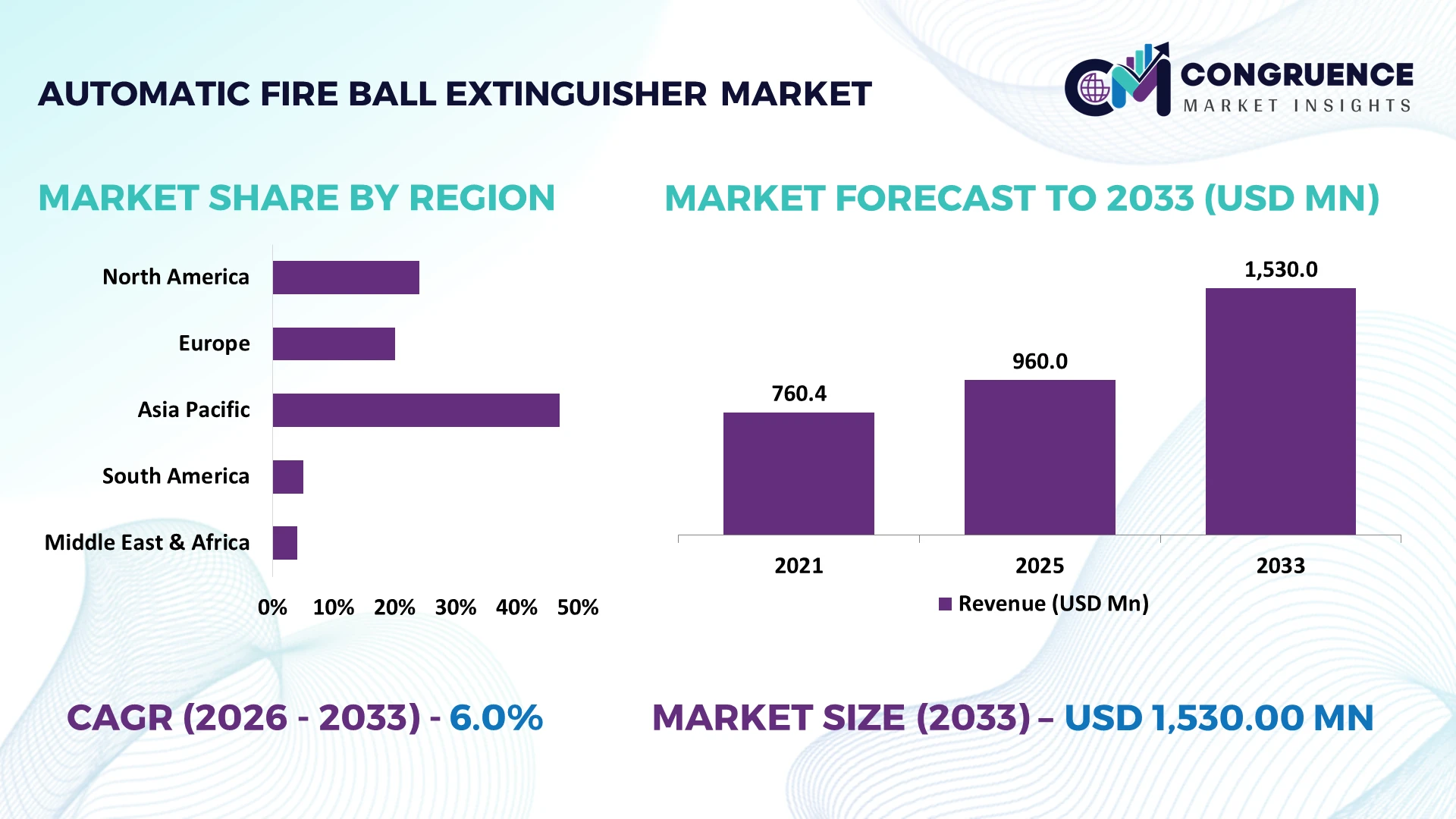
The Global Automatic Fire Ball Extinguisher Market was valued at USD 960 Million in 2025 and is anticipated to reach a value of USD 1530 Million by 2033 expanding at a CAGR of 6% between 2026 and 2033. Growth is being accelerated by stricter industrial fire safety compliance, wider deployment in warehouses and electrical infrastructure, and increased adoption of autonomous fire suppression systems across commercial and residential facilities.
China remains the dominant country with approximately 34% of global manufacturing capacity, supported by sustained investments in industrial safety equipment and electronics production, while Japan accounts for nearly 18% of advanced fire protection technology deployment through automation-focused facilities. Following ongoing supply chain diversification across Asia in 2026, Southeast Asian manufacturing adoption has increased by around 12%, strengthening regional production resilience and export competitiveness.
Manufacturers prioritizing certified automation, localized production, and technology-driven product differentiation are positioned to secure stronger contracts across industrial, infrastructure, and institutional fire protection projects.
Market Size & Growth: USD 960 Million in 2025, projected to reach USD 1530 Million by 2033 at 6% CAGR, driven by expanding automated fire safety installations across industrial facilities.
Top Growth Drivers: Industrial safety upgrades (+24%), warehouse automation (+19%), and electrical infrastructure expansion (+17%) continue accelerating global demand.
Short-Term Forecast: By 2028, installation time declines by 18% while inspection efficiency improves by 22% through standardized deployment practices.
Emerging Technologies: AI-enabled monitoring, IoT-connected fire detection, and advanced extinguishing compounds improve response accuracy by nearly 20%.
Regional Leaders: Asia Pacific approaches USD 620 Million, Europe exceeds USD 360 Million, and North America reaches nearly USD 310 Million, supported by stronger commercial safety adoption.
Consumer/End-User Trends: More than 46% of new warehouse and logistics facilities integrate automatic fire ball extinguishers into layered fire protection systems.
Pilot/Case Example: A 2026 industrial warehouse deployment reduced first-response fire intervention time by approximately 35% through autonomous activation.
Competitive Landscape: Leading manufacturers collectively control around 42% market share, with AFO Fire Extinguisher, Elide Fire, FireEx, Ceasefire, and Safelincs strengthening global expansion.
Regulatory & ESG Impact: Updated fire safety regulations improve compliance rates by roughly 16% while supporting lower maintenance requirements across commercial facilities.
Investment & Funding: More than USD 420 Million supports manufacturing expansion, strategic partnerships, and regional production diversification amid global supply chain realignment.
Innovation & Future Outlook: Smart connected extinguishers, recyclable materials, and predictive maintenance platforms increase lifecycle efficiency by over 21%, reinforcing next-generation fire protection strategies.
Automatic Fire Ball Extinguisher Market demand is expanding across industrial manufacturing, logistics centers, power distribution facilities, and commercial buildings where rapid autonomous fire suppression improves operational continuity. Recent innovations include IoT-enabled monitoring, enhanced extinguishing compounds, and compact certified designs, while smart product integration has increased by nearly 20%. Strengthened fire safety regulations and regional manufacturing diversification in 2026 continue supporting product deployment, setting the foundation for broader strategic market expansion.
The Automatic Fire Ball Extinguisher Market is becoming strategically important as manufacturers, facility operators, and infrastructure developers prioritize autonomous fire protection to reduce operational disruption and strengthen workplace safety. Industrial supply-chain restructuring across Asia and higher compliance standards for warehouses, energy assets, and manufacturing facilities are accelerating deployment decisions. Companies are increasingly integrating passive fire suppression products into broader risk management strategies to improve asset resilience and minimize emergency response dependence.
Modern automatic fire ball extinguishers provide approximately 30% faster initial fire response than conventional handheld extinguishers by activating without manual intervention, while reducing routine maintenance requirements by nearly 18% through simplified inspection processes. China leads large-scale manufacturing and cost-efficient production, whereas Japan emphasizes innovation through advanced testing standards and higher adoption in automated industrial facilities. Over the next two to three years, smart fire safety integration is expected to increase by nearly 22%, supported by digital facility management platforms and connected building infrastructure.
A 2026 logistics warehouse deployment combining automatic fire ball extinguishers with intelligent fire detection reduced localized fire damage by approximately 27% and improved operational continuity. Manufacturers are expanding certified production capacity, strengthening distributor partnerships, and investing in product standardization to address institutional demand. Businesses establishing scalable, compliance-ready portfolios with localized manufacturing capabilities will strengthen competitive positioning and secure long-term procurement opportunities.
Industrial modernization and stricter fire protection requirements are driving faster deployment of automatic fire ball extinguishers across manufacturing, logistics, and commercial infrastructure. More than 48% of newly developed warehouse facilities now incorporate autonomous fire suppression components within layered safety systems, while automated industrial facilities have improved fire response efficiency by nearly 26%. China's continued expansion of advanced manufacturing and India's industrial infrastructure upgrades are increasing demand for certified passive fire protection products. This structural shift encourages manufacturers to expand production capacity, introduce internationally certified product portfolios, and establish strategic distribution partnerships. Companies investing in localized manufacturing and application-specific product innovation are securing stronger positions in institutional procurement and industrial safety projects.
Compliance variation across national fire safety standards continues to slow product commercialization and cross-border deployment. Certification timelines have extended by nearly 15% in several regulated markets, while specialized component costs remain approximately 12% above pre-disruption levels due to electronic and chemical material supply constraints. Manufacturers operating across multiple jurisdictions face higher testing, documentation, and product adaptation costs, reducing deployment efficiency and margin flexibility. Companies are responding through supplier diversification, localized component sourcing, and long-term procurement agreements to stabilize production. Businesses capable of harmonizing certification processes while reducing dependence on imported components gain stronger operational resilience and improve delivery consistency in competitive industrial contracts.
The integration of automatic fire ball extinguishers into intelligent building ecosystems is creating new commercial opportunities beyond traditional industrial applications. Connected fire safety platforms improve maintenance efficiency by approximately 24%, while predictive inspection technologies reduce manual monitoring requirements by nearly 20%. South Korea and Singapore are expanding smart infrastructure programs that increasingly specify connected safety equipment for commercial developments. Manufacturers are investing in IoT-enabled monitoring, digital compliance management, and strategic technology partnerships to differentiate product portfolios. An emerging opportunity lies in retrofit solutions for aging commercial buildings, where simplified installation lowers implementation costs and accelerates adoption without extensive infrastructure modification.
Expanding deployment across different building types requires overcoming integration complexity, installer capability gaps, and evolving technical standards. Around 21% of facility operators report interoperability challenges when combining autonomous fire suppression products with legacy alarm infrastructure, while skilled fire safety technician shortages exceed 16% in several industrial economies. Japan and Germany continue updating advanced building safety requirements, increasing implementation complexity for multinational suppliers. Companies must invest in installer training, standardized digital interfaces, and interoperable product architectures to ensure consistent deployment quality. Organizations that successfully simplify integration while maintaining certification and operational reliability will establish sustainable competitive advantages as intelligent fire protection systems become increasingly standardized.
Smart Fire Protection Integration Modern automatic fire ball extinguishers are increasingly integrated with IoT-enabled fire monitoring platforms, with connected deployment increasing by nearly 23% during 2026. Intelligent building management systems now reduce manual inspection cycles by approximately 18% while improving response verification. Commercial facility operators in Japan and South Korea are standardizing connected safety infrastructure, prompting manufacturers to expand software partnerships and digital monitoring capabilities that improve lifecycle management and operational efficiency.
Localized Manufacturing Expansion Supply-chain diversification is reshaping production strategies as manufacturers reduce dependence on single-country sourcing. Localized component procurement has increased by around 21%, while average delivery lead times have declined by nearly 16% following expanded manufacturing footprints in India and Southeast Asia. Companies are restructuring supplier networks, establishing regional assembly facilities, and strengthening long-term procurement agreements to improve delivery reliability and reduce operational disruptions caused by geopolitical trade adjustments.
Certification-Driven Product Innovation Regulatory updates are accelerating demand for internationally certified fire safety products, with compliance-focused product launches increasing by approximately 19% and third-party testing investments rising by nearly 15%. Manufacturers are redesigning extinguishing compounds, improving activation consistency, and expanding multi-standard certifications to simplify deployment across different markets. This shift strengthens buyer confidence while reducing qualification complexity for industrial contractors and institutional procurement programs.
Compact Industrial Deployment Models Space-efficient fire protection solutions are becoming standard across electrical rooms, logistics hubs, and automated production facilities. Compact installations have increased by approximately 26%, while installation time has declined by nearly 20% through modular deployment practices. Chinese manufacturers are expanding high-volume production and partnering with industrial automation providers, enabling enterprises to improve fire protection coverage without major infrastructure modifications or extended operational downtime.
Dry Powder remains the leading type, accounting for approximately 47% of the Automatic Fire Ball Extinguisher Market due to its broad compatibility across Class A, B, and C fire risks, cost efficiency, and straightforward deployment. Manufacturing plants, warehouses, and electrical installations continue to prioritize Dry Powder solutions because they require minimal infrastructure changes and provide dependable suppression performance. Foam follows as a well-established option for liquid fuel hazards, while Water Mist continues serving specialized applications requiring lower water consumption and reduced collateral damage. Manufacturers are strengthening production capacity and expanding certified product portfolios to address rising institutional procurement requirements.
Clean Agent represents the fastest-growing type as adoption accelerates in data centers, healthcare facilities, and electronics manufacturing where residue-free suppression is operationally critical. Deployment across sensitive electronic environments has increased by approximately 24%, while enterprise demand for clean suppression technologies has risen nearly 18%. Companies are investing in environmentally responsible extinguishing formulations, strategic technology partnerships, and premium product differentiation to strengthen competitiveness. This shift is redirecting investment toward high-value, technology-focused fire protection solutions while preserving Dry Powder's leadership in high-volume industrial deployments.
Industrial applications hold the largest share at approximately 44% as manufacturing plants, warehouses, energy facilities, and processing industries require autonomous fire suppression to minimize production interruptions and strengthen workplace safety. Industrial operators increasingly integrate automatic fire ball extinguishers within layered fire protection systems, improving emergency response efficiency by nearly 27%. Commercial buildings remain a significant deployment area due to stricter building safety compliance, while Residential adoption continues expanding through simplified installation and greater consumer awareness. Automotive applications maintain a specialized role in fleet safety and transport equipment protection.
Commercial represents the fastest-growing application as smart buildings, logistics centers, and institutional facilities expand intelligent safety infrastructure. Commercial installations have increased by around 22%, supported by digital facility management and integrated fire monitoring technologies. Companies are responding through distribution expansion, customized installation packages, and partnerships with building automation providers. Demand is shifting toward scalable fire protection platforms that combine autonomous suppression with connected safety management, strengthening operational continuity across high-occupancy and asset-intensive environments.
Manufacturing accounts for approximately 41% of total end-user demand because continuous production environments require dependable autonomous fire protection to reduce operational downtime and protect high-value equipment. Large industrial facilities increasingly standardize automatic fire ball extinguishers across production lines, electrical control rooms, and storage zones, improving facility preparedness by nearly 25%. Oil & Gas remains a strategic segment due to elevated fire risk, while Government agencies continue investing in public infrastructure protection. Transportation supports steady adoption through logistics facilities, rail operations, and fleet maintenance centers.
Healthcare is the fastest-growing end-user segment as hospitals, laboratories, and pharmaceutical manufacturing facilities prioritize residue-free, rapid-response fire suppression for sensitive environments. Healthcare deployments have increased by approximately 21%, while customized fire safety solutions have improved compliance efficiency by nearly 17%. Manufacturers are developing sector-specific products, expanding channel partnerships, and offering application-focused certification support. Competitive positioning increasingly depends on tailoring fire protection solutions to operational risk profiles rather than supplying standardized products across every industry.
Asia-Pacific accounted for the largest market share at 42% in 2025 however, Middle East & Africa is expected to register the fastest growth, expanding at a 7.4% CAGR between 2026 and 2033.
Industrial Compliance and Smart Facility Integration Drive Deployment
North America represents approximately 24% of global market demand, supported by strict fire protection standards, advanced warehouse infrastructure, and widespread automation across manufacturing and logistics facilities. Enterprises increasingly deploy automatic fire ball extinguishers within integrated fire safety ecosystems to reduce operational interruptions and improve asset protection. More than 44% of new distribution centers incorporate autonomous fire suppression solutions during facility development. Investments in smart buildings and industrial modernization continue accelerating product adoption, while distributors strengthen partnerships with facility management providers and safety integrators. Companies are prioritizing certified products, localized inventories, and digital inspection capabilities to shorten deployment timelines and improve compliance efficiency across commercial and industrial facilities.
United States Market Outlook: The United States remains the region's largest market due to extensive industrial infrastructure, advanced logistics networks, and continuous investment in workplace safety modernization. Approximately 49% of large warehouse expansion projects now specify autonomous fire suppression solutions within integrated safety systems. Domestic manufacturers continue expanding certified product portfolios, strengthening installer networks, and collaborating with commercial construction firms to accelerate deployment across manufacturing plants, distribution hubs, educational institutions, and critical infrastructure.
Regulatory Modernization Strengthens Certified Product Adoption
Europe accounts for nearly 23% of global demand, supported by rigorous fire safety regulations, modernization of commercial buildings, and expanding industrial automation. Enterprises increasingly prioritize certified autonomous fire suppression technologies to simplify compliance while reducing maintenance complexity. Around 28% of commercial refurbishment projects now include upgraded automated fire safety equipment. Sustainability objectives are encouraging manufacturers to introduce environmentally responsible extinguishing agents and recyclable product designs. Companies continue investing in product certification, distribution partnerships, and localized technical support, strengthening deployment across manufacturing, transportation, healthcare, and public infrastructure while improving long-term operational reliability.
Germany Market Outlook: Germany leads the European market through its strong manufacturing ecosystem, engineering expertise, and advanced industrial automation. Nearly 31% of newly upgraded industrial facilities integrate automated fire protection solutions into digital factory environments. Domestic enterprises emphasize precision engineering, internationally certified products, and collaborative innovation with industrial equipment manufacturers, strengthening competitive positioning across both domestic deployment and export-oriented markets.
Manufacturing Scale and Infrastructure Expansion Reinforce Leadership
Asia-Pacific contributes approximately 42% of global market activity through its extensive manufacturing base, expanding industrial infrastructure, and large-scale commercial construction. Industrial parks, logistics hubs, and electronics manufacturing facilities continue accelerating deployment of autonomous fire suppression systems. Manufacturing capacity has expanded by approximately 18% across key production hubs during 2026, supported by localized component sourcing and export-oriented production strategies. Companies are investing in production automation, regional assembly facilities, and certification capabilities to improve delivery speed while strengthening supply-chain resilience. Strong infrastructure investment and industrial expansion continue positioning the region as the global production and deployment center.
China Market Outlook: China maintains regional leadership through large-scale manufacturing capacity, extensive electronics production, and continuous industrial infrastructure expansion. Approximately 34% of worldwide manufacturing capacity for automatic fire ball extinguishers is concentrated within the country. Domestic manufacturers are expanding automated production lines, strengthening export partnerships, and improving product certification to serve international industrial, commercial, and institutional fire protection requirements with greater operational efficiency.
Industrial Infrastructure Upgrades Support Market Expansion
South America represents an emerging deployment market where industrial modernization, mining operations, logistics expansion, and commercial construction are strengthening demand for autonomous fire protection. Approximately 14% of newly commissioned industrial facilities now incorporate automated fire suppression products during initial installation. Infrastructure limitations and uneven regulatory implementation continue influencing deployment speed, yet enterprise investment remains focused on operational risk reduction. Companies are expanding distributor partnerships, improving technical service capabilities, and localizing inventories to support industrial customers while reducing procurement delays across key manufacturing and infrastructure projects.
Brazil Market Outlook: Brazil serves as the largest national market because of its diversified manufacturing sector, expanding logistics infrastructure, and substantial mining and energy industries. Industrial safety upgrades have increased deployment by nearly 19% across selected manufacturing facilities. Local distributors continue strengthening partnerships with global manufacturers while investing in technical certification and after-sales support to improve installation quality and long-term customer retention.
Infrastructure Investment Accelerates Fire Safety Modernization
Middle East & Africa is experiencing rapid deployment driven by large infrastructure developments, energy investments, airport expansion, and commercial real estate modernization. Large construction projects increasingly specify autonomous fire protection technologies to improve operational resilience and meet evolving safety requirements. Deployment across newly developed commercial facilities has increased by approximately 24%, supported by modernization initiatives and industrial diversification strategies. Companies are expanding regional distribution centers, strengthening engineering partnerships, and establishing localized service capabilities to improve project execution while supporting large institutional procurement programs.
Saudi Arabia Market Outlook: Saudi Arabia leads regional demand through extensive infrastructure investment, industrial diversification, and large-scale commercial developments. Nearly 27% of major industrial expansion projects include upgraded autonomous fire protection systems during construction planning. Manufacturers and distributors continue expanding strategic partnerships with engineering contractors while strengthening local inventories and technical training programs to support national industrial development initiatives and high-value infrastructure projects.
The market is led by AFO Fire Extinguisher, Elide Fire, Ceasefire Industries, FireEx, and Safelincs, competing against regional manufacturers focused on cost-efficient production and localized distribution. The top five players collectively account for approximately 42% of global market activity. Global leaders differentiate through certified technologies, international distribution, and product reliability, while regional competitors compete aggressively on pricing, reducing procurement costs by nearly 12%. Technology-focused manufacturers improve activation consistency by approximately 18%, whereas supply-chain optimization shortens delivery cycles by almost 16%. Competition increasingly centers on manufacturing expansion, certification upgrades, strategic distributor partnerships, and selective vertical integration to secure institutional contracts. The competitive landscape is shifting toward intelligent fire safety integration and standardized global compliance, raising technical qualification requirements for new entrants. Strong certification capability, dependable supply networks, rapid product customization, and scalable manufacturing remain essential for outperforming established competitors in industrial and commercial procurement.
AFO Fire Extinguisher
Elide Fire Ball
Ceasefire Industries
FireEx
Safelincs
Fire Shield Systems
Lifeguard Fire Safety
Kanex Fire
Newage Fire Protection
Britannia Fire
Minimax
Protec Fire Detection PLC
FlameStop Australia
Firechief Global
Automatic fire ball extinguishers are increasingly built around advanced ABC dry chemical formulations, precision thermal activation mechanisms, and maintenance-free designs that improve early-stage fire suppression reliability. Modern activation systems reduce response time by approximately 22% compared with conventional manually operated extinguishers, while optimized extinguishing compounds improve suppression efficiency by nearly 18%. Around 48% of new industrial warehouse deployments now integrate autonomous fire suppression devices as part of layered fire protection strategies, strengthening operational continuity and reducing dependence on immediate human intervention.
Emerging technologies include IoT-enabled monitoring, RFID-based inspection tracking, and intelligent facility management integration. Connected fire safety platforms improve inspection efficiency by nearly 20%, while digital asset management lowers maintenance planning costs by approximately 15%. Adoption of smart monitoring functions has reached nearly 27% across high-value commercial and manufacturing facilities. Companies are combining autonomous suppression products with cloud-based compliance platforms and predictive maintenance software, creating stronger operational visibility and simplifying enterprise-wide fire safety management.
Disruptive innovation between 2026 and 2028 will focus on AI-assisted risk analytics, environmentally improved extinguishing agents, and modular fire protection ecosystems. Compared with legacy standalone fire extinguishers, connected autonomous systems deliver approximately 30% faster incident response and stronger compliance management. Technology leaders investing in intelligent safety integration, digital certification, and localized automated manufacturing gain competitive advantages over cost-focused suppliers. Organizations acting now secure higher operational resilience, stronger regulatory readiness, and differentiated value in industrial, commercial, and institutional fire protection markets.
March 2025 Elide Fire Australia expanded promotion of its automatic fire suppression portfolio for residential, commercial, and vehicle applications, highlighting activation within 3–10 seconds and maintenance-free operation for up to 5 years, strengthening distributor-led market expansion. Source: https://elidefire.com.au
August 2025 Elide Fire Australia increased its focus on warehouse and industrial fire protection, emphasizing automatic activation technology covering up to 2.5 cubic meters per unit, reinforcing adoption across logistics and manufacturing facilities. Source: https://elidefire.com.au
October 2025 El Gendi Group and the Arab Organization for Industrialization signed a cooperation agreement to establish a manufacturing facility for smart fire systems integrating automatic fire extinguishing technology with alarm and control platforms, strengthening domestic production capabilities. Source: https://elidefiremea.com
February 2026 ELIDE FIRE announced continued product availability with fire extinguishing balls carrying a service life through July 2031, supporting long-term deployment planning and sustained replacement cycles for distributors and industrial users. Source: https://fireball.co.jp
The report provides comprehensive analysis of the Automatic Fire Ball Extinguisher Market across product types, applications, end-users, competitive positioning, technology developments, and regional deployment trends between 2026 and 2033. It evaluates Dry Powder, Foam, Clean Agent, and Water Mist technologies across Residential, Commercial, Industrial, and Automotive applications, together with demand from Manufacturing, Oil & Gas, Transportation, Healthcare, and Government sectors. The assessment covers more than 20 countries across five major regions while examining deployment patterns, certification trends, and technology adoption levels exceeding 45% in advanced industrial facilities.
The study also evaluates manufacturing strategies, supply-chain developments, smart fire safety integration, and competitive benchmarking among leading market participants. Strategic insights include technology adoption, regional expansion priorities, investment positioning, procurement trends, and product innovation supporting enterprise decision-making. Coverage extends to emerging intelligent fire protection systems, digital inspection technologies, and localized manufacturing initiatives, enabling stakeholders to identify high-potential growth segments, optimize expansion strategies, strengthen competitive positioning, and prepare for evolving operational and regulatory requirements through 2033.
| Report Attribute/Metric | Report Details |
|---|---|
Market Revenue in 2025 | USD 960 Million |
Market Revenue in 2033 | USD 1530 Million |
CAGR (2026 - 2033) | 6% |
Base Year | 2025 |
Forecast Period | 2026 - 2033 |
Historic Period | 2021 - 2025 |
Segments Covered | By Type
By Application
By End-User
|
Key Report Deliverable | Revenue Forecast, Growth Trends, Market Dynamics, Segmental Overview, Regional and Country-wise Analysis, Competition Landscape |
Region Covered | North America, Europe, Asia-Pacific, South America, Middle East, Africa |
Key Players Analyzed | AFO Fire Extinguisher, Elide Fire Ball, Ceasefire Industries, FireEx, Safelincs, Fire Shield Systems, Lifeguard Fire Safety, Kanex Fire, Newage Fire Protection, Britannia Fire, Minimax, Protec Fire Detection PLC, FlameStop Australia, Firechief Global |
Customization & Pricing | Available on Request (10% Customization is Free) |




