
Reports
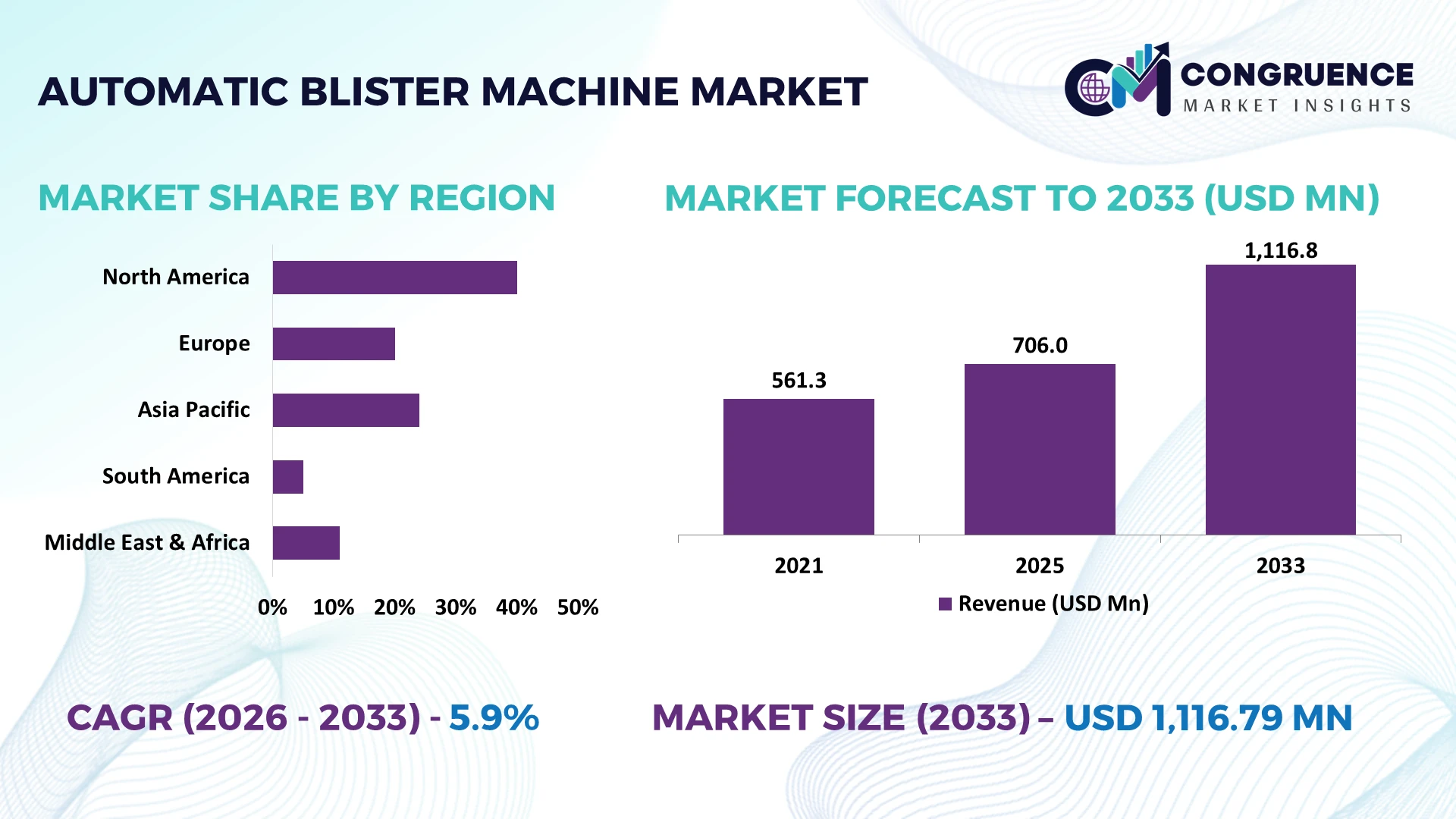
The Global Automatic Blister Machine Market was valued at USD 706 Million in 2025 and is anticipated to reach a value of USD 1116.79 Million by 2033 expanding at a CAGR of 5.9% between 2026 and 2033. Growth is driven by pharmaceutical packaging automation, rising unit-dose production, serialization requirements, and replacement of labor-intensive blister lines with high-speed servo-controlled systems.
China holds an estimated 31% share of global automatic blister-machine production capacity, supported by pharmaceutical, nutraceutical, and contract-packaging industries, with automation adoption exceeding 65% across newer facilities. India follows at roughly 14% capacity, accelerated by pharmaceutical exports and packaging modernization. EU GMP upgrades and supply-chain diversification since geopolitical disruptions have further increased investment in automated lines.
Strategically, manufacturers prioritizing servo automation, digital inspection, and flexible format changeovers gain stronger productivity and compliance advantages.
Market Size & Growth: USD 706 Million in 2025 is projected to reach USD 1116.79 Million by 2033 at a 5.9% CAGR, driven by pharmaceutical automation and high-speed packaging upgrades.
Top Growth Drivers: Pharmaceutical packaging automation contributes 28%, serialization-driven upgrades 22%, and contract packaging expansion 17% of growth momentum.
Short-Term Forecast: By 2028, automated format-change systems are set to reduce changeover costs by 12% and improve line efficiency by 9%.
Emerging Technologies: AI-based vision inspection, servo robotics, and recyclable high-barrier materials are advancing smart blister production.
Regional Leaders: Asia-Pacific is projected at USD 520 Million, Europe at USD 285 Million, and North America at USD 250 Million, with automation penetration accelerating across pharmaceutical plants.
Consumer/End-User Trends: More than 62% of pharmaceutical packaging operations increasingly prioritize unit-dose formats, traceability, and tamper-evident protection.
Pilot/Case Example: A 2025 pharmaceutical packaging modernization project using robotic feeding and AI inspection delivered a 14% reduction in packaging defects.
Competitive Landscape: China leads manufacturing capacity at approximately 31%, with key competition from Uhlmann, Marchesini Group, IMA, Romaco, and Mediseal.
Regulatory & ESG Impact: Serialization and GMP compliance programs are pushing automated inspection adoption above 60%, while recyclable-material integration targets packaging-waste reductions of 10%.
Investment & Funding: Global pharmaceutical packaging automation investment exceeds USD 1.8 Billion annually, emphasizing factory expansion, robotics partnerships, digital inspection, and flexible production platforms.
Innovation & Future Outlook: Next-generation lines combine AI quality control, predictive maintenance, robotic loading, and recyclable substrates, shifting competition toward connected, low-waste, rapid-changeover packaging systems.
Automatic blister machines are gaining strongest demand across pharmaceuticals, nutraceuticals, medical products, and contract packaging, where precise dosing, tamper resistance, and traceability are critical. Servo-driven systems and integrated vision inspection are improving production performance, while recyclable blister substrates are gaining traction, with adoption approaching 25% in newer packaging programs. Supply-chain diversification following geopolitical disruptions is accelerating regional equipment deployment and modernization, strengthening the strategic importance of flexible, compliant packaging capacity.
Automatic blister machines are becoming strategic production assets as pharmaceutical manufacturers prioritize traceability, flexible packaging, and higher line utilization rather than standalone packaging capacity. Serialization, GMP enforcement, and digital quality controls are accelerating replacement of semi-automatic equipment. Servo-driven lines typically deliver 8–12% higher throughput and reduce format-change time by 15–20% versus legacy mechanical systems, improving asset utilization and lowering labor intensity.
China commands greater manufacturing scale, while Germany and Italy lead in precision engineering, robotics integration, and high-speed pharmaceutical packaging platforms. India is rapidly expanding deployment as pharmaceutical exporters modernize plants for regulated markets. Over the next 2–3 years, connected inspection, predictive maintenance, and automated material handling are positioned to lift overall equipment effectiveness by 7–10%, while recyclable blister substrates gain adoption as manufacturers respond to sustainability targets.
A practical deployment model combines automatic feeding, servo forming, robotic cartoning interfaces, and machine-vision inspection within one production cell. Companies are redirecting capital toward modular equipment, remote diagnostics, and multi-format tooling, while machine builders are strengthening partnerships with pharmaceutical CDMOs and packaging-material suppliers. Competitive positioning increasingly depends on flexible automation, compliance-ready architecture, and lower lifecycle operating costs.
Pharmaceutical serialization, GMP modernization, and contract manufacturing expansion are strengthening demand for automatic blister platforms. Newer systems can improve throughput by 10–15% and reduce manual intervention by approximately 20%, while integrated vision inspection cuts packaging-error exposure by nearly 8%. India’s expanding export-oriented pharmaceutical base is increasing investment in automated packaging lines designed for regulated markets. Manufacturers are responding with servo-controlled equipment, automated feeding, and digital batch monitoring. The non-obvious advantage is higher production flexibility: modular tooling enables manufacturers to switch formats faster, allowing one line to serve multiple SKUs without proportionally increasing equipment footprints.
Automatic blister systems require substantial upfront investment, while precision components, servo drives, forming tools, and control electronics can represent 25–35% of equipment value. Imported components expose manufacturers in India and Southeast Asia to currency movements, logistics disruptions, and extended replacement cycles. Tooling and validation requirements can add 10–15% to installation expenditure for regulated pharmaceutical facilities. Companies are reducing exposure through multi-year supplier contracts, localized maintenance inventories, and dual sourcing of critical components. The sharper constraint is not equipment availability but lifecycle economics: smaller producers often delay automation when utilization remains below 60%, weakening the payback case and slowing modernization.
AI-enabled vision inspection, predictive maintenance, and digitally managed format changes create an opportunity to convert blister machines into connected production assets. Predictive analytics can reduce unplanned downtime by 10–15%, while automated changeovers can improve line availability by 8–12%. India, China, and Southeast Asian pharmaceutical hubs offer strong opportunities as manufacturers expand export-compliant capacity. Recyclable high-barrier films are also creating new equipment requirements, particularly for precise forming and sealing control. Machine builders are investing in modular architectures and software partnerships to capture this shift. A distinctive opportunity lies in shared multi-SKU lines, enabling CDMOs to increase equipment utilization without duplicating dedicated packaging infrastructure.
Advanced blister lines increasingly combine robotics, machine vision, PLC controls, serialization software, and manufacturing execution systems, making integration complexity a material execution barrier. Commissioning errors can extend ramp-up periods by 10–20%, while shortages of automation specialists affect maintenance responsiveness and uptime. European pharmaceutical hubs face stringent validation requirements, whereas fast-expanding facilities in India must simultaneously build technical capabilities and digital infrastructure. Companies are addressing the challenge through vendor-managed commissioning, remote diagnostics, operator certification, and predictive maintenance programs. The strategic issue is interoperability: equipment that cannot communicate reliably with plant-level systems limits digital performance gains, forcing buyers to prioritize open architectures and standardized data interfaces.
AI Inspection Moves Upstream: AI-enabled vision systems are moving from final inspection toward in-line defect prevention, with adoption rising around 12–15% in newly automated pharmaceutical lines. Companies are integrating cameras with servo controls to reduce reject rates by 8–10% and tighten batch consistency.
Flexible Changeovers Gain Priority: Multi-format production is increasing as manufacturers manage shorter SKU cycles and contract-packaging workloads. Servo-driven changeover systems are cutting setup time by 15–20%, while modular tooling reduces format-related downtime by roughly 10%. Indian and European plants are prioritizing flexible lines over single-format capacity.
Connected Machines Reshape Service: Remote monitoring, predictive alerts, and digital HMIs are becoming standard procurement requirements, particularly where skilled technicians are scarce. Approximately 20% of newer installations now emphasize connected diagnostics, helping reduce unplanned downtime by 8–12%. OEMs are expanding remote-support partnerships rather than relying solely on field-service teams.
Sustainable Materials Alter Line Design: Recyclable and lower-material blister structures are gaining attention as packaging regulations tighten and pharmaceutical companies reassess material footprints. Around 10–15% of new equipment specifications increasingly address material compatibility, sealing precision, or waste control. PMMI’s 2026 pharmaceutical manufacturing research identifies sustainability, digitization, and equipment connectivity as key packaging priorities, reinforcing the shift toward adaptable machinery.
Rotary machines represent the leading type at approximately 31% market share, supported by continuous feeding, high output, and strong suitability for pharmaceutical tablet and capsule runs. Their production efficiency is typically 12–18% higher than conventional flatbed configurations at sustained volumes, making them attractive for large Indian and Chinese manufacturing plants. Flatbed systems retain relevance where lower volumes, frequent format changes, and simpler tooling economics matter. Automatic systems capture broader adoption through integrated feeding and sealing, while servo-driven machines are gaining fastest, expanding at an estimated 14% adoption rate as manufacturers seek precision motion control and shorter changeovers.
Continuous systems remain strategically important for high-throughput environments, particularly where production consistency outweighs tooling flexibility. Companies are shifting capital toward servo-driven and continuous platforms, with automation-focused investments increasing roughly 10–13% as plants prioritize OEE, reduced manual intervention, and scalable multi-SKU production.
Tablet Packaging leads with approximately 44% market share because tablets require high-speed counting, precise cavity formation, sealing consistency, and dependable batch traceability. Automated tablet lines can reduce manual handling by roughly 20% and improve packaging throughput by 10–15% compared with labor-intensive configurations. Capsule Packaging follows as a mature application, while Medical Device Packaging maintains specialized demand where sterile-barrier integrity and controlled sealing are critical. Companies are increasingly specifying vision inspection and serialization-ready controls across pharmaceutical packaging cells.
Nutraceutical Packaging is the fastest-growing application, with adoption increasing around 13–16% as supplement manufacturers expand SKU portfolios and require shorter production runs. Flexible blister equipment allows rapid tooling changes and tighter batch control, improving asset utilization by approximately 8–10%. Manufacturers are responding through modular platforms, contract-packaging partnerships, and scalable automation. The strategic shift is toward equipment capable of handling diverse formulations without sacrificing pharmaceutical-grade inspection and traceability.
Pharmaceutical Companies account for approximately 58% of automatic blister machine demand, reflecting high production volumes, stringent validation requirements, and continuous dependence on controlled packaging environments. Their automated lines typically target 10–15% higher throughput and 8–12% lower manual intervention than legacy configurations. Nutraceutical Manufacturers are expanding faster, with adoption rising around 15% as product portfolios diversify and premium unit-dose formats gain traction. Medical Device Manufacturers remain specialized buyers, emphasizing barrier integrity and validated sealing rather than maximum speed.
Contract Packaging Companies are strengthening their position through multi-client, multi-format production, with equipment utilization targets frequently exceeding 70%. Their purchasing decisions increasingly favor modular tooling, rapid changeovers, and remote diagnostics. Pharmaceutical companies are prioritizing high-capacity validated systems, while CDMOs and contract packagers are investing in flexible platforms and OEM service agreements. This divergence is shifting competitive advantage toward suppliers able to customize machines, integrate inspection systems, and support diverse production environments.
Asia-Pacific accounted for the largest market share at 44% in 2025 however, Middle East & Africa is expected to register the fastest growth, expanding at a CAGR of 7.1% between 2026 and 2033.
Pharmaceutical modernization shifts toward integrated, compliant packaging
North America holds approximately 21% of global automatic blister machine demand, concentrated heavily in U.S. pharmaceutical manufacturing and contract packaging facilities. Deployment is increasingly tied to serialization, electronic batch documentation, vision inspection, and flexible packaging lines rather than standalone equipment replacement. U.S. manufacturers are prioritizing automated lines capable of supporting multiple SKUs, with integrated inspection systems reducing manual quality checks by roughly 15%. Contract packaging expansion is also encouraging investment in modular equipment and remote diagnostics. Workforce shortages are accelerating automation across packaging operations, while tighter quality expectations favor validated machine platforms. Suppliers are responding through service partnerships, local spare-parts inventories, and integrated cartoning solutions, strengthening lifecycle support as a competitive differentiator.
United States Market Outlook: The United States remains the region’s principal deployment center because of its large pharmaceutical manufacturing base, sophisticated CDMO network, and stringent compliance environment. High-value facilities increasingly specify serialization-ready equipment, automated inspection, and rapid changeover capabilities. Demand is particularly strong where multi-product production requires consistent validated performance.
Engineering leadership meets sustainability-driven modernization
Europe represents approximately 24% of global automatic blister machine demand, supported by Germany, Italy, Switzerland, and the United Kingdom. The region remains a major production and technology center, with pharmaceutical machinery manufacturers emphasizing robotics, servo motion, digital inspection, and high-speed continuous operation. Sustainability requirements are increasingly influencing equipment specifications, particularly compatibility with recyclable or lower-material blister structures. Newer installations can improve line availability by approximately 8–12% through automated changeovers and predictive monitoring. Germany and Italy retain strong equipment-engineering concentration, while manufacturers across Western Europe are upgrading older lines to satisfy stricter documentation and environmental requirements. OEMs are responding through modular machine architecture, integrated digital controls, and partnerships with packaging-material developers.
Germany Market Outlook: Germany maintains a strong position through advanced pharmaceutical engineering, automation expertise, and a dense supplier ecosystem. Manufacturers increasingly combine robotics, vision systems, and digital quality controls within validated packaging environments. Investment emphasis is shifting toward high-speed flexible lines capable of supporting multiple formats while maintaining rigorous documentation and process consistency.
Scale advantage accelerates localized automation deployment
Asia-Pacific commands approximately 44% of global automatic blister machine demand, with China and India providing the strongest manufacturing and deployment bases. China combines extensive machinery production capacity with competitive equipment pricing, while India is rapidly expanding pharmaceutical packaging infrastructure for domestic and export-oriented production. Indian manufacturers produce an estimated 225–250 blister machines annually, demonstrating substantial local engineering capability. Automation adoption is accelerating as pharmaceutical plants pursue higher throughput, reduced manual handling, and compliance-ready packaging. Chinese and Indian suppliers increasingly compete through shorter delivery cycles, localized service, and customized tooling. Equipment capable of 300–600 blisters per minute is becoming increasingly relevant for high-volume facilities, strengthening demand for servo-driven and continuous systems. (Express Pharma)
China Market Outlook: China remains the region’s largest equipment manufacturing base, combining extensive pharmaceutical production with a mature machinery supply chain. Domestic OEMs compete strongly on price, customization, and delivery speed, while pharmaceutical facilities increasingly adopt servo-controlled systems and integrated inspection. This combination supports both domestic deployment and growing equipment exports.
Import dependence drives selective modernization
South America accounts for approximately 7% of global automatic blister machine demand, with Brazil representing the principal deployment and pharmaceutical manufacturing center. Equipment purchases remain concentrated among established pharmaceutical companies and contract packaging operations that require reliable tablet and capsule packaging. Brazilian facilities are increasingly adopting automated feeding and inspection, with newer installations targeting 8–10% higher production efficiency than legacy mechanical lines. Import dependence for sophisticated machinery and components continues to lengthen procurement cycles, encouraging distributors and OEMs to strengthen local technical support. Companies are favoring modular equipment that can accommodate multiple formats without major infrastructure changes. Brazil’s pharmaceutical expansion is therefore creating demand for adaptable machines, while suppliers with regional service networks gain an advantage over purely export-oriented vendors.
Brazil Market Outlook: Brazil leads South American deployment because of its pharmaceutical manufacturing scale, established industrial infrastructure, and concentration of large drug producers. Manufacturers increasingly prioritize validated blister systems, automated inspection, and flexible tooling. Local service availability remains a critical purchasing factor because imported equipment requires faster technical response and dependable spare-parts access.
Pharmaceutical localization drives infrastructure investment
Middle East & Africa represents approximately 4% of global automatic blister machine demand but is emerging as a significant equipment-modernization zone. Saudi Arabia, the United Arab Emirates, South Africa, and Egypt are expanding pharmaceutical manufacturing and packaging capabilities, increasing demand for GMP-oriented automation. New facilities increasingly specify automated blister lines with serialization and inspection capabilities, while local production initiatives are reducing dependence on imported finished medicines. Equipment deployment is still uneven, with advanced facilities operating alongside labor-intensive packaging operations. Companies are addressing this gap through turnkey installations, distributor partnerships, operator training, and localized maintenance. Investment is increasingly directed toward scalable systems capable of supporting future capacity expansion without replacing core packaging infrastructure.
Saudi Arabia Market Outlook: Saudi Arabia is strategically positioned through pharmaceutical localization programs, modern industrial infrastructure, and investment in domestic drug manufacturing. New production facilities increasingly incorporate automated packaging and digital quality controls from the initial design stage. This approach supports faster compliance readiness and creates demand for integrated blister systems rather than incremental machinery upgrades.
Uhlmann, Marchesini Group, IMA, Romaco, and Mediseal compete primarily through European engineering, while Chinese OEMs and Indian manufacturers compete on price, delivery, localization, and customization. The top five global players are estimated to control about 35% of the market, leaving substantial room for regional specialists. Technology leaders differentiate through servo motion, vision inspection, and integrated cartoning, delivering roughly 8–12% higher line efficiency and 10–15% faster format changes. Cost-focused suppliers typically compete with equipment priced 20–30% below premium European systems, particularly in India and Southeast Asia. Competition is shifting toward localized service, spare-parts availability, and recyclable-material compatibility. Romaco’s Indian format-part localization illustrates the move toward shorter lead times and lower service friction. The main entry barrier remains validated pharmaceutical engineering combined with global after-sales support. Winning requires reliable automation, flexible tooling, competitive lifecycle economics, and local technical infrastructure rather than machine price alone. These capabilities determine procurement decisions and renewals globally.
Uhlmann Pac-Systeme
Marchesini Group
IMA Group
Romaco
Mediseal
Syntegon Technology
ACG
MULTIVAC
OPTIMA Packaging Group
Bausch+Ströbel
MG2
CAM Packaging
Jornen Machinery
Quintess Micron
Automatic blister machines now rely on servo motion, digital HMIs, machine vision, and automated feeding. Servo platforms improve changeover efficiency by 10–15%, while integrated vision cuts inspection labor 8–12%. Deployment is strongest in high-volume pharmaceutical plants, where connected controls improve traceability, batch accuracy, and line stability.
Emerging systems integrate AI-assisted inspection, predictive maintenance, robotic loading, and MES connectivity. Predictive analytics can reduce unplanned downtime 8–10%, while robotic handling improves packaging efficiency 5–7%. Adoption is concentrated in newly modernized plants, with roughly 20–25% of advanced installations incorporating connected monitoring. These capabilities favor premium OEMs with integrated software and service ecosystems, especially pharmaceutical manufacturers seeking validated digital workflows.
Disruptive progress is shifting toward sustainable materials, flexible tooling, and modular lines. Marchesini’s NOVA reaches up to 600 blisters/minute and supports mono-material solutions, while newer servo architectures deliver roughly 10% faster changeovers than legacy mechanical systems. From 2026–2028, integration of vision, robotics, and digital production data will strengthen OEE by 7–10%, reduce manual intervention, and accelerate multi-SKU deployment. Companies acting now gain faster compliance readiness, lower lifecycle costs, stronger customization advantages, and greater resilience against labor shortages and packaging-material volatility. Early adopters also secure shorter commissioning cycles, more predictable maintenance, and better asset utilization.
November 2025 Uhlmann opened its Jakarta branch, strengthening Southeast Asian support and local production capability. The company presented the ECO 350 blister line in Indonesia, expanding service reach for pharmaceutical manufacturers and improving access to blister packaging technology. Source: uhlmann.de
October 2025 Romaco localized Noack blister-machine format-part production in India and prepared the N 950E as a test machine. The initiative shortens delivery times, strengthens customer proximity, and reduces dependence on European format-part supply for Indian pharmaceutical operations. Source: romaco.com
February 2026 IMA added a two-row Sombrero feeding system to its C40 blister machine, expanding layouts for medium-speed production. The upgrade supports broader product variability and continuous feeding, reducing operator intervention and improving deployment flexibility for pharmaceutical manufacturers. Source: ima.it
November 2024 Syntegon showcased SPC 1000 automated monitoring technology, reducing manual environmental-monitoring interventions by 80% and increasing availability by up to 300 hours annually. The development demonstrates automation’s measurable impact on packaging operations, compliance workflows, and labor efficiency. Source: syntegon.com
The report evaluates the Automatic Blister Machine Market across Rotary, Flatbed, Automatic, Servo-Driven, and Continuous machine types, covering Tablet Packaging, Capsule Packaging, Medical Device Packaging, and Nutraceutical Packaging applications. End-user analysis spans Pharmaceutical Companies, Nutraceutical Manufacturers, Medical Device Manufacturers, and Contract Packaging Companies, providing a structured view of purchasing intensity, deployment requirements, and automation priorities.
Geographic coverage includes North America, Europe, Asia-Pacific, South America, and Middle East & Africa, with country-level assessment of manufacturing concentration, technology adoption, infrastructure readiness, and localization. The report examines servo automation, machine vision, robotics, digital controls, sustainable materials, and integrated packaging lines, including niche opportunities in flexible multi-SKU production. Quantitative adoption indicators and competitive positioning support investment planning, capacity expansion, supplier selection, technology prioritization, and strategic positioning through 2026–2033.
| Report Attribute/Metric | Report Details |
|---|---|
Market Revenue in 2025 | USD 706 Million |
Market Revenue in 2033 | USD 1116.79 Million |
CAGR (2026 - 2033) | 5.9% |
Base Year | 2025 |
Forecast Period | 2026 - 2033 |
Historic Period | 2021 - 2025 |
Segments Covered | By Type
By Application
By End-User
|
Key Report Deliverable | Revenue Forecast, Growth Trends, Market Dynamics, Segmental Overview, Regional and Country-wise Analysis, Competition Landscape |
Region Covered | North America, Europe, Asia-Pacific, South America, Middle East, Africa |
Key Players Analyzed | Uhlmann Pac-Systeme, Marchesini Group, IMA Group, Romaco, Mediseal, Syntegon Technology, ACG, MULTIVAC, OPTIMA Packaging Group, Bausch+Ströbel, MG2, CAM Packaging, Jornen Machinery, Quintess Micron |
Customization & Pricing | Available on Request (10% Customization is Free) |




