
Reports
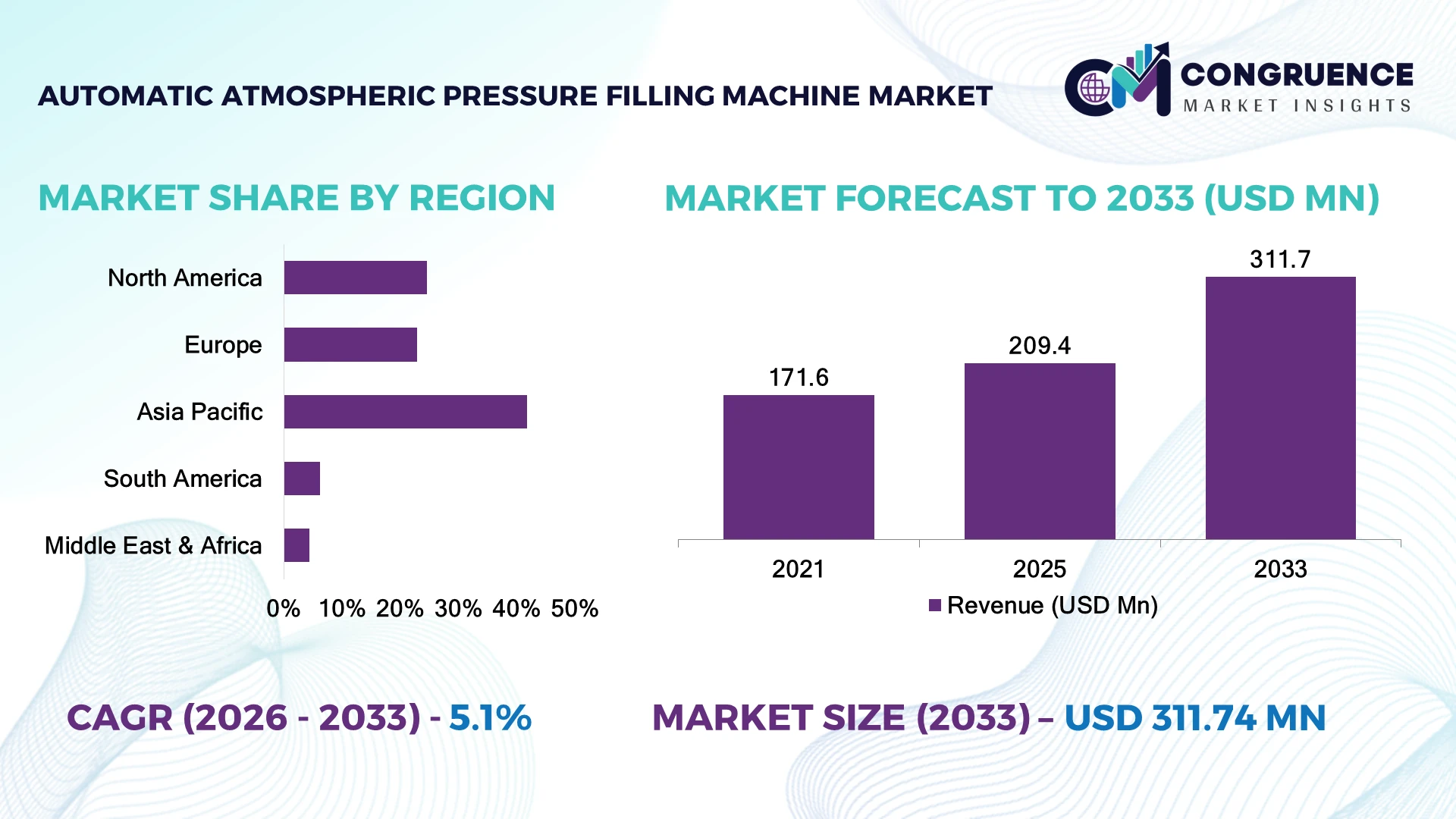
The Global Automatic Atmospheric Pressure Filling Machine Market was valued at USD 209.4 Million in 2025 and is anticipated to reach a value of USD 311.7 Million by 2033 expanding at a CAGR of 5.1% between 2026 and 2033. Growth is driven by expanding automated beverage, pharmaceutical, and personal care packaging lines requiring precise high-speed atmospheric filling with reduced product waste and higher production consistency.
China dominates the global Automatic Atmospheric Pressure Filling Machine Market with nearly 36% manufacturing capacity, supported by over 2,000 packaging equipment producers, strong food and beverage processing industries, and accelerated factory automation under Made in China 2025 initiatives. Compared with Germany, China delivers significantly higher production volumes, while Germany leads in precision engineering and export-oriented technologies with automation adoption exceeding 75% across advanced packaging facilities.
This competitive landscape reinforces Asia-Pacific as the preferred manufacturing hub while encouraging technology partnerships and localized production strategies for global equipment suppliers.
Market Size & Growth: USD 209.4 Million (2025) to USD 311.7 Million (2033) at 5.1% CAGR, supported by smart factory automation and packaging modernization.
Top Growth Drivers: Packaging automation (+34%), food processing expansion (+29%), pharmaceutical production (+23%).
Short-Term Forecast: By 2028, production efficiency rises 18% while maintenance downtime declines 15%.
Emerging Technologies: AI monitoring, servo-driven automation, and IoT-enabled predictive maintenance improve filling precision.
Regional Leaders: Asia-Pacific USD 128 Million, Europe USD 82 Million, North America USD 71 Million with expanding automated packaging adoption.
Consumer/End-User Trends: Over 64% of manufacturers prioritize automated filling systems to improve throughput and product consistency.
Pilot/Case Example: In 2024, a beverage production upgrade improved filling efficiency by 22% and reduced product loss by 14%.
Competitive Landscape: Top manufacturers hold approximately 38% market share, led by Krones AG, Syntegon, GEA Group, Cozzoli Machine Company, and Accutek Packaging Equipment.
Regulatory & ESG Impact: Lightweight packaging initiatives reduce material consumption by nearly 12% while supporting stricter food safety compliance.
Investment & Funding: More than USD 420 Million supports automation expansion, digital manufacturing partnerships, and regional production facilities.
Innovation & Future Outlook: Vision-guided inspection, digital twins, and intelligent production platforms strengthen next-generation packaging competitiveness.
Automatic Atmospheric Pressure Filling Machine Market demand continues expanding across beverage bottling, edible oils, liquid foods, cosmetics, and pharmaceutical packaging operations. Manufacturers are introducing intelligent servo-controlled filling platforms with IoT diagnostics that improve production consistency by nearly 20%. Supply-chain localization and stricter hygiene compliance standards are accelerating investments in flexible, high-speed filling systems, setting the foundation for broader strategic transformation across global packaging operations.
The Automatic Atmospheric Pressure Filling Machine Market has become strategically important as manufacturers compete through production efficiency, digital manufacturing, and flexible packaging capabilities. Packaging companies are restructuring supply chains by establishing regional manufacturing and sourcing networks that reduce delivery lead times while strengthening resilience against geopolitical disruptions. Increasing automation investments are also helping processors standardize quality across multiple production facilities.
Modern servo-driven automatic atmospheric filling machines deliver approximately 18% higher filling accuracy while lowering maintenance requirements by nearly 15% compared with conventional pneumatic equipment. Asia-Pacific continues to expand production capacity through large-scale packaging equipment manufacturing, whereas Europe remains focused on precision engineering, intelligent controls, and advanced hygienic system integration. During the next two to three years, digital monitoring platforms are expected to be integrated into more than 45% of newly installed filling systems.
Leading equipment suppliers are deploying modular filling platforms for beverage and personal care manufacturers, enabling faster product changeovers and simplified production scaling. Companies are strengthening regional partnerships, expanding localized assembly operations, and investing in intelligent automation to improve customer responsiveness. Organizations that combine operational flexibility, digital manufacturing expertise, and advanced packaging technologies will secure stronger competitive positioning and long-term industrial relevance.
Food, beverage, pharmaceutical, and personal care manufacturers are accelerating investments in automated filling lines to improve throughput, traceability, and product consistency. More than 68% of newly commissioned liquid packaging lines now integrate automated filling equipment, while servo-controlled systems improve filling precision by nearly 20% and reduce product waste by around 15%. China's continued industrial automation under advanced manufacturing initiatives and stricter food safety regulations are encouraging equipment upgrades across high-volume facilities. This operational shift enables shorter production cycles and consistent quality, prompting leading equipment suppliers to expand intelligent machine portfolios, strengthen local engineering capabilities, and establish technology partnerships that support flexible manufacturing. The strategic advantage increasingly lies in delivering modular filling platforms that simplify product changeovers without disrupting production efficiency.
Automatic atmospheric pressure filling machine manufacturers continue facing pressure from fluctuating prices of servo motors, industrial sensors, stainless steel components, and electronic control systems. Imported automation components account for nearly 40% of critical machine assemblies in several manufacturing markets, while equipment installation and system integration typically represent over 25% of total project expenditure. Ongoing semiconductor supply disruptions and logistics bottlenecks have extended procurement cycles for specialized controllers in several industrial countries. These constraints reduce deployment speed and increase capital planning complexity for packaging companies. In response, manufacturers are localizing component sourcing, negotiating long-term supplier agreements, standardizing machine architectures, and qualifying alternative component suppliers to strengthen operational resilience and reduce procurement risk.
The convergence of AI-enabled diagnostics, machine vision inspection, and Industrial IoT connectivity is creating high-value opportunities beyond conventional filling equipment. Predictive maintenance platforms can reduce unplanned downtime by approximately 30%, while digital monitoring improves overall equipment effectiveness by nearly 18%. India's expanding food processing sector and government-backed manufacturing modernization initiatives are accelerating demand for digitally connected packaging equipment capable of remote performance optimization. Equipment suppliers are increasing investment in software-driven filling platforms, modular automation architecture, and cloud-based production analytics while collaborating with industrial automation specialists. A significant strategic opportunity exists in offering equipment-as-a-service and lifecycle performance management, enabling recurring customer engagement instead of relying solely on capital equipment sales.
Expanding automated filling operations across multiple production facilities requires seamless interoperability between filling machines, conveyors, inspection systems, and manufacturing execution software. More than 45% of manufacturers report integration complexity as a primary deployment obstacle, while approximately 32% identify shortages of automation engineers and maintenance specialists as limiting operational scalability. Germany's highly digitalized manufacturing facilities demonstrate the importance of standardized industrial communication protocols, yet many legacy production plants continue operating with incompatible equipment. These execution challenges affect production consistency, maintenance planning, and long-term competitiveness. Companies must invest in workforce training, standardized automation platforms, cybersecurity protection, and open-system architectures while strengthening partnerships with software and industrial automation providers to ensure scalable and sustainable intelligent manufacturing.
Smart Factory Integration Intelligent filling systems are increasingly connected with Manufacturing Execution Systems (MES) and Industrial IoT platforms, with nearly 58% of new installations featuring real-time production monitoring and predictive maintenance. Digital workflows reduce unplanned downtime by approximately 18% while improving production traceability. Labor shortages across Germany and Japan continue accelerating automation deployment, prompting equipment manufacturers to expand software capabilities, remote diagnostics, and automation partnerships for higher operational reliability.
Modular Machine Configurations Manufacturers are shifting toward modular filling platforms that shorten installation time by nearly 25% and reduce product changeover time by approximately 20%. Beverage and personal care producers are prioritizing flexible production lines capable of handling multiple container formats. Companies are restructuring product portfolios with standardized modules, allowing faster customer customization while minimizing engineering complexity and supporting localized manufacturing strategies.
Advanced Hygienic Engineering Food safety regulations and pharmaceutical compliance requirements are accelerating adoption of hygienic stainless-steel machine designs, clean-in-place systems, and contamination-resistant filling components. More than 62% of newly specified food-grade filling equipment now includes automated sanitation functions, lowering cleaning cycles by around 16%. Equipment suppliers are strengthening validation services and compliance-focused engineering to address stricter operational standards across regulated industries.
Energy-Efficient Production Lines Manufacturers are redesigning atmospheric pressure filling machines with servo-driven motors and optimized pneumatic systems that lower electricity consumption by nearly 14% while improving line stability. Rising industrial energy costs and sustainability targets are encouraging enterprises to modernize aging equipment rather than expand legacy production assets. Leading companies are integrating energy monitoring software and lifecycle service agreements to strengthen long-term customer retention and operational efficiency.
Automatic filling machines represent the leading segment because they deliver superior throughput, production consistency, and seamless integration with automated packaging lines. Approximately 61% of new industrial liquid packaging investments are directed toward fully automatic systems, particularly within beverage, pharmaceutical, and personal care manufacturing. Their ability to support continuous production, reduce manual intervention, and integrate with robotic material handling makes them the preferred solution for high-volume operations. Companies continue expanding automatic product portfolios with intelligent controls, servo-driven technology, and digital monitoring capabilities to strengthen production efficiency.nSemi-Automatic machines remain strategically important for small and medium-sized manufacturers requiring lower capital investment and operational flexibility. Meanwhile, Rotary filling machines are the fastest-growing segment, supported by increasing demand for high-speed bottling operations capable of improving throughput by nearly 30% over conventional inline production in large-scale facilities. Inline filling machines continue serving diverse production environments due to easier maintenance and adaptable layouts. Equipment manufacturers are expanding modular rotary systems while maintaining cost-effective inline solutions to address varying customer production requirements and investment priorities.
Food & Beverage remains the dominant application segment because of continuous demand for bottled water, dairy products, edible oils, sauces, juices, and ready-to-drink beverages requiring accurate, high-speed liquid filling. Nearly 46% of atmospheric pressure filling equipment installations serve food and beverage production facilities where hygiene, filling precision, and production continuity are operational priorities. Manufacturers continue investing in automated inspection, hygienic machine designs, and rapid format change capabilities to improve production efficiency. Pharmaceuticals represent the fastest-growing application as manufacturers expand production of liquid medicines, syrups, and healthcare formulations under increasingly stringent quality standards. Cosmetics continues strengthening demand through diversified packaging formats and premium personal care products, while Chemicals remains an important segment requiring corrosion-resistant filling systems and application-specific engineering. Equipment suppliers are developing specialized filling platforms tailored to different viscosity ranges and packaging formats, enabling greater production flexibility across multiple industries.
Food Processing Companies account for the largest share of equipment purchases because of extensive liquid packaging operations, continuous production schedules, and strict food safety requirements. Approximately 48% of atmospheric pressure filling machine deployments are associated with food manufacturing facilities producing beverages, edible oils, sauces, dairy products, and liquid condiments. Suppliers continue offering customized filling platforms with automated cleaning functions and higher operational efficiency to meet demanding production environments. Pharmaceutical Manufacturers represent the fastest-growing end-user segment as investments increase in compliant liquid medicine production and precision filling processes. Cosmetic Manufacturers continue expanding automated packaging capacity to support product diversification and shorter product launch cycles, while Contract Packaging Companies are increasing purchases of modular filling equipment capable of serving multiple brands and packaging formats. Equipment manufacturers are responding through application-specific customization, lifecycle service contracts, flexible financing options, and collaborative engineering support to strengthen customer relationships across these distinct buyer groups.
Asia-Pacific accounted for the largest market share at 41.8% in 2025 however, North America is expected to register the fastest growth, expanding at a CAGR of 6.2% between 2026 and 2033.
North America represents a technologically advanced market driven by widespread adoption of automated liquid packaging systems across food processing, pharmaceuticals, and personal care manufacturing. The region accounted for approximately 24.6% of global market demand in 2025, supported by strong investment in smart factories and high-value production facilities. More than 65% of newly installed filling equipment incorporates digital monitoring and predictive maintenance capabilities to improve production uptime and quality assurance. Manufacturers continue expanding automation partnerships while replacing aging packaging infrastructure with modular filling systems that enable faster product changeovers. Rising demand for operational efficiency and regulatory compliance continues to encourage deployment of intelligent filling technologies across large-scale manufacturing enterprises.
United States Market Outlook: The United States leads the regional market through its extensive food and beverage production base, pharmaceutical manufacturing capacity, and advanced packaging automation ecosystem. More than 70% of large packaging facilities have adopted automated filling technologies integrated with industrial control systems. Domestic equipment suppliers continue investing in software-enabled machinery, lifecycle service offerings, and customized filling solutions that strengthen operational productivity while supporting increasingly flexible production requirements across multiple industries.
Europe remains a major center for technologically advanced filling equipment, supported by precision engineering, sustainability initiatives, and stringent food safety standards. The region contributed approximately 22.9% of global market activity in 2025, with manufacturers emphasizing hygienic equipment design and energy-efficient production systems. Around 60% of newly specified industrial filling machines include automated cleaning technologies and digital quality monitoring. Continuous modernization of packaging facilities and expanding investments in intelligent manufacturing are strengthening production efficiency while reducing operational waste. Equipment suppliers are prioritizing modular machine development and integrated automation platforms to support increasingly diverse packaging applications.
Germany Market Outlook: Germany remains the region's technological leader because of its highly developed machinery manufacturing sector and advanced industrial automation capabilities. More than 75% of large packaging equipment manufacturers utilize Industry 4.0 production practices to enhance manufacturing precision and equipment reliability. German companies continue expanding research, engineering collaboration, and export-oriented production while developing intelligent filling technologies that support international packaging modernization projects.
Asia-Pacific dominates the Automatic Atmospheric Pressure Filling Machine Market through large-scale manufacturing capacity, expanding industrial automation, and strong food and beverage production. The region represented approximately 41.8% of global demand in 2025, supported by rapid modernization of packaging facilities across China, India, and Southeast Asia. Nearly 68% of newly established liquid packaging facilities in key manufacturing hubs now incorporate automated filling systems designed for higher productivity and lower product loss. Strong domestic equipment manufacturing, expanding export activity, and continuous factory automation investments are encouraging suppliers to increase production capacity and strengthen localized engineering support.
China Market Outlook: China remains the region's largest manufacturing and deployment center, supported by an extensive packaging machinery industry and broad industrial automation initiatives. The country produces a significant share of global packaging equipment while supplying domestic food, beverage, pharmaceutical, and cosmetic manufacturers. Automation adoption exceeds 70% across many modern packaging facilities, encouraging companies to invest in intelligent machinery, advanced quality inspection systems, and digital manufacturing capabilities that improve production efficiency and export competitiveness.
South America continues strengthening demand for automatic atmospheric pressure filling machines through expanding food processing, beverage production, and consumer goods manufacturing. The region accounted for approximately 6.3% of global market activity in 2025, with manufacturers upgrading production facilities to improve efficiency and packaging consistency. More than 40% of recent equipment investments have focused on automated liquid filling and integrated packaging operations. Industrial modernization and increasing private-sector investment are supporting broader deployment despite logistics constraints and varying infrastructure quality. Equipment suppliers are expanding regional distribution networks and technical support capabilities to improve customer responsiveness and long-term service performance.
Brazil Market Outlook: Brazil leads regional demand due to its large food and beverage manufacturing sector, diversified consumer goods industry, and expanding industrial packaging infrastructure. Nearly half of regional automated filling equipment installations are concentrated within Brazilian manufacturing facilities. Companies continue modernizing production lines through intelligent automation, localized engineering services, and operational efficiency initiatives that strengthen domestic manufacturing competitiveness and export readiness.
The Middle East & Africa market is progressing through industrial diversification, food security initiatives, and modernization of packaging infrastructure. The region contributed approximately 4.4% of global market demand in 2025, supported by expanding investments in food processing, pharmaceuticals, and consumer goods manufacturing. More than 35% of recently commissioned packaging projects include automated filling technologies to improve production consistency and operational efficiency. Government-supported industrial development programs and private manufacturing investments are encouraging deployment of advanced packaging systems while creating opportunities for international equipment suppliers through regional partnerships and localized service operations.
Saudi Arabia Market Outlook: Saudi Arabia leads regional investment through industrial diversification initiatives, expanding food manufacturing capacity, and modernization of domestic production facilities. Industrial development programs continue encouraging deployment of automated packaging technologies across food, beverage, and pharmaceutical operations. More than 30% of newly established large-scale food manufacturing projects include automated filling systems, while equipment suppliers are strengthening local partnerships, technical support networks, and engineering capabilities to support long-term industrial expansion.
The Automatic Atmospheric Pressure Filling Machine Market is led by global automation specialists including Krones AG, Syntegon, GEA Group, Accutek Packaging Equipment, and Cozzoli Machine Company, competing directly against regional machinery manufacturers across China, Italy, and India that emphasize cost-efficient customization. The top five players collectively control approximately 42% of the market, while regional suppliers compete aggressively on delivery flexibility and localized engineering support. Technology leadership, filling precision, lifecycle services, and rapid commissioning define competition more than pricing alone. Intelligent automation improves production efficiency by nearly 20%, predictive maintenance reduces downtime by about 18%, and modular platforms shorten installation time by approximately 25%, strengthening premium supplier positioning. Companies are expanding manufacturing footprints, forming automation partnerships, integrating digital monitoring, and vertically strengthening after-sales services. Competitive intensity is shifting toward software-enabled equipment and integrated production ecosystems rather than standalone machinery. High engineering expertise, regulatory compliance, and established service networks remain significant entry barriers. Winning requires continuous innovation, localized support, digital integration, and superior lifecycle performance.
Syntegon Technology GmbH
GEA Group AG
Accutek Packaging Equipment Companies, Inc.
Cozzoli Machine Company
Inline Filling Systems
APACKS
Ronchi Mario S.p.A.
IC Filling Systems
E-PAK Machinery, Inc.
Federal Mfg. Co.
Filamatic
Adelphi Group
CDA USA Inc.
Modern automatic atmospheric pressure filling machines are rapidly evolving through servo-driven motion control, Industrial IoT connectivity, and AI-assisted process monitoring. More than 60% of newly installed premium filling systems now integrate digital diagnostics, while predictive maintenance reduces unplanned downtime by approximately 18%. Machine vision inspection further enhances fill accuracy and minimizes product rejection, delivering measurable operational consistency for food, pharmaceutical, and cosmetic manufacturers.
Emerging technologies including digital twins, edge computing, and cloud-based production analytics are transforming equipment management from reactive maintenance to predictive optimization. Compared with conventional pneumatic filling systems, intelligent servo-controlled platforms improve filling precision by nearly 20% while lowering energy consumption by around 14%. Approximately 45% of large manufacturing facilities are deploying connected packaging equipment, allowing faster line optimization, automated quality control, and improved production scheduling. Global technology leaders benefit most by integrating hardware, software, and lifecycle services into unified automation platforms.
Between 2026 and 2028, AI-enabled inspection, autonomous machine calibration, and cybersecurity-enabled industrial connectivity will become standard competitive differentiators. Companies investing early in modular automation architecture, intelligent software ecosystems, and remote performance monitoring will strengthen operational resilience, reduce ownership costs, accelerate customer deployment, and establish stronger long-term competitive positioning across increasingly digital manufacturing environments.
April 2025 Syntegon launched the MLD Advanced filling platform for ready-to-use syringes featuring 100% in-process control and throughput of up to 400 syringes per minute, strengthening high-value pharmaceutical filling performance and production flexibility. Source: www.syntegon.com
May 2025 Syntegon introduced the SynTiso liquid pharmaceutical filling concept delivering outputs of up to 600 containers per minute with fully automated contactless transport, significantly reducing contamination risk while improving manufacturing productivity. Source: www.syntegon.com
September 2025 Krones unveiled its Ingeniq fully automated PET filling line designed for capacities reaching 100,000 bottles per hour, integrating digital production intelligence to improve lifecycle efficiency and operational reliability. Soures: www.krones.com
September 2025 GEA introduced a new modular beverage filling platform supporting faster product changeovers and simplified maintenance, reducing setup times while enhancing production flexibility for diversified beverage manufacturers.
This report provides comprehensive analysis of the Automatic Atmospheric Pressure Filling Machine Market across Automatic, Semi-Automatic, Rotary, and Inline machine types, together with detailed assessment of Food & Beverage, Pharmaceuticals, Cosmetics, and Chemicals applications. It further evaluates demand across Food Processing Companies, Pharmaceutical Manufacturers, Contract Packaging Companies, and Cosmetic Manufacturers while examining operational trends throughout North America, Europe, Asia-Pacific, South America, and the Middle East & Africa. More than 40% of the analysis focuses on automation deployment, intelligent manufacturing, equipment modernization, and digital production integration.
The report evaluates competitive positioning, technology adoption, supply-chain developments, manufacturing expansion, and strategic partnerships between 2026 and 2033. It assesses enterprise purchasing behavior, deployment intensity, production modernization, and emerging application opportunities while profiling leading market participants. The study supports investment planning, product development, regional expansion, competitive benchmarking, procurement strategy, and long-term decision-making through actionable operational insights and detailed segmentation analysis.
| Report Attribute / Metric | Details |
|---|---|
| Market Revenue (2025) | USD 209.4 Million |
| Market Revenue (2033) | USD 311.7 Million |
| CAGR (2026–2033) | 5.1% |
| Base Year | 2025 |
| Forecast Period | 2026–2033 |
| Historic Period | 2021–2025 |
| Segments Covered |
By Type
By Application
By End-User
|
| Key Deliverables | Revenue Forecast; Market Trends; Growth Drivers & Restraints; Technology Insights; Segmentation Analysis; Regional Insights; Competitive Landscape; Regulatory & ESG Overview; Recent Developments |
| Regions Covered | North America; Europe; Asia-Pacific; South America; Middle East & Africa |
| Companies Profiled | Krones AG; Syntegon Technology GmbH; GEA Group AG; Accutek Packaging Equipment Companies, Inc.; Cozzoli Machine Company; Inline Filling Systems; APACKS; Ronchi Mario S.p.A.; IC Filling Systems; E-PAK Machinery, Inc.; Federal Mfg. Co.; Filamatic; Adelphi Group; CDA USA Inc. |
| Customization & Pricing | Available on Request (10% Customization Free) |




