Global Automated Window Blinds Market Report Overview
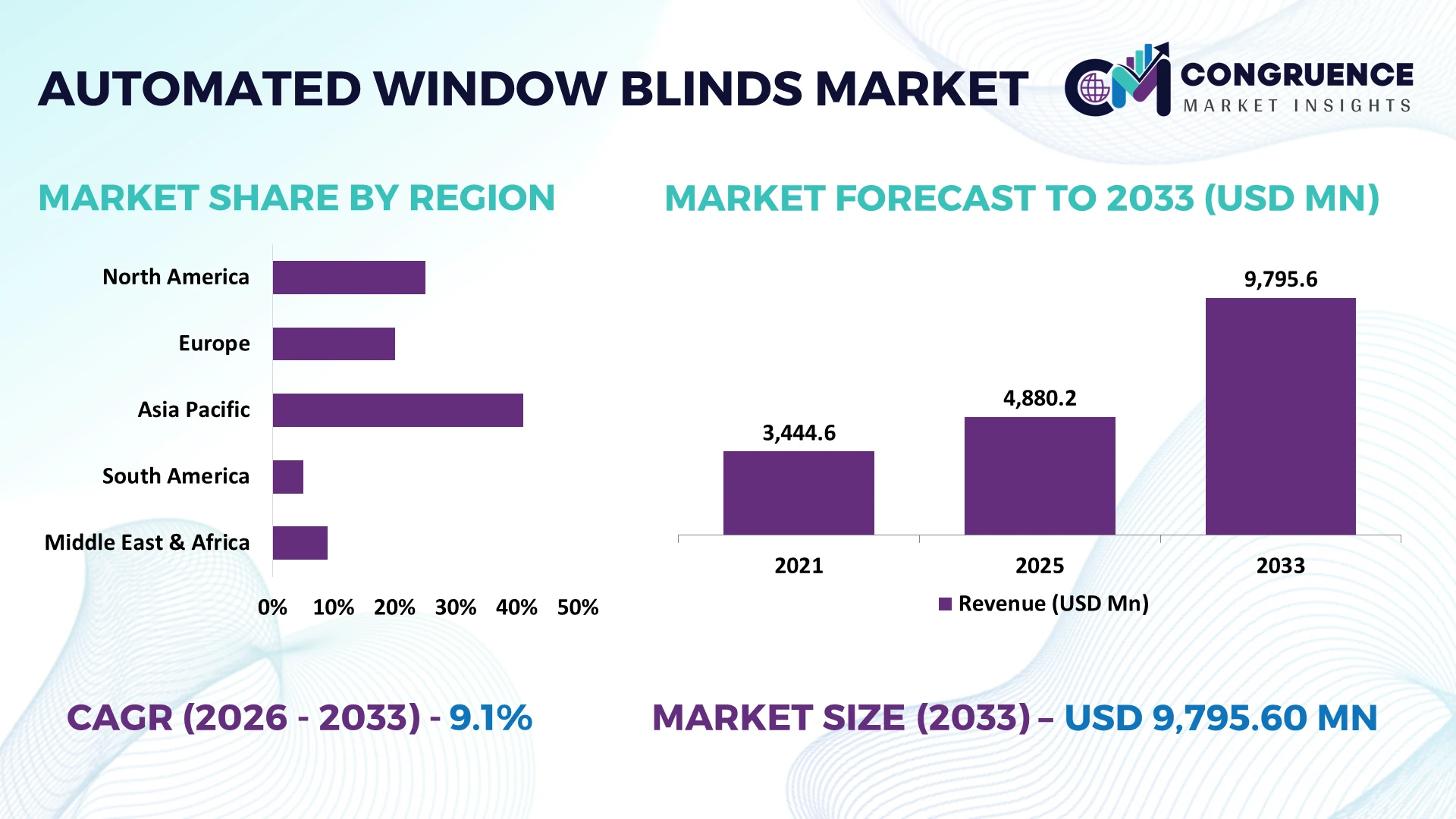
The Global Automated Window Blinds Market was valued at USD 4880.15 Million in 2025 and is anticipated to reach a value of USD 9795.6 Million by 2033 expanding at a CAGR of 9.1% between 2026 and 2033. Growth is driven by smart home retrofitting, Matter-compatible motorized shading systems, automated daylight management, and increasingly stringent building energy-efficiency requirements.
The United States represents a major market for automated window blinds, supported by residential renovation, commercial building automation, and established smart home distribution networks. The U.S. Department of Energy identifies window heat gain and loss as responsible for approximately 25%–30% of residential heating and cooling energy use. California's Title 24 building energy standards strengthen the commercial relevance of automated shading controls. Compared with India, the United States benefits from more established professional installation channels, integrated home automation ecosystems, and broader availability of connected shading products.
Manufacturers should prioritize interoperable motors, retrofit-friendly installation, and energy-responsive controls to capture premium residential and commercial building projects.
Key Highlights of the Global Automated Window Blinds Market
-
Market Size & Growth: USD 4,880.15 million in 2025, reaching USD 9,795.6 million by 2033 at 9.1% CAGR, driven by smart home integration and automated shading retrofits.
-
Top Growth Drivers: Window-related heating and cooling loads account for 25%–30% of residential HVAC energy use, strengthening the case for energy-responsive blinds and intelligent solar control.
-
Short-Term Forecast: By 2028, advanced shading installations will increasingly target the 13.5% electricity savings demonstrated in utility-monitored automated shade deployments.
-
Emerging Technologies: Matter 1.3 interoperability, Thread-connected motors, and AI-assisted daylight optimization enable coordinated operation across multiple smart home ecosystems.
-
Regional Leaders: North America leads premium connected shading adoption; Europe emphasizes building energy compliance; Asia-Pacific expands affordable motorized blind manufacturing and smart residential installations.
-
Consumer/End-User Trends: Automated window attachments demonstrated 3.4% gas savings in a utility evaluation, reinforcing energy efficiency as a measurable purchasing consideration.
-
Pilot/Case Example: A 2025 Chicago high-rise study evaluated 39 automated insulating shades over 44 weeks, demonstrating daily energy consumption reductions of up to 20.5%.
-
Competitive Landscape: Somfy, Hunter Douglas, Lutron Electronics, Springs Window Fashions, and Coulisse compete through motor reliability, wireless connectivity, and integrated shading controls.
-
Regulatory & ESG Impact: The 2024 AERC certification expansion incorporated automated window attachments, strengthening independent assessment of energy performance and supporting sustainable building procurement.
-
Investment & Funding: A U.S. Department of Energy smart automated shading initiative received USD 1.4 million in federal funding, establishing an early commercialization pathway for intelligent window systems.
-
Innovation & Future Outlook: Matter-compatible products support integration with Apple Home, Alexa, and Google Home, accelerating the transition toward interoperable, sensor-driven shading ecosystems.
The Automated Window Blinds Market is benefiting from premium residential construction, hospitality refurbishment, healthcare facilities, and commercial office modernization. Battery-powered motors, solar-assisted charging, wireless occupancy sensors, and programmable daylight controls are reducing installation complexity while improving building automation capabilities. A 2025 commercial building study demonstrated energy consumption reductions of up to 20.5% using automated insulating shades, establishing a measurable operational advantage over conventional blinds. Growing emphasis on building energy performance and interoperable connected devices is shifting procurement toward integrated shading platforms, making technology differentiation and installation economics central to competitive positioning.
What Is the Strategic Relevance and Future Pathways of the Automated Window Blinds Market?
Automated window blinds are becoming strategically important as building owners integrate shading systems into energy management, connected living, and commercial property modernization. The transition from standalone motorized blinds to interoperable building controls is reshaping product development and distribution partnerships. Window attachments influence thermal performance, while approximately 25%–30% of residential heating and cooling energy consumption is associated with heat transfer through windows. Manufacturers are consequently prioritizing sensor-based controls, retrofit-compatible motors, and integration with building management systems.
Technology differentiation increasingly depends on measurable operational performance. Automated insulating shades demonstrated electricity savings of 13.5% in monitored installations, outperforming conventional manually operated coverings that depend on occupant intervention. The United States emphasizes premium residential automation and commercial energy optimization, while Germany benefits from established building efficiency requirements and advanced façade engineering. China offers manufacturing scale in motors, electronic controllers, and wireless connectivity components, supporting competitive equipment production and export distribution.
Between 2026 and 2028, deployment priorities will concentrate on wireless retrofits, Matter-compatible controls, and occupancy-responsive shading. Commercial offices can coordinate blinds with daylight sensors and HVAC schedules to reduce unnecessary cooling and artificial lighting. Somfy, Lutron, and Hunter Douglas are strengthening connected product ecosystems and installation networks. Competitive advantage will increasingly depend on verified energy performance, dependable interoperability, and lifecycle service capabilities rather than motorization alone.
Automated Window Blinds Market Dynamics
DRIVER:
Smart Building Integration and Energy Optimization
Building electrification and intelligent energy management are accelerating automated shading adoption across residential and commercial properties. The U.S. Department of Energy estimates that windows account for approximately 30% of residential heating and cooling energy use, creating a substantial opportunity for automated solar control. Research on advanced window attachments has demonstrated electricity savings of 13.5% and gas savings of 3.4% under monitored conditions. California's Title 24 building energy standards reinforce demand for coordinated daylighting and lighting controls. Manufacturers including Somfy and Lutron are expanding wireless control compatibility and integrated shading solutions. The strategic advantage lies in connecting blinds with HVAC and lighting systems, transforming standalone products into measurable building efficiency assets.
RESTRAINT:
Installation Economics and Component Supply Exposure
Higher acquisition costs, installation requirements, and dependence on electronic components constrain automated window blind penetration in price-sensitive applications. Battery-operated motors reduce wiring requirements but introduce replacement cycles, while hardwired installations require electrical planning and professional commissioning. China's dominant position in global rare-earth processing, exceeding 90% in recent industry estimates, creates upstream exposure for permanent-magnet motor supply chains. Additionally, 25%–30% of residential heating and cooling energy use is associated with windows, but actual shading savings depend heavily on climate, glazing characteristics, and occupant behavior. Manufacturers are responding through rechargeable motors, standardized mounting hardware, alternative component sourcing, and simplified retrofit kits. Installation labor productivity remains a critical determinant of project profitability.
OPPORTUNITY:
Retrofit Automation and Intelligent Shading Platforms
Retrofitting existing window coverings presents a commercially attractive opportunity for manufacturers targeting buildings where complete window replacement is impractical. A Chicago commercial building evaluation demonstrated up to 20.5% lower daily energy consumption with automated insulating shades, compared with 11.8% using manually controlled insulating shades. Weather-normalized analysis indicated potential energy savings of 20%–35% against conventional mini-blinds. In Germany, emerging Matter-over-Thread solutions support cross-platform control without replacing existing shading fabrics. Companies including Eve MotionBlinds and Zemismart are developing retrofit motors and wireless controllers. Between 2026 and 2028, integrating solar sensors, programmable schedules, and energy analytics offers manufacturers an opportunity to expand into recurring maintenance services and building performance optimization.
CHALLENGE:
Interoperability Reliability and Large-Scale Commissioning
Maintaining reliable performance across connected building ecosystems represents a significant execution challenge for automated window blind manufacturers. Matter 1.3 supports standardized window-covering controls, but differences in firmware, device provisioning, and network architecture complicate commercial deployment. A Chicago evaluation covering 39 automated shades across 44 weeks demonstrated that performance depends on control strategy and operational consistency. Automated systems achieved up to 20.5% daily energy reductions, compared with 11.8% under manual operation, emphasizing the importance of commissioning quality. German building automation suppliers face additional integration requirements involving KNX infrastructure, Thread border routers, and property management systems. Manufacturers must invest in firmware validation, installer certification, cybersecurity maintenance, and remote diagnostics to sustain reliable operation across large installations.
Automated Window Blinds Market Latest Trends
-
Battery Motorization Simplifies Installation Workflows: Rechargeable lithium-ion motors are replacing wiring-intensive configurations in residential renovation projects. Typical battery specifications of 7.4V–12V support compact motorized systems, while USB-C charging and solar-assisted operation reduce routine servicing. Manufacturers including Somfy and Coulisse are expanding rechargeable motor portfolios, enabling installers to complete upgrades without extensive electrical modifications. The operational shift favors standardized mounting assemblies and faster project turnaround.
-
Daylight Harvesting Gains Commercial Importance: Commercial property operators increasingly coordinate shading positions with daylight availability rather than relying on fixed schedules. Automated insulating shades demonstrated up to 20.5% daily energy reductions in a monitored Chicago installation, compared with 11.8% for manually operated alternatives. Lutron and other building control specialists are integrating shading with dimmable lighting and occupancy-based automation, improving the efficiency of perimeter office zones.
-
Wireless Protocols Reshape Product Architecture: Matter 1.3 introduced standardized window-covering functionality, strengthening interoperability across connected device ecosystems. Thread networking operates on 2.4 GHz wireless infrastructure, while Bluetooth-based commissioning simplifies device onboarding. Companies including Eve MotionBlinds and SmartWings are incorporating cross-platform connectivity, reducing dependence on proprietary control hubs. This transition shifts competitive differentiation toward firmware quality, secure device management, and dependable connectivity.
-
Insulating Fabrics Advance Thermal Performance: Cellular constructions and reflective shading materials are receiving greater attention as building owners seek passive temperature control. The U.S. Department of Energy reports that tightly installed cellular shades can reduce winter window heat loss by 40% or more and unwanted summer solar heat by up to 60%. Manufacturers are combining insulating fabrics with automated positioning to improve year-round performance and support premium product differentiation.
Segmentation Analysis
By Type
Roller Blinds Lead Scalable Motorized Shading Installations
Roller Blinds represent the leading product category in the Automated Window Blinds Market, supported by straightforward motor integration, compact hardware, and compatibility with standardized installation systems. Their continuous fabric construction supports centralized control, blackout operation, and commercial façade applications. Manufacturers including Somfy, Hunter Douglas, and Coulisse offer motorization technologies suited to roller configurations. Compared with Venetian Blinds, roller systems require fewer moving components for basic positioning, simplifying manufacturing and installation. Vertical Blinds remain relevant for wide glazing and commercial interiors, while Roman Blinds address premium residential projects emphasizing decorative finishes and concealed automation.
Cellular Blinds are positioned for strong adoption growth because their insulating structure provides functional advantages beyond privacy and light control. Research indicates that tightly fitted cellular shades can reduce winter window heat loss by at least 40% and unwanted summer solar heat by up to 60%. These performance characteristics support higher-value product positioning in energy-conscious residential projects. Manufacturers are developing motorized cellular systems with programmable scheduling and thermal performance ratings, shifting product investment toward differentiated fabrics and intelligent operating mechanisms.
- In April 2026, the Window Covering Manufacturers Association recognized products launched during 2025 across nine award categories, including roller shades, cellular shades, motorization, and automation, highlighting continuing engineering investment and product differentiation.
By Application
Residential Applications Anchor Automated Shading Demand
Residential applications constitute the primary demand base for automated window blinds, supported by smart home installations, premium housing construction, and renovation spending. Homeowners prioritize privacy scheduling, child-safe cordless operation, voice control, and coordinated shading across multiple rooms. Automated window coverings also support temperature management, particularly in homes with extensive glazing. Approximately 30% of residential heating energy is lost through windows, establishing a practical efficiency incentive. Manufacturers including Hunter Douglas and Somfy are expanding connected control options and installer networks to address residential customization requirements. Compared with commercial procurement, residential purchasing emphasizes design compatibility, convenience, and simplified operation.
Commercial applications are becoming increasingly important for integrated daylight management and building energy optimization. Offices require synchronized shading across multiple floors, while Hospitality facilities prioritize guest comfort, room automation, and centralized operational controls. Healthcare applications emphasize glare reduction, patient privacy, and accessible operation. Efficient window attachments have demonstrated reductions of up to 30% in annual heating and cooling energy consumption under certain field conditions. Suppliers are developing application-specific controls, durable materials, and integration capabilities that improve institutional procurement competitiveness.
- Lawrence Berkeley National Laboratory reported in February 2025 that commercial window upgrades can deliver approximately 4%–6% site energy savings in typical buildings, with substantially higher savings in suitable properties, reinforcing interest in advanced building-envelope technologies.
By End-User
Homeowners Dominate Connected Window Covering Purchases
Homeowners form the largest end-user group for automated window blinds, supported by individual purchasing decisions, renovation activity, and increasing integration of connected household devices. Demand concentrates on programmable Roller Blinds, motorized Cellular Blinds, and wireless systems compatible with existing smart home platforms. Residential buyers increasingly evaluate installation complexity, battery servicing, and product aesthetics alongside automation capabilities. Efficient window attachments can deliver comparable energy benefits to certain double-pane window replacements at approximately one-third of the replacement cost in suitable applications. This economic distinction supports retrofit-oriented product positioning. Manufacturers are responding with modular motors, rechargeable systems, and customizable control interfaces.
Offices represent an important institutional buyer group because centralized shading controls improve management of daylight, glare, and perimeter thermal conditions. Hotels prioritize automated guestroom operation and consistent service standards, while Hospitals require dependable privacy controls and simplified accessibility. Commercial windows influence building loads representing approximately 6% of annual U.S. primary energy consumption, indicating the operational importance of façade performance. Suppliers are targeting professional installation channels, building automation partnerships, and remote maintenance capabilities to strengthen institutional relationships and long-term service opportunities.
- In 2025, Lawrence Berkeley National Laboratory identified energy savings of up to 26% for commercial buildings with particularly favorable window-upgrade potential, strengthening the business case for coordinated façade modernization and automated environmental controls..
Region-Wise Market Insights
North America accounted for the largest market share in 2025 however, Asia-Pacific is expected to register the fastest growth between 2026 and 2033.

North America Automated Window Blinds Market
Smart Home Integration and Commercial Building Modernization
North America maintains a leading position in automated window blinds adoption, supported by established home automation ecosystems, professional installation networks, and commercial building modernization. The United States represents the region's principal demand center, with manufacturers emphasizing motorized roller shades, intelligent daylight controls, and premium residential customization. Automated shading increasingly integrates with HVAC systems, occupancy sensors, and programmable lighting platforms. A monitored Chicago high-rise evaluation involving 39 automated insulating shades over 44 weeks demonstrated daily energy consumption reductions of up to 20.5%, highlighting the operational value of coordinated window controls. Somfy, Hunter Douglas, and Lutron compete through wireless connectivity, control reliability, and professional distribution partnerships. Canadian installations emphasize thermal insulation and winter comfort, while U.S. commercial projects prioritize daylight harvesting and glare management. Retrofit-compatible motorization remains particularly important for upgrading occupied buildings without extensive electrical modifications.
United States Market Outlook: The United States benefits from established smart home distribution, advanced building automation infrastructure, and energy-conscious commercial property management. California's Title 24 building energy standards encourage coordinated lighting and daylight control strategies. The U.S. Department of Energy estimates that approximately 30% of residential heating energy is lost through windows, strengthening demand for automated insulating coverings. Manufacturers are targeting residential renovations, corporate offices, and premium hospitality installations through connected shading portfolios and certified installation partners.
Europe Automated Window Blinds Market
Building Energy Regulations Accelerate Intelligent Shading Adoption
Europe's automated window blinds industry is shaped by building efficiency regulations, established exterior shading manufacturers, and demand for integrated façade controls. Germany, France, Italy, and the Netherlands represent important markets for motorized roller blinds, Venetian systems, and solar-responsive shading installations. The revised Energy Performance of Buildings Directive requires member states to implement updated provisions by May 2026, reinforcing investment in building modernization. Approximately 75% of European Union buildings have poor energy performance, creating a substantial renovation requirement. Manufacturers including Somfy, Warema, and Renson emphasize automated solar protection, weather-responsive controls, and integration with KNX building automation infrastructure. European projects increasingly specify shading alongside glazing, ventilation, and lighting systems rather than treating blinds as standalone interior products. This approach strengthens opportunities for engineering-led suppliers offering verified thermal performance, architectural customization, and coordinated façade management.
Germany Market Outlook: Germany combines advanced façade engineering, established shading equipment manufacturing, and stringent building performance expectations. Companies such as Warema and HELLA support automated solar protection through exterior Venetian blinds, roller shutters, and intelligent controllers. The country's Building Energy Act establishes a regulatory framework for energy-efficient building operation. German manufacturers increasingly emphasize KNX-compatible automation, wind protection sensors, and precision-controlled daylight management, supporting commercial refurbishment and premium residential installations.
Asia-Pacific Automated Window Blinds Market
Manufacturing Scale and Connected Residential Infrastructure Expansion
Asia-Pacific is positioned for rapid automated window blinds adoption through concentrated electronics manufacturing, expanding residential construction, and competitive motor production. China provides substantial manufacturing capabilities in tubular motors, wireless controllers, electronic assemblies, and finished shading systems. Guangdong and Zhejiang support integrated supply chains connecting component suppliers, automation manufacturers, and export distributors. Matter-compatible devices, Zigbee connectivity, and rechargeable motors are becoming important product differentiators. China's smart home ecosystem benefits from widespread connected device distribution and domestic platform integration, while Japan emphasizes compact automation and building functionality. India offers opportunities in premium apartments, hotels, and modern office developments. China's 2025 national urbanization rate exceeded 67%, supporting the underlying scale of urban residential infrastructure. Manufacturers are expanding original equipment manufacturing partnerships, modular product platforms, and localized distribution to serve differentiated purchasing requirements across these countries.
China Market Outlook: China holds a strategic manufacturing advantage through electronics clusters in Shenzhen, motor production capabilities in Zhejiang, and extensive smart home device distribution. Companies including Dooya and Aqara offer automated shading technologies supporting wireless control and connected home integration. China's 2025 urbanization rate of approximately 67.9% reflects a substantial urban housing base. Manufacturers are emphasizing integrated motor-controller assemblies, competitive production economics, and export-oriented product certification to strengthen international distribution.
South America Automated Window Blinds Market
Premium Property Renovation Supports Motorized Shading Demand
South America's automated window blinds market is concentrated in higher-income residential developments, corporate properties, hospitality establishments, and architectural renovation projects. Brazil represents the principal commercial opportunity, supported by established interior furnishing distribution and growing interest in automated environmental controls. São Paulo and Rio de Janeiro provide concentrated demand from premium apartments, offices, and hospitality properties. Chile and Colombia offer additional opportunities through commercial property refurbishment and specialized interior installation networks. Brazil's urban population exceeds 85% of its total population, creating a substantial urban property base for advanced window covering suppliers. However, imported motors, electronic controllers, and proprietary automation components expose distributors to currency fluctuations and customs costs. Manufacturers and regional installers are responding through local assembly partnerships, standardized motor configurations, and broader after-sales support, improving accessibility without compromising product reliability.
Brazil Market Outlook: Brazil benefits from a large urban housing stock, established architectural furnishing businesses, and demand for solar protection in warm-climate cities. São Paulo's commercial property sector supports automated roller blinds and glare-control systems for offices and mixed-use developments. Brazil's population is more than 85% urban, concentrating potential installations around metropolitan construction and renovation activity. Local distributors increasingly prioritize rechargeable motors, compatible controllers, and installation services that reduce dependence on specialized electrical contractors.
Middle East & Africa Automated Window Blinds Market
Hospitality Investment and Climate-Responsive Building Automation
The Middle East & Africa automated window blinds market is influenced by large-scale hospitality investment, premium property development, and demand for solar heat management. Saudi Arabia and the United Arab Emirates are important deployment centers, with commercial developers specifying automated shading for hotels, luxury residences, offices, and mixed-use properties. Saudi Arabia's Vision 2030 development program supports major construction and hospitality infrastructure activity, while Dubai's premium property market favors integrated smart building controls. The UAE's summer temperatures frequently exceed 40°C, strengthening the operational importance of managing solar exposure and indoor comfort. Automated roller and blackout blinds are increasingly incorporated into room management systems alongside lighting and air conditioning. Manufacturers are working with property developers, systems integrators, and hospitality contractors to secure project specifications, improve installation coordination, and establish regional maintenance capabilities.
Saudi Arabia Market Outlook: Saudi Arabia represents a strategically important market through large construction programs, hospitality infrastructure expansion, and integrated building technology procurement. NEOM's development portfolio and Red Sea hospitality projects create opportunities for automated shading within digitally managed properties. The Red Sea destination's initial development phase includes plans for 16 resorts, demonstrating the scale of hospitality infrastructure investment. Suppliers are targeting centralized guestroom controls, heat-resistant motor components, and partnerships with local engineering contractors to support reliable deployment in demanding climatic conditions.
Market Competition Landscape
The Automated Window Blinds Market features established shading specialists Somfy, Hunter Douglas, Lutron Electronics, Springs Window Fashions, and Coulisse competing against connected device innovators Aqara and cost focused manufacturers such as Dooya. Market concentration favors established brands through installer networks, proprietary controls, and architectural specifications, although a verified combined top five market share remains unavailable. Competition increasingly centers on interoperability, installation economics, and energy performance. Automated insulating shades have demonstrated electricity savings of 13.5%, while cellular constructions can reduce winter window heat loss by 40% or more. Somfy emphasizes motor ecosystems, Lutron integrates shading with lighting automation, and Coulisse develops connected motor platforms. Chinese suppliers compete through manufacturing integration and competitively priced wireless controllers. Matter compatibility is shifting differentiation from proprietary hardware toward firmware reliability and platform integration. Certification, installer expertise, and dependable servicing remain entry barriers. Winning requires interoperable products, efficient installation, and measurable performance advantages across customer segments.
Companies Profiled in the Automated Window Blinds Market Report
Technology Insights for the Automated Window Blinds Market
Current automated window blind technologies combine tubular motors, rechargeable batteries, wireless controllers, and programmable shading schedules. Zigbee, Z-Wave, and proprietary radio systems support centralized operation, while daylight sensors coordinate blind positioning with indoor lighting requirements. Monitored automated insulating shades demonstrated electricity savings of 13.5%, compared with manually operated coverings dependent on occupant intervention. Commercial installations increasingly connect shading controllers with building management systems, improving operational consistency and reducing unnecessary solar heat gain. Somfy and Lutron benefit from established integration capabilities and professional installation networks.
Emerging technologies emphasize Matter interoperability, Thread mesh networking, and solar-assisted battery charging. Matter 1.3 introduced standardized window-covering functionality, enabling compatible devices to operate across different smart home ecosystems. Cellular shading materials provide additional performance advantages, reducing winter window heat loss by 40% or more under suitable installation conditions. Compared with conventional single-layer coverings, these insulated systems deliver superior thermal resistance. Manufacturers including Coulisse and Aqara are developing connected products that simplify commissioning and support differentiated residential automation requirements.
Between 2026 and 2028, AI-assisted solar positioning, predictive occupancy controls, and integrated energy analytics will reshape advanced shading platforms. Manufacturers prioritizing secure firmware, standardized connectivity, and retrofit compatibility will strengthen competitiveness through lower installation complexity and improved building performance.
Recent Developments in the Global Automated Window Blinds Market
-
September 2026 – Somfy announced native Control4 integration for its Zigbee 3.0 shading motors, eliminating external bridges for compatible installations. Targeted for Q1 2027, the development simplifies commissioning and strengthens professional smart home integration. Source: somfypro.com.
-
June 2025 – Hunter Douglas expanded PowerView Automation compatibility to selected specialty-shaped shades and introduced Pirouette A Deux. The spring product rollout extended motorization into 2 previously challenging shade geometries, arches and angles, expanding customization opportunities for residential integrators. Source: cepro.com.
-
May 2025 – Aqara partnered with A-OK to introduce Matter-enabled motorized shading solutions across 7 product categories, including interior blinds and roller shutters. The collaboration integrates multi-protocol connectivity, expanding cross-platform compatibility and international distribution opportunities for automated shading systems. Source: aqara.com.
-
April 2026 – Window Covering Manufacturers Association announced its 2025 Product Awards winners, recognizing innovations introduced during the preceding year. The program covered 9 product categories, including motorization and automation, strengthening industry recognition of differentiated window covering technologies. Source: wcmanet.com.
Scope of the Automated Window Blinds Market Report
The Automated Window Blinds Market Report examines industry structure, competitive positioning, technology adoption, and deployment opportunities across 2026–2033. Product segmentation covers Roller Blinds, Venetian Blinds, Roman Blinds, Vertical Blinds, and Cellular Blinds. Application analysis evaluates Residential, Commercial, Hospitality, and Healthcare installations, while end-user coverage includes Homeowners, Offices, Hotels, and Hospitals. Geographic assessment encompasses North America, Europe, Asia-Pacific, South America, and Middle East & Africa, highlighting manufacturing concentration, distribution networks, and country-specific procurement dynamics.
The report evaluates wireless motorization, Matter interoperability, sensor-based automation, rechargeable power systems, and insulating materials. Quantitative performance indicators include documented electricity savings of 13.5% and winter window heat-loss reductions exceeding 40% under suitable conditions. Competitive benchmarking addresses product differentiation, installation economics, strategic partnerships, and emerging retrofit opportunities, supporting investment prioritization, geographic expansion, and technology positioning through 2033.
Automated Window Blinds Market Report Summary
| Report Attribute/Metric | Report Details |
|---|
Market Revenue in 2025 | USD 4880.15 Million |
Market Revenue in 2033 | USD 9795.6 Million |
CAGR (2026 - 2033) | 9.1% |
Base Year | 2025 |
Forecast Period | 2026 - 2033 |
Historic Period | 2021 - 2025 |
Segments Covered | By TypeBy ApplicationBy End-User |
Key Report Deliverable | Revenue Forecast, Growth Trends, Market Dynamics, Segmental Overview, Regional and Country-wise Analysis, Competition Landscape |
Region Covered | North America, Europe, Asia-Pacific, South America, Middle East, Africa |
Key Players Analyzed | Somfy SA, Hunter Douglas N.V., Lutron Electronics Co., Inc., Springs Window Fashions LLC, Coulisse B.V., Nice S.p.A., Dooya, Warema Renkhoff SE, Renson, QMotion, SmartWings, Aqara |
Customization & Pricing | Available on Request (10% Customization is Free) |