
Reports
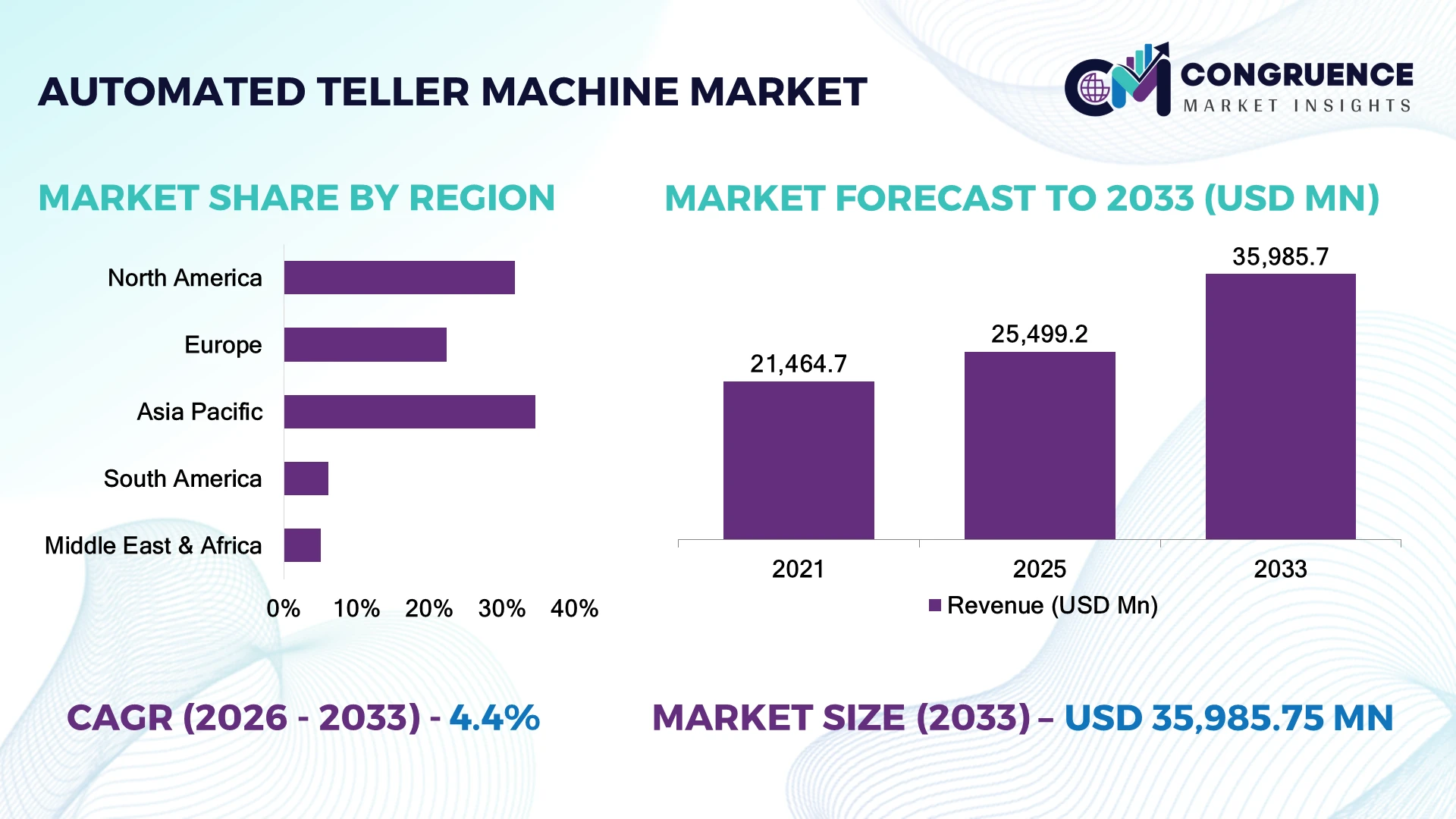
The Global Automated Teller Machine Market was valued at USD 25,499.2 Million in 2025 and is anticipated to reach a value of USD 35,985.7 Million by 2033 expanding at a CAGR of 4.4% between 2026 and 2033. Growth is being driven by cash-recycler replacement cycles, ATM-as-a-Service outsourcing, rising cash-deposit functionality, and modernization of aging self-service banking infrastructure.
The U.S. remains a leading high-value ATM market, with 2025 ATM shipments increasing 13% as banks, credit unions, and retailers refreshed aging estates. India had more than 258,000 ATMs including cash recyclers and white-label machines by May 2025, compared with roughly 246,000 scheduled-commercial-bank and white-label ATMs in September 2024. India’s government-backed financial-inclusion strategy continues to prioritize Tier III–VI access, while U.S. operators increasingly emphasize recycling and managed services.
Strategic investment should prioritize cash-recycling technology, software modernization, outsourced operations, and high-availability networks rather than undifferentiated conventional cash dispensers.
Market Size & Growth: USD 25,499.2 Million in 2025 is projected to reach USD 35,985.7 Million by 2033 at 4.4% CAGR, driven by cash-recycler replacement and ATM modernization.
Top Growth Drivers: Cash-recycler adoption 60%, ATM outsourcing 58%, and rising ATM usage 58% are reshaping deployment economics.
Short-Term Forecast: By 2028, recycler-based deployments are positioned to reduce cash-handling requirements by 15–25% and improve machine availability through localized cash recycling.
Emerging Technologies: Cash recyclers, NFC-enabled transactions, mobile authentication, AI-based monitoring, and cloud ATM management are replacing single-purpose cash dispensing.
Regional Leaders: North America is projected near USD 9.5 billion by 2033, Asia-Pacific near USD 10.8 billion, and Europe around USD 7.2 billion, with recycling driving modernization.
Consumer/End-User Trends: 58% of surveyed banks report rising ATM usage, while 70% observe increasing customer demand for cash deposits and advanced self-service functions.
Pilot/Case Example: In 2026, Indian banks floated RFPs for approximately 17,350 ATMs, including about 13,100 cash recyclers, meaning more than 75% of planned installations favored recycling technology.
Competitive Landscape: NCR Atleos, Diebold Nixdorf, Hyosung Innovue, GRG Banking, and Hitachi Channel Solutions compete across hardware, software, managed services, and cash-management technology.
Regulatory & ESG Impact: RBI rules supporting white-label ATMs expand non-bank participation and financial inclusion, while recycling can reduce cash replenishment frequency and associated logistics requirements.
Investment & Funding: North American operators are expected to install approximately 60,000 new recycling ATMs by 2029, reflecting sustained investment in self-service cash infrastructure.
Innovation & Future Outlook: The market is shifting toward ATM-as-a-Service, intelligent cash management, remote monitoring, biometric authentication, and multifunctional self-service platforms rather than standalone cash dispensers.
The Automated Teller Machine Market is undergoing a technology-led replacement cycle rather than simply expanding through conventional installations. Global ATM shipments increased 1% to approximately 293,400 units in 2025, with cash recyclers representing 60% of shipments. In India, public-sector banks are accelerating recycler deployment while U.S. operators increasingly use managed-service models, creating stronger demand for software, uptime optimization, and lifecycle contracts.
The Automated Teller Machine Market is becoming strategically important because banks are restructuring branch networks while retaining physical cash access through increasingly automated self-service infrastructure. The U.S. branch footprint has declined materially over the past decade, increasing the operational importance of ATMs for cash access. In India, meanwhile, banks are shifting from conventional dispensers toward cash recyclers as part of a broader outsourcing and infrastructure-modernization cycle.
Cash recyclers provide a measurable operational advantage over conventional dispensers by accepting, validating, and reusing deposited notes, reducing dependence on frequent cash replenishment. More than 75% of Indian ATM installations planned in early 2026 were cash recyclers, demonstrating the speed of this transition. North America is emphasizing ATM refresh programs, ATM-as-a-Service, and software modernization, while India is prioritizing recycler deployment and geographic coverage.
During 2026–2028, banks are expected to increase investment in intelligent cash management, cloud monitoring, NFC, mobile integration, and remote diagnostics. Fixed-price managed-service contracts are also gaining traction as banks seek predictable operating costs. The strategic advantage will shift toward providers capable of combining hardware reliability, software security, cash logistics, and measurable uptime improvements into integrated self-service banking platforms.
Cash-recycling adoption is becoming the strongest structural driver as banks seek higher ATM availability while reducing cash-logistics intensity. Cash recyclers can reduce cash replenishment and cash-in-transit visits by approximately 20–50%, while improving machine availability toward 99% in optimized deployments. India’s 2026 procurement cycle is accelerating this shift, with banks planning approximately 17,350 new ATMs, predominantly recyclers. The operational benefit is particularly strong in high-volume locations where deposited notes can fund subsequent withdrawals. ATM manufacturers and managed-service providers are responding with recycler-focused portfolios, remote monitoring, and cash-management partnerships. The strategic shift is from selling dispensing hardware to optimizing the entire cash lifecycle, creating stronger recurring-service opportunities and improving fleet economics.
ATM operators face escalating cybersecurity and physical-security requirements as attack methods shift from conventional skimming toward jackpotting, malware, and network intrusion. The FBI recorded more than 700 U.S. ATM jackpotting incidents in 2025, generating losses above USD 20 million, while European ATM attack incidents increased from 7,115 in 2023 to 14,664 in 2024. These threats increase patching, surveillance, encryption, technician, and insurance costs, directly affecting operating margins and fleet refresh decisions. Banks are responding through hardened enclosures, remote monitoring, encrypted communications, secure key management, and faster operating-system migration. The non-obvious constraint is that security modernization increasingly becomes a prerequisite for keeping older machines connected, accelerating replacement of otherwise functional hardware.
ATM-as-a-Service is creating a higher-value opportunity by shifting banks from equipment ownership toward managed infrastructure, software, maintenance, and cash operations. NCR Atleos reported 33% growth in ATM-as-a-Service during 2025, while its hardware business increased 14%, demonstrating stronger momentum for recurring service models. Cloud-based monitoring, predictive diagnostics, remote key management, and multifunctional terminals can reduce technician visits and improve fleet visibility. India’s expanding recycler deployment creates an additional opportunity for vendors to bundle equipment with cash logistics and maintenance contracts. Companies are positioning through long-term service agreements, software platforms, and partnerships with banks and independent ATM deployers. The strategic opportunity is monetizing uptime and transaction availability rather than relying solely on hardware replacement cycles.
ATM networks increasingly require integration across legacy processors, banking applications, cash-management platforms, contactless readers, cybersecurity layers, and remote-monitoring systems. More than 53,000 ATM crime incidents were recorded in a global industry database by December 2025, highlighting the operational complexity of securing geographically dispersed estates. Meanwhile, ATM operators must support multiple connectivity paths and maintain availability across locations with inconsistent network quality. Companies are investing in centralized fleet management, standardized software stacks, multi-carrier connectivity, and modular hardware to simplify upgrades. The long-term challenge is maintaining consistent security and uptime across mixed-generation fleets while introducing cloud and AI capabilities. Vendors that provide open APIs, remote diagnostics, and lifecycle migration support can reduce integration friction and strengthen customer retention.
Cash Recycling Becomes Standard: Indian banks are accelerating recycler deployment, with approximately 17,350 ATMs planned in the 2026 procurement cycle and more than 75% expected to use advanced recycling technology. This shift reduces cash replenishment requirements and improves liquidity management. Vendors are expanding recycler portfolios and pairing equipment with cash-management and maintenance services.
ATMaaS Gains Commercial Momentum: Outsourced ATM operations are shifting from supplementary services toward core banking infrastructure. NCR Atleos reported 33% ATM-as-a-Service growth in 2025 alongside 14% hardware growth, indicating stronger recurring-service momentum. Banks are increasingly transferring maintenance, monitoring, software, and fleet-management responsibilities to specialist operators to improve cost predictability.
Security Moves Beyond Skimming: ATM protection is increasingly focused on malware, jackpotting, relay attacks, and remote intrusion. U.S. jackpotting incidents exceeded 700 in 2025, while European terminal attacks more than doubled between 2023 and 2024. Operators are deploying layered cybersecurity, physical hardening, remote surveillance, and secure key-management systems rather than relying on anti-skimming hardware alone.
Cloud Management Replaces Site Visits: Remote diagnostics, centralized monitoring, and predictive alerts are reducing dependence on physical servicing across dispersed ATM estates. Cash-recycling systems can reduce cash-in-transit visits by 20–50%, while high-availability deployments approach 99% uptime. Banks and independent deployers are therefore prioritizing cloud-connected fleets, automated fault detection, and remote software management to improve operational consistency.
Cash dispensers remain the leading ATM type, accounting for approximately 54% of installed demand because of their lower acquisition cost, mature servicing ecosystem, and suitability for high-volume withdrawal locations. Cash recyclers represent approximately 32% but are the fastest-growing type, driven by banks seeking lower cash-logistics costs and improved cash availability. Deposit-enabled and multifunction ATMs collectively account for roughly 14%, retaining strategic relevance as banks migrate routine branch transactions toward self-service channels.
The investment balance is shifting toward recyclers as their operational economics improve at high-traffic locations. Recycler deployments can reduce replenishment frequency by approximately 20–50%, while intelligent deposit and cash-validation capabilities increase machine utilization. Manufacturers are expanding recycler portfolios, improving note-handling modules, and partnering with banks and ATM deployers on managed-service contracts. The commercial implication is a gradual transition from low-cost dispensing hardware toward higher-value cash-management platforms, with mature dispensers remaining important for cost-sensitive and geographically dispersed installations.
Datos Insights reported that global ATM shipments increased 1% to 293,400 units in 2025, with cash recyclers accounting for 60% of total shipments, confirming recyclers as the principal technology driving the current replacement cycle.
Cash withdrawal remains the leading application, representing approximately 58% of ATM transaction demand because it is supported by the largest installed base and remains essential across retail banking and cash-intensive locations. Cash deposit and recycling applications account for around 24%, while balance inquiry, bill payment, transfers, cardless transactions, and other multifunction services contribute approximately 18%. Deposit and recycling functions represent the fastest-growing application segment as banks increasingly use ATMs to absorb routine teller activities and reduce branch operating intensity.
The application mix is shifting from single-purpose dispensing toward multifunction self-service. Deposit-enabled transactions can increase ATM utility and reduce branch dependence, while cardless and mobile-authenticated services improve convenience. NCR Atleos reported growth across deposit and ReadyCode transactions in 2025, reinforcing the expansion of non-withdrawal functionality. Companies are responding with software-upgradable terminals, contactless interfaces, remote transaction management, and multifunction platforms. The business priority is increasing transactions per installed unit rather than simply expanding machine count.
NCR Atleos reported that its network business recorded growth in surcharge-free, deposit, and ReadyCode transactions during 2025, demonstrating increasing utilization of ATMs for services beyond conventional cash withdrawal.
Commercial and retail banks represent the leading end-user group, accounting for approximately 61% of ATM demand because they operate extensive networks and require direct control over cash availability, security, compliance, and customer access. Independent ATM deployers account for approximately 23%, while retailers and other non-bank locations contribute about 16%. Independent deployers are the fastest-growing end-user group as financial institutions increasingly outsource ATM ownership, maintenance, cash logistics, and monitoring to reduce capital intensity and operating complexity.
The buying model is therefore shifting from outright hardware procurement toward managed infrastructure. NCR Atleos reported 33% growth in ATM-as-a-Service during 2025, while its managed ATM estate exceeded 500,000 devices. Banks are prioritizing uptime, cybersecurity, remote monitoring, and predictable operating costs, whereas independent deployers emphasize transaction economics, site productivity, and rapid servicing. Manufacturers and service providers are responding with multi-year contracts, fleet-management platforms, multi-vendor maintenance, and cash-management services. Competitive positioning increasingly depends on lifecycle economics and service coverage rather than terminal specifications alone.
ATM Industry Association research released in January 2026 identified Independent ATM Deployers as a critical component of India's cash-access ecosystem, with regulatory requirements, interchange economics, operating costs, and technology investment directly shaping their sustainability.
Asia-Pacific accounted for the largest market share at 34.6% in 2025 however, Middle East & Africa is expected to register the fastest growth, expanding at a CAGR of 5.3% between 2026 and 2033.
ATM-as-a-Service Is Reshaping Mature Fleet Economics
North America represents approximately 31.8% of the global Automated Teller Machine Market, supported by a large installed base, established independent ATM deployers, strong cash-access networks, and rapid adoption of managed self-service infrastructure. The U.S. remains the regional demand center as banks reduce branch footprints while preserving cash access through distributed ATM networks. NCR Atleos reported 14% ATM hardware revenue growth in 2025 and more than USD 200 million in quarterly ATM-as-a-Service bookings, highlighting the shift toward outsourced fleet management. Cash recyclers, deposit-enabled terminals, remote monitoring, and cloud-based software are gaining priority over conventional replacement-only programs. Vendors are increasingly competing through service availability, transaction economics, and network reach rather than hardware specifications alone.
U.S. Market Outlook: The U.S. is the region's primary ATM technology and outsourcing hub, with ATM networks increasingly supporting near-branch services through retail locations. More than 90% of U.S. consumers continue to expect cash to remain useful as a payment or store-of-value instrument, reinforcing the need for accessible cash infrastructure. Providers are expanding deposit functionality, managed services, and shared networks to capture transactions beyond traditional withdrawals.
Fleet Rationalization Is Accelerating Intelligent Replacement
Europe accounts for approximately 22.4% of global ATM demand, but the market is characterized by fleet consolidation rather than unit expansion. The euro area had approximately 248,900 ATMs at the end of 2025, down 1.3% year over year, while 38% accepted contactless transactions. Germany alone operated approximately 48,000 cash-withdrawal ATMs at the end of 2025, a 3% decline from the previous year. Banks are consolidating estates while upgrading strategically important machines with contactless access, cash recycling, remote diagnostics, and multifunction capabilities. Suppliers are therefore focusing on replacement value, software integration, cybersecurity, and managed-service contracts rather than maximizing installed-unit growth.
Germany Market Outlook: Germany remains Europe's most strategically significant ATM market because of its large cash infrastructure and extensive banking network. Approximately 48,000 cash-withdrawal ATMs remained operational at the end of 2025 despite a 3% annual decline. This contraction is creating a replacement-focused market in which banks prioritize uptime, security, contactless functionality, and efficient cash logistics over expanding physical terminal density.
Cash Infrastructure Scale Is Driving Recycler Adoption
Asia-Pacific holds approximately 34.6% of the global Automated Teller Machine Market, supported by India's large deployment base, China's extensive self-service banking infrastructure, and continued cash usage across Southeast Asian economies. India is the region's most strategically important growth market, with RBI data showing more than 215,000 ATMs and cash recycler machines operated by scheduled commercial banks in March 2025, excluding additional white-label infrastructure. Non-bank white-label ATMs remain important for extending access into semi-urban and rural locations. Banks are increasingly replacing conventional dispensers with cash recyclers, while manufacturers are localizing note-handling technology, software, and service capabilities. The competitive focus is shifting toward lower cash-logistics intensity and higher utilization per terminal.
India Market Outlook: India combines extensive ATM demand with a clear policy-driven need for geographically distributed cash access. RBI's framework for white-label ATMs specifically supports broader deployment in semi-urban and rural areas, while banks increasingly favor cash recyclers for high-volume locations. The country's 2025 infrastructure base included more than 215,000 bank-operated ATMs and cash recycler machines, creating substantial replacement and technology-upgrade opportunities.
Brazil Leads Selective Fleet Modernization
South America represents approximately 6.1% of global Automated Teller Machine Market demand, with Brazil accounting for the largest share because of its extensive banking infrastructure and continued use of cash across retail and informal economic activity. The market is shifting from broad ATM-network expansion toward selective modernization, with banks emphasizing lower maintenance requirements, remote fleet management, and multifunction capabilities. Brazil's centralized financial infrastructure supports large-scale software and security upgrades, while geographically dispersed locations sustain demand for reliable cash access. Vendors are increasingly using managed-service agreements and modular hardware to address cost sensitivity. The strongest opportunity lies in upgrading productive locations with cash recycling and contactless functionality rather than adding low-utilization terminals.
Brazil Market Outlook: Brazil remains the principal South American market because of its extensive financial infrastructure and established ATM estate. The country's central-bank-maintained ATM dataset provides a long-running national measure of terminal deployment, supporting systematic fleet planning. Banks and independent operators are increasingly prioritizing software modernization, cybersecurity, cash optimization, and remote diagnostics, allowing existing locations to deliver more transactions without proportional network expansion.
Financial Inclusion and Cash Logistics Drive Modernization
Middle East & Africa accounts for approximately 5.1% of global Automated Teller Machine Market demand, with Gulf countries providing the strongest technology adoption and African markets creating demand for distributed cash-access infrastructure. Saudi Arabia registered 14,674 ATMs in 2025, a 2.7% decline from 2024, while cash withdrawals reached SAR 537.5 billion, demonstrating that transaction value remains substantial despite terminal rationalization. Banks are consolidating low-productivity machines while upgrading strategic locations with multifunction terminals, contactless access, and enhanced security. In Africa, white-label networks, mobile-linked ATMs, and lower-cost terminals remain important for underserved markets. Suppliers are combining hardware with cash logistics, managed services, and localized maintenance to improve deployment economics.
Saudi Arabia Market Outlook: Saudi Arabia is the region's leading technology-focused ATM market, supported by sophisticated banking infrastructure and high transaction values. The country recorded SAR 537.5 billion in ATM cash withdrawals during 2025, with 61.7% processed through the Mada network. The 2.7% decline in ATM count alongside strong withdrawal value indicates a shift toward higher productivity per terminal, encouraging banks to prioritize multifunction machines, cash optimization, and strategically located networks.
Siemens Mobility, Alstom, Hitachi Rail, CRRC, and Thales compete as integrated automation OEMs, while NCR Atleos and specialist self-service suppliers compete for software, terminals, and managed-service contracts. The top five players are estimated to control about 62% of market value. Competition centers on hardware reliability, cash recycling, cybersecurity, service coverage, and lifecycle cost, with recycling deployments reducing replenishment requirements by 20–50% and managed-service models growing more than 30% at leading providers. Global OEMs compete through vertically integrated platforms and long-term bank contracts; Asian manufacturers emphasize production scale and price, while European suppliers differentiate through security, interoperability, and customization. The competitive shift is moving toward cloud-connected terminals, AI-assisted monitoring, and ATM-as-a-Service rather than standalone hardware. PCI security requirements, installed networks, certification, and cash-logistics relationships raise entry barriers. Winning requires high uptime, secure software, localized service coverage, efficient cash handling, and recurring contracts that demonstrate measurable operating savings across diverse banking networks.
NCR Atleos Corporation
Diebold Nixdorf, Incorporated
Hyosung Innovue
GRG Banking Equipment Co., Ltd.
Hitachi Channel Solutions, Ltd.
Fujitsu Limited
Glory Ltd.
OKI Electric Industry Co., Ltd.
Euronet Worldwide, Inc.
Keba AG
CMSI
Nautilus Hyosung
ARCA
Cash recyclers are the most consequential current technology shift, combining deposits, validation, and withdrawals in one terminal. Compared with conventional dispensers, recycling can reduce cash-replenishment requirements by approximately 20–50%. ATMIA reported 37% of bank respondents identifying cash recycling as their primary cash-optimization strategy in 2024/25. This favors vendors with strong note-handling reliability and cash-management integration.
Cloud-connected ATM management is emerging as the operating layer for distributed fleets. IoT-enabled terminals can transmit more than 100 equipment data points for predictive servicing, while remote diagnostics can reduce unnecessary technician visits by approximately 15–25%. Diebold Nixdorf’s DN Series has surpassed 200,000 shipments, signaling meaningful deployment of data-driven self-service architecture. Banks gain higher uptime visibility and more predictable maintenance costs.
From 2026–2028, AI-assisted monitoring, biometric authentication, NFC, and software-defined ATM platforms will push the market toward intelligent self-service. AI can improve anomaly detection and maintenance prioritization by roughly 10–20% in targeted workflows, while contactless authentication reduces transaction friction. NCR Atleos, Diebold Nixdorf, and fintech-linked deployers benefit most from integrated hardware, software, and managed-service ecosystems. Operators acting now can standardize fleets before fragmented legacy estates increase migration costs and security exposure while improving security governance, transaction continuity, and lifecycle economics across distributed banking networks globally.
February 2026 NCR Atleos reported 14% ATM hardware growth and record ATM-as-a-Service bookings above USD 200 million quarterly. The performance strengthens recurring self-service contracts and supports continued investment in managed ATM networks and cloud-connected fleet services worldwide. (NCR Atleos Corporation) Source: ncratleos.com
January 2025 Diebold Nixdorf expanded its Geldmaat partnership to manage more than 1,800 ATMs and cash systems across the Netherlands. The agreement deepens managed services, maintenance, and cash-recycling deployment while improving nationwide cash-access reliability and consistency. (Diebold Nixdorf Investor Relations) Source: dieboldnixdorf.com
May 2025 QNB launched the Middle East’s first bulk-cash-deposit ATM service, accepting bundles of up to 300 banknotes. The deployment expands multifunction self-service banking, supports Qatar’s digital transformation agenda, and increases branch-automation capacity while reducing routine teller dependency. (QNB) Source: qnb.com
April 2026 Eurojust reported nine arrests linked to approximately 10 ATM bombings across Germany and Switzerland. Coordinated enforcement is accelerating physical-security investment, strengthening demand for hardened terminals, secure cash storage, and lower cash exposure across European ATM networks. (Eurojust) Source: eurojust.europa.eu
The Automated Teller Machine Market Report evaluates demand across cash dispensers, cash recyclers, deposit-enabled terminals, and multifunction ATMs, with application coverage spanning cash withdrawal, cash deposit, transfers, bill payment, and cardless services. End-user analysis includes commercial banks, independent ATM deployers, retailers, and other non-bank operators. The report assesses conventional and advanced terminal architectures alongside ATM-as-a-Service models.
Geographic coverage includes North America, Europe, Asia-Pacific, South America, and the Middle East & Africa, with country-level focus on the United States, India, Germany, Brazil, and Saudi Arabia. Technology analysis covers cash recycling, NFC, biometrics, AI-assisted monitoring, IoT connectivity, remote diagnostics, cybersecurity, and cloud fleet management. With cash recyclers accounting for approximately 60% of global ATM shipments in 2025, the report identifies replacement priorities, outsourcing opportunities, technology gaps, partnership targets, and deployment strategies supporting investment and competitive positioning through 2033.
| Report Attribute/Metric | Report Details |
|---|---|
|
Market Revenue in 2025 |
USD 25,499.2 Million |
|
Market Revenue in 2033 |
USD 35,985.7 Million |
|
CAGR (2026 - 2033) |
4.4% |
|
Base Year |
2025 |
|
Forecast Period |
2026 - 2033 |
|
Historic Period |
2021 - 2025 |
|
Segments Covered |
By Type
By Application
By End-User
|
|
Key Report Deliverable |
Revenue Forecast, Growth Trends, Market Dynamics, Segmental Overview, Regional and Country-wise Analysis, Competition Landscape |
|
Region Covered |
North America, Europe, Asia-Pacific, South America, Middle East, Africa |
|
Key Players Analyzed |
NCR Atleos Corporation, Diebold Nixdorf, Incorporated, Hyosung Innovue, GRG Banking Equipment Co., Ltd., Hitachi Channel Solutions, Ltd., Fujitsu Limited, Glory Ltd., OKI Electric Industry Co., Ltd., Euronet Worldwide, Inc., Keba AG, CMSI, Nautilus Hyosung, ARCA |
|
Customization & Pricing |
Available on Request (10% Customization is Free) |




