
Reports
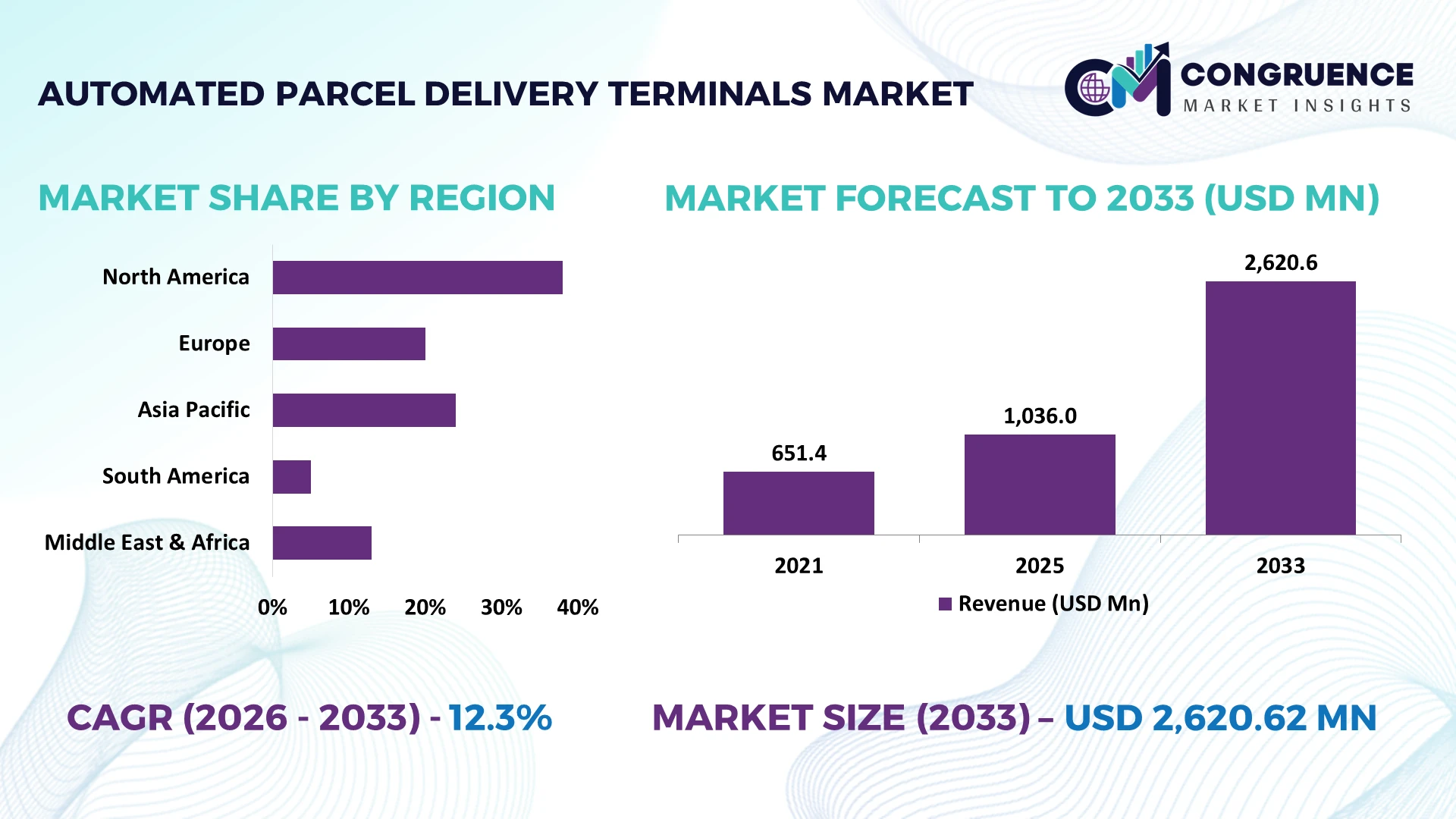
The Global Automated Parcel Delivery Terminals Market was valued at USD 1036.01 Million in 2025 and is anticipated to reach a value of USD 2620.62 Million by 2033 expanding at a CAGR of 12.3% between 2026 and 2033. Growth is driven by e-commerce parcel density, carrier migration from door delivery to out-of-home networks, labor-cost pressure, and automated locker integration with mobile authentication and last-mile routing systems.
Poland remains the most mature country deployment benchmark, with InPost operating 28,165 automated parcel machines in 2025, up 11%, and controlling approximately 70% of its domestic APM network. Around 87% of Polish users select InPost lockers most often, versus Germany’s more fragmented landscape of over 15,500 DHL automated stations. Cross-border e-commerce and Europe’s post-Ukraine-war logistics restructuring are reinforcing dense, carrier-integrated last-mile infrastructure around retail, marketplaces, postal services, and urban logistics.
Strategically, operators should prioritize high-density locker networks, merchant integration, automated sorting, and multi-carrier interoperability because network proximity and compartment utilization increasingly determine last-mile economics.
Market Size & Growth: USD 1,036.01 million in 2025 reaches USD 2,620.62 million by 2033 at 12.3%, driven by e-commerce and out-of-home delivery conversion.
Top Growth Drivers: APM networks expanded 30%, parcel volumes increased 25%, and Eurozone machine deployment rose 55%, demonstrating accelerated infrastructure conversion.
Short-Term Forecast: By 2027, AI-assisted parcel identification can reduce manual handling time by up to 80%, strengthening terminal throughput and labor productivity.
Emerging Technologies: AI routing, autonomous solar-powered lockers, mobile authentication, and open-network terminals are transforming automated last-mile infrastructure.
Regional Leaders: By 2033, indicative allocation places Europe near USD 1.05 billion, Asia-Pacific USD 760 million, and North America USD 550 million as locker density expands.
Consumer/End-User Trends: 87% of Polish consumers prefer InPost lockers, demonstrating how network density converts convenience into recurring delivery behavior.
Pilot/Case Example: InPost’s autonomous locker pilot demonstrated last-mile deliveries generating up to 98% less CO₂ than home delivery.
Competitive Landscape: InPost holds approximately 70% of Poland’s APM network, competing with DHL, Cainiao, Quadient, and KEBA across automated delivery infrastructure.
Regulatory & ESG Impact: Automated locker delivery can cut last-mile CO₂ emissions by up to 98%, aligning deployment with urban decarbonization requirements.
Investment & Funding: InPost added 14,241 APMs during 2025, a 30% network increase, alongside acquisitions and logistics-infrastructure expansion across Europe.
Innovation & Future Outlook: Germany targets 30,000 DHL automated terminals by 2030, doubling current infrastructure as carrier-open lockers and registration-free collection broaden adoption.
The Automated Parcel Delivery Terminals Market is shifting from supplementary parcel collection toward core last-mile infrastructure for e-commerce marketplaces, postal operators, retailers, and courier networks. InPost expanded its APM estate 30% to 61,196 machines in 2025, demonstrating the speed of network densification. AI-assisted parcel identification, app-based authentication, autonomous off-grid lockers, and carrier-open terminals are improving throughput and site flexibility. Meanwhile, labor constraints, cross-border e-commerce and European logistics-network restructuring are pushing operators toward consolidated out-of-home delivery, setting up the strategic discussion around network economics and competitive positioning.
Automated parcel delivery terminals are becoming strategic infrastructure as carriers restructure last-mile networks around consolidated out-of-home delivery rather than repeated doorstep stops. InPost operated 61,196 automated parcel machines in 2025 after expanding its network 30%, demonstrating how terminal density creates both delivery economics and customer lock-in. Labor constraints, urban congestion, cross-border e-commerce, and digital authentication are pushing postal operators and parcel carriers toward automated infrastructure.
A courier can place dozens of parcels at one terminal stop, while traditional home delivery requires separate addresses; dense locker routes can reduce last-mile emissions by up to 98% under favorable operating conditions. Poland leads in consumer adoption and network density, while Germany is accelerating infrastructure deployment and North America remains more home-delivery oriented. Through 2026–2028, deployment will increasingly favor multi-carrier access, modular compartments, AI routing, and off-grid terminals.
DHL’s plan to expand Germany’s automated network toward 30,000 terminals by 2030 illustrates infrastructure-scale commitment. Operators are securing retail sites, integrating marketplaces, acquiring delivery networks, and investing in sorting capacity. Competitive advantage will increasingly depend on terminal proximity, utilization, interoperability, and parcel density rather than simply owning delivery vehicles.
Carrier migration toward consolidated delivery points is fundamentally changing parcel economics. InPost expanded its automated parcel machine estate 30% in 2025, while parcel volumes increased approximately 25%; in Poland, around 87% of consumers identify lockers as their preferred InPost delivery method. High terminal density allows couriers to deliver multiple shipments during one stop instead of servicing dispersed residential addresses, increasing route productivity and reducing failed deliveries. Germany is undergoing a comparable infrastructure shift as DHL scales its automated network toward 30,000 terminals by 2030. Operators are responding by securing supermarket, fuel-station, residential, and transit locations while integrating terminals directly with marketplace checkout systems. The strategic insight is that site density creates a network effect: each additional convenient location improves both consumer adoption and courier route economics.
Rapid terminal installation does not guarantee profitable utilization because site rental, electricity, connectivity, maintenance, compartment mix, and replenishment frequency vary sharply by location. A network expanding 30% annually can dilute average utilization when new machines are installed ahead of parcel density, while peak-season compartment occupancy can exceed 90% at high-demand urban sites. Conversely, poorly positioned terminals remain underused despite identical hardware investment. European operators also face fragmented permitting, accessibility requirements, landlord negotiations, and municipal restrictions that slow deployment. Companies are reducing exposure through modular locker sizing, data-led site selection, retail-host partnerships, and relocation of underperforming units. Poland’s mature network demonstrates a non-obvious constraint: once basic geographic coverage is achieved, profitability depends less on adding terminals and more on optimizing compartment turnover, collection speed, and parcels handled per machine.
Multi-carrier terminals represent a major opportunity because shared infrastructure can increase compartment utilization without requiring each parcel operator to build a dedicated network. Germany’s automated terminal base already exceeds 15,000 DHL locations, while planned expansion targets 30,000 by 2030; simultaneously, open-access locker models are reducing carrier-specific barriers. AI-driven capacity forecasting, dynamic compartment allocation, mobile authentication, and solar-powered off-grid terminals can extend deployment into residential and lower-footfall locations. Operators are positioning through retailer partnerships, API integration, modular hardware, and acquisitions that add immediate network density. A particularly valuable opportunity is returns consolidation: the same terminal handling outbound delivery can aggregate e-commerce returns, increasing utilization across both logistics directions. Companies controlling interoperable software and high-quality locations can monetize infrastructure across multiple carriers rather than depending on proprietary parcel volumes alone.
Scaling terminals across thousands of locations creates execution challenges spanning cybersecurity, uptime, software integration, remote maintenance, and capacity orchestration. Networks exceeding 60,000 machines require continuous synchronization between carrier routing systems, customer applications, access credentials, compartment availability, and merchant platforms. Even 1% terminal downtime across such an estate can temporarily affect more than 600 machines, disrupting collection windows and courier routes. Peak-season utilization above 90% further increases overflow risk when compartment sizes do not match parcel mix. Operators must also protect QR codes, mobile credentials, customer data, and remote-control interfaces against fraud and unauthorized access. Companies are investing in predictive maintenance, encrypted authentication, cloud monitoring, redundant connectivity, and AI-based capacity allocation. Long-term leadership therefore depends on operating terminals as resilient digital infrastructure, not simply deploying physical locker boxes at scale.
Networks Shift Toward Denser Coverage: InPost expanded its automated parcel machine estate by 30% to 61,196 units in 2025, while parcel volumes increased roughly 25%. Operators are prioritizing shorter customer walking distances instead of broad geographic coverage alone. In Poland, mature locker usage is pushing investment toward high-throughput urban locations, with companies using parcel-density analytics and modular expansion to raise compartment turnover without repeatedly adding new sites.
Retail Sites Become Logistics Nodes: Supermarkets, convenience stores, fuel stations, and shopping centers are increasingly hosting automated terminals because existing footfall, lighting, parking, and power reduce deployment complexity. DHL is moving toward 30,000 automated terminals in Germany by 2030, while InPost added more than 14,000 machines during 2025. Operators are signing long-duration host partnerships that convert retail property into distributed logistics infrastructure and generate additional customer visits for site owners.
Off-Grid Terminals Expand Site Choice: Battery-supported and solar-powered terminals are reducing dependence on trenching, fixed electrical connections, and complex civil works. Autonomous configurations can be installed in days rather than infrastructure-intensive deployment cycles measured in weeks. Companies are redesigning terminals around low-power displays, wireless connectivity, modular batteries, and remote diagnostics, allowing networks to enter parking areas and residential locations where conventional powered installations have unfavorable economics.
Returns Become Locker-Based Workflows: Automated returns are moving from staffed counters toward QR-enabled, label-free terminal processes as e-commerce operators target lower reverse-logistics handling costs. Out-of-home networks can consolidate dozens of returned parcels at one collection point, while consumer locker preference reaches approximately 87% within Poland’s mature InPost ecosystem. Operators are integrating marketplace APIs and digital authorization, turning returns from a secondary function into a utilization driver outside delivery peaks.
Outdoor Lockers lead with an estimated 50–55% share because 24/7 accessibility, roadside placement, supermarket integration, and minimal dependence on building opening hours make them the most scalable format for high-volume parcel networks. Poland and Germany demonstrate this model through rapidly densifying outdoor terminal estates. Indoor Lockers retain approximately 25–30% share, serving shopping centers, workplaces, transport facilities, and controlled residential environments where weather protection and security offset restricted access hours.
Modular Lockers are the fastest-growing provided type as operators increasingly match compartment capacity to location-specific parcel demand rather than installing standardized terminal configurations. Additional modules can expand capacity without relocating the core controller, improving capital utilization at saturated sites. Refrigerated Lockers remain specialized around grocery fulfillment, while Temperature-Controlled Lockers extend the concept to products requiring defined storage conditions. Operators are investing in weather-resistant hardware, modular compartment architecture, low-energy cooling, and remote monitoring. Investment priorities are therefore moving from uniform locker deployment toward configurable terminals matched to site throughput, parcel dimensions, and environmental requirements.
E-Commerce Delivery leads with approximately 50–55% of application demand because online marketplaces generate recurring parcel density capable of supporting high locker utilization. Last-Mile Delivery closely overlaps operationally but serves the broader carrier objective of consolidating multiple household stops into single terminal drops. InPost’s parcel volumes increased approximately 25% in 2025 alongside 30% machine expansion, demonstrating how e-commerce throughput and terminal density reinforce one another. Click-and-Collect remains established among omnichannel retailers seeking to connect digital ordering with physical locations.
Returns Management is the fastest-growing provided application as QR authentication, label-free processing, and marketplace integration remove staffed counter requirements. Grocery Delivery remains smaller because refrigerated or Temperature-Controlled Lockers require higher hardware, energy, and maintenance intensity, but it provides strategically valuable extension beyond conventional parcels. Operators are expanding marketplace APIs, automated notifications, reverse-logistics functionality, and refrigerated modules. The commercial shift favors platforms capable of processing delivery, collection, and returns through the same installed terminal, raising utilization across more hours of the operating day.
Logistics Providers lead with approximately 35–40% of end-user demand because they control parcel routing, sorting infrastructure, courier fleets, and network-capacity decisions required to achieve high terminal utilization. Courier Companies represent another substantial buying group, increasingly replacing repeated residential stops with consolidated locker drops. E-Commerce Retailers strengthen deployment through checkout integration and preferred delivery incentives, using automated terminals to reduce failed-delivery exposure and provide customers with flexible collection windows.
Residential Communities are the fastest-growing provided end-user as apartment developments face rising parcel volumes, concierge workload, theft exposure, and limited unattended storage. Grocery Retailers remain strategically distinct, deploying Refrigerated and Temperature-Controlled Lockers where collection windows must preserve food quality. With major European APM estates expanding around 30% annually, suppliers are developing modular configurations, property-management integrations, multi-carrier software, and service-based pricing. Competitive positioning is shifting toward ecosystem development: hardware manufacturers increasingly need carrier APIs, remote maintenance, analytics, and configurable access systems to win enterprise deployments rather than selling standalone cabinets.
Europe accounted for the largest market share at 42% in 2025 however, Asia-Pacific is expected to register the fastest growth, expanding at a CAGR of 14.6% between 2026 and 2033.
Residential Logistics Drives Locker Integration
North America accounts for approximately 24% of automated parcel delivery terminal demand, led by the U.S. and its high e-commerce parcel intensity, multifamily housing stock, and established carrier infrastructure. Unlike Europe’s carrier-owned public networks, U.S. deployment is concentrated around apartment buildings, universities, offices, retail stores, and commercial properties. Amazon Hub, Parcel Pending by Quadient, Luxer One, and major property managers have normalized unattended delivery infrastructure across residential environments. More than 35% of U.S. households rent their homes, creating concentrated parcel volumes suited to shared terminals. Operators increasingly integrate cloud access control, mobile notifications, carrier-independent delivery, and property-management software. The operational shift is from amenity-based lockers toward infrastructure that reduces front-desk handling, parcel theft exposure, and repeated courier access within high-density properties.
United States Market Outlook: U.S. e-commerce represents roughly 16% of total retail sales, creating sustained parcel flows across metropolitan logistics networks. Multifamily properties provide particularly favorable terminal economics because hundreds of households can share one installation. Suppliers are targeting property developers and logistics operators with carrier-open systems, modular compartments, cloud monitoring, and recurring software-service contracts.
Out-of-Home Networks Become Core Infrastructure
Europe leads with approximately 42% of global demand, supported by dense urban populations, mature postal systems, strong e-commerce penetration, and extensive out-of-home delivery behavior. Poland, Germany, the UK, France, and Italy are central deployment markets. InPost operated 61,196 automated parcel machines across its network in 2025 after adding 14,241 units, while DHL is working toward approximately 30,000 automated terminals in Germany by 2030. Operators are integrating lockers with sorting centers, marketplace checkout, returns processing, and mobile authentication rather than treating them as standalone collection points. Urban emissions restrictions and courier labor pressure reinforce consolidated delivery economics. The competitive focus has consequently shifted toward walking-distance coverage, high compartment turnover, modular expansion, and retailer-host partnerships that improve site economics without requiring dedicated logistics real estate.
Poland Market Outlook: Poland is the benchmark for consumer adoption, with approximately 87% of InPost users selecting automated parcel machines as their preferred delivery option. InPost operates more than 28,000 machines domestically, creating exceptionally dense access. This network effect raises entry barriers because new operators must compete simultaneously on location proximity, marketplace integration, and collection convenience.
E-Commerce Scale Accelerates Automated Collection
Asia-Pacific represents approximately 26% of global demand, driven by China, Japan, Australia, Singapore, and South Korea, where high digital-commerce penetration supports automated parcel infrastructure. China combines enormous parcel throughput with smart-city logistics, mobile payments, and dense residential compounds, making community locker networks operationally attractive. More than 170 billion express parcels were handled nationally in 2024, creating a scale advantage unmatched by other markets. Cainiao and other logistics platforms integrate terminals with route optimization, digital authentication, and marketplace data, while Japan uses lockers to address redelivery and courier labor constraints. Australia is expanding carrier-neutral and postal locker networks across metropolitan areas. Suppliers increasingly emphasize QR access, modular hardware, remote monitoring, and local manufacturing. The region’s differentiator is integration: terminals function as nodes within digital commerce ecosystems rather than isolated parcel-storage equipment.
China Market Outlook: China’s express-delivery system handles more than 170 billion parcels annually, providing exceptional throughput for community and residential terminals. Dense apartment complexes enable couriers to consolidate numerous deliveries into single stops. Operators are integrating locker networks with e-commerce platforms, digital payments, route-planning systems, and automated sorting, making software interoperability as important as physical terminal capacity.
Brazil Builds Alternative Delivery Infrastructure
South America represents approximately 4% of global demand, with Brazil accounting for the largest deployment opportunity due to its e-commerce scale, concentrated metropolitan population, and difficult last-mile economics. São Paulo, Rio de Janeiro, and other large urban centers combine congestion, security concerns, gated residential properties, and high failed-delivery costs, creating a practical case for unattended collection. Brazil’s e-commerce penetration has moved above 10% of retail activity, supporting parcel-terminal placement around shopping centers, residential developments, convenience stores, and transport locations. Deployment nevertheless remains less dense than European networks because fragmented carrier infrastructure and site economics limit nationwide coverage. Operators are responding through retail partnerships, carrier-neutral hardware, cloud-managed terminals, and selective metropolitan deployment. The near-term business case centers on reducing redelivery and security exposure rather than maximizing national locker density.
Brazil Market Outlook: Brazil provides the region’s strongest terminal opportunity through a population above 200 million and highly concentrated digital-commerce demand in major cities. Operators can generate stronger utilization by placing terminals inside secure retail and residential environments. Successful scaling depends on carrier interoperability, localized payment and notification systems, dependable maintenance, and disciplined site selection across metropolitan delivery corridors.
Smart-City Investment Modernizes Parcel Infrastructure
Middle East & Africa represents approximately 4% of global demand, with the UAE, Saudi Arabia, Israel, and South Africa concentrating automated terminal deployment. Gulf markets combine high smartphone penetration, digitally active consumers, modern retail infrastructure, and government-backed smart-city programs, creating favorable conditions for app-controlled parcel collection. Saudi Arabia’s Vision 2030 logistics transformation is increasing investment in e-commerce fulfillment and last-mile infrastructure, while the UAE’s dense urban hubs support terminals in residential towers, malls, business districts, and transport nodes. Extreme temperatures create an additional hardware requirement, increasing demand for weather-resistant electronics and, where necessary, temperature-controlled compartments. South African deployment is more selective because infrastructure and security conditions vary substantially between locations. Vendors are using logistics partnerships, cloud platforms, modular systems, and locally supported maintenance to reduce execution risk.
United Arab Emirates Market Outlook: The UAE combines internet penetration above 99% with highly concentrated urban development and advanced digital-payment infrastructure. Dubai and Abu Dhabi provide favorable terminal economics because residential towers and commercial complexes aggregate substantial parcel volumes. Suppliers are differentiating through 24/7 access, mobile authentication, heat-resistant hardware, and integration with courier and property-management systems.
InPost, DHL, Cainiao, Quadient, KEBA, and Cleveron compete across carrier-owned networks, hardware platforms, and open-access terminal infrastructure. The top five participants control approximately 55% of organized automated-terminal activity, although concentration varies sharply by country. InPost competes through network density, with its machine estate expanding 30% in 2025; DHL targets infrastructure scale, while Quadient and KEBA emphasize carrier-neutral hardware and software integration. Cainiao leverages marketplace data and logistics integration, particularly in China. Competition increasingly centers on compartment utilization, deployment speed, interoperability, and lifecycle cost; modular expansion can increase site capacity by more than 20% without replacing core controllers, while consolidated delivery can reduce last-mile emissions by up to 98% under favorable routes. Operators are acquiring networks, securing retail locations, integrating returns, and deploying off-grid hardware. Prime-site scarcity, software integration, maintenance density, and network effects create entry barriers. Winning requires dense locations, high utilization, carrier interoperability, reliable uptime, and scalable digital orchestration.
InPost S.A.
DHL Group
Cainiao Smart Logistics Network Limited
Quadient S.A.
KEBA Group AG
Cleveron AS
TZ Limited
Bloq.it
SwipBox International A/S
Parcel Pending
Luxer One
Smiota Inc.
Vlocker
Kern Limited
Current automated parcel terminals combine cloud-managed lockers, QR or app authentication, remote diagnostics, modular compartments, and carrier APIs. Mature networks increasingly use battery-powered hardware that removes fixed-grid installation requirements and accelerates site commissioning. InPost expanded its automated machine estate 30% during 2025, showing deployment at scale. Compared with staffed or doorstep workflows, out-of-home delivery achieves above 99% first-attempt delivery in mature networks, reducing redelivery activity and improving courier productivity.
Emerging technology centers on carrier-agnostic software, AI-based capacity forecasting, dynamic compartment allocation, computer vision, and integrated returns. Open networks allow several carriers to share one terminal, improving asset utilization while reducing duplicated infrastructure. Battery-powered NEXT lockers provide a 10-year designed lifespan and can be deployed without electrical civil works. Cloud orchestration enables operators to redirect parcels toward available compartments, improving peak-period capacity management and supporting higher utilization.
Disruptive development through 2026–2028 will combine autonomous off-grid terminals, predictive maintenance, label-free returns, digital identity, and routing data. Operators with integrated hardware-software stacks benefit because interoperability shortens partner onboarding and supports faster geographic scaling. InPost’s 20,000-unit NEXT commitment demonstrates this shift. Competitive advantage will increasingly depend on software uptime, open APIs, location analytics, energy independence, and automated capacity optimization rather than locker hardware alone.
November 2024 Quadient expanded its DECATHLON partnership in France, adding more than 140 lockers within 12 months and reaching 210 equipped stores. Cloud monitoring and automated pickup codes strengthened click-and-collect capacity while reducing store-staff involvement in parcel handover. Source: quadient.com
March 2025 Allegro announced plans to add 2,500 parcel lockers in Poland during 2025, supplementing more than 4,500 existing units. Its own delivery channels handled 24% of Q4 2024 parcels, strengthening control over fulfillment economics and carrier dependence. Source: reuters.com
September 2025 InPost partnered with Bloq.it for more than 20,000 NEXT lockers across Europe and acquired a minority stake. Battery-powered terminals eliminate grid dependence, enabling faster site rollout across France, Britain, Italy, Portugal and Spain over five years. Source: bloq.it
January 2026 InPost reported 61,196 automated parcel machines after adding 14,200 during 2025, a 30% increase. Lockers represented 65% of 94,500 out-of-home points, while Eurozone APM deliveries increased 51%, validating accelerated European network conversion toward automated collection infrastructure. Source: PPTI
The Automated Parcel Delivery Terminals Market Report assesses Indoor Lockers, Outdoor Lockers, Refrigerated Lockers, Temperature-Controlled Lockers, and Modular Lockers across E-Commerce Delivery, Last-Mile Delivery, Click-and-Collect, Returns Management, and Grocery Delivery. End-user coverage includes E-Commerce Retailers, Logistics Providers, Courier Companies, Grocery Retailers, and Residential Communities. Outdoor systems represent approximately 50–55% of deployment, reflecting their 24/7 accessibility and site flexibility.
Regional analysis covers North America, Europe, Asia-Pacific, South America, and Middle East & Africa, including country-level infrastructure and deployment patterns. Technology coverage examines AI capacity forecasting, carrier-agnostic platforms, modular compartments, battery-powered terminals, cloud monitoring, digital authentication, and automated returns. With major networks expanding machine estates by approximately 30% annually, the report supports 2026–2033 investment planning, location strategy, technology partnerships, competitive benchmarking, infrastructure expansion, and identification of high-utilization deployment models.
| Report Attribute/Metric | Report Details |
|---|---|
Market Revenue in 2025 | USD 1036.01 Million |
Market Revenue in 2033 | USD 2620.62 Million |
CAGR (2026 - 2033) | 12.3% |
Base Year | 2025 |
Forecast Period | 2026 - 2033 |
Historic Period | 2021 - 2025 |
Segments Covered | By Type
By Application
By End-User
|
Key Report Deliverable | Revenue Forecast, Growth Trends, Market Dynamics, Segmental Overview, Regional and Country-wise Analysis, Competition Landscape |
Region Covered | North America, Europe, Asia-Pacific, South America, Middle East, Africa |
Key Players Analyzed | InPost S.A., DHL Group, Cainiao Smart Logistics Network Limited, Quadient S.A., KEBA Group AG, Cleveron AS, TZ Limited, Bloq.it, SwipBox International A/S, Parcel Pending, Luxer One, Smiota Inc., Vlocker, Kern Limited |
Customization & Pricing | Available on Request (10% Customization is Free) |




