
Reports
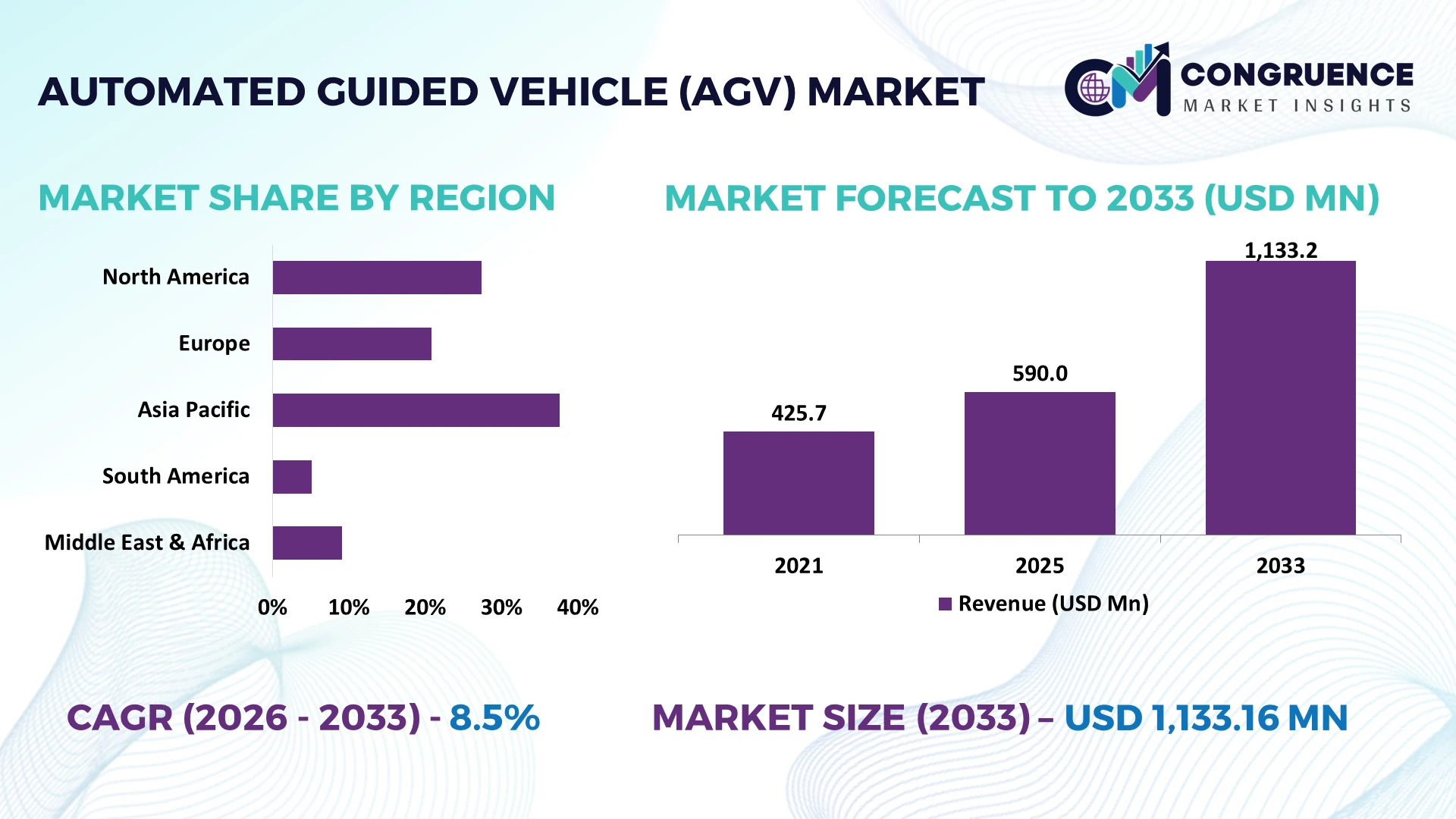
The Global Automated Guided Vehicle (AGV) Market was valued at USD 590.0 Million in 2025 and is anticipated to reach a value of USD 1,133.2 Million by 2033 expanding at a CAGR of 8.5% between 2026 and 2033. Growth is driven by warehouse automation, labor-cost pressure, reshoring of manufacturing, and rapid deployment of AI-enabled navigation, fleet management, and autonomous material-handling systems.
China remains the dominant country, supported by large-scale electronics, automotive, and e-commerce logistics operations, with automated material-handling adoption exceeding 30% across advanced warehouse deployments. Japan follows with strong automotive and electronics automation, while Germany maintains high AGV utilization in Industry 4.0 factories. China’s manufacturing automation push under its “Made in China 2025” strategy reinforces domestic AGV investment and localization. China’s scale and manufacturing density position it ahead of Japan in deployment volume, while Germany emphasizes high-precision industrial integration. This divergence makes localized fleet software, navigation, and service capabilities increasingly important for global suppliers.
Strategic implication, AGV manufacturers that combine autonomous navigation, interoperable fleet orchestration, and localized service networks will strengthen positioning across high-growth manufacturing and logistics hubs.
Market Size & Growth: USD 590.0 million in 2025 to USD 1,133.2 million by 2033 at an 8.5% CAGR, driven by warehouse and factory automation.
Top Growth Drivers: Labor-cost pressure 9%; warehouse automation 11%; e-commerce fulfillment 13%.
Short-Term Forecast: By 2028, AGV deployment efficiency is projected to improve 15%, while manual material-handling costs decline 10%.
Emerging Technologies: AI navigation, LiDAR-based perception, digital twins, and cloud fleet orchestration are accelerating advanced AGV capabilities.
Regional Leaders: Asia Pacific approaches USD 560 million; Europe exceeds USD 300 million; North America approaches USD 270 million by 2033, supported by automated logistics expansion.
Consumer/End-User Trends: More than 35% of advanced warehouses prioritize autonomous material movement for repetitive internal transport.
Pilot/Case Example: A 2024 automotive-factory AGV deployment reduced internal transport time by approximately 20% through automated routing and synchronized fleet control.
Competitive Landscape: Leading suppliers collectively hold approximately 35% share, with key players including Toyota Industries, Daifuku, KUKA, SSI SCHAEFER, and JBT.
Regulatory & ESG Impact: Automated electric fleets can reduce internal vehicle emissions by 20% while supporting workplace-safety and energy-efficiency objectives.
Investment & Funding: More than USD 1 billion in combined automation investments is supporting robotics expansion, software integration, manufacturing capacity, and logistics partnerships.
Innovation & Future Outlook: Next-generation AGVs are shifting toward AMR-like autonomy, AI fleet optimization, predictive maintenance, and multi-system interoperability.
The Automated Guided Vehicle (AGV) Market is expanding across automotive plants, semiconductor facilities, warehouses, pharmaceutical production, and cold-chain logistics as operators prioritize precise, repeatable material movement. AI-enabled navigation and LiDAR integration are reducing dependence on fixed routes, while more than 30% of advanced facilities increasingly incorporate autonomous transport into digital workflows. Supply-chain restructuring and localized manufacturing are further accelerating deployment, creating a stronger strategic role for intelligent intralogistics.
Automated Guided Vehicles are becoming strategically important because material movement increasingly determines factory throughput, warehouse utilization, and labor productivity. Manufacturers are shifting capital toward autonomous intralogistics as reshoring, shorter fulfillment cycles, and tighter inventory controls reshape supply-chain architecture. In automotive and electronics facilities, AGVs increasingly operate as connected production assets rather than standalone transport machines.
Technology adoption is also changing the cost equation. Modern laser- or LiDAR-guided AGVs can reduce repetitive transport labor requirements by roughly 20–30% compared with conventional manual movement while improving route consistency and traceability. China emphasizes high-volume deployment across manufacturing hubs, Japan focuses on precision automation, and Germany integrates AGVs closely with Industry 4.0 production systems.
Over the next 2–3 years, fleet utilization, autonomous routing, and predictive maintenance will become key operational indicators, with digitally coordinated fleets targeting 15–20% higher utilization. A practical deployment in automotive manufacturing demonstrates how synchronized AGVs can reduce material-transfer delays while maintaining production continuity. Companies are therefore increasing software investment, forming robotics partnerships, and expanding localized service capabilities. Competitive advantage will increasingly depend on interoperable autonomy rather than vehicle hardware alone.
Warehouse and manufacturing automation is accelerating AGV adoption as labor-intensive transport becomes harder to scale. E-commerce fulfillment operations are targeting productivity improvements of 15–25%, while automated routing can reduce repetitive material-transfer labor by approximately 20%. China’s automotive and electronics clusters are increasingly integrating AGVs with warehouse-management and manufacturing-execution systems. The shift toward AI-assisted navigation also reduces dependence on fixed pathways, allowing fleets to adapt to changing production layouts. Companies are responding by investing in LiDAR, machine vision, fleet-control software, and localized service networks. The non-obvious advantage is data generation: each AGV movement creates operational intelligence that helps factories identify bottlenecks and redesign workflows beyond the initial automation project.
Initial AGV deployment remains constrained by vehicle, navigation, software, charging, and infrastructure costs, with integrated projects often carrying 15–25% higher upfront expenditure than basic automated transport systems. Interoperability between legacy warehouse-management platforms and new fleet-management software further increases engineering requirements. In Germany and Japan, highly customized production environments can require extensive integration before fleets achieve stable throughput. Supply-chain disruptions affecting sensors, controllers, batteries, and semiconductor components can also increase procurement volatility by more than 10%. Companies are reducing exposure through multi-source procurement, standardized interfaces, longer supplier contracts, and modular vehicle architectures. The key limitation is not vehicle availability alone; fragmented factory infrastructure can prevent otherwise capable AGVs from achieving expected utilization.
AI navigation and software-defined fleet management are opening new AGV opportunities beyond fixed-route transportation. Dynamic routing can improve fleet utilization by 15–20%, while predictive maintenance programs can reduce unplanned equipment downtime by approximately 20%. India’s automotive, pharmaceutical, and electronics manufacturing expansion creates additional demand for scalable intralogistics without requiring complete facility redesigns. Cloud-based fleet orchestration is emerging as a strategic differentiator because operators can coordinate mixed AGV fleets, conveyors, robots, and warehouse systems through a unified layer. Companies are increasing R&D spending on machine vision, digital twins, and autonomous decision-making. A less obvious opportunity lies in brownfield factories: software-led navigation enables automation in facilities where installing extensive fixed infrastructure is economically unattractive.
Scaling AGV fleets from pilot projects to hundreds of connected vehicles creates substantial execution complexity. Fleet-management networks can involve dozens of software endpoints, while a 20–30% increase in vehicle density can expose routing conflicts and charging bottlenecks if infrastructure is not redesigned. Cybersecurity is becoming equally important as AGVs connect with warehouse-management, manufacturing-execution, and enterprise systems. North American and European operators are placing greater emphasis on secure industrial connectivity and resilient data architectures. Companies must invest in network segmentation, encrypted communications, redundancy, simulation environments, and workforce training. The long-term challenge is maintaining consistent autonomous performance as facilities, production schedules, and vehicle fleets evolve. Strategic advantage will depend on scalable orchestration rather than simply increasing AGV unit volumes.
AI Navigation Replaces Fixed Routing: AI vision, LiDAR, and natural-navigation systems are reducing commissioning time by around 20% and enabling layout changes without physical guide paths. Adoption is shifting toward flexible fleets that can reroute around congestion and production changes. Companies are upgrading legacy AGVs with intelligent fleet software, improving utilization by 15–20% while reducing dependence on fixed infrastructure.
Private 5G Reshapes Fleet Connectivity: Private 5G deployments are delivering approximately 20% productivity gains and up to 15% lower connectivity-related capital costs in early industrial implementations. Automotive and electronics facilities are using deterministic connectivity for synchronized AGV fleets, real-time traffic control, and machine coordination. Suppliers are partnering with industrial-network providers as wireless infrastructure becomes an operational component rather than a supporting utility.
Lithium-Ion Accelerates Shift: Lithium-ion batteries are gaining ground as facilities seek faster charging, higher availability, and reduced maintenance. Automated fleets using opportunity charging can increase vehicle availability by roughly 15%, while charging downtime can fall by about 20%. Energy-price volatility and tighter warehouse operating schedules are accelerating adoption, prompting manufacturers to redesign AGV platforms around battery intelligence, automated charging, and energy-management software.
Mixed Fleets Become Standard: Warehouses are increasingly combining AGVs, autonomous mobile robots, conveyors, and robotic picking systems instead of deploying isolated vehicle fleets. Mixed automation can improve material-flow productivity by 15–25% and reduce manual handoffs by approximately 20%. The non-obvious shift is toward orchestration software as the control layer. Companies are therefore prioritizing interoperable fleet-management platforms and partnerships that connect equipment from multiple vendors.
Tow Vehicles, Unit Load Carriers, Pallet Trucks, Forklift AGVs, and Assembly Line Vehicles represent the principal vehicle configurations. Forklift AGVs hold the leading position at approximately 29% share because they combine pallet handling, transport, storage, and retrieval within existing warehouse infrastructure. Their compatibility with conventional racking supports scalable deployment, while autonomous lifting reduces repetitive operator intervention. Unit Load Carriers follow with roughly 22%, particularly across distribution centers requiring consistent pallet and tote movement.
Assembly Line Vehicles represent the fastest-expanding configuration, with adoption increasing approximately 10–12% as automotive and electronics plants synchronize component delivery with production takt time. Tow Vehicles remain important for high-volume movement of multiple carts, while Pallet Trucks provide a lower-complexity entry point for warehouses. Companies are increasingly shifting investment toward forklift and assembly-line platforms, while modular navigation and fleet software improve interoperability across vehicle classes.
Transportation & Distribution, Storage & Assembly, and Packaging constitute the principal AGV applications. Transportation & Distribution leads with approximately 40% share because repetitive movement between receiving, storage, production, and dispatch areas provides the clearest automation economics. Storage & Assembly follows at roughly 35%, supported by synchronized component delivery and automated inventory movement. Packaging represents a smaller but increasingly specialized application, particularly where AGVs connect palletizing, staging, and outbound workflows.
Storage & Assembly is recording the fastest operational shift, with adoption increasing around 12% as manufacturers integrate AGVs with production scheduling and real-time inventory systems. Transportation applications remain mature, but companies are expanding from single-route vehicles toward dynamically coordinated fleets. Packaging deployments are becoming more integrated with robotic cells, reducing manual transfer points by approximately 20%.
Automotive, Food & Beverage, Retail, Healthcare, Logistics, Manufacturing, and Aerospace constitute the major AGV end-user groups. Automotive remains the dominant buyer at approximately 35% share because high-volume plants require continuous component movement, synchronized assembly supply, and repeatable production-floor logistics. Manufacturing follows at about 25%, while Logistics is expanding rapidly as distribution centers handle greater order frequency and tighter fulfillment windows.
Retail and Logistics represent the fastest-shifting buyer groups, with deployment growth of roughly 12–14% as e-commerce facilities prioritize automated transportation and order-flow consistency. Food & Beverage increasingly emphasizes hygienic and temperature-controlled material movement, while Healthcare favors controlled internal transport for supplies and medicines. Aerospace remains specialized but benefits from AGVs designed for high-value components. Companies are responding through vertical-specific configurations, system-integrator partnerships, subscription-based fleet software, and scalable deployment models.
Asia Pacific accounted for the largest market share at 37.6% in 2025 however, Asia Pacific is expected to register the fastest growth, expanding at a CAGR of 8.9% between 2026 and 2033.

North America accounted for 27.4% of the global AGV market in 2025, with the United States representing the region’s principal deployment center. E-commerce fulfillment, automotive manufacturing, food distribution, and third-party logistics drive concentrated demand for automated pallet movement and replenishment. Large distribution facilities increasingly integrate AGVs with warehouse-management systems, robotic picking, and automated storage infrastructure. Private wireless networks and fleet-orchestration platforms are strengthening real-time coordination, while high warehouse labor costs continue to support automation economics. Companies are increasingly favoring scalable deployments that can expand across multiple facilities rather than isolated vehicle projects. The region’s mature logistics infrastructure also supports faster integration of AGVs into existing workflows, making software interoperability and service coverage increasingly important competitive factors.
United States Market Outlook: The United States holds the dominant position within North America, supported by extensive fulfillment infrastructure, advanced manufacturing, and large-scale logistics operators. The country accounted for approximately 24% of global AGV demand through its concentration of automated warehouses and industrial facilities. Deployment increasingly focuses on pallet transportation, replenishment, and high-frequency internal logistics.
Europe accounted for approximately 20.8% of the global AGV market in 2025, with Germany, Italy, France, and the United Kingdom representing major deployment centers. Automotive, machinery, electronics, and logistics operations are integrating AGVs with manufacturing-execution systems and robotic production cells. Germany’s industrial automation ecosystem supports high levels of connected material movement, while European sustainability priorities are accelerating electric AGV adoption and energy-efficient charging. Approximately 20% of European industrial automation deployments increasingly emphasize connected production and material-flow optimization. Companies are responding through modular AGV platforms, interoperable software, and partnerships between robotics, controls, and logistics providers. Demand is increasingly shifting from standalone vehicles toward coordinated intralogistics systems capable of supporting flexible production.
Germany Market Outlook: Germany is the leading European AGV market, supported by its automotive and machinery manufacturing base and strong Industry 4.0 infrastructure. The country represents approximately 7% of global AGV demand and has extensive use of automated vehicles for assembly-line supply, component movement, and warehouse operations. Investment is increasingly focused on connected fleets and flexible factory automation.
Asia Pacific accounted for 37.6% of the global AGV market in 2025, making it the largest regional market. China, Japan, South Korea, and India account for the majority of regional deployment, supported by electronics, automotive, semiconductor, and e-commerce operations. China alone represents approximately 20% of global AGV demand, reflecting its extensive manufacturing footprint and warehouse modernization. Japan emphasizes precision automation and labor-saving technologies, while India is expanding AGV deployment alongside new manufacturing and logistics infrastructure. Companies are increasingly combining AGVs with AI navigation, automated storage, machine vision, and digital fleet management. Local manufacturing capacity is also strengthening, particularly in China, where suppliers are developing application-specific vehicles for high-volume factories. This combination of manufacturing scale and technology localization gives Asia Pacific the strongest deployment base.
China Market Outlook: China is the leading country in the global AGV market, supported by automotive, electronics, semiconductor, and e-commerce manufacturing. The country contributes approximately 20% of global AGV demand and has rapidly expanded domestic production capabilities. Industrial operators increasingly deploy AGVs across smart factories, automated warehouses, and high-volume production facilities, while local suppliers improve customization and shorten equipment deployment cycles.
South America accounted for approximately 5.1% of global AGV demand in 2025, with Brazil representing the primary deployment market. Automotive manufacturing, food processing, consumer goods, mining-related logistics, and large distribution facilities form the principal demand centers. AGV adoption remains concentrated in operations where repetitive material movement provides measurable productivity benefits, while uneven infrastructure limits broader deployment. Brazil’s industrial corridors are increasingly incorporating automated pallet transportation and warehouse movement, with selected facilities targeting productivity improvements of approximately 15–20%. Companies are favoring modular AGVs, local system integrators, and phased installations that reduce infrastructure requirements. The strategic opportunity lies in brownfield facilities, where flexible navigation systems can automate material flow without extensive fixed-guide installation.
Brazil Market Outlook: Brazil represents approximately 2.5% of global AGV demand and remains South America’s principal market because of its automotive, food-processing, manufacturing, and logistics infrastructure. Large industrial facilities are increasingly deploying AGVs for pallet movement and repetitive internal transport. Companies are prioritizing scalable systems that can deliver measurable productivity improvements while limiting major facility modifications.
Middle East & Africa accounted for approximately 9.1% of the broader global automated guided vehicle systems market in 2025, with deployment concentrated in the United Arab Emirates, Saudi Arabia, ports, logistics zones, pharmaceutical facilities, and advanced warehouses. Large-scale infrastructure modernization is encouraging operators to integrate AGVs with automated storage, robotic picking, and warehouse-management platforms. The region remains less mature than established manufacturing markets, but major logistics facilities increasingly target 15–20% improvements in internal material-flow productivity through automation. Companies are responding with system-integrator partnerships, localized maintenance capabilities, and fleet platforms designed for high-throughput environments. Harsh operating conditions also make battery thermal management and preventive maintenance important selection criteria. Demand is therefore becoming concentrated around large, technologically advanced logistics projects rather than fragmented small-scale deployments.
United Arab Emirates Market Outlook: The United Arab Emirates accounts for approximately 2.0% of global AGV systems demand and represents the region’s leading deployment hub because of its ports, free zones, fulfillment infrastructure, and advanced logistics facilities. Major warehouses increasingly combine AGVs with automated storage and robotic picking, supporting high-throughput material movement and strengthening the country’s position as an automated logistics center.
Daifuku, KION Group, Toyota Industries, Jungheinrich, and KUKA compete as global automation leaders, while JBT, SSI SCHAEFER, Murata Machinery, and Seegrid challenge them through specialized material-handling systems. OEMs compete with automation integrators and technology suppliers across warehouse, manufacturing, automotive, and logistics deployments. The top five players collectively represent approximately 40–50% of the market, indicating meaningful concentration alongside regional competition. Competition centers on technology, deployment speed, customization, lifecycle cost, and supply reliability. Natural-navigation and fleet-management upgrades can improve utilization by approximately 5–10%, while modular architectures can reduce reconfiguration costs by 10–20%. Companies are expanding production, integrating fleet software with WMS/MES platforms, and forming application partnerships to secure larger deployments. The competitive shift is moving from standalone AGVs toward software-led, interoperable material-flow platforms. High entry barriers include safety validation, navigation expertise, fleet orchestration, engineering capability, service networks, and customer references. Winning requires scalable hardware, intelligent software, rapid deployment, customization, and dependable lifecycle support.
Daifuku Co., Ltd.
KION Group AG
Toyota Industries Corporation
Jungheinrich AG
KUKA SE & Co. KGaA
JBT Marel Corporation
SSI SCHAEFER Group
Murata Machinery, Ltd.
Hyster-Yale Materials Handling, Inc.
Scott Technology Limited
OMRON Corporation
Mitsubishi Logisnext Co., Ltd.
E80 Group S.p.A.
Seegrid Corporation
Laser-guided AGVs remain widely used in structured factories, while natural-feature and SLAM navigation are expanding flexible deployments. Removing magnetic tape, beacons, or embedded wire can reduce installation effort by approximately 15–25%, while dynamic rerouting can improve fleet utilization by 5–10%. Modern systems increasingly combine LiDAR, safety scanners, 3D cameras, onboard mapping, and machine-vision capabilities for safer navigation and more flexible material movement.
AI-enabled fleet orchestration is becoming the disruptive technology layer. Dynamic task allocation, traffic management, battery monitoring, predictive maintenance, and WMS/MES integration can improve multi-AGV efficiency by approximately 8–15% compared with static dispatching approaches. Cloud-based fleet dashboards and digital-twin capabilities can reduce avoidable downtime by approximately 10–15%. Interoperability is also becoming commercially important as manufacturers combine AGVs from different suppliers within the same facility.
During 2026–2028, modular vehicle architectures, autonomous navigation, AI fleet management, LiDAR, vision systems, and lithium-ion battery platforms will increasingly influence purchasing decisions. Compared with fixed-path AGVs, modular natural-navigation systems can reduce reconfiguration time by approximately 20–30%. Technology-focused suppliers and integrators benefit as customers prioritize flexibility, faster deployment, and mixed-fleet compatibility. Acting now allows operators to standardize software, integrate existing WMS/MES infrastructure, and scale automation without extensive facility redesign.
March 2025 — Scott Technology launched NexBot at ProMat 2025, introducing a modular AGV architecture supporting counterbalance fork, straddle fork, lift-deck, conveyor-deck, and tugger configurations. The modular design targets reduced deployment time and engineering costs while allowing one platform to support multiple material-handling workflows across logistics, manufacturing, warehousing, and e-commerce. Source: scottautomation.com
April 2024 — Daifuku modified its Shiga Works facility to strengthen manufacturing and logistics capabilities. Building M was designated for maintenance-parts management and AGV manufacturing, while Building G included a cleanroom for semiconductor and LCD production systems. The expansion strengthens production capacity and supports growing automation demand in semiconductor-related applications.
August 2025 — KUKA expanded its mobile-robotics portfolio with the KMP 250P autonomous mobile platform, designed for payloads up to 250 kilograms and equipped with laser scanners and 3D cameras. The platform supports flexible intralogistics applications and strengthens KUKA's position in scalable autonomous material transportation across manufacturing environments. Source: kuka.com
January 2026 — MarketsandMarkets identified Daifuku, Toyota Industries, KUKA, KION, and Mitsubishi Logisnext among key companies competing across Asia Pacific AGV deployments, with competition increasingly focused on fleet integration, navigation technologies, and regional service coverage. This shift increases pressure on suppliers to combine hardware with integrated software and localized support.
The Automated Guided Vehicle (AGV) Market Report covers Tow Vehicles, Unit Load Carriers, Pallet Trucks, Forklift AGVs, and Assembly Line Vehicles across Transportation & Distribution, Storage & Assembly, and Packaging applications. End-user analysis includes Automotive, Food & Beverage, Retail, Healthcare, Logistics, Manufacturing, and Aerospace, covering both established high-volume deployments and specialized material-handling requirements.
Regional coverage spans North America, Europe, Asia Pacific, South America, and Middle East & Africa, with country-level assessment of major automation markets. Technology analysis includes laser, magnetic, inductive, optical, vision, natural-navigation, LiDAR, fleet-management software, AI-enabled routing, battery technologies, and WMS/MES integration. The report evaluates established suppliers, emerging technology companies, modular platforms, interoperability, deployment patterns, and niche automation opportunities. These insights support investment planning, geographic expansion, competitive positioning, supplier selection, technology adoption, and product-roadmap decisions through 2026–2033.
| Report Attribute / Metric | Details |
|---|---|
| Market Revenue (2025) | USD 590.0 Million |
| Market Revenue (2033) | USD 1,133.2 Million |
| CAGR (2026–2033) | 8.5% |
| Base Year | 2025 |
| Forecast Period | 2026–2033 |
| Historic Period | 2021–2025 |
| Segments Covered |
By Type
By Application
By End-User
|
| Key Deliverables | Revenue Forecast; Market Trends; Growth Drivers & Restraints; Technology Insights; Segmentation Analysis; Regional Insights; Competitive Landscape; Regulatory & ESG Overview; Recent Developments |
| Regions Covered | North America; Europe; Asia-Pacific; South America; Middle East & Africa |
| Companies Profiled | Daifuku Co., Ltd.; KION Group AG; Toyota Industries Corporation; Jungheinrich AG; KUKA SE & Co. KGaA; JBT Marel Corporation; SSI SCHAEFER Group; Murata Machinery, Ltd.; Hyster-Yale Materials Handling, Inc.; Scott Technology Limited; OMRON Corporation; Mitsubishi Logisnext Co., Ltd.; E80 Group S.p.A.; Seegrid Corporation |
| Customization & Pricing | Available on Request (10% Customization Free) |




