
Reports
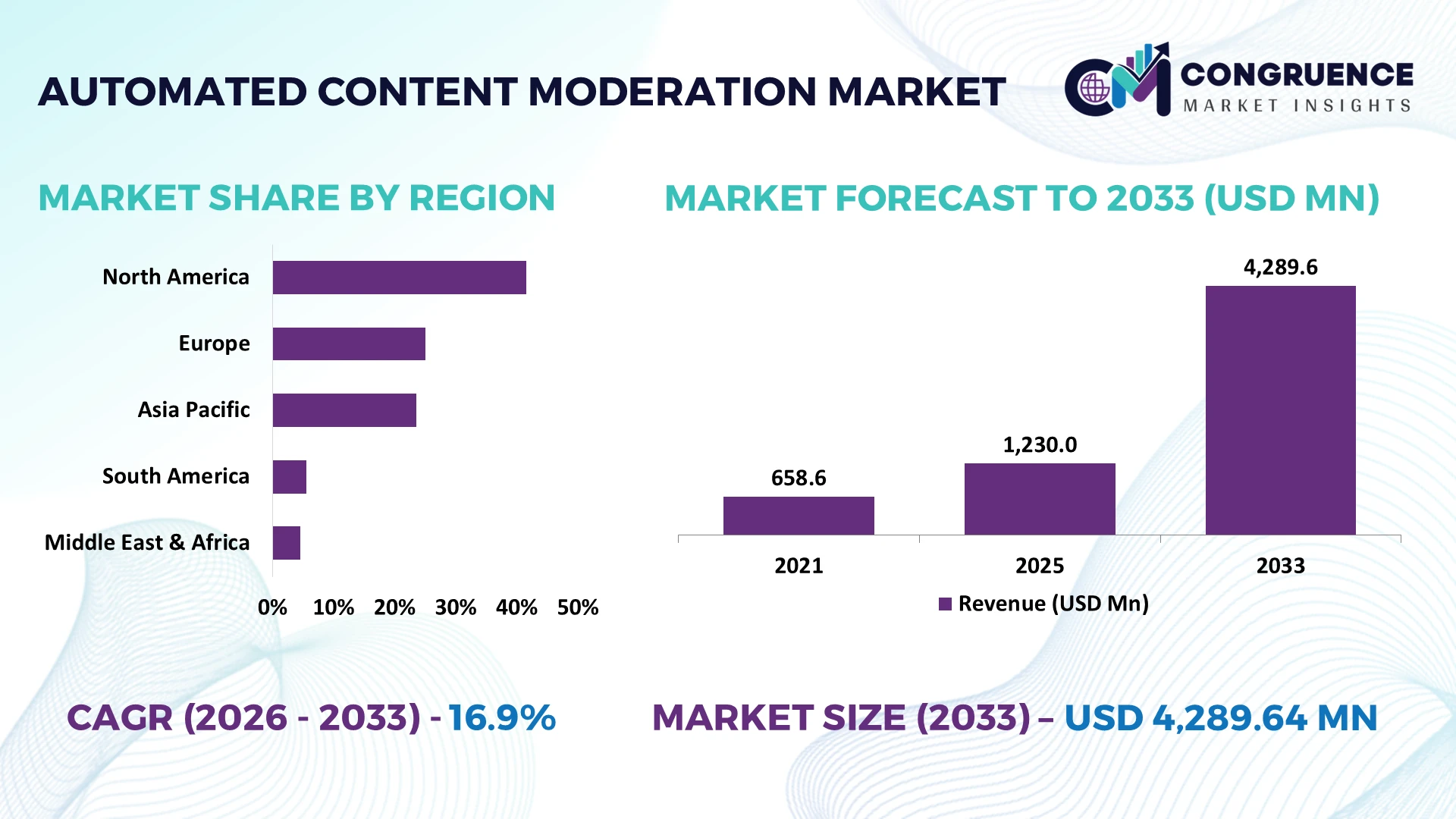
The Global Automated Content Moderation Market was valued at USD 1,230.0 Million in 2025 and is anticipated to reach a value of USD 4,289.6 Million by 2033 expanding at a CAGR of 16.9% between 2026 and 2033. Growth is driven by escalating user-generated content volumes, AI-powered harmful content detection, generative AI misuse, and increasingly stringent digital platform safety regulations.
The United States leads the automated content moderation market, supported by an estimated 34.5% global market share, substantial AI infrastructure investments, and established social media, gaming, and e-commerce industries. U.S. private AI investment reached USD 109.1 billion in 2024, compared with USD 9.3 billion in China. The European Union's Digital Services Act further accelerates compliance-oriented moderation technology development among American platform operators.
Enterprises prioritizing scalable multimodal detection, contextual intelligence, and regulatory compliance automation are positioned to strengthen competitive differentiation and reduce moderation expenditure.
Market Size & Growth: USD 1,230.0 million in 2025, reaching USD 4,289.6 million by 2033 at 16.9% CAGR, driven by AI-enabled content screening.
Top Growth Drivers: User-generated content expansion (40%), regulatory compliance (35%), and generative AI-related risks (25%).
Short-Term Forecast: By 2028, advanced moderation deployments target 30% lower manual review workloads.
Emerging Technologies: Multimodal AI, contextual language models, and deepfake detection enable screening across 3 major content formats.
Regional Leaders: Projected 2033 values include North America (USD 1,672.9 million; AI integration), Asia Pacific (USD 1,201.1 million; mobile adoption), and Europe (USD 1,029.5 million; regulatory compliance).
Consumer/End-User Trends: Approximately 75% of surveyed organizations reported AI adoption in at least one business function in 2024, supporting enterprise automation.
Pilot/Case Example: In 2023, OpenAI reported GPT-4 moderation experiments reducing policy development cycles from months to hours.
Competitive Landscape: Microsoft holds an estimated 16% share, competing with Google, AWS, ActiveFence, and Hive.
Regulatory & ESG Impact: Digital Services Act violations carry penalties reaching 6% of annual worldwide turnover.
Investment & Funding: Global private generative AI investment reached USD 33.9 billion in 2024, strengthening adjacent safety technologies.
Innovation & Future Outlook: Next-generation platforms integrate 3 capabilities: real-time detection, contextual classification, and automated compliance reporting.
The Automated Content Moderation Market is expanding across social networking platforms, online marketplaces, gaming communities, and digital advertising ecosystems. Advanced multimodal AI solutions increasingly combine text, image, audio, and video screening within unified moderation workflows. With automated screening targeting over 90% of routine policy violations in optimized deployments, regulatory accountability and contextual accuracy are becoming central to enterprise technology procurement strategies.
Automated content moderation is becoming strategically important as digital enterprises increasingly compete on platform safety, advertiser confidence, and regulatory accountability. The proliferation of AI-generated media is restructuring trust and safety operations, compelling businesses to integrate preventive detection mechanisms rather than rely exclusively on reactive reporting. Advanced AI-assisted screening targets 30–50% reductions in routine manual review workloads compared with conventional human-led moderation systems.
The United States maintains an advantage in foundational AI development and enterprise-scale moderation infrastructure, while China emphasizes localized content governance and high-volume platform screening. Germany and France prioritize transparent decision-making and regulatory auditability under the European Union's Digital Services Act. By 2028–2029, advanced deployments are expected to target automated resolution of approximately 70–80% of routine moderation cases, with human intervention concentrated on ambiguous decisions.
Online marketplaces are deploying image recognition and natural language processing to identify fraudulent listings, prohibited products, and misleading promotional claims before publication. Technology providers are expanding multilingual datasets, cloud-based moderation APIs, and partnerships with specialized trust and safety companies. Competitive leadership increasingly depends on balancing detection accuracy, processing speed, operational economics, and jurisdiction-specific policy enforcement within scalable enterprise architectures.
The accelerating production of user-generated and AI-generated content is intensifying demand for automated content moderation solutions across social media, gaming, and e-commerce platforms. Global internet penetration reached approximately 68% in 2024, expanding the volume of digital interactions requiring continuous screening. Meanwhile, the European Union's Digital Services Act imposes penalties of up to 6% of annual worldwide turnover for noncompliance. These requirements encourage platform operators to target 30–40% reductions in manual moderation workloads through automated classification and real-time risk detection. Microsoft, Google, and specialized moderation providers are expanding cloud-based safety APIs and contextual AI capabilities. Pre-publication screening increasingly protects advertising monetization by preventing harmful content from reaching commercially sensitive environments.
Automated content moderation remains constrained by inconsistent detection accuracy across languages, cultural contexts, and ambiguous communication formats. English accounts for approximately 49% of websites with identifiable content languages, contributing to unequal availability of multilingual training resources. Enterprise deployments targeting 95% classification accuracy still face significant review requirements when processing millions of daily submissions. Even a 1% false-positive rate generates substantial operational overhead at platform scale. India's multilingual digital ecosystem illustrates the difficulty of applying standardized moderation models across regional languages and mixed-language communication. Providers are addressing these limitations through localized datasets, configurable confidence thresholds, and human-assisted verification. The resulting customization requirements increase implementation costs and restrict standardized software deployment across international markets.
Generative AI proliferation creates substantial opportunities for automated content moderation providers specializing in synthetic media authentication, deepfake detection, and cross-format contextual analysis. Enterprise generative AI adoption reached approximately 71% among surveyed organizations in 2024, expanding demand for preventive safety infrastructure. Next-generation multimodal systems target 25–40% reductions in duplicate screening processes by evaluating interconnected text, image, audio, and video signals. In the United States, initiatives such as the Coalition for Content Provenance and Authenticity are encouraging standardized digital media verification. Technology providers are investing in provenance detection, adversarial training, and integrated moderation APIs. Embedding authentication directly into content creation workflows establishes recurring enterprise demand beyond conventional post-publication moderation services.
Maintaining moderation effectiveness against rapidly evolving adversarial content represents a significant long-term execution challenge. The increasing use of generative AI enables malicious actors to modify visual patterns, linguistic expressions, and synthetic identities to circumvent established detection systems. Even a 2% detection failure across one million violating submissions leaves 20,000 harmful items unresolved. Simultaneously, maintaining false-positive rates below 1% becomes increasingly difficult as policy categories expand. Emerging AI governance requirements in the European Union intensify expectations surrounding model transparency and accountability. Moderation providers must invest in continuous model retraining, adversarial testing, real-time threat intelligence, and scalable feedback infrastructure. Sustainable competitiveness depends on shortening model adaptation cycles without compromising detection consistency or legitimate user expression.
Risk-Based Moderation Workflow Prioritization: Enterprises are replacing uniform content screening queues with risk-weighted classification workflows, targeting 25–35% reductions in reviewer workloads and 20% faster escalation handling. Automated systems prioritize severe violations while routing ambiguous submissions to specialist teams. Companies are restructuring moderation operations around confidence thresholds, reducing unnecessary reviews without compromising critical safety interventions.
Real-Time Moderation of Live Interactions: Gaming platforms, livestreaming services, and virtual communities are shifting toward continuous interaction monitoring, targeting detection latency below two seconds and 30% faster intervention. Streaming analytics and incremental content classification enable immediate enforcement during live sessions. Technology providers are scaling low-latency processing infrastructure and integrating moderation capabilities directly into communication platforms.
Audit-Ready Moderation Decision Infrastructure: The European Union's Digital Services Act requires designated very large platforms serving at least 45 million monthly EU users to meet enhanced accountability obligations. Enterprises are targeting 25–40% reductions in compliance documentation workloads through automated decision logging. Providers are integrating policy versioning, appeal management, and traceable enforcement records into moderation dashboards.
Consolidation of Content Safety Workflows: Digital enterprises are consolidating fragmented moderation tools into centralized trust and safety platforms, targeting 15–25% lower integration expenditure and 20–30% fewer duplicated reviews. Shared policy engines enable consistent enforcement across multiple digital properties. Vendors are expanding interoperable APIs and unified management interfaces, transforming moderation procurement from individual detection tools toward enterprise-wide infrastructure.
Text Moderation accounted for an estimated 38.5% market share in 2025, supported by extensive deployment across social media comments, product reviews, messaging applications, and community forums. Natural language processing, contextual classification, and automated keyword detection enable enterprises to process high-volume textual submissions with relatively low computational requirements. Image Moderation represents approximately 27.5% of the market, driven by widespread implementation of computer vision technologies for identifying inappropriate imagery, prohibited products, and policy violations. Established text and image moderation solutions benefit from mature training datasets, standardized APIs, and straightforward integration with existing digital infrastructure.
Video Moderation represents the fastest-growing segment, supported by expanding short-form video consumption, livestreaming, and interactive entertainment platforms. Advanced video screening workflows target 30–40% reductions in manual inspection requirements through automated frame analysis and speech recognition. Audio Moderation is gaining relevance across voice-enabled applications and gaming environments, while Multimodal Moderation integrates multiple content formats within unified classification systems. Companies including Microsoft, Google, and Hive are expanding cross-format detection capabilities, shifting investment toward scalable inference infrastructure and contextual intelligence.
Social Media accounted for an estimated 41.5% market share in 2025, reflecting continuous screening requirements across user-generated posts, comments, profiles, and multimedia submissions. Large social networking platforms depend on automated classification to maintain community standards without proportionately expanding human moderation teams. E-commerce accounted for approximately 24.0% of the market, supported by automated product listing verification, fraudulent review detection, and prohibited merchandise identification. Marketplace operators increasingly embed moderation within seller onboarding and product publication workflows, strengthening transaction integrity while minimizing operational disruptions.
Online Gaming represents the fastest-growing application, driven by persistent multiplayer interactions, voice communication, and player-generated content. Advanced gaming moderation deployments target 25–35% reductions in incident identification and response times through automated behavioral analysis. Online Communities increasingly require configurable moderation systems supporting community-specific policies, while Media and Entertainment platforms emphasize audience safety and advertiser suitability. Other Applications include educational platforms and digital collaboration environments. Technology providers are developing application-specific detection models, flexible API architectures, and real-time intervention mechanisms, redirecting deployment priorities toward interactive digital environments.
Large Enterprises accounted for an estimated 69.5% market share in 2025, supported by extensive digital infrastructure, substantial content processing requirements, and dedicated trust and safety departments. Established technology companies, multinational retailers, and digital entertainment operators require sophisticated moderation systems capable of enforcing multiple policies across international markets. Large-scale implementations increasingly incorporate configurable classification models, centralized management dashboards, and differentiated escalation procedures. Automated workflows targeting 30–40% reductions in routine human review requirements strengthen operational efficiency while allowing specialist teams to concentrate on complex enforcement decisions.
Small and Medium Enterprises (SMEs) represent the fastest-growing end-user segment, benefiting from subscription-based moderation software, consumption-based pricing, and readily deployable cloud APIs. SMEs accounted for an estimated 30.5% market share in 2025, with adoption expanding among emerging marketplaces, independent gaming studios, and community-driven digital businesses. Unlike large enterprises prioritizing customization and infrastructure control, smaller organizations emphasize affordability and implementation speed. Providers are introducing tiered subscriptions, preconfigured policy templates, and low-code integration tools, expanding accessibility while reducing dependence on dedicated moderation personnel.
North America accounted for the largest market share at 41.5% in 2025 however, Asia Pacific is expected to register the fastest growth, expanding at a CAGR of 19.8% between 2026 and 2033.
North America accounted for 41.5% of the global automated content moderation market in 2025, supported by established cloud computing infrastructure, leading social media enterprises, and advanced artificial intelligence capabilities. Large digital platform operators increasingly integrate automated screening across advertising networks, online marketplaces, gaming environments, and enterprise communication systems. The region benefits from extensive investment in foundational AI models, specialized semiconductor infrastructure, and scalable content classification technologies. In January 2025, Microsoft announced plans to invest approximately USD 80 billion in AI-enabled data centers during its fiscal year, with more than half allocated to the United States. This infrastructure expansion strengthens processing capabilities for computationally intensive moderation workloads. Technology providers are prioritizing configurable policy engines, enterprise-grade security, and integrated moderation APIs, enabling digital businesses to consolidate fragmented trust and safety operations.
United States Market Outlook:
The United States dominates regional demand through established technology companies, digital advertising networks, and specialized content safety solution providers. Approximately 90% of American adults use the internet, creating extensive requirements for continuous digital content governance. Companies including Microsoft, Google, Amazon Web Services, and Hive are strengthening automated classification capabilities, while enterprise buyers increasingly prioritize moderation accuracy, platform interoperability, and operational scalability.
Europe accounted for 25.0% of the global automated content moderation market in 2025, driven by stringent digital governance requirements, established enterprise technology adoption, and growing demand for transparent content enforcement. The European Union's Digital Services Act requires designated very large online platforms and search engines serving at least 45 million monthly EU users to implement enhanced risk management and accountability measures. Consequently, digital enterprises are integrating automated decision documentation, appeal management, and policy-specific classification within existing moderation infrastructure. Germany, France, and the United Kingdom represent important deployment centers across e-commerce, digital publishing, and online entertainment industries. Technology providers are expanding multilingual detection capabilities and privacy-conscious processing architectures. European procurement strategies increasingly emphasize explainable AI, auditable enforcement decisions, and regulatory interoperability, creating opportunities for specialized moderation platforms that combine operational efficiency with compliance assurance.
Germany Market Outlook:
Germany represents a strategically important market through its established digital commerce ecosystem, enterprise software industry, and stringent data protection environment. Internet penetration exceeds 90%, supporting substantial online interaction and digital transaction volumes. German enterprises increasingly require automated moderation solutions with localized language processing, secure data handling, and configurable enforcement mechanisms, encouraging providers to strengthen European hosting infrastructure and compliance-oriented product development.
Asia Pacific accounted for 23.5% of the global automated content moderation market in 2025, supported by expanding mobile internet connectivity, high-volume digital commerce platforms, and rapidly evolving online entertainment ecosystems. China, India, Japan, and South Korea generate substantial moderation requirements across short-form video applications, multiplayer gaming, social commerce, and messaging services. The region's linguistic diversity encourages investment in localized classification models capable of interpreting regional dialects, mixed-language communication, and culturally specific expressions. India's internet subscriber base surpassed 970 million during 2024, demonstrating the scale of digital interactions requiring automated governance infrastructure. Platform operators increasingly integrate content screening directly into publication and transaction workflows rather than relying exclusively on retrospective enforcement. Technology providers are expanding regional cloud partnerships, language-specific datasets, and consumption-based deployment models to address varying infrastructure capabilities and enterprise purchasing requirements.
China Market Outlook:
China maintains a strong regional position through its extensive domestic social media, digital entertainment, and e-commerce ecosystems. The country's internet user population exceeded 1.1 billion by the end of 2024, creating substantial demand for high-throughput content screening infrastructure. Enterprises including ByteDance, Tencent, and Alibaba are advancing automated classification systems, supported by domestic AI development and established requirements for digital content governance.
South America accounted for 5.5% of the global automated content moderation market in 2025, supported by expanding digital commerce, social networking adoption, and mobile-based financial services. Brazil, Argentina, and Colombia are emerging as important deployment markets where online businesses increasingly require automated screening of fraudulent listings, misleading advertisements, inappropriate comments, and deceptive user profiles. Mercado Libre reported approximately 100 million annual unique buyers during 2024, illustrating the operational scale of regional digital marketplaces. Portuguese and Spanish language customization remains essential for accurate contextual classification across culturally diverse consumer communities. However, uneven cloud infrastructure availability and enterprise technology budgets constrain sophisticated moderation deployments outside major commercial centers. Technology providers are addressing these limitations through affordable subscription models, lightweight classification APIs, and partnerships with regional cloud operators, enabling businesses to introduce scalable content governance without substantial infrastructure expenditure.
Brazil Market Outlook:
Brazil leads regional adoption through its established digital marketplace ecosystem, extensive social media engagement, and growing cloud computing infrastructure. In September 2024, Microsoft announced a USD 2.7 billion investment in Brazilian cloud and AI infrastructure over three years. This expansion supports enterprise access to advanced computing capabilities, strengthening opportunities for Portuguese-language content moderation, automated marketplace verification, and digital platform safety solutions.
Middle East & Africa accounted for 4.5% of the global automated content moderation market in 2025, supported by digital transformation initiatives, expanding online retail platforms, and government-backed artificial intelligence infrastructure development. Saudi Arabia, the United Arab Emirates, and South Africa represent strategically significant deployment markets across digital media, financial technology, gaming, and enterprise communication services. In 2024, Microsoft announced a USD 1.5 billion investment in UAE-based AI technology company G42, strengthening regional artificial intelligence development and cloud infrastructure capabilities. Automated moderation requirements increasingly emphasize Arabic-language classification, culturally appropriate enforcement policies, and secure processing environments. Infrastructure disparities across African markets continue to influence deployment costs and implementation speed. Technology providers are responding through regional hosting partnerships, localized language models, and flexible cloud-based delivery architectures, improving accessibility while supporting jurisdiction-specific content governance requirements.
United Arab Emirates Market Outlook:
The United Arab Emirates maintains a strategic advantage through advanced telecommunications infrastructure, government-supported AI initiatives, and internationally connected digital enterprises. Internet penetration approaches 99%, supporting extensive engagement across digital commerce, entertainment, and communication platforms. Enterprise adoption increasingly emphasizes multilingual moderation, secure cloud processing, and automated brand protection, positioning the country as an important deployment hub for advanced content safety technologies.
Microsoft, Google, and Amazon Web Services compete against specialized content safety providers ActiveFence and Hive through scalable infrastructure, classification accuracy, and enterprise integration. The five leading players collectively account for an estimated 54.5% market share, reflecting a moderately concentrated competitive structure. Cloud hyperscalers leverage bundled AI services and established enterprise relationships, while specialists differentiate through contextual intelligence, policy customization, and threat detection. Automated workflows targeting 30–40% lower manual review requirements strengthen pricing competitiveness, while inference optimization targets 20–25% processing cost reductions. Companies are expanding multilingual classification capabilities, integrating moderation APIs, and establishing partnerships with digital platform operators. Competition is shifting from standalone detection tools toward unified trust and safety infrastructure incorporating real-time enforcement and compliance documentation. Proprietary training datasets, computational infrastructure, and jurisdiction-specific policy expertise create substantial entry barriers. Winning requires superior contextual accuracy, predictable processing economics, rapid deployment, and adaptable moderation architectures capable of supporting complex enterprise governance requirements internationally.
Microsoft Corporation
Google LLC
Amazon Web Services, Inc.
ActiveFence Ltd.
Hive
OpenAI
Clarifai, Inc.
Besedo
WebPurify
Sightengine
Two Hat Security
Checkstep Ltd.
Bodyguard.ai
Unitary AI
Natural language processing, computer vision, and machine learning underpin automated content moderation across digital platforms. Transformer-based classification systems interpret contextual relationships more effectively than conventional keyword filters, targeting 25–35% improvements in detection accuracy. Computer vision automates image screening, while confidence-based routing targets 30% reductions in routine manual reviews. YouTube's automated systems already identify most removed videos before human intervention, demonstrating enterprise-scale adoption and operational maturity across established digital ecosystems.
Emerging technologies include multimodal foundation models, speech recognition, and retrieval-augmented policy classification. Multimodal architectures evaluate interconnected textual, visual, and acoustic signals, targeting 20–30% reductions in duplicated screening processes. Streaming inference enables continuous monitoring of live interactions, targeting 25% faster intervention. Cloud hyperscalers benefit from integrated computing infrastructure, while specialized providers compete through localized datasets, configurable enforcement thresholds, and application-specific classification models. API integration increasingly supports centralized moderation across multiple digital properties.
Between 2026 and 2028, disruptive technologies will increasingly incorporate synthetic media authentication, adaptive learning, and automated policy interpretation. Provenance verification strengthens content authenticity assessment, while continuous model optimization targets 15–25% lower retraining overhead. Enterprises integrating these technologies gain faster enforcement capabilities, improved regulatory auditability, and more predictable processing expenditure. Early investment strengthens competitive positioning as digital governance becomes increasingly embedded within enterprise infrastructure.
February 2024 – Amazon Web Services upgraded Amazon Rekognition's image moderation model, introducing 26 additional classification labels and a three-tier taxonomy. The enhancement enabled more granular policy enforcement and improved recognition of illustrated content across gaming, e-commerce, and social media applications. Source: aws.amazon.com
September 2024 – OpenAI introduced its GPT-4o-based moderation model, supporting two input formats: text and images. The upgraded Moderation API improved multilingual classification accuracy and probability calibration, enabling developers to implement more precise content screening and customized safety enforcement across applications. Source: openai.com
January 2025 – Hive partnered with the Internet Watch Foundation to strengthen automated child safety detection, incorporating intelligence covering approximately 8,000 websites containing confirmed abusive material. The collaboration expanded detection coverage and strengthened proactive safeguarding capabilities for Hive's digital platform customers. Source: tollbit.forbes.com
April 2025 – Google disclosed a 90% reduction in reported public figure impersonation scam advertisements following enhanced enforcement measures. Its advertising safety initiative combined advanced language models and specialist investigations, strengthening advertiser verification, fraudulent content prevention, and consumer protection across digital platforms. Source: blog.google
The Automated Content Moderation Market Report provides comprehensive coverage across Text Moderation, Image Moderation, Video Moderation, Audio Moderation, and Multimodal Moderation. Application analysis encompasses Social Media, E-commerce, Online Gaming, Online Communities, Media and Entertainment, and Other Applications, while end-user segmentation evaluates Large Enterprises and Small and Medium Enterprises. The report examines natural language processing, computer vision, machine learning, generative AI, synthetic media detection, and emerging automated policy enforcement technologies.
Geographical coverage includes North America, Europe, Asia Pacific, South America, and Middle East & Africa, encompassing regional deployment patterns, regulatory frameworks, enterprise adoption, and infrastructure development. The analysis evaluates competitive positioning, technology differentiation, strategic partnerships, investment priorities, and emerging business models. Detailed segment-level assessments and competitive intelligence support investment planning, geographical expansion, product development, and sustainable market positioning between 2026 and 2033.
| Report Attribute / Metric | Details |
|---|---|
| Market Revenue (2025) | USD 1,230.0 Million |
| Market Revenue (2033) | USD 4,289.6 Million |
| CAGR (2026–2033) | 16.9% |
| Base Year | 2025 |
| Forecast Period | 2026–2033 |
| Historic Period | 2021–2025 |
| Segments Covered |
By Type
By Application
By End-User
|
| Key Report Deliverables | Revenue Forecast; Market Trends; Growth Drivers & Restraints; Technology Insights; Segmentation Analysis; Regional Insights; Competitive Landscape; Regulatory & ESG Overview; Recent Developments |
| Regions Covered | North America; Europe; Asia-Pacific; South America; Middle East & Africa |
| Key Players Analyzed | Microsoft Corporation; Google LLC; Amazon Web Services, Inc.; ActiveFence Ltd.; Hive; OpenAI; Clarifai, Inc.; Besedo; WebPurify; Sightengine; Two Hat Security; Checkstep Ltd.; Bodyguard.ai; Unitary AI |
| Customization & Pricing | Available on Request (10% Customization Free) |




