
Reports
The Global Auto Ventilated Seats Market was valued at USD 816.0 Million in 2025 and is anticipated to reach a value of USD 1,160.4 Million by 2033 expanding at a CAGR of 4.5% between 2026 and 2033. Growth is driven by increasing integration of climate-controlled seating systems, rising premium vehicle penetration, and automakers’ focus on passenger comfort technologies.
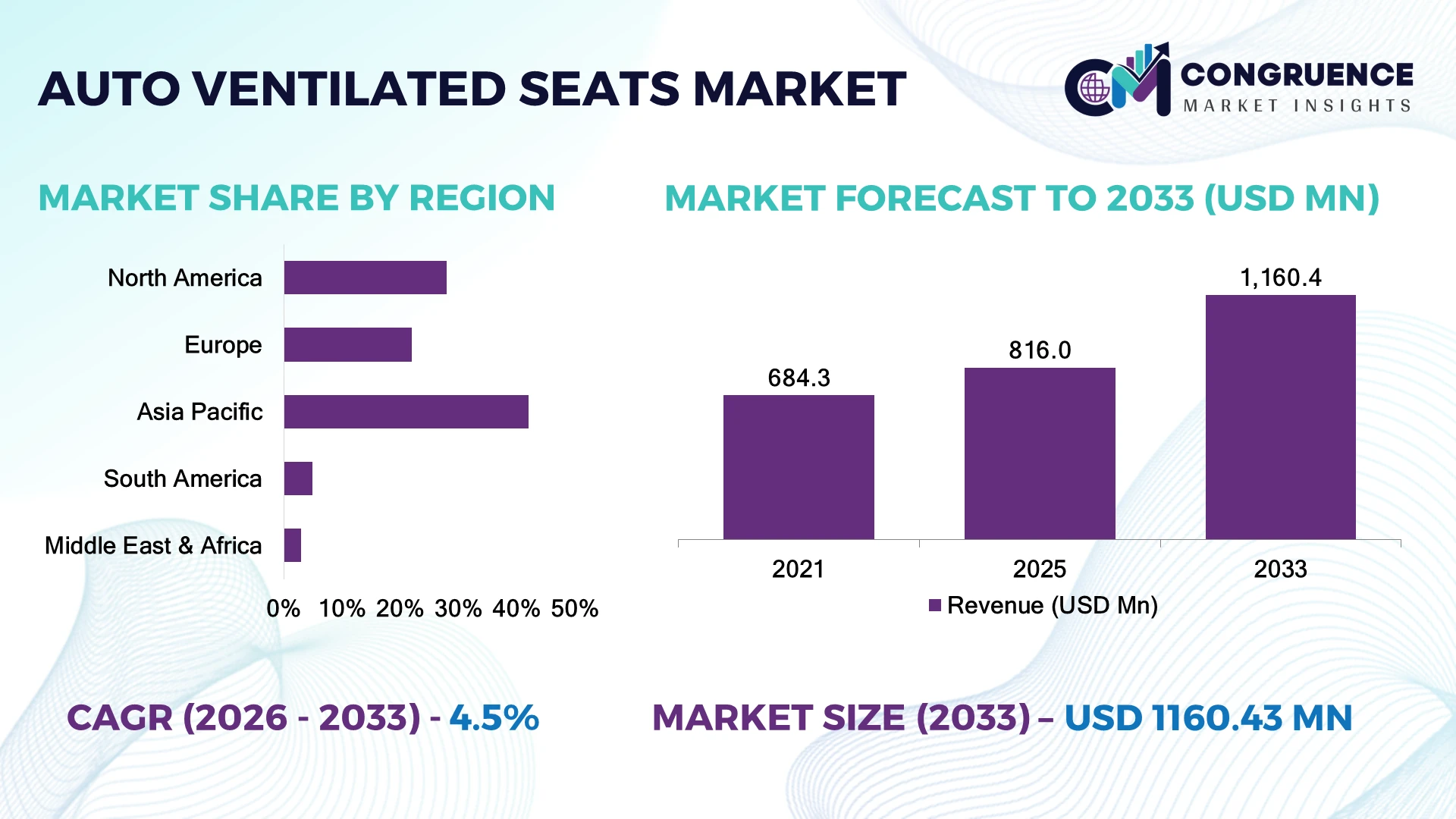
China dominates the market with nearly 35% share, supported by large-scale EV production, automotive seat manufacturing capacity, and investments in smart vehicle interiors. The country produced over 30 million vehicles in 2024, while Germany and the U.S. continue expanding premium automotive technologies with strong adoption in luxury vehicles. China’s EV ecosystem has accelerated ventilated seat integration, with more than 40% of new premium EV models featuring advanced thermal comfort functions.
Strategic implication Automakers prioritizing intelligent seating innovation and localized supply chains will strengthen competitive positioning in evolving vehicle interior markets.
Market Size & Growth: USD 816.0 Million (2025) to USD 1,160.4 Million (2033) at 4.5% CAGR, driven by rising adoption of smart comfort systems in premium and electric vehicles.
Top Growth Drivers: Premium vehicle adoption (35%), EV interior upgrades (40%), and smart cabin technology integration (30%) are accelerating market expansion.
Short-Term Forecast: By 2028, ventilated seat penetration in mid-to-premium vehicles is projected to increase by 15%, supported by improved component efficiency.
Emerging Technologies: AI-based climate adjustment, lightweight thermal materials, and sensor-enabled seating systems are reshaping advanced automotive interiors.
Regional Leaders: Asia Pacific reaches approximately USD 420 Million, North America USD 260 Million, and Europe USD 300 Million by 2033, supported by EV and luxury vehicle adoption.
Consumer/End-User Trends: Over 45% of premium vehicle buyers prioritize enhanced cabin comfort features, increasing demand for ventilated and heated seating combinations.
Pilot/Case Example: In 2024, EV manufacturers implementing intelligent seat climate controls achieved up to 20% improvement in passenger thermal comfort efficiency.
Competitive Landscape: Lear Corporation leads with approximately 20% share, followed by Adient, Faurecia, Magna International, and Toyota Boshoku in advanced seating solutions.
Regulatory & ESG Impact: Lightweight seating innovations reduce material usage by nearly 10%, supporting vehicle efficiency targets and sustainability initiatives.
Investment & Funding: Automotive suppliers invested over USD 2 billion in smart cabin technologies, focusing on EV partnerships and regional manufacturing expansion.
Innovation & Future Outlook: Next-generation ventilated seats will integrate AI personalization, energy-efficient cooling modules, and connected cabin ecosystems for future mobility platforms.
Auto Ventilated Seats Market is gaining importance as automakers shift toward intelligent cabin experiences, especially across electric vehicles, luxury cars, and connected mobility platforms. Recent innovations include quieter blower systems, graphene-based thermal materials, and sensor-controlled airflow management, improving comfort performance by nearly 25%. Supply-chain restructuring in Asia and increased EV localization strategies are encouraging manufacturers to expand advanced seating production capabilities while reducing dependency on imported components.
The Auto Ventilated Seats Market is becoming strategically important as vehicle manufacturers compete beyond performance and efficiency by enhancing passenger experience through advanced interior technologies. The transition toward electric and connected vehicles is accelerating investments in intelligent seating solutions, with automakers integrating thermal comfort features as a key differentiation factor.
Automotive seating suppliers are restructuring supply chains by expanding regional production hubs, particularly across Asia Pacific and North America, to support growing EV manufacturing ecosystems. Compared with traditional ventilation systems, advanced sensor-based seating technologies improve airflow precision by nearly 30% while reducing energy consumption through automated temperature management.
Regional adoption varies significantly, with China leading large-scale production through its EV manufacturing network, while Europe emphasizes premium vehicle innovation and sustainability-focused materials. North America is increasing adoption through luxury SUVs and electric vehicle platforms. Over the next 2–3 years, manufacturers are expected to prioritize modular seat architectures, localized component sourcing, and software-enabled cabin controls.
Companies are strengthening partnerships with automakers and technology providers to develop lightweight, efficient, and connected seating systems. Strategic investments in intelligent seating platforms will determine competitive advantage as vehicle interiors become a major factor in future mobility differentiation.
The increasing adoption of electric and premium vehicles is driving demand for auto ventilated seats as manufacturers prioritize intelligent cabin comfort systems. China accounted for over 30% of global EV production in 2024, accelerating integration of thermal management features in advanced vehicles. More than 40% of newly launched premium EV models now include ventilated seating functions as standard or optional equipment. Automakers including luxury and EV-focused brands are expanding partnerships with seating suppliers to develop energy-efficient cooling modules, lightweight seat structures, and sensor-based climate controls, creating stronger differentiation in competitive automotive interiors.
High manufacturing costs for ventilated seat components remain a key limitation, particularly due to dependency on specialized blowers, electronic modules, and thermal materials. Advanced ventilated seating systems can increase seat assembly costs by approximately 15–20% compared with conventional seating solutions, limiting adoption in cost-sensitive vehicle segments. Supply disruptions affecting electronic components in countries such as China and South Korea have highlighted vulnerabilities in automotive interior supply chains. Manufacturers are reducing exposure through localized sourcing strategies, multi-supplier contracts, and investments in regional production facilities to improve cost control and maintain consistent component availability.
The integration of AI-based climate personalization and connected cabin systems presents significant opportunities for auto ventilated seat manufacturers. Sensor-enabled seating technologies can improve airflow optimization by nearly 25–30% while reducing unnecessary energy consumption through automated temperature adjustments. India, Mexico, and Southeast Asian automotive hubs are emerging as expansion markets due to increasing premium vehicle production and growing EV investments. Companies are focusing on R&D partnerships with automotive electronics providers to develop adaptive seating platforms, while modular designs are creating opportunities for broader adoption across SUVs, commercial vehicles, and next-generation mobility platforms.
The increasing complexity of integrating ventilated seats with digital vehicle architectures creates long-term execution challenges for manufacturers. Modern smart seating systems require compatibility with climate control software, vehicle sensors, and power management networks, increasing engineering requirements by nearly 20%. Cybersecurity concerns are also rising as connected cabin components become part of broader vehicle operating systems. Automotive suppliers in Germany, Japan, and the United States are investing in software capabilities and collaborative development models to address integration challenges. Companies must strengthen electronic expertise, testing infrastructure, and supplier coordination to ensure reliable deployment across diverse vehicle platforms.
AI Climate Personalization Growth Automakers are integrating AI-enabled thermal management into vehicle seating systems, with intelligent sensors improving temperature adjustment accuracy by nearly 30% and reducing unnecessary cooling cycles by approximately 15%. Premium vehicle manufacturers in Germany, Japan, and the United States are deploying connected seat-control platforms that synchronize with cabin climate systems. Companies are responding through software partnerships and investment in sensor-based seating architectures to improve passenger experience while optimizing energy efficiency in EV platforms.
Lightweight Material Adoption Rising Automotive suppliers are shifting toward lightweight foams, recycled materials, and compact ventilation modules, reducing seat system weight by 10–15% while improving vehicle efficiency. Increasing sustainability requirements in Europe and material cost pressures across supply chains are accelerating this transition. Companies are redesigning seat structures through advanced composites and localized sourcing strategies, enabling faster production cycles and improved compatibility with electric vehicle platforms.
EV Cabin Integration Expansion Electric vehicle manufacturers are increasingly positioning ventilated seats as a premium interior feature, with more than 40% of newly introduced high-end EV models incorporating advanced thermal seating options. Battery efficiency concerns are driving demand for low-power ventilation technologies that minimize energy consumption. Suppliers are forming partnerships with EV manufacturers in China and South Korea to scale integrated cabin solutions and strengthen smart mobility offerings.
Automated Seat Manufacturing Shift Automation adoption in automotive seat production is increasing as manufacturers use robotics, digital quality monitoring, and predictive maintenance systems to improve operational consistency. Advanced production lines are delivering approximately 20% faster assembly cycles and reducing defect rates by nearly 12%. Supply-chain disruptions have encouraged companies in Mexico and Eastern Europe to expand automated manufacturing hubs, improving production resilience and reducing dependency on labor-intensive processes.
Active ventilation systems represent the leading type segment, accounting for approximately 65% of adoption due to their superior airflow performance, integration flexibility, and compatibility with premium vehicle platforms. These systems use powered fans and advanced air circulation mechanisms to provide faster cooling compared with passive solutions. Their strong presence in luxury SUVs, electric vehicles, and executive-class vehicles has encouraged suppliers to invest in compact blower technology and improved thermal materials. Passive ventilation systems continue maintaining relevance in cost-sensitive vehicle categories, particularly where affordability and simpler seat construction remain priorities. The fastest-growing segment is smart ventilated seating systems, supported by integration with sensors, AI controls, and connected cabin technologies. Adoption of intelligent systems is increasing by nearly 25% annually across premium EV launches, while more than 35% of new luxury models now incorporate automated climate adjustment features. Companies are prioritizing modular designs and electronics partnerships to expand smart seating availability across broader vehicle categories.
Passenger vehicles dominate the application segment with approximately 75% market share, driven by rising consumer expectations for enhanced cabin comfort, luxury features, and personalized driving experiences. Sedans, SUVs, and premium electric vehicles represent the strongest demand areas, where ventilated seats are becoming a competitive differentiation feature. Around 45% of premium vehicle buyers prioritize advanced comfort technologies, encouraging automakers to integrate ventilated seating as standard or optional equipment. The fastest-growing application is electric vehicles, supported by increasing focus on efficient cabin management and reduced energy consumption. EV manufacturers are adopting low-power ventilation systems that improve thermal comfort while minimizing battery impact. Commercial vehicles and fleet applications remain emerging segments, with adoption increasing as operators evaluate driver comfort and productivity benefits. Companies are expanding partnerships with EV manufacturers and developing scalable seating platforms to address diverse application requirements.
Automotive manufacturers represent the leading end-user segment, accounting for approximately 70% of demand due to direct integration of ventilated seats into new vehicle platforms. Original equipment manufacturers prioritize advanced seating solutions to enhance brand differentiation, particularly in premium vehicles and EV models. Companies are increasing collaboration with seating suppliers to improve customization, reduce production complexity, and accelerate vehicle launches. More than 50% of premium vehicle development programs now include advanced interior technology planning during early design stages. The fastest-growing end-user group is electric vehicle manufacturers, driven by demand for intelligent cabin experiences and efficient thermal management solutions. EV-focused companies are increasing adoption of smart seating technologies by nearly 30% as they compete on passenger experience beyond battery performance. Automotive aftermarket providers and luxury vehicle customization companies continue expanding their role by targeting upgrade-oriented consumers. Suppliers are responding through flexible manufacturing, strategic partnerships, and region-specific product development.
Asia-Pacific accounted for the largest market share at 42% in 2025 however, North America is expected to register the fastest growth, expanding at a CAGR of 5.2% between 2026 and 2033.
North America holds a strong position in the auto ventilated seats market, supported by high penetration of premium SUVs, electric vehicles, and luxury automotive platforms. The region contributes nearly 28% of global demand, with the United States accounting for the majority of adoption through advanced vehicle production and consumer preference for comfort technologies. More than 45% of new luxury vehicles launched in the U.S. include ventilated seating options, supported by investments in smart cabin systems and EV manufacturing facilities. Automakers are expanding partnerships with seating technology suppliers to integrate efficient cooling modules and connected seat controls into next-generation vehicles.
United States Market Outlook: The United States remains the key market due to its strong premium vehicle ecosystem, advanced automotive manufacturing base, and rising EV production. Over 1.5 million EVs were sold in the country in 2024, increasing demand for energy-efficient interior technologies. Automotive suppliers are expanding domestic production capabilities to improve supply reliability and support localized vehicle programs.
Europe represents a technologically advanced market driven by luxury vehicle manufacturers, stringent sustainability objectives, and demand for enhanced passenger experiences. The region accounts for approximately 22% of global adoption, with Germany, France, and the United Kingdom leading premium automotive production. European automakers are increasingly integrating ventilated seats with digital climate systems, while sustainability initiatives are encouraging lightweight materials and energy-efficient seat designs. More than 35% of premium European vehicles now feature advanced seating comfort technologies. Manufacturers are investing in smart material research and supplier collaborations to improve efficiency and align with evolving vehicle design standards.
Germany Market Outlook: Germany leads Europe through its strong automotive manufacturing ecosystem and technology leadership in premium vehicles. The country produces more than 3 million passenger vehicles annually, creating significant demand for advanced seating solutions. German manufacturers are focusing on connected interiors, lightweight components, and supplier partnerships to strengthen automotive innovation capabilities.
Asia-Pacific dominates the global auto ventilated seats market due to large-scale vehicle production, expanding EV manufacturing, and strong automotive supplier networks. The region contributes approximately 42% of market demand, with China, Japan, and South Korea driving adoption. China produced over 30 million vehicles in 2024, creating a large manufacturing base for advanced seating systems. More than 40% of premium EV models introduced in China incorporate ventilated seating features, supported by rapid smart vehicle development. Companies are expanding production capacity, forming OEM partnerships, and investing in localized component manufacturing to meet rising demand.
China Market Outlook: China remains the leading country due to its dominant EV ecosystem, extensive automotive supply chain, and smart vehicle innovation. The country accounts for more than half of global EV sales, encouraging manufacturers to integrate advanced cabin technologies. Local suppliers are increasing investment in automated seat production and intelligent comfort systems to support domestic and export-oriented vehicle programs.
South America is an emerging market for auto ventilated seats, supported by increasing premium vehicle imports, expanding automotive assembly operations, and growing consumer interest in enhanced comfort features. The region contributes nearly 5% of global demand, with Brazil and Argentina representing the primary automotive markets. Adoption remains concentrated in luxury SUVs and imported vehicles, where more than 25% of premium models offer advanced seating features. Supply-chain limitations and lower production volumes continue affecting wider deployment. Companies are focusing on partnerships with regional distributors and flexible manufacturing approaches to improve accessibility.
Brazil Market Outlook: Brazil represents the largest automotive market in South America, supported by established vehicle production and expanding premium vehicle demand. The country manufactures over 2 million vehicles annually, creating opportunities for advanced interior technologies. Automakers are gradually introducing ventilated seating systems through higher-value vehicle segments while strengthening local supplier relationships.
Middle East & Africa adoption is driven by luxury vehicle demand, extreme climate conditions, and increasing investments in modern mobility infrastructure. The region represents approximately 3% of global market demand, with the Gulf countries showing higher adoption due to premium vehicle concentration. More than 50% of luxury vehicles sold in markets such as the UAE include advanced comfort features, including ventilated seating systems. Automotive distributors and manufacturers are expanding premium vehicle portfolios while improving service networks. Climate-focused demand and rising investment in smart mobility ecosystems are encouraging suppliers to introduce efficient thermal comfort technologies.
United Arab Emirates Market Outlook: The UAE leads regional adoption due to strong luxury vehicle sales, advanced infrastructure, and high consumer preference for premium automotive features. Over 60% of new luxury vehicle registrations include enhanced interior technologies, supported by a favorable premium mobility environment. Manufacturers are strengthening partnerships with dealers and technology providers to expand advanced seating availability.
The Auto Ventilated Seats Market features competition between global seating suppliers, automotive technology providers, and regional manufacturers. Leading suppliers such as Adient, Lear Corporation, and Magna International compete with OEM-focused innovators and cost-efficient Asian manufacturers. The top five players collectively account for approximately 55% of market presence, creating a moderately consolidated structure. Competition is driven by thermal technology performance, customization capability, supply reliability, and pricing efficiency, with advanced systems improving cooling performance by 20–30% compared with traditional solutions. Companies are expanding through OEM partnerships, localized manufacturing, and integrated seat electronics development. The competitive landscape is shifting toward intelligent seating platforms, where software integration and lightweight materials are becoming key differentiators. High tooling costs, technical expertise requirements, and automotive qualification processes create strong entry barriers. Winning players must combine scalable production, advanced comfort technologies, and strong automaker relationships to outperform established competitors.
Adient plc
Magna International Inc.
Faurecia SE
Toyota Boshoku Corporation
TS TECH Co., Ltd.
Brose Fahrzeugteile GmbH & Co. KG
NHK Spring Co., Ltd.
Gentherm Incorporated
Tachi-S Co., Ltd.
Johnson Controls International plc
DURA Automotive Systems LLC
Auto ventilated seats are evolving from conventional fan-based systems toward intelligent thermal management platforms. Sensor-controlled ventilation, AI climate adjustment, and connected seat controls are becoming key technologies, improving temperature regulation accuracy by nearly 30%. Around 40% of premium EV launches now integrate advanced seating technologies, creating competitive advantages for manufacturers focused on smart cabin experiences.
Emerging technologies such as graphene-based thermal materials, low-power cooling modules, and adaptive airflow systems are improving efficiency and reducing energy consumption by approximately 15–20% compared with traditional ventilation designs. Companies combining seating hardware with software capabilities are gaining stronger positions as vehicle interiors become increasingly digitalized. Advanced suppliers benefit from OEM partnerships and early integration into vehicle development programs.
Between 2026 and 2028, disruptive technologies including AI-driven occupant monitoring and personalized climate systems will reshape seating strategies. New intelligent systems are expected to deliver 20% faster comfort response compared with older mechanical solutions. Automakers and suppliers investing now in connected seating ecosystems will strengthen differentiation, improve operational efficiency, and capture demand from next-generation electric mobility platforms.
February 2025 – Lear Corporation announced the ComfortMax Seat integration with General Motors, combining thermal comfort technologies into seat trim covers. The system delivers up to 40% faster time-to-sensation for heating and ventilation while reducing part count by up to 50%, strengthening intelligent seating adoption. Source: www.lear.com
September 2025 – Lear Corporation expanded its partnership with Palantir to accelerate AI-driven manufacturing transformation. The collaboration extends use of Palantir Foundry, Warp Speed manufacturing systems, and AI platforms across Lear’s global manufacturing footprint, with more than 11,000 employees using the technology. Source: www.lear.com
October 2025 – Toyota Boshoku Corporation showcased advanced seating and interior concepts at Japan Mobility Show 2025, including relaxation-focused seating and integrated interior control technologies aimed at future mobility experiences. Source: www.toyota-boshoku.com
2025 – Gentherm Incorporated continued advancing automotive thermal management technologies, including Climate Control Seats and related comfort systems designed for next-generation vehicle platforms.
The Auto Ventilated Seats Market Report covers comprehensive analysis across product types, applications, end-users, technologies, and major geographic markets. The study evaluates active and smart ventilation systems, passenger vehicle adoption, electric vehicle integration, premium automotive applications, and supplier strategies across North America, Europe, Asia-Pacific, South America, and Middle East & Africa.
The report analyzes competitive positioning, manufacturing trends, technology advancements, and emerging opportunities shaping market direction from 2026 to 2033. It evaluates adoption patterns, supplier participation, innovation pipelines, and strategic initiatives supporting investment planning, expansion decisions, and competitive benchmarking. Coverage includes intelligent cabin technologies, thermal management solutions, lightweight materials, and evolving automotive interior ecosystems influencing future market development.
| Report Attribute / Metric | Details |
|---|---|
| Market Revenue (2025) | USD 816.0 Million |
| Market Revenue (2033) | USD 1,160.4 Million |
| CAGR (2026–2033) | 4.5% |
| Base Year | 2025 |
| Forecast Period | 2026–2033 |
| Historic Period | 2021–2025 |
| Segments Covered |
By Type
By Application
By End-User
|
| Key Deliverables | Revenue Forecast; Market Trends; Growth Drivers & Restraints; Technology Insights; Segmentation Analysis; Regional Insights; Competitive Landscape; Regulatory & ESG Overview; Recent Developments |
| Regions Covered | North America; Europe; Asia-Pacific; South America; Middle East & Africa |
| Companies Profiled | Lear Corporation; Adient plc; Magna International Inc.; Faurecia SE; Toyota Boshoku Corporation; TS TECH Co., Ltd.; Brose Fahrzeugteile GmbH & Co. KG; NHK Spring Co., Ltd.; Gentherm Incorporated; Tachi-S Co., Ltd.; Johnson Controls International plc; DURA Automotive Systems LLC |
| Customization & Pricing | Available on Request (10% Customization Free) |




