
Reports
The Global Augmented Reality And Virtual Reality In Aviation Market was valued at USD 1450 Million in 2025 and is anticipated to reach a value of USD 18961.91 Million by 2033 expanding at a CAGR of 37.9% between 2026 and 2033. Growth is being driven by immersive pilot training, AR-guided aircraft maintenance, digital-twin workflows, and defense aviation programs replacing aircraft-intensive instruction with repeatable simulation; U.S. Air Force deployments have reduced overall training time by 72% and aircraft requirements by 50%.
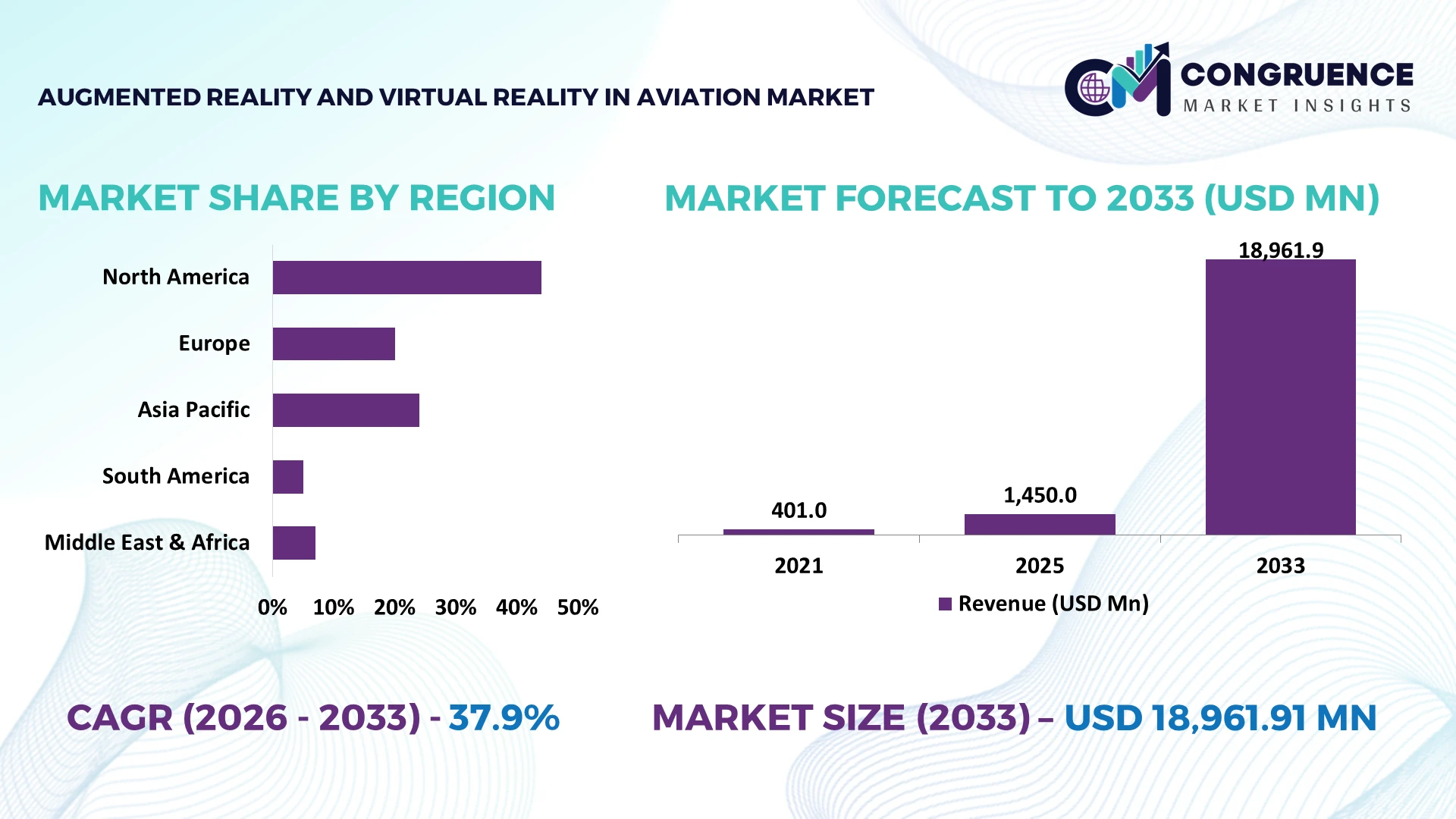
The United States is the dominant country, representing approximately 28% of the 2025 global market based on industry benchmarks. Adoption spans commercial aerospace, MRO, defense aviation, and flight training, reinforced by a USD 5 million FAA aerospace-maintenance XR research program. China remains smaller today but is scaling rapidly, supported by expanding domestic aviation capacity and immersive training adoption.
The strategic priority is clear: aviation OEMs, airlines, MRO providers, and defense contractors integrating certified immersive training and maintenance workflows early gain measurable advantages in training capacity, technician productivity, and aircraft availability.
Market Size & Growth: USD 1.45 billion in 2025 advances toward USD 18.96 billion by 2033 at 37.9%, driven by immersive training and AR-assisted maintenance.
Top Growth Drivers: VR maintenance programs have demonstrated 72% shorter training time, 50% fewer aircraft requirements, and 45% lower classroom requirements.
Short-Term Forecast: By 2028, advanced aviation XR deployments will increasingly benchmark performance against 45% classroom-hour reductions and substantially higher simulation-based training capacity.
Emerging Technologies: AI coaching, mixed-reality cockpits, digital twins, spatial computing, and cloud-based 3D procedure training are moving aviation XR beyond standalone headsets.
Regional Leaders: North America holds approximately 37% historical share, Europe benefits from Airbus-led immersive training, while Asia-Pacific gains from expanding Chinese aviation and simulation infrastructure.
End-User Trends: Military aviation is accelerating adoption as VR enables multiple technicians to train simultaneously without taking operational aircraft out of service.
Pilot/Case Example: U.S. naval aviation VR training produced approximately 8.5% improvement in SEM scores and 22% improvement in RR-flight scores.
Competitive Landscape: North America holds approximately 37% regional leadership, while CAE, Airbus, Microsoft, Honeywell, Boeing, and Thales anchor the high-value aviation XR ecosystem.
Regulatory & ESG Impact: FAA-backed XR research includes a USD 5 million program targeting safer, more efficient aerospace maintenance and human-performance validation.
Investment & Funding: Loft Dynamics raised USD 24 million in 2025, bringing total funding to USD 60 million for expansion of certified VR pilot-training technology.
Innovation & Future Outlook: A USD 28 million U.S. Navy contract covering 50 extended-reality flight simulators demonstrates the strategic shift toward scalable, reconfigurable immersive aviation training.
The Augmented Reality And Virtual Reality In Aviation Market is increasingly concentrated around pilot instruction, aircraft maintenance, engineering visualization, and military readiness. Immersive maintenance deployments have demonstrated training-time reductions of 72%, while AI coaching, mixed-reality cockpits, digital twins, and portable VR trainers are broadening deployment. FAA research and defense modernization are simultaneously pushing XR toward validated, operationally integrated aviation workflows and the next strategic phase.
Augmented reality and virtual reality are becoming strategic aviation infrastructure as airlines, aerospace manufacturers, MRO organizations, and defense operators confront workforce shortages while increasing aircraft utilization. The industry requires more than 2.4 million new aviation professionals through 2045, including 728,000 maintenance technicians. This workforce transition is accelerating digital adoption from classroom-heavy instruction toward immersive, competency-based training that can standardize technical knowledge across distributed operations.
The operational advantage is already measurable. At Travis Air Force Base, VR-enabled aircraft maintenance training reduced overall training time by 72%, classroom requirements by 45%, and aircraft requirements by 50% versus conventional approaches. U.S. deployment is consequently moving deeper into maintenance and military readiness, while China and India face stronger pressure to scale digital training alongside fleet and aviation-workforce expansion. Virtual environments also preserve aircraft availability by shifting repetitive procedural practice away from operational assets.
Through 2026–2028, investment priorities will increasingly favor mixed reality, AI-supported instruction, digital twins, and multi-user simulation integrated with competency assessment. FAA-backed evaluation of extended reality for aerospace maintenance further strengthens the pathway toward validated operational use. Technology providers are partnering with aviation organizations to convert aircraft, maintenance procedures, and training scenarios into reusable digital environments. Competitive advantage will increasingly belong to operators that treat immersive technology as scalable workforce and asset-productivity infrastructure rather than standalone training hardware.
Aviation workforce pressure is turning immersive training into an operational requirement rather than an experimental technology. Commercial aviation requires 674,000 new pilots and 728,000 maintenance technicians through 2045, while approximately two-thirds of overall personnel demand reflects replacement needs. This creates an acute knowledge-transfer problem as experienced technicians retire. At Travis Air Force Base, VR maintenance instruction reduced training time by 72%, aircraft requirements by 50%, and classroom requirements by 45%. The structural shift from instructor-dependent training toward competency-based digital learning allows multiple technicians to practice simultaneously without occupying serviceable aircraft. Boeing, defense organizations, training specialists, and aerospace operators are consequently investing in mixed reality, simulation platforms, digital aircraft models, and partnerships that compress qualification cycles while protecting scarce aircraft availability.
Aviation XR deployment remains constrained by validation requirements, device fragmentation, and the difficulty of integrating immersive systems with safety-critical maintenance procedures. FAA research has reviewed 74 studies covering XR-enabled remote collaboration, reflecting continuing human-factors questions around interfaces, interaction modes, shared visualization, and maintenance performance. Meanwhile, immersive training environments require accurate digital replication of increasingly complex aircraft; the U.S. Air Force needed a four-week scanning operation covering equipment and aircraft including the C-17 and KC-46A to develop training products. Unlike consumer XR, aviation applications cannot tolerate inaccurate procedural overlays or inconsistent spatial tracking. Operators therefore face additional testing, content-validation, configuration-control, and cybersecurity costs. Technology suppliers are reducing exposure through hardware-agnostic software, controlled digital-twin libraries, modular content architectures, and partnerships with aviation authorities and operators before pursuing fleet-wide deployment.
The strongest opportunity extends beyond VR classrooms into persistent digital aircraft environments connecting training, maintenance, engineering, and remote assistance. Existing naval aviation testing demonstrated approximately 8.5% improvement in SEM training scores and 22% improvement in RR-flight scores, while one VR architecture connected up to eight aircraft simultaneously. Applying this model to commercial MRO creates a less obvious opportunity: scarce specialists can support distributed technicians through shared AR visualization instead of traveling between maintenance locations. India and China offer particularly strong deployment potential as aviation fleets and technical-workforce requirements expand simultaneously. Between 2026 and 2028, AI-generated training scenarios, digital twins, spatial computing, and performance analytics will increasingly converge. Aerospace companies are positioning through XR research, simulation partnerships, reusable aircraft models, and cloud-delivered training ecosystems that transform specialist knowledge into scalable digital capacity.
The long-term challenge is converting successful XR pilots into repeatable, secure workflows across different aircraft types, maintenance bases, training standards, and workforce skill levels. Boeing projects demand for 728,000 new maintenance technicians and 674,000 pilots through 2045, making deployment consistency more important than isolated demonstrations. U.S. Air Force programs already cover multiple platforms including the C-17, C-5M, and KC-46A, illustrating the content-management burden created when procedures, configurations, and aircraft systems differ. Cybersecurity adds another execution layer because connected headsets, cloud simulation, digital twins, and remote expert systems introduce additional data interfaces into aviation environments. Companies must therefore solve interoperability, content versioning, human-factor validation, and secure integration simultaneously. Investment in common XR architectures, standardized aircraft datasets, recurrent validation, and regulator-industry collaboration will determine which platforms achieve sustainable enterprise-scale adoption.
VR Moves Into Airline Curricula: Austrian Airlines fully integrated VR into A320 type-rating training by end-2025 after a three-year development program with Airbus and Lufthansa Aviation Training. The shift moves headsets from supplementary experimentation into scheduled instruction, reducing reliance on scarce simulator slots. Airlines are now standardizing aircraft-specific content and embedding immersive modules earlier within qualification workflows.
Spatial Computing Extends Remote Training: CAE tested Apple Vision Pro-based immersive training on the Bombardier Global 7500 and targeted additional aircraft platforms during FY2026. Its digital training ecosystem already supported more than 5,500 business-aviation customers. Spatial computing is shifting procedural familiarization outside dedicated training centers, prompting providers to connect headset applications with AI coaching, analytics, and centralized training management.
Fleet-Specific VR Deployment Accelerates: Kalitta Air adopted FlightDeckToGo across its Boeing 777 operation in 2026 for both pilots and maintenance technicians, while CommuteAir expanded from cockpit instruction into exterior walkaround training. The important shift is platform depth: airlines are moving from single-task VR pilots toward multiple recurrent workflows, increasing content reuse and improving utilization of physical aircraft and training devices.
Multi-Crew Simulation Gains Commercial Scale: Loft Dynamics launched an H145 multi-pilot VR simulator in 2026, gaining commitments from operators in France and Japan while establishing India’s first dedicated H125 VR training site. Multi-user immersive environments are extending XR beyond individual procedural rehearsal into crew coordination. Suppliers are consequently expanding certified aircraft libraries and partnering with MRO and helicopter operators.
Head-Mounted Displays lead the type segmentation with an estimated 32% share, reflecting their established use across flight instruction, defense simulation, maintenance visualization, and procedural familiarization. Their advantage comes from portability, relatively low infrastructure requirements, and compatibility with increasingly sophisticated aviation software. Virtual Reality Headsets form another mature category, particularly for cockpit rehearsal and abnormal-event simulation, while Simulation Systems retain strategic importance where motion fidelity, instructor control, and formal competency assessment remain essential. Current aerospace and defense benchmarks place head-mounted or helmet-mounted implementations close to 31.96% of immersive deployment, confirming their scale advantage.
Mixed Reality Systems are the fastest-growing type as operators combine physical controls with spatially anchored digital aircraft environments. Augmented Reality Glasses are gaining relevance for line maintenance, remote expert support, and assembly guidance, where technicians require hands-free information without losing sight of physical equipment. Suppliers are therefore shifting R&D toward lighter optics, higher-resolution passthrough, eye tracking, and hardware-agnostic software. Investment is moving from isolated headset procurement toward interoperable platforms spanning VR, AR, and mixed reality.
Pilot Training leads the application mix with approximately 33% share, supported by recurring type-rating requirements, cockpit familiarization, emergency-procedure rehearsal, and pressure to increase training throughput. Flight Simulation remains closely linked but serves higher-fidelity maneuver, systems, and proficiency requirements where simulator integration remains critical. Aircraft Maintenance is emerging as the fastest-growing application, supported by interactive engine procedures, virtual walkarounds, component visualization, and remote technical assistance. Industry benchmarks place broader training and simulation at around 37–41% of current immersive aviation deployment, demonstrating how strongly operational learning influences purchasing decisions.
Maintenance adoption is strengthening because virtual environments allow technicians to rehearse complex tasks without immobilizing operational aircraft. Cabin Crew Training is expanding through emergency evacuation, door-operation, and safety scenarios, while Aircraft Design uses mixed reality for spatial validation, engineering reviews, and assembly planning. Companies are adapting by building aircraft-specific digital twins, automating scenario delivery, and integrating performance analytics into training platforms. Investment priorities are consequently shifting toward reusable applications that support multiple qualification stages rather than isolated demonstration programs.
Airlines represent the largest end-user group with an estimated 35% share, reflecting their combined requirements for pilot qualification, recurrent training, cabin instruction, fleet familiarization, and increasingly maintenance support. Their purchasing power is reinforced by large training populations and costly dependence on full-flight simulators and operational aircraft. Flight Training Centers remain established buyers because immersive systems increase device availability and extend procedural learning beyond fixed simulator schedules. Aircraft Manufacturers use XR for engineering reviews, customer training, production support, and digital aircraft familiarization, creating a broader lifecycle role for immersive technology.
Defense Organizations are the fastest-expanding buyer group as mission rehearsal, distributed training, multi-crew simulation, and aircraft-readiness requirements accelerate adoption. Maintenance Providers are also increasing deployment where virtual aircraft access reduces training dependence on hangar availability. Companies are responding with defense-specific configurations, airline fleet packages, subscription content, and partnerships with OEMs and training specialists. Future competitive advantage will depend increasingly on serving entire aviation ecosystems rather than selling standalone hardware, with customizable content and cross-platform interoperability becoming decisive purchasing criteria.
North America accounted for the largest market share at approximately 37% in 2025 however, Asia-Pacific is expected to register the fastest growth, expanding at a CAGR of approximately 39.3% between 2026 and 2033.

Defense Training and MRO Digitization Lead Deployment
North America holds approximately 37% of the global Augmented Reality And Virtual Reality In Aviation Market, supported by concentrated aerospace manufacturing, military aviation, simulator infrastructure, and enterprise XR development. The United States drives deployment through immersive maintenance instruction, mission rehearsal, cockpit simulation, and engineering visualization. U.S. Air Force VR maintenance programs have demonstrated 72% shorter training time, 50% lower aircraft requirements, and 45% lower classroom requirements, strengthening the operational case for immersive instruction. FAA-backed aerospace-maintenance XR research is simultaneously moving the technology toward stronger human-factors validation. Boeing, Honeywell, Microsoft, CAE, defense organizations, and specialist simulation developers are expanding software integration and aircraft-specific digital environments. The important structural shift is from standalone headset trials toward reusable training architectures capable of supporting technicians, pilots, and distributed operational teams.
United States Market Outlook: The United States combines military procurement, commercial aviation scale, aerospace engineering, and advanced computing ecosystems, making it the region's primary technology commercialization hub. U.S. naval aviation testing has recorded approximately 8.5% improvement in SEM scores and 22% improvement in RR-flight scores using immersive training, demonstrating measurable performance value beyond visualization alone.
Approved VR Training Moves Into Operations
Europe's aviation XR market is shifting decisively from technology evaluation toward approved operational training, supported by Airbus, Lufthansa Aviation Training, defense contractors, airlines, and specialist simulator companies. Europe represents an estimated 25–27% of global deployment, with Germany, France, the United Kingdom, Austria, Belgium, and Switzerland forming important innovation clusters. In 2025, Brussels Airlines introduced VR within an authority-approved A320 type-rating program, replacing selected conventional Flat Panel Trainer sessions rather than merely supplementing them. Lufthansa Aviation Training's broader XR ecosystem already reaches approximately 20,000 trainees annually, demonstrating enterprise-scale utilization. Airbus-linked digital flight-training tools are strengthening standardization across multiple airline environments. Suppliers are consequently prioritizing certified procedure trainers, portable headsets, aircraft-specific software, and interoperability with established simulator infrastructure, shifting competitive value from hardware specifications toward regulatory acceptance and reusable training content.
Germany Market Outlook: Germany combines Lufthansa Aviation Training's operational scale with a strong commercial aerospace and technical-training ecosystem. Approximately 20,000 Lufthansa flight attendants already complete part of annual training using virtual aircraft cabins. Frankfurt and Munich VR hubs demonstrate how immersive technology can run parallel training sessions while reducing dependence on physical cabin assets and instructor-intensive delivery.
Fleet Expansion Accelerates Immersive Training Infrastructure
Asia-Pacific represents approximately 24–25% of the global aviation AR/VR market and is developing the strongest expansion trajectory as aircraft fleets, pilot populations, MRO capacity, and indigenous aerospace programs scale simultaneously. China, India, Japan, Singapore, and Australia are strengthening simulation and digital-training infrastructure, creating demand for portable systems that require less physical space than conventional full-flight simulators. India provides a particularly visible deployment signal: in July 2026, Indocopters announced the country's first Loft Dynamics Airbus H125 TXi VR full-motion simulator, establishing South Asia's first dedicated H125 VR training site. The installation combines six-degree-of-freedom motion with a 360-degree immersive environment. This model is strategically important because compact simulation infrastructure can place advanced training closer to operators, reducing dependence on centralized facilities while supporting emergency, mission-specific, and type-specific instruction.
India Market Outlook: India's aviation opportunity is strengthening through simultaneous localization of aircraft production, MRO, and training. The first dedicated H125 VR training facility in Greater Noida complements Airbus Helicopters' H125 final assembly activity in Vemagal. This creates an integrated domestic ecosystem where aircraft availability, maintenance capability, and pilot readiness can scale together rather than through imported training infrastructure alone.
Brazil Anchors Aerospace Digitalization Demand
South America remains a smaller aviation XR market, representing an estimated 5–7% of global activity, but Brazil provides an unusually strong aerospace foundation through Embraer, airline fleets, executive aviation, defense programs, and established simulator networks. Adoption is concentrated around pilot qualification, engineering visualization, aircraft familiarization, and maintenance training rather than broad enterprise deployment. Embraer's training ecosystem spans commercial, executive, and defense aircraft and increasingly combines simulator partnerships with digital flight-operation capabilities. The region's principal constraint is uneven access to advanced training infrastructure outside major Brazilian aviation centers, making compact VR systems strategically attractive for decentralized operators. Airlines and training providers can use immersive procedural learning to reduce dependence on expensive fixed simulator capacity. Investment is therefore moving toward modular training, digital courseware, and partnerships capable of extending advanced instruction without replicating full-scale facilities across every operating location.
Brazil Market Outlook: Brazil holds the strongest strategic position through Embraer's aerospace manufacturing and training ecosystem. Embraer supports Commercial Aviation, Executive Aviation, and Defense & Security platforms while partnering with specialist training providers and simulator manufacturers. This installed aircraft base creates recurring opportunities for aircraft-specific virtual instruction, maintenance visualization, engineering collaboration, and distributed crew familiarization.
Gulf Aviation Investment Digitizes Training Capacity
Middle East & Africa represents approximately 6–8% of global aviation AR/VR activity, with deployment concentrated in the UAE, Saudi Arabia, Israel, and major aviation-training hubs. Gulf carriers are integrating immersive systems as part of broader fleet and workforce modernization rather than isolated technology programs. Emirates provides the clearest operational benchmark: its Dubai training expansion increases annual pilot-training capacity by 54% and 45,000 hours, supported by immersive flight-deck preparation and digitally recorded training sessions. Its virtual MIRA environment also targets nearly 23,000 cabin crew, with 8–10 employees able to train simultaneously within the same VR scenario. These deployments show how high-volume airlines can connect XR with conventional simulation infrastructure. Suppliers are consequently targeting Gulf operators through customized training content, airline partnerships, digital assessment tools, and integrated simulation ecosystems.
United Arab Emirates Market Outlook: The UAE combines Emirates' global training scale with aggressive aviation infrastructure modernization. Emirates' expanded facilities are designed to deliver approximately 130,000 pilot-training hours annually when fully developed, while immersive preparation and VR cabin-safety workflows extend digitalization beyond cockpit simulation. This creates a high-value testing environment for scalable airline XR applications.
CAE, Honeywell, Microsoft, HTC, Elbit Systems, and specialist providers such as Loft Dynamics compete across distinct layers of aviation immersive technology, with aerospace training incumbents challenging software and headset innovators for enterprise control. The top five players account for approximately 35–40% of market activity, leaving substantial scope for aircraft-specific specialists. Competition centers on certification, simulation fidelity, interoperability, and deployment economics; compact VR devices can require roughly 90% less physical space, while advanced virtual training has demonstrated training-time reductions above 70% in selected maintenance programs. CAE and Honeywell leverage installed aviation relationships, Microsoft and HTC supply spatial-computing ecosystems, while Loft Dynamics differentiates through certified, aircraft-specific VR simulation. Partnerships with airlines, OEMs, MRO providers, and defense organizations are replacing standalone hardware sales. Regulatory validation and proprietary aircraft content remain significant entry barriers. Competitive leadership requires certified workflows, reusable digital aircraft libraries, measurable training outcomes, and integration across existing aviation training infrastructure.
CAE Inc.
Honeywell International Inc.
Microsoft Corporation
HTC Corporation
Elbit Systems Ltd.
BAE Systems plc
Loft Dynamics AG
Bohemia Interactive Simulations
Aero Glass
EON Reality, Inc.
Magic Leap, Inc.
PTC Inc.
Sony Group Corporation
Varjo Technologies Oy
Spatial computing, full-motion VR, AR maintenance overlays, and digital twins define aviation immersive technology. Qualified VR flight-training devices can operate in footprints about 90% smaller than traditional full-flight simulators while cutting carbon emissions by up to 90%. AR glasses increasingly place maintenance instructions, component data, and remote expertise directly within technicians’ sightlines. Adoption is progressing from experimental use toward approved training workflows, with qualified VR devices now supporting proficiency checks, type ratings, and instrument training.
Emerging systems combine mixed reality with AI coaching, biometric assessment, eye tracking, and real-time performance analytics. CAE has deployed AI-enabled RISE capabilities across more than 100 simulators, while spatial-computing applications extend cockpit familiarization beyond training centers. Compared with conventional simulator-dependent preparation, selected VR maintenance deployments have reduced training time by 72% and aircraft requirements by 50%, creating capacity advantages for airlines, MRO providers, and defense organizations managing scarce equipment and instructors.
Between 2026 and 2028, disruptive value will come from interoperable digital aircraft environments linking training, maintenance, engineering, and remote assistance. Hardware-agnostic platforms and reusable aircraft models will lower content duplication while supporting distributed workforces. Operators integrating validated XR with existing simulator infrastructure now gain faster qualification cycles, higher asset availability, and defensible training scalability.
October 2024 NAVAIR introduced Project Link, a T-45C mixed-reality trainer combining physical cockpit controls with virtual displays and external views. The system advances individualized naval pilot instruction, performance assessment, and extended-reality integration under Naval Aviation Training Next. Source: navair.navy.mil
August 2025 Loft Dynamics secured USD 24 million to accelerate Boeing 737 and Airbus A320 VR simulator development and introduce AI-based pilot performance feedback. The funding expands immersive simulation from helicopters toward high-volume commercial fixed-wing airline training. Source: aviationweek.com
February 2026 Austrian Airlines confirmed full VR integration into A320 type-rating training following development with Airbus and Lufthansa Aviation Training. Pilots complete three 180-minute virtual sessions, establishing immersive instruction as an operational component of airline qualification. Source: austrianairlines.ag
July 2026 Indocopters partnered with Loft Dynamics to install India’s first Airbus H125 TXi full-motion VR simulator, creating South Asia’s first dedicated H125 VR training site. Deployment expands localized helicopter pilot training alongside India’s growing H125 ecosystem. Source: verticalmag.com
The Augmented Reality And Virtual Reality In Aviation Market Report evaluates Head-Mounted Displays, Augmented Reality Glasses, Virtual Reality Headsets, Mixed Reality Systems, and Simulation Systems across Pilot Training, Aircraft Maintenance, Flight Simulation, Cabin Crew Training, and Aircraft Design. End-user coverage includes Airlines, Aircraft Manufacturers, Defense Organizations, Maintenance Providers, and Flight Training Centers, with North America holding approximately 37% of current market activity and Asia-Pacific demonstrating accelerating deployment momentum.
The report examines North America, Europe, Asia-Pacific, South America, and Middle East & Africa while tracking spatial computing, AI-enabled coaching, digital twins, full-motion VR, remote maintenance assistance, and immersive performance analytics. Competitive assessment covers major aviation training providers, XR developers, technology platforms, and specialist simulation companies. Between 2026 and 2033, the analysis supports investment planning, geographic expansion, technology partnerships, product positioning, and identification of emerging opportunities in distributed pilot instruction, digitally enabled MRO, defense readiness, and aircraft-specific immersive training ecosystems.
| Report Attribute/Metric | Report Details |
|---|---|
Market Revenue in 2025 | USD 1450 Million |
Market Revenue in 2033 | USD 18961.91 Million |
CAGR (2026 - 2033) | 37.9% |
Base Year | 2025 |
Forecast Period | 2026 - 2033 |
Historic Period | 2021 - 2025 |
Segments Covered | By Type
By Application
By End-User
|
Key Report Deliverable | Revenue Forecast, Growth Trends, Market Dynamics, Segmental Overview, Regional and Country-wise Analysis, Competition Landscape |
Region Covered | North America, Europe, Asia-Pacific, South America, Middle East, Africa |
Key Players Analyzed | CAE Inc., Honeywell International Inc., Microsoft Corporation, HTC Corporation, Elbit Systems Ltd., BAE Systems plc, Loft Dynamics AG, Bohemia Interactive Simulations, Aero Glass, EON Reality, Inc., Magic Leap, Inc., PTC Inc., Sony Group Corporation, Varjo Technologies Oy |
Customization & Pricing | Available on Request (10% Customization is Free) |




