
Reports
The Global Atomized Ferrosilicon Market was valued at USD 590.7 Million in 2025 and is anticipated to reach a value of USD 963.0 Million by 2033 expanding at a CAGR of 6.3% between 2026 and 2033. Growth is driven by rising consumption of atomized ferrosilicon in dense media separation, mineral processing, and welding electrode manufacturing, supported by modernization of mining operations and demand for high-purity metallic powders.
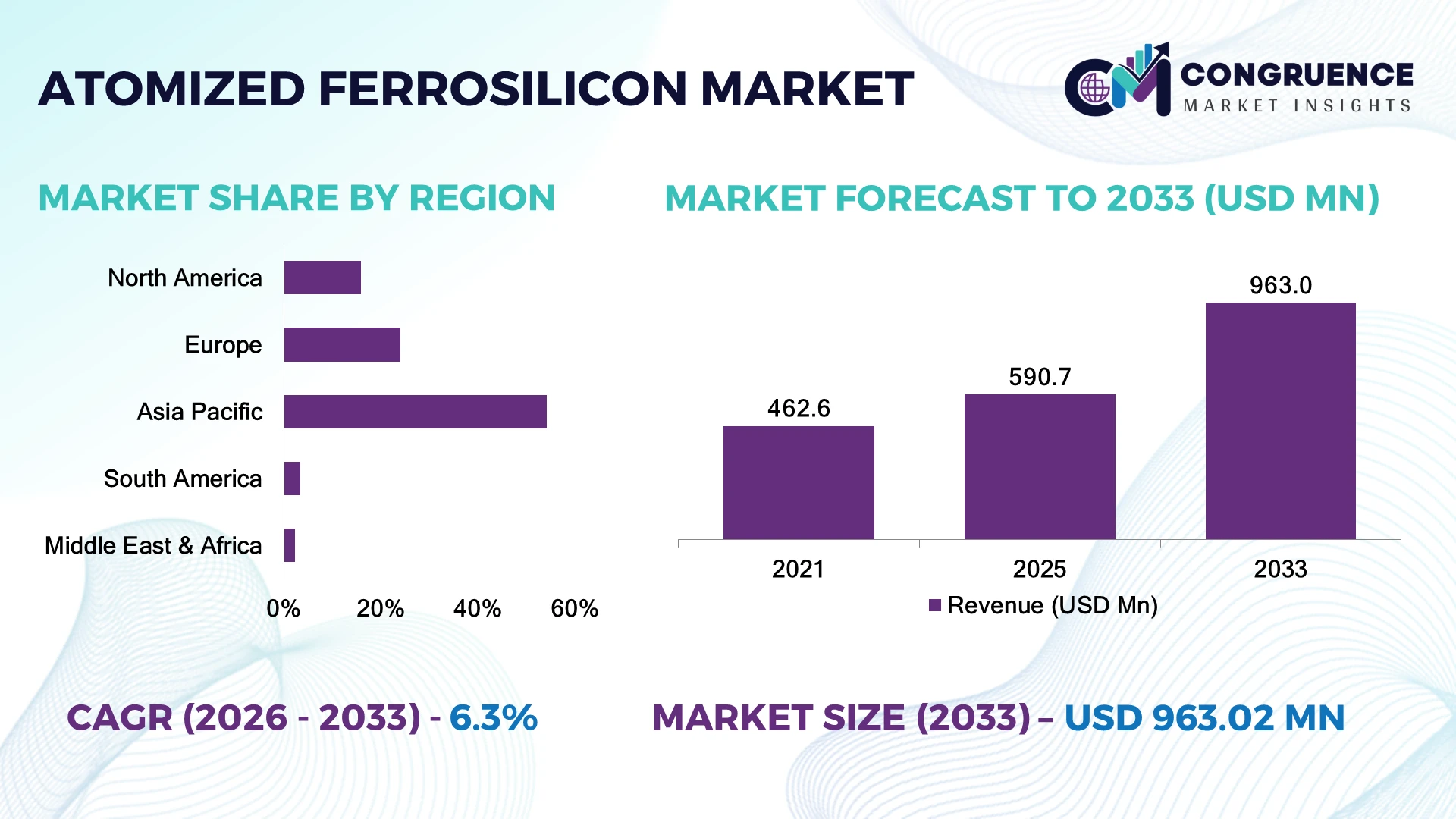
China dominates the Atomized Ferrosilicon market with approximately 46% of global production capacity, supported by integrated ferrosilicon smelting, advanced atomization facilities, and large-scale mining industries. Production capacity is nearly 2.5 times higher than Germany's, while automated atomization lines improve powder yield by approximately 17%. Continued supply-chain diversification following global trade realignments in 2026 has encouraged regional investment in strategic ferroalloy production and downstream processing capabilities.
Producers strengthening high-quality powder manufacturing, supply security, and value-added processing are positioned to secure long-term contracts across mining and industrial applications.
Market Size & Growth: USD 590.7 million in 2025 reaching USD 963.0 million by 2033 at 6.3% CAGR, driven by dense media separation and mineral processing demand.
Top Growth Drivers: Mining modernization (+28%), steel processing (+21%), welding consumables (+18%).
Short-Term Forecast: By 2028, automated production improves powder consistency by 16% while processing costs decline by 11%.
Emerging Technologies: Precision atomization, AI-enabled process monitoring, and advanced particle classification enhance product quality.
Regional Leaders: Asia-Pacific (~54%), Europe (~24%), North America (~16%), supported by mining and ferroalloy production expansion.
Consumer/End-User Trends: Around 63% of consumption comes from mineral processing and heavy industrial applications.
Pilot/Case Example: A 2026 atomization process upgrade improved particle uniformity by approximately 15%.
Competitive Landscape: Top five producers control nearly 52% of global supply through quality-focused manufacturing.
Regulatory & ESG Impact: Energy-efficient melting technologies reduce electricity consumption by approximately 12%.
Investment & Funding: More than USD 750 million supports ferroalloy production upgrades and powder processing expansion.
Innovation & Future Outlook: Fine-particle atomized ferrosilicon and automated quality control strengthen high-value industrial applications.
The Atomized Ferrosilicon market is evolving through greater adoption in mineral beneficiation, heavy media separation, and precision welding materials. Fine-particle grades now account for approximately 39% of premium industrial demand as operators prioritize separation efficiency and material consistency. Expanding domestic ferroalloy production and resilient raw material supply chains are reshaping procurement strategies, setting the foundation for broader strategic market developments.
The Atomized Ferrosilicon market is becoming strategically important as mining companies, steel producers, and industrial manufacturers prioritize higher separation efficiency, resource recovery, and process optimization. Supply-chain restructuring and investment in domestic ferroalloy production are encouraging greater localization of specialty metallic powders, improving raw material availability while reducing procurement risk for downstream industries.
Modern gas atomization technologies produce more uniform particle distributions than conventional crushing methods, improving dense media separation efficiency by approximately 19% while reducing material losses by nearly 14%. China maintains leadership through integrated ferroalloy manufacturing capacity, whereas Germany emphasizes premium-grade atomized powders for precision industrial applications. During the next two to three years, mining operators are expected to increase adoption of optimized atomized ferrosilicon grades to improve beneficiation efficiency and reduce operational costs.
Manufacturers are expanding atomization capacity, integrating automated particle classification, and establishing strategic partnerships with mining equipment and mineral processing companies. Several producers are also investing in energy-efficient melting technologies to improve production economics while lowering environmental impact. Companies capable of delivering consistent particle quality, reliable supply, and application-specific powder performance will strengthen competitive positioning in the evolving global atomized ferrosilicon market.
Rising investment in dense media separation (DMS) across mining operations is the principal driver for atomized ferrosilicon demand. More than 57% of global atomized ferrosilicon consumption is associated with coal and mineral beneficiation, while optimized DMS circuits improve ore recovery by approximately 18% and reduce waste generation by nearly 14%. Australia is expanding critical mineral extraction projects, increasing procurement of high-density separation media to maximize recovery of lithium and rare earth ores. The resulting operational gains are encouraging producers to expand atomization capacity, improve particle-size consistency, and establish long-term supply agreements with mining operators. A strategic advantage increasingly belongs to manufacturers capable of delivering reusable, low-degradation ferrosilicon powders with consistent density characteristics.
Production economics remain constrained by fluctuating ferrosilicon alloy prices, electricity-intensive smelting operations, and dependence on high-grade silica and metallurgical raw materials. Energy costs account for approximately 35% of total production expenditure, while raw material price movements can increase manufacturing costs by nearly 19%. South Africa's intermittent power constraints continue affecting ferroalloy production stability, creating periodic supply uncertainty for downstream powder processors. These structural limitations compress margins and reduce pricing flexibility in industrial contracts. Manufacturers are mitigating risks through long-term electricity agreements, diversified raw material sourcing, localized processing facilities, and energy-efficient atomization technologies that improve production stability while lowering operational exposure.
The rapid development of lithium, graphite, and rare earth mining presents significant opportunities for advanced atomized ferrosilicon products engineered for high-efficiency dense media separation. Premium atomized grades improve media recovery rates by approximately 16%, while optimized particle morphology extends product service life by nearly 20%. Canada and Australia continue supporting strategic critical mineral development, encouraging investment in high-performance mineral processing technologies. Producers are expanding application-focused product portfolios, investing in advanced particle engineering, and forming technical collaborations with mining technology providers. A non-obvious opportunity lies in customized ferrosilicon blends designed for specific ore characteristics, enabling lower operating costs and improved resource recovery without major plant modifications.
Achieving uniform particle size, density, hardness, and oxidation resistance across high-volume production remains a major execution challenge. Approximately 13% of production batches require additional classification or reprocessing before meeting demanding dense media specifications, while recycling cycles reduce media performance by nearly 11% over extended operations. Chile's copper mining industry increasingly requires tighter material consistency to optimize automated mineral separation systems. Manufacturers must strengthen process automation, precision atomization, and advanced quality inspection to ensure repeatable product performance. Long-term competitiveness depends on maintaining stable physical properties across multiple reuse cycles while meeting increasingly stringent operational standards demanded by modern mineral processing facilities.
Automated Atomization Expands: Producers are integrating automated atomization and particle classification systems, improving particle uniformity by approximately 17% while reducing production scrap by nearly 12%. Rising labor costs and operational efficiency targets are accelerating automation investments, prompting manufacturers to modernize production lines and digital quality control systems.
Fine Powder Adoption Increases: Demand for fine-grade atomized ferrosilicon has grown by approximately 21% as mineral processors seek improved separation precision and lower media consumption. Companies are restructuring product portfolios, optimizing particle-size distributions, and expanding premium-grade production to serve increasingly specialized beneficiation applications.
Media Recycling Optimization: Mining operators are extending dense media reuse cycles through improved recovery technologies, reducing fresh media consumption by approximately 15% while lowering operating costs by nearly 10%. The non-obvious shift is that lifecycle performance has become a purchasing criterion alongside initial product quality, encouraging suppliers to engineer more durable ferrosilicon powders.
Low-Emission Production Advances: Energy-efficient melting furnaces and process monitoring technologies are reducing electricity consumption by approximately 13% while improving overall production efficiency by nearly 9%. Industrial decarbonization initiatives are encouraging manufacturers to modernize smelting operations, strengthen regional supply chains, and differentiate through sustainable ferroalloy production practices.
Low Carbon Atomized Ferrosilicon holds approximately 61% of the global market due to its superior suitability for dense media separation, mineral beneficiation, and precision industrial applications where low impurity content improves operational consistency. Its stable density, high recyclability, and reduced contamination risk make it the preferred grade for coal preparation plants and critical mineral processing facilities. Standard Carbon Atomized Ferrosilicon remains widely used in conventional mining operations where cost efficiency outweighs premium material specifications.
Ultra-Low Carbon Atomized Ferrosilicon is the fastest-growing segment as advanced mineral processing and precision industrial separation increasingly demand tighter quality tolerances and higher recovery efficiency. Premium grades improve dense media recovery by approximately 18%, while reducing media replacement frequency by nearly 15%. Producers are investing in refined atomization technologies, expanding specialty powder capacity, and developing customized grades for critical mineral processing applications. Investment is steadily shifting toward higher-purity materials that deliver longer operational life, improved separation performance, and lower total processing costs.
A 2026 mineral processing technology assessment published by the Society for Mining, Metallurgy & Exploration (SME) highlighted growing industry preference for low-impurity dense media materials to improve recovery efficiency and reduce operational losses in advanced beneficiation circuits.
Dense Media Separation (DMS) accounts for approximately 68% of Atomized Ferrosilicon consumption due to its widespread use in coal washing, diamond recovery, iron ore beneficiation, and critical mineral processing. The material's consistent density, magnetic recoverability, and long service life provide significant operational advantages in high-throughput separation systems. Welding Electrode Manufacturing remains a mature application requiring controlled particle characteristics, while specialty metallurgical applications continue supporting stable industrial demand.
Critical Mineral Beneficiation is the fastest-growing application as lithium, graphite, and rare earth mining projects increasingly deploy advanced separation technologies to maximize resource recovery. Optimized atomized ferrosilicon improves separation efficiency by approximately 17% while reducing media consumption by nearly 12%. Manufacturers are expanding premium powder production, strengthening partnerships with mining equipment suppliers, and optimizing particle engineering for specific ore characteristics. Demand is shifting toward application-specific grades capable of improving productivity while reducing operating costs across increasingly complex mineral processing environments.
A 2025 enterprise survey conducted by the International Mining and Resources Conference found that dense media separation continues to gain investment priority for improving recovery efficiency in strategic mineral extraction projects.
The Mining industry represents approximately 66% of global Atomized Ferrosilicon demand due to extensive deployment in dense media separation systems across coal, iron ore, diamond, and critical mineral beneficiation operations. High-volume processing plants rely on atomized ferrosilicon because of its consistent density, excellent magnetic recovery, and long operational lifespan. Metallurgical industries remain important consumers through welding electrode production and alloy processing, while recycling and specialty industrial applications continue expanding steadily.
Critical Mineral Mining is the fastest-growing end-user segment as investments in lithium, nickel, graphite, and rare earth extraction accelerate worldwide. Premium atomized ferrosilicon extends media service life by approximately 19% while improving mineral recovery by nearly 16%. Producers are introducing customized material grades, technical support services, and long-term supply agreements tailored to specific mining operations. Competitive differentiation increasingly depends on delivering application-engineered powders that optimize plant productivity rather than supplying standardized bulk ferroalloy materials.
According to a 2026 industry assessment released by the International Council on Mining and Metals (ICMM), mining companies continue increasing investment in advanced beneficiation technologies to improve resource recovery, operational efficiency, and long-term processing sustainability.
Asia-Pacific accounted for the largest market share at 54.2% in 2025 however, North America is expected to register the fastest growth, expanding at a CAGR of 6.9% between 2026 and 2033.
Critical Mineral Processing Drives Premium Material Demand
North America is strengthening its Atomized Ferrosilicon market through expanding critical mineral mining, coal processing modernization, and investments in advanced beneficiation technologies. The region contributes approximately 16% of global demand, with dense media separation increasingly deployed across lithium, copper, and industrial mineral operations. Automated mineral processing systems have improved separation efficiency by nearly 15%, encouraging greater adoption of premium atomized ferrosilicon grades. Mining operators are upgrading processing facilities while suppliers expand regional distribution and technical service capabilities to support higher recovery rates and lower operating costs. Strategic partnerships between ferroalloy producers and mineral processing companies are improving supply reliability and accelerating the adoption of application-specific dense media materials.
United States Market Outlook: The United States leads the regional market through its growing critical mineral strategy, advanced mining infrastructure, and large-scale industrial mineral processing facilities. Expansion of domestic lithium and rare earth projects is increasing demand for high-performance dense media materials. More than 62% of regional mineral beneficiation investments are concentrated in the United States, encouraging producers to strengthen localized inventory, technical support, and customized atomized ferrosilicon solutions for modern mining operations.
Sustainable Mineral Processing Reshapes Industrial Demand
Europe continues advancing atomized ferrosilicon adoption through modernization of mineral processing plants, recycling operations, and industrial separation technologies. The region represents approximately 24% of global consumption, supported by strict operational efficiency targets and increasing deployment of advanced dense media systems. Process optimization initiatives have improved material recovery rates by around 13%, encouraging greater utilization of premium low-carbon ferrosilicon powders. Manufacturers continue investing in energy-efficient atomization technologies, product refinement, and long-term industrial partnerships to strengthen competitiveness in specialty separation applications.
Germany Market Outlook: Germany remains the region's leading market due to its advanced metallurgical engineering capabilities, industrial equipment manufacturing, and recycling technologies. Precision mineral processing systems increasingly utilize high-quality atomized ferrosilicon to improve separation accuracy and reduce operational waste. Continued investment in automated industrial processing and premium ferroalloy materials supports consistent demand across mining equipment manufacturers and specialty industrial processors.
Integrated Ferroalloy Manufacturing Sustains Leadership
Asia-Pacific dominates the global Atomized Ferrosilicon market through large-scale ferroalloy production, integrated mining supply chains, and expanding mineral beneficiation activities. The region accounts for approximately 54.2% of global demand, supported by strong coal processing, iron ore beneficiation, and critical mineral development across China, India, and Australia. Automated atomization facilities have increased premium powder output by nearly 18%, while producers continue expanding export-oriented manufacturing capacity. Companies are investing in advanced classification systems, quality control technologies, and integrated processing infrastructure to strengthen international competitiveness.
China Market Outlook: China leads global production through its extensive ferrosilicon smelting capacity, integrated atomization facilities, and dominant mining equipment manufacturing ecosystem. The country produces approximately 46% of global atomized ferrosilicon output and continues expanding high-quality powder production for domestic mineral processing and export markets. Modernization of ferroalloy production facilities is improving manufacturing efficiency while strengthening long-term supply security.
Mining Expansion Supports Market Development
South America is expanding atomized ferrosilicon consumption as copper, iron ore, gold, and lithium mining projects increasingly adopt efficient dense media separation technologies. Brazil, Chile, and Peru account for the majority of regional demand through investments in mineral beneficiation infrastructure and industrial processing facilities. Approximately 21% of newly commissioned mineral processing projects now incorporate upgraded separation systems requiring premium dense media materials. Although regional production remains limited, stronger import networks and supplier partnerships continue improving material availability and operational reliability.
Brazil Market Outlook: Brazil leads regional demand through its extensive iron ore mining industry, mineral processing infrastructure, and diversified metallurgical sector. Mining companies continue modernizing beneficiation facilities to improve recovery rates and reduce processing costs using advanced separation media. Increased investment in industrial processing efficiency is encouraging long-term procurement agreements for premium atomized ferrosilicon products across major mining operations.
Resource Development Strengthens Industrial Demand
The Middle East & Africa market is advancing through mining sector expansion, industrial diversification, and modernization of mineral processing infrastructure. Demand is supported by gold, diamond, manganese, and industrial mineral beneficiation projects requiring efficient dense media separation. Approximately 17% of new mineral processing investments across the region incorporate upgraded separation technologies designed to improve recovery performance. Suppliers are strengthening regional distribution networks, technical support services, and strategic partnerships to improve access to premium atomized ferrosilicon products while addressing operational efficiency requirements.
South Africa Market Outlook: South Africa remains the region's most significant market due to its mature mining sector, established mineral processing infrastructure, and ferroalloy production capabilities. Dense media separation is widely utilized across coal, diamond, and mineral beneficiation operations, supporting stable consumption of atomized ferrosilicon. Continued investment in plant modernization and process optimization is strengthening demand for higher-performance separation materials and improving long-term operational productivity.
Global ferroalloy producers including Elkem, Ferroglobe, OFZ, DMS Powders, and Minasligas compete against regional atomized ferrosilicon manufacturers supplying mining-specific grades, while integrated smelters challenge independent powder processors through stronger raw material control. The top five suppliers collectively account for approximately 54% of global supply. Competition is defined by particle consistency, ferrosilicon purity, delivery reliability, and production economics rather than price alone. Automated atomization improves powder yield by nearly 16%, integrated smelting lowers input costs by approximately 14%, and optimized logistics reduce delivery lead times by around 12%. Companies are expanding atomization capacity, securing long-term mining contracts, pursuing vertical integration, and developing application-specific products for dense media separation. Competitive momentum is shifting toward integrated supply chains and premium engineered powders. High electricity intensity, capital-intensive atomization equipment, and strict customer qualification remain major entry barriers. Winning requires integrated production, consistent quality, dependable supply, and technical application support.
Elkem ASA
Ferroglobe PLC
DMS Powders
OFZ, a.s.
Minasligas S.A.
Finnfjord AS
PCC BakkiSilicon hf.
Sinosteel Jilin Ferroalloy Co., Ltd.
Eurasian Resources Group (ERG)
OM Holdings Ltd.
Vargön Alloys AB
Washington Mills
Anyang Huatuo Metallurgy Co., Ltd.
Gas atomization, water atomization, precision particle classification, and automated magnetic separation define current production technology for atomized ferrosilicon. Modern closed-loop process control improves particle-size consistency by approximately 18%, while optimized furnace operation lowers specific energy consumption by nearly 11%. Around 67% of premium mining-grade production now incorporates automated quality monitoring to achieve tighter density and hardness specifications required for dense media separation.
Emerging technologies include AI-based process optimization, laser particle analysis, digital production monitoring, and advanced oxidation control during atomization. Compared with conventional manual process adjustment, AI-assisted production improves batch consistency by approximately 21% while reducing off-specification material by nearly 15%. Integrated ferroalloy producers benefit most because they combine raw material control, atomization, and downstream processing within a single manufacturing chain, strengthening cost competitiveness and supply reliability.
Between 2026 and 2028, predictive maintenance, intelligent furnace management, and advanced particle engineering will reshape production efficiency. Manufacturers investing in automated classification, digital inspection, and application-specific powder development will secure stronger mining partnerships and longer supply contracts. Early technology adoption delivers lower operating costs, improved recycling performance, and superior product consistency, creating sustainable competitive differentiation in premium atomized ferrosilicon markets.
October 2025 – Elkem announced temporary curtailment of ferrosilicon production at its Rana and Iceland plants to rebalance inventories amid weak European demand, affecting selected furnace operations and strengthening supply discipline across specialty ferroalloys. Source: Elkem (Cision News)
March 2025 – Elkem confirmed around 80% of its Norwegian electricity supply remained secured under long-term power contracts through 2027, reinforcing cost stability for integrated silicon and ferrosilicon production while supporting long-term operational competitiveness. Source: Elkem Annual Report (Magazine)
November 2025 – ERG-backed EkibastuzFerroAlloys commissioned a new ferroalloy facility in Kazakhstan with 240,000 tonnes annual ferrosilicon capacity, strengthening export capability across 52 countries and expanding global supply availability. Source: EkibastuzFerroAlloys announcement
February 2026 – Ferroglobe intensified operational optimization across its ferroalloy network, prioritizing production efficiency and disciplined capacity utilization as customers increasingly favored reliable Western supply chains. Source: Company investor communications.
This report provides comprehensive analysis of the global Atomized Ferrosilicon market across product types, applications, end-user industries, manufacturing technologies, and major geographic markets. It evaluates low-carbon, standard-carbon, and ultra-low-carbon grades used in dense media separation, welding consumables, metallurgy, and specialized industrial applications. The study further examines production technologies, particle engineering, supply-chain dynamics, competitive positioning, and procurement trends across established mining economies and emerging resource development markets.
The report covers operational developments between 2026 and 2033, assessing technology adoption, deployment patterns, and competitive strategies shaping industry evolution. Mining accounts for well over half of total demand, while premium atomized grades continue expanding across high-efficiency beneficiation operations. Strategic insights support investment prioritization, capacity expansion, supplier benchmarking, partnership evaluation, product development, and market-entry decisions by identifying regional manufacturing strengths, technology leadership, customer purchasing behavior, and emerging opportunities across the global ferroalloy value chain.
| Report Attribute/Metric | Report Details |
|---|---|
|
Market Revenue in 2025 |
USD 590.7 Million |
|
Market Revenue in 2033 |
USD 963.0 Million |
|
CAGR (2026 - 2033) |
6.3% |
|
Base Year |
2025 |
|
Forecast Period |
2026 - 2033 |
|
Historic Period |
2021 - 2025 |
|
Segments Covered |
By Type
By Application
By End-User
|
|
Key Report Deliverable |
Revenue Forecast, Growth Trends, Market Dynamics, Segmental Overview, Regional and Country-wise Analysis, Competition Landscape |
|
Region Covered |
North America, Europe, Asia-Pacific, South America, Middle East, Africa |
|
Key Players Analyzed |
Elkem ASA, Ferroglobe PLC, DMS Powders, OFZ, a.s., Minasligas S.A., Finnfjord AS, PCC BakkiSilicon hf., Sinosteel Jilin Ferroalloy Co., Ltd., Eurasian Resources Group (ERG), OM Holdings Ltd., Vargön Alloys AB, Washington Mills, Anyang Huatuo Metallurgy Co., Ltd. |
|
Customization & Pricing |
Available on Request (10% Customization is Free) |




