
Reports
The Global Astaxanthin Gummies Market was valued at USD 205.9 Million in 2025 and is anticipated to reach a value of USD 563.1 Million by 2033 expanding at a CAGR of 13.4% between 2026 and 2033. Rising consumer preference for antioxidant-rich nutraceutical gummies, expanding algae-derived astaxanthin production, and growing preventive wellness spending are accelerating premium supplement adoption across retail and e-commerce channels.
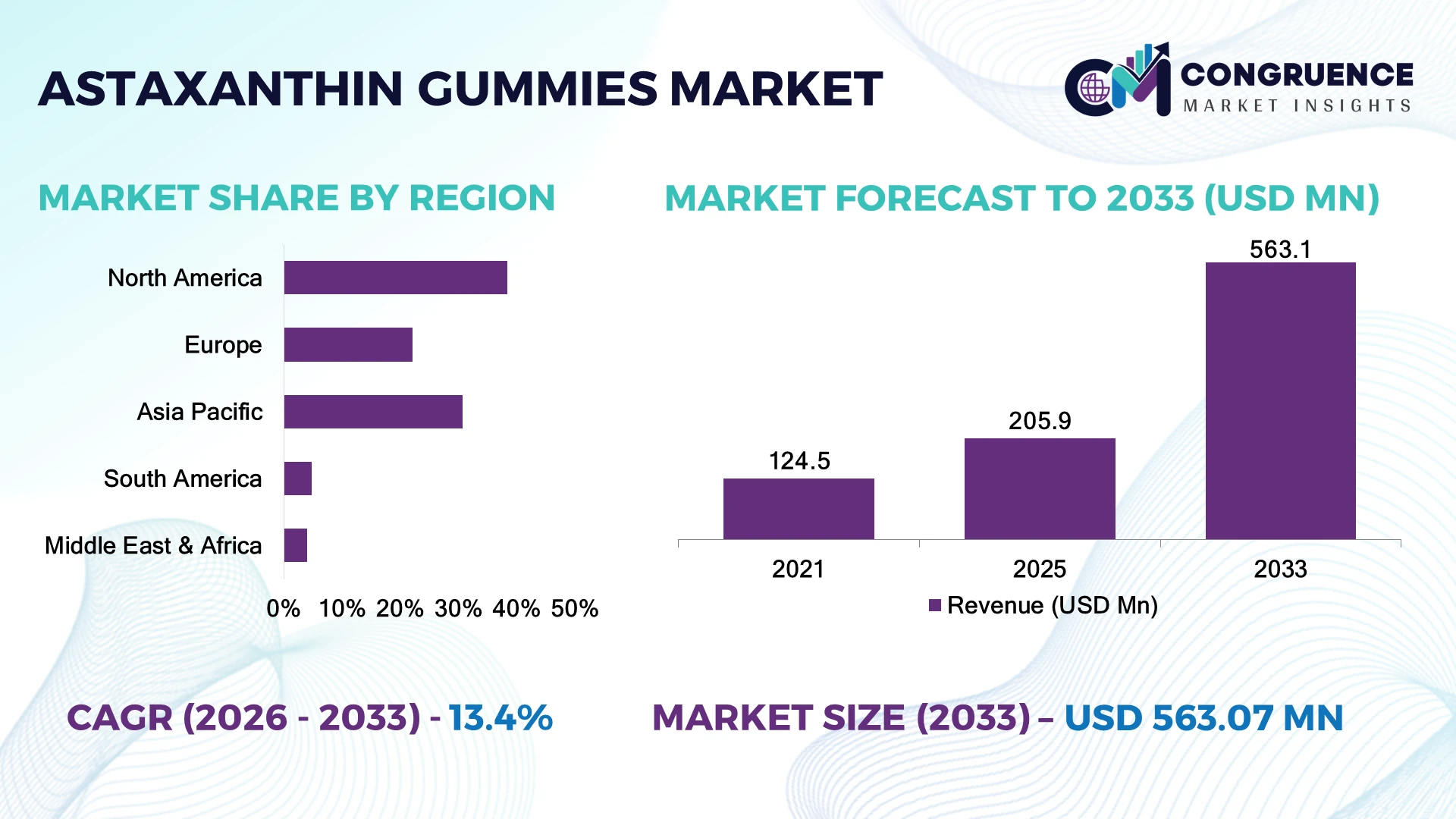
The United States leads the market with approximately 34% global demand, supported by advanced nutraceutical manufacturing, strong dietary supplement penetration, and expanding investments in algae-derived ingredients. More than 62% of premium antioxidant supplement launches now feature clean-label positioning, compared with nearly 28% in Japan, where marine-sourced astaxanthin production remains highly specialized. Following ongoing global supply-chain diversification after Red Sea shipping disruptions, manufacturers increasingly regionalized ingredient sourcing to improve inventory resilience and reduce procurement risks.
Companies prioritizing vertically integrated ingredient sourcing and premium formulation capabilities will secure stronger brand differentiation and long-term retail positioning.
Market Size & Growth: USD 205.9 million in 2025, projected to reach USD 563.1 million by 2033 at 13.4% CAGR, driven by premium nutraceutical innovation.
Top Growth Drivers: Clean-label demand (+41%), antioxidant supplementation (+37%), e-commerce nutrition sales (+34%).
Short-Term Forecast: By 2028, manufacturing efficiency improves 18% through automated gummy production and advanced encapsulation.
Emerging Technologies: Microencapsulation, algae fermentation optimization, and sugar-reduced formulations enhance stability by nearly 25%.
Regional Leaders: North America, Asia-Pacific, and Europe lead adoption with expanding preventive healthcare spending.
Consumer/End-User Trends: Nearly 57% of wellness consumers prefer gummies over conventional capsules for daily supplementation.
Pilot/Case Example: 2026 production optimization reduced ingredient waste by approximately 16% through precision dosing systems.
Competitive Landscape: Top manufacturers control nearly 44% market share through premium formulations and brand expansion.
Regulatory & ESG Impact: Sustainable algae cultivation reduces production emissions by approximately 20% while supporting cleaner ingredient sourcing.
Investment & Funding: More than USD 180 million supports algae cultivation, manufacturing expansion, and formulation innovation.
Innovation & Future Outlook: Personalized nutrition and multifunctional gummies are reshaping premium supplement portfolios.
Astaxanthin Gummies Market demand continues expanding across healthy aging, sports nutrition, skin health, and immune wellness applications. Advanced microencapsulation technology improves ingredient stability by approximately 22%, while sugar-free and plant-based formulations gain stronger retail acceptance. Manufacturers are increasingly localizing algae ingredient procurement to reduce supply volatility, positioning multifunctional nutraceutical gummies as the next phase of premium consumer health products before broader strategic market expansion.
Astaxanthin gummies have evolved from a niche dietary supplement into a strategically important functional nutrition category as consumers increasingly prioritize preventive healthcare and convenient daily wellness formats. Regulatory emphasis on ingredient traceability, clean-label manufacturing, and scientifically validated formulations is encouraging premium product development while reshaping procurement strategies across the nutraceutical value chain. Digital retail expansion and subscription-based wellness platforms continue strengthening direct consumer engagement.
Advanced microencapsulation technology delivers approximately 25% higher ingredient stability than conventional blending methods while improving taste consistency and shelf life. The United States maintains leadership through product innovation and retail penetration, whereas Japan strengthens competitive advantage through high-purity natural astaxanthin production and marine biotechnology expertise. Over the next two to three years, more than 40% of premium launches are expected to combine astaxanthin with collagen, vitamins, or adaptogenic ingredients to create multifunctional health solutions.
Manufacturers are expanding algae cultivation partnerships, investing in sustainable extraction technologies, and strengthening contract manufacturing capabilities to ensure stable raw material availability. Companies capable of integrating scientific validation, premium ingredient sourcing, and differentiated consumer formulations will establish stronger competitive positioning as preventive nutrition becomes a central pillar of global health and wellness spending.
Growing consumer preference for convenient functional nutrition is accelerating astaxanthin gummy adoption across preventive healthcare and beauty-from-within categories. Nearly 58% of premium dietary supplement launches now emphasize clean-label or naturally sourced ingredients, while gummy-format supplement sales account for over 34% of new nutraceutical introductions. In the United States, retailers are expanding shelf space for antioxidant formulations as personalized wellness gains momentum. This demand shift is driving higher investment in algae cultivation, precision formulation, and sugar-reduced manufacturing technologies. Companies are strengthening ingredient partnerships, expanding production capacity, and introducing clinically supported formulations to differentiate premium offerings. A notable strategic advantage lies in combining astaxanthin with collagen or vitamins, increasing consumer value without significantly raising production complexity.
Dependence on natural microalgae production continues to limit supply flexibility and create cost pressure across premium astaxanthin gummies. Natural astaxanthin production costs remain approximately 30%–40% higher than synthetic alternatives, while raw material procurement represents nearly 45% of finished product manufacturing costs. Japan remains a major supplier of high-purity astaxanthin, making manufacturers vulnerable to production fluctuations and international logistics disruptions. These constraints affect pricing consistency, inventory planning, and retail competitiveness. Companies are reducing exposure through multi-country sourcing strategies, localized contract manufacturing, and long-term algae cultivation agreements. Increasing investment in cultivation efficiency and alternative extraction technologies is also helping stabilize production economics while improving long-term supply resilience.
Personalized nutrition platforms are creating high-value opportunities for differentiated astaxanthin gummy formulations targeting skin health, active aging, eye health, and sports recovery. More than 46% of premium supplement consumers actively seek multifunctional products, while digital health platforms have increased personalized supplement recommendations by nearly 32%. South Korea is emerging as an innovation hub for beauty-focused nutraceutical formulations integrating antioxidants with collagen peptides and probiotics. Companies are investing in AI-assisted formulation design, advanced microencapsulation, and direct-to-consumer subscription models to improve product differentiation. A significant opportunity lies in combining biomarker-driven nutrition with customized gummy delivery systems, enabling premium pricing while strengthening long-term consumer engagement and brand loyalty.
Expanding globally requires stronger scientific validation and harmonized compliance across increasingly diverse regulatory frameworks. Nearly 38% of premium nutraceutical launches require additional stability or efficacy documentation before entering new international markets, while formulation reformulation rates approach 20% because ingredient standards differ across countries. Australia, the United States, and European markets apply varying requirements for health claims, creating additional commercialization complexity. These differences increase product development timelines, quality assurance costs, and packaging modifications. Companies must strengthen clinical research, digital traceability, regulatory intelligence, and manufacturing validation while investing in globally standardized quality systems. Sustained competitiveness will depend on demonstrating consistent efficacy alongside regulatory compliance rather than relying solely on premium branding.
Advanced Clean-Label Formulations Manufacturers are replacing artificial colors, gelatin, and refined sugars with plant-based alternatives, increasing clean-label product launches by nearly 42%. Ingredient transparency is becoming a purchasing criterion as regulatory scrutiny of supplement labeling strengthens. Companies are reformulating portfolios, expanding natural ingredient sourcing, and standardizing premium-quality manufacturing to improve retail acceptance and export readiness.
Multifunctional Wellness Combinations Combination gummies containing astaxanthin with collagen, vitamin C, probiotics, or hyaluronic acid now represent almost 36% of premium product introductions. Cross-functional formulations improve perceived consumer value while simplifying supplement routines. Brands are accelerating co-development partnerships with ingredient suppliers to launch differentiated products targeting beauty, immunity, and healthy aging through a single delivery format.
Microencapsulation Performance Gains Advanced encapsulation technologies improve astaxanthin stability by approximately 24% while extending product shelf life by nearly 18%. Enhanced bioavailability supports stronger product differentiation and consistent dosage performance during transportation. Manufacturers are modernizing production lines with automated precision dosing and moisture-controlled processing to maintain formulation quality across global distribution networks.
Digital Wellness Channel Expansion Online supplement sales account for more than 48% of premium gummy purchases, supported by personalized nutrition platforms and subscription-based fulfillment. First-party consumer data is increasingly guiding product innovation and inventory planning. Companies are integrating AI-driven recommendation engines, expanding localized fulfillment centers, and optimizing omnichannel operations to improve customer retention while reducing demand forecasting errors by approximately 15%.
Natural astaxanthin gummies account for approximately 71% of the global market due to superior consumer acceptance, stronger antioxidant positioning, and regulatory preference for naturally derived nutraceutical ingredients. Their dominance is reinforced by premium retail placement, clean-label compatibility, and growing demand for algae-based supplements across North America and Japan. Synthetic astaxanthin gummies continue serving price-sensitive segments but remain constrained by lower acceptance in premium dietary supplements. Manufacturers are expanding algae cultivation, investing in advanced extraction technologies, and strengthening vertically integrated supply chains to improve ingredient consistency and production scalability.
Natural astaxanthin is also the fastest-growing segment as preventive healthcare and beauty-from-within formulations gain wider consumer adoption. More than 62% of newly launched premium antioxidant gummies now incorporate naturally sourced astaxanthin, while production efficiency has improved by nearly 18% through optimized cultivation and extraction processes. Companies are prioritizing strategic partnerships with microalgae producers, premium branding, and clinical validation, shifting investment toward high-purity formulations that support stronger differentiation and long-term pricing power.
According to the Council for Responsible Nutrition's 2025 Consumer Survey, more than 75% of U.S. dietary supplement users prefer products containing naturally sourced ingredients, reinforcing premium demand for algae-derived astaxanthin formulations.
Skin health represents the largest application, accounting for approximately 39% of global demand, supported by growing consumer interest in beauty-from-within nutrition and antioxidant-based skincare support. Strong demand across Japan, South Korea, and the United States continues driving premium product innovation. Eye health remains an established category because of increasing digital screen exposure, while immune health and cardiovascular wellness maintain consistent consumer demand. Companies are expanding clinically supported formulations and combining astaxanthin with collagen, vitamins, and hyaluronic acid to improve product differentiation.
Healthy aging is the fastest-growing application as preventive wellness becomes a long-term consumer priority. Nearly 35% of newly introduced multifunctional nutraceutical gummies now target age-related wellness benefits, while combination formulations have increased by approximately 28% over the past two years. Manufacturers are expanding personalized nutrition portfolios, strengthening scientific substantiation, and optimizing ingredient delivery technologies to improve efficacy while broadening premium retail distribution.
A 2025 survey published by the International Alliance of Dietary/Food Supplement Associations (IADSA) found that healthy aging and beauty support ranked among the fastest-growing motivations for daily dietary supplement consumption across multiple developed markets.
Adults account for approximately 67% of total astaxanthin gummies consumption due to higher preventive healthcare spending, established supplement routines, and growing awareness of antioxidant benefits. The segment benefits from increasing adoption among working professionals seeking convenient wellness products supporting skin health, immunity, and active lifestyles. Seniors remain an important consumer base for healthy aging formulations, while sports enthusiasts continue expanding demand for recovery-focused supplements. Companies are introducing premium formulations, personalized nutrition programs, and targeted marketing strategies to strengthen consumer retention across adult demographics.
The seniors segment is expanding most rapidly as longevity-focused nutrition gains wider acceptance. Nearly 43% of new premium astaxanthin gummy launches now include formulations addressing age-related wellness, vision support, or joint health. Manufacturers are strengthening healthcare partnerships, investing in clinically validated ingredient combinations, and introducing easy-to-consume gummy formats specifically designed for older consumers, improving long-term customer loyalty while expanding premium product penetration.
The Council for Responsible Nutrition's 2025 consumer research indicates that adults aged 55 years and above represent one of the fastest-growing groups adopting daily nutritional supplements for healthy aging and preventive wellness.
North America accounted for the largest market share at 38.4% in 2025 however, Asia-Pacific is expected to register the fastest growth, expanding at a CAGR of 15.2% between 2026 and 2033.

Premium Nutraceutical Innovation Drives Regional Leadership
North America maintains market leadership through advanced nutraceutical manufacturing, mature dietary supplement distribution, and high consumer spending on preventive wellness. The region accounts for approximately 38.4% of global demand, supported by established regulatory frameworks and strong penetration of premium antioxidant formulations. More than 60% of new astaxanthin gummy launches incorporate clean-label positioning and multifunctional health claims, reflecting evolving consumer preferences. Manufacturers continue investing in automated gummy production, algae-derived ingredient sourcing, and omnichannel retail expansion. Strategic collaborations between ingredient suppliers and contract manufacturers are improving production flexibility while reducing formulation development timelines. The market continues benefiting from sophisticated retail infrastructure, widespread digital health adoption, and premium product differentiation.
United States Market Outlook: The United States dominates regional consumption through a well-developed dietary supplement industry, strong clinical research capabilities, and advanced contract manufacturing infrastructure. Nearly 65% of premium antioxidant gummies launched in North America are introduced first in the U.S., supported by expanding e-commerce platforms, personalized nutrition services, and increasing consumer adoption of daily wellness supplements. Investments in algae-based ingredient production and premium formulation technologies continue strengthening long-term market competitiveness.
Clean-Label Regulations Strengthen Premium Positioning
Europe continues expanding through stringent quality standards, clean-label product development, and growing consumer awareness of preventive nutrition. Demand is particularly strong across Germany, the United Kingdom, and Nordic countries, where naturally sourced nutraceutical ingredients receive premium positioning. Nearly 55% of newly introduced antioxidant gummies emphasize plant-based or naturally derived formulations. Companies are strengthening regional manufacturing partnerships and investing in sustainable packaging solutions while expanding specialty retail and pharmacy distribution. Regulatory consistency continues encouraging premium-quality formulations with clinically supported ingredient profiles.
Germany Market Outlook: Germany serves as the region's primary innovation hub through its established nutraceutical manufacturing base, advanced food science expertise, and strong consumer confidence in evidence-based dietary supplements. Premium wellness products continue gaining shelf space across pharmacies and health retailers, while investments in sustainable manufacturing and high-purity ingredient sourcing improve product quality and strengthen export competitiveness across European markets.
Manufacturing Scale Accelerates Market Expansion
Asia-Pacific represents the fastest-growing regional market, supported by expanding nutraceutical manufacturing, rising middle-class healthcare spending, and strong marine biotechnology capabilities. Japan and China lead regional production, while South Korea drives innovation in beauty-focused nutritional supplements. More than 48% of regional algae-derived astaxanthin production supports dietary supplement applications. Companies continue expanding production facilities, improving cultivation technologies, and increasing exports of premium antioxidant ingredients to North America and Europe. Digital commerce platforms further accelerate consumer access to premium nutraceutical products.
Japan Market Outlook: Japan remains the technological leader in natural astaxanthin production through advanced microalgae cultivation, high-purity extraction technologies, and decades of commercial expertise. Domestic manufacturers continue investing in premium nutraceutical innovation and clinical research, while efficient production systems support consistent ingredient quality. Japan's strong export capabilities and advanced biotechnology infrastructure reinforce its strategic importance within the global astaxanthin gummies value chain.
Preventive Wellness Expands Consumer Demand
South America is witnessing gradual market expansion as preventive healthcare awareness, organized retail growth, and online supplement availability improve consumer access. Brazil accounts for the largest share of regional demand, supported by expanding health-conscious urban populations and increasing investments in dietary supplements. Premium antioxidant products are gaining stronger acceptance among younger consumers seeking convenient wellness solutions. Manufacturers are strengthening distributor partnerships, expanding localized packaging operations, and improving supply chain efficiency while balancing affordability with premium product positioning.
Brazil Market Outlook: Brazil leads regional development through its expanding nutraceutical sector, growing e-commerce penetration, and increasing consumer expenditure on functional nutrition. Domestic supplement manufacturers continue broadening premium gummy portfolios while improving local manufacturing capabilities. Strategic investments in distribution infrastructure and retail partnerships are enhancing nationwide product availability and strengthening long-term market penetration.
Health Retail Modernization Supports Growth
The Middle East & Africa market is expanding through healthcare modernization, premium pharmacy expansion, and rising demand for preventive nutrition among urban consumers. Gulf countries are strengthening wellness retail infrastructure, while digital commerce improves accessibility to imported premium supplements. Demand continues increasing for clean-label, sugar-free, and naturally sourced formulations. International brands are expanding regional partnerships, improving localized distribution networks, and investing in regulatory compliance to strengthen long-term market presence.
United Arab Emirates Market Outlook: The United Arab Emirates has emerged as the region's primary premium nutraceutical hub through advanced retail infrastructure, high consumer purchasing power, and efficient import logistics. International wellness brands continue introducing premium antioxidant gummies through pharmacy chains and digital health platforms. Continued investment in healthcare retail modernization and specialized nutrition products is strengthening the country's position as a regional gateway for high-value dietary supplements.
Premium nutraceutical brands including Nutrex Hawaii, AstaReal, NOW Foods, Nordic Naturals, and Doctor's Best compete directly with private-label supplement manufacturers, while algae ingredient specialists compete with finished-product formulators for value-chain influence. The top five participants collectively account for approximately 43% of the market, leveraging proprietary natural astaxanthin sourcing and premium branding. Competition centers on ingredient purity, bioavailability, clean-label positioning, and supply security rather than price alone. Clinically validated formulations command nearly 22% higher retail pricing, while vertically integrated algae cultivation reduces raw material procurement volatility by approximately 18%. Companies are expanding contract manufacturing partnerships, investing in proprietary extraction technologies, and integrating algae cultivation with finished-product development to strengthen supply resilience. The competitive landscape is shifting toward science-backed multifunctional gummies and transparent ingredient traceability. High regulatory compliance requirements, clinical substantiation, and reliable natural astaxanthin sourcing remain major entry barriers. Winning depends on controlling premium ingredient quality, validated health positioning, and resilient global supply networks.
Nutrex Hawaii
AstaReal AB
Fuji Chemical Industries Co., Ltd.
NOW Foods
Nordic Naturals
Doctor's Best
California Gold Nutrition
Sports Research
Solgar
Nature's Bounty
GNC Holdings
Swanson Health Products
Life Extension
Healthy Origins
Astaxanthin gummies are increasingly manufactured using advanced microencapsulation, controlled-release matrices, and precision pectin-based gummy technologies that preserve antioxidant stability while improving sensory performance. Nearly 54% of premium product launches now utilize encapsulated natural astaxanthin to reduce oxidation, while optimized low-temperature processing improves ingredient retention by approximately 20%. Automated dosing systems and digital quality monitoring further enhance batch consistency, supporting premium positioning across global nutraceutical markets.
Emerging technologies are focused on algae cultivation optimization, fermentation-assisted biomass production, and AI-supported formulation development. Modern encapsulation systems deliver approximately 28% greater ingredient stability than conventional blending while extending shelf life and maintaining color integrity. More than 46% of leading manufacturers have integrated digital production analytics into formulation workflows to improve manufacturing precision and reduce material waste. Vertically integrated producers with proprietary algae cultivation capabilities gain the strongest competitive advantage through greater supply control and consistent ingredient quality.
Between 2026 and 2028, personalized nutrition platforms, smart formulation software, and sustainable algae bioprocessing are expected to redefine premium supplement development. Bioavailability-enhancing delivery systems and sugar-free functional gummies will continue expanding across wellness, beauty, and active lifestyle categories. Companies investing early in scalable algae biotechnology, intelligent manufacturing automation, and clinically differentiated formulations will secure stronger retail positioning, higher consumer confidence, and long-term competitive advantage.
March 2025: AstaReal announced publication of the world's first clinical study demonstrating natural astaxanthin's benefits for children's eye health, expanding evidence supporting future pediatric nutraceutical formulations. Source: astareal.com (PR Newswire)
September 2025: AstaReal–Fuji Chemical received the NutraIngredients-Asia Editor's Award for its pediatric astaxanthin research initiative, strengthening scientific differentiation and reinforcing premium positioning within the global nutraceutical ingredient market. Source: astareal.com (Astareal)
December 2025: AstaReal announced EFSA approval permitting its natural astaxanthin for selected food and beverage applications, expanding commercialization opportunities beyond supplements and supporting future functional gummy innovation across Europe. Source: cision.com (Cision News)
May 2026: Fuji Chemical Industries showcased AstaReal natural astaxanthin at Vitafoods India 2026, expanding engagement with formulation partners and contract manufacturers targeting the rapidly growing nutraceutical ingredients market. Source: astareal.com (Astareal)
The report delivers comprehensive analysis of the astaxanthin gummies market across product types, applications, end-users, distribution trends, and major regional markets between 2026 and 2033. It evaluates natural and synthetic ingredient categories, consumer health applications, manufacturing technologies, and evolving purchasing behavior across North America, Europe, Asia-Pacific, South America, and the Middle East & Africa. The assessment covers market participation across premium brands, contract manufacturers, ingredient suppliers, and private-label producers while examining deployment trends, formulation preferences, and retail channel evolution.
The study further analyzes technological innovation, algae cultivation advancements, encapsulation technologies, regulatory developments, and competitive positioning shaping future industry dynamics. Strategic insights support investment prioritization, product portfolio development, geographic expansion, sourcing optimization, and partnership decisions. Coverage also extends to emerging personalized nutrition platforms, sustainable ingredient production, premium clean-label formulations, and multifunctional wellness gummies, enabling stakeholders to identify high-potential opportunities and strengthen long-term competitive positioning in the evolving nutraceutical marketplace.
| Report Attribute/Metric | Report Details |
|---|---|
|
Market Revenue in 2025 |
USD 205.9 Million |
|
Market Revenue in 2033 |
USD 563.1 Million |
|
CAGR (2026 - 2033) |
13.4% |
|
Base Year |
2025 |
|
Forecast Period |
2026 - 2033 |
|
Historic Period |
2021 - 2025 |
|
Segments Covered |
By Type
By Application
By End-User
|
|
Key Report Deliverable |
Revenue Forecast, Growth Trends, Market Dynamics, Segmental Overview, Regional and Country-wise Analysis, Competition Landscape |
|
Region Covered |
North America, Europe, Asia-Pacific, South America, Middle East, Africa |
|
Key Players Analyzed |
Nutrex Hawaii, AstaReal AB, Fuji Chemical Industries Co., Ltd., NOW Foods, Nordic Naturals, Doctor's Best, California Gold Nutrition, Sports Research, Solgar, Nature's Bounty, GNC Holdings, Swanson Health Products, Life Extension, Healthy Origins |
|
Customization & Pricing |
Available on Request (10% Customization is Free) |




