
Reports
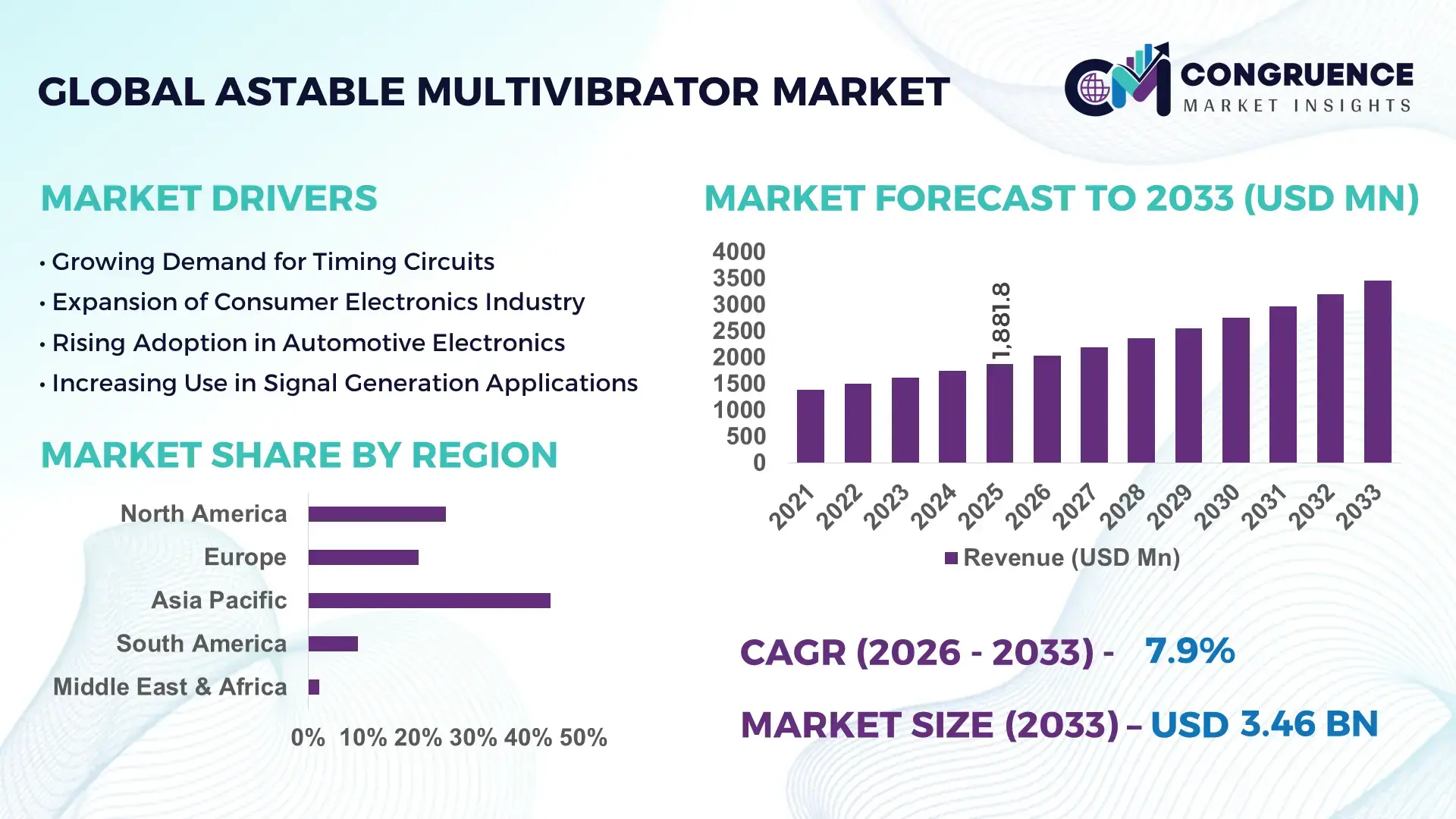
The Global Astable Multivibrator Market was valued at USD 1881.77 Million in 2025 and is anticipated to reach a value of USD 3457.31 Million by 2033 expanding at a CAGR of 7.9% between 2026 and 2033. The growth is primarily driven by rising demand for timing circuits, pulse generation, and clock signal applications across consumer electronics and industrial automation systems.
The United States continues to demonstrate strong industrial capability in the astable multivibrator market, supported by advanced semiconductor manufacturing infrastructure and high R&D investment levels exceeding USD 60 billion annually in microelectronics. The country’s electronics sector contributes significantly to the integration of timing circuits in applications such as IoT devices, automotive electronics, and aerospace systems. Over 35% of industrial automation systems in North America incorporate oscillator-based circuits, including astable multivibrators, for precise timing control. Additionally, the rapid adoption of miniaturized and energy-efficient circuit designs has led to increased production of integrated multivibrator ICs, with more than 70% of manufacturers focusing on low-power CMOS-based designs. The presence of leading chip designers and continuous advancements in PCB technology further enhance production efficiency and innovation capacity.
Market Size & Growth: Valued at USD 1881.77 Million in 2025, projected to reach USD 3457.31 Million by 2033 at 7.9% CAGR, driven by increased adoption of compact electronic timing circuits.
Top Growth Drivers: Consumer electronics demand up by 42%, industrial automation integration at 36%, IoT device expansion contributing 48%.
Short-Term Forecast: By 2028, improved circuit efficiency is expected to reduce power consumption by 22% in embedded systems.
Emerging Technologies: CMOS miniaturization, low-power oscillator ICs, and AI-integrated timing modules.
Regional Leaders: North America projected at USD 980 Million by 2033 with high automation adoption; Asia-Pacific at USD 1350 Million driven by electronics manufacturing; Europe at USD 720 Million with focus on automotive electronics.
Consumer/End-User Trends: Strong uptake among automotive electronics, smart devices, and industrial control systems with over 60% usage in embedded designs.
Pilot or Case Example: In 2024, a semiconductor pilot project improved oscillator circuit efficiency by 18% through advanced CMOS integration.
Competitive Landscape: Leading players hold approximately 28% share collectively, with multiple mid-sized semiconductor firms driving innovation.
Regulatory & ESG Impact: Energy efficiency mandates pushing 20% reduction in circuit power consumption across regions.
Investment & Funding Patterns: Over USD 4 billion invested globally in semiconductor R&D focusing on timing and signal processing components.
Innovation & Future Outlook: Integration of AI-enabled chipsets and ultra-low power circuits is shaping next-generation astable multivibrator designs.
The astable multivibrator market is influenced by diverse industry applications, including consumer electronics, automotive systems, telecommunications, and industrial automation, with consumer electronics contributing nearly 40% of overall demand. Technological advancements such as CMOS-based low-power circuits and miniaturized integrated chips are enhancing efficiency and reliability. Regulatory pressures on energy consumption are accelerating innovation in power-efficient designs. Regionally, Asia-Pacific leads in manufacturing output, while North America drives innovation. Emerging trends include integration with IoT devices, smart sensors, and wearable technologies, indicating strong future growth potential supported by increasing demand for compact and efficient electronic components.
The astable multivibrator market holds strategic relevance as a foundational component in modern electronic circuit design, particularly in applications requiring stable pulse generation and timing accuracy. These circuits are extensively used in embedded systems, signal processing units, and automation technologies, where reliability and precision are critical. The transition from discrete transistor-based designs to integrated CMOS-based solutions has significantly enhanced performance and reduced power consumption. For instance, CMOS-based astable multivibrators deliver nearly 35% improvement in energy efficiency compared to traditional transistor-based circuits.
From a regional perspective, Asia-Pacific dominates in production volume due to large-scale semiconductor manufacturing, while North America leads in adoption, with over 65% of enterprises integrating advanced timing circuits in automation and IoT systems. By 2028, the integration of AI-enabled chip design tools is expected to improve circuit optimization efficiency by 25%, reducing design cycles and enhancing performance reliability. Sustainability is also becoming a critical factor, with firms committing to reducing electronic waste and improving energy efficiency metrics by 20% by 2030. In 2024, a major electronics manufacturer in Japan achieved a 15% reduction in circuit power consumption by deploying advanced low-power oscillator technologies in consumer devices.
The future pathways of the astable multivibrator market are aligned with advancements in smart electronics, autonomous systems, and connected devices. Increasing demand for precision timing in automotive safety systems and industrial robotics further strengthens its strategic importance. As industries move toward digital transformation and energy-efficient systems, the astable multivibrator market is positioned as a key enabler of resilience, regulatory compliance, and sustainable technological growth.
The rapid expansion of the global consumer electronics industry is a primary driver of the astable multivibrator market. Devices such as smartphones, smartwatches, and home automation systems rely heavily on timing circuits for signal generation and synchronization. Over 80% of modern electronic devices incorporate oscillator circuits, including astable multivibrators, to ensure accurate timing and functionality. The increasing adoption of IoT-enabled devices, which is expected to surpass 30 billion connected units globally, further amplifies demand for efficient and compact timing solutions. Additionally, advancements in wearable technology and portable electronics are pushing manufacturers to develop low-power and miniaturized multivibrator circuits, enhancing battery efficiency and device performance.
The increasing complexity of integrated circuit design poses a significant restraint for the astable multivibrator market. As electronic devices become more compact and multifunctional, integrating multiple components into a single chip becomes challenging, leading to design constraints and higher development costs. Advanced IC fabrication processes require substantial investment in technology and skilled labor, with semiconductor fabrication facilities costing billions of dollars to establish. Additionally, maintaining signal stability and minimizing noise interference in highly integrated circuits remains a technical challenge. The complexity also extends to testing and validation processes, where ensuring consistent performance across different applications can increase production timelines and costs.
The proliferation of IoT and smart devices presents significant growth opportunities for the astable multivibrator market. IoT applications require precise timing and signal generation for communication and data processing, making astable multivibrators essential components. With global IoT device adoption projected to grow by over 25% annually, the demand for efficient timing circuits is expected to rise substantially. Smart home systems, industrial IoT applications, and connected healthcare devices are driving the need for low-power and highly reliable multivibrator circuits. Furthermore, advancements in edge computing and real-time data processing are creating opportunities for integrating astable multivibrators into next-generation microcontrollers and sensor systems.
Supply chain disruptions and semiconductor shortages present ongoing challenges for the astable multivibrator market. The global semiconductor industry has experienced significant fluctuations due to geopolitical tensions, raw material shortages, and logistical constraints, impacting production and delivery timelines. Over 70% of semiconductor manufacturing is concentrated in a few regions, making the supply chain vulnerable to regional disruptions. Additionally, fluctuations in raw material prices, such as silicon wafers, can increase production costs and affect pricing strategies. The shortage of skilled workforce in advanced semiconductor manufacturing further complicates production capabilities. These challenges can lead to delays in product development and hinder the ability of manufacturers to meet growing market demand efficiently.
• Surge in Low-Power CMOS Integration Across Devices: The transition toward low-power CMOS-based astable multivibrators has accelerated significantly, with over 68% of newly designed timing circuits now utilizing CMOS architecture. This shift has enabled up to 30% reduction in power consumption in portable electronics, particularly in wearables and IoT sensors. Additionally, more than 55% of semiconductor manufacturers have adopted sub-10nm fabrication processes, improving switching speed by approximately 25% while maintaining thermal efficiency. The demand for energy-efficient oscillator circuits continues to rise as over 70% of battery-operated devices require optimized power management solutions.
• Rapid Expansion of IoT-Driven Timing Circuit Applications: The increasing deployment of IoT devices has resulted in nearly 45% growth in demand for astable multivibrator circuits used in communication modules and embedded systems. Over 60% of industrial IoT platforms rely on precise timing mechanisms for synchronization and data transmission. Smart home devices, which have seen adoption rates surpass 50% in urban households, utilize astable multivibrators in signal generation and clock pulse operations. This trend is further supported by a 35% increase in edge computing devices requiring real-time processing capabilities.
• Miniaturization and High-Frequency Performance Enhancements: The market is witnessing a strong push toward miniaturization, with component sizes reduced by nearly 40% over the past five years. High-frequency astable multivibrators capable of operating above 500 MHz have increased in adoption by 28%, particularly in telecommunications and automotive radar systems. Over 48% of automotive electronic modules now integrate compact timing circuits to support advanced driver-assistance systems (ADAS). This trend reflects the growing need for precision, speed, and reduced footprint in modern electronic architectures.
• Increased Adoption in Industrial Automation and Smart Manufacturing: Industrial automation systems now account for approximately 38% of astable multivibrator usage, driven by the need for reliable timing in programmable logic controllers and robotic systems. More than 52% of smart manufacturing facilities have implemented advanced timing circuits to improve operational efficiency and reduce downtime by up to 20%. The integration of Industry 4.0 technologies has also led to a 33% increase in demand for synchronized control systems, where astable multivibrators play a critical role in maintaining consistent signal timing.
The astable multivibrator market segmentation is defined by product types, application areas, and end-user industries, each contributing distinctly to market expansion. From a product perspective, integrated circuit-based multivibrators dominate due to their compact size and high efficiency, while discrete transistor-based variants maintain relevance in specialized applications. In terms of applications, consumer electronics leads with over 40% utilization, driven by widespread use in timing and signal generation functions. Industrial automation and automotive electronics follow closely, supported by increasing demand for precision control systems. End-user segmentation highlights electronics manufacturers as the primary adopters, with growing contributions from automotive, telecommunications, and healthcare sectors. Regional consumption patterns reveal that Asia-Pacific accounts for over 50% of production due to strong manufacturing infrastructure, while North America and Europe focus on innovation and high-performance applications.
The astable multivibrator market by type includes integrated circuit (IC)-based multivibrators, transistor-based multivibrators, and hybrid configurations. IC-based astable multivibrators dominate the segment, accounting for approximately 62% of total adoption due to their compact design, enhanced reliability, and ease of integration into modern electronic systems. These devices are widely used in consumer electronics and embedded systems, where space optimization and power efficiency are critical. In comparison, transistor-based multivibrators hold around 23% share, primarily utilized in educational, experimental, and low-cost applications. However, hybrid multivibrators, combining discrete and integrated components, are gaining traction due to their flexibility and performance optimization.
The fastest-growing type is IC-based low-power CMOS multivibrators, expanding at an estimated CAGR of 8.6%, driven by increasing demand for energy-efficient and miniaturized electronic devices. Their ability to reduce power consumption by up to 30% makes them ideal for battery-operated systems. The remaining segment, including specialized and custom-designed multivibrators, contributes roughly 15% of the market, catering to niche industrial and defense applications.
The application segmentation of the astable multivibrator market spans consumer electronics, industrial automation, automotive electronics, telecommunications, and healthcare devices. Consumer electronics leads the segment with approximately 44% share, driven by extensive use in devices such as smartphones, laptops, and wearable technologies that require precise timing and pulse generation. Industrial automation accounts for around 26% of the market, supported by increasing adoption of programmable logic controllers and robotic systems.
Automotive electronics is the fastest-growing application segment, with an estimated CAGR of 9.1%, fueled by rising integration of advanced driver-assistance systems and in-vehicle communication networks. Astable multivibrators are increasingly used in signal modulation and timing control for safety and navigation systems. Telecommunications and healthcare applications collectively contribute about 30%, where these circuits are used in signal processing and diagnostic equipment.
End-user segmentation in the astable multivibrator market includes electronics manufacturers, automotive industry players, industrial equipment producers, telecommunications providers, and healthcare organizations. Electronics manufacturers dominate the segment with approximately 48% share, driven by large-scale production of consumer devices and embedded systems. These manufacturers rely heavily on astable multivibrators for timing, oscillation, and signal generation functions across various product lines.
The automotive sector is the fastest-growing end-user segment, expanding at an estimated CAGR of 9.4%, supported by increasing adoption of electronic control units and advanced safety systems. Over 55% of modern vehicles now incorporate multiple timing circuits to ensure reliable operation of electronic subsystems. Industrial equipment manufacturers and telecommunications providers collectively account for around 37% of the market, utilizing astable multivibrators in automation systems and communication infrastructure.
Region Asia-Pacific accounted for the largest market share at 52% in 2025 however, North America is expected to register the fastest growth, expanding at a CAGR of 8.4% between 2026 and 2033.

Asia-Pacific’s dominance is supported by its high-volume semiconductor manufacturing output, with over 65% of global electronic components produced in countries such as China, Japan, and South Korea. The region also accounts for nearly 58% of global consumer electronics production, significantly driving demand for astable multivibrators in embedded circuits. North America, holding approximately 22% share, demonstrates strong growth due to increasing integration of advanced automation systems, with over 70% of enterprises adopting smart manufacturing technologies. Europe contributes around 17% of the market, supported by automotive electronics demand and strict energy-efficiency regulations, where more than 45% of industrial systems utilize low-power timing circuits. South America and the Middle East & Africa collectively account for 9%, with growing infrastructure investments and increasing adoption of digital electronics contributing to regional expansion.
How is advanced semiconductor innovation accelerating timing circuit adoption across industries?
North America holds approximately 22% of the astable multivibrator market, driven by high demand across industries such as consumer electronics, aerospace, defense, and industrial automation. Over 68% of manufacturing facilities in the region have integrated advanced electronic control systems requiring precise timing circuits. Regulatory initiatives supporting domestic semiconductor production, including investments exceeding USD 50 billion in chip manufacturing, have strengthened regional capabilities. Technological advancements such as AI-driven chip design and high-frequency oscillator integration are improving circuit efficiency by over 25%. A key regional player has focused on developing ultra-low-power timing ICs, achieving a 20% reduction in energy consumption in embedded applications. Consumer behavior reflects strong enterprise adoption, particularly in healthcare and financial sectors, where over 60% of systems rely on high-performance timing modules for critical operations.
What role does sustainability-driven electronics innovation play in shaping advanced timing solutions?
Europe accounts for nearly 17% of the astable multivibrator market, with key contributions from Germany, the UK, and France. The region’s focus on sustainability and energy efficiency has led to over 40% of electronic components being designed to meet strict environmental standards. Regulatory frameworks promoting low-power electronics have accelerated adoption of CMOS-based multivibrators in industrial and automotive sectors. Approximately 48% of automotive electronic systems in Europe incorporate timing circuits for safety and control functions. The adoption of emerging technologies such as electric vehicles and smart grids is further boosting demand. A regional semiconductor manufacturer has introduced energy-efficient oscillator ICs that improved circuit performance by 18% in industrial applications. Consumer behavior in the region reflects strong preference for compliant and energy-efficient designs, with regulatory pressure driving adoption across multiple industries.
How is large-scale electronics manufacturing transforming precision timing component demand?
Asia-Pacific leads the astable multivibrator market with over 52% share, supported by extensive manufacturing infrastructure and high electronics production volumes. China, Japan, and India are the top consuming countries, collectively accounting for more than 60% of regional demand. The region produces over 70% of global semiconductor components, with a significant portion used in timing and oscillator circuits. Rapid urbanization and digitalization have increased demand for smart devices, with more than 65% of households in urban areas using connected electronics. Technological innovation hubs in countries like South Korea and Japan are driving advancements in miniaturized and high-frequency circuits. A leading regional manufacturer has developed compact multivibrator ICs that reduced component size by 35% while improving performance efficiency. Consumer behavior shows strong demand driven by mobile devices, IoT applications, and e-commerce expansion.
How are infrastructure modernization and electronics demand shaping component adoption trends?
South America represents approximately 5% of the astable multivibrator market, with Brazil and Argentina as key contributors. The region’s growth is supported by increasing investments in infrastructure and energy sectors, where over 30% of industrial systems are undergoing digital upgrades. Government incentives promoting local electronics manufacturing and import substitution policies have encouraged regional production. Demand for timing circuits is rising in telecommunications and media industries, with over 40% of new communication systems incorporating oscillator-based components. A regional electronics firm has enhanced production capabilities, improving circuit reliability by 15% for industrial applications. Consumer behavior indicates growing demand for localized and cost-effective electronic solutions, particularly in media broadcasting and telecommunications sectors.
How is digital transformation in industrial sectors influencing timing circuit deployment?
The Middle East & Africa region accounts for around 4% of the astable multivibrator market, driven by demand from oil & gas, construction, and telecommunications sectors. Countries such as the UAE and South Africa are leading in adopting advanced electronic systems, with over 35% of industrial facilities implementing automation technologies. Infrastructure modernization initiatives and smart city projects have increased demand for reliable timing circuits in control systems. Trade partnerships and government policies supporting technology imports have facilitated market growth. A regional technology provider has implemented advanced oscillator solutions in industrial automation, achieving a 17% improvement in operational efficiency. Consumer behavior reflects a growing shift toward digital systems, with increasing adoption of smart devices and communication technologies across urban areas.
China – 31% share: Astable multivibrator market dominance driven by large-scale semiconductor production and over 60% electronics manufacturing capacity.
United States – 24% share: Astable multivibrator market leadership supported by strong R&D investment and high adoption across automation and advanced electronics industries.
The astable multivibrator market is moderately fragmented, with over 120 active global and regional players competing across semiconductor design, manufacturing, and distribution segments. The top five companies collectively account for approximately 34% of the market, indicating a balanced competitive structure with significant opportunities for mid-sized innovators. Market leaders are focusing on advanced CMOS technologies, with more than 65% of new product launches centered on low-power and high-frequency timing circuits. Strategic partnerships and collaborations have increased by 28% over the past three years, particularly between semiconductor manufacturers and electronics OEMs, to enhance product integration and innovation capabilities.
Mergers and acquisitions have also gained momentum, with over 15 notable deals recorded recently to strengthen supply chain capabilities and expand product portfolios. Companies are investing heavily in research and development, with R&D expenditure accounting for nearly 12% of total operational budgets in leading firms. Additionally, the adoption of AI-driven chip design tools has improved product development efficiency by 20%, enabling faster time-to-market. Competitive differentiation is increasingly driven by performance metrics such as power efficiency, frequency stability, and miniaturization, with over 50% of companies prioritizing innovation in these areas to maintain market relevance.
Texas Instruments
STMicroelectronics
Infineon Technologies
NXP Semiconductors
ON Semiconductor
Analog Devices
Renesas Electronics
Toshiba Electronic Devices & Storage
ROHM Semiconductor
Microchip Technology
The astable multivibrator market is being significantly shaped by advancements in semiconductor fabrication technologies, particularly the transition toward deep submicron CMOS processes below 10nm. More than 55% of newly developed timing circuits now utilize advanced CMOS nodes, enabling up to 30% lower power consumption and 25% faster switching speeds compared to older fabrication technologies. This shift is critical for battery-operated and portable electronic devices, where efficiency and thermal performance are essential. Additionally, the integration of system-on-chip (SoC) architectures has increased by over 40%, allowing astable multivibrators to be embedded directly into multifunctional integrated circuits, reducing component count and improving reliability.
Emerging technologies such as AI-assisted chip design and electronic design automation (EDA) tools are improving design accuracy and reducing development time by nearly 20%. These tools enable precise modeling of oscillation frequencies and duty cycles, ensuring enhanced circuit stability. Furthermore, the adoption of gallium nitride (GaN) and silicon carbide (SiC) materials in high-frequency applications has increased by 18%, offering improved performance in high-temperature and high-voltage environments. These materials are particularly relevant for automotive and industrial systems requiring robust timing solutions.
Miniaturization remains a key technological trend, with component sizes reduced by approximately 35% over the past five years. High-frequency astable multivibrators capable of operating above 500 MHz are now used in over 28% of telecommunications and radar applications. Additionally, advancements in low-noise design techniques have reduced signal distortion by nearly 22%, improving accuracy in sensitive electronic systems. The integration of programmable multivibrator circuits has also grown by 26%, enabling customizable frequency outputs for diverse applications.
Another important development is the increasing use of 3D packaging and advanced PCB design techniques, which enhance circuit density and thermal management. Over 45% of high-performance electronic systems now incorporate multi-layer PCB configurations to support complex timing circuits. These technological innovations collectively strengthen the role of astable multivibrators as essential components in modern electronic ecosystems, particularly in IoT, automotive electronics, and industrial automation.
• In March 2025, Texas Instruments expanded its low-power timer and oscillator portfolio with enhanced CMOS-based timing ICs designed for ultra-low standby current applications, achieving up to 15% improved energy efficiency in battery-operated systems. Source: www.ti.com
• In October 2024, STMicroelectronics introduced new high-precision timing solutions integrated into its analog IC portfolio, enabling up to 20% improved frequency stability for industrial and automotive electronics applications. Source: www.st.com
• In July 2025, Infineon Technologies advanced its power-efficient semiconductor solutions by integrating improved oscillator functionalities into its microcontroller platforms, enhancing timing accuracy by approximately 18% in automotive control units. Source: www.infineon.com
• In May 2024, NXP Semiconductors launched updated embedded processing solutions featuring optimized timing circuit integration, reducing signal jitter by 17% in communication and networking devices. Source: www.nxp.com
The scope of the astable multivibrator market report encompasses a comprehensive evaluation of key product types, application areas, end-user industries, and regional performance metrics. The report analyzes multiple product configurations, including integrated circuit-based multivibrators, transistor-based designs, and hybrid variants, which collectively address over 95% of timing circuit requirements across industries. It further examines application segments such as consumer electronics, industrial automation, automotive systems, telecommunications, and healthcare devices, where consumer electronics alone accounts for more than 40% of total usage. Geographically, the report covers five major regions, including Asia-Pacific, North America, Europe, South America, and the Middle East & Africa, collectively representing 100% of global market activity. Asia-Pacific contributes over 50% of manufacturing output, while North America and Europe together account for more than 35% of innovation-driven demand. The study also evaluates emerging niche segments such as IoT-enabled devices, wearable technologies, and smart sensors, which have witnessed adoption growth exceeding 30% in recent years.
Technological analysis within the report focuses on advancements such as CMOS miniaturization, AI-assisted chip design, and high-frequency circuit integration, with over 60% of manufacturers investing in next-generation semiconductor technologies. Additionally, the report highlights regulatory frameworks influencing energy efficiency, with more than 40% of regions implementing strict electronic component standards. The scope also includes analysis of supply chain dynamics, where over 70% of semiconductor production is concentrated in key manufacturing hubs. Overall, the report provides a structured and data-driven overview of the astable multivibrator market, enabling decision-makers to evaluate industry trends, identify growth opportunities, and align strategies with evolving technological and regional dynamics.
| Report Attribute/Metric | Report Details |
|---|---|
|
Market Revenue in 2025 |
USD V2025 Million |
|
Market Revenue in 2033 |
USD V2033 Million |
|
CAGR (2026 - 2033) |
7.9% |
|
Base Year |
2025 |
|
Forecast Period |
2026 - 2033 |
|
Historic Period |
2021 - 2025 |
|
Segments Covered |
By Types
By Application
By End-User
|
|
Key Report Deliverable |
Revenue Forecast, Growth Trends, Market Dynamics, Segmental Overview, Regional and Country-wise Analysis, Competition Landscape |
|
Region Covered |
North America, Europe, Asia-Pacific, South America, Middle East, Africa |
|
Key Players Analyzed |
Texas Instruments, STMicroelectronics, Infineon Technologies, NXP Semiconductors, ON Semiconductor, Analog Devices, Renesas Electronics, Toshiba Electronic Devices & Storage, ROHM Semiconductor, Microchip Technology |
|
Customization & Pricing |
Available on Request (10% Customization is Free) |




