
Reports
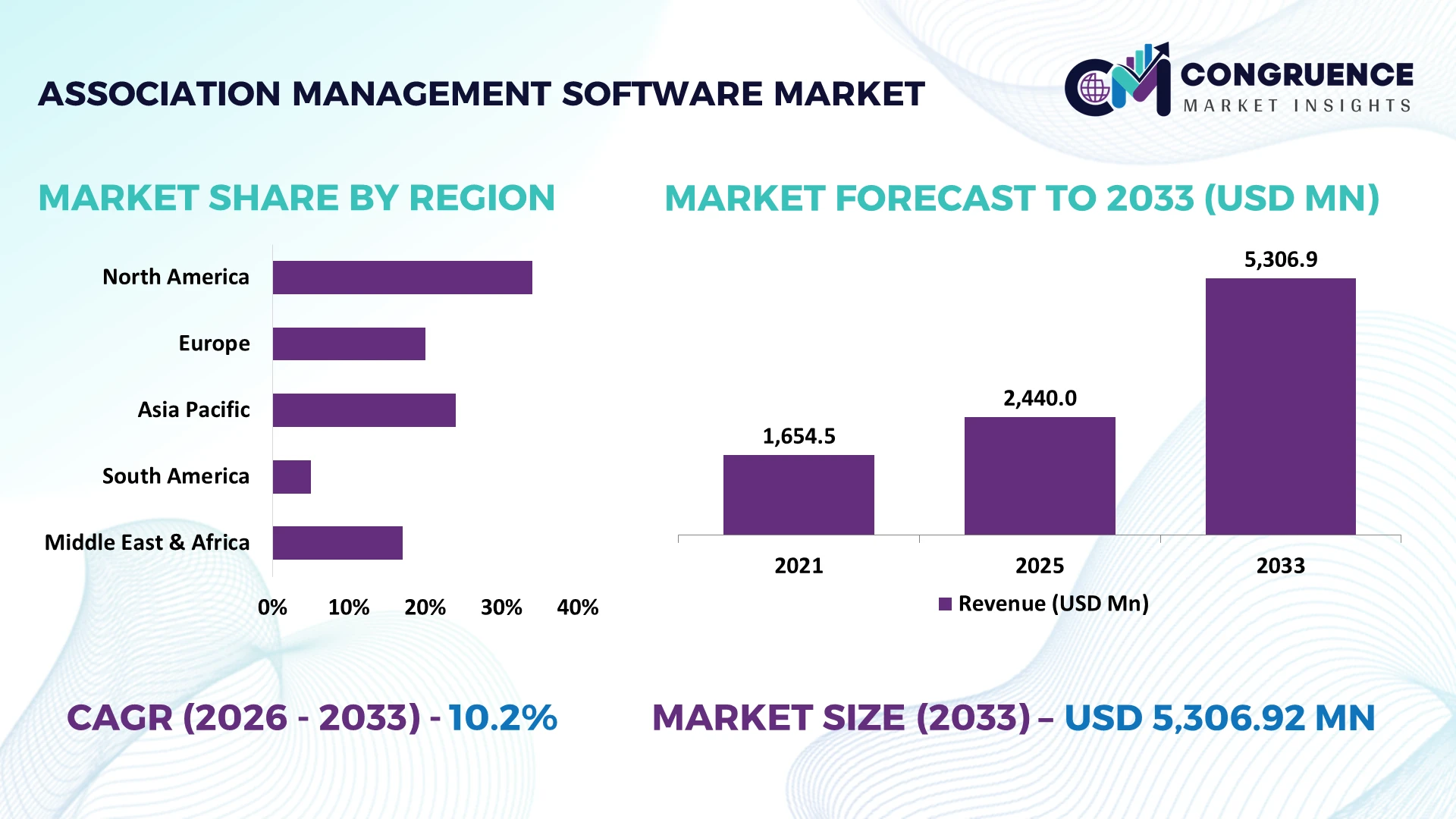
The Global Association Management Software Market was valued at USD 2440 Million in 2025 and is anticipated to reach a value of USD 5306.92 Million by 2033 expanding at a CAGR of 10.2% between 2026 and 2033. Growth is driven by cloud-native membership platforms, automated renewals, integrated payment processing, AI-enabled engagement analytics, and replacement of disconnected CRM, event, accounting, and communication systems with unified association management suites.
The United States commands an estimated 40% of global demand, supported by more than 65,000 trade and professional associations and nonprofit organizations spending over USD 100 billion annually on technology. Roughly 70% of U.S. associations use cloud-based operational platforms, versus approximately 60% adoption across the UK. GDPR enforcement in Europe is simultaneously accelerating privacy-first member-data architecture and consent-management modernization.
Vendors combining AI personalization, integrated payments, cybersecurity, and configurable cloud workflows hold the strongest strategic position as associations consolidate technology stacks and prioritize measurable member retention.
Market Size & Growth: USD 2.44 billion in 2025 reaches USD 5.31 billion by 2033 at 10.2%, driven by cloud migration, membership automation, and integrated digital engagement.
Top Growth Drivers: Cloud migration contributes approximately 35%, workflow automation 28%, and digital member engagement 22% to incremental software adoption.
Short-Term Forecast: By 2028, AI-enabled workflow automation is positioned to reduce repetitive membership-administration effort by 20–30%, improving staff productivity and response speed.
Emerging Technologies: Generative AI, predictive analytics, and intelligent automation increasingly influence platforms, with approximately 30% of associations actively experimenting with AI-enabled operational workflows.
Regional Leaders: Modeled 2033 opportunity reaches USD 2.12 billion in North America, USD 1.33 billion in Europe, and USD 1.22 billion in Asia-Pacific as cloud deployment intensifies.
End-User Trends: Approximately 70% of digitally mature associations prioritize integrated member experiences, shifting procurement from standalone databases toward unified CRM, events, payments, and communications.
Pilot/Case Example: In 2025, AI-assisted member-service deployments demonstrated approximately 25% faster routine inquiry handling through automated knowledge retrieval and workflow routing.
Competitive Landscape: Personify holds an estimated 8% share, competing with Fonteva, Momentive Software, GrowthZone, and iMIS across cloud-based association technology ecosystems.
Regulatory & ESG Impact: GDPR can impose penalties reaching 4% of global annual turnover, making consent controls, data governance, auditability, and secure member-data management procurement priorities.
Investment & Funding: More than USD 100 million in recent sector transactions and technology investment reflects consolidation around cloud platforms, payments, analytics, and integrated association workflows.
Innovation & Future Outlook: By 2028, AI-assisted functionality is expected across 50%+ of advanced platforms, shifting competition toward predictive retention, conversational service, and automated member-journey orchestration.
Association Management Software demand is concentrating around membership lifecycle automation, event management, payments, credentialing, fundraising, and personalized digital engagement. Cloud-native architectures and generative AI are reshaping administrative workflows, with roughly 30% of associations already experimenting with AI applications. GDPR-era data governance further favors unified platforms with embedded privacy controls, creating a clear transition toward strategically integrated member-management ecosystems.
Association Management Software is becoming strategically important because associations now compete on member experience, retention, digital service depth, and staff productivity rather than administrative scale alone. In 2025, 63% of association professionals planned higher IT budgets, while 39% of associations were already using AI. This shift is accelerating replacement of fragmented databases, spreadsheets, email tools, and event systems with unified cloud platforms that connect CRM, payments, learning, events, and engagement analytics.
Modern automation creates a measurable operating advantage over legacy workflows. GrowthZone users have reported invoicing time savings of at least 75%, while integrated platforms eliminate repeated data entry and reduce manual renewal handling. North American associations show stronger cloud and AI deployment, whereas European organizations place heavier emphasis on privacy, consent, and GDPR-compliant data architecture. By 2028, AI-assisted service, predictive retention, and automated content workflows should become standard across advanced platforms.
Healthcare Financial Management Association demonstrates the operational model: its Fonteva-enabled transformation increased new-member acquisition by 20% and reduced churn by 5%, while meaningful analytics emerged within three months. Vendors are responding through AI investment, embedded payments, ecosystem partnerships, and platform consolidation. Long-term advantage will belong to providers that combine automation, trusted data, integration depth, and measurable member outcomes.
Member recruitment and retention pressure is pushing associations toward integrated, analytics-driven platforms. In 2025, 77% of surveyed associations identified recruitment strategy as a major challenge, 37% cited member engagement, and 61% were actively pursuing innovative approaches to expand membership. At the same time, 42% reported year-over-year membership gains, showing that stronger digital execution is producing measurable differentiation. U.S. and Canadian associations are replacing disconnected CRM, email, event, and billing systems with unified member databases and automated journeys. Vendors are responding by expanding predictive engagement tools, renewal automation, embedded payments, and behavioral segmentation. The non-obvious advantage is data compounding: every event registration, course completion, payment, and communication improves retention targeting, turning the AMS from an administrative system into a member-lifetime-value engine.
Legacy data structures and fragmented software estates remain a structural restraint because migration costs rise sharply when membership, accounting, events, credentials, and communications sit across incompatible systems. In one global association benchmark, 82% of respondents had either not integrated AI or had done so only minimally, while 77% had barely used AI for member customization. Additionally, 60% lacked an internal AI policy, limiting safe platform deployment. UK and European associations face added GDPR-related complexity when transferring historical member data and consent records. Organizations are reducing exposure through staged migrations, API-first integration, data cleansing, and multi-year platform contracts. Strategically, the largest cost is not subscription pricing; it is maintaining duplicate data models and manual reconciliation that prevent associations from exploiting automation at scale.
AI is creating a new operating layer across recruitment, member support, communications, learning, and predictive analytics. In 2025, 58% of associations reported using AI occasionally or frequently, up from 36% a year earlier, while 76% of members used AI at least several times weekly. Board-level support for association AI adoption also reached 61%, versus 23% in 2024. This creates an opportunity for AMS vendors to embed generative search, next-best-action recommendations, automated campaign creation, and churn prediction directly into member records. U.S. associations are leading deployment, but Canadian and European organizations are rapidly formalizing governance. Providers are investing in native AI assistants, CRM partnerships, secure knowledge layers, and workflow orchestration. The overlooked opportunity is staff leverage: AI increases service capacity without requiring proportional headcount expansion.
As AMS platforms consolidate payments, personal data, credentials, event histories, and AI-enabled workflows, cybersecurity becomes a long-term execution challenge rather than a standalone compliance function. In 2025, 30% of cybersecurity professionals were already using AI security tools, while association research showed 71% of organizations lacked a published AI ethics statement and 60% had no internal AI policy. UK data further showed only 18% of charities had adopted AI tools, indicating governance maturity remains uneven. Platform providers must secure APIs, payment integrations, identity systems, and third-party extensions while maintaining configurable workflows. Companies are responding through zero-trust architecture, stronger role-based access, audit logging, encryption, and cybersecurity partnerships. The strategic pressure point is ecosystem complexity: every new integration improves functionality but expands the attack surface and governance burden.
Platform Consolidation Replaces Tool Sprawl. Associations are reducing fragmented technology stacks as 47% identify system integration as a technology priority and 63% plan higher technology spending. U.S. organizations increasingly consolidate membership records, events, payments, learning, and communications within connected environments. Vendors are expanding APIs, native integrations, and migration services, reducing reconciliation workloads and strengthening data consistency across member-facing operations.
Self-Service Becomes Operational Default. Member portals are shifting routine administration away from staff as organizations digitize renewals, profile updates, registrations, credential tracking, and payments. With 76% of association members using AI several times weekly and 61% of boards supporting AI adoption, expectations for immediate digital service are rising. Platform providers are redesigning portals around mobile access, conversational search, and automated transaction workflows.
Event Technology Moves Toward Hybrid. Associations are integrating event registration, mobile applications, attendance tracking, continuing education, and post-event engagement directly into member records. Around 57% of association professionals identify events as a primary engagement channel, while 34% prioritize stronger event technology. Vendors are connecting AMS and event workflows, enabling behavioral data captured during conferences to influence subsequent communications, education recommendations, and sponsorship strategies.
Data Governance Shapes Platform Selection. Regulatory scrutiny is turning consent management, retention controls, and auditable permissions into procurement requirements. GDPR penalties can reach 4% of global annual turnover, while 60% of associations still lack formal internal AI policies. European organizations are strengthening governance faster, prompting vendors to add configurable consent, access controls, audit trails, and data-residency capabilities alongside conventional membership functionality.
Cloud-Based solutions account for an estimated 48% of Association Management Software deployments, supported by subscription accessibility, remote administration, automatic upgrades, and easier integration with payments, email, events, and learning systems. Their advantage is particularly pronounced among small and mid-sized associations lacking dedicated infrastructure teams. On-Premises solutions represent approximately 18%, remaining relevant for organizations requiring direct infrastructure control or customized legacy environments. Hybrid deployments hold close to 14%, serving associations transitioning sensitive workflows gradually while retaining selected internal systems.
Integrated Platforms, representing approximately 20%, are the fastest-strengthening type as buyers move beyond basic membership databases toward unified CRM, finance, events, communications, learning, and engagement environments. Approximately 47% of association technology decision-makers identify integration as a priority, reinforcing this shift. Vendors are responding by expanding open APIs, application marketplaces, embedded payments, analytics, and single-sign-on capabilities. Cloud-Based solutions retain scale leadership, but Integrated Platforms are capturing higher-value modernization projects because reducing application fragmentation improves data visibility and lowers administrative complexity.
Membership Management accounts for an estimated 36% of application demand because member records, renewals, subscriptions, directories, credentials, and lifecycle administration form the operational foundation of association platforms. Event Management represents approximately 20%, reflecting conferences, webinars, training programs, and continuing education activity. Financial Management accounts for about 16%, while Communication Management represents roughly 13%, supported by automated email, segmentation, notifications, and campaign orchestration.
Member Engagement, at approximately 15%, is the fastest-strengthening application as associations prioritize retention and measurable participation over database administration alone. With 37% of organizations identifying engagement as a major membership challenge and 61% pursuing innovative membership strategies, behavioral scoring, personalized content, online communities, and predictive recommendations are becoming operational priorities. Vendors are integrating engagement analytics directly with CRM records while automating renewal triggers and targeted communications. Membership Management remains indispensable, but purchasing decisions increasingly depend on how effectively platforms convert transactional member data into actionable engagement intelligence.
Professional Associations represent an estimated 35% of Association Management Software demand, reflecting large membership databases, certification programs, continuing education, conferences, chapters, and recurring renewal requirements. Trade Associations account for approximately 27%, where advocacy, committees, industry events, and organizational memberships create complex account structures. Nonprofit Organizations hold around 20%, while Chambers of Commerce and Alumni Associations represent approximately 10% and 8%, respectively, with requirements centered on networking, events, directories, and communications.
Nonprofit Organizations are the fastest-strengthening end-user segment as cloud pricing, configurable workflows, and integrated digital engagement reduce historical technology barriers. Digital fundraising, volunteer administration, memberships, events, and communications increasingly converge within shared platforms. Vendors are responding with tiered subscriptions, nonprofit-specific templates, payment integrations, donor-member data connectivity, and implementation partnerships. Professional Associations remain the highest-value buyers because operational complexity supports broader feature deployment, while Chambers of Commerce favor business directories and local engagement functionality. Alumni Associations increasingly prioritize mobile communities and event-driven engagement, shifting vendor differentiation toward configurable sector-specific experiences.
North America accounted for the largest market share at 42% in 2025 however, Asia-Pacific is expected to register the fastest growth, expanding at a CAGR of 12.1% between 2026 and 2033.
Integrated Member Platforms Reshape Operations
North America accounts for approximately 42% of global Association Management Software demand, supported by extensive professional association, trade group, chamber, nonprofit, and alumni networks. Cloud-first procurement is mature, while organizations increasingly replace standalone membership databases with integrated CRM, event, payment, learning, community, and analytics platforms. In the United States, 63% of association professionals planned increased technology spending, strengthening demand for configurable SaaS environments. AI is moving into communications, knowledge retrieval, content production, and administrative workflows, while embedded payments create tighter links between member records and transaction data. Canadian organizations follow similar modernization patterns but operate under stronger privacy-governance requirements. Vendors including Momentive Software, GrowthZone, Higher Logic, and iMIS are expanding automation, APIs, digital communities, and ecosystem integrations, making platform breadth and implementation capability decisive purchasing factors.
United States Market Outlook: The United States remains the core deployment market, supported by tens of thousands of professional and trade associations and a sophisticated association-technology ecosystem. With 58% of associations reporting occasional or frequent AI usage in 2025, procurement is shifting toward AI-ready platforms. U.S. buyers increasingly prioritize predictive engagement, embedded payments, mobile self-service, configurable workflows, and consolidated member data over basic record management.
Privacy-First Modernization Defines Platform Selection
Europe represents approximately 24% of global Association Management Software activity, with the UK, Germany, France, Netherlands, and Nordic countries providing the strongest digital-association ecosystems. GDPR has fundamentally shaped platform architecture: organizations prioritize consent management, configurable retention policies, auditable permissions, encryption, and controlled data transfers alongside conventional membership functionality. GDPR penalties can reach 4% of worldwide annual turnover, making compliance functionality a commercial requirement rather than an optional module. European associations are simultaneously migrating away from bespoke databases toward cloud environments that connect membership, events, payments, communications, and learning. Deployment remains more governance-intensive than in the United States, particularly where associations operate across jurisdictions. Software providers are responding with European hosting options, enhanced access controls, API governance, and privacy-by-design capabilities, while AI adoption increasingly centers on controlled knowledge retrieval and staff productivity.
United Kingdom Market Outlook: The UK combines a large professional-membership ecosystem with mature SaaS adoption and sophisticated digital-service expectations. More than 170,000 charities alongside numerous professional bodies and trade associations create a broad addressable user base. Procurement increasingly favors configurable cloud platforms capable of supporting subscriptions, events, qualifications, communities, and GDPR-aligned data governance while reducing dependence on manually maintained legacy databases.
Mobile-First Membership Models Accelerate Deployment
Asia-Pacific holds an estimated 20% share, with Australia, India, Singapore, Japan, and increasingly Southeast Asia supporting wider adoption of cloud association platforms. Deployment differs structurally from North America: mobile access, scalable subscription pricing, localized payment methods, and rapid implementation carry greater weight for emerging association ecosystems. India’s digital infrastructure provides a particularly strong foundation, with internet penetration exceeding 55% and UPI processing more than 18 billion monthly transactions during 2025, enabling digital dues collection and event commerce at exceptional scale. Australia represents the more mature professional-association technology market, emphasizing integrated membership, continuing education, and events. Vendors are introducing mobile-responsive portals, configurable SaaS tiers, localized payment integrations, and low-code workflows. The non-obvious opportunity lies in leapfrogging legacy AMS infrastructure: newer associations can move directly into cloud-native operating models without expensive database replacement programs.
India Market Outlook: India offers significant long-term deployment potential across professional bodies, chambers, alumni networks, nonprofit organizations, and sector associations. UPI’s massive transaction infrastructure makes automated membership payments and recurring digital collections increasingly practical. Indian organizations also benefit from a deep SaaS talent base, encouraging vendors to localize pricing, payment gateways, mobile interfaces, multilingual communications, and implementation partnerships for digitally expanding membership ecosystems.
Cloud Economics Broaden Digital Access
South America represents approximately 6% of global Association Management Software demand, led by Brazil and followed by Argentina, Chile, and Colombia. Adoption is moving from locally hosted membership databases toward subscription-based cloud platforms as associations seek lower infrastructure requirements and stronger remote accessibility. Brazil’s internet penetration exceeds 80%, while Pix processes billions of transactions monthly, creating favorable infrastructure for digital dues, registrations, donations, and event payments. Professional bodies and trade associations increasingly require integrated communication, financial administration, member portals, and event functionality, although currency volatility and uneven technology budgets constrain enterprise-grade implementations. Vendors are responding with modular subscriptions, Portuguese and Spanish interfaces, local payment connections, and implementation partnerships. Flexible packaging is strategically important because buyers frequently expand functionality incrementally rather than committing immediately to comprehensive enterprise suites.
Brazil Market Outlook: Brazil is the region’s strongest AMS deployment environment because of its large professional, commercial, and nonprofit institutional base combined with advanced digital-payment infrastructure. Pix enables instant, low-friction transactions across membership and event workflows. Vendors targeting Brazil increasingly require Portuguese localization, configurable taxation and payment functionality, mobile-first portals, and scalable subscription structures aligned with organizations of widely different operational sophistication.
Institutional Digitization Creates New Deployment Hubs
Middle East & Africa accounts for approximately 8% of global Association Management Software activity, with the UAE, Saudi Arabia, South Africa, and selected Gulf markets providing the strongest enterprise deployment conditions. Government-led digital transformation is encouraging chambers, professional councils, industry organizations, and nonprofit institutions to modernize member-facing services. Saudi Arabia recorded internet usage above 99%, while the UAE maintains similarly high connectivity, supporting mobile-first membership portals, digital payments, virtual events, and automated communications. Gulf organizations increasingly demand Arabic-English interfaces, secure cloud hosting, configurable approval workflows, and integration with national digital services. South Africa offers a broader established association ecosystem but faces greater budget variation. Vendors are responding through cloud localization, regional implementation partners, multilingual interfaces, and modular deployment models, turning institutional digitization into a practical entry route for international AMS providers.
United Arab Emirates Market Outlook: The UAE provides a concentrated technology-led market built around chambers, professional organizations, free-zone communities, and multinational business networks. Internet penetration above 99% and widespread digital-payment adoption support fully digital membership journeys. International vendors can differentiate through Arabic localization, UAE-hosted cloud options, event-management integration, automated onboarding, and partnerships with local technology consultancies serving institutionally complex organizations.
Momentive Software, iMIS, GrowthZone, Fonteva, and Higher Logic compete across integrated association platforms, while specialized SaaS providers challenge them through simpler deployment and vertical customization. The top five vendors hold an estimated 32% combined share, leaving substantial space for differentiated platforms. Enterprise providers compete on integration depth, AI, payments, communities, and implementation scale; cloud specialists emphasize deployment speed and lower administrative burden. Modern SaaS platforms can reduce selected manual workflows by 20–30%, while integrated billing automation delivers processing improvements exceeding 25% in mature deployments. Vendors are expanding APIs, embedded payments, AI assistants, and partner marketplaces while consolidating previously separate membership, events, learning, and engagement functions. The competitive shift favors unified data architectures over standalone AMS databases. Migration complexity, historical member-data quality, security requirements, and ecosystem integration create strong entry barriers. Winning requires configurable workflows, demonstrable implementation speed, trusted data governance, broad integrations, and measurable improvements in member engagement, retention, and staff productivity across organizations.
Momentive Software
iMIS
GrowthZone
Fonteva
Higher Logic
WildApricot
Glue Up
MemberClicks
MemberLeap
MemberSuite
Raklet
ClubExpress
Neon One
Novi AMS
Cloud-native AMS platforms, API-first architectures, embedded payments, workflow automation, and unified member databases currently define technology modernization. Automated renewals and self-service workflows can reduce administrative effort 20–30%, while integrated data eliminates roughly 15–25% of duplicate processing. Cloud deployment exceeds 60% among digitally mature associations, giving vendors with configurable integrations, mobile portals, and secure payment ecosystems a measurable implementation advantage.
Emerging technology centers on generative AI, predictive engagement, RAG search, low-code orchestration, and real-time behavioral analytics. Association AI adoption reached 39% in 2025, supporting personalized communications, knowledge discovery, and churn intervention. Compared with legacy manual segmentation, AI-assisted workflows can improve campaign productivity 25–35%. Integration with LMS, event, community, finance, and CRM applications increasingly turns the AMS into an operational intelligence layer.
Disruptive development is shifting toward agentic AI, Model Context Protocol connectivity, autonomous member service, and governed cross-platform intelligence. Between 2026 and 2028, advanced platforms should automate 40–50% of repetitive renewal, moderation, routing, and content tasks. Large integrated providers benefit from broader datasets; focused vendors compete through vertical specialization and faster deployment. Associations acting now gain cleaner data foundations, lower service costs, faster response times, and stronger personalization before autonomous workflows become a standard procurement requirement across complex member lifecycle operations.
August 2024 GrowthZone partnered with rasa.io to offer AI-driven personalized newsletters across its 4,600+ association and nonprofit customers. The integration extends AMS data into individualized communications, strengthening member engagement and retention while reducing manual content-selection work at scale.
May 2025 AIIM deployed Aidan, its first AI search assistant, with Higher Logic and IBM watsonx using retrieval-augmented generation. The deployment made association knowledge conversationally accessible inside AIIM’s member community, demonstrating governed AI search as a member-service model. Source: aiim.org
May 2026 Higher Logic launched Vanilla MCP, connecting live community data directly with ChatGPT, Claude, and Cursor through Model Context Protocol. Offered free to Vanilla customers, the integration converts historically siloed community intelligence into conversational, auditable AI workflows. Source: higherlogic.com
July 2026 Momentive Software introduced Momentive Community for 37,000+ mission-driven organizations across 30+ countries. Featuring two-way AMS synchronization and an AI Community Assistant, the platform extends engagement between events while reducing routine moderation workload for association staff operations. Source: momentivesoftware.com
The Association Management Software Market Report evaluates Cloud-Based, On-Premises, Hybrid, and Integrated Platforms across Membership Management, Event Management, Communication Management, Financial Management, and Member Engagement applications. End-user coverage includes Professional Associations, Trade Associations, Nonprofit Organizations, Chambers of Commerce, and Alumni Associations. Cloud-Based solutions represent an estimated 48% of deployments, while integrated platforms are gaining strategic importance as organizations consolidate fragmented technology stacks.
Regional coverage spans North America, Europe, Asia-Pacific, South America, and Middle East & Africa, with country-level assessment of digital maturity and association ecosystems. Technology analysis covers generative AI, RAG search, agentic automation, APIs, embedded payments, predictive engagement, digital communities, and low-code workflows. The report also evaluates privacy-first platforms and AI governance, supporting 2026–2033 investment planning, market entry, partnership selection, product positioning, acquisition assessment, and competitive strategy.
| Report Attribute/Metric | Report Details |
|---|---|
Market Revenue in 2025 | USD 2440 Million |
Market Revenue in 2033 | USD 5306.92 Million |
CAGR (2026 - 2033) | 10.2% |
Base Year | 2025 |
Forecast Period | 2026 - 2033 |
Historic Period | 2021 - 2025 |
Segments Covered | By Type
By Application
By End-User
|
Key Report Deliverable | Revenue Forecast, Growth Trends, Market Dynamics, Segmental Overview, Regional and Country-wise Analysis, Competition Landscape |
Region Covered | North America, Europe, Asia-Pacific, South America, Middle East, Africa |
Key Players Analyzed | Momentive Software, iMIS, GrowthZone, Fonteva, Higher Logic, WildApricot, Glue Up, MemberClicks, MemberLeap, MemberSuite, Raklet, ClubExpress, Neon One, Novi AMS |
Customization & Pricing | Available on Request (10% Customization is Free) |




