
Reports
The Global Asphalt Release Agent Market was valued at USD 410.0 Million in 2025 and is anticipated to reach a value of USD 587.5 Million by 2033 expanding at a CAGR of 4.6% between 2026 and 2033. Growth is being driven by replacement of diesel-based release practices with biodegradable, water-dilutable formulations that protect asphalt quality while reducing equipment cleaning and environmental compliance risks.
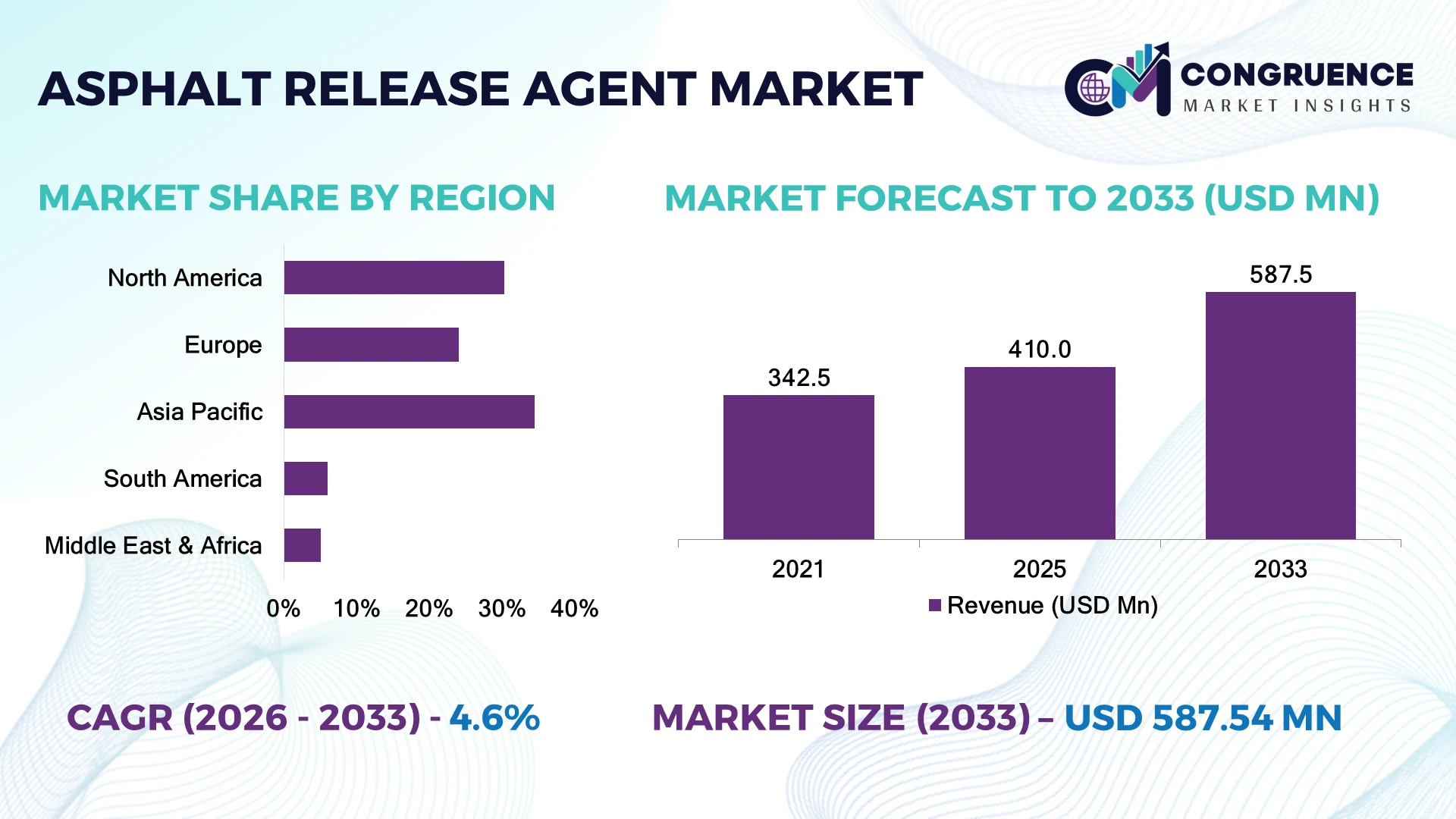
Asia Pacific held approximately 34.5% of global market value in 2024, with China representing 58.7% of regional demand; North America accounted for 30.3%, while the U.S. represented 83.8% of North American consumption. U.S. infrastructure investment remains significant, with $545.7 billion in adjusted IIJA funding available by June 2026 and 73.7% already obligated.
Strategically, suppliers combining bio-based chemistry, application efficiency, and compliance-ready formulations are positioned to capture replacement demand as road agencies tighten material requirements.
Market Size & Growth: USD 410.0 million in 2025 to USD 587.5 million by 2033 at 4.6% CAGR, supported by bio-based formulation adoption and road rehabilitation.
Top Growth Drivers: Bio-based products: 55.3%; truck-bed applications: 44.2%; Asia Pacific: 34.5%.
Short-Term Forecast: By 2028, concentrated water-dilutable systems can reduce active-product consumption by up to 90% versus undiluted application formats.
Emerging Technologies: Soy-based esters, water-emulsion chemistry, low-VOC formulations, and longer-residence molecular films are reshaping asphalt release performance.
Regional Leaders: Asia Pacific: USD 128.8 million in 2024; North America: USD 113.2 million; Europe: USD 90.0 million, with bio-based adoption accelerating across major paving markets.
Consumer/End-User Trends: Truck beds represented 44.2% of application demand, making transport-stage release performance the largest recurring consumption point.
Pilot/Case Example: 2026 BIO-SLIDE 30 commercialization introduced soy-enhanced chemistry for truck beds, pavers, rollers, and paving equipment across North America.
Competitive Landscape: FUCHS, Zeller+Gmelin, BG Chemical, Meyer Lab, Zep, and SoySolv compete across specialty, bio-based, and application-specific formulations.
Regulatory & ESG Impact: Modern specifications prohibit diesel and petroleum derivatives that contaminate or alter asphalt, accelerating compliant alternatives.
Investment & Funding: U.S. IIJA infrastructure funding reached $545.7 billion available by June 2026, sustaining road-project activity and downstream chemical demand.
Innovation & Future Outlook: Competitive differentiation is shifting toward renewable feedstocks, precise dilution, longer-lasting films, lower runoff, and compatibility with polymer-modified asphalt.
The Asphalt Release Agent Market is increasingly concentrated around truck-bed protection, paving-equipment efficiency, and environmentally compliant chemistry. Bio-based formulations already represented 55.3% of 2024 market value, while 2026 commercialization of soy-enhanced products demonstrates movement from laboratory development toward scalable deployment. Infrastructure procurement is simultaneously shifting away from diesel-based practices toward approved, water-dilutable alternatives, creating stronger opportunities for specialized formulation suppliers.
Asphalt release agents are becoming strategically important because paving contractors increasingly manage material integrity, equipment uptime, worker exposure, and environmental compliance as interconnected cost factors. Modern specifications prohibit diesel and petroleum derivatives where they can contaminate or alter asphalt, forcing contractors toward purpose-formulated release chemistry and making product approval increasingly important for supplier access.
The technology shift is measurable at the application level: concentrated formulations can be diluted with water, with some commercial products supporting dilution ratios as high as 10:1, reducing concentrate volume required per application while maintaining a thin release film. Bio-based chemistry is gaining particular traction, while conventional petroleum-based products retain relevance where price and established operating practices dominate.
Regional priorities differ sharply. Asia Pacific combines infrastructure scale with cost-sensitive procurement, while North America emphasizes compliance and bio-based adoption. In 2026, the U.S. infrastructure pipeline remains substantial, with 73.7% of available IIJA funding already obligated by June. Over the next 2–3 years, suppliers that expand approved-product portfolios, localize distribution, and partner with contractors and paving-equipment channels will gain operational leverage. The strategic advantage rests on chemistry that lowers cleaning requirements without compromising asphalt performance.
Environmental specifications restricting diesel and petroleum-derived release materials are accelerating adoption of purpose-formulated asphalt release agents. Bio-based formulations accounted for approximately 55% of market value in 2024, while truck-bed applications represented about 44% of demand, concentrating purchasing around high-frequency hauling operations. In the United States, state-level paving specifications increasingly favor materials that prevent asphalt contamination and surface defects. Contractors are responding by replacing solvent-heavy practices with water-dilutable, soy-based, and biodegradable formulations. Manufacturers are expanding formulation portfolios and strengthening distributor relationships around major paving corridors. The non-obvious advantage is reduced equipment cleaning: a release film that prevents asphalt adhesion can lower maintenance interruptions while improving batch-to-batch operational consistency.
Raw-material variability remains a structural constraint, particularly for bio-based esters, specialty surfactants, and performance additives. Petroleum-linked inputs can fluctuate by more than 20% during supply disruptions, while bio-based formulations typically carry a premium of approximately 10–25% over basic commodity alternatives. Smaller contractors therefore remain price-sensitive despite regulatory pressure to replace diesel-based practices. In India and Southeast Asia, fragmented distribution also increases delivered formulation costs and complicates inventory planning. Manufacturers are reducing exposure through dual-feedstock formulations, regional warehousing, longer supplier contracts, and concentrated products that reduce transport volumes. The operational pressure is strongest where contractors purchase through intermediaries; suppliers with localized blending and dependable technical support can protect margins while reducing customer switching resistance.
Concentrated release formulations create an underdeveloped efficiency opportunity because selected products can support dilution ratios approaching 10:1, substantially reducing concentrate consumption per application. Automated or controlled spraying can further reduce overspray and material waste by approximately 15–30% compared with inconsistent manual application. In the United States, large paving contractors are increasingly positioned to standardize application rates across fleets, creating demand for measurable performance rather than commodity chemical supply. Manufacturers can capture this opportunity through calibrated dispensing systems, contractor training, equipment partnerships, and application-specific formulations. A less obvious opportunity lies in commercial asphalt plants and fleet operators, where digital usage tracking can connect chemical consumption with truck cycles, cleaning intervals, and equipment downtime, strengthening procurement economics.
Performance consistency remains difficult when release agents encounter polymer-modified asphalt, warm-mix formulations, recycled asphalt pavement, and varying aggregate compositions. RAP usage in U.S. asphalt mixtures has exceeded 20% of total mix volume in many applications, increasing formulation complexity and requiring reliable non-stick performance across changing material characteristics. Application temperature, dilution accuracy, spray coverage, and equipment configuration can each materially alter results. Manufacturers therefore face pressure to validate products across multiple asphalt grades rather than rely on laboratory performance alone. Companies are investing in field trials, contractor partnerships, application testing, and formulation optimization. The strategic challenge is achieving a stable release film without transferring contaminants into asphalt, particularly as recycled-content requirements and performance specifications become more demanding.
Bio-Based Chemistry Gains Ground: Soy-derived and biodegradable formulations are moving from niche products toward mainstream paving use, with bio-based products representing roughly 55% of market value. Contractors increasingly prioritize lower-contamination formulations as diesel restrictions tighten. Manufacturers are expanding renewable-feedstock portfolios while maintaining compatibility with conventional paving equipment.
Concentrates Reshape Chemical Logistics: High-dilution products supporting ratios near 10:1 are changing purchasing and storage practices. Concentrated formulations can reduce transported chemical volume by approximately 80–90% versus ready-to-use equivalents, lowering warehouse requirements and shipment frequency. Suppliers are responding with application-specific concentrates and clearer dilution-control protocols.
Truck-Bed Use Drives Standardization: Truck-bed applications account for approximately 44% of demand, encouraging fleet operators to standardize spray rates, coverage procedures, and cleaning schedules. Controlled application can reduce chemical wastage by 15–30% compared with inconsistent manual spraying. Manufacturers are increasingly pairing formulations with calibrated dispensing equipment and operator training.
RAP Changes Formulation Testing: Higher recycled-asphalt usage is forcing manufacturers to test release performance against more variable mix compositions rather than conventional asphalt alone. RAP commonly exceeds 20% of mixture volume in many U.S. paving applications, increasing sensitivity to contamination and adhesion. Suppliers are responding with broader field validation and polymer-compatible formulations.
Bio-based asphalt release agents represent the leading product type, accounting for approximately 55% of market value in 2024, supported by biodegradable chemistry, lower environmental burden, and increasing restrictions on petroleum-derived release materials. Petroleum-based formulations retain roughly 30–32% share because of established contractor familiarity, thermal stability, and competitive pricing, particularly in cost-sensitive paving operations. Other formulations, including water-emulsion, hybrid, and specialty chemistries, account for the balance and increasingly serve applications requiring specific temperature or equipment compatibility.
Bio-based products are also the fastest-moving category, with adoption supported by tighter environmental specifications and contractor efforts to replace diesel-based practices. Companies are expanding renewable-feedstock portfolios, improving dilution performance, and partnering with paving distributors to accelerate conversion. The investment priority is shifting from commodity release chemistry toward formulations that combine non-stick performance with compliance and lower lifecycle handling costs.
The National Asphalt Pavement Association reported in 2025 that U.S. asphalt mixtures incorporated 21.9% reclaimed asphalt pavement on average, reinforcing the need for release formulations compatible with increasingly diverse asphalt compositions.
Truck beds represent the dominant application, accounting for approximately 44% of global asphalt release-agent demand. Their leadership reflects repeated loading and unloading cycles, where adhesion directly affects material recovery, cleaning time, and fleet utilization. Pavers represent roughly 30% of application demand, while rollers account for about 15%; other equipment and specialty uses comprise the remainder. Truck-bed demand therefore remains anchored to transport intensity rather than equipment ownership alone.
Pavers are emerging as the fastest-growing application as automated paving systems and resurfacing programs increase the importance of consistent material flow and reduced equipment stoppages. Companies are developing longer-lasting films, water-dilutable formulations, and equipment-compatible chemistries for continuous operations. The shift creates a more performance-driven purchasing model, particularly among large contractors operating standardized fleets. Suppliers increasingly target equipment manufacturers, paving contractors, and distributors simultaneously, positioning application compatibility as a differentiator rather than competing solely on chemical price.
U.S. asphalt operations used approximately 96.1 million tons of reclaimed asphalt pavement annually, increasing the importance of reliable material handling across truck transport and paving workflows.
Road construction and maintenance represents the leading end-user group, accounting for approximately 70% of market consumption because asphalt hauling, paving, and compaction create repeated release-agent requirements across large equipment fleets. Commercial infrastructure represents an estimated 15–18%, while roofing, industrial flooring, and specialty construction account for the balance. Road contractors therefore determine purchasing volumes through project frequency, fleet size, and material throughput rather than occasional equipment usage.
Commercial infrastructure and specialty contractors are becoming faster adopters of higher-performance formulations as procurement increasingly incorporates environmental compliance and equipment lifecycle considerations. Demand is shifting toward products that combine low-VOC chemistry, biodegradable feedstocks, and predictable application rates. Manufacturers are responding through contractor-specific packaging, distributor partnerships, technical application support, and bulk procurement programs. For large road contractors, standardized release-agent specifications across fleets can reduce operational variability and simplify purchasing, while suppliers gain stronger account retention by integrating formulation supply with equipment and application guidance.
U.S. road paving activity increasingly incorporates recycled materials, with reclaimed asphalt pavement averaging 21.9% of new asphalt mixtures, strengthening demand for release chemistry validated across variable mix compositions.
Asia Pacific accounted for the largest market share at 34.5% in 2025 however, North America is expected to register the fastest growth, expanding at a CAGR of 4.8% between 2026 and 2033.

Compliance-led formulation upgrades are reshaping mature paving operations
North America represented approximately 30.3% of global asphalt release agent demand, with the United States accounting for 83.8% of regional consumption. Mature road-maintenance activity, stringent environmental specifications, and established distributor networks support strong penetration of bio-based and water-based formulations. Demand is concentrated around highway resurfacing, municipal rehabilitation, and large contractor fleets where release performance directly affects cleaning frequency and equipment utilization. Suppliers are increasingly emphasizing ready-to-use formulations, application-specific concentrates, and technical support rather than competing purely on chemical price. The region’s competitive advantage is its ability to convert regulatory requirements into standardized procurement specifications, creating recurring demand for compliant products.
United States Market Outlook: The United States remains the principal North American market because of its extensive asphalt paving network and recurring rehabilitation programs. Approximately 96.1 million tons of reclaimed asphalt pavement are reused annually, increasing the need for release formulations that maintain performance across variable asphalt mixes and recycled-content applications.
Sustainability compliance is moving product selection beyond price
Europe accounted for approximately 24.1% of global asphalt release agent demand in 2024, with Germany, the United Kingdom, France, Italy, and Spain forming the principal consumption base. REACH-related chemical controls and sustainability requirements are accelerating movement toward bio-based, biodegradable, and lower-emission formulations. The United Kingdom provides a strong infrastructure catalyst: its 2026 Road Investment Strategy commits more than £27 billion over five years, including £8.4 billion for renewals. Suppliers are responding by strengthening compliant formulations and aligning product specifications with contractor sustainability requirements. The key business shift is from conventional release chemistry toward products demonstrating environmental and operational performance simultaneously.
Germany Market Outlook: Germany combines a large industrial base with stringent chemical-management requirements and extensive motorway maintenance needs. Its position within Europe's advanced construction-equipment ecosystem supports demand for technically validated release agents, particularly formulations compatible with modern paving machinery and environmentally controlled procurement. Suppliers with localized technical support and compliant product documentation are better positioned for contractor qualification.
Infrastructure scale is accelerating localized formulation and distribution
Asia Pacific accounted for approximately 34.5% of the global asphalt release agent market, making it the largest regional demand center. China represented about 58.7% of Asia Pacific consumption, while India is strengthening its position through highway expansion and equipment deployment. NHAI constructed 5,614 km of national highways during FY2024–25, while capital expenditure exceeded ₹2.5 trillion. This scale favors suppliers capable of high-volume distribution, competitive formulations, and localized technical support. Manufacturers are increasingly balancing petroleum-based products for price-sensitive contractors with bio-based alternatives for regulated urban projects. The region's strategic advantage is the combination of infrastructure volume and manufacturing depth, allowing formulation suppliers to localize production and shorten delivery cycles.
China Market Outlook: China remains the largest Asia Pacific country market, supported by extensive expressway construction, municipal road upgrades, and domestic chemical manufacturing capacity. Approximately 58.7% of Asia Pacific demand originated in China in 2024. Local producers benefit from cost-efficient supply chains, while multinational suppliers are strengthening distribution and localized product portfolios to compete in environmentally compliant applications.
Road rehabilitation is creating selective demand for higher-performance formulations
South America remains a developing consumption base, with Brazil and Argentina representing the principal markets. Demand is concentrated around highway rehabilitation, freight corridors, urban road upgrades, and asphalt-intensive construction. Brazil's large road network creates recurring truck-bed and paving-equipment requirements, while fragmented contractor structures keep purchasing highly price-sensitive. Suppliers are increasingly using distributors and regional chemical partners rather than relying exclusively on direct sales. Bio-based formulations are gaining relevance where environmental requirements and export-oriented infrastructure projects raise specification standards. The strategic opportunity is therefore concentrated in reliable local supply and application-specific products rather than broad commodity distribution. Companies that establish regional inventory can reduce delivery volatility and improve contractor retention.
Brazil Market Outlook: Brazil offers the strongest commercial base in South America because of its extensive highway network, agricultural freight corridors, and recurring pavement rehabilitation requirements. The country's large asphalt-consuming construction ecosystem supports recurring demand for truck-bed release applications. Suppliers can strengthen penetration through regional distributors, bulk packaging, and formulations designed for high-temperature operating conditions.
Mega-project construction is increasing demand for reliable paving chemistry
Middle East & Africa accounted for approximately 4.0% of global asphalt release agent demand in 2024, with Saudi Arabia, the UAE, and South Africa providing the strongest commercial opportunities. Saudi Arabia's infrastructure modernization and large-scale urban development projects are increasing asphalt handling requirements across highways, airports, industrial zones, and new urban districts. Extreme temperatures place greater emphasis on thermal stability and consistent release performance. Suppliers are responding through application-specific formulations, distributor partnerships, and localized inventory. The region remains smaller than established markets, but project concentration creates sizeable account-level opportunities where technical qualification and dependable delivery matter more than broad retail coverage.
Saudi Arabia Market Outlook: Saudi Arabia is the region's most strategically significant market because infrastructure modernization and major urban development programs require sustained road and transport construction. The country's hot operating conditions increase the importance of thermally stable release films and reliable truck-bed performance. Suppliers with local distribution and technical field support can secure larger project-based contracts and reduce dependence on imported spot supply.
FUCHS, Zeller+Gmelin, and Meyer Lab compete as formulation leaders, while SoySolv, Zep, and regional specialists target bio-based, compliant, and cost-efficient niches. The top five players collectively command about 50% of market revenue, leaving meaningful space for specialists. Competition centers on formulation performance, compliance, and delivered cost; concentrated products can reduce usage by 80–90%, while field-approved formulations reduce qualification friction. Players are expanding through distributor networks, customer co-development, and application-specific portfolios spanning truck beds, pavers, and rollers. FUCHS is broadening mineral-, vegetable-oil, emulsion, and concentrate options, while Meyer integrates dispensing systems with release chemistry. The competitive shift is toward bio-based chemistry, high-dilution concentrates, and documented performance rather than commodity formulations. Entry barriers include formulation validation, regulatory approvals, contractor relationships, and field testing. Winning requires proven release performance, low application cost, regulatory readiness, and dependable supply. Suppliers combining technical service with distribution density can secure long-term fleet and contractor accounts.
FUCHS
Zeller+Gmelin
BG Chemical
Meyer Lab
Zep Inc.
SoySolv Biosolvents
Rhomar Industries Inc.
Industrial Chemical Solutions
McGee Industries, Inc.
Miller-Stephenson Chemical Company, Inc.
Lube-Tech
ChemStation
Brody Chemical
PavePro
Current technology is moving from petroleum-heavy release chemistry toward biodegradable esters, water emulsions, and concentrated film-forming systems. FUCHS offers ester-based formulations with more than 70% biodegradability after 28 days, while conventional mineral products remain important for cost-sensitive operations. Concentrates supporting dilution up to 10:1 can cut transported product volume by about 90%, improving logistics economics and storage efficiency.
Emerging systems integrate release chemistry with controlled spraying and equipment monitoring. Meyer Lab offers PLC-controlled dispensing with real-time usage data, while advanced formulations target modified high-polymer asphalt and complex mix designs. Compared with uncontrolled manual application, precision dispensing can reduce chemical waste by roughly 15–30% and improve coverage consistency. This primarily benefits paving contractors and fleet operators standardizing application rates across equipment classes.
Through 2026–2028, differentiation will center on renewable feedstocks, durable molecular films, automated dosing, and formulation-specific performance validation. Soy-enhanced products are moving into commercialization, while DOT and NTPEP qualification increasingly functions as a technology-access gate. The shift is from purchasing chemical volume toward purchasing operating performance: fewer cleanups, lower consumption, and reliable release across truck beds, pavers, and rollers. Companies investing in compliant formulations, dispensing integration, and field validation can strengthen specification access.
July 2026 Airable Research Lab and Warsaw Chemical partnered to commercialize BIO-SLIDE 30, a soy-enhanced asphalt release agent. Warsaw Chemical will manufacture and distribute it across North America, moving renewable chemistry into commercial supply and strengthening bio-based availability. Source: soyohio.org
January 2025 Meyer Lab’s Super Slider remained listed by Texas DOT for truck beds and other paving equipment, with ready-to-use application status. Qualification supports specification-driven purchasing and gives contractors a validated water-based option for routine asphalt handling operations and applications. Source: txdot.gov
June 2025 FUCHS consolidated BITEEREX asphalt release products under the RENOCAST AP brand as part of broader portfolio restructuring. The transition retained established formulations while creating unified international product architecture, improving portfolio clarity and strengthening cross-market commercial positioning. Source: baumannoil.de
March 2025 Zep secured Kansas DOT prequalification for Pinnacle, BMF, and No. 1 asphalt release agents, each approved for truck beds and paving equipment at 5:1 dilution. The approvals strengthen specification access and support public-project distribution through 2025 contracts. Source: ksdot.gov
The report evaluates bio-based, petroleum-based, water-emulsion, hybrid, and specialty asphalt release formulations across truck beds, pavers, rollers, asphalt plants, and other paving equipment. End-user coverage includes road construction contractors, asphalt producers, municipal agencies, infrastructure operators, and specialty construction businesses. Geographic analysis spans North America, Europe, Asia Pacific, South America, and the Middle East & Africa, with detailed country coverage across major demand centers.
Technology assessment covers biodegradable chemistry, concentrated formulations, film-forming polymers, water-dilutable systems, automated dispensing, and equipment-compatible release solutions. The study also examines regulatory qualification, contractor adoption, distributor networks, raw-material exposure, and application efficiency. With truck beds representing roughly 44% of application demand and bio-based formulations accounting for approximately 55% of market value, the report supports investment planning, geographic expansion, product prioritization, competitive positioning, partnership strategy, and technology decisions through 2026–2033.
| Report Attribute/Metric | Report Details |
|---|---|
|
Market Revenue in 2025 |
USD 410 Million |
|
Market Revenue in 2033 |
USD 587.5 Million |
|
CAGR (2026 - 2033) |
4.6% |
|
Base Year |
2025 |
|
Forecast Period |
2026 - 2033 |
|
Historic Period |
2021 - 2025 |
|
Segments Covered |
By Type
By Application
By End-User
|
|
Key Report Deliverable |
Revenue Forecast, Growth Trends, Market Dynamics, Segmental Overview, Regional and Country-wise Analysis, Competition Landscape |
|
Region Covered |
North America, Europe, Asia-Pacific, South America, Middle East, Africa |
|
Key Players Analyzed |
FUCHS, Zeller+Gmelin, BG Chemical, Meyer Lab, Zep Inc., SoySolv Biosolvents, Rhomar Industries Inc., Industrial Chemical Solutions, McGee Industries, Inc., Miller-Stephenson Chemical Company, Inc., Lube-Tech, ChemStation, Brody Chemical, PavePro |
|
Customization & Pricing |
Available on Request (10% Customization is Free) |




