
Reports
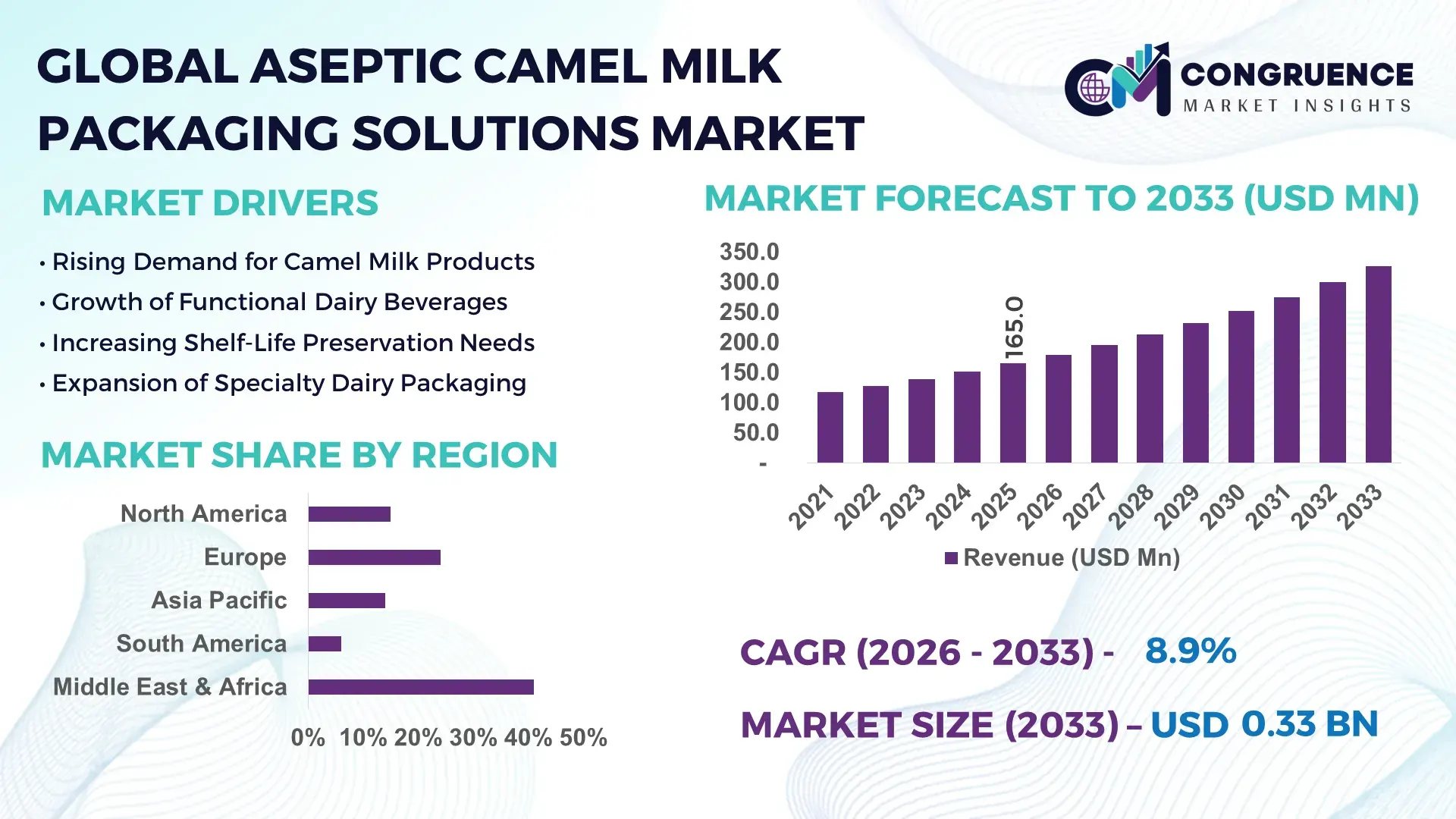
The Global Aseptic Camel Milk Packaging Solutions Market was valued at USD 165.0 Million in 2025 and is anticipated to reach a value of USD 326.4 Million by 2033 expanding at a CAGR of 8.9% between 2026 and 2033, according to an analysis by Congruence Market Insights.Growth is primarily driven by the rising commercialization of camel milk dairy products and the need for shelf-stable packaging solutions that preserve nutritional value without refrigeration.
The United Arab Emirates (UAE) remains a leading production hub for industrial camel milk processing and packaging technologies. The country produces over 9,000 tons of camel milk annually, with large dairy farms operating more than 7,000 camelsdedicated to commercial milk production. Advanced processing facilities in Dubai and Abu Dhabi utilize fully automated aseptic filling lines capable of packaging over 12,000 cartons per hour, supporting export to more than 35 international markets. Approximately 60% of packaged camel milk products in the region are distributed in aseptic cartons and multilayer pouches, reflecting strong adoption of long-shelf-life technologies. Additionally, government-backed food innovation programs have invested over USD 40 million in dairy processing modernization initiatives, enabling the integration of high-temperature short-time (HTST) sterilization and advanced multilayer barrier packaging systems tailored for camel milk’s unique protein and fat composition.
Market Size & Growth:The market was valued at USD 165.0 million in 2025and is projected to reach USD 326.4 million by 2033, expanding at 8.9% CAGR, driven by rising demand for shelf-stable camel milk products in export markets.
Top Growth Drivers:Growing dairy exports (+38%), extended shelf-life efficiency improvement (+45%), and rising functional dairy product adoption (+33%).
Short-Term Forecast:By 2028, automated aseptic filling technologies are expected to improve packaging throughput efficiency by 22%and reduce product spoilage losses by 18%.
Emerging Technologies:Multilayer barrier laminates, high-pressure sterilization systems, and AI-enabled packaging inspection platforms are increasingly deployed across camel milk processing facilities.
Regional Leaders:Middle East projected to reach USD 130 million by 2033due to large-scale camel dairy farms; Europe projected USD 82 milliondriven by specialty dairy imports; Asia-Pacific projected USD 70 millionsupported by health-focused dairy consumption trends.
Consumer/End-User Trends:Health-conscious consumers increasingly favor camel milk for its 30–40% higher vitamin C levelscompared with conventional cow milk, boosting demand for long-life packaged formats.
Pilot or Case Example:In 2024, a large camel dairy facility implemented automated aseptic packaging lines that improved operational efficiency by 27%and reduced contamination incidents by 15%.
Competitive Landscape:Market leadership is concentrated with ~32% share held by a leading aseptic packaging technology provider, followed by several global packaging firms and specialized dairy processing equipment manufacturers.
Regulatory & ESG Impact:Food safety authorities across GCC nations require sterile packaging validation and microbiological testing standards exceeding 99.9% contamination prevention ratesfor dairy exports.
Investment & Funding Patterns:More than USD 210 million has been invested globally in camel dairy processing and packaging modernization projects over the past five years.
Innovation & Future Outlook:Integration of recyclable multilayer cartons and digital quality-tracking sensors is expected to reshape supply chains and enable traceability across over 80% of export-oriented camel dairy products by 2030.
Camel milk packaging solutions serve multiple sectors including functional dairy beverages (48%), infant nutrition products (22%), nutraceutical dairy formulations (18%), and specialty retail beverages (12%). Technological innovation in multilayer carton barriers and UV-sterilized packaging systems is improving product stability and extending shelf life to 9–12 months. Regulatory frameworks promoting sustainable packaging materials and rising demand for lactose-friendly dairy products are accelerating adoption across Europe, the Middle East, and Asia.
The Aseptic Camel Milk Packaging Solutions Marketis gaining strategic importance as camel milk transitions from a regional specialty product to a globally traded functional dairy beverage. Camel milk contains approximately three times more vitamin C than conventional cow milk and lower lactose content, making it attractive to health-focused consumers and specialty nutrition markets. However, the milk’s high enzymatic activity and unique protein structure require advanced aseptic processing and packaging systems to maintain safety and nutritional integrity during long-distance distribution.
Modern aseptic packaging lines combining ultra-high temperature (UHT) processing with multilayer sterile carton fillinghave significantly enhanced operational performance. For example, robotic sterile filling systems deliver nearly 35% higher packaging accuracy compared to traditional semi-automated dairy filling lines, reducing contamination risk and improving export compliance. These technologies are particularly valuable for camel dairy producers targeting global markets where shelf stability of 6–12 monthsis necessary for international logistics.
Regionally, the Middle East dominates in production volume, supported by large camel dairy farms and advanced dairy processing facilities. Meanwhile, Europe leads in consumer adoption, where specialty dairy retailers report that nearly 42% of imported camel milk products are sold in aseptic carton formatsdue to convenience and longer shelf life. In Asia-Pacific, premium health food chains have recorded over 30% year-on-year growth in camel milk beverage listings, indicating expanding consumer awareness.
In the short term, by 2028, smart packaging technologies such as AI-based visual contamination detection and IoT-enabled packaging line monitoringare expected to reduce production defects by up to 20%across advanced dairy facilities. Sustainability commitments are also shaping market strategies. Many packaging manufacturers are targeting 50% recyclable multilayer packaging materials by 2030, aligning with global ESG frameworks for food packaging waste reduction.
A notable micro-scenario occurred in 2024, when a large camel dairy facility in the Middle East implemented automated sterile carton packaging technology, achieving 24% higher packaging throughput and reducing microbial contamination by nearly 18%. Such technological advancements highlight how integrated processing and packaging innovations are transforming camel milk supply chains.
As demand for functional dairy products continues to expand globally, the Aseptic Camel Milk Packaging Solutions Marketis expected to emerge as a crucial pillar supporting food safety compliance, export scalability, and sustainable dairy distribution, positioning it as a long-term enabler of resilient and globally connected camel milk supply chains.
The Aseptic Camel Milk Packaging Solutions Marketis evolving alongside the rapid commercialization of camel milk as a premium dairy product in international markets. Traditionally consumed in the Middle East and North Africa, camel milk is now entering global health food markets due to its high vitamin C content, immune-support properties, and lower lactose levels compared with conventional dairy milk. These attributes have encouraged dairy producers to scale production and expand export networks, increasing demand for reliable aseptic packaging technologies capable of maintaining product sterility and nutritional integrity.
Technological innovation in aseptic processing equipment and multilayer packaging materials is a major influence shaping the market. Modern packaging solutions use multilayer barriers composed of polyethylene, aluminum foil, and paperboard, which can extend the shelf life of camel milk to up to 12 months without refrigeration. Automation is also becoming more common, with many large camel dairy plants adopting robotic filling systems capable of processing over 10,000–14,000 packages per hour. Meanwhile, regulatory standards for dairy safety and sterilization are tightening globally, requiring packaging systems to achieve 99.9% microbial contamination prevention, pushing manufacturers toward advanced aseptic technologies.
Demand for camel milk is rising globally due to its nutritional and functional health benefits, which include up to 3× higher vitamin C content and significantly lower lactose levels compared with cow milk. These properties make camel milk increasingly attractive to consumers seeking digestive-friendly dairy alternatives. As global specialty dairy consumption expands, producers are scaling up camel milk processing operations and exporting packaged products to international markets. Export-oriented camel dairy companies require packaging technologies capable of preserving milk quality during long shipping durations that often exceed 30–40 days in international supply chains. Aseptic packaging systems provide a critical solution by enabling shelf life of 9–12 months without refrigeration, reducing spoilage and logistics costs. Additionally, advanced packaging materials with multi-layer oxygen and light barriersprotect sensitive nutrients such as vitamin C and immunoglobulins present in camel milk. Retail channels are also adapting to this trend. Specialty food stores and e-commerce platforms have reported that more than 55% of imported camel milk products are sold in shelf-stable aseptic cartons, highlighting the importance of these packaging technologies in expanding global distribution networks.
Despite strong demand growth, the high capital investment required for aseptic packaging facilities remains a significant restraint. Fully integrated aseptic dairy processing and packaging lines can cost 20–30% more than conventional dairy bottling systems, due to the need for sterilization chambers, high-precision filling machines, and advanced quality monitoring systems. Additionally, aseptic packaging materials often consist of multiple layers including aluminum foil and polymer coatings, increasing raw material costs and supply chain complexity. Small and medium-scale camel dairy farms, which account for a large share of production in regions such as North Africa and Central Asia, often lack the financial capacity to invest in such infrastructure. These producers frequently rely on chilled distribution or local sales rather than long-shelf-life packaging systems. Furthermore, the specialized technical expertise required to operate aseptic filling lines adds to operational costs. Skilled technicians are needed to manage sterilization processes and ensure contamination control levels exceeding 99.9% microbial elimination, creating workforce challenges in emerging camel dairy markets.
The rapid expansion of international camel dairy trade presents a major opportunity for packaging technology providers. Camel milk exports have increased steadily as health-focused consumers seek dairy products with enhanced nutritional benefits. Several countries in the Middle East have established large-scale camel dairy farms with production capacities exceeding 10 million liters of camel milk annually, creating strong demand for packaging systems that can support long-distance distribution. E-commerce and specialty health food retailers are also contributing to market expansion. Online retail platforms have reported over 35% annual growth in specialty dairy product listings, including camel milk powders, beverages, and flavored variants. Aseptic packaging solutions enable these products to remain stable during global shipping and storage, making them suitable for digital commerce channels. In addition, the growing popularity of camel milk-based nutraceutical beverages and infant nutrition products is encouraging packaging innovation. Manufacturers are exploring biodegradable multilayer cartons and recyclable polymer pouches, opening new opportunities for sustainable packaging solutions tailored to camel dairy products.
Camel milk’s unique biochemical composition presents significant challenges for processing and packaging technologies. Compared with cow milk, camel milk contains different protein structures and natural antimicrobial enzymes that can react differently under heat sterilization processes. Maintaining the balance between sterilization effectiveness and preservation of nutritional components requires precise control of temperature, pressure, and sterilization time parametersduring packaging. Regulatory compliance further complicates market expansion. Many importing countries require stringent dairy safety certifications, including sterile packaging validation tests that demonstrate microbial contamination prevention rates above 99.9%. Packaging manufacturers must also comply with food-contact material regulations governing multilayer polymer and aluminum packaging materials. Additionally, environmental regulations related to packaging waste are becoming stricter worldwide, pushing companies to develop recyclable or biodegradable aseptic materials while maintaining barrier performance. Achieving these sustainability targets without compromising product safety or shelf life remains a major technological challenge for the industry.
• Expansion of Long-Shelf-Life Camel Milk Products: Demand for shelf-stable camel milk beverages is expanding rapidly as international distribution networks grow. Industry data indicates that over 65% of exported camel milk products are now packaged using aseptic cartons or multilayer pouches, enabling shelf lives of 9–12 monthswithout refrigeration. Premium dairy brands have also introduced flavored camel milk beverages and fortified dairy drinks, increasing product variety by nearly 28% across retail shelves in the past three years.
• Automation in Aseptic Filling and Sterilization Lines: Automation technologies are transforming camel milk packaging operations. Modern dairy processing facilities are adopting robotic sterile filling lines capable of packaging 10,000–14,000 units per hour, improving production efficiency by 25–30%. Advanced sensors and automated cleaning systems are also reducing contamination incidents by approximately 18%, enhancing compliance with strict dairy safety regulations.
• Sustainable Multilayer Packaging Development: Sustainability initiatives are influencing packaging material innovation. Packaging manufacturers are developing recyclable multilayer carton materials that reduce plastic content by 30–40%while maintaining oxygen and light barrier performance. Several dairy companies have also introduced eco-labeled packaging, and nearly 45% of new camel milk product launches in 2024 featured environmentally optimized packaging designs.
• Growth of Premium Health-Focused Dairy Segments: Camel milk is increasingly marketed as a functional dairy product due to its high nutrient density and digestive benefits. Consumer surveys show that over 52% of specialty dairy consumers consider camel milk a health-focused alternative to conventional milk, encouraging brands to expand premium product lines. As a result, packaged camel milk product availability across international specialty retailers has increased by around 33% in recent years.
The Aseptic Camel Milk Packaging Solutions Market is segmented based on packaging type, application areas, and end-user categories, reflecting the evolving structure of the camel dairy industry. As camel milk moves beyond regional consumption into global specialty food markets, packaging solutions are increasingly designed to support long-distance distribution, extended shelf life, and product safety. Multilayer aseptic packaging materials dominate due to their ability to protect sensitive nutrients while preventing microbial contamination. Applications range from packaged beverages and infant nutrition products to nutraceutical dairy formulations. End-user segments include dairy processing companies, beverage manufacturers, nutraceutical producers, and specialty food retailers, all of which require sterile packaging solutions to maintain quality and meet international food safety standards.
The aseptic carton packaging segmentleads the market, accounting for approximately 48% of total packaging adoption. Carton-based aseptic solutions provide superior barrier protection against oxygen and light while maintaining lightweight and transport-friendly packaging. Their structure, typically consisting of paperboard, aluminum foil, and polymer layers, enables camel milk to maintain stability for extended periods without refrigeration. Aseptic PET bottlesrepresent the fastest-growing packaging type with an estimated 10.2% growth rate, driven by increasing demand for ready-to-drink camel milk beverages and flavored dairy drinks. These bottles provide strong durability and consumer convenience, making them particularly popular in premium retail channels. Other packaging formats such as multilayer pouches, bag-in-box systems, and glass containerstogether contribute approximately 27% of market usage, serving niche segments such as bulk dairy distribution and specialty product lines.
• A 2024 dairy technology initiative demonstrated that advanced multilayer carton packaging preserved over 95% of vitamin C content in camel milk during 9-month storage periods, highlighting the effectiveness of modern aseptic carton technologies.
Packaged camel milk beveragesrepresent the leading application segment with nearly 52% adoption, driven by rising consumer demand for shelf-stable dairy drinks in international markets. Camel milk beverages are increasingly available in flavored varieties such as chocolate and vanilla, expanding their appeal to mainstream retail consumers. The infant nutrition and specialized dairy formulations segmentis emerging as the fastest-growing application area with an estimated 9.5% expansion rate, supported by research highlighting camel milk’s hypoallergenic properties and nutritional benefits. Manufacturers are exploring aseptic packaging formats that preserve bioactive proteins and micronutrients important for specialized nutrition products. Other applications including nutraceutical beverages, powdered camel milk packaging, and specialty dairy dessertsaccount for about 33% of the total application landscape, serving niche but high-value markets. Consumer adoption patterns also show growing interest in camel milk products globally. In recent surveys, over 41% of health-conscious consumers reported willingness to try camel milk beverages as an alternative dairy option, particularly in urban premium retail markets.
• A 2024 food innovation program introduced aseptic packaged camel milk beverages across multiple European specialty retail chains, expanding availability to more than 1,200 retail outlets.
Camel dairy processing companiesrepresent the largest end-user segment, accounting for approximately 46% of total aseptic packaging demand. Large dairy farms and processing facilities require high-capacity sterile packaging systems capable of supporting international exports and extended shelf-life requirements. The nutraceutical and functional beverage manufacturers segmentis the fastest-growing end-user category with an estimated 9.7% expansion rate, fueled by the rising popularity of health-focused dairy drinks and functional nutrition products derived from camel milk. Other end-users include specialty food retailers, beverage startups, and dairy ingredient manufacturers, which collectively contribute around 38% of total market usage. Many of these companies are targeting premium health food consumers who are willing to pay higher prices for functional dairy products. Industry adoption statistics further highlight the shift toward advanced packaging technologies. In recent industry surveys, about 44% of specialty dairy brands reported investing in aseptic packaging solutions to expand their export capabilities and improve product shelf life.
• A 2025 dairy industry program demonstrated that automated aseptic packaging systems increased production efficiency by over 25% in large camel dairy processing facilities, enabling higher output while maintaining strict food safety standards.
Middle East & Africa accounted for the largest market share at 41% in 2025 however, Asia-Pacific is expected to register the fastest growth, expanding at a CAGR of 10.3% between 2026 and 2033.
The Middle East & Africa region leads due to its strong camel dairy infrastructure, where over 70% of the world’s commercial camel milk production facilitiesare located. Countries such as the UAE and Saudi Arabia collectively manage more than 150,000 dairy camelsused for industrial milk production, generating annual output exceeding 60 million litersof camel milk. Approximately 68% of packaged camel milk exports from the region are distributed in aseptic cartons and multilayer pouches, highlighting strong adoption of sterile packaging solutions. Asia-Pacific is emerging rapidly due to expanding health-conscious consumer markets in China, India, and Japan, where specialty dairy imports have increased by over 35% in the past five years. Europe represents about 24% of global demand, driven by premium retail distribution networks across Germany, France, and the United Kingdom. Meanwhile, North America holds approximately 15% market share, supported by specialty dairy retailers and nutraceutical beverage manufacturers increasingly introducing camel milk-based products.
North America represents roughly 15% of the global Aseptic Camel Milk Packaging Solutions Market, supported by a growing consumer preference for specialty dairy beverages and nutraceutical nutrition products. The United States and Canada together account for more than 80% of regional camel milk product consumption, with distribution primarily through premium health food retailers and online grocery platforms. Functional dairy beverages, lactose-sensitive dietary products, and specialty nutrition formulations are the primary industries driving demand for aseptic packaging technologies. Regulatory frameworks such as the Food Safety Modernization Act (FSMA)require strict sterile packaging and contamination prevention processes for imported dairy products. These standards have encouraged packaging companies to integrate automated sterilization systems and real-time contamination monitoring technologiesin dairy packaging facilities. Digital transformation is also gaining traction, with packaging manufacturers adopting AI-enabled quality inspection systems capable of detecting defects in over 95% of packaging units during high-speed production runs. Regional consumer behavior reflects strong health-oriented purchasing patterns. Approximately 44% of specialty dairy consumers in the United States prefer shelf-stable dairy beverages, making aseptic cartons and PET bottle packaging increasingly popular. One notable regional example is Desert Farms, a camel milk supplier in the United States, which expanded its shelf-stable camel milk product line using aseptic packaging formats to support nationwide distribution through e-commerce and specialty retail chains.
Europe accounts for approximately 24% of the global Aseptic Camel Milk Packaging Solutions Market, driven by strong demand for premium dairy imports and strict sustainability regulations governing food packaging. Key markets include Germany, the United Kingdom, France, and the Netherlands, which collectively represent more than 70% of the region’s specialty dairy imports. Regulatory authorities such as the European Food Safety Authority (EFSA)and EU packaging directives require food packaging materials to meet stringent safety and recyclability standards. As a result, nearly 52% of camel milk products sold in European retail channels are packaged in recyclable aseptic cartons, aligning with environmental regulations targeting reduced plastic waste. European dairy distributors are also adopting advanced packaging technologies such as multilayer recyclable cartons and high-speed sterile filling lines capable of packaging more than 12,000 units per hour. These systems enhance food safety while supporting large-scale retail distribution networks. Local packaging technology providers such as SIG Grouphave introduced recyclable aseptic carton materials designed specifically for dairy beverages, supporting sustainability goals across European retail supply chains. Consumer behavior in Europe reflects strong regulatory awareness and sustainability-driven purchasing decisions. Surveys indicate that nearly 57% of European consumers prefer dairy products packaged in recyclable or environmentally certified packaging materials, reinforcing the shift toward eco-friendly aseptic packaging formats.
Asia-Pacific ranks as the fastest-growing regional marketfor aseptic camel milk packaging solutions, accounting for nearly 14% of global demand. China, India, and Japan represent the top consumption markets, collectively accounting for over 65% of camel milk product imports in the region. Rapid urbanization and increasing consumer awareness of functional foods are major contributors to the region’s growth. E-commerce platforms have significantly expanded distribution networks, with over 40% of camel milk beverage sales in Asia-Pacific occurring through online retail channels. This distribution model favors shelf-stable packaging formats that can withstand long-distance logistics without refrigeration. Infrastructure development in dairy processing and packaging is also expanding. Several dairy manufacturers in China have installed automated aseptic packaging lines capable of producing more than 9,000 units per hour, supporting the growth of imported specialty dairy beverages. Innovation hubs in Japan and Singapore are focusing on sustainable packaging technologies, including plant-based multilayer polymer barriers that reduce plastic content by 35% while maintaining shelf-life stability. Consumer behavior across Asia-Pacific shows strong adoption of functional nutrition products. Surveys indicate that more than 46% of urban consumers in China consider camel milk a premium health beverage, contributing to growing demand for sterile packaging solutions.
South America represents approximately 6% of the global Aseptic Camel Milk Packaging Solutions Market, with demand concentrated primarily in Brazil and Argentina. These countries account for nearly 70% of specialty dairy imports in the region, driven by expanding health-conscious consumer segments. Infrastructure development in the food processing sector is supporting the adoption of advanced packaging technologies. Several dairy processing facilities in Brazil have upgraded packaging equipment to include semi-automated sterile filling systems capable of processing more than 6,000 packages per hour, enabling efficient packaging of imported camel milk beverages. Trade policies supporting specialty food imports are also encouraging market expansion. Regional governments have introduced regulatory reforms that streamline certification processes for imported functional dairy products, enabling faster retail distribution. Consumer behavior across South America reflects strong interest in alternative dairy beverages and specialty nutrition products. Approximately 38% of urban consumers in Brazil report willingness to purchase imported functional dairy drinks, supporting growth in aseptic packaging formats designed for long shelf life and international transport. A regional specialty beverage distributor has recently expanded its camel milk beverage portfolio, introducing shelf-stable aseptic packaging formats to support cross-border distribution throughout the Southern Cone region.
The Middle East & Africa region accounts for approximately 41% of the global Aseptic Camel Milk Packaging Solutions Market, making it the largest regional contributor. Countries such as the United Arab Emirates, Saudi Arabia, and Kenyahost some of the world’s largest commercial camel dairy operations, collectively managing more than 500,000 dairy camelsdedicated to milk production. Demand for aseptic packaging technologies is driven by large-scale dairy processing facilities that produce shelf-stable camel milk beverages for both domestic consumption and export markets. Advanced processing plants in the UAE operate fully automated aseptic packaging lines capable of filling over 14,000 packages per hour, enabling large-scale production for international distribution. Technological modernization initiatives across the region are also supporting market growth. Several dairy facilities have introduced high-temperature sterilization systems combined with multilayer barrier packaging, extending product shelf life to nearly 12 months without refrigeration. Local companies such as Camelicioushave invested heavily in modern dairy processing and packaging infrastructure, producing packaged camel milk products distributed across more than 30 international markets. Regional consumer behavior reflects strong cultural acceptance of camel milk as a staple dairy product. In Gulf countries, camel milk accounts for over 18% of total specialty dairy consumption, supporting continuous investment in sterile packaging technologies.
United Arab Emirates – 21% Market Share: due to large-scale commercial camel dairy farms and advanced automated dairy packaging facilities supporting exports to more than 35 countries.
Saudi Arabia – 17% Market Share: supported by strong domestic camel milk production infrastructure and growing investment in modern sterile dairy processing and packaging technologies.
The Aseptic Camel Milk Packaging Solutions Marketfeatures a moderately fragmented competitive environment with approximately 35–40 active global and regional playersinvolved in packaging technology, materials manufacturing, and dairy processing equipment. The top five companies collectively control nearly 44% of the global market, reflecting a mix of multinational packaging technology providers and specialized dairy processing equipment manufacturers.
Major packaging technology companies dominate the high-end segment by supplying advanced aseptic filling machines capable of processing 10,000–14,000 packages per hour, along with multilayer barrier materials designed for long-shelf-life dairy beverages. Competition in this market is driven by innovation in sterile packaging materials, automation technologies, and sustainability-focused packaging designs. Several companies have introduced recyclable multilayer carton materials capable of reducing plastic content by 30–40%while maintaining oxygen and light barrier performance.
Strategic initiatives such as technology partnerships, joint ventures with camel dairy farms, and investments in automated packaging linesare becoming increasingly common. Over the past three years, more than 18 strategic collaborationshave been announced between packaging equipment manufacturers and dairy processing companies to expand shelf-stable camel milk product distribution.
Product innovation also plays a critical role in competitive positioning. Companies are developing smart packaging technologies equipped with digital traceability systems and sensor-based contamination monitoring, improving product safety and supply chain transparency. Additionally, sustainability is becoming a key differentiator, with packaging manufacturers committing to 50–60% recyclable packaging materials across their aseptic carton product lines by 2030.
SIG Group AG
Elopak AS
Greatview Aseptic Packaging Co. Ltd.
Uflex Ltd.
Amcor plc
Scholle IPN
IPI SRL (Industrial Packaging International)
Billerud AB
Krones AG
Bosch Packaging Technology
Ecolean AB
Aseptia Inc.
Evergreen Packaging LLC
Liquibox Corporation
Technological innovation plays a critical role in the development of the Aseptic Camel Milk Packaging Solutions Market, as camel milk requires specialized processing and packaging conditions to maintain its nutritional profile and microbiological stability. Modern aseptic packaging systems combine ultra-high temperature (UHT) sterilization with sterile filling environments, enabling camel milk products to remain stable for 9–12 months without refrigeration. These systems operate at sterilization temperatures exceeding 135°C for 2–4 seconds, effectively eliminating microorganisms while preserving essential nutrients such as vitamin C and immunoglobulins.
Multilayer packaging materials are another important technological advancement. Typical aseptic cartons used for camel milk packaging consist of six protective layers, including paperboard, polyethylene polymers, and a thin aluminum barrier layer. This structure prevents oxygen penetration and blocks up to 99% of light exposure, protecting sensitive dairy nutrients from degradation.
Automation technologies are also transforming packaging operations. High-speed aseptic filling lines equipped with robotic arms and automated sterilization chambers can process 12,000–14,000 packages per hour, significantly improving operational efficiency. Many packaging plants have introduced AI-driven machine vision inspection systemscapable of detecting micro-defects in packaging materials with accuracy rates above 96%, ensuring compliance with strict food safety standards.
Digital traceability technologies are gaining importance in dairy supply chains. Smart packaging systems integrated with QR-based traceability codes and IoT sensorsallow manufacturers to monitor product temperature, transportation conditions, and shelf-life indicators throughout the distribution process. These systems are particularly valuable for international camel milk exports that may require 30–45 days of logistics transit time.
Sustainability innovations are also shaping the technology landscape. Packaging manufacturers are developing bio-based polymer coatings and recyclable multilayer cartons, reducing packaging-related carbon emissions by nearly 20–25%compared with conventional materials. Additionally, research initiatives are exploring plant-derived barrier films capable of replacing aluminum foil layers, potentially reducing packaging weight by 15–20% while maintaining shelf-life stability.
• In January 2026, SIG Grouppartnered with Sawani (MILAF Global Food Company) to launch NOUG Camel UHT Milkpackaged in SIG aseptic cartonsand co-packed in Saudi Arabia by United National Dairy Co. The initiative marks a strategic expansion of aseptic carton solutions into the camel milk category to support growing demand for shelf-stable camel dairy beverages. Source: www.sig.biz
• In July 2025, SIG Groupintroduced the world’s first 1-liter aseptic carton with a full barrier but no aluminum layerunder the SIG Terra portfolio. The packaging reduces the carbon footprint of standard cartons and was first commercialized through retail products in Germany, demonstrating scalable sustainable aseptic packaging technology.
• In May 2025, SIG Grouplaunched SIG Terra Alu-free + Full barrier, a breakthrough aseptic carton packaging material designed to eliminate aluminum layers while maintaining full product protection and shelf life of up to 12 months. The innovation can run on existing filling lines and reduce packaging carbon footprint by up to 61%.
• In July 2025, Tetra Pakexpanded its aseptic packaging production capacity by launching a second aseptic carton material production line at its Binh Duong facility in Vietnam, enabling the plant to manufacture 15 additional packaging formatsand more than doubling production capacity for beverage carton materials in the Asia-Pacific region.
The Aseptic Camel Milk Packaging Solutions Market Reportprovides a comprehensive analysis of the evolving global market for sterile packaging technologies used in the camel dairy industry. The report examines multiple packaging formats including aseptic cartons, PET bottles, multilayer pouches, bag-in-box systems, and flexible packaging structures, all designed to preserve camel milk quality and extend shelf life without refrigeration. These technologies are increasingly essential as global camel milk production exceeds 3 million tons annually, with commercial dairy operations expanding across the Middle East, Africa, and emerging specialty dairy markets worldwide.
The report covers a wide range of application segments, including packaged camel milk beverages, nutraceutical dairy formulations, infant nutrition products, specialty dairy desserts, and powdered camel milk products. Packaged beverages represent the largest application area due to the rising demand for ready-to-drink functional dairy products. The study also explores industry demand from multiple end-user sectors, including dairy processing companies, functional beverage manufacturers, specialty food retailers, nutraceutical product developers, and e-commerce distribution platforms.
Geographically, the report evaluates market dynamics across North America, Europe, Asia-Pacific, South America, and the Middle East & Africa, covering more than 20 key countrieswith active camel dairy trade and packaging technology adoption. The analysis includes insights into regional dairy production capacity, consumer adoption trends, regulatory frameworks governing food packaging materials, and sustainability initiatives targeting reduced plastic waste.
In addition to market segmentation, the report provides a detailed overview of technology trends shaping aseptic packaging systems, such as automated sterile filling lines capable of processing over 10,000–14,000 packages per hour, multilayer recyclable packaging materials, and digital traceability technologies integrated into food packaging supply chains. Emerging niche segments, including bio-based aseptic packaging materials and smart packaging systems with sensor-enabled monitoring, are also evaluated.
Overall, the report serves as a strategic resource for industry stakeholders by delivering detailed insights into packaging technologies, regional adoption patterns, and evolving consumer demand within the global camel milk value chain, enabling decision-makers to identify expansion opportunities and innovation pathways across the Aseptic Camel Milk Packaging Solutions Market.
| Report Attribute / Metric | Details |
|---|---|
| Market Revenue (2025) | USD 165.0 Million |
| Market Revenue (2033) | USD 326.4 Million |
| CAGR (2026–2033) | 8.9% |
| Base Year | 2025 |
| Forecast Period | 2026–2033 |
| Historic Period | 2021–2025 |
| Segments Covered |
By Type
By Application
By End-User Insights
|
| Key Report Deliverables | Revenue Forecast; Market Trends; Growth Drivers & Restraints; Technology Insights; Segmentation Analysis; Regional Insights; Competitive Landscape; Regulatory & ESG Overview; Recent Developments |
| Regions Covered | North America; Europe; Asia-Pacific; South America; Middle East & Africa |
| Key Players Analyzed | Tetra Pak International S.A.; SIG Group AG; Elopak AS; Greatview Aseptic Packaging Co. Ltd.; Uflex Ltd.; Amcor plc; Scholle IPN; IPI SRL (Industrial Packaging International); Billerud AB; Krones AG; Bosch Packaging Technology; Ecolean AB; Aseptia Inc.; Evergreen Packaging LLC; Liquibox Corporation |
| Customization & Pricing | Available on Request (10% Customization Free) |




