
Reports
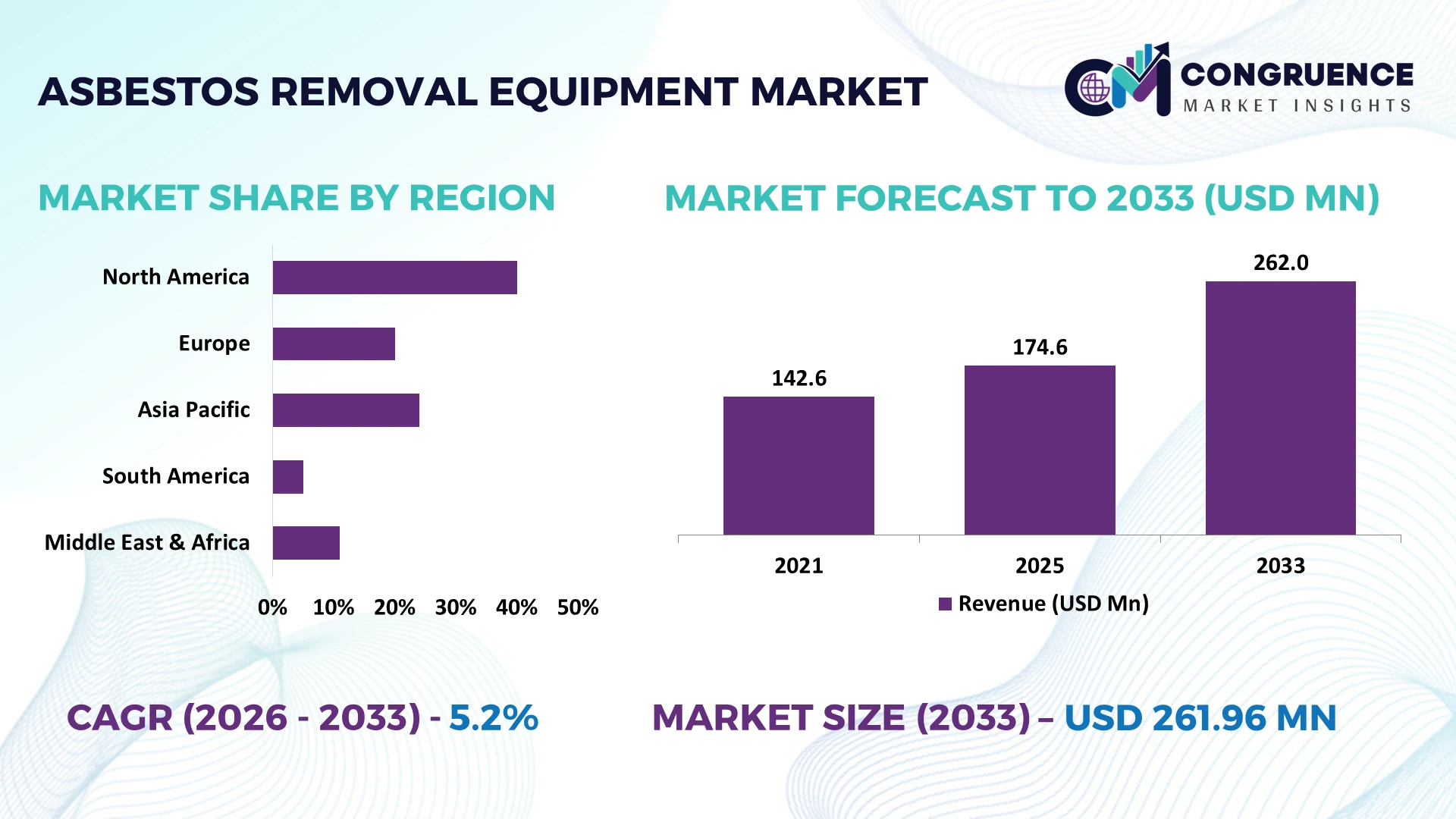
The Global Asbestos Removal Equipment Market was valued at USD 174.63 Million in 2025 and is anticipated to reach a value of USD 261.96 Million by 2033 expanding at a CAGR of 5.2% between 2026 and 2033. Growth is driven by stricter demolition controls, aging asbestos-containing building stock, and rising deployment of HEPA filtration, negative-air containment, and remote-controlled removal systems across refurbishment projects.
The United States remains the dominant country, supported by an asbestos-abatement services market estimated at USD 1.00 billion in 2024, while federal NESHAP requirements govern asbestos controls during qualifying demolition and renovation activities. The UK emphasizes licensed higher-risk removal, with exposure controlled at 0.1 f/cm³ over four hours, reinforcing equipment adoption for compliant containment and air monitoring.
Strategically, suppliers prioritizing certified containment, high-efficiency filtration, and digitally monitored removal systems are best positioned to capture compliance-led replacement demand.
Market Size & Growth: USD 174.63 million in 2025 is projected to reach USD 261.96 million by 2033 at a 5.2% CAGR, supported by regulated renovation, demolition, and advanced containment requirements.
Top Growth Drivers: Regulatory enforcement contributes approximately 35%, aging infrastructure 28%, and technology-led equipment replacement 22% to the market's growth momentum.
Short-Term Forecast: By 2028, automated air-monitoring and containment systems are positioned to deliver approximately 8% higher operational efficiency and 6% lower labor-intensive processing costs.
Emerging Technologies: AI-enabled particulate monitoring, automated negative-pressure control, HEPA filtration, and remotely operated removal equipment are reshaping high-risk asbestos abatement workflows.
Regional Leaders: North America is projected at approximately USD 105 million, Europe near USD 78 million, and Asia-Pacific around USD 52 million by 2033, with adoption accelerating through stricter refurbishment controls.
Consumer/End-User Trends: Approximately 40% of professional abatement operators increasingly prioritize integrated filtration, containment, and real-time monitoring rather than standalone equipment.
Pilot/Case Example: UK licensed-removal operations operating under asbestos regulations demonstrate the importance of controlled exposure, with the legal control limit maintained at 0.1 f/cm³ over four hours.
Competitive Landscape: North American and European suppliers collectively hold an estimated 45% share, with leading competition spanning specialized filtration, containment, remediation, and industrial safety equipment providers.
Regulatory & ESG Impact: U.S. NESHAP requirements and UK licensing controls are strengthening equipment compliance, while high-efficiency filtration can reduce airborne particulate exposure by more than 90% in properly engineered containment systems.
Investment & Funding: Global remediation and building-renovation programs are directing more than USD 1 billion toward asbestos-related abatement services, supporting equipment modernization, contractor expansion, and technology partnerships.
Innovation & Future Outlook: Next-generation systems will combine AI air-quality analytics, connected sensors, automated pressure balancing, and remote operation, shifting competition toward integrated compliance platforms rather than conventional removal tools.
The Asbestos Removal Equipment Market is increasingly concentrated around professional abatement contractors, demolition firms, industrial facilities, schools, hospitals, and aging commercial buildings requiring controlled remediation. Approximately 40% of operators are moving toward integrated containment and monitoring solutions as regulations tighten and project documentation becomes more demanding. In the UK, higher-risk asbestos removal requires licensed contractors, while U.S. demolition and renovation projects face federal asbestos-control requirements, reinforcing demand for compliant equipment and measurable operational controls. This shift strengthens the strategic case for automation, filtration efficiency, and digitally monitored containment systems.
The Asbestos Removal Equipment Market is becoming strategically important as aging building stock, regulated demolition, and occupational-exposure controls turn remediation capability into a competitive differentiator. In the United States, federal asbestos requirements are accelerating demand for compliant containment, filtration, and monitoring systems, while the UK maintains a 0.1 f/cm³ four-hour control limit. This regulatory shift is restructuring contractor procurement toward certified, integrated equipment platforms.
Technology is also changing project economics. Modern HEPA-equipped negative-air systems with automated pressure monitoring can reduce manual inspection requirements by approximately 15% and improve containment consistency by nearly 10% versus conventional setups. Germany and the UK emphasize tightly controlled licensed-removal workflows, while the United States has greater equipment deployment across commercial renovation, industrial facilities, schools, and infrastructure projects. Over the next 2–3 years, connected monitoring and automated pressure control are expected to penetrate roughly 30% of professional remediation workflows.
Practically, large demolition projects increasingly combine negative-pressure units, air scrubbers, remote monitoring, and sealed containment zones to maintain compliance throughout phased removal. Companies are responding by expanding specialized equipment portfolios, partnering with remediation contractors, and investing in sensor-enabled systems. Competitive advantage will increasingly depend on equipment reliability, documented compliance, deployment speed, and lifecycle operating efficiency rather than standalone hardware capability.
Stricter asbestos-control requirements are the primary structural driver, with regulatory compliance influencing approximately 35% of equipment purchasing decisions among professional remediation operators. Automated air monitoring can improve process-control efficiency by about 10%, while advanced HEPA filtration systems reduce particulate-management exposure by more than 90% when properly engineered. In the United States, NESHAP-controlled demolition and renovation activity is encouraging contractors to replace fragmented equipment with integrated containment systems. Companies are responding through equipment upgrades, contractor partnerships, and localized service networks. The non-obvious advantage is documentation: connected monitoring creates auditable operating records that reduce compliance friction and strengthen contractor selection in high-value industrial and infrastructure projects.
High acquisition and maintenance costs constrain adoption, particularly among smaller remediation contractors. Advanced negative-air machines, HEPA filtration units, and monitoring equipment can carry 20–30% higher upfront costs than conventional systems, while specialized replacement filters and components can account for roughly 10–15% of annual equipment expenditure. In the United States, fragmented contractor networks also create uneven access to advanced service capabilities. Supply-chain disruptions affecting motors, filtration media, sensors, and control components can extend equipment replacement cycles. Companies are mitigating these pressures through multi-year procurement contracts, domestic sourcing, modular equipment designs, and supplier diversification. The key operational constraint is total lifecycle cost rather than initial purchase price, making serviceability increasingly decisive.
Digital monitoring creates an underdeveloped opportunity for equipment suppliers to move beyond hardware sales. Approximately 30% of professional remediation workflows are positioned for connected pressure, particulate, and equipment-status monitoring over the next 2–3 years, while automated controls can improve operating consistency by 10–15%. In the UK, stringent documentation requirements create a strong use case for digitally recorded exposure-control data. Suppliers can combine IoT sensors, cloud dashboards, automated alarms, HEPA filtration, and predictive maintenance into subscription-supported platforms. Companies investing in R&D partnerships with remediation contractors and environmental-monitoring specialists can capture recurring service revenue while improving equipment utilization. The strongest opportunity lies in converting compliance data into an operational asset.
Long-term scalability is challenged by skilled-labor shortages, heterogeneous equipment fleets, and integration complexity across containment environments. Manual procedures can consume 15–20% more operational time than standardized digitally monitored workflows, while workforce training requirements can add 5–10% to project preparation costs. In the United States and United Kingdom, evolving compliance documentation further increases the need for consistent operator competency. Companies must invest in workforce certification, interoperable sensor architectures, remote diagnostics, and standardized operating protocols. The deeper challenge is maintaining identical containment performance across dispersed project sites. Suppliers that combine intuitive controls with remote technical support will gain an operational advantage by reducing deployment variability and dependence on highly specialized onsite expertise.
Digital Monitoring Moves Onsite: Real-time pressure and air-quality monitoring is becoming more common in professional containment workflows, with about 45% of newly installed containment systems incorporating digital pressure or filter-performance indicators. Companies are integrating sensors with negative-air machines to reduce manual checks and strengthen compliance records.
Portable Systems Gain Ground: Battery-powered vacuum systems account for approximately 24% of newly introduced portable equipment, reflecting demand for mobility across confined renovation areas. Lightweight designs reduce setup constraints and improve equipment flexibility, prompting manufacturers to expand cordless and compact HEPA product portfolios.
Filtration Standards Tighten: HEPA filtration remains central to professional removal, with certified systems targeting 99.97% capture efficiency for 0.3-micron particles. Approximately 32% of large commercial remediation projects now incorporate remote environmental sensing, encouraging suppliers to combine filtration, monitoring, and alarm functions into integrated equipment packages.
Automation Reshapes Containment: Variable-speed negative-air systems and automated pressure controls are gaining attention as projects require continuous containment over extended work periods. Modern systems can maintain approximately 5 Pa pressure differentials, while 2025 equipment innovation increasingly incorporates variable-frequency drives, prompting manufacturers to prioritize energy-efficient controls and remote operating capabilities.
Negative Air Machines represent the leading type within the specified equipment mix, accounting for approximately 31% of demand because they provide continuous pressure control across containment zones and integrate directly with HEPA filtration. Their scalable airflow capability makes them particularly important for large renovation and demolition environments. HEPA Vacuums follow at approximately 24%, supported by localized fiber and debris capture, while Air Scrubbers account for nearly 19% because of their role in continuous airborne-particle filtration. Wet Removal Systems and Decontamination Units remain essential specialized equipment for controlled material removal and worker transition areas.
Wet Removal Systems are emerging as the fastest-growing type, with adoption increasing by approximately 9% as contractors prioritize methods that suppress airborne fiber generation at the point of removal. Companies are consequently expanding integrated product portfolios rather than relying on standalone machines. The strategic shift favors suppliers offering compatible negative-air, filtration, wet-removal, and decontamination configurations that reduce setup complexity and improve equipment utilization.
Building Renovation is the leading application, accounting for approximately 40% of equipment demand as older structures undergo HVAC replacement, structural modification, flooring upgrades, and modernization work requiring asbestos controls before disturbance. Demolition represents the fastest-growing application, with deployment expanding around 9% as redevelopment and infrastructure replacement expose asbestos-containing materials. Industrial Maintenance contributes roughly 20%, supported by shutdown-based remediation, while Pipe & Insulation Removal remains a specialized application with concentrated demand around older mechanical systems.
Renovation has a broader equipment requirement than many single-purpose projects because contractors frequently combine negative-air machines, HEPA vacuums, air scrubbers, and decontamination units within one containment workflow. Demolition increasingly requires higher-capacity systems and faster deployment, shifting purchasing toward mobile equipment fleets. Companies are responding by expanding rental availability, standardizing equipment packages, and developing systems that can transition between renovation and demolition environments without extensive reconfiguration.
Abatement Contractors are the leading end-user group, accounting for approximately 46% of equipment demand because they operate across multiple projects and require high utilization, mobility, and dependable containment performance. Construction Companies follow at approximately 25%, supported by renovation and demolition contracts, while Industrial Facilities represent around 18% and Government Agencies approximately 11%. Abatement contractors therefore exert the strongest influence over equipment specifications, service requirements, and fleet purchasing decisions.
Government Agencies are emerging as the fastest-growing end-user group, with adoption increasing by approximately 8% as public-building renovation, school modernization, and infrastructure projects strengthen requirements for documented asbestos control. Industrial Facilities increasingly favor equipment capable of supporting scheduled shutdowns without disrupting adjacent operations. Suppliers are responding through contractor partnerships, rental programs, equipment servicing, and customized fleet packages. The non-obvious competitive shift is toward availability and technical support, as contractors increasingly value rapid deployment and reliable maintenance alongside equipment performance.
North America accounted for the largest market share at 38% in 2025 however, Asia-Pacific is expected to register the fastest growth, expanding at a CAGR of 5.8% between 2026 and 2033.
Regulatory Compliance and Infrastructure Remediation Lead Demand
North America holds approximately 38% of the global market, with the United States representing the primary demand center due to extensive commercial, institutional, industrial, and infrastructure remediation activity. More than 70% of U.S. states apply asbestos-related requirements to regulated demolition or renovation activities, supporting consistent deployment of negative-air machines, HEPA vacuums, containment systems, and air-monitoring equipment. Canada contributes through infrastructure renewal and stringent occupational controls. U.S. contractors increasingly favor integrated equipment fleets capable of supporting multi-zone containment, while suppliers are expanding rental, maintenance, and technical-support networks. Digital pressure monitoring is becoming increasingly relevant on complex projects, improving documentation and reducing manual verification requirements. The region's mature contractor ecosystem gives equipment manufacturers an advantage in premium filtration, automation, and service-based deployment models.
United States Market Outlook: The United States remains the dominant country, supported by its large remediation contractor base and extensive inventory of older buildings. Equipment demand is concentrated around schools, healthcare facilities, commercial properties, industrial sites, and demolition projects. Leading suppliers increasingly combine HEPA filtration, negative pressure, containment, and monitoring into standardized project packages.
Strict Compliance and Building Modernization Reshape Procurement
Europe accounts for approximately 26% of global demand and remains a technologically mature market because asbestos controls are embedded within occupational-safety and refurbishment practices. Germany, the United Kingdom, France, and the Netherlands represent important equipment-demand centers, particularly across aging commercial buildings, public facilities, industrial assets, and transportation infrastructure. More than 30 European countries maintain asbestos-control measures, sustaining demand for certified filtration and containment equipment. European contractors increasingly prioritize energy-efficient negative-pressure systems and digitally controlled decontamination units. Suppliers are responding with modular equipment, rental programs, and integrated service packages. The region also demonstrates stronger interest in equipment lifecycle efficiency, with advanced negative-pressure systems offering substantial energy savings compared with conventional motor configurations. This creates a competitive advantage for manufacturers combining compliance, efficiency, and lower operating costs.
Germany Market Outlook: Germany stands out through stringent workplace controls, industrial modernization, and extensive refurbishment activity. Its large manufacturing and commercial-building base creates recurring requirements for controlled asbestos remediation. Equipment suppliers benefit from demand for high-performance extraction, containment, and decontamination systems, while energy-efficient motors and digitally monitored equipment increasingly influence procurement decisions.
Urban Redevelopment Accelerates Specialized Equipment Deployment
Asia-Pacific represents approximately 23% of the global market and is positioned as the fastest-expanding demand center as China, India, Japan, Australia, and Southeast Asian economies modernize aging buildings and industrial facilities. Urban redevelopment accounts for a substantial portion of asbestos-remediation activity, while older factories, public buildings, and infrastructure projects require specialized containment and filtration equipment. India is becoming increasingly relevant as inspection and remediation activity expands across public infrastructure and older construction. Japan and Australia maintain more mature compliance practices, supporting higher-value equipment adoption. Manufacturers are responding through distributor partnerships, localized service capabilities, compact systems, and adaptable equipment suited to varied project scales. The region's key strategic advantage is volume of modernization activity, while the principal opportunity lies in moving contractors from basic equipment toward certified, integrated remediation systems.
China Market Outlook: China represents the strongest industrial-scale opportunity in Asia-Pacific because of its extensive manufacturing base, urban redevelopment activity, and large inventory of aging industrial and commercial structures. Demand increasingly favors higher-capacity filtration, negative-pressure equipment, and controlled decontamination systems for complex sites. Suppliers with local distribution and technical-service capabilities are positioned to improve deployment speed and project coverage.
Industrial Renovation Creates Selective Remediation Demand
South America represents a smaller but strategically relevant equipment market, with Brazil accounting for the largest share of regional demand because of its industrial scale, construction activity, and extensive building stock. Approximately 7% of global demand is estimated to originate from South American projects, concentrated around commercial renovation, industrial maintenance, demolition, and specialized insulation removal. Brazil's large urban centers create recurring remediation requirements, while Argentina and Chile provide smaller project opportunities. Adoption remains more fragmented than in North America and Europe, with equipment purchasing often influenced by project-specific requirements and contractor capability. Suppliers are increasingly using distributors, rental arrangements, and service partnerships to reduce capital barriers. The strongest opportunity is standardized mobile equipment that can serve multiple project types, improving utilization where contractor fleets remain relatively limited.
Brazil Market Outlook: Brazil is the region's most significant market because of its industrial base, urban construction activity, and concentration of large infrastructure projects. Demand is strongest in São Paulo and other major industrial centers, where contractors require HEPA extraction, negative-pressure systems, and controlled containment. Local distribution and technical servicing remain critical for improving equipment availability and reducing project downtime.
Infrastructure Modernization Expands Specialized Remediation
Middle East & Africa accounts for approximately 13% of global demand, with the United Arab Emirates, Saudi Arabia, and South Africa representing important deployment centers. Large-scale commercial construction, hospitality redevelopment, industrial modernization, and public-infrastructure projects are creating opportunities where legacy materials require controlled assessment and removal. Approximately 40% of regional demand is concentrated around infrastructure and building-modernization projects, increasing requirements for mobile containment, HEPA filtration, and decontamination equipment. International contractors are raising equipment standards on major projects, encouraging local suppliers to align with internationally recognized safety practices. Companies are responding through equipment leasing, distributor partnerships, and project-specific service agreements. The region's non-obvious advantage is its concentration of large projects, where high-capacity equipment can generate stronger utilization than fragmented small-site applications.
United Arab Emirates Market Outlook: The UAE is the leading strategic market because of its high concentration of commercial redevelopment, hospitality renovation, and large infrastructure projects. Major contractors increasingly require internationally compliant containment and filtration systems for controlled work environments. Equipment suppliers with rapid deployment, rental availability, and technical support can capture demand generated by fast-moving construction schedules.
The Asbestos Removal Equipment Market features global filtration and industrial-equipment companies such as 3M, Nilfisk, Kärcher, and Numatic competing with specialized suppliers including Dehaco, Abatement Technologies, and deconta. The top five players collectively account for approximately 40–45% of the market, indicating a moderately fragmented structure. Competition centers on filtration performance, equipment reliability, customization, service coverage, and delivery speed. Premium systems typically command 10–20% higher pricing when advanced monitoring, HEPA filtration, or automated controls are integrated. European specialists compete through customization and compliance expertise, while larger manufacturers leverage distribution and manufacturing scale. Companies are expanding rental programs, developing modular equipment, strengthening distributor networks, and integrating digital monitoring. The competitive shift is toward complete remediation packages rather than standalone machines. High certification requirements, specialized engineering, and service infrastructure create meaningful entry barriers. Winning suppliers will combine certified performance, rapid deployment, lifecycle efficiency, and strong contractor support.
3M
Nilfisk A/S
Alfred Kärcher SE & Co. KG
Numatic International Ltd.
Abatement Technologies, Inc.
Dehaco B.V.
deconta GmbH
ILC Dover
Thermac
Sundström Safety AB
RONDA Enviro Vac
Amesa Suministros SL
Kerstar
NegAir Ltd.
Current asbestos removal equipment is centered on H-class/HEPA vacuums, negative-air machines, air scrubbers, and continuous pressure monitoring. Certified HEPA systems capture 99.97% of 0.3-micron particles, while automatic filter-cleaning designs can preserve suction performance and cut intervention time by roughly 8%. Adoption is strongest among professional contractors handling regulated renovation and demolition.
Emerging systems integrate variable-speed drives, digital manometers, remote pressure alerts, modular containment, and connected maintenance records. Advanced negative-pressure units can reduce energy consumption by up to 70% versus older motor technology, while remote monitoring can improve workflow oversight by 10–15%. Deployment is shifting toward integrated equipment packages, particularly in the UK, Australia, and North America, where compliance documentation increasingly influences procurement.
Disruptive technologies are moving removal toward compact containment and automated extraction. Mini-containment concepts can increase enclosure air circulation from roughly six changes hourly to nearly one per minute, while integrated vacuum-and-waste systems can accelerate removal by more than 200% versus manual handling. By 2026–2028, connected monitoring, energy-efficient drives, and modular decontamination units will increasingly define premium equipment specifications. Technology-focused manufacturers and specialized abatement contractors benefit most because integration lowers setup complexity, strengthens compliance evidence, improves fleet utilization, and supports faster project execution across complex, multi-zone remediation projects today.
February 2025 — Dustcontrol upgraded its asbestos extractor from DC 2800 to DC 2900 H Asbestos, adding a protective enclosure and container option. The redesign strengthens fiber containment and equipment handling, supporting contractors seeking point-of-source extraction and lower contamination exposure. Source: dustcontrol.com
May 2025 — Alltask expanded its relationship with British Gas On Demand toward Electrical Services, targeting asbestos-containing equipment removal across field operations. Alltask reported more than £6.9 million of previous British Gas work, strengthening its position for nationwide remediation contracts. Source: alltask.co.uk
May 2025 — The Guinness Partnership published a five-year asbestos-removal procurement pipeline covering properties across England, with an estimated £1.666 million contract value. The 2026–2031 program signals sustained institutional remediation demand and creates opportunities for contractors and specialist equipment suppliers. Source: find-tender.service.gov.uk
November 2024 — Halton partnered with DECX Technology to introduce the Vita VDU-750 decontamination unit in India. The system uses automated hydrogen-peroxide-vapour technology delivering a 6-log10 reduction, expanding decontamination capabilities and strengthening Halton’s access to India’s industrial and healthcare markets. Source: halton.com
The Scope of the Asbestos Removal Equipment Market Report covers five equipment types: Negative Air Machines, HEPA Vacuums, Air Scrubbers, Wet Removal Systems, and Decontamination Units. Application coverage spans Building Renovation, Demolition, Industrial Maintenance, and Pipe & Insulation Removal, while end-user analysis evaluates Abatement Contractors, Construction Companies, Industrial Facilities, and Government Agencies. The report also assesses adoption of filtration, negative-pressure control, automated monitoring, modular containment, and energy-efficient equipment.
Geographic coverage includes North America, Europe, Asia-Pacific, South America, and Middle East & Africa, with country-level assessment of major demand centers. The analysis tracks deployment concentration, technology adoption, procurement patterns, competitive positioning, and emerging niche opportunities. Coverage of 5 types, 4 applications, and 4 end-user groups provides a structured basis for evaluating market priorities. The findings support investment planning, geographic expansion, product development, partnership strategy, fleet optimization, and competitive positioning through 2026–2033.
| Report Attribute/Metric | Report Details |
|---|---|
Market Revenue in 2025 | USD 174.63 Million |
Market Revenue in 2033 | USD 261.96 Million |
CAGR (2026 - 2033) | 5.2% |
Base Year | 2025 |
Forecast Period | 2026 - 2033 |
Historic Period | 2021 - 2025 |
Segments Covered | By Type
By Application
By End-User
|
Key Report Deliverable | Revenue Forecast, Growth Trends, Market Dynamics, Segmental Overview, Regional and Country-wise Analysis, Competition Landscape |
Region Covered | North America, Europe, Asia-Pacific, South America, Middle East, Africa |
Key Players Analyzed | 3M, Nilfisk A/S, Alfred Kärcher SE & Co. KG, Numatic International Ltd., Abatement Technologies, Inc., Dehaco B.V., deconta GmbH, ILC Dover, Thermac, Sundström Safety AB, RONDA Enviro Vac, Amesa Suministros SL, Kerstar, NegAir Ltd. |
Customization & Pricing | Available on Request (10% Customization is Free) |




