
Reports
The Global Artificial Intelligence in E-commerce Market was valued at USD 8650 Million in 2025 and is anticipated to reach a value of USD 55406.8 Million by 2033 expanding at a CAGR of 26.13% between 2026 and 2033. Growth is being accelerated by enterprise-wide deployment of AI-powered product recommendations, intelligent pricing engines, automated customer support, and predictive inventory optimization across global digital commerce ecosystems.
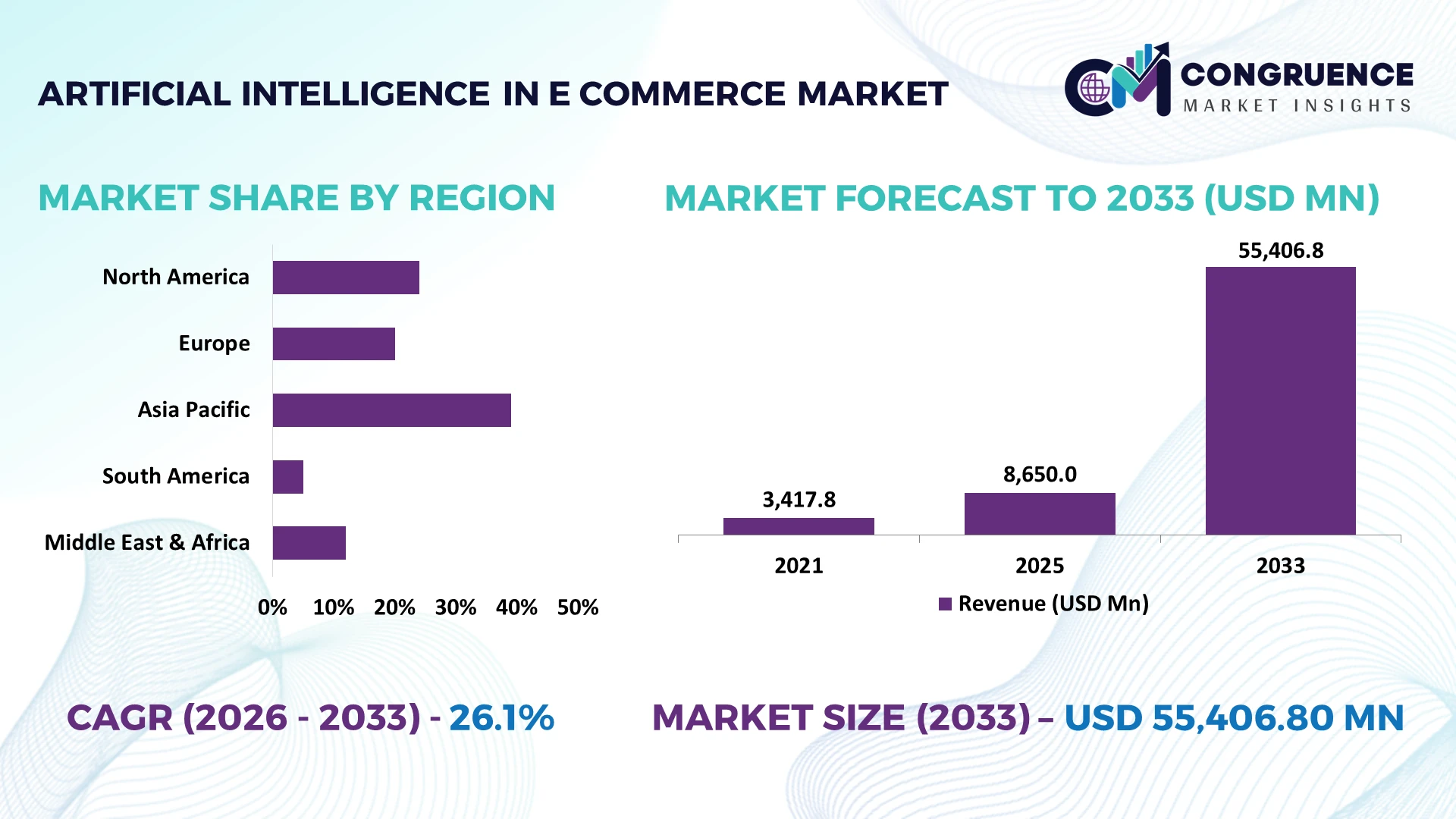
The United States leads the global market with approximately 36% share, supported by over 80% AI adoption among large online retailers, strong hyperscale cloud infrastructure, and sustained enterprise investments across retail, logistics, and digital payments. Compared with China, where AI-enabled cross-border commerce and live shopping platforms continue expanding rapidly, the U.S. maintains stronger enterprise software integration despite increasing regional competition. Ongoing AI policy development and semiconductor supply-chain realignment in 2026 continue influencing deployment strategies across major markets.
Businesses that prioritize scalable AI platforms, localized customer intelligence, and resilient digital commerce infrastructure are positioned to strengthen competitive advantage and long-term market leadership.
Market Size & Growth: USD 8650 Million in 2025 is projected to reach USD 55406.8 Million by 2033 at a CAGR of 26.13%, driven by enterprise AI adoption for personalization and automated commerce operations.
Top Growth Drivers: AI-powered personalization lifts conversion rates by approximately 25%, intelligent pricing improves margins by nearly 12%, and automated fulfillment reduces processing time by around 35%.
Short-Term Forecast: By 2028, AI-enabled retailers are expected to reduce customer service costs by about 30% while increasing order processing efficiency by nearly 40%.
Emerging Technologies: Generative AI, autonomous shopping assistants, and computer vision are transforming advanced digital merchandising and inventory automation across global retail networks.
Regional Leaders: North America exceeds USD 20 Billion, Asia-Pacific approaches USD 18 Billion, and Europe surpasses USD 11 Billion by 2033, supported by expanding enterprise AI deployment and regional digital commerce expansion.
Consumer/End-User Trends: More than 70% of online shoppers engage with AI-powered recommendations, improving purchase frequency and customer retention.
Pilot/Case Example: In 2026, AI-driven warehouse optimization projects reduced order fulfillment time by approximately 28% while improving inventory accuracy by nearly 20%.
Competitive Landscape: Leading providers collectively account for roughly 45% market share, with Amazon Web Services, Microsoft, Google Cloud, Salesforce, and Adobe driving enterprise innovation.
Regulatory & ESG Impact: Responsible AI governance and energy-efficient infrastructure improve compliance readiness by over 20% while supporting transparent algorithm deployment amid evolving global AI regulations.
Investment & Funding: More than USD 12 Billion in enterprise investments supports AI platforms, strategic partnerships, and retail automation despite ongoing semiconductor supply-chain adjustments.
Innovation & Future Outlook: Multimodal AI, autonomous commerce agents, and predictive decision intelligence are reshaping high-growth e-commerce ecosystems with stronger focus on scalable, real-time personalization.
Artificial Intelligence in E-commerce Market continues expanding through intelligent search, conversational shopping assistants, predictive merchandising, and automated fulfillment technologies that improve customer engagement and operational precision. More than 65% of enterprise retailers are increasing AI investments to strengthen omnichannel experiences and demand forecasting. As regulatory expectations for responsible AI evolve and supply-chain resilience remains a priority, vendors are advancing scalable platforms, setting the foundation for the strategic market assessment that follows.
Artificial Intelligence in E-commerce has become a strategic differentiator as retailers compete through real-time personalization, automated decision-making, and intelligent fulfillment rather than product assortment alone. The market is also benefiting from supply-chain restructuring following global sourcing diversification and continued digital infrastructure modernization, enabling enterprises to build more resilient and data-driven commerce ecosystems. AI deployment is increasingly linked to customer lifetime value, inventory precision, and operational responsiveness, making it a board-level investment priority.
Compared with traditional rule-based commerce platforms, modern AI-powered recommendation and forecasting engines improve inventory forecast accuracy by nearly 30% while reducing manual merchandising effort by approximately 40%. The United States leads in enterprise-scale AI deployment supported by mature cloud infrastructure, whereas China advances through AI-enabled social commerce, livestream retail, and high-volume digital transactions. Over the next two to three years, more than 75% of leading online retailers are expected to integrate generative AI into customer engagement and merchandising workflows to improve operational agility.
Large retailers are deploying AI-powered warehouse orchestration and conversational shopping assistants to shorten fulfillment cycles and strengthen customer retention. Companies are expanding strategic partnerships with cloud providers, logistics specialists, and AI software developers while increasing investment in proprietary commerce intelligence. Organizations that combine scalable AI infrastructure with responsible governance and continuous model optimization will secure stronger competitive positioning and long-term operational resilience.
Enterprise-wide adoption of intelligent commerce platforms is transforming merchandising, pricing, customer engagement, and fulfillment into automated, data-driven processes. AI-powered recommendation engines increase conversion rates by approximately 25%, while predictive inventory systems reduce stock shortages by nearly 30% and automated customer support resolves up to 70% of routine inquiries. In the United States, major retailers continue integrating generative AI with omnichannel operations following expanded investments in cloud infrastructure and digital fulfillment. This structural shift improves operating efficiency while reducing service costs. Companies are responding through technology partnerships, acquisitions, and in-house AI model development, enabling faster product launches and highly personalized customer experiences. A key strategic advantage lies in combining first-party consumer data with AI-driven decision intelligence to improve profitability and customer retention simultaneously.
Fragmented enterprise data environments and tightening AI governance requirements continue slowing large-scale implementation across digital commerce ecosystems. Around 45% of retailers report integration challenges between legacy commerce platforms and advanced AI applications, while nearly 35% experience delays due to data quality and interoperability issues. In Europe, stricter AI governance frameworks require greater transparency and model accountability, increasing deployment complexity for multinational retailers. These structural limitations raise implementation costs, extend deployment timelines, and reduce operational scalability. Companies are mitigating risks through standardized data architectures, localized cloud deployments, and long-term technology partnerships that improve interoperability. Organizations investing early in governance frameworks and unified data management are reducing compliance burdens while creating stronger foundations for enterprise-wide AI deployment.
Next-generation AI technologies are creating new opportunities beyond personalization by enabling autonomous merchandising, intelligent procurement, and predictive supply-chain orchestration. More than 60% of enterprise retailers are prioritizing generative AI pilots, while AI-assisted content creation reduces campaign development time by approximately 50% and dynamic pricing improves promotional effectiveness by nearly 15%. India is emerging as a strategic innovation hub through rapid digital commerce expansion and large-scale AI developer ecosystems supporting localized retail solutions. Companies are increasing R&D spending, building ecosystem partnerships, and expanding AI marketplaces to accelerate deployment across small and mid-sized merchants. A notable strategic opportunity lies in combining multimodal AI with real-time consumer analytics to create adaptive commerce experiences that continuously optimize product discovery and purchasing behavior.
Moving from successful pilot projects to enterprise-wide AI deployment remains a significant execution challenge because of cybersecurity exposure, model governance, and workforce capability gaps. Nearly 40% of organizations report shortages of advanced AI specialists, while approximately 30% encounter performance inconsistencies when deploying models across multiple business units. In Japan, retailers operating highly automated fulfillment networks must balance AI innovation with stringent reliability and operational continuity requirements. These challenges affect deployment consistency, customer trust, and long-term competitiveness. Companies are strengthening cybersecurity frameworks, investing in AI governance platforms, and expanding partnerships with cloud and semiconductor providers to improve scalability. Organizations that successfully standardize AI lifecycle management and workforce capabilities will establish sustainable operational advantages as intelligent commerce becomes increasingly embedded across retail value chains.
AI Shopping Agents Expand Enterprise retailers are deploying generative AI shopping assistants that now handle nearly 45% of pre-purchase interactions and improve product discovery accuracy by around 32%. Following rapid advances in large language models and enterprise AI platforms, companies are embedding conversational commerce into websites and mobile applications. This reduces customer support workloads while increasing conversion quality. Retailers in the United States are scaling strategic partnerships with cloud AI providers to standardize multilingual customer engagement and accelerate digital commerce operations.
Predictive Fulfillment Optimization Grows AI-driven demand forecasting and warehouse orchestration are reducing inventory forecasting errors by approximately 28% and improving fulfillment speed by nearly 24%. Persistent supply-chain diversification and inventory volatility are encouraging retailers to synchronize procurement, logistics, and fulfillment through real-time analytics. Companies are restructuring warehouse workflows, expanding automation investments, and integrating predictive replenishment systems to reduce stock imbalances while improving order consistency across multiple distribution centers.
Responsible AI Governance Strengthens Enterprise adoption is increasingly aligned with explainable AI and governance frameworks as more than 60% of large retailers establish internal AI oversight programs. Regulatory evolution in Europe and stricter enterprise procurement standards are driving demand for transparent algorithms and auditable decision models. Companies are redesigning deployment workflows, strengthening data governance policies, and adopting model monitoring platforms that improve compliance while protecting customer trust and operational continuity.
Unified Commerce Intelligence Advances More than 55% of enterprise retailers are integrating AI across marketing, merchandising, pricing, and customer service through unified commerce platforms, reducing decision cycles by approximately 35%. A notable shift involves combining first-party customer data with operational analytics rather than relying primarily on third-party data sources. Companies are expanding enterprise software ecosystems, automating cross-functional workflows, and forming technology alliances to improve real-time commercial intelligence and strengthen long-term operational resilience.
Software remains the leading segment with an estimated market share of approximately 46%, driven by widespread deployment of recommendation engines, predictive analytics, intelligent search, and pricing optimization solutions. Organizations favor software because of rapid implementation, seamless integration with existing commerce infrastructure, and measurable operational improvements. Services continue supporting enterprise deployments through consulting, customization, and AI model optimization, particularly among multinational retailers managing complex digital ecosystems. Companies are expanding software portfolios with embedded generative AI capabilities while strengthening implementation partnerships to improve deployment efficiency and customer outcomes.
Platforms represent the fastest-growing segment as enterprises increasingly seek unified environments combining AI development, deployment, governance, and analytics. Adoption of enterprise AI platforms has increased by nearly 30% across large retailers, while integrated platforms reduce operational complexity by approximately 25% compared with fragmented architectures. Vendors are investing in scalable cloud-native ecosystems and strategic alliances that simplify cross-channel AI deployment. Investment priorities are steadily shifting toward end-to-end platforms capable of supporting long-term automation, governance, and intelligent commerce operations.
Product Recommendations account for the largest share at approximately 34%, supported by their direct influence on customer engagement, basket value, and conversion performance. AI recommendation engines increase average order values by nearly 20% while improving click-through performance by approximately 25%, making them an essential capability for enterprise retailers. Personalized Marketing is the fastest-growing application as generative AI enables real-time campaign optimization, audience segmentation, and dynamic content generation. Companies continue integrating these capabilities into omnichannel marketing strategies to strengthen customer retention and purchasing frequency.
Customer Service remains strategically important through conversational AI and automated support, while Inventory Management is expanding with predictive replenishment and demand planning technologies that reduce stock discrepancies by around 30%. Fraud Detection continues gaining relevance as digital payment volumes increase, with AI identifying suspicious transactions nearly 40% faster than conventional rule-based systems. Enterprises are scaling automation, integrating multiple AI applications into unified commerce workflows, and prioritizing deployment strategies that maximize operational intelligence across customer-facing and back-end processes.
Online Retailers hold the dominant position with an estimated market share of approximately 41% because of their dependence on continuous customer engagement, dynamic pricing, and automated fulfillment. Large digital retailers deploy AI extensively across merchandising, customer support, inventory planning, and marketing to improve operational responsiveness. Marketplaces continue expanding AI integration for seller management, search optimization, and fraud prevention, while Retail Chains increasingly connect physical stores with digital commerce platforms. Companies are delivering customized AI solutions and subscription-based deployment models to strengthen adoption across these established customer groups.
Direct-to-Consumer Brands represent the fastest-growing end-user segment as businesses increasingly invest in personalized digital experiences and first-party customer intelligence. AI adoption among D2C brands has increased by approximately 35%, while automated campaign optimization reduces customer acquisition costs by nearly 18%. E-commerce Service Providers are also strengthening demand by embedding AI into logistics, payment processing, and storefront management platforms. Vendors are expanding ecosystem partnerships, industry-specific product offerings, and flexible pricing models to capture evolving enterprise requirements and reinforce long-term competitive positioning.
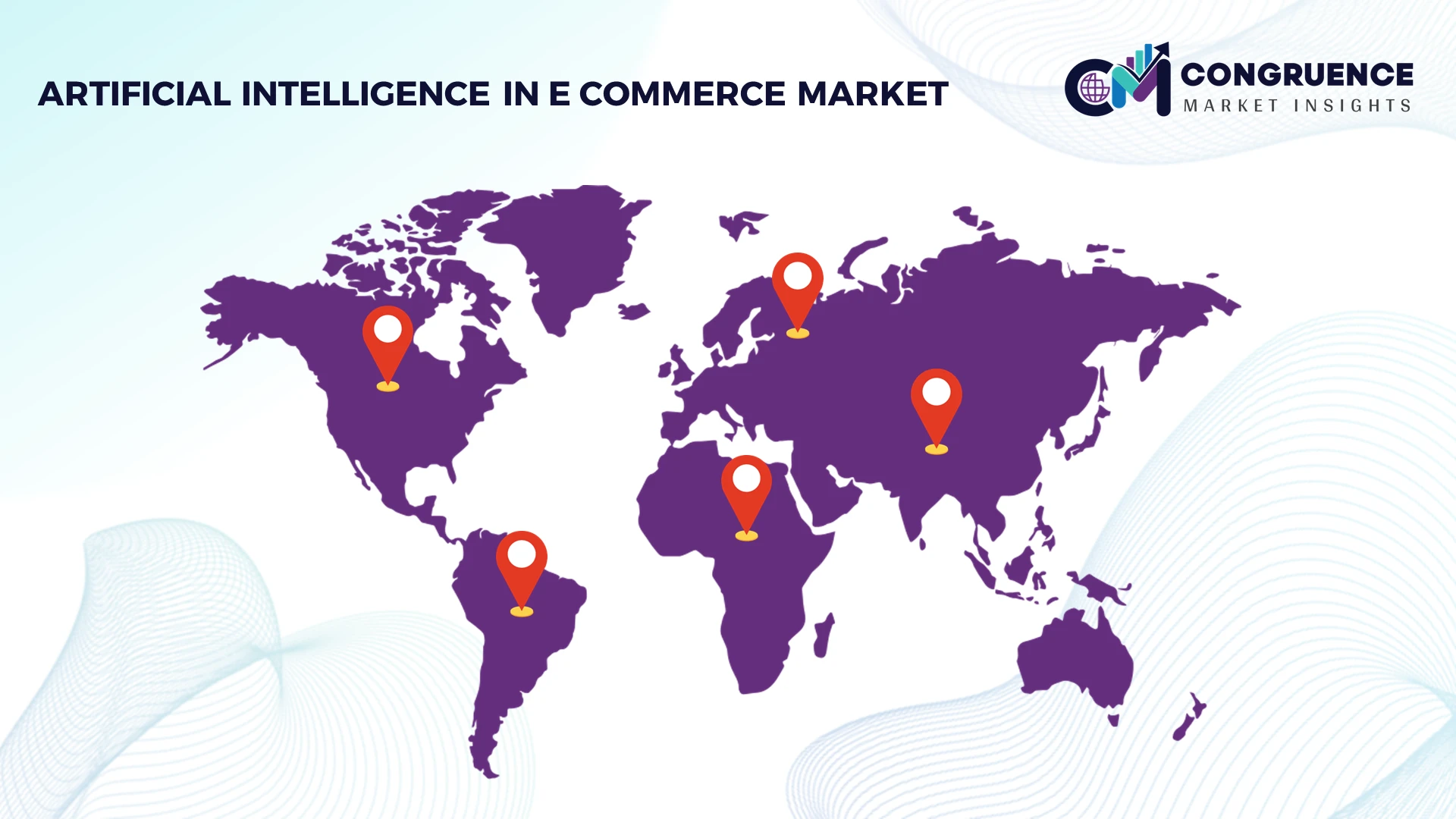
North America accounted for the largest market share at 36.2% in 2025 however, Asia-Pacific is expected to register the fastest growth, expanding at a CAGR of 28.8% between 2026 and 2033.
Enterprise AI Scaling Through Digital Commerce Leadership
North America remains the leading regional market due to its mature digital commerce ecosystem, advanced cloud infrastructure, and strong enterprise AI adoption. Large retailers are integrating generative AI, predictive analytics, and intelligent fulfillment into end-to-end commerce operations, supporting approximately 36.2% of global market demand. More than 78% of major online retailers have embedded AI across customer engagement and inventory optimization workflows. Continued investments in hyperscale data centers and AI infrastructure are accelerating deployment speed while improving operational resilience. Strategic partnerships between retail enterprises and cloud technology providers are reducing implementation timelines by nearly 30%, enabling scalable omnichannel commerce. Companies continue prioritizing proprietary AI development and enterprise-wide automation to improve customer retention, merchandising precision, and operational efficiency.
United States Market Outlook: The United States dominates regional demand through advanced enterprise software deployment, digital payment infrastructure, and large-scale online retail operations. More than 80% of leading enterprise retailers have adopted AI-powered recommendation engines or intelligent customer service platforms. Strong investments in cloud computing, AI accelerators, and fulfillment automation continue strengthening operational leadership. Retailers are expanding collaborations with AI software developers and logistics providers to enhance real-time personalization, predictive inventory management, and intelligent order fulfillment across nationwide digital commerce networks.
Governance-Driven AI Modernization Reshaping Retail
Europe continues strengthening its position through responsible AI deployment, advanced digital retail modernization, and robust enterprise technology adoption. The region contributes approximately 24% of global market activity, supported by expanding investments in intelligent retail infrastructure and transparent AI governance. More than 62% of large retailers are implementing explainable AI frameworks alongside automated merchandising and customer engagement solutions. Regulatory alignment is encouraging enterprises to strengthen model governance and data transparency while modernizing commerce platforms. Businesses are increasing partnerships with enterprise software vendors to deploy secure AI applications that improve operational efficiency without compromising compliance. The combination of regulatory certainty and digital transformation is reinforcing long-term enterprise adoption.
Germany Market Outlook: Germany leads the regional market through its advanced enterprise technology ecosystem, strong retail digitization, and industrial software expertise. Approximately 68% of major retailers have accelerated AI implementation across pricing optimization, inventory planning, and customer analytics. Companies continue investing in cloud-enabled commerce platforms and AI governance capabilities, enabling scalable deployment while maintaining high operational standards and strengthening enterprise competitiveness across domestic and international retail operations.
Large-Scale Digital Commerce Accelerates AI Deployment
Asia-Pacific represents the fastest-expanding regional market as digital commerce platforms rapidly integrate AI into consumer engagement, logistics, and fulfillment. The region accounts for approximately 30% of global deployment activity, supported by expanding internet penetration, mobile commerce, and enterprise cloud adoption. More than 72% of major online marketplaces are deploying AI-powered recommendation systems and automated customer interaction tools. Investments in hyperscale digital infrastructure and intelligent logistics networks continue improving fulfillment speed and operational efficiency. Companies are strengthening ecosystem partnerships while expanding localized AI capabilities to support multilingual commerce and cross-border transactions across diverse consumer markets.
China Market Outlook: China remains the region's largest AI-enabled e-commerce ecosystem due to high digital transaction volumes, advanced social commerce, and extensive AI integration across retail platforms. More than 75% of leading digital commerce enterprises utilize AI for dynamic pricing, personalized recommendations, and intelligent logistics optimization. Continued investment in cloud infrastructure, intelligent warehousing, and AI research enables rapid commercialization of advanced retail technologies while strengthening global competitiveness.
Digital Retail Expansion Strengthens AI Adoption
South America is experiencing increasing AI deployment as retailers modernize digital commerce operations and improve customer engagement. The region contributes approximately 6% of global market activity, supported by expanding mobile commerce and digital payment adoption. AI-enabled customer service deployments have increased by nearly 35% among leading online retailers, while warehouse automation initiatives continue improving fulfillment efficiency. Infrastructure limitations remain in selected markets, but enterprise investment in cloud-based commerce platforms and regional logistics partnerships is accelerating digital transformation. Companies are focusing on scalable SaaS-based AI solutions that minimize implementation costs while improving operational performance.
Brazil Market Outlook: Brazil leads regional adoption through its expanding online retail sector, digital payment ecosystem, and enterprise investment in intelligent commerce technologies. Nearly 60% of large online retailers have implemented AI-powered customer engagement or marketing automation solutions. Businesses continue strengthening logistics partnerships and cloud infrastructure investments to improve fulfillment consistency, optimize demand forecasting, and expand AI-enabled commerce capabilities across rapidly growing consumer markets.
Digital Infrastructure Investment Accelerates Transformation
The Middle East & Africa market is advancing through national digital transformation initiatives, cloud infrastructure expansion, and increasing enterprise investment in intelligent commerce technologies. The region represents approximately 3.8% of global market activity while demonstrating strong deployment momentum across modern retail ecosystems. AI-enabled customer analytics adoption has increased by nearly 40% among large retail organizations, supported by expanding hyperscale cloud investments and digital infrastructure modernization. Companies are strengthening partnerships with technology providers to improve omnichannel commerce, payment security, and intelligent fulfillment capabilities while accelerating enterprise AI implementation across emerging retail markets.
United Arab Emirates Market Outlook: The United Arab Emirates serves as the regional innovation hub through advanced digital infrastructure, supportive technology policies, and strong enterprise investment in AI-powered commerce. More than 65% of leading retail enterprises have integrated AI into customer engagement, marketing, or operational planning. Continued investments in smart logistics, cloud computing, and digital commerce ecosystems position the country as a strategic gateway for enterprise AI deployment across the wider Middle East.
Competition is led by Microsoft, Google, Amazon Web Services, Salesforce, Adobe, and IBM, while specialized AI commerce providers compete through niche automation and personalization capabilities. Global cloud technology leaders compete against commerce software innovators on platform integration, model performance, deployment speed, and enterprise scalability. The top five participants collectively control approximately 48% of the market. AI-powered recommendation accuracy improves customer conversion by nearly 25%, while workflow automation lowers operating costs by around 20%, making technology performance a primary competitive differentiator rather than pricing alone. Companies are expanding through strategic acquisitions, cloud partnerships, vertical AI integration, and industry-specific product development. Competition is increasingly shifting toward proprietary generative AI capabilities, unified commerce platforms, and secure enterprise deployments as customers demand end-to-end intelligence. High implementation complexity, enterprise data integration, and governance requirements remain significant entry barriers. Sustained success depends on scalable AI platforms, continuous innovation, trusted deployment, and deep integration across digital commerce operations.
Microsoft
Amazon Web Services
Salesforce
Adobe
IBM
Oracle
SAP
NVIDIA
Alibaba Cloud
C3 AI
BigCommerce
Shopify
Dynamic Yield
Artificial intelligence in e-commerce is increasingly centered on generative AI, predictive analytics, recommendation engines, and computer vision integrated with cloud-native commerce platforms. More than 72% of large online retailers have deployed AI across merchandising, customer engagement, or inventory planning, while recommendation engines improve conversion performance by approximately 25%. AI-powered demand forecasting reduces inventory errors by nearly 30%, strengthening supply planning and fulfillment accuracy. Integration with customer data platforms and enterprise resource planning systems enables real-time decision-making, allowing retailers to optimize pricing, promotions, and inventory from a unified operational environment.
Emerging technologies between 2026 and 2028 include autonomous shopping agents, multimodal AI, vector search, and digital twins for fulfillment optimization. Compared with conventional rule-based commerce systems, generative AI reduces content production time by around 60% while increasing merchandising productivity by nearly 40%. More than 55% of enterprise retailers are piloting AI agents capable of automating customer interactions, product discovery, and purchasing workflows. Organizations deploying multimodal AI with predictive logistics gain faster response times, lower operational costs, and improved cross-channel customer experiences, creating measurable competitive differentiation.
Disruptive innovation is shifting competition toward integrated AI commerce ecosystems rather than standalone applications. Cloud providers, enterprise software vendors, and digital commerce platforms are embedding AI governance, explainability, and autonomous decision intelligence directly into retail operations. Early adopters are expected to achieve 20–30% faster operational execution through 2028 by combining agentic commerce, intelligent automation, and real-time analytics, making immediate technology investment essential for sustaining competitive advantage.
May 2025 Shopify introduced AI Store Builder, enabling merchants to generate complete online storefronts from text prompts with three AI-generated store layouts, significantly accelerating store creation and onboarding efficiency. Business impact: faster merchant deployment and reduced setup effort. Source: Reuters
December 2025 Shopify launched its Winter '26 Edition with more than 150 platform updates, embedding AI agents and universal commerce capabilities into developer workflows. Business impact: accelerated AI-native commerce application development and enterprise deployment. Source: Shopify News
May 2026 Google introduced Universal Commerce Protocol enhancements and AI shopping tools connecting Search, Gemini, and Merchant Center, enabling unified AI-assisted purchasing workflows. Business impact: improved retailer visibility across AI-driven shopping experiences and streamlined customer journeys. Source: Google Blog
June 2026 Salesforce released its largest Agentforce Commerce update, reporting retailer-operated AI shopping agents delivered sales growth 59% faster than retailers without shopper agents during measured deployments. Business impact: strengthened autonomous commerce capabilities and enterprise AI adoption. Source: Salesforce News
This report delivers a comprehensive assessment of the Artificial Intelligence in E-commerce market across software, services, and platforms, covering product recommendations, personalized marketing, customer service, inventory management, and fraud detection. It evaluates adoption across online retailers, marketplaces, direct-to-consumer brands, retail chains, and e-commerce service providers while analyzing competitive positioning across North America, Europe, Asia-Pacific, South America, and the Middle East & Africa. More than 70% of enterprise deployments currently focus on customer experience optimization and intelligent commerce automation.
The report examines technology adoption patterns, enterprise deployment strategies, digital infrastructure evolution, and emerging AI innovations expected to shape market direction between 2026 and 2033. It provides strategic insights into regional expansion opportunities, competitive benchmarking, operational transformation, partnership activity, and investment priorities. Coverage also extends to emerging areas including agentic commerce, multimodal AI, autonomous shopping assistants, predictive fulfillment, and AI governance, enabling decision-makers to strengthen market positioning, optimize technology investments, and develop sustainable long-term growth strategies.
| Report Attribute/Metric | Report Details |
|---|---|
Market Revenue in 2025 | USD 8650 Million |
Market Revenue in 2033 | USD 55406.8 Million |
CAGR (2026 - 2033) | 26.13% |
Base Year | 2025 |
Forecast Period | 2026 - 2033 |
Historic Period | 2021 - 2025 |
Segments Covered | By Type
By Application
By End-User
|
Key Report Deliverable | Revenue Forecast, Growth Trends, Market Dynamics, Segmental Overview, Regional and Country-wise Analysis, Competition Landscape |
Region Covered | North America, Europe, Asia-Pacific, South America, Middle East, Africa |
Key Players Analyzed | Microsoft, Google, Amazon Web Services, Salesforce, Adobe, IBM, Oracle, SAP, NVIDIA, Alibaba Cloud, C3 AI, BigCommerce, Shopify, Dynamic Yield |
Customization & Pricing | Available on Request (10% Customization is Free) |




