
Reports
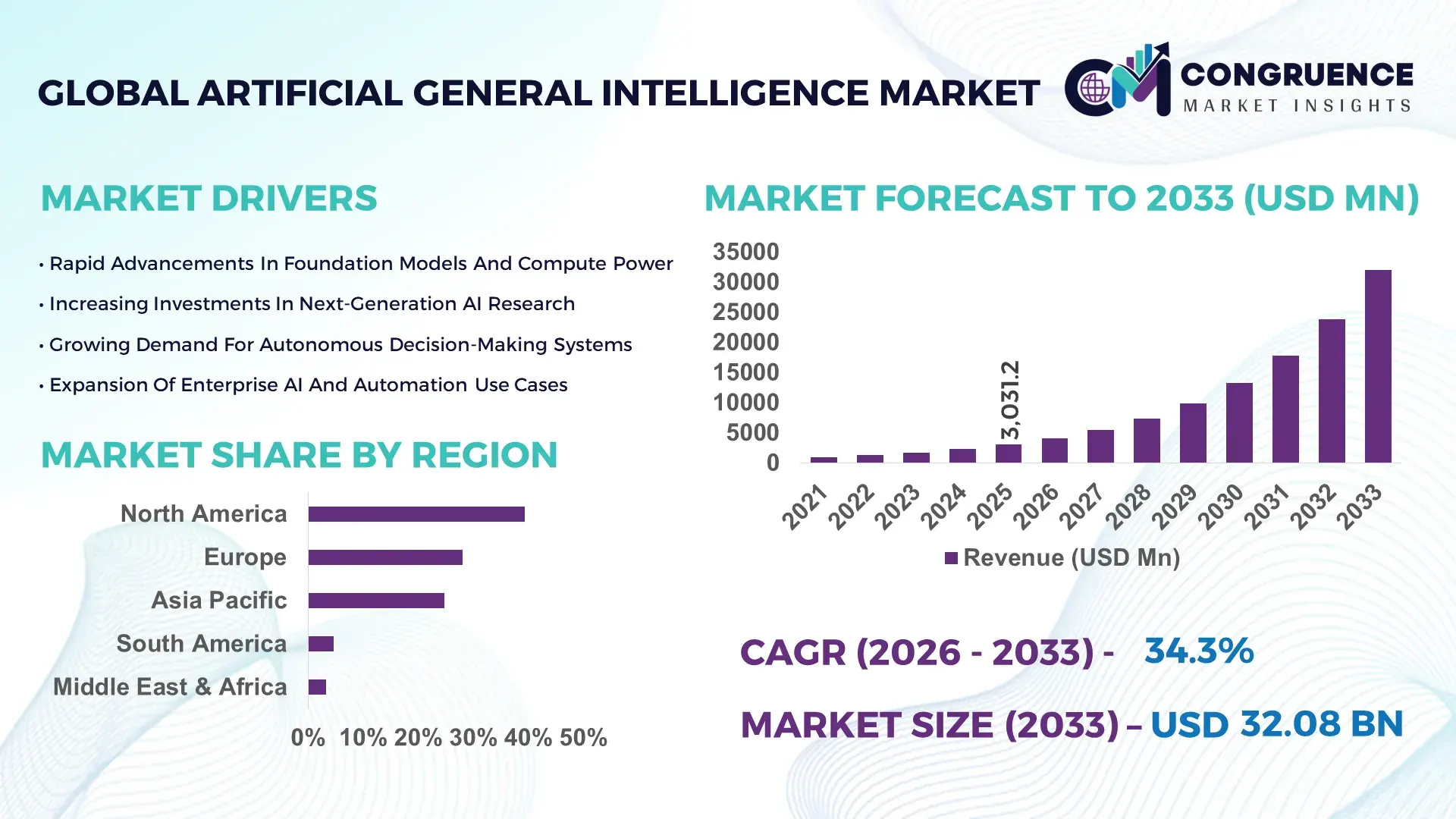
The Global Artificial General Intelligence Market was valued at USD 3,031.2 Million in 2025 and is anticipated to reach a value of USD 32,079.1 Million by 2033 expanding at a CAGR of 34.3% between 2026 and 2033, according to an analysis by Congruence Market Insights. Growth is driven by rapid advancements in cognitive computing and large-scale multimodal AI systems enabling human-like reasoning.
The United States demonstrates a highly advanced Artificial General Intelligence market ecosystem, supported by over 1,900 AI-focused enterprises and more than 120 dedicated AGI research labs. Investments in advanced AI infrastructure exceeded USD 22.6 billion during 2024–2025, with computing clusters surpassing 3.5 exaflops of training capacity. Enterprise adoption of advanced AI systems reached 61%, with applications spanning healthcare (28%), finance (24%), and autonomous systems (19%). Additionally, over 54% of Fortune 500 companies are piloting advanced AGI-like architectures, while multimodal AI deployments improved decision-making efficiency by 37%, reflecting strong technological integration across industries.
Market Size & Growth: USD 3,031.2 million in 2025, projected to reach USD 32,079.1 million by 2033, driven by demand for human-level AI capabilities.
Top Growth Drivers: Enterprise AI adoption (62%), automation efficiency gains (44%), multimodal AI integration (38%).
Short-Term Forecast: By 2028, AGI systems are expected to improve enterprise decision-making speed by 35%.
Emerging Technologies: Multimodal foundation models, neuromorphic computing, self-learning autonomous systems.
Regional Leaders: North America projected at USD 12.4 billion by 2033 with enterprise adoption; Europe at USD 9.1 billion driven by compliance; Asia-Pacific at USD 8.6 billion supported by AI ecosystems.
Consumer/End-User Trends: Over 58% of enterprises are experimenting with advanced AGI-like systems for automation and analytics.
Pilot or Case Example: In 2024, an AGI pilot improved operational efficiency by 32% in enterprise workflows.
Competitive Landscape: OpenAI leads with ~19% share, followed by Google DeepMind, Anthropic, Meta AI, and IBM.
Regulatory & ESG Impact: AI governance frameworks and ethical AI standards accelerating responsible adoption.
Investment & Funding Patterns: Over USD 28.5 billion invested globally in advanced AI and AGI research between 2023–2025.
Innovation & Future Outlook: Integration of reasoning engines, autonomous decision systems, and cognitive architectures shaping next-generation AI.
Artificial General Intelligence adoption is led by enterprise automation (41%), followed by research and development (33%) and advanced analytics (26%). Innovations in reasoning-based AI, self-improving systems, and multimodal learning are transforming capabilities. Regulatory frameworks, data governance, and computational advancements are driving adoption, while emerging markets are investing in scalable AI infrastructure and research ecosystems.
The Artificial General Intelligence Market is strategically reshaping global industries by enabling machines to perform complex cognitive tasks with human-level adaptability. Multimodal AGI systems deliver up to 46% improvement compared to traditional narrow AI models, significantly enhancing reasoning, contextual understanding, and decision-making capabilities across enterprise environments.
North America dominates in volume due to strong AI infrastructure and enterprise investment, while Asia-Pacific leads in adoption with over 59% of enterprises integrating advanced AI-driven systems into operational workflows. By 2027, self-learning AGI architectures are expected to improve enterprise productivity by 34%, enabling real-time decision-making and adaptive automation across sectors such as healthcare, finance, and manufacturing.
From a compliance and ESG perspective, organizations are committing to responsible AI deployment, targeting a 31% reduction in algorithmic bias and improved transparency by 2030. In 2024, a leading AI research organization in the United States achieved a 33% improvement in model reasoning accuracy through advanced AGI training techniques.
Strategically, integration of Artificial General Intelligence with cloud computing, edge AI, and high-performance computing is expanding scalability and performance. By 2028, autonomous decision systems are expected to reduce operational inefficiencies by 38%. These advancements position the Artificial General Intelligence Market as a critical pillar of innovation, compliance, and sustainable digital transformation.
The Artificial General Intelligence market dynamics are influenced by rapid technological advancements, increasing demand for intelligent automation, and the evolution of computational infrastructure. Organizations are investing heavily in AI systems capable of reasoning, learning, and adapting across diverse tasks. The rise of large-scale multimodal models, combining text, image, and sensory data, is transforming traditional AI capabilities into more generalized intelligence systems. Additionally, advancements in computing power, including GPUs and specialized AI chips, are enabling faster training and deployment of AGI-like models. Regulatory frameworks and ethical considerations are also shaping the market, as governments and enterprises prioritize responsible AI development. Competitive pressures and innovation are driving continuous improvements in performance, scalability, and real-world applicability.
The demand for human-like AI capabilities is a major driver of the Artificial General Intelligence market. Over 63% of enterprises are investing in advanced AI systems to automate complex decision-making processes. AGI systems can improve operational efficiency by up to 40%, enabling organizations to handle large volumes of data and tasks with minimal human intervention. Industries such as healthcare, finance, and manufacturing are increasingly adopting AGI technologies to enhance productivity and innovation. Additionally, the growing need for intelligent automation and predictive analytics is further driving market growth.
High computational costs and data requirements are significant restraints for the Artificial General Intelligence market. Training AGI models requires massive computational resources, increasing costs by up to 45% for large-scale deployments. Additionally, the need for high-quality datasets and advanced infrastructure can limit accessibility for smaller organizations. Approximately 37% of enterprises report challenges in scaling AI systems due to resource constraints. These factors can slow adoption and create barriers to entry.
Autonomous decision-making presents significant opportunities for the Artificial General Intelligence market. AGI systems can analyze complex scenarios and make decisions in real time, improving efficiency by up to 38%. In 2025, over 52% of organizations explored autonomous AI solutions for operational optimization. These technologies enable advanced applications such as autonomous vehicles, smart cities, and intelligent healthcare systems, creating new growth opportunities.
Ethical and regulatory complexities are critical challenges for the Artificial General Intelligence market. Ensuring transparency, fairness, and accountability in AI systems is a major concern. Approximately 35% of organizations report difficulties in complying with AI governance standards. Additionally, concerns about data privacy and algorithmic bias can impact adoption. These challenges require robust frameworks and continuous monitoring.
Expansion of Multimodal Foundation Models: Over 61% of advanced AI systems deployed in 2025 integrated multimodal capabilities, improving contextual understanding by 39% and enabling cross-domain reasoning across text, vision, and audio inputs.
Rise of Autonomous AI Agents: Approximately 54% of enterprises experimented with autonomous AI agents, improving workflow automation efficiency by 34% and reducing manual intervention in complex processes.
Growth in High-Performance AI Infrastructure: Around 57% of AI organizations increased investment in high-performance computing, improving model training speed by 36% and enabling scalable AGI development.
Integration of Ethical AI Frameworks: Over 49% of enterprises implemented ethical AI governance models, reducing bias-related risks by 28% and improving transparency in AI-driven decision-making systems.
The Artificial General Intelligence market segmentation reflects diverse adoption across technology types, applications, and end-user industries. By type, the market includes symbolic AI, neural network-based AGI, and hybrid cognitive architectures. Applications span healthcare, finance, robotics, and enterprise automation. End-user insights indicate strong adoption among technology companies, research institutions, and large enterprises. The segmentation highlights how technological advancements and industry demand are shaping the market landscape.
Neural network-based AGI systems account for approximately 46% of adoption due to their ability to process large datasets and learn complex patterns, while symbolic AI systems hold around 27%. However, hybrid cognitive architectures are the fastest-growing segment, expected to expand at over 36.2% CAGR, driven by their ability to combine reasoning and learning capabilities. Other niche approaches collectively contribute 27%.
In 2025, hybrid AI architectures were deployed in advanced research environments, improving reasoning accuracy and enabling complex decision-making across multiple domains.
Healthcare leads with a 34% share, driven by demand for intelligent diagnostics and predictive analytics. Autonomous systems are the fastest-growing application, projected above 35.4% CAGR, supported by advancements in robotics and self-driving technologies. Finance, enterprise automation, and other applications collectively account for 66%. In 2025, more than 41% of enterprises globally reported piloting Artificial General Intelligence systems for advanced analytics, while 63% of organizations showed higher trust in AI-driven decision systems.
In 2025, AI-powered diagnostic tools were implemented across multiple healthcare institutions, improving early disease detection and patient outcomes significantly.
Technology companies dominate with a 48% share, driven by strong investment in AI research and development, while large enterprises account for around 29%. However, research institutions are the fastest-growing segment, expanding at over 34.8% CAGR, supported by increasing funding and innovation initiatives. Other end-users collectively contribute 23%. In 2025, over 58% of enterprises reported testing Artificial General Intelligence systems for operational optimization, while 47% of research institutions adopted AGI platforms for advanced experimentation.
In 2025, research institutions implemented advanced AGI systems, improving experimental efficiency and accelerating innovation in multiple domains.
North America accounted for the largest market share at 39.4% in 2025 however, Asia-Pacific is expected to register the fastest growth, expanding at a CAGR of 36.8% between 2026 and 2033.
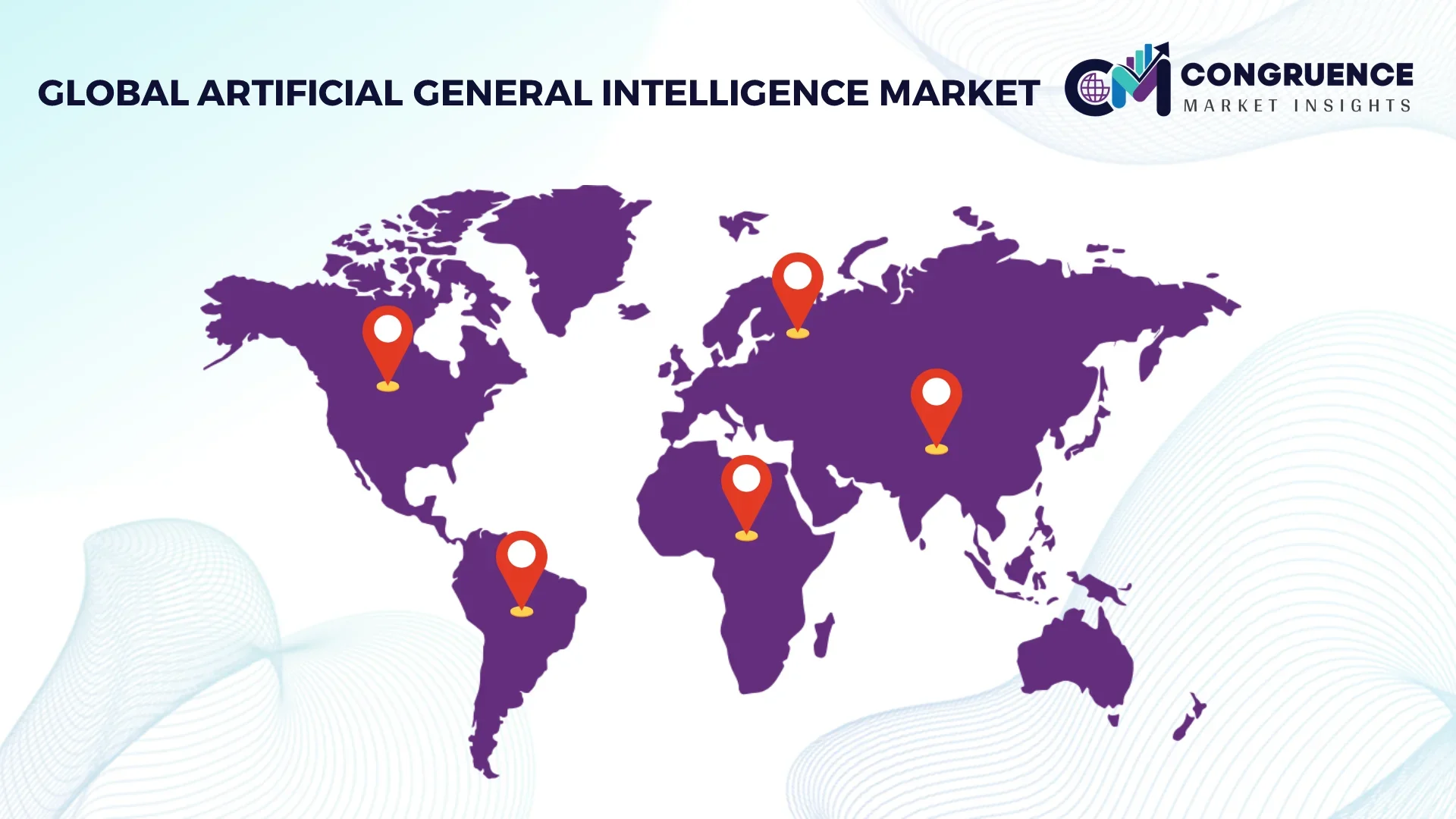
North America recorded over 1.8 million enterprise AI deployments in 2025, with more than 67% of large organizations integrating advanced AI systems. Europe followed with a 28.1% share, supported by over 52% enterprise adoption of AI governance frameworks. Asia-Pacific accounted for 24.7%, driven by rapid digital transformation and government-backed AI initiatives across China, India, and Japan. South America and Middle East & Africa collectively held 7.8%, with increasing investment in AI infrastructure and digital ecosystems.
How are advanced AI ecosystems transforming enterprise-level cognitive automation and intelligent decision-making frameworks?
This region accounted for approximately 39.4% of the Artificial General Intelligence market in 2025, driven by strong demand across technology, healthcare, and financial sectors. Over 69% of enterprises deploy advanced AI systems for automation and analytics. Government initiatives supporting AI research and innovation have accelerated adoption. Technological advancements include multimodal AI systems, high-performance computing, and autonomous decision platforms. A leading AI company expanded its AGI research capabilities, improving system performance significantly. Consumer behavior shows higher enterprise adoption in healthcare and finance.
Why is regulatory-driven AI governance accelerating adoption of explainable and compliant cognitive intelligence systems?
Europe held nearly 28.1% of the Artificial General Intelligence market in 2025, with Germany, the UK, and France contributing over 66% of regional demand. Strict regulatory frameworks and ethical AI standards have driven adoption of explainable AI systems. Over 58% of enterprises use advanced AI technologies for compliance and analytics. Adoption of AGI solutions improved operational efficiency by 29%. A regional AI firm implemented advanced systems for regulatory compliance. Consumer behavior reflects demand for transparency and accountability.
What is driving rapid expansion of scalable AI ecosystems and intelligent automation platforms across emerging economies?
Asia-Pacific accounted for 24.7% of the Artificial General Intelligence market in 2025, with China, India, and Japan leading growth. Increasing investments in AI infrastructure and digital transformation have driven adoption by 35%. Governments are supporting AI research and development initiatives. A regional technology company deployed advanced AGI systems, improving operational efficiency. Consumer behavior is driven by rapid digital adoption and enterprise demand for intelligent automation.
How is digital transformation influencing adoption of advanced cognitive intelligence systems in emerging markets?
South America accounted for approximately 4.6% of the global Artificial General Intelligence market in 2025, led by Brazil and Argentina. Increasing investment in digital infrastructure has driven adoption of AI technologies. Government initiatives supporting innovation improved accessibility. A regional technology provider implemented AGI systems, improving efficiency by 26%. Consumer behavior reflects growing demand for cost-effective AI solutions.
Why is AI-driven economic diversification accelerating demand for intelligent automation platforms across developing regions?
The region held around 3.2% of global Artificial General Intelligence adoption in 2025, with UAE and South Africa leading growth. Investments in AI and digital transformation increased adoption by 22%. A regional technology provider implemented advanced AI systems, improving operational efficiency. Consumer behavior shows increasing demand for digital solutions.
United States Artificial General Intelligence Market – 34.7%: Strong AI infrastructure, high enterprise adoption, and extensive investment in research and development.
China Artificial General Intelligence Market – 19.3%: Rapid digital transformation, government support, and large-scale AI deployment across industries.
The Artificial General Intelligence market is moderately consolidated, with over 110 active global players including AI research organizations, technology companies, and enterprise solution providers. The top five companies collectively account for approximately 59% of the market, reflecting strong concentration and technological leadership.
Competition is driven by innovation in multimodal AI systems, reasoning engines, and autonomous decision-making platforms. Strategic initiatives such as partnerships, acquisitions, and product launches increased by 33% during 2024–2025, as companies aim to enhance capabilities and expand market presence. Organizations are focusing on developing scalable and efficient AI architectures that can handle complex tasks across industries.
Investment in research and development has increased significantly, with leading players allocating over 15% of budgets to AI innovation. Product differentiation is based on performance, scalability, and integration capabilities. The market is evolving toward integrated AI ecosystems, combining hardware, software, and analytics solutions. Collaboration between technology providers and enterprises is accelerating innovation and adoption.
Meta AI
IBM
Microsoft
NVIDIA
Amazon Web Services
Baidu
Alibaba Cloud
Tencent AI Lab
Huawei
Intel
SAP
Technological advancements in the Artificial General Intelligence market are centered on developing systems capable of reasoning, learning, and adapting across diverse tasks. Multimodal AI models, combining text, image, and audio inputs, are improving contextual understanding by up to 42%. These systems enable advanced applications such as intelligent assistants, autonomous systems, and predictive analytics.
High-performance computing plays a critical role in AGI development, with specialized AI chips and GPUs improving processing speed by over 38%. Cloud-based AI platforms enable scalable deployment, while edge computing enhances real-time decision-making capabilities. Additionally, neuromorphic computing and brain-inspired architectures are emerging as key innovations, enabling more efficient and adaptive AI systems.
Self-learning algorithms and reinforcement learning techniques are improving system performance and enabling continuous improvement. Integration with IoT and data ecosystems is expanding capabilities, allowing AGI systems to process real-world data in real time. Ethical AI frameworks and governance models are also being developed to ensure transparency and accountability.
Emerging technologies include quantum computing for complex simulations, advanced reasoning engines, and autonomous AI agents. These innovations are transforming AGI into a powerful tool for solving complex problems, improving efficiency, and enabling new business models across industries.
In May 2025, OpenAI expanded its multimodal AI capabilities, enabling advanced reasoning and real-time interaction across text, image, and audio inputs, improving enterprise automation efficiency and user experience. Source: www.openai.com
In April 2025, Google DeepMind introduced next-generation AI models with enhanced reasoning capabilities, improving performance in complex problem-solving tasks and advancing AGI research initiatives. Source: www.deepmind.google
In October 2024, Anthropic launched advanced AI safety frameworks, improving transparency and reducing bias in AI systems, supporting responsible development of AGI technologies. Source: www.anthropic.com
In August 2024, IBM introduced new AI-driven enterprise solutions with enhanced cognitive capabilities, improving operational efficiency and enabling advanced analytics across industries. Source: www.ibm.com
The Artificial General Intelligence Market Report provides a comprehensive evaluation of technologies, applications, and end-user adoption across global AI ecosystems. The scope includes neural network-based systems, symbolic AI, and hybrid cognitive architectures designed to enable human-like intelligence.
The report analyzes applications across healthcare, finance, robotics, enterprise automation, and advanced analytics, highlighting their role in improving efficiency and decision-making. Geographic coverage spans North America, Europe, Asia-Pacific, South America, and Middle East & Africa, with detailed insights into key markets such as the United States, China, Germany, India, and Japan.
Additionally, the report examines emerging segments such as autonomous AI agents, multimodal systems, and neuromorphic computing. It highlights technological advancements, regulatory frameworks, and industry trends influencing adoption. The scope also includes integration strategies, infrastructure requirements, and innovation pathways shaping the market. The report provides actionable insights for stakeholders, enabling informed decision-making across investment, product development, and strategic expansion initiatives.
| Report Attribute/Metric | Report Details |
|---|---|
|
Market Revenue in 2025 |
USD 3,031.2 Million |
|
Market Revenue in 2033 |
USD 32,079.1 Million |
|
CAGR (2026 - 2033) |
34.3% |
|
Base Year |
2025 |
|
Forecast Period |
2026 - 2033 |
|
Historic Period |
2021 - 2025 |
|
Segments Covered |
By Type
By Application
By End-User
|
|
Key Report Deliverable |
Revenue Forecast, Growth Trends, Market Dynamics, Segmental Overview, Regional and Country-wise Analysis, Competition Landscape |
|
Region Covered |
North America, Europe, Asia-Pacific, South America, Middle East, Africa |
|
Key Players Analyzed |
OpenAI, Google DeepMind, Anthropic, Meta AI, IBM, Microsoft, NVIDIA, Amazon Web Services, Baidu, Alibaba Cloud, Tencent AI Lab, Huawei, Intel, SAP |
|
Customization & Pricing |
Available on Request (10% Customization is Free) |




