
Reports
The Global Aromatic Amines Market was valued at USD 15,490.3 Million in 2025 and is anticipated to reach a value of USD 22,712.4 Million by 2033 expanding at a CAGR of 4.9% between 2026 and 2033. Growth is being driven by polyurethane insulation, rubber chemicals, dyes and pigments, pharmaceuticals, and higher-performance chemical intermediates, with aniline remaining the principal volume anchor.
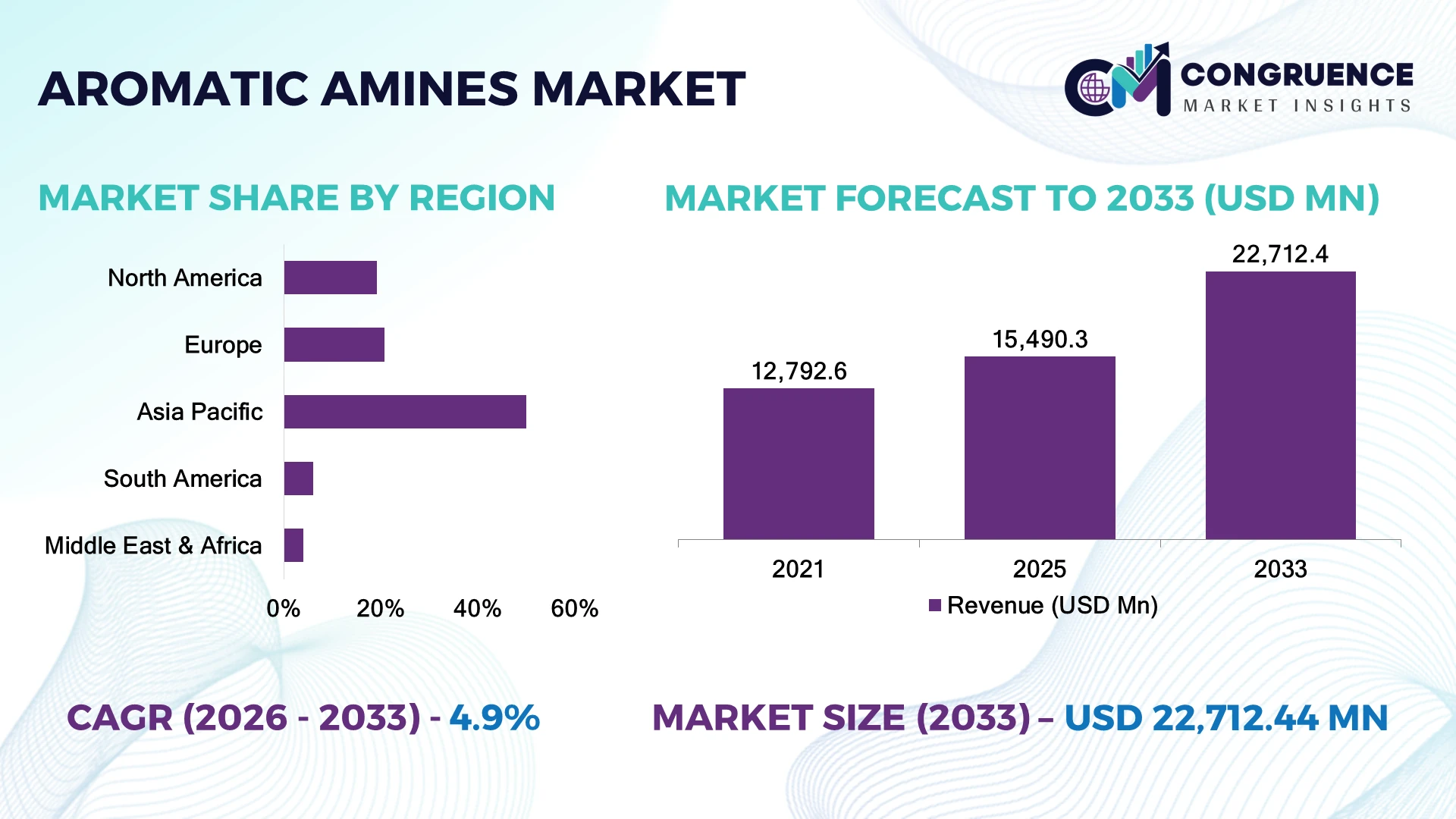
China and the wider Asia-Pacific manufacturing base account for more than 50% of global aniline demand, supported by polyurethane, textile, rubber, and chemical-intermediate production; aniline represented approximately 78% of aromatic amine consumption by type in 2025. India is smaller but strategically important, with aniline demand reaching about 355,600 tonnes in 2025. China therefore combines scale with downstream integration, while India is strengthening domestic specialty-chemical capacity amid global supply-chain diversification.
Strategic implication: procurement resilience, integrated feedstock access, and cleaner production technology increasingly determine aromatic amines investment competitiveness.
Market Size & Growth: USD 15,490.3 million in 2025 to USD 22,712.4 million by 2033 at a 4.9% CAGR, supported by MDI-linked polyurethane demand and specialty chemical diversification.
Top Growth Drivers: MDI and polyurethane applications contribute roughly 65% of demand; rubber-processing chemicals account for about 15%; dyes and pigments contribute approximately 11%.
Short-Term Forecast: By 2028, automated process control can improve production efficiency by 8–12%, while optimized hydrogenation can reduce raw-material losses by 3–6%.
Emerging Technologies: Catalytic hydrogenation, vapor-phase processing, AI-assisted process monitoring, and advanced purification are tightening yield control, with digital monitoring adoption reaching approximately 20–30% at advanced chemical facilities.
Regional Leaders: Asia-Pacific represents roughly 50–57% of demand; Europe contributes approximately USD 3.5 billion; North America approaches USD 3.2 billion, with Asian producers emphasizing integrated downstream manufacturing.
Consumer/End-User Trends: Building and construction represents approximately 52–65% of aniline-linked demand through polyurethane applications, while automotive and rubber processing maintain strong specification-driven consumption.
Pilot/Case Example: India processed approximately 355,600 tonnes of aniline in 2025, demonstrating expanding domestic chemical-intermediate consumption and strengthening the country's role in specialty-chemical supply chains.
Competitive Landscape: BASF, Covestro, Wanhua Chemical, Huntsman, and Tosoh compete across integrated aromatic-amine and downstream chemical value chains, with leading integrated producers controlling substantial regional capacity.
Regulatory & ESG Impact: Cleaner hydrogenation and emission-control systems can reduce process energy and waste intensity by approximately 5–15%, while chemical-safety requirements increasingly influence plant modernization.
Investment & Funding: Global producers are directing multi-million-dollar investments toward integrated feedstocks, debottlenecking, specialty derivatives, and lower-emission processing as supply-chain localization accelerates.
Innovation & Future Outlook: 2026–2028 priorities center on high-purity grades, automated reaction control, low-emission hydrogenation, specialty derivatives, and vertically integrated production to strengthen cost and supply security.
The Aromatic Amines Market spans aniline, toluene diamine, phenylenediamines, and specialty arylamines serving polyurethane, rubber, dyes, pharmaceuticals, and agrochemicals. Aniline represents approximately 78% of the type mix, while advanced catalytic hydrogenation and purification are improving yield consistency. In 2026, producers are prioritizing localized feedstocks, lower-emission processing, and specialty-grade capacity as global chemical supply chains diversify.
Aromatic amines are becoming strategically important because they sit upstream of several industrial value chains rather than serving a single end-use market. Aniline is particularly critical to MDI and polyurethane production, while derivative chemistries support rubber processing, dyes, pharmaceuticals, and agrochemicals. This diversification makes production capacity, feedstock security, and downstream integration increasingly important for chemical manufacturers.
Technology is also changing the economics of production. Modern catalytic hydrogenation and automated process control provide tighter selectivity and batch consistency than legacy operating systems, with efficiency improvements of approximately 5–12% and lower raw-material losses of 3–6%. Asia-Pacific retains the strongest manufacturing scale, while European producers face greater emphasis on emissions, chemical safety, and process modernization.
Through 2026–2028, companies are prioritizing debottlenecking, specialty-grade production, digital process monitoring, and integrated feedstock strategies. India is expanding its domestic chemical-intermediate base, while Chinese producers retain significant downstream integration. Competitive advantage will increasingly depend on combining low-cost production with traceable supply, high-purity output, regulatory readiness, and flexible derivative manufacturing rather than relying solely on commodity-scale capacity.
Aniline demand is being anchored by polyurethane and MDI production, which together account for approximately 60–65% of global aniline consumption. Building insulation and automotive lightweighting are increasing demand for high-purity intermediates, while integrated producers can reduce feedstock and logistics exposure by 5–10% through captive chains. China continues expanding downstream polyurethane capacity, while India is strengthening domestic chemical-intermediate production as supply chains diversify. Producers are responding through debottlenecking, backward integration, and process-efficiency investments. The strategic shift is toward integrated aromatic amine complexes rather than standalone production: controlling benzene, aniline, MDI, and derivative streams improves utilization and protects margins when intermediate prices fluctuate.
Aromatic amine economics remain sensitive to benzene, hydrogen, energy, and chlor-alkali input costs, with feedstock and utilities collectively representing roughly 55–70% of production economics for major intermediates. Sudden benzene price movements can alter manufacturing costs by approximately 5–15%, while tighter European energy markets increase pressure on energy-intensive processing. China’s integrated producers have a structural advantage through localized feedstock networks, whereas import-dependent manufacturers face greater exposure to freight and inventory costs. Companies are reducing risk through multi-source procurement, longer-term feedstock contracts, localized storage, and process optimization. The key restraint is margin volatility: high utilization does not guarantee profitability when raw-material movements cannot be passed through quickly to downstream customers.
Specialty aromatic amines offer manufacturers a route beyond commodity aniline, particularly in pharmaceutical intermediates, advanced polymers, dyes, electronic chemicals, and high-performance coatings. High-purity grades can command approximately 15–30% pricing premiums, while automated purification and tighter reaction control can improve yield by 5–10%. Japan and Germany remain important high-specification markets, while Indian chemical hubs are attracting investment in specialty intermediates as customers diversify Asian sourcing. Companies are increasing R&D around selective hydrogenation, continuous processing, and advanced separation technologies. A less obvious opportunity is flexible multi-product capacity: plants capable of switching between commodity and specialty grades can redirect production toward higher-margin applications when construction or automotive demand softens.
Aromatic amine producers face increasing complexity in controlling hazardous emissions, wastewater, worker exposure, and process safety while maintaining continuous production. Advanced abatement, closed-loop handling, and monitoring systems can add approximately 5–15% to modernization expenditure, while compliance-related process controls can increase operational monitoring requirements by 10–20%. European plants face particularly stringent environmental expectations, while Asian producers are progressively upgrading older chemical complexes. Companies must integrate emission-control equipment with reactors, separation systems, and digital monitoring rather than treating compliance as an isolated retrofit. The non-obvious challenge is maintaining product consistency during modernization: shutdowns, equipment changes, and altered reaction conditions can affect validated specifications, making phased upgrades and technical partnerships essential for uninterrupted customer supply.
Catalytic Processing Gains Precision: Producers are replacing older batch-intensive reaction workflows with catalytic hydrogenation and tighter process controls, improving selectivity by approximately 5–10% and reducing raw-material losses by 3–6%. Chinese and Indian plants are increasing automation around temperature, pressure, and hydrogen-feed monitoring. The operational shift improves consistency while reducing operator intervention in hazardous processing zones.
Digital Process Monitoring Expands: Advanced chemical facilities are integrating real-time sensors, predictive analytics, and digital batch records, with approximately 20–30% of sophisticated plants adopting higher levels of process digitization. Automated anomaly detection can shorten response times by 10–20%. The trend is particularly relevant where complex multi-stage purification requires continuous quality verification.
Specialty Grades Gain Production Priority: Manufacturers are increasing capacity flexibility for pharmaceutical, electronic-chemical, pigment, and high-performance polymer applications, where specialty grades can achieve 15–30% pricing premiums. Flexible purification trains allow producers to shift approximately 10–20% of available capacity toward higher-value specifications as downstream orders change. This is gradually reducing dependence on commodity-volume economics.
Supply Chains Move Toward Localization: Global chemical disruptions and freight volatility are encouraging buyers to qualify secondary suppliers closer to major manufacturing hubs. Dual sourcing can reduce single-origin exposure by approximately 20–30%, while localized inventories can shorten replenishment cycles by 10–20%. Indian and Southeast Asian producers are consequently gaining opportunities to supply customers seeking alternatives to concentrated Chinese sourcing.
Aniline is the leading product type in the global Aromatic Amines Market, accounting for approximately 75–80% of total demand in 2025. Its dominance comes from large-scale integration into MDI production, polyurethane systems, rubber chemicals, dyes, and chemical intermediates. Toluidines and phenylenediamines collectively represent roughly 10–15%, supported by dyes, pigments, pharmaceuticals, and specialty chemicals, while diphenylamine, naphthylamines, and other specialty grades occupy smaller but higher-value niches.
Phenylenediamines represent one of the faster-expanding specialty categories, with demand supported by high-purity pharmaceutical intermediates, dyes, pigments, and performance chemicals. Specialty aromatic amines can command approximately 15–30% higher pricing than commodity grades, encouraging producers to shift investment toward purification and flexible production trains. BASF, Covestro, Wanhua Chemical, and Asian specialty producers are strengthening integrated capacity, while Indian manufacturers are increasing domestic intermediate production to reduce import dependence.
Industry insight: Covestro operates more than 1 million tonnes of annual aniline production capacity, demonstrating the scale advantage of integrated aniline-to-MDI production and the importance of upstream control in this market.
Polyurethane intermediates represent the leading application, accounting for approximately 60–65% of global aromatic amine consumption, primarily through aniline's role in MDI production. Rubber chemicals contribute approximately 12–16%, while dyes and pigments account for around 10–13%. Pharmaceuticals, agrochemicals, and specialty chemical synthesis represent smaller shares but generate higher-value demand because purity, molecular consistency, and regulatory specifications are more stringent.
Pharmaceuticals and specialty chemicals constitute the fastest-shifting application group, with demand for high-purity aromatic amines increasing approximately 7–10% as manufacturers diversify intermediate sourcing and develop more complex formulations. Companies are responding by adding purification capability, flexible batch processing, and application-specific grades rather than competing solely on commodity volume. The operational distinction is important: polyurethane demand rewards scale and feedstock integration, whereas pharmaceutical and specialty applications reward quality assurance and production flexibility. India's expanding chemical-manufacturing ecosystem is therefore creating opportunities for producers positioned between commodity aniline and highly specialized intermediates.
Industry insight: BASF reported that global automotive production increased 3.7% in 2025, while battery-electric vehicle production increased 28.9%, strengthening downstream demand for polyurethane materials used across automotive components and related applications.
Chemical and plastics manufacturers represent the leading end-user group, accounting for approximately 55–60% of global aromatic amine consumption. Their dominance reflects direct use of aniline and related intermediates in MDI, polyurethane, rubber chemicals, and polymer value chains. Automotive and construction industries collectively account for approximately 20–25% of downstream demand, while pharmaceuticals, textiles, agriculture, and other specialty industries represent the balance. Large integrated chemical companies prioritize reliable feedstock access, plant utilization, and long-term supply contracts.
Pharmaceutical and specialty chemical manufacturers are among the fastest-growing end-user groups, with demand increasing approximately 7–10% as higher-purity intermediates and localized sourcing gain importance. These buyers typically accept higher specification-related costs in exchange for consistent quality and regulatory documentation. Producers are consequently developing dedicated grades, smaller flexible batches, technical partnerships, and regional inventory programs. India is gaining strategic relevance for specialty-chemical sourcing, while China retains substantial scale in integrated chemical manufacturing. The competitive implication is a two-tier market: commodity buyers prioritize cost and continuity, whereas specialty customers prioritize purity, qualification, and traceability.
Industry insight: BASF's 2025 Materials portfolio showed Chemicals and Plastics represented 56% of direct customer-industry sales, highlighting the continued concentration of large-scale chemical demand within integrated industrial value chains.
Asia-Pacific accounted for the largest market share at 49.9% in 2025 however, North America is expected to register the fastest growth, expanding at a CAGR of 5.7% between 2026 and 2033. Asia-Pacific's lead reflects integrated aniline, MDI, polyurethane, dye, and specialty-chemical production, while North American demand is supported by construction, automotive, and advanced materials applications.
Integrated MDI Production Strengthens Regional Supply Security
North America contributes approximately 19.2% of global aromatic amines demand, with the United States accounting for most regional consumption through polyurethane, automotive, construction, rubber, and specialty-chemical applications. Integrated production is strategically important because aniline is a primary feedstock for MDI. Huntsman's Geismar complex and its associated aniline infrastructure illustrate this integration, while U.S. producers increasingly emphasize supply reliability and domestic feedstock control. Huntsman operates world-scale MDI facilities and holds approximately 78% of aniline and nitrobenzene production capacity at its Rubicon joint venture. North American producers are also prioritizing process automation, specialty grades, and localized inventories as global chemical trade becomes more fragmented.
United States Market Outlook: The United States represents approximately 11.8% of global aniline demand and benefits from established polyurethane manufacturing, large construction-material consumption, and sophisticated chemical infrastructure. Gulf Coast chemical clusters provide integrated feedstock, storage, logistics, and downstream-processing advantages, enabling producers to manage intermediate supply more efficiently than import-dependent markets.
Low-Carbon Processing Reshapes European Production Economics
Europe represents approximately 20.8% of global aromatic amines demand, with Germany, Belgium, and the Netherlands forming important production and downstream-processing hubs. Energy costs and environmental requirements are accelerating modernization toward lower-emission processing, renewable electricity, advanced monitoring, and higher-value specialty grades. BASF's European amines portfolio transitioned to 100% renewable electricity in 2025, with an expected annual reduction of approximately 188,000 tonnes of CO₂-equivalent emissions compared with its 2020 baseline. The competitive implication is clear: European producers increasingly differentiate through carbon performance and specification quality rather than commodity cost alone.
Germany Market Outlook: Germany remains the region's key aromatic-amine production and specialty-chemical center, anchored by Ludwigshafen and other integrated chemical clusters. BASF reports more than 100,000 tonnes of specialty-amine capacity globally, while its German operations provide access to advanced laboratories, downstream customers, and established chemical infrastructure. This ecosystem supports premium-grade development and lower-carbon production.
Integrated Chemical Clusters Preserve Scale Advantage
Asia-Pacific accounts for approximately 49.9% of global aromatic amines demand and remains the principal production and consumption center. China drives regional scale through integrated benzene, aniline, MDI, polyurethane, rubber, dyes, and agrochemical value chains, while India is expanding specialty-chemical and intermediate manufacturing. Aniline alone represented approximately 56.7% of global market demand in Asia-Pacific in 2025. Wanhua's integrated polyurethane platform illustrates the scale advantage, with global MDI capacity reaching approximately 4.5 million tonnes after planned expansion. Producers are emphasizing captive feedstocks, downstream integration, and export-oriented logistics.
China Market Outlook: China is the strategic center of Asian aromatic-amine production, combining large-scale feedstock availability with extensive downstream polyurethane, textile, rubber, pigment, and agrochemical manufacturing. Wanhua's planned MDI expansion demonstrates continued investment in vertically integrated chemical capacity. This structure enables producers to capture value across multiple stages while reducing dependence on merchant intermediates and external logistics.
Polyurethane and Industrial Chemicals Drive Selective Expansion
South America represents approximately 6.1% of global aromatic amines demand, with Brazil providing the principal consumption base through polyurethane, automotive components, coatings, agricultural chemicals, and rubber processing. Demand remains concentrated around industrial corridors with established chemical distribution and manufacturing infrastructure. Brazil's downstream polyurethane sector creates recurring requirements for aniline-derived MDI, while specialty chemical users increasingly require consistent purity and documented supply. Import dependence for several aromatic-amine grades increases exposure to freight, currency, and inventory costs. Producers and distributors are therefore emphasizing regional warehousing, multi-origin procurement, and application-specific technical support. The strongest commercial opportunity lies in supplying established downstream manufacturers rather than building standalone commodity capacity.
Brazil Market Outlook: Brazil is the region's largest industrial market for aromatic amines, supported by automotive manufacturing, construction materials, agricultural chemicals, and polymer processing. Its diversified downstream base provides demand across both commodity and specialty grades. Local distributors with inventory near São Paulo and other industrial centers can reduce replenishment exposure and provide faster technical support to polyurethane and chemical processors.
Industrial Diversification Creates New Chemical Demand
Middle East & Africa accounts for approximately 4.0% of global aromatic amines demand, with consumption concentrated in Saudi Arabia, the United Arab Emirates, South Africa, and selected North African manufacturing hubs. Chemical diversification, construction materials, polyurethane insulation, coatings, and agricultural chemicals are strengthening downstream requirements. Saudi Arabia's industrial-development strategy is particularly relevant because petrochemical integration provides feedstock and infrastructure advantages for higher-value chemical manufacturing. Producers and distributors are expanding storage, technical-service networks, and long-term procurement arrangements rather than relying solely on spot imports. The region's strategic opportunity is downstream integration: localized conversion of imported intermediates into polyurethane, coatings, and specialty formulations can capture more value while reducing exposure to international freight volatility.
Saudi Arabia Market Outlook: Saudi Arabia provides the strongest platform for regional chemical diversification because of its integrated petrochemical infrastructure, industrial clusters, and expanding downstream manufacturing base. Access to hydrocarbons, established ports, and chemical logistics supports cost-efficient feedstock movement. Continued development of specialty chemicals and construction materials can increase domestic aromatic-amine utilization while positioning the country as a regional distribution hub.
BASF, Covestro, Wanhua Chemical, Huntsman, and Tosoh compete through integrated aniline-to-isocyanate chains, while regional Chinese and Indian producers challenge on cost and specialty grades. The top five are estimated to control approximately 48% of global aromatic amine value. Competition centers on feedstock integration, purity, energy efficiency, and supply reliability; integrated production can reduce intermediate logistics costs by 5–10%, while specialty grades command 15–30% premiums. BASF is expanding MDI capacity in Geismar and evaluating India, Wanhua is extending integrated Chinese capacity, and Huntsman leverages its Rubicon aniline infrastructure. The competitive shift is toward vertical integration, localized supply, and lower-carbon processing rather than standalone commodity production. Entry barriers include hazardous-chemical permitting, process technology, feedstock access, customer qualification, and substantial capital requirements. Winning requires captive or secured feedstocks, high plant utilization, reliable regional logistics, specialty-grade capability, and continuous process innovation that protects margins while meeting increasingly stringent environmental specifications.
BASF SE
Covestro AG
Wanhua Chemical Group Co., Ltd.
Huntsman Corporation
Tosoh Corporation
LANXESS AG
Sumitomo Chemical Co., Ltd.
Mitsubishi Chemical Group Corporation
Zhejiang Jiuzhou Pharmaceutical Co., Ltd.
Jiangsu Yangnong Chemical Co., Ltd.
Aarti Industries Limited
Atul Ltd.
Gujarat Alkalies and Chemicals Limited
Anhui Bayi Chemical Industry Co., Ltd.
Aromatic amine production is shifting toward catalytic hydrogenation, continuous processing, heat integration, and automated reaction control. Modern systems can improve selectivity by 5–10% and reduce steam or energy intensity by 5–8% versus older batch-oriented configurations. Adoption is strongest at integrated chemical complexes, where digital sensors and advanced process controls coordinate nitrobenzene, aniline, purification, and downstream MDI operations. This integration improves throughput, consistency, and operator safety.
Advanced purification, membrane separation, real-time spectroscopy, and predictive analytics are emerging across specialty-grade production. Automated quality monitoring can reduce manual sampling by 15–25%, while predictive maintenance can lower unplanned downtime by 5–10%. BASF's integrated Asian amine operations demonstrate the competitive advantage of combining capacity expansion with lower-carbon electricity and process optimization. Specialty producers benefit disproportionately because tighter purity control supports pharmaceutical, electronic-chemical, and high-performance applications.
Between 2026 and 2028, AI-assisted process optimization, low-emission hydrogenation, digital twins, and closed-loop heat recovery will become increasingly important. Compared with conventional operator-led adjustment, model-based control can shorten process-response times by 10–20%. Large integrated producers gain through scale and data availability, while specialty manufacturers gain through flexible batch optimization. Companies acting now can lock in lower energy intensity, higher yield stability, and stronger regulatory readiness before technology requirements become procurement differentiators.
September 2026 BASF evaluated an MDI complex in Dahej, India, securing industrial land while advancing feasibility work. The project would localize MDI supply and strengthen the upstream aromatic-amine chain. BASF's existing Dahej infrastructure provides an integration base for regional customers. Source: BASF
October 2025 BASF expanded DMAPA capacity at Nanjing, nearly doubling annual output while increasing PEA capacity 25%. The site also uses 100% renewable electricity, cutting annual CO₂ emissions 9,800 tonnes and strengthening sustainable amine supply. Source: BASF
February 2025 Wanhua Chemical advanced its Fujian MDI expansion, including new phosgenation, separation, tank-storage, and supporting infrastructure. The project reinforces integrated polyurethane capacity and strengthens downstream feedstock security in China's coastal chemical manufacturing network. Source: whchem.com
February 2026 BASF confirmed its Geismar isocyanates expansion remained on schedule for 2026 startup, increasing North American MDI capacity from 380,000 to approximately 600,000 tonnes annually. The investment strengthens regional supply resilience for polyurethane customers. Source: BASF
The Aromatic Amines Market Report covers aniline, toluidines, phenylenediamines, diphenylamine, naphthylamines, and other specialty aromatic amines across polyurethane intermediates, rubber chemicals, dyes and pigments, pharmaceuticals, agrochemicals, coatings, and specialty chemical synthesis. End-user analysis evaluates chemical and plastics manufacturers, automotive, construction, pharmaceuticals, textiles, agriculture, and other industrial buyers, with aniline representing approximately 75–80% of demand.
Regional coverage spans North America, Europe, Asia-Pacific, South America, and Middle East & Africa, with detailed country assessment across major production and consumption hubs. Technology analysis includes catalytic hydrogenation, continuous processing, advanced purification, digital process control, AI-assisted optimization, heat integration, and low-emission manufacturing. The report supports capacity planning, feedstock strategy, specialty-grade investment, regional expansion, supplier diversification, competitive benchmarking, and technology prioritization through 2026–2033, including opportunities created by localized production and higher-purity applications.
| Report Attribute/Metric | Report Details |
|---|---|
|
Market Revenue in 2025 |
USD 15,490.3 Million |
|
Market Revenue in 2033 |
USD 22,712.4 Million |
|
CAGR (2026 - 2033) |
4.9% |
|
Base Year |
2025 |
|
Forecast Period |
2026 - 2033 |
|
Historic Period |
2021 - 2025 |
|
Segments Covered |
By Type
By Application
By End-User
|
|
Key Report Deliverable |
Revenue Forecast, Growth Trends, Market Dynamics, Segmental Overview, Regional and Country-wise Analysis, Competition Landscape |
|
Region Covered |
North America, Europe, Asia-Pacific, South America, Middle East, Africa |
|
Key Players Analyzed |
BASF SE, Covestro AG, Wanhua Chemical Group Co., Ltd., Huntsman Corporation, Tosoh Corporation, LANXESS AG, Sumitomo Chemical Co., Ltd., Mitsubishi Chemical Group Corporation, Zhejiang Jiuzhou Pharmaceutical Co., Ltd., Jiangsu Yangnong Chemical Co., Ltd., Aarti Industries Limited, Atul Ltd., Gujarat Alkalies and Chemicals Limited, Anhui Bayi Chemical Industry Co., Ltd. |
|
Customization & Pricing |
Available on Request (10% Customization is Free) |




