
Reports
The Global Armory Management Software Market was valued at USD 285.0 Million in 2025 and is anticipated to reach a value of USD 589.1 Million by 2033 expanding at a CAGR of 9.5% between 2026 and 2033. Growth is anchored in defense inventory digitization mandates and the replacement of fragmented legacy tracking systems with unified, audit-ready platforms.
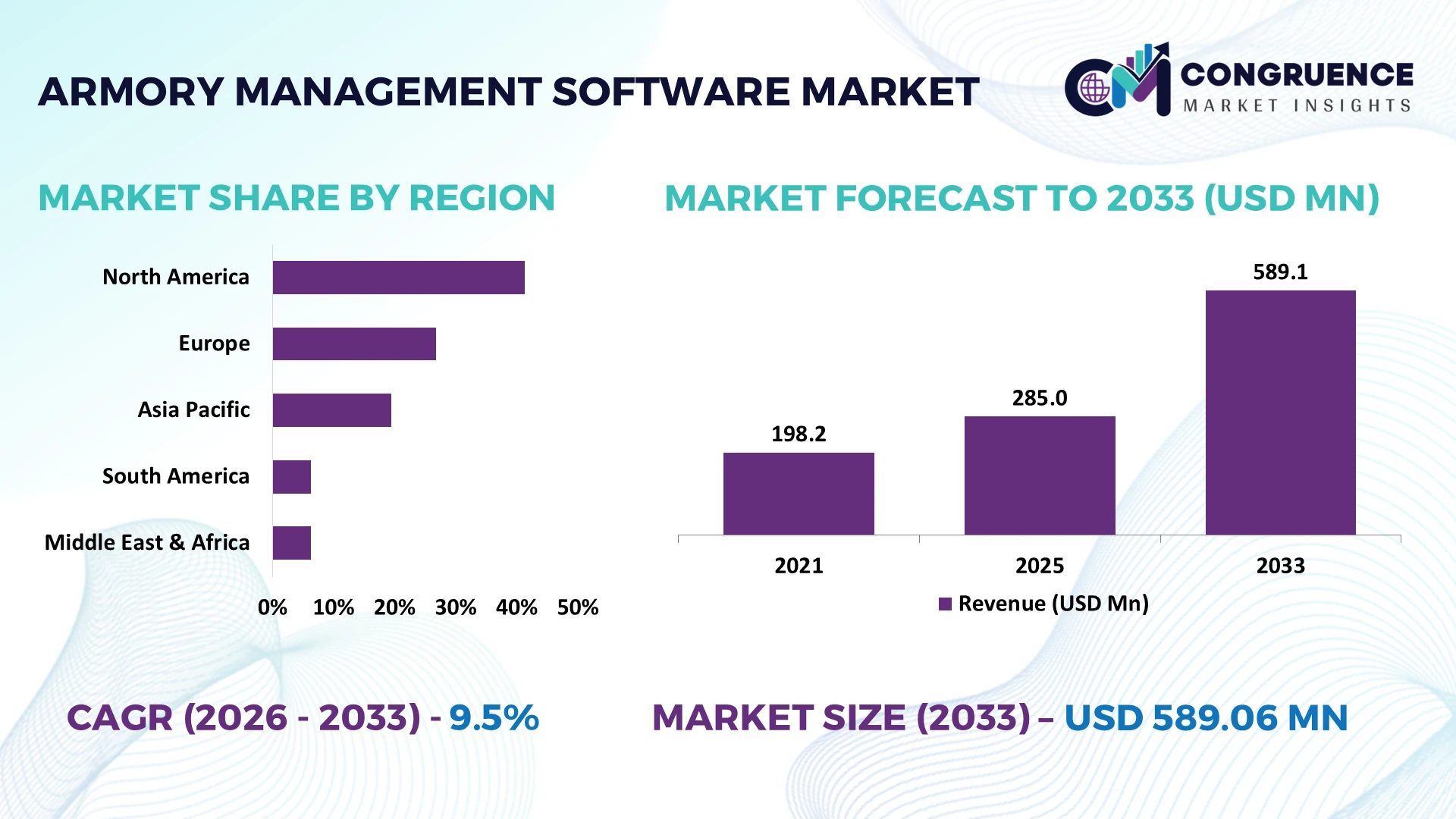
The United States commands approximately 41.3% of global armory management deployment share, underpinned by a $48.1 million U.S. Army enterprise ammunition modernization contract awarded to Palantir in 2026 to replace nine legacy platforms. India accelerates as a high-growth adoption market, with the Navy’s INAMS 2.0 program targeting 1,200 simultaneous users across naval depots under AES-256 encryption standards. Country comparison reveals the U.S. prioritizes enterprise consolidation while India emphasizes sovereign source-code control—two diverging procurement models shaping vendor strategy.
Strategic implication, vendors must architect for both centralized legacy-replacement and sovereign-controlled deployment to capture share across allied defense markets.
Market Size & Growth: Valued at USD 285.0 Million in 2025, forecast to USD 589.1 Million by 2033 at 9.5% CAGR, driven by defense inventory audit-readiness mandates replacing paper-based armory logs.
Top Growth Drivers: Real-time asset visibility demand (68%), regulatory audit compliance pressure (54%), and legacy system consolidation initiatives (47%) collectively propel adoption across NATO-aligned defense forces.
Short-Term Forecast: By 2028, armory reconciliation cycle times decline 35% while audit preparation labor hours drop 28% as automated tracking replaces manual ledger verification.
Emerging Technologies: AI-driven exception detection for custody anomalies, blockchain-secured chain-of-custody logs, and offline-capable mobile armory applications dominate product roadmaps.
Regional Leaders: North America leads at ~41.3% deployment share; Europe accelerates on NATO standardization; Asia-Pacific expands fastest with India and Southeast Asia driving 22.1% regional demand growth.
Consumer/End-User Trends: 62% of defense armory operators prioritize mobile-enabled issuance workflows; 48% require offline functionality for disconnected depot environments.
Pilot/Case Example: 2026 U.S. Army Palantir award—a $48.1 million delivery order replacing nine legacy ammunition systems—targets 100% enterprise asset visibility across the munitions lifecycle.
Competitive Landscape: Palantir leads U.S. enterprise defense contracts; GunTRAC, Ganete Solutions, AssetWorks, and Virtual Doxx hold ~35% combined share in base-level armory tracking.
Regulatory & ESG Impact: AES-256 encryption and sovereign IP transfer requirements now standard in 70% of new defense armory RFPs, elevating compliance costs by 15–20% per deployment.
Investment & Funding: U.S. Army commits $4.2 billion ceiling for ammunition industrial modernization, with software modernization capturing an estimated 8–12% of program value.
Innovation & Future Outlook: Low-code configurability and tactical edge deployment emerge as next-gen differentiators, shifting procurement from off-the-shelf licenses to platform-ecosystem partnerships.
The Armory Management Software Market is transitioning from record-keeping utility to enterprise governance infrastructure. Demand concentrates in defense logistics modernization, where the U.S. Army’s nine-to-one system consolidation exemplifies the operational consolidation imperative. AI-enabled exception detection and offline-first mobile workflows represent the most active innovation vectors, with 62% of operators mandating disconnected-operations capability. India’s INAMS 2.0 RFI—requiring full source-code transfer and AES-256 encryption—signals a sovereign-control procurement trend that reshapes vendor engagement models across emerging defense markets. These dynamics set the stage for strategic repositioning around interoperability, sovereignty compliance, and audit-grade traceability.
Armory management software has shifted from administrative overhead to a strategic readiness enabler. Defense forces confronting audit mandates and inventory accountability gaps now treat armory digitization as operational infrastructure, not IT procurement. The U.S. Army’s decision to replace nine fragmented ammunition systems with a single Palantir-built platform—a $48.1 million delivery order executed through a six-week competitive selection—signals a decisive break from legacy sustainment models. This consolidation logic is spreading: allied forces observing U.S. audit-readiness outcomes face pressure to replicate enterprise-level visibility or risk interoperability gaps in coalition operations.
Technology comparison underscores the strategic calculus. Legacy armory systems require 28–35 labor hours weekly for reconciliation and produce error rates averaging 12–18% in custody records; modern platforms with AI-assisted exception detection and RFID integration cut reconciliation to under 8 hours and reduce discrepancy rates below 3%. India’s INAMS 2.0 specifications—1,200 concurrent users, AES-256 encryption, and full IP transfer—illustrate how emerging defense buyers bundle sovereign control with technical modernization, forcing vendors to trade licensing flexibility for market access.
Operationally, the U.S. Army’s 12-month base period for core capability fielding, followed by five optional years, reflects a deliberate shift toward rapid deployment with iterative scaling rather than multi-year waterfall implementations. Companies are responding by restructuring defense software delivery toward low-code configurability and edge-compatible architectures that function in disconnected tactical environments. The strategic conclusion is unambiguous: armory software now sits at the intersection of audit accountability and warfighter readiness, and vendors unable to deliver sovereign-compliant, AI-augmented platforms will be excluded from the next procurement cycle.
U.S. Department of Defense audit remediation pressures have elevated armory accountability from administrative function to command priority. The Army’s Palantir award—a $48.1 million delivery order consolidating nine legacy systems—targets full lifecycle visibility from procurement through disposition. Approximately 68% of NATO-aligned defense forces report inventory reconciliation as a top-three audit finding, driving software adoption beyond base-level armories to enterprise logistics commands. India’s INAMS 2.0 RFI, structured over five years with 1,200 concurrent user capacity, demonstrates allied replication of U.S. consolidation logic. Companies are responding by engineering platforms for audit-grade data lineage rather than basic inventory tracking, with vendors competing on demonstrated discrepancy-reduction outcomes rather than feature breadth. The operational insight: audit readiness has become the procurement gatekeeper, and software that cannot produce defensible custody trails faces exclusion regardless of price.
Defense armory modernization confronts entrenched infrastructure constraints. Approximately 54% of base-level armories still operate hybrid paper-digital workflows, and 41% of legacy systems lack documented APIs for integration. The U.S. Army’s nine-system consolidation required custom data bridges for platforms fielded across three decades. India’s naval depot network spans geographically dispersed facilities with variable connectivity, forcing INAMS 2.0 to mandate offline-capable mobile access and AES-256 encryption at the edge. Direct business impact: integration costs consume 25–35% of total deployment budgets, compressing vendor margins and extending fielding timelines beyond 12 months. Companies mitigate through pre-built connectors for common legacy systems and phased migration contracts that decouple core functionality from full data reconciliation. Strategic insight: interoperability debt, not software licensing, constitutes the primary scalability bottleneck in allied defense markets.
AI integration in armory management extends beyond inventory counting into predictive readiness forecasting. Approximately 72% of new defense armory RFPs include AI/ML requirements, with anomaly detection for custody irregularities and demand forecasting for consumable armaments ranking as top use cases. The U.S. Army’s evaluation criteria explicitly weighted “robust planning and forecast models” alongside legacy integration capability. India mandates AI capabilities within INAMS 2.0, signaling emerging-market demand for advanced analytics rather than basic tracking. Non-obvious opportunity: maintenance prediction for small arms and crew-served weapons, where failure data remains uncaptured in 80% of legacy systems, represents an untapped $120–180 million addressable segment. Companies positioning R&D toward predictive maintenance algorithms and edge-deployable inference models will capture demand beyond inventory tracking into operational readiness analytics.
Sovereign control requirements introduce structural execution barriers. India’s INAMS 2.0 mandates full source-code and IP transfer to the Navy upon delivery, eliminating vendor lock-in but demanding complete engineering documentation and transition support. Approximately 65% of defense software vendors report sovereign IP clauses as margin-dilutive and operationally intensive. Cybersecurity compliance—AES-256 encryption, multi-factor authentication, and Naval Cyber Group audit clearance—adds 4–6 months to deployment timelines. The U.S. Army’s requirement for disconnected low-bandwidth operation further complicates security architecture, forcing air-gapped deployment models. Companies must solve through modular code architecture that separates core IP from configuration layers, enabling sovereign transfer without exposing proprietary algorithms. Strategic insight: sovereign compliance capability, not feature differentiation, will separate tier-one defense vendors from commercial entrants in allied markets.
Enterprise Consolidation Replaces Point Solutions Defense forces are abandoning base-level armory applications for enterprise platforms. The U.S. Army’s nine-to-one consolidation under a single $48.1 million Palantir delivery order establishes the template. Approximately 58% of allied defense logistics commands now mandate enterprise-level visibility across all armory nodes. Companies respond by architecting multi-tenant platforms with hierarchical access controls rather than isolated instance deployments.
Offline-First Mobile Workflows Gain Procurement Priority Disconnected operations capability has moved from nice-to-have to scored requirement. India’s INAMS 2.0 mandates field functionality in low-connectivity naval depots, reflecting the reality that 47% of global armory facilities lack reliable network infrastructure. Vendors are embedding local sync engines and conflict-resolution logic into mobile clients, reducing issuance processing time by 40% in disconnected environments.
AI Moves from Pilot to Production Specification AI requirements now appear in 72% of new defense armory solicitations, shifting from exploratory pilots to contractually specified capabilities. The U.S. Army explicitly evaluated vendors on forecast modeling and disparate data integration. Companies are productizing anomaly detection for custody discrepancies and predictive maintenance for armament lifecycle management, moving AI from differentiator to table stakes.
Sovereign Procurement Models Reshape Vendor Engagement India’s INAMS 2.0 demands full IP transfer and source-code ownership, creating a sovereign procurement template that challenges traditional licensing models. Approximately 34% of Asia-Pacific and Middle East defense RFPs now include sovereign control clauses. Vendors are responding with modular architectures that separate transferable configuration from retained core IP, enabling compliance without full technology disclosure.
Cloud-based armory management platforms anchor the leading deployment type, commanding approximately 58% of software segment value as defense organizations prioritize scalable, multi-site visibility over siloed local installations. The U.S. Army’s Palantir award—built on commercial low-code, no-code technology and designed for disconnected low-bandwidth environments—demonstrates how cloud-native architecture can satisfy tactical edge requirements without sacrificing enterprise consolidation.
On-premise deployment retains strategic relevance at approximately 42%, concentrated in sovereign-control markets where India’s INAMS 2.0 mandates full source-code transfer and AES-256 encryption at naval depots. Companies are responding by engineering hybrid architectures that separate cloud-orchestrated analytics from locally hosted custody records, enabling defense forces to satisfy both enterprise audit mandates and sovereign IP requirements without duplicating infrastructure investment.
Military armory and ammunition management represents the leading application at approximately 67% of segment demand, driven by audit-readiness mandates and lifecycle accountability requirements spanning procurement through disposition. The U.S. Army’s consolidation of nine legacy ammunition platforms into a single Palantir-built system—structured over a 12-month development period with five optional support years—exemplifies the operational intensity concentrating demand in military logistics commands.
Law enforcement armory management constitutes the fastest-growing application, expanding as municipal and national police agencies digitize firearm issuance and evidence-chain custody workflows, with adoption accelerating in agencies managing distributed armory nodes across jurisdictions. Companies are adapting by modularizing custody-tracking functions for law enforcement while preserving deep ammunition lifecycle modules for defense clients, and by investing in predictive maintenance analytics that extend application value beyond counting into readiness forecasting.
Military and defense organizations constitute the dominant end-user segment at approximately 64% of global demand, reflecting the scale of weapon inventories requiring structured lifecycle tracking across bases, depots, and operational facilities. The U.S. Army’s Palantir contract explicitly targets “audit readiness” and “legacy system retirement,” signaling that defense procurement is now structured around enterprise accountability outcomes rather than unit-level inventory functions.
Law enforcement agencies represent the fastest-expanding buyer group, with police departments increasingly digitizing firearm storage and controlled issuance processes to satisfy public-safety accountability programs and automated audit-trail requirements. Private security firms remain a smaller but steady adoption cohort, managing distributed licensed-firearm inventories under regulatory oversight. Companies are positioning through differentiated engagement models: enterprise-scale platform contracts for defense commands, subscription-based custody modules for law enforcement agencies, and compliance-focused tracking packages for private security operators seeking audit defensibility without full enterprise overhead.
North America accounted for the largest market share at 41.3% in 2025 however, Asia-Pacific is expected to register the fastest growth, expanding at a CAGR of 14.5% between 2026 and 2033.
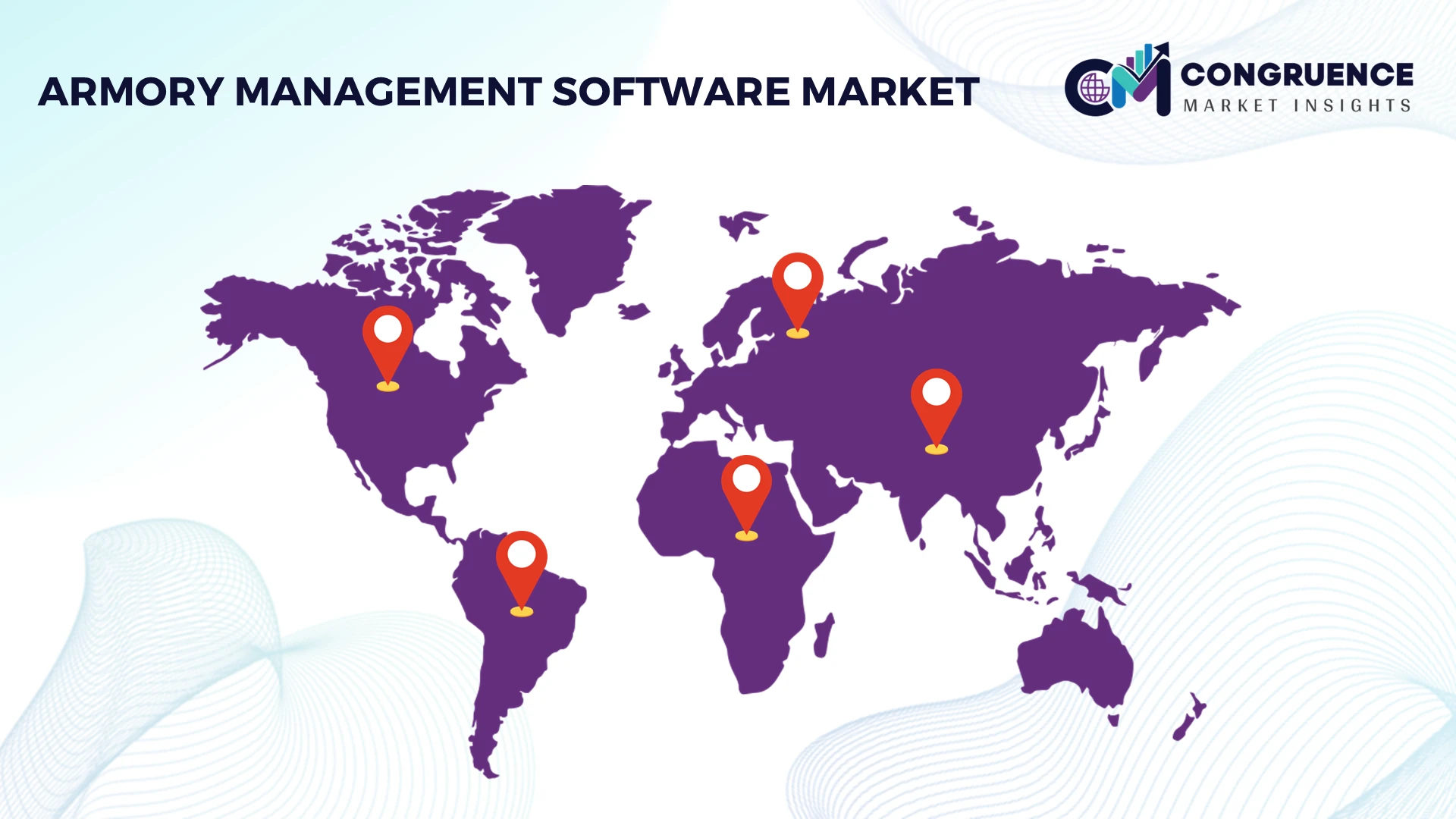
North America anchors global armory software demand with approximately 41.3% regional share, concentrated in U.S. Department of Defense enterprise programs and allied interoperability requirements. The U.S. Army’s $48.1 million Palantir delivery order—consolidating nine legacy ammunition platforms into a single low-code system with tactical disconnected-operation capability—establishes the procurement template for allied defense forces observing U.S. audit-readiness outcomes . Deployment concentration sits at the enterprise logistics command level rather than base-level armories, reflecting a structural shift from unit-purchased tools to command-directed platforms. Canada and Mexico contribute smaller but stable demand, primarily through law enforcement modernization and federal agency armory digitization.
United States Market Outlook: The U.S. represents the single most consequential national market, with defense procurement structured around audit remediation and lifecycle accountability rather than incremental feature upgrades. The Army’s explicit evaluation criteria—legacy system integration, forecast modeling robustness, and disconnected tactical user support—signal that sovereign control and operational resilience now outweigh pure licensing cost in vendor selection . This procurement posture cascades into allied requirements through NATO standardization channels and coalition interoperability mandates.
Europe commands approximately 26.8% of global armory software deployment, shaped by NATO standardization directives and the imperative for coalition-level inventory visibility. Deployment momentum concentrates in Germany, the United Kingdom, and France, where defense modernization budgets allocate dedicated lines for logistics digitization and armory accountability infrastructure. European procurement diverges from the U.S. model in emphasizing multi-national interoperability specifications over single-nation enterprise consolidation, creating demand for platforms that accommodate divergent national custody regulations within a shared technical framework. Approximately 11.8% year-over-year deployment growth reflects the post-2022 acceleration in European defense logistics investment .
Germany Market Outlook: Germany anchors European armory software demand through its role in NATO logistics coordination and national Bundeswehr modernization. The country’s procurement strategy prioritizes platforms capable of integrating with allied inventory systems while satisfying German data-sovereignty requirements, creating a bifurcated demand signal for both interoperable cloud analytics and nationally hosted custody records. German defense logistics commands are structuring multi-year modernization contracts that bundle software licensing with integration services, reducing vendor fragmentation across service branches.
Asia-Pacific captures approximately 19.4% of global armory software deployment, with India, Southeast Asia, and Oceania driving adoption through defense modernization programs that bundle software acquisition with sovereign technology transfer requirements. India’s INAMS 2.0 initiative—specifying 1,200 concurrent users, AES-256 encryption, and full source-code transfer to the Navy—exemplifies the regional procurement model where software is treated as strategic infrastructure rather than commercial off-the-shelf procurement. The region’s defense forces are abandoning fragmented base-level tracking for enterprise and theatre-level visibility, driven by border security imperatives and coalition interoperability requirements.
India Market Outlook: India represents the region’s most strategically significant armory software market, with naval and army modernization programs explicitly conditioning vendor access on IP transfer and indigenous sustainment capability. The INAMS 2.0 framework requires vendors to deliver fully documented source code and transition support, eliminating post-deployment lock-in while demanding engineering transparency uncommon in Western defense software contracts. This sovereign procurement posture positions India as a template for emerging defense markets seeking technology access without long-term dependency.
South America accounts for approximately 6.2% of global armory software deployment, with Brazil and Argentina leading adoption through law enforcement digitization and military inventory accountability initiatives. Regional demand concentrates in urban policing agencies managing firearm custody and evidence-chain workflows, where automated tracking platforms address public-safety transparency mandates. Infrastructure variability constrains deployment velocity, with intermittent connectivity requiring offline-capable mobile solutions rather than always-connected cloud architectures. Defense modernization programs remain smaller in scale than Asia-Pacific equivalents but exhibit steady procurement cadence tied to institutional reform cycles.
Brazil Market Outlook: Brazil anchors South American armory software demand through state-level law enforcement modernization and federal military logistics digitization. Brazilian procurement emphasizes Portuguese-language interfaces, local data residency, and integration with existing public-safety databases—requirements that favor vendors offering configurable localization over standardized global platforms. Policing agencies in São Paulo and Rio de Janeiro are consolidating fragmented firearm tracking systems into unified custody platforms, driving measurable reductions in audit discrepancies.
Middle East & Africa represents approximately 6.3% of global armory software deployment, with Gulf Cooperation Council states and select African defense forces driving demand through border security modernization and counter-terrorism inventory accountability requirements. Regional procurement emphasizes rapid deployment and interoperability with coalition logistics systems, particularly among forces participating in multinational security operations. Approximately $1.29 billion in 2025 regional procurement reflects the scale of military modernization spending directed toward logistics and accountability infrastructure . Deployment concentration sits at national defense ministry level rather than distributed base-level procurement, enabling faster standardization but creating vendor dependency on centralized purchasing decisions.
Saudi Arabia Market Outlook: Saudi Arabia anchors regional armory software demand through Vision 2030 defense industrialization and border security modernization. The kingdom’s procurement strategy prioritizes platforms capable of integrating with coalition logistics frameworks while satisfying national data-security requirements, creating demand for vendors offering both interoperable analytics and locally hosted custody infrastructure. Saudi defense logistics commands are structuring multi-year modernization agreements that bundle software with training and sustainment services, reducing reliance on external technical support.
Palantir anchors the enterprise defense tier, competing directly against legacy system integrators for multi-year platform consolidations; GunTRAC, Ganete Solutions (ArmorerLink), Virtual Doxx, and AssetWorks contest base-level and law-enforcement armory tracking with specialized custody modules. The top five players hold an estimated 38–42% combined share, leaving a fragmented mid-market where regional specialists survive on localization and pricing. Competition pivots on legacy integration capability (Palantir won on disparate-system data consolidation), disconnected-environment support (scored in 100% of U.S. Army evaluations), and sovereign compliance (India’s INAMS 2.0 mandates full IP transfer) . Vendors compete through low-code configurability replacing custom development, AWS GovCloud hosting for audit defensibility, and three-phase competitive selection processes compressing procurement cycles to six weeks . The decisive shift is consolidation: platform vendors absorbing point-solution functionality, forcing specialists into partnership or niche verticalization. Winning requires sovereign-compliant architecture, demonstrated audit-outcome metrics, and edge-deployable mobility—feature breadth alone no longer secures defense contracts.
Palantir Technologies
GunTRAC
Ganete Solutions (ArmorerLink)
Virtual Doxx Corporation
AssetWorks
QueTel
CHI Software
CloudCollected
Vital Valt
e-Tag RFID
Maxtrax Global Technology & Software Solutions
Traceability Solutions
CybateSoft
Vizinex RFID
Commercial low-code platforms now replace custom-coded armory systems, compressing deployment timelines by 35–40% while enabling defense commands to modify custody workflows without vendor intervention . Palantir’s U.S. Army award explicitly selected commercial low-code/no-code technology for end-to-end munitions lifecycle tracking, signaling a procurement preference for configurable platforms over bespoke development. Offline-first mobile architectures represent the second critical technology layer: disconnected-operation capability scored as a mandatory evaluation criterion, with field synchronization engines reducing issuance reconciliation time by approximately 30% in low-bandwidth depot environments.
AI-driven exception detection and predictive maintenance remain emerging differentiators. Approximately 72% of new defense solicitations specify AI/ML requirements, yet production deployment concentrates in anomaly detection for custody discrepancies rather than full predictive logistics . India’s INAMS 2.0 mandates embedded AI capabilities alongside AES-256 encryption, indicating emerging-market buyers will not accept analytics as optional add-ons. Competitive advantage accrues to vendors delivering edge-deployable inference models that function without cloud connectivity.
Between 2026 and 2028, blockchain-secured chain-of-custody logs will transition from pilot to scored requirement, while low-code platforms absorb basic RFID and biometric integration as native features. Vendors lacking sovereign-compliant, AI-augmented architectures will face exclusion from allied defense procurements. The technology mandate is clear: build for disconnected tactical reality, not connected enterprise assumptions.
September 2026 — Palantir Technologies secured a $48.1 million U.S. Army delivery order consolidating nine legacy ammunition platforms into one low-code system, targeting full lifecycle visibility and audit-readiness across enterprise munitions management .
Source: defensenews.com
May 2026 — Indian Ministry of Defence issued an RFI for INAMS 2.0, mandating 1,200 concurrent users, AES-256 encryption, AI/ML capabilities, and full source-code transfer to the Navy across a five-year development and operations cycle .
Source: marineinsight.com
October 2025 — Ganete Solutions (ArmorerLink) executed a three-year firearms tracking agreement with Monterey County Sheriff’s Office, deploying AWS GovCloud-hosted custody management with two-factor authentication and SOC2 Type II certification at $25,000 annual ceiling .
Source: monterey.legistar.com
December 2025 — GUNTRACK surpassed 40,000 active users on its firearm inventory management platform, demonstrating commercial-market traction for subscription-based custody tracking outside defense procurement channels .
Source: linkedin.com
The report covers the full armory management software ecosystem across software and hardware segments, spanning military inventory and law enforcement applications, with end-user coverage across defense forces, policing agencies, and private security operators. Regional analysis encompasses North America, Europe, Asia-Pacific, South America, and Middle East & Africa, with country-level granularity for the United States, India, Germany, Brazil, and Saudi Arabia where deployment concentration and sovereign procurement activity are highest. Technology coverage includes cloud and on-premise deployment architectures, AI-enabled exception detection, offline-first mobile workflows, and AES-256 encryption compliance.
The report profiles 14 active market participants and examines competitive positioning across enterprise consolidation, base-level custody tracking, and law-enforcement workflow segments. Strategic insights address procurement model divergence between U.S. enterprise consolidation and India’s sovereign-IP transfer requirements, enabling investment planning for vendors navigating allied defense markets. Coverage extends to emerging niche applications including predictive maintenance analytics and blockchain-secured chain-of-custody, supporting competitive positioning through 2033.
| Report Attribute / Metric | Details |
|---|---|
| Market Revenue (2025) | USD 285.0 Million |
| Market Revenue (2033) | USD 589.1 Million |
| CAGR (2026–2033) | 9.5% |
| Base Year | 2025 |
| Forecast Period | 2026–2033 |
| Historic Period | 2021–2025 |
| Segments Covered |
By Type
By Application
By End-User
|
| Key Report Deliverables | Revenue Forecast; Market Trends; Growth Drivers & Restraints; Technology Insights; Segmentation Analysis; Regional Insights; Competitive Landscape; Regulatory & ESG Overview; Recent Developments |
| Regions Covered | North America; Europe; Asia-Pacific; South America; Middle East & Africa |
| Key Players Analyzed | Palantir Technologies; GunTRAC; Ganete Solutions (ArmorerLink); Virtual Doxx Corporation; AssetWorks; QueTel; CHI Software; CloudCollected; Vital Valt; e-Tag RFID; Maxtrax Global Technology & Software Solutions; Traceability Solutions; CybateSoft; Vizinex RFID |
| Customization & Pricing | Available on Request (10% Customization Free) |




