
Reports
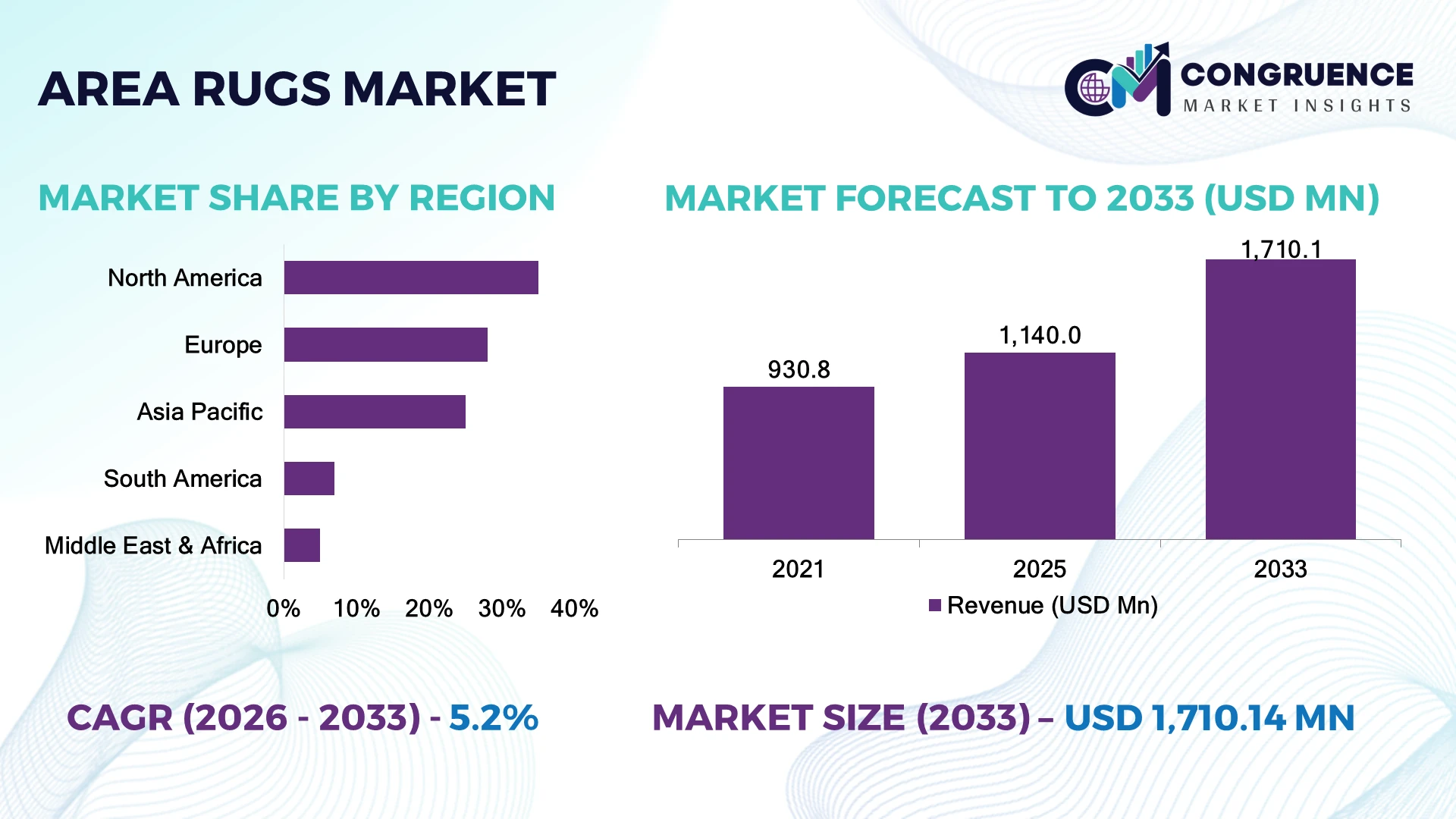
The Global Area Rugs Market was valued at USD 1,140.0 Million in 2025 and is anticipated to reach a value of USD 1,710.1 Million by 2033 expanding at a CAGR of 5.20% between 2026 and 2033. Growth is driven by digital customization, machine-tufted production, washable constructions, and increasing adoption of recycled and stain-resistant fibers as retailers shift toward faster product cycles and differentiated home-decor collections.
The United States remains the dominant country market, accounting for roughly 27% of the global value pool, while India is expanding faster at about 9.4% annually through 2030, supported by 42 million sq. m. of rug volume in 2025 and a strong export manufacturing base. U.S. imports supply more than 85% of domestic area-rug consumption, while India increasingly serves premium handmade and wool categories. Tariff uncertainty is accelerating sourcing diversification between India, China, and Turkey.
Strategically, manufacturers should prioritize localized sourcing, digital product development, and flexible production capacity to protect margins while capturing premium and high-volume demand.
Market Size & Growth: The market stands at USD 1.14 billion in 2025 and targets USD 1.71 billion by 2033 at a 5.20% CAGR, supported by machine-made production and digital home-decor retail.
Top Growth Drivers: Digital customization 32%, sustainable-material adoption 28%, and e-commerce purchasing 25% are the three strongest demand accelerators.
Short-Term Forecast: By 2028, automated tufting and digital design workflows are positioned to reduce production-cycle time by 15% and improve design throughput by 20%.
Emerging Technologies: AI-assisted pattern development, automated tufting, digital printing, and recycled-fiber processing are reshaping advanced rug manufacturing and customization.
Regional Leaders: North America is projected near USD 5.5 billion by 2033, Europe around USD 4.3 billion, and Asia Pacific approximately USD 4.0 billion, with online purchasing accelerating adoption.
Consumer/End-User Trends: Household applications represent about 60% of demand, while washable, stain-resistant, customizable, and eco-conscious rugs gain traction among digitally engaged buyers.
Pilot/Case Example: In 2025, digital-printing and automated-production initiatives demonstrated production-cycle reductions of approximately 15%, enabling faster seasonal assortment changes and lower sampling requirements.
Competitive Landscape: North America leads the value pool at about 32%, with Mohawk Industries, Milliken & Company, The Dixie Group, Oriental Weavers, and Jaipur Rugs competing across design, manufacturing, distribution, and customization.
Regulatory & ESG Impact: Chemical-safety requirements and recycled-material initiatives are pushing manufacturers toward lower-impact fibers, with sustainable-material preferences approaching 30% of purchasing considerations in targeted consumer segments.
Investment & Funding: Industry investment is increasingly directed toward automated looms, digital printing, recycled-fiber processing, and e-commerce infrastructure, with manufacturers prioritizing productivity improvements of 10–20%.
Innovation & Future Outlook: Next-generation washable rugs, digitally customized designs, recycled synthetics, low-impact dyes, and AI-supported merchandising will shift competition toward speed, traceability, and product personalization.
The Area Rugs Market is increasingly concentrated around residential remodeling, hospitality interiors, online customization, and premium sustainable collections. Approximately 60% of demand comes from household applications, while machine-made formats are gaining operational importance because they deliver shorter production cycles and scalable pricing. Supply-chain restructuring following tariff uncertainty is also encouraging U.S. retailers to diversify sourcing toward India and Turkey, creating a stronger strategic link between manufacturing flexibility and assortment profitability.
The Area Rugs Market is becoming strategically important as flooring, interior design, e-commerce, and home-renovation value chains converge. Rugs increasingly function as modular design assets rather than simple floor coverings, allowing retailers and property developers to refresh interiors without permanent flooring replacement. Household applications already account for roughly 60% of demand, reinforcing the importance of residential design cycles and replacement-led purchasing.
Technology is changing the economics of production. Automated tufting and digital printing can compress design-to-production cycles by approximately 15–20% compared with slower conventional sampling and manual development workflows. The United States remains the largest demand center, while India is advancing faster through export-oriented manufacturing and rising domestic consumption. This creates a two-speed competitive environment: mature markets prioritize customization and retail efficiency, whereas manufacturing hubs emphasize capacity, cost control, and product diversification.
Over the next 2–3 years, companies are expected to increase investment in digital merchandising, automated production, recycled-fiber processing, and direct-to-consumer distribution. U.S. import dependence above 85% is encouraging sourcing diversification, while Indian manufacturers are moving toward higher-value wool and designer collections. Strategic advantage will increasingly depend on combining flexible production with digital demand visibility, sustainable materials, and resilient multi-country sourcing.
Digital merchandising and automated rug production are accelerating assortment turnover and reducing development bottlenecks. Machine-made formats already command a substantial portion of the category, while household applications account for approximately 60% of demand. Automated tufting and digital printing can reduce development and production-cycle time by 15–20%, enabling manufacturers to respond faster to seasonal design shifts. In the United States, e-commerce expansion is strengthening demand for washable, stain-resistant, and customizable products, while Indian producers are combining traditional craftsmanship with scalable manufacturing. Companies are responding through automated equipment investments, digital design partnerships, and expanded D2C capabilities. The non-obvious advantage is faster SKU testing: brands can validate niche patterns digitally before committing significant production capacity.
Supply-chain dependence remains a structural constraint, particularly in the United States, where imports account for more than 85% of area-rug supply. India, China, and Turkey therefore remain critical sourcing markets, exposing retailers to freight volatility, tariff changes, and extended replenishment cycles. Additional duties on selected Chinese-origin products can reach 25%, while Asian container logistics continue to influence landed costs. These pressures directly affect gross margins and promotional flexibility, especially for value-oriented synthetic rugs. Companies are reducing exposure through multi-country sourcing, longer supplier contracts, near-port quality operations, and greater use of Indian and Turkish production partners. The key operational insight is that sourcing diversification is becoming a margin-management tool rather than simply a supply-continuity measure.
Sustainable materials, premium wool constructions, and digitally customized products are opening higher-value opportunities beyond standardized synthetic rugs. Eco-conscious purchasing considerations are approaching 30% in targeted consumer groups, while India is recording approximately 9.4% annual expansion in its area-rug market, creating an attractive platform for premium manufacturing and export diversification. Recycled polyester, natural plant fibers, low-impact dyes, and traceable wool can support product differentiation while addressing retailer ESG requirements. Companies are increasing R&D around recycled inputs, partnering with material suppliers, and expanding premium collections through Indian manufacturing hubs. A distinctive opportunity lies in combining traditional hand-knotting with digital customization, allowing brands to command premium positioning without abandoning scalable online merchandising.
Expanding customization creates execution complexity across thousands of designs, sizes, materials, and production specifications. Digital assortment expansion can increase SKU requirements by more than 20%, placing pressure on inventory planning, quality control, sampling, and fulfillment consistency. Handmade products add further variability in lead times and finishing standards, while machine-made collections require continuous equipment utilization and skilled technical maintenance. Companies must strengthen ERP integration, automated quality inspection, digital production planning, and supplier coordination to maintain consistency. In the United States, heavy reliance on imported products increases the consequences of disruption, while Indian manufacturers face pressure to scale craftsmanship without compromising quality. The strategic challenge is balancing personalization with standardized processes so product variety does not erode operational efficiency.
Washable Rug Adoption Accelerates: Washable and low-pile rugs are moving from niche offerings toward mainstream household assortments, particularly in the U.S., where pet-friendly and easy-care formats address frequent replacement needs. Machine-made products already represent about 57% of global type demand, while washable construction is gaining visibility across online channels. Manufacturers are expanding stain-resistant polyester and polypropylene collections, using digital product launches to shorten assortment cycles and reduce inventory exposure.
Automation Reshapes Rug Manufacturing: Automated tufting, digital printing, and precision cutting are increasingly replacing labor-intensive production steps, improving repeatability and enabling smaller customized batches. U.S. textile-product mills recorded average hourly earnings of about USD 28.35 in July 2026, reinforcing pressure to automate labor-sensitive processes. Manufacturers are responding with equipment modernization, integrated design-to-production workflows, and partnerships that combine automated manufacturing with premium handcrafted finishing.
Sourcing Moves Beyond China: Tariff uncertainty and freight-cost volatility are accelerating supplier diversification toward India, Turkey, and other established rug-producing markets. India already supplies roughly 40% of global handmade-carpet exports, while its carpets-and-rugs sector is expanding machine-tufted capacity alongside established artisan clusters. Companies are increasing multi-country sourcing, dual-vendor qualification, and regional inventory buffers. The non-obvious shift is that procurement flexibility is becoming a competitive design capability: brands with broader supplier networks can introduce seasonal patterns faster without locking capital into large production runs.
Traceability Enters Premium Collections: Sustainable wool, jute, recycled PET, and material-traceability programs are moving deeper into premium rug portfolios. Sustainable-material preferences are approaching 30% among targeted consumer segments, while manufacturers are increasing use of recycled and responsibly sourced fibers to meet retailer ESG requirements. European and North American buyers are placing greater emphasis on material disclosure and product durability. Companies are responding through certified fiber sourcing, lower-impact dyeing, digital provenance information, and longer-life construction, turning sustainability credentials into a measurable product-differentiation tool.
Machine-made area rugs represent the leading type, accounting for approximately 57% of global demand, supported by standardized sizing, consistent quality, scalable output, and lower production costs. Their advantage is strongest in value and mid-market collections where retailers require predictable replenishment and broad pattern availability. Handmade rugs retain a strategically important premium position, particularly across luxury residential interiors and designer-led projects, but their longer production cycles constrain volume scalability. Companies are therefore increasing machine-made collections while preserving handmade lines for higher-margin differentiation.
The fastest-growing shift is toward digitally produced and machine-tufted formats, with automation improving design flexibility and reducing production lead times by roughly 15–20%. Handmade products still command stronger craftsmanship credentials, while machine-made rugs offer superior inventory responsiveness. Indian manufacturers are combining automated tufting with traditional design expertise, while U.S. brands are emphasizing washable and digitally customized ranges.
Residential applications lead the area rugs market with approximately 62% of demand, reflecting recurring purchases across living rooms, bedrooms, dining areas, hallways, and open-plan spaces. Household buyers prioritize comfort, aesthetics, washable construction, stain resistance, and coordinated designs, creating strong demand for machine-made and digitally merchandised products. Commercial applications remain smaller but increasingly important, particularly for offices, hotels, restaurants, and retail environments requiring durability, acoustic performance, and standardized replenishment. Companies are balancing residential volume with selective commercial expansion to improve order stability.
Commercial applications are the faster-moving segment as hospitality refurbishments, office redesigns, and retail upgrades increase demand for durable and customized formats. Commercial procurement emphasizes lifecycle performance more strongly than residential purchasing, with low-maintenance and high-traffic constructions gaining importance. Residential demand remains dominant, but commercial projects provide larger order sizes and stronger customization potential.
Residential households remain the dominant end-user group, representing roughly 60–62% of global area-rug demand. Their purchasing behavior is driven by home renovation, interior refresh cycles, lifestyle changes, and increased online access to customized designs. Hospitality buyers form a smaller but strategically valuable segment because hotels and resorts require coordinated, high-volume collections with greater durability and visual consistency. Corporate offices and retail facilities add demand for acoustic, stain-resistant, and brand-aligned rugs, but their procurement remains more project-dependent than household purchasing.
Hospitality is emerging as the fastest-growing high-value end-user group as hotels, serviced apartments, and boutique properties invest in interior refresh programs. Commercial buyers typically place larger orders and demand tighter specifications, making customization and contract manufacturing important competitive tools. Household buyers favor affordability and convenience, whereas hospitality buyers emphasize lifecycle performance and replacement efficiency.
North America accounted for the largest market share at 35% in 2025 however, Asia-Pacific is expected to register the fastest growth, expanding at a CAGR of 6.4% between 2026 and 2033.
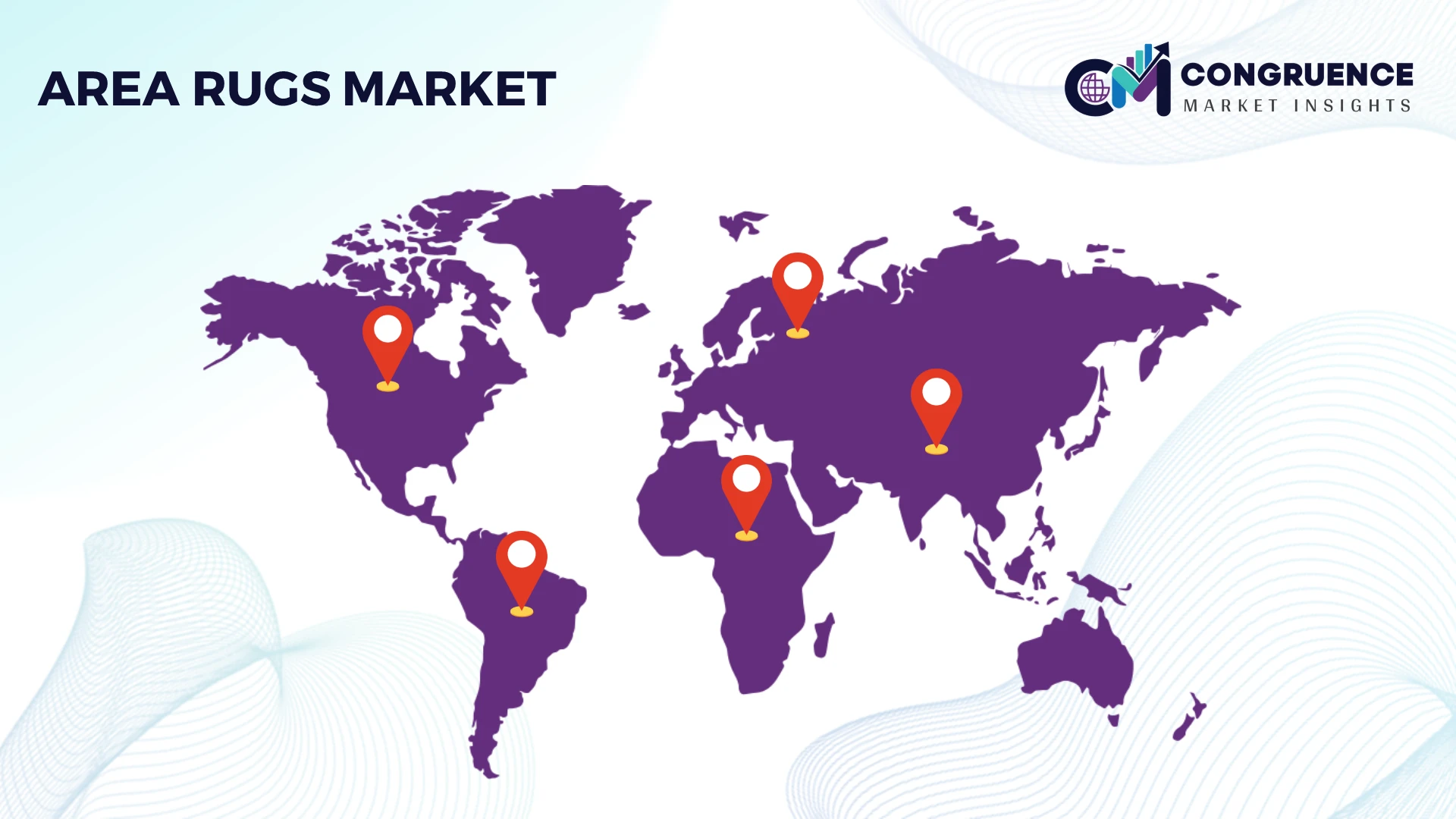
North America held approximately 35% of the global Area Rugs Market in 2025, maintaining the strongest regional position through high household furnishing expenditure, established specialty retail, and mature e-commerce channels. The United States represents the dominant country market, contributing roughly 28% of global demand, while Canada and Mexico provide smaller but strategically relevant consumer and manufacturing bases. Residential applications account for approximately 60% of regional demand, with washable, stain-resistant, machine-made, and customized formats gaining traction. Retailers are increasing private-label assortments and digital visualization tools to accelerate product selection and inventory turnover. Import dependence remains significant, with roughly 80% of U.S. area rugs sourced internationally, encouraging diversification toward India, Turkey, and other manufacturing hubs.
United States Market Outlook: The United States represents approximately 28% of global area-rug demand and remains the region's principal consumption and distribution hub. Its extensive home-improvement retail network, high online purchasing penetration, and strong renovation activity support premium and mass-market collections. Retailers are increasingly combining domestic merchandising and logistics capabilities with diversified overseas manufacturing to improve assortment flexibility and manage landed-cost pressure.
Europe represented approximately 28% of the global Area Rugs Market in 2025, making it the second-largest regional market. Germany, the United Kingdom, France, and Italy account for substantial demand, while Turkey provides an important manufacturing and export connection to European retailers. Premium wool, jute, recycled polyester, and artisan constructions are gaining share as consumers and procurement teams increasingly prioritize durability and material transparency. Approximately 25–30% of targeted European buyers place greater emphasis on sustainable-material characteristics when evaluating home-textile products. Manufacturers are strengthening certified-material portfolios, digital product information, and lower-impact dyeing processes. Online retail is also expanding customized collections, allowing brands to test designs without relying entirely on physical showroom capacity.
Germany Market Outlook: Germany accounts for approximately 6% of global area-rug demand and provides one of Europe's strongest premium home-furnishing markets. Its sophisticated specialty-retail network, logistics infrastructure, and sustainability-focused purchasing environment favor durable and traceable products. Manufacturers targeting German buyers are emphasizing certified fibers, recycled inputs, long-life construction, and transparent product specifications.
Asia-Pacific accounted for approximately 25% of the global Area Rugs Market in 2025 and represents the fastest-expanding major regional market. China contributes around 13.5% of global demand, while India accounts for approximately 6%, giving the region a strong combination of consumption scale and manufacturing capability. India also represents roughly 40% of global handmade-carpet exports, reinforcing its importance in premium and artisan supply chains. Machine-tufted production is expanding as manufacturers seek shorter lead times and greater design flexibility, while digital printing supports smaller customized batches. Companies are investing in automated tufting, integrated quality control, digital design systems, and export logistics. Supply-chain diversification away from China is further strengthening India's role in international retail sourcing.
India Market Outlook: India represents approximately 6% of global area-rug demand while maintaining a disproportionately important role in international handmade-rug supply. Its combination of artisan clusters, wool and natural-fiber expertise, and expanding mechanized production supports both premium and scalable collections. Manufacturers are increasing investment in machine-tufting, digital design, export logistics, and customized products to capture higher-value international orders.
South America represented approximately 7% of the global Area Rugs Market in 2025, with Brazil accounting for about 3.5% and remaining the principal regional demand center. Residential remodeling, apartment development, hospitality refurbishment, and expanding digital retail are strengthening demand for machine-made and mid-premium products. Price sensitivity remains higher than in North America and Western Europe, encouraging polypropylene and blended-fiber adoption, while premium wool and handmade products remain concentrated in affluent urban markets. Currency volatility and imported-material costs continue to influence procurement decisions. Distributors are therefore increasing local inventory coverage, supplier diversification, and shorter replenishment cycles. Companies with flexible sourcing and regional warehousing are better positioned to balance affordability with product variety.
Brazil Market Outlook: Brazil accounts for approximately 3.5% of global area-rug demand and represents the strongest commercial platform in South America. São Paulo functions as a major retail, design, and distribution hub, supporting residential and hospitality projects. Local distributors increasingly combine imported collections with domestically sourced products to reduce exposure to currency movements, freight costs, and extended international replenishment cycles.
The Middle East & Africa accounted for approximately 5% of the global Area Rugs Market in 2025, with the United Arab Emirates and Saudi Arabia serving as the principal project-driven markets. Saudi Arabia contributes roughly 1.2% of global demand, while the UAE represents approximately 1.5%, supported by luxury hospitality, tourism infrastructure, residential developments, and mixed-use projects. Premium handmade and customized rugs remain particularly relevant for hotels, resorts, luxury residences, and commercial interiors. Large-scale development programs are increasing demand for coordinated furnishing packages, while import-dependent procurement creates pressure for reliable regional distribution. Manufacturers are responding through designer partnerships, project-specific production, regional inventory, and contract-supply capabilities rather than relying solely on conventional retail channels.
Saudi Arabia Market Outlook: Saudi Arabia represents approximately 1.2% of global area-rug demand and is the region's most strategically significant project market. Its expanding hospitality, tourism, residential, and mixed-use development pipeline supports customized, specification-driven procurement. Suppliers are strengthening local partnerships and project-sales teams to secure larger furnishing contracts, while premium manufacturers are adapting designs and materials to luxury hospitality requirements.
The Area Rugs Market pits Mohawk Home, Oriental Weavers, Surya, Loloi Rugs, and Nourison Home against specialized artisan and regional producers such as Jaipur Rugs and OBEETEE. The top five players collectively command approximately 19% share, confirming a fragmented structure. Competition centers on price, customization, supply-chain responsiveness, and digital merchandising, with automation improving production efficiency by 15–20% and online channels accelerating assortment turnover. Mohawk emphasizes scale and distribution, Oriental Weavers integrates manufacturing, while Jaipur Rugs competes through artisan craftsmanship and premium customization. Ruggable differentiates through washable product engineering and direct-to-consumer distribution. Supply diversification toward India and Turkey is reshaping sourcing strategies as tariff and freight pressures persist. Established retail relationships, manufacturing networks, design portfolios, and procurement scale remain major entry barriers. Competitive advantage increasingly depends on combining manufacturing flexibility, distinctive designs, resilient sourcing, rapid replenishment, and digitally enabled customization.
Mohawk Industries, Inc.
Shaw Industries Group, Inc.
Oriental Weavers
Jaipur Rugs
Surya, Inc.
Nourison Home
Loloi Rugs
Safavieh
Milliken & Company
Ruggable
The Dixie Group, Inc.
Momeni Inc.
Capel Rugs
Balta Group
Digital printing, automated tufting, computer-aided design, and automated cutting are becoming important production technologies for scalable rug manufacturing. Digital workflows reduce sampling and development cycles by approximately 15–20%, while automated tufting can improve production consistency by 10–15%. Adoption is strongest among manufacturers serving high-volume retail, private-label programs, and customized online collections, where shorter production cycles directly improve inventory responsiveness.
Washable-rug engineering is also disrupting conventional product design through specialized backings, synthetic-fiber construction, stain resistance, and simplified cleaning. Compared with conventional fixed rugs, washable formats can reduce cleaning-related handling time by approximately 20–30%. Ruggable's washable product architecture demonstrates how product engineering is becoming a competitive differentiator rather than merely a material innovation. Companies with strong DTC capabilities benefit most because product convenience can be communicated directly through digital merchandising.
Between 2026 and 2028, AI-assisted pattern generation, virtual room visualization, automated quality inspection, and connected inventory systems will increasingly integrate design with production and distribution. Virtual visualization can reduce physical sampling requirements by approximately 20%, while AI-supported workflows accelerate pattern iteration. Digital-first brands gain speed advantages, whereas vertically integrated manufacturers gain scale benefits. The strategic priority is shifting from isolated automation toward connected design-to-delivery systems that improve customization, inventory accuracy, and response speed.
February 2026 Mohawk Industries reported fourth-quarter 2025 net sales of approximately USD 2.7 billion, up 2.4% year over year. The performance reinforced the company's scale advantage across flooring categories and supported continued operational focus on product development, manufacturing efficiency, and distribution capabilities. Source: mohawkind.com
September 2025 Ruggable introduced its All-in-One washable rug system, moving from its traditional two-piece construction to one-piece designs. The launch included two textures and simplified washing and assembly, strengthening the company's product differentiation and addressing convenience-driven household purchasing behavior. Source: rugnews.com
May 2025 Oriental Weavers USA introduced a redesigned website as part of its digital strategy. The company serves customers across more than 150 countries, and the platform upgrade strengthens product discovery, digital merchandising, and customer engagement across its international distribution network. Source: orientalweavers.com
April 2024 Jaipur Living opened a new designer-focused Studio experience featuring 18-inch rug swatches across its assortment. The showroom strengthened tactile product evaluation and designer engagement, supporting premium specification, customization, and consultation-led purchasing for residential and commercial interiors. Source: jaipurliving.com
The Area Rugs Market Report covers major product and construction categories, including handmade and machine-made formats, residential and commercial applications, and household, hospitality, corporate, and retail end-users. Geographic coverage includes North America, Europe, Asia-Pacific, South America, and the Middle East & Africa, with country-level assessment of major consumption, manufacturing, and sourcing hubs. Emerging niches include washable rugs, customized collections, sustainable fibers, premium wool, and digitally merchandised products.
The report evaluates automated tufting, digital printing, computer-aided design, sustainable-material integration, e-commerce adoption, supply-chain diversification, and inventory optimization. Approximately 60–67% residential concentration across relevant market definitions highlights the importance of household purchasing, while 15–20% potential production-efficiency improvements reinforce automation's strategic relevance. The analysis supports investment planning, manufacturing expansion, sourcing decisions, competitive positioning, product development, partnerships, and market-entry priorities throughout 2026–2033
| Report Attribute / Metric | Details |
|---|---|
| Market Revenue (2025) | USD 1,140.0 Million |
| Market Revenue (2033) | USD 1,710.1 Million |
| CAGR (2026–2033) | 5.20% |
| Base Year | 2025 |
| Forecast Period | 2026–2033 |
| Historic Period | 2021–2025 |
| Segments Covered |
By Type
By Application
By End-User
|
| Key Deliverables | Revenue Forecast; Market Trends; Growth Drivers & Restraints; Technology Insights; Segmentation Analysis; Regional Insights; Competitive Landscape; Regulatory & ESG Overview; Recent Developments |
| Regions Covered | North America; Europe; Asia-Pacific; South America; Middle East & Africa |
| Companies Profiled | Mohawk Industries, Inc.; Shaw Industries Group, Inc.; Oriental Weavers; Jaipur Rugs; Surya, Inc.; Nourison Home; Loloi Rugs; Safavieh; Milliken & Company; Ruggable; The Dixie Group, Inc.; Momeni Inc.; Capel Rugs; Balta Group |
| Customization & Pricing | Available on Request (10% Customization Free) |




