
Reports
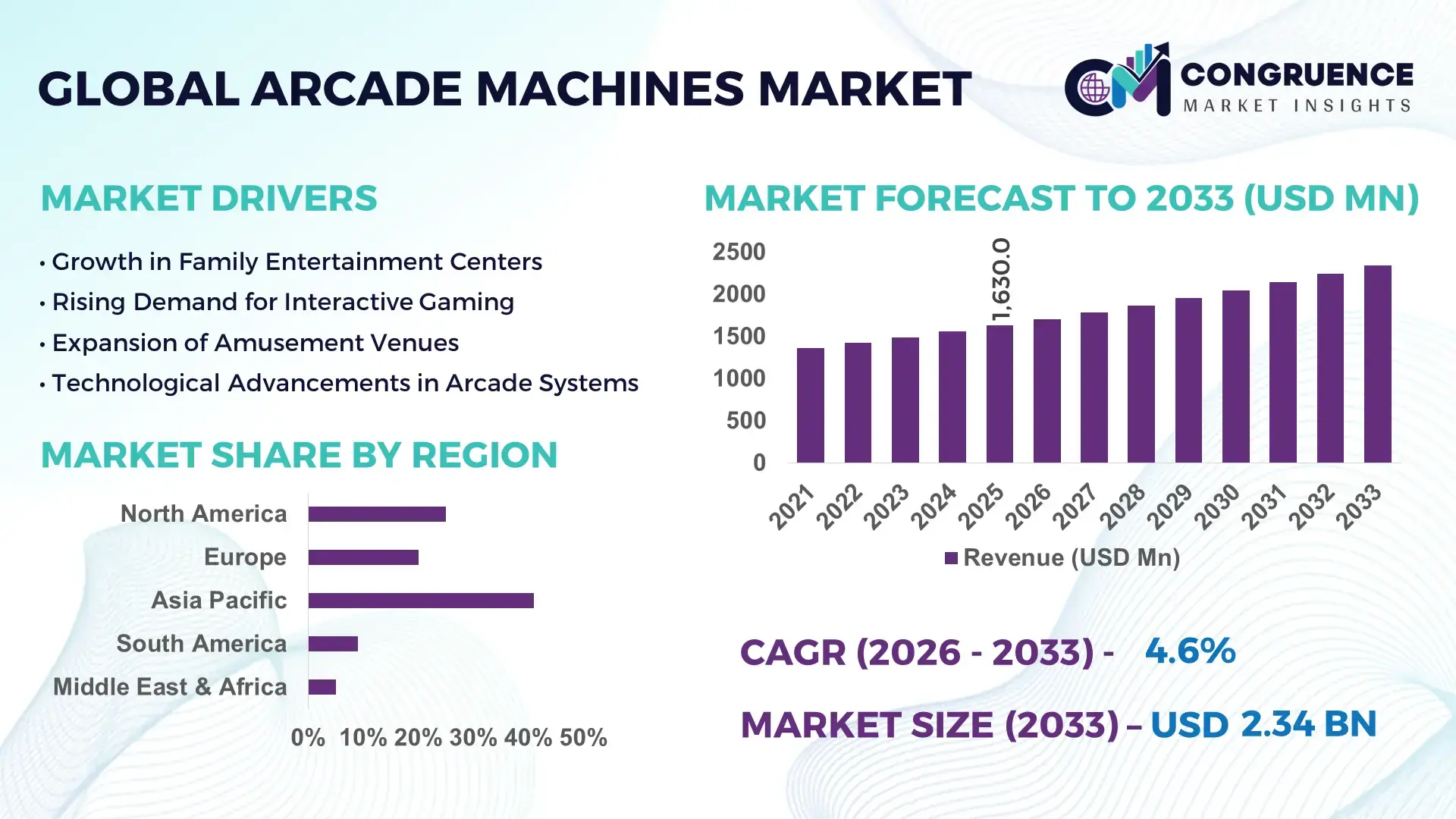
The Global Arcade Machines Market was valued at USD 1630 Million in 2025 and is anticipated to reach a value of USD 2342.98 Million by 2033 expanding at a CAGR of 4.64% between 2026 and 2033. Growth is accelerating through location-based entertainment expansion, AI-enabled interactive gaming systems, cashless payment integration, and rising deployment of immersive multiplayer arcade platforms across malls, esports arenas, and family entertainment centers.
Japan leads the global arcade machines market with approximately 31% installed machine share, supported by over USD 420 million in annual entertainment hardware investments and high-density gaming zones across Tokyo and Osaka. China follows with faster deployment growth, driven by smart entertainment complexes and domestic manufacturing scale, while the United States maintains strong premium arcade adoption in hybrid retail-entertainment venues. Advanced motion simulation systems improved player retention rates by nearly 18% in high-traffic centers during 2026 amid broader Asia-Pacific entertainment infrastructure expansion.
Manufacturers prioritizing connected arcade ecosystems, modular machine upgrades, and regional supply-chain localization are securing stronger operator contracts and higher-margin recurring revenue opportunities across the competitive global arcade machines industry.
Market Size & Growth: USD 1630 million in 2025 reaching USD 2342.98 million by 2033 at 4.64% CAGR, driven by AI-integrated multiplayer arcade systems and cashless gaming upgrades.
Top Growth Drivers: Immersive gaming demand increased 22%, esports-linked arcade traffic rose 19%, and smart entertainment venue expansion accelerated 17% globally.
Short-Term Forecast: By 2028, predictive maintenance integration reduces machine downtime by 26% while operational efficiency improves 21% across premium arcade chains.
Emerging Technologies: AI gameplay analytics, VR motion platforms, and cloud-connected arcade management systems improved player engagement rates by nearly 24%.
Regional Leaders: Asia-Pacific exceeds USD 980 million through dense entertainment hubs, North America crosses USD 610 million with hybrid gaming venues, and Europe surpasses USD 420 million through retro-gaming modernization.
Consumer/End-User Trends: Nearly 48% of urban entertainment consumers preferred multiplayer experiential arcade gaming over standalone console gaming in 2026.
Pilot/Case Example: In 2026, a Southeast Asian family entertainment operator deployed smart redemption systems, increasing repeat customer visits by 16%.
Competitive Landscape: The top five manufacturers control approximately 44% market share, led by Sega, Bandai Namco, Raw Thrills, Taito, and UNIS.
Regulatory & ESG Impact: Energy-efficient arcade systems lowered power consumption by 14% as operators aligned with stricter commercial energy compliance targets.
Investment & Funding: Global investments exceeded USD 510 million in 2026, fueled by regional entertainment expansion partnerships and localized manufacturing strategies.
Innovation & Future Outlook: Advanced mixed-reality arcade ecosystems and subscription-based machine servicing models are reshaping long-term operator profitability and expansion planning.
The arcade machines market is experiencing strong demand across family entertainment centers, esports-linked gaming venues, premium malls, and hospitality entertainment zones. AI-powered gameplay analytics, VR-integrated simulators, and cashless transaction systems improved customer retention by nearly 20% in high-footfall locations during 2026. Regional component sourcing diversification and compact modular machine designs are also reshaping deployment economics, creating a stronger foundation for strategic expansion and competitive positioning.
The arcade machines market is becoming strategically important as entertainment operators compete to increase customer dwell time, diversify recurring revenue streams, and strengthen experiential retail formats. Infrastructure modernization across malls, transit hubs, and mixed-use commercial complexes is accelerating deployment of connected arcade ecosystems with cloud-based analytics and cashless engagement systems. Japan and South Korea continue leading high-density arcade innovation, while the United States is expanding hybrid food-and-gaming venues that increased customer spending per visit by nearly 15% during 2026. Simultaneously, supply-chain restructuring in China and Southeast Asia is reducing component procurement lead times by approximately 18%, improving deployment flexibility for large entertainment operators.
AI-enabled predictive maintenance platforms are outperforming legacy standalone arcade systems by reducing machine downtime nearly 28% and lowering field servicing costs by 16%. Operators in Dubai and Singapore are integrating VR motion simulators and multiplayer redemption gaming to improve repeat visitation metrics, particularly in premium family entertainment centers. Over the next two to three years, connected arcade deployments are expected to exceed 55% penetration across newly established urban entertainment venues as operators prioritize centralized machine management and digital payment interoperability.
A major entertainment chain in Thailand recently partnered with hardware developers to deploy modular arcade systems supporting faster game rotation cycles and lower refurbishment costs. Companies are increasingly allocating investments toward immersive gaming partnerships, regional assembly operations, and subscription-based servicing models to strengthen operational resilience. Businesses securing scalable technology integration, localized supply capability, and high-engagement gaming ecosystems are positioned to capture stronger competitive advantage in the evolving arcade entertainment industry.
The rapid expansion of location-based entertainment infrastructure is accelerating arcade machine deployment across commercial gaming venues, malls, and hospitality complexes. Smart multiplayer systems improved customer engagement rates by approximately 21%, while AI-driven redemption platforms increased repeat visits by 17% in high-footfall entertainment centers during 2026. Japan and the United States are investing heavily in hybrid esports-entertainment venues, supported by rising demand for interactive social gaming experiences. Simultaneously, China’s localized component manufacturing ecosystem reduced production turnaround times by nearly 14%, improving inventory responsiveness for machine suppliers. Companies are responding through strategic licensing partnerships, VR-enabled product launches, and expansion of modular gaming platforms designed for faster content updates. Operators prioritizing connected gaming ecosystems are achieving stronger floor utilization and higher revenue productivity per square meter.
Arcade machine manufacturers continue facing pressure from semiconductor dependency, imported display component costs, and rising hardware upgrade requirements. Advanced motion simulators and immersive VR cabinets require up to 32% higher integration expenditure compared to conventional arcade units, limiting rapid deployment among mid-sized operators. Taiwan and South Korea remain critical suppliers for gaming processors and display modules, creating procurement vulnerabilities during logistics disruptions and trade policy fluctuations. Additionally, energy-intensive arcade systems increased operational electricity expenses by nearly 12% across large entertainment facilities in 2026. Companies are reducing exposure through regionalized assembly operations, long-term supplier contracts, and adoption of interchangeable hardware architectures that simplify maintenance cycles. Businesses unable to optimize hardware sourcing and lifecycle management face weaker profitability and slower deployment scalability in competitive entertainment markets.
AI-powered personalization systems and compact entertainment venue models are creating new operational opportunities for arcade machine providers. Smart gameplay analytics improved player retention by approximately 23%, while cloud-connected arcade management systems reduced machine monitoring labor requirements by 19% in multi-site operations. India and Saudi Arabia are emerging as high-potential deployment markets due to rapid commercial infrastructure expansion and rising investment in family entertainment destinations. Simultaneously, energy-efficient arcade hardware using low-power LED systems lowered electricity consumption by nearly 15%, supporting sustainability-focused venue upgrades. Companies are accelerating R&D spending on adaptive gaming software, mixed-reality experiences, and subscription-based content delivery platforms. An important strategic shift involves smaller-format arcade deployments in transit hubs and retail micro-centers, opening new recurring revenue channels beyond traditional gaming arcades.
The growing integration of connected payment systems, cloud gaming controls, and multiplayer network infrastructure is increasing execution complexity across the arcade machines market. Nearly 41% of large entertainment operators reported integration delays linked to software interoperability and legacy hardware compatibility during 2026 deployments. Cybersecurity risks are also intensifying as arcade ecosystems adopt digital wallets, biometric authentication, and centralized customer analytics platforms. In the United States and Germany, stricter digital payment compliance standards are increasing certification and infrastructure validation costs for operators. Workforce limitations in advanced gaming software maintenance further slowed service response efficiency by approximately 13% across high-density entertainment venues. Companies must strengthen cybersecurity frameworks, invest in interoperable software architecture, and expand technical partnership networks to maintain operational consistency and long-term competitiveness in increasingly digitalized arcade environments.
• AI-Powered Gameplay Optimization arcade operators are deploying machine-learning analytics to track player engagement, spending cycles, and game retention patterns in real time. Smart recommendation systems improved repeat gameplay frequency by nearly 18%, while predictive servicing platforms reduced unexpected machine downtime by 24% across high-density gaming venues in Japan and the United States. Companies are integrating centralized dashboards and cloud-connected cabinets to streamline multi-location management as labor costs and maintenance response times continue rising.
• Compact Urban Arcade Formats are reshaping deployment strategies across shopping districts, metro stations, and mixed-use retail hubs. Smaller-format arcade layouts lowered floor-space requirements by approximately 28% while increasing machine utilization rates by 16% in Singapore and South Korea during 2026. Operators are prioritizing modular cabinets and rapid-install gaming systems to support flexible leasing structures and faster site expansion. This shift is also reducing refurbishment timelines and improving location profitability in high-rent commercial zones.
• Cashless Ecosystem Expansion is accelerating through QR-based payments, mobile wallets, and digital loyalty integration across modern entertainment facilities. Nearly 57% of newly deployed arcade systems in China adopted unified cashless interfaces in 2026, reducing transaction processing times by 31%. Companies are restructuring software partnerships and payment infrastructure to improve customer data capture, simplify multiplayer account synchronization, and comply with tightening digital payment security standards in major urban markets.
• Immersive Motion Gaming Adoption continues gaining momentum as VR racing simulators, interactive shooting platforms, and synchronized multiplayer systems drive premium arcade differentiation. Advanced motion-based cabinets increased customer session duration by nearly 22% in Dubai and Thailand entertainment complexes. Hardware suppliers are responding through joint ventures with content studios and localized assembly operations to offset logistics volatility and shorten deployment cycles amid continued pressure on imported electronic component sourcing.
Video Arcade Machines remain the dominant segment due to high scalability, software update flexibility, and strong compatibility with multiplayer digital ecosystems. Operators reported nearly 34% higher floor utilization from video-based cabinets compared to conventional mechanical systems during 2026, particularly in Japan and the United States. Their ability to integrate cloud gaming analytics, digital payment systems, and downloadable content supports lower long-term operational costs and faster game rotation cycles. Companies are prioritizing investments in AI-enhanced gameplay systems and multiplayer engagement features to strengthen customer retention in premium entertainment venues.
Racing Arcade Machines represent the fastest-growing segment as immersive motion simulators and esports-linked driving experiences gain traction across malls and entertainment hubs. Advanced racing platforms improved average customer session times by approximately 21%, while synchronized multiplayer systems increased repeat participation rates by 17%. Shooting Arcade Machines continue maintaining strategic relevance through VR-assisted interactive gaming formats, while Dance Arcade Machines are expanding in youth-focused urban entertainment centers. Claw Machines remain operationally valuable due to low maintenance requirements and high-volume deployment economics in retail-heavy environments.
Family Entertainment Centers hold the leading application share due to high machine density, extended customer dwell time, and diversified revenue generation models. Integrated redemption systems and multiplayer arcade environments increased repeat customer visitation by nearly 19% during 2026 across major entertainment operators in the United States and Saudi Arabia. Operators are scaling mixed-experience layouts combining racing simulators, claw machines, and interactive video gaming platforms to maximize space productivity and customer engagement. Automated ticketing systems and centralized machine monitoring are also improving operational efficiency in large entertainment complexes.
Bars and Restaurants are emerging as the fastest-growing application segment as operators adopt compact arcade installations to increase customer retention and average spending duration. Arcade-assisted hospitality formats improved beverage and food transaction frequency by approximately 14% in urban social venues across South Korea and the United Kingdom. Gaming Centers remain strategically important for competitive multiplayer deployment, while Shopping Malls continue integrating arcade zones to strengthen foot traffic recovery. Amusement Parks are expanding immersive simulator installations and synchronized gaming attractions to improve seasonal customer throughput and premium visitor experiences.
Entertainment Centers represent the dominant end-user segment due to large-scale machine deployment capacity, high customer turnover, and continuous content refresh requirements. Large entertainment operators increased connected arcade installations by approximately 27% during 2026 to improve centralized machine management and customer engagement analytics. These venues depend heavily on integrated multiplayer ecosystems, VR simulators, and digital redemption infrastructure to maintain competitive differentiation. Companies are responding through long-term technology partnerships, localized servicing networks, and modular hardware deployment strategies that simplify expansion across high-footfall commercial environments.
The Hospitality Industry is emerging as the fastest-growing end-user category as hotels and resort operators integrate arcade gaming into experiential leisure packages and family-focused entertainment offerings. Hospitality-linked arcade zones improved guest activity participation by nearly 18% in Thailand and the United Arab Emirates. Gaming Arcades continue maintaining strong deployment intensity through competitive esports and retro-gaming formats, while Theme Parks are investing in synchronized motion gaming systems for premium attractions. Retail Venues and Educational Centers are adopting compact interactive machines to improve customer engagement and experiential learning environments through lower-footprint gaming infrastructure.
Asia-Pacific accounted for the largest market share at 41% in 2025 however, Middle East & Africa is expected to register the fastest growth, expanding at a CAGR of 6.1% between 2026 and 2033.
Hybrid Entertainment Venues Reshape Deployment Strategy
North America maintains strong arcade machine deployment intensity through hybrid entertainment formats integrating dining, esports, and immersive gaming experiences. The region contributed approximately 27% of global installations in 2025, supported by high consumer spending across family entertainment centers and social gaming venues. Operators in the United States and Canada accelerated deployment of cloud-connected arcade ecosystems, with cashless gaming systems integrated into nearly 62% of newly upgraded facilities during 2026. Major venue operators are also prioritizing predictive maintenance software and modular cabinet infrastructure to reduce servicing costs and improve floor productivity. Strategic partnerships between entertainment chains and gaming technology developers are accelerating deployment cycles for VR racing simulators and multiplayer video gaming systems.
United States Market Outlook: The United States leads North American arcade operations through large-scale entertainment infrastructure, advanced payment integration, and strong esports-linked gaming demand. Family entertainment chains expanded immersive gaming floor capacity by approximately 18% during 2026, particularly across Texas, California, and Florida. Operators are increasingly investing in AI-driven customer analytics, synchronized multiplayer platforms, and compact urban gaming formats to improve repeat visitation and maximize venue profitability.
Energy-Efficient Modernization Gains Momentum
Europe is strengthening its arcade machine ecosystem through energy-efficient modernization programs and digitally integrated entertainment venues. The region accounted for nearly 22% of global arcade deployments in 2025, driven by retro-gaming demand and modernization of amusement infrastructure across Germany, the United Kingdom, and France. Smart power-management systems reduced arcade energy consumption by approximately 13% across upgraded facilities during 2026, aligning with tightening commercial sustainability standards. Operators are increasingly adopting modular arcade systems and centralized software monitoring to optimize maintenance scheduling and operational consistency. Growing integration of immersive simulators into mixed-use entertainment destinations is also supporting premium gaming experiences in high-traffic urban centers.
Germany Market Outlook: Germany remains strategically important due to advanced commercial entertainment infrastructure, engineering-led gaming technology integration, and strong operational focus on energy efficiency. Arcade venue operators increased adoption of centralized monitoring platforms by approximately 21% during 2026 to improve servicing efficiency and regulatory compliance. The country’s emphasis on sustainable commercial operations is accelerating deployment of low-power gaming systems and durable modular cabinets across entertainment and hospitality venues.
Manufacturing Scale and High-Density Deployment Leadership
Asia-Pacific dominates the arcade machines market through concentrated manufacturing ecosystems, large entertainment venue networks, and high-frequency consumer gaming culture. The region generated approximately 41% of global deployment activity in 2025, supported by large-scale arcade infrastructure across Japan, China, and South Korea. China expanded localized arcade hardware assembly capacity by nearly 16% during 2026, improving supply-chain responsiveness and reducing import dependency for regional operators. Simultaneously, Japan continues leading advanced multiplayer gaming deployment through immersive simulator technologies and AI-integrated entertainment systems. Companies are accelerating partnerships with mall developers and family entertainment operators to scale connected gaming ecosystems across urban commercial zones.
Japan Market Outlook: Japan remains the technological and operational center of the global arcade machines industry, supported by dense gaming infrastructure and strong consumer participation in competitive arcade experiences. Advanced multiplayer gaming cabinets represented nearly 48% of newly installed systems across major Japanese entertainment venues during 2026. Domestic operators are heavily focused on synchronized esports gaming, AI-assisted engagement analytics, and rapid content refresh cycles to maintain high machine utilization and customer retention rates.
Retail Entertainment Expansion Supports Demand
South America is witnessing steady arcade machine adoption through shopping mall entertainment expansion and modernization of urban gaming centers. The region represented approximately 6% of global deployment activity in 2025, with Brazil and Argentina leading demand across family-oriented entertainment venues. Compact arcade installations increased by nearly 14% during 2026 as operators optimized smaller retail spaces and reduced upfront deployment costs. However, imported component dependency and inconsistent logistics infrastructure continue affecting large-scale hardware replacement cycles. Companies are responding through localized assembly partnerships and lower-maintenance machine designs tailored for mid-sized commercial operators seeking faster profitability and simplified servicing requirements.
Brazil Market Outlook: Brazil leads South American arcade deployment through expanding retail-entertainment infrastructure and growing demand for interactive social gaming formats. Entertainment operators increased multiplayer arcade installations by approximately 17% during 2026 within major shopping complexes across São Paulo and Rio de Janeiro. Domestic distributors are prioritizing compact modular gaming systems and localized maintenance support to reduce import-related servicing delays and improve deployment flexibility across rapidly expanding commercial entertainment sites.
Entertainment Infrastructure Investments Accelerate Adoption
Middle East & Africa is emerging as a high-growth arcade machines market driven by aggressive entertainment infrastructure investments and tourism-focused commercial development. The region accounted for nearly 4% of global deployments in 2025, with the United Arab Emirates and Saudi Arabia leading premium arcade expansion projects. Large entertainment complexes integrated immersive VR gaming systems and synchronized multiplayer attractions, increasing customer engagement rates by approximately 19% during 2026. Operators are prioritizing premium family entertainment ecosystems within malls, resorts, and mixed-use developments to strengthen non-oil commercial diversification strategies. Strategic partnerships with international gaming technology providers are accelerating deployment of advanced motion simulation and cashless arcade platforms.
Saudi Arabia Market Outlook: Saudi Arabia is rapidly strengthening its arcade entertainment ecosystem through large-scale commercial modernization programs and tourism-focused infrastructure investment. Family entertainment operators expanded premium gaming floor installations by nearly 22% during 2026 within Riyadh and Jeddah mixed-use entertainment districts. The country’s emphasis on experiential leisure development is encouraging deployment of immersive simulator gaming, AI-enabled engagement systems, and integrated digital payment infrastructure across next-generation entertainment destinations.
The arcade machines market is led by Sega, Bandai Namco, Raw Thrills, Taito, and UNIS competing directly against regional manufacturers and low-cost assembly specialists across Asia and North America. The top five players collectively control approximately 44% market share through technology leadership, distribution reach, and exclusive gaming content integration. Competition centers on immersive gameplay performance, cabinet durability, software refresh speed, and operational efficiency. AI-enabled predictive maintenance systems reduced servicing costs by nearly 16%, while modular cabinet architecture shortened installation timelines by 21% for premium operators. Japanese technology leaders are competing with Chinese cost-focused manufacturers through differentiated multiplayer ecosystems and faster hardware localization strategies. Companies are expanding through entertainment partnerships, regional assembly operations, and vertically integrated content development to secure recurring operator contracts. Technology integration complexity, licensing costs, and supply-chain control remain major entry barriers. Winning increasingly depends on scalable connected gaming ecosystems, localized servicing capability, and rapid content innovation.
Sega Corporation
Bandai Namco Entertainment Inc.
Taito Corporation
Raw Thrills Inc.
UNIS Technology Ltd.
Adrenaline Amusements
Andamiro Co. Ltd.
Elaut Group
LAI Games
Wahlap Technology
Coastal Amusements Inc.
Konami Amusement
ICE Games
Bay Tek Entertainment
AI-enabled gameplay analytics, cloud-connected machine monitoring, and cashless payment ecosystems are becoming core technologies across modern arcade deployments. Nearly 58% of newly installed arcade systems in 2026 integrated centralized performance tracking platforms, improving machine uptime by approximately 24% and reducing maintenance response times by 18%. Operators are also deploying dynamic content-update systems that shorten game refresh cycles and improve player retention. Companies with integrated software-management capabilities are securing stronger multi-location contracts from entertainment chains seeking operational consistency and lower servicing complexity.
Emerging technologies such as VR motion simulators, mixed-reality multiplayer gaming, and biometric engagement tracking are reshaping competitive differentiation. Advanced motion-based arcade cabinets increased average customer session duration by nearly 22% compared to traditional fixed-screen systems. Japan and South Korea are accelerating deployment of synchronized esports-compatible gaming platforms, while U.S. operators are integrating loyalty-linked mobile applications to strengthen repeat visitation rates. Manufacturers are expanding partnerships with gaming studios and payment technology providers to improve immersive content delivery and real-time customer analytics integration.
Between 2026 and 2028, modular hardware architecture and edge-based processing systems will significantly influence deployment economics and scalability. New modular arcade platforms lower upgrade costs by approximately 27% versus legacy cabinet replacement models while improving installation speed by 19%. Technology leaders investing in connected ecosystems, AI-assisted maintenance, and localized hardware assembly will gain stronger operational leverage as entertainment venues prioritize high-efficiency immersive gaming infrastructure.
April 2025 – Bandai Namco launched the “Level Up” PAC-MAN themed arcade at Angel Stadium in California, marking the first permanent arcade installation inside a Major League Baseball venue. The partnership extension runs four additional years, strengthening experiential entertainment deployment and brand visibility in sports venues. Source: domain: bandai.com
May 2026 – Raw Thrills globally launched STRANGER THINGS ARCADE™, a four-player immersive redemption platform integrating advanced multiplayer technology and licensed entertainment IP. The new system strengthened operator demand for high-engagement themed gaming experiences while expanding premium arcade attraction deployment across family entertainment centers. Source: domain: arcadeheroes.com
March 2025 – Bandai Namco Holdings restructured its amusement operations through the establishment of Bandai Namco Experience Inc., consolidating arcade machine planning and development functions. The operational restructuring enhanced development coordination and accelerated global entertainment facility expansion priorities under its updated mid-term strategy. Source: domain: bandainamco.co.jp
June 2025 – Bandai Namco accelerated overseas amusement expansion plans, operating nearly 60 entertainment facilities outside Japan, primarily across the United Kingdom and Hong Kong. The strategy strengthened international machine deployment capacity and improved localized operational control as global experiential entertainment demand continued increasing. Source: domain: intergameonline.com
The Arcade Machines Market report delivers detailed analysis across machine types, applications, end-user industries, deployment models, and regional operational dynamics between 2026 and 2033. The study evaluates Video Arcade Machines, Racing Arcade Machines, Shooting Arcade Machines, Dance Arcade Machines, and Claw Machines, alongside application coverage spanning gaming centers, amusement parks, shopping malls, family entertainment centers, and hospitality venues. More than 40% of deployment activity remains concentrated in high-density entertainment ecosystems integrating connected gaming infrastructure and cashless engagement technologies.
The report further examines operational modernization trends, AI-enabled gameplay analytics, VR-based immersive systems, modular cabinet architecture, and cloud-connected machine management platforms shaping future deployment strategies. Regional analysis covers North America, Europe, Asia-Pacific, South America, and Middle East & Africa, highlighting manufacturing concentration, infrastructure investments, and adoption intensity. Strategic insights support investment planning, technology positioning, partnership evaluation, supply-chain optimization, and expansion strategy development for entertainment operators, hardware manufacturers, and arcade ecosystem providers navigating evolving consumer engagement models.
| Report Attribute/Metric | Report Details |
|---|---|
|
Market Revenue in 2025 |
USD 1630 Million |
|
Market Revenue in 2033 |
USD 2342.98 Million |
|
CAGR (2026 - 2033) |
4.64% |
|
Base Year |
2025 |
|
Forecast Period |
2026 - 2033 |
|
Historic Period |
2021 - 2025 |
|
Segments Covered |
By Type
By Application
By End-User
|
|
Key Report Deliverable |
Revenue Forecast, Growth Trends, Market Dynamics, Segmental Overview, Regional and Country-wise Analysis, Competition Landscape |
|
Region Covered |
North America, Europe, Asia-Pacific, South America, Middle East, Africa |
|
Key Players Analyzed |
Sega Corporation, Bandai Namco Entertainment Inc., Taito Corporation, Raw Thrills Inc., UNIS Technology Ltd., Adrenaline Amusements, Andamiro Co. Ltd., Elaut Group, LAI Games, Wahlap Technology, Coastal Amusements Inc., Konami Amusement, ICE Games, Bay Tek Entertainment |
|
Customization & Pricing |
Available on Request (10% Customization is Free) |




