
Reports
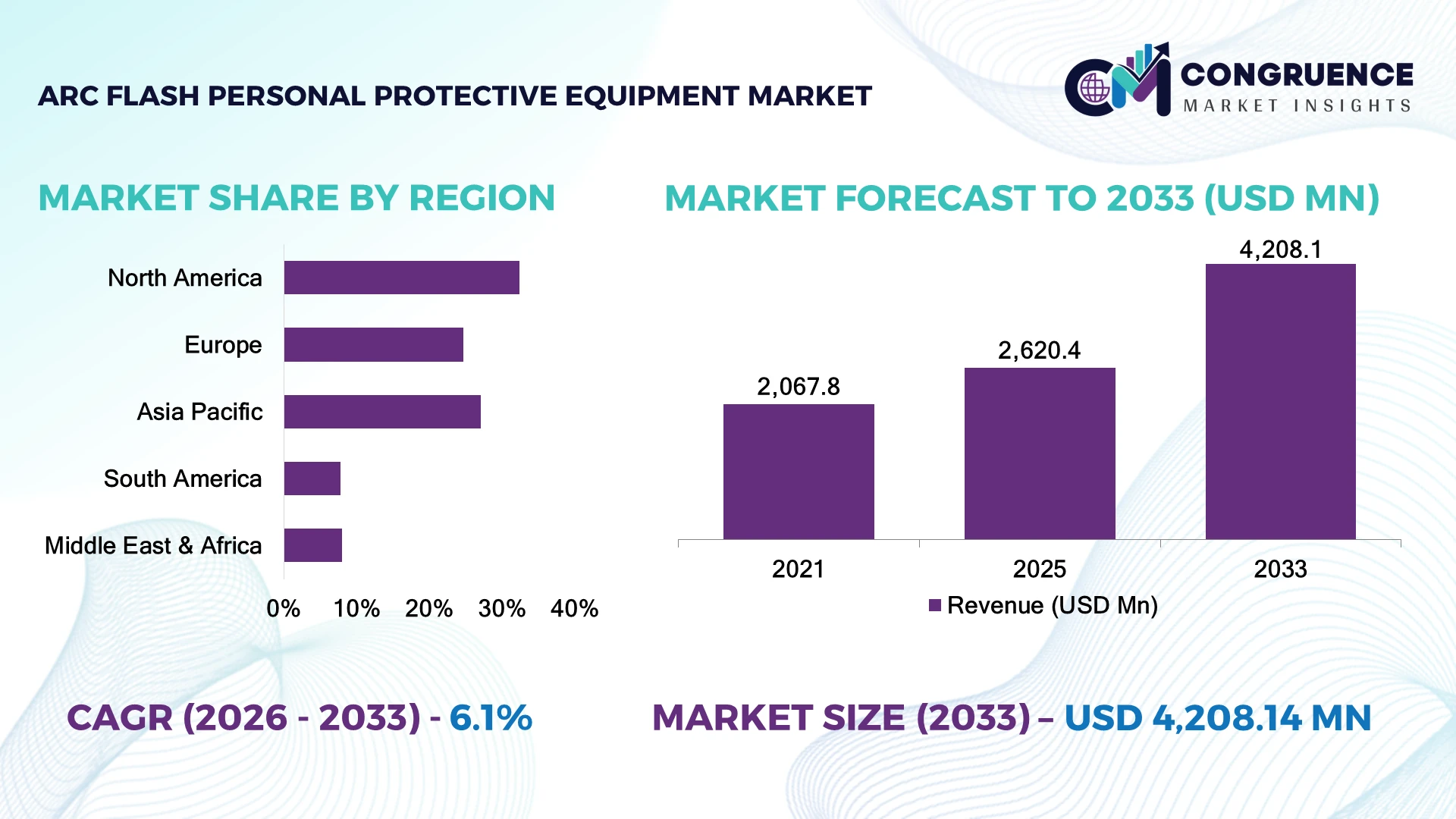
The Global Arc Flash Personal Protective Equipment Market was valued at USD 2,620.4 Million in 2025 and is anticipated to reach a value of USD 4,208.1 Million by 2033 expanding at a CAGR of 6.1% between 2026 and 2033. Growth is being driven by grid modernization, industrial electrification, stricter arc-rated workwear requirements, and replacement of legacy FR garments with lighter multi-hazard PPE systems.
The United States remains the dominant country market, supported by utility, semiconductor, manufacturing, data-center, and infrastructure investment. U.S. federal grid programs announced in 2026 include USD 1.9 billion in funding opportunities, reinforcing electrical infrastructure activity. India is expanding industrial electrical-safety deployment across manufacturing and power projects, while U.S. procurement emphasizes certified arc-rated systems. The strategic priority is to align product portfolios with infrastructure investment, certification requirements, and enterprise-scale PPE standardization.
Market Size & Growth: USD 2,620.4 million in 2025 to USD 4,208.1 million by 2033 at 6.1% CAGR, supported by grid modernization and stricter arc-rated PPE requirements.
Top Growth Drivers: Grid investment 38%; industrial electrification 31%; regulatory compliance 24%.
Short-Term Forecast: By 2028, standardized PPE procurement and digital inventory management can reduce replacement inefficiencies by 10–15% across large electrical-workforce fleets.
Emerging Technologies: Lightweight multi-layer fabrics, moisture-management fibers, and digitally traceable PPE can improve wearer comfort and inventory control by approximately 12–18%.
Regional Leaders: North America is projected at about USD 1.4 billion by 2033, Europe at USD 1.0 billion, and Asia-Pacific at USD 1.2 billion, with adoption shifting toward certified multi-hazard ensembles.
Consumer/End-User Trends: Utilities and electrical contractors represent more than 60% of recurring arc-rated PPE procurement, while industrial maintenance teams increasingly standardize worker protection kits.
Pilot/Case Example: 2026 U.S. grid-modernization programs include USD 1.9 billion in funding opportunities, strengthening electrical-worker protection requirements across transmission and infrastructure projects.
Competitive Landscape: Honeywell, 3M, DuPont, Ansell, and Lakeland Industries collectively represent roughly 40–45% of organized global supply, competing through certification, fabric performance, customization, and distribution reach.
Regulatory & ESG Impact: Updated ASTM F1506 requirements reinforce arc-rated clothing performance and labeling, while longer-life garments can reduce replacement frequency by approximately 10–15%.
Investment & Funding: USD 1.9 billion in U.S. grid-upgrade funding opportunities in 2026 is reinforcing electrical infrastructure expansion and associated PPE procurement requirements.
Innovation & Future Outlook: 2026–2028 investment is shifting toward lighter fabrics, higher arc ratings, integrated face-and-body protection, and digitally managed PPE inventories rather than basic FR garment replacement.
The Arc Flash Personal Protective Equipment Market is being reshaped by demand for lighter, higher-arc-rating garments across utilities, industrial manufacturing, renewable-energy installations, data centers, and electrical maintenance operations. Approximately 60% of organized procurement is concentrated among repeat industrial and utility users, making lifecycle durability and standardized PPE kits increasingly important. Updated arc-rated clothing requirements are also strengthening specification-driven purchasing and compliance-led replacement cycles.
Arc flash PPE is becoming a strategic procurement category because electrical infrastructure is becoming more complex while employers face tighter requirements for hazard assessment, arc-rated clothing, and worker protection. The shift is particularly visible in the United States, where 2026 grid-modernization funding is accelerating transmission upgrades and increasing the number of electrical-work environments requiring engineered protection.
Technology is changing the economics of protection. Modern lightweight multi-layer arc-rated fabrics can deliver comparable thermal protection with approximately 10–15% lower garment weight than conventional constructions, improving mobility and wearer acceptance. Mature U.S. and European buyers emphasize documented arc ratings, fit, durability, and lifecycle management, while India is scaling certified workwear programs across manufacturing and power infrastructure. Updated ASTM F1506 requirements further reinforce performance and labeling discipline.
Over the next 2–3 years, utilities, manufacturers, and contractors are expected to increase standardized PPE kits, digital inventory controls, and multi-hazard protection. Companies are responding through fabric R&D, regional production, distributor partnerships, and customized enterprise contracts. Competitive advantage will increasingly depend on combining certified protection, wearer comfort, reliable supply, and measurable lifecycle economics rather than competing on garment price alone.
Grid modernization and industrial electrification are increasing procurement of higher-rated arc flash PPE, particularly across U.S. utilities, data centers, semiconductor plants, and advanced manufacturing. Approximately 38% of demand is linked to utility and electrical infrastructure applications, while industrial maintenance represents nearly 29% and data-center projects are expanding at an estimated 15% annual deployment pace. The shift toward higher-voltage equipment is raising requirements for multi-layer arc-rated garments, face protection, and integrated PPE kits. Manufacturers are responding with lighter fabrics, expanded certification portfolios, and regional production partnerships. The non-obvious advantage is lifecycle standardization: enterprise buyers increasingly consolidate PPE specifications across sites, allowing suppliers with broad product families to secure larger recurring contracts and reduce procurement fragmentation.
Certification complexity and material costs remain structural constraints, particularly for smaller PPE manufacturers entering high-specification industrial contracts. Flame-resistant fibers, arc-rated fabrics, and specialized face shields can account for approximately 35–45% of garment production costs, while compliance-related testing can extend product qualification cycles by 10–20%. In India and Southeast Asian manufacturing hubs, imported specialty fibers expose producers to currency and logistics volatility, creating additional margin pressure. Buyers also face replacement costs when garments fail inspection or lose certification through improper care. Leading suppliers are responding through multi-year material contracts, localized sourcing, and vertically integrated fabric development. The strategic pressure point is not product availability but maintaining certified performance at a commercially viable total cost across large distributed workforces.
The strongest opportunity lies in lightweight PPE that combines arc-flash, flame-resistant, thermal, and visibility protection without increasing garment burden. Advanced fabric structures can reduce garment weight by approximately 10–15%, while moisture-management designs improve wearer comfort by an estimated 15–20% during extended electrical maintenance shifts. India, Saudi Arabia, and the United States offer particularly attractive opportunities as power infrastructure, industrial facilities, and data centers expand. Digital PPE inventory platforms represent another underpenetrated opportunity, with centralized tracking capable of reducing avoidable replacement and stock discrepancies by roughly 10–18%. Suppliers are investing in textile R&D, connected inventory systems, and enterprise partnerships. The strategic opportunity is to sell PPE as a lifecycle-managed safety system rather than as individual garments.
Long-term deployment is challenged by inconsistent hazard assessments, workforce training gaps, PPE fit variability, and integration across multiple safety-management systems. Large electrical contractors can operate with 10–20% workforce turnover annually, increasing the frequency of training and fit-management requirements. Improper garment selection or maintenance can reduce effective protection even when certified equipment is specified. Digital PPE tracking also introduces cybersecurity and interoperability requirements when integrated with enterprise EHS platforms. U.S. utilities and multinational manufacturers are responding with standardized PPE matrices, centralized training, digital inspection records, and supplier-managed programs. Manufacturers must therefore solve more than material performance: scalable sizing, worker compliance, traceability, and replacement workflows will determine whether advanced PPE delivers consistent protection across geographically dispersed operations.
Lighter Arc-Rated Garments: Lightweight fabric construction is gaining traction as employers prioritize worker mobility without sacrificing thermal protection. Newer garments are approximately 10–15% lighter than comparable legacy designs, while moisture-management features can improve perceived comfort by 15–20%. U.S. utilities and industrial contractors are increasingly standardizing lighter multi-layer ensembles, encouraging manufacturers to shift textile R&D toward performance-per-weight rather than maximum material density.
Multi-Hazard PPE Integration: Procurement is shifting from individual garments toward integrated protection covering arc flash, flame, heat, visibility, and mechanical exposure. Multi-hazard kits can reduce SKU complexity by approximately 20–30% across standardized workforces. Large manufacturers and utilities are restructuring specifications around common PPE matrices, while suppliers are expanding compatible face shields, gloves, hoods, and outerwear to capture larger enterprise contracts.
Digital PPE Management Expands: Enterprise buyers are increasingly combining PPE inventories with digital inspection, worker assignment, and replacement records. Connected workflows can reduce stock discrepancies and avoidable replacements by approximately 10–18%, particularly across multi-site electrical operations. The United States and Germany are seeing stronger enterprise-level standardization, prompting suppliers to develop digital traceability and managed-service capabilities alongside physical PPE portfolios.
Regional Supply Chains Diversify: Specialty fiber and technical-textile procurement is becoming more geographically diversified as manufacturers manage logistics volatility and qualification requirements. Regional sourcing initiatives can reduce selected material lead times by 15–25%, improving production planning for large contracts. Indian and Southeast Asian manufacturers are increasing local textile-processing capabilities, while global suppliers are expanding dual-source arrangements to protect continuity for certified arc-rated product lines.
Arc-Rated Clothing Leads as Protection Moves Toward Lightweight Multi-Hazard Systems
Arc-rated clothing is estimated to account for approximately 46% of the Arc Flash Personal Protective Equipment Market, supported by broad deployment across utility, manufacturing, oil & gas, and electrical maintenance operations. Its dominance reflects scalable garment configurations, standardized arc ratings, and compatibility with existing industrial uniforms. Gloves and hand protection represent about 23%, while face and head protection contributes nearly 17%, with both categories benefiting from increasing task-specific hazard assessments. Footwear and other protective accessories retain strategic relevance where grounding, mechanical protection, and full-body protection must operate together.
The fastest-growing type is lightweight multi-hazard arc-rated apparel, gaining adoption as employers prioritize thermal protection without excessive garment weight. Demand for breathable engineered fabrics is rising, with premium lightweight products commanding roughly 12–15% higher procurement interest in safety-intensive workplaces. Manufacturers are responding through fiber engineering, modular garment designs, and partnerships with industrial PPE distributors. Investment is shifting from basic compliance garments toward durable, ergonomic systems that improve worker acceptance and reduce replacement frequency.
NFPA’s 2025 revision materials continue to specify arc-rated PPE according to incident-energy exposure, including minimum 8, 25, and 40 cal/cm² protection levels, reinforcing task-specific PPE selection rather than one-size-fits-all procurement.
Industrial Electrical Maintenance Remains the Core Deployment Base
Industrial electrical maintenance is estimated to represent approximately 38% of market demand, reflecting sustained PPE requirements around switchgear, motor-control centers, distribution panels, transformers, and energized maintenance activities. Utility operations follow at roughly 27%, where transmission and distribution assets require higher-rated clothing and specialized gloves. Manufacturing, construction, oil & gas, and other electrical-intensive environments collectively account for the remaining demand, with purchasing increasingly tied to documented incident-energy assessments rather than broad occupational categories.
Construction and renewable-energy installation represent the fastest-expanding application cluster, driven by new electrical infrastructure, battery systems, and decentralized generation assets. Adoption in these settings is estimated to be growing about 8–10% faster than mature maintenance applications as contractors standardize PPE requirements across temporary and permanent worksites. Companies are responding with rental programs, distributor partnerships, application-specific kits, and integrated PPE training. The business implication is significant: suppliers able to combine compliant protection, rapid availability, and task-specific customization are gaining procurement preference over undifferentiated garment vendors.
OSHA’s accident database contained 407 arc-flash-related records through August 20, 2025, illustrating the continuing operational relevance of arc-flash controls across electrical workplaces and reinforcing employer emphasis on hazard assessment and protective equipment.
Electrical Utilities Anchor Demand While Energy-Intensive Industry Accelerates
Electrical utilities are estimated to account for approximately 34% of Arc Flash Personal Protective Equipment Market demand, reflecting large technician populations, extensive energized infrastructure, and recurring maintenance requirements. Industrial manufacturers represent nearly 29%, supported by continuous operation of switchboards, drives, control panels, and high-voltage systems. Electrical contractors and commercial facilities form additional demand pools, with purchasing increasingly influenced by project specifications and contractor safety programs rather than centralized corporate procurement alone.
Industrial manufacturers are the fastest-growing major end-user group, as electrification, automation, data-center construction, and higher equipment density increase the frequency of electrical maintenance tasks. Their share is expected to gain roughly 3–4 percentage points as companies expand preventive-maintenance programs and standardize PPE across multiple facilities. Leading suppliers are targeting this shift through customized garment programs, distributor networks, volume contracts, and multi-hazard product portfolios. DuPont’s 2025 innovation program highlighted multi-hazard protection, sustainability, and electrical-hazard solutions, including a 40-cal arc-flash suit designed for renewables and electrification-related work.
DuPont’s 2025 Innovation Awards included a 40-cal arc-flash suit for renewables and electrification applications, while another recognized industrial garment incorporated 30% recycled materials, showing how protection performance and material sustainability are increasingly being combined in commercial PPE development.
North America accounted for the largest market share at 32.4% in 2025 however, Asia-Pacific is expected to register the fastest growth, expanding at a CAGR of 7.1% between 2026 and 2033.
Hazard-Based PPE Procurement Is Replacing Broad Compliance Purchasing
North America remains the largest Arc Flash Personal Protective Equipment Market, representing approximately 32.4% of global demand, supported by mature electrical-safety practices across utilities, manufacturing, oil & gas, data centers, and commercial infrastructure. The United States concentrates most regional consumption as employers increasingly link PPE specifications to incident-energy analysis, equipment labeling, and task-specific risk assessments. NFPA 70E requirements distinguish protection categories and working conditions, including systems with available fault currents ranging from below 1.5 kA to 10 kA or higher. This is pushing buyers toward calibrated arc-rated garments rather than generic flame-resistant workwear. Manufacturers are responding with lighter multi-hazard fabrics, higher-rated face protection, and integrated PPE kits. Data-center construction and grid modernization are expanding procurement intensity, while standardized safety programs are strengthening recurring replacement demand.
United States Market Outlook: The United States is the region's principal demand center because of its extensive utility infrastructure, industrial electrical equipment base, and mature workplace-safety framework. NFPA 70E-based hazard assessment supports differentiated PPE selection according to incident energy and fault conditions. The market is also benefiting from expansion of data centers, semiconductor facilities, battery manufacturing, and power infrastructure, where energized maintenance creates recurring requirements for arc-rated clothing, gloves, shields, and protective accessories.
Standardization and Lightweight Protection Are Reshaping Procurement
Europe represents approximately 24.7% of global Arc Flash Personal Protective Equipment demand, with Germany, France, the United Kingdom, Italy, and the Nordic industrial economies forming the principal procurement centers. IEC-based testing and product-performance requirements are encouraging manufacturers to emphasize certified arc-rated garments, thermal stability, ergonomic construction, and multi-hazard protection. The 2025 publication of IEC TR 63491 strengthened guidance for selecting, using, and maintaining electrical-arc PPE, reinforcing risk-based purchasing. Industrial automation, renewable-energy infrastructure, rail electrification, and grid modernization are increasing exposure to higher electrical-system complexity. Suppliers are consequently expanding lightweight fabric portfolios and localized technical support, while buyers increasingly evaluate durability and worker mobility alongside protection ratings.
Germany Market Outlook: Germany provides Europe's strongest industrial demand base through its electrical equipment manufacturing, automotive production, chemicals, machinery, and advanced factory infrastructure. High-voltage systems and automated production lines require structured electrical maintenance programs, supporting consistent demand for arc-rated clothing and accessories. German manufacturers are also positioned to accelerate adoption of lighter multi-hazard PPE as industrial employers balance thermal protection with ergonomics and workforce productivity.
Industrial Electrification Is Expanding the Addressable PPE Base
Asia-Pacific is estimated to hold approximately 27.1% of the global market, with China, Japan, South Korea, India, and Australia driving procurement through manufacturing, utilities, mining, construction, and renewable-energy projects. India is particularly important as industrial electrification and power infrastructure expansion increase the number of electrical maintenance environments requiring compliant protective equipment. Government electrical-safety guidance in India explicitly requires PPE and devices protecting workers from arc-flash-related electrical injury. Manufacturers are increasing local production, distributor coverage, and task-specific product portfolios, while international suppliers are developing regionally adapted sizing and pricing strategies. China remains a major manufacturing and supply-chain center, creating cost advantages but also intensifying competition between global premium brands and regional manufacturers.
India Market Outlook: India is emerging as a strategically important demand and manufacturing market, supported by power-grid expansion, industrial automation, steel production, renewables, rail electrification, and large infrastructure projects. National electrical-safety requirements call for PPE conforming to relevant standards and maintained in sound working condition. The country's combination of expanding electrical infrastructure and cost-sensitive procurement is encouraging suppliers to localize production while retaining higher-rated protection for critical industrial applications.
Mining and Power Infrastructure Are Concentrating Premium PPE Demand
South America accounts for an estimated 7.8% of global Arc Flash Personal Protective Equipment demand, with Brazil and Chile representing the principal industrial consumption centers. Mining, metals processing, utilities, oil & gas, and large-scale electrical infrastructure create concentrated requirements for high-performance arc-rated garments and accessories. Brazil's NR-10 framework provides an established electrical-safety foundation, while 2025 regulatory clarifications concerning PPE for thermal hazards from electric arc and flash fire demonstrate continuing attention to product compliance. Buyers remain sensitive to imported-product pricing and lead times, encouraging distributors and manufacturers to maintain regional inventory. Premium suppliers are increasingly targeting mining and utility contracts where documented protection performance carries greater procurement weight than upfront garment cost.
Brazil Market Outlook: Brazil is the most significant South American market because of its diversified industrial base spanning mining, steel, energy, manufacturing, and large electrical networks. NR-10 provides a structured framework for electrical-installation and service safety, supporting demand for compliant protective equipment. Regulatory clarifications issued in 2025 concerning thermal-protection PPE reinforce product specification discipline. Local distribution capability remains strategically important because industrial customers prioritize dependable replenishment for geographically dispersed operations.
Energy Infrastructure Modernization Is Driving Higher-Rated Protection
Middle East & Africa represents approximately 8.0% of global demand, with Saudi Arabia, the United Arab Emirates, South Africa, and Qatar accounting for a substantial share of industrial procurement. Oil & gas processing, utilities, petrochemicals, mining, and large infrastructure projects create high-value applications for arc-rated clothing, gloves, face protection, and complete electrical PPE systems. Saudi Arabia is particularly significant because industrial diversification and power-system investment are increasing electrical-equipment density beyond conventional hydrocarbons. Contractors are strengthening site-level PPE specifications, while international manufacturers are expanding distributor partnerships and localized inventory. High ambient temperatures are also pushing demand toward breathable, lightweight fabrics that retain thermal protection without excessive heat burden, creating a premium product niche.
Saudi Arabia Market Outlook: Saudi Arabia represents the region's strongest strategic market, supported by oil & gas processing, utilities, industrial facilities, construction, and large-scale infrastructure development. Electrical-system expansion associated with industrial diversification is broadening PPE requirements beyond traditional energy operations. Suppliers with lightweight arc-rated garments, rapid regional fulfillment, and technical compliance support are positioned favorably as contractors standardize safety requirements across increasingly complex industrial projects.
The Arc Flash Personal Protective Equipment Market pits global safety platforms such as 3M, DuPont, MSA Safety, Ansell, and Honeywell/PIP against specialized suppliers including National Safety Apparel, Lakeland Industries, Oberon, and CATU. The top five players collectively command an estimated 35–40% share, leaving substantial room for regional manufacturers competing primarily on price and availability. Competition centers on certified protection, fabric engineering, ergonomics, and supply reliability; premium lightweight products can command 10–15% higher pricing, while localized sourcing can reduce procurement costs by roughly 8–12%. Players are expanding through distributor networks, product partnerships, material innovation, and vertically integrated PPE portfolios. The competitive landscape is shifting toward multi-hazard garments, lightweight high-calorie protection, and integrated head-to-toe systems. Recent consolidation, including PIP’s acquisition of Honeywell’s PPE business, strengthens portfolio breadth and distribution reach. Entry barriers remain high because certification, testing infrastructure, and established industrial relationships constrain rapid scale. Winning requires certified performance, dependable supply, ergonomic innovation, and application-specific customization.
3M Company
DuPont de Nemours, Inc.
MSA Safety Incorporated
Ansell Limited
Protective Industrial Products, Inc. (PIP)
National Safety Apparel
Lakeland Industries, Inc.
Oberon Company
CATU
Drägerwerk AG & Co. KGaA
Cintas Corporation
Delta Plus Group
Radians, Inc.
Saf-T-Gard International, Inc.
Lightweight engineered fabrics are becoming the core technology shift, combining aramid blends, inherent flame resistance, and improved moisture management. Premium 40-cal/cm² garments can weigh around 11 oz/yd², reducing garment burden versus heavier legacy constructions by approximately 15–25%. Advanced face shields are adding anti-scratch coatings, weight-balancing frames, improved ventilation, and nanotechnology-enhanced optical clarity. These features can extend usable product life by roughly 10–15% while improving worker mobility and visual accuracy during energized maintenance.
Smart PPE is emerging through connected identification, digital inspection records, RFID-enabled inventory control, and software-linked electrical safety programs. Enterprise deployment remains concentrated among large utilities, manufacturers, and contractors, but digital PPE management adoption is estimated at 15–20% among advanced safety programs. Integrated systems reduce manual inspection and replenishment workloads by approximately 20%, benefiting suppliers that combine PPE with compliance services and digital workflow tools.
From 2026–2028, material science, modular protection, and connected PPE will increasingly converge. New lightweight constructions can deliver roughly 20% better ergonomic performance than conventional heavy systems while retaining required arc ratings. Premium global manufacturers benefit first because certification laboratories, material R&D, and industrial customer relationships create an advantage. The competitive priority is shifting from simply meeting protection thresholds toward measurable comfort, lifecycle efficiency, traceability, and multi-hazard performance.
May 2025 Protective Industrial Products completed its acquisition of Honeywell’s PPE business, adding brands including Salisbury and expanding its head-to-toe portfolio across electrical safety, head, fall, hearing, and respiratory protection. The transaction materially strengthened PIP’s global product breadth and distribution platform. Source: pipglobal.com
August 2025 DuPont received three 2025 R&D 100 Awards, including recognition for materials technologies supporting industrial worker protection. The awards covered innovations addressing chemical, flame, and protective-material performance, reinforcing DuPont’s materials-led differentiation and strengthening its innovation position in high-performance protective apparel. Source: dupont.com
November 2025 DuPont introduced Tyvek APX at A+A 2025, delivering substantially higher breathability while maintaining protection and durability. The material innovation targeted improved worker comfort and productivity, reinforcing the industry shift toward lighter protective materials that reduce heat burden during demanding industrial operations. Source: dupont.com
2025 Honeywell Salisbury continued expanding its arc-flash portfolio with 40-cal/cm² Pro-Wear Plus garments weighing 11 oz/yd², emphasizing lightweight construction, improved breathability, and ergonomic mobility. The product strategy targets utilities and industrial users seeking higher protection without the operational burden associated with heavier protective garments. Source: Honeywell.com
The Arc Flash Personal Protective Equipment Market Report evaluates demand across arc-rated clothing, electrical gloves, face and head protection, footwear, and integrated protective accessories. Application coverage spans industrial electrical maintenance, utilities, manufacturing, construction, oil & gas, mining, and renewable-energy installations, while end-user analysis distinguishes utilities, industrial enterprises, electrical contractors, and commercial facilities. The report assesses mature procurement categories alongside emerging multi-hazard and lightweight protection systems.
Regional coverage includes North America, Europe, Asia-Pacific, South America, and Middle East & Africa, with country-level analysis of major industrial and electrical infrastructure markets. Technology assessment covers engineered aramid fabrics, lightweight high-calorie garments, advanced face shields, digital PPE management, and connected inspection systems. Strategic analysis supports supplier positioning, localization, portfolio expansion, partnership planning, investment priorities, and competitive strategy through 2026–2033.
| Report Attribute/Metric | Report Details |
|---|---|
|
Market Revenue in 2025 |
USD 2,620.4 Million |
|
Market Revenue in 2033 |
USD 4,208.1 Million |
|
CAGR (2026 - 2033) |
6.1% |
|
Base Year |
2025 |
|
Forecast Period |
2026 - 2033 |
|
Historic Period |
2021 - 2025 |
|
Segments Covered |
By Type
By Application
By End-User
|
|
Key Report Deliverable |
Revenue Forecast, Growth Trends, Market Dynamics, Segmental Overview, Regional and Country-wise Analysis, Competition Landscape |
|
Region Covered |
North America, Europe, Asia-Pacific, South America, Middle East, Africa |
|
Key Players Analyzed |
3M Company, DuPont de Nemours, Inc., MSA Safety Incorporated, Ansell Limited, Protective Industrial Products, Inc. (PIP), National Safety Apparel, Lakeland Industries, Inc., Oberon Company, CATU, Drägerwerk AG & Co. KGaA, Cintas Corporation, Delta Plus Group, Radians, Inc., Saf-T-Gard International, Inc. |
|
Customization & Pricing |
Available on Request (10% Customization is Free) |




