
Reports
The Global Aramid Powder Market was valued at USD 75.3 Million in 2025 and is anticipated to reach a value of USD 119.1 Million by 2033 expanding at a CAGR of 5.9% between 2026 and 2033. Growth is being driven by rising use of high-performance aramid powder in friction materials, sealing systems, composites, coatings, and lightweight components requiring superior wear resistance, thermal stability, and low density.
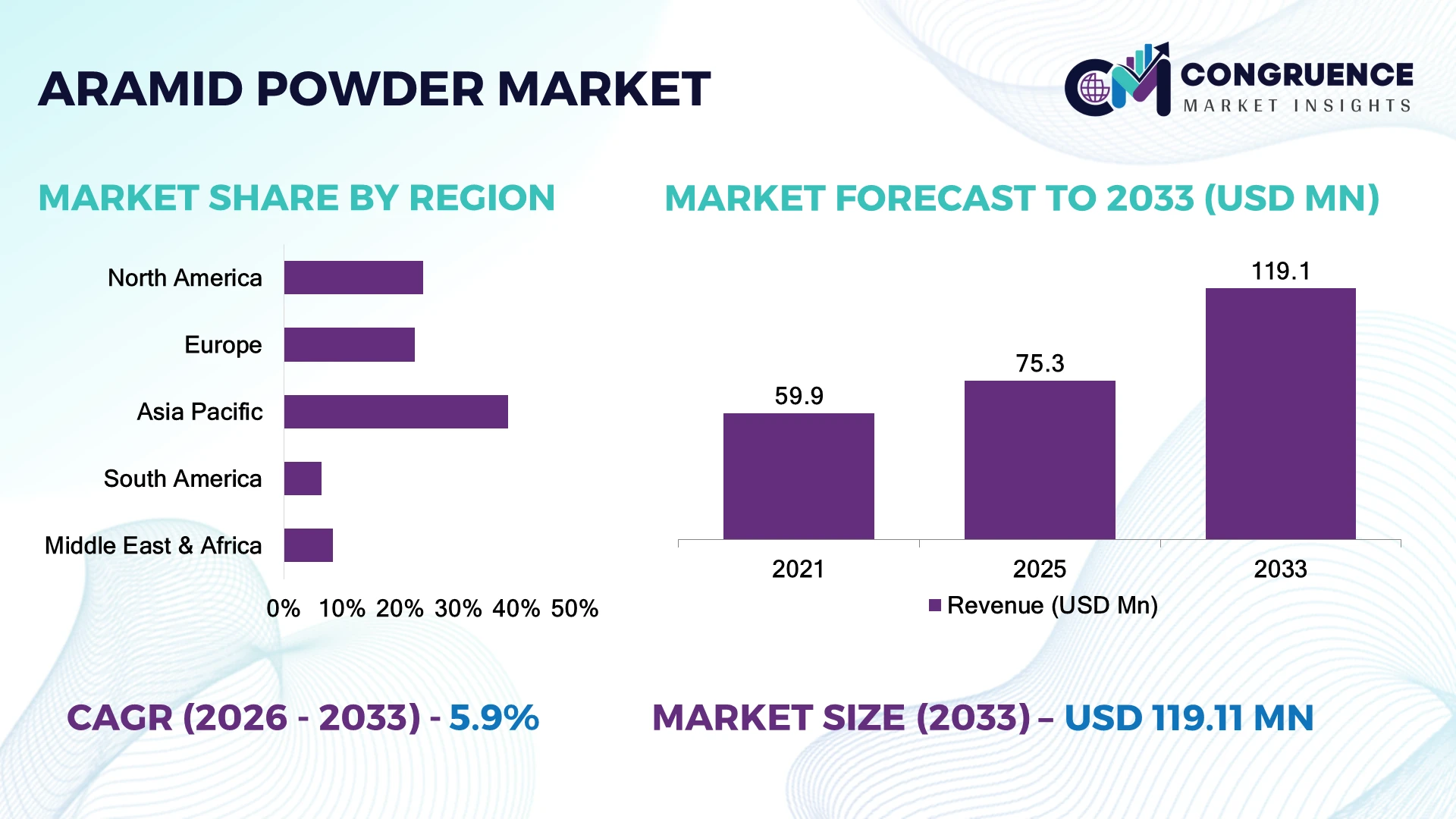
China represents the dominant manufacturing and consumption hub, accounting for approximately 30–35% of global aramid powder demand, supported by friction-material manufacturing, automotive components, industrial composites, and electronics. Japan and the United States maintain stronger positions in premium-grade specialty applications, while China benefits from larger production capacity and localized downstream conversion. Automotive and industrial friction applications together account for more than 50% of demand, with advanced formulations increasingly replacing conventional reinforcement materials.
Strategically, suppliers with localized production, controlled fiber morphology, and application-specific grades are gaining an advantage in high-value friction and composite formulations.
Market Size & Growth: USD 75.3 million in 2025 to USD 119.1 million by 2033 at a 5.9% CAGR, supported by friction materials, high-temperature composites, and lightweight engineering components.
Top Growth Drivers: Friction materials 32%, industrial composites 21%, and high-temperature sealing applications 16% represent the principal demand drivers.
Short-Term Forecast: By 2028, optimized aramid powder formulations can improve wear resistance by 10–18% and extend component service intervals by 8–15% in demanding friction applications.
Emerging Technologies: Fine-particle aramid powder, surface-functionalized grades, hybrid aramid-mineral formulations, and precision dispersion technologies are improving composite consistency and thermal performance.
Regional Leaders: Asia-Pacific is projected at approximately USD 60 million by 2033, Europe at USD 27 million, and North America at USD 23 million, with localized specialty-grade production expanding across Asian manufacturing hubs.
Consumer/End-User Trends: Automotive friction-material manufacturers account for approximately 38–42% of demand, increasingly specifying aramid reinforcement where lower wear debris and improved thermal stability are required.
Pilot/Case Example: 2026 friction-material development programs using optimized aramid powder formulations target approximately 10–15% lower wear rates and improved fade resistance during repeated high-temperature braking cycles.
Competitive Landscape: Teijin is among the leading global suppliers, with an estimated 15–20% share of specialty aramid powder-related supply, competing with DuPont, Kolon Industries, Hyosung Advanced Materials, and regional processors.
Regulatory & ESG Impact: Restrictions on hazardous friction-material constituents are accelerating material substitution, while aramid-based formulations can reduce particulate-intensive wear components by approximately 5–10% in optimized formulations.
Investment & Funding: Specialty-material producers are directing approximately USD 100–150 million across broader aramid capacity, downstream processing, and application development, emphasizing localized supply and higher-value grades.
Innovation & Future Outlook: Next-generation aramid powders are moving toward controlled particle morphology, hybrid reinforcement, surface modification, and application-specific grades, shifting competition from volume supply toward formulation performance.
The Aramid Powder Market is concentrated in friction materials, brake components, clutch systems, sealing compounds, thermoplastic composites, and high-temperature coatings. Fine-particle grades are gaining traction where dispersion quality directly affects component performance, with specialty formulations improving wear resistance by approximately 10–18%. Supply-chain localization across China, Japan, India, and Southeast Asia is also becoming more important as downstream manufacturers seek shorter qualification and replenishment cycles.
Aramid powder is becoming strategically important as manufacturers replace heavier or less thermally stable reinforcement materials in friction, sealing, composite, and high-performance polymer applications. Its combination of low density, thermal resistance, mechanical strength, and abrasion resistance allows component manufacturers to improve performance without proportionally increasing material weight. This is particularly relevant to automotive lightweighting and high-temperature industrial systems.
The market is also shifting toward application-specific powder morphology rather than standardized reinforcement grades. Compared with conventional fiber reinforcement, optimized powder formulations can improve dispersion consistency and reduce localized material defects, supporting approximately 5–15% improvements in selected wear or friction-performance indicators. China has the strongest manufacturing scale, while Japan and the United States remain important for specialty formulations, qualification-intensive applications, and advanced composite development.
Over the next 2–3 years, investment will increasingly target finer particle control, surface treatment, hybrid reinforcement, and localized downstream processing. Automotive brake and clutch manufacturers are integrating aramid powder into formulations designed for repeated thermal cycling, while industrial suppliers are developing grades for seals, gaskets, and engineered plastics. Companies that combine reliable powder morphology with application engineering and regional supply capability will gain stronger negotiating power and deeper customer qualification, making formulation expertise a more durable competitive advantage than volume capacity alone.
Automotive friction materials remain the strongest structural driver, representing approximately 38–42% of aramid powder consumption, as manufacturers prioritize thermal stability, abrasion resistance, and lightweight reinforcement. Aramid-containing formulations can improve wear resistance by roughly 10–18% while supporting 5–10% reductions in component density versus selected conventional reinforcement systems. China's large brake, clutch, and industrial-component manufacturing base is accelerating formulation adoption, while India is expanding localized automotive-component production. The transition toward copper-reduced and lower-emission friction formulations is reinforcing demand for aramid-based alternatives. Producers are responding with finer particle grades, controlled morphology, and application-specific formulations, shifting investment toward downstream technical support rather than simply increasing commodity powder capacity.
High-grade aramid powder remains exposed to upstream para-aramid and meta-aramid feedstock economics, with raw materials and conversion collectively representing approximately 55–70% of production costs for specialty grades. Feedstock price movements of 8–15% can materially affect downstream formulation margins, particularly for smaller friction-material manufacturers operating under fixed supply contracts. Qualification requirements also limit rapid substitution because changing reinforcement morphology can alter friction coefficient, wear, and thermal behavior by 5–10%. Japan's specialty-material supply chain is highly quality controlled, while Chinese producers benefit from greater manufacturing scale and localization. Producers are reducing exposure through long-term feedstock contracts, dual sourcing, process optimization, and regional conversion facilities that shorten logistics cycles and improve inventory control.
Fine-particle and surface-modified aramid powders are creating a higher-value opportunity in precision friction, sealing, and engineered-polymer applications. Controlled morphology can improve dispersion consistency by approximately 10–20%, while optimized formulations can reduce component wear by 8–15% under demanding thermal cycles. India, Southeast Asia, and Eastern Europe offer particularly attractive opportunities as automotive-component manufacturing expands and suppliers seek locally available performance additives. Another emerging opportunity is hybrid reinforcement combining aramid powder with mineral, ceramic, or carbon-based materials to balance friction, strength, and cost. Producers are investing in particle engineering, surface treatment, and application laboratories, while partnering with brake, clutch, seal, and composite manufacturers to secure formulation qualification before competitors.
Maintaining consistent particle size, morphology, moisture content, and dispersion remains a significant execution challenge because relatively small formulation variations can shift friction and wear performance by 5–10%. High-temperature processing can also alter polymer-fiber interfaces, requiring tighter mixing and curing controls across production batches. Automotive suppliers increasingly demand batch traceability and repeatable performance across multiple manufacturing locations, adding approximately 10–15% to quality-control requirements for highly engineered grades. The non-obvious challenge is that powder quality alone does not guarantee component performance; compatibility with resin systems, fillers, and processing temperatures determines the final result. Producers must therefore strengthen application laboratories, automated quality monitoring, technical partnerships, and customer-specific formulation databases to maintain qualification consistency.
Finer Particle Grades Gain Traction: Automotive and industrial formulators are increasingly shifting toward controlled fine-particle aramid powders, improving dispersion consistency by approximately 10–20% and reducing localized reinforcement defects. Suppliers are upgrading milling, classification, and particle-control processes to support tighter formulation specifications, particularly for premium brake and clutch compounds where small morphology variations directly affect wear behavior.
Hybrid Reinforcement Becomes More Practical: Formulators are combining aramid powder with mineral, ceramic, graphite, and other reinforcement systems to balance performance and material cost. Hybrid formulations can reduce reliance on individual additives by approximately 10–15% while maintaining targeted friction and thermal properties. European and Asian compounders are expanding laboratory validation to qualify these combinations for increasingly application-specific friction materials.
Localized Conversion Reduces Supply Exposure: Chinese and Indian downstream manufacturers are increasing regional processing and inventory capabilities as specialty-material supply chains face transportation and qualification pressures. Local conversion can shorten replenishment cycles by approximately 15–25% and reduce safety-stock requirements by 10–15%. Producers are responding through regional warehousing, toll processing, and closer technical collaboration with automotive-component manufacturers.
Low-Emission Formulations Reshape Material Selection: Brake and clutch manufacturers are reassessing reinforcement packages as environmental requirements tighten and conventional material systems face greater scrutiny. Aramid-based formulations can reduce dependence on selected conventional reinforcements by approximately 5–15% while maintaining thermal stability and wear performance. Suppliers are responding with copper-reduced, low-dust, and application-specific powder systems designed around evolving friction-material specifications.
Para-aramid powder represents approximately 70–75% of global Aramid Powder demand, supported by its higher tensile strength, abrasion resistance, thermal stability, and suitability for friction materials, reinforced polymers, and high-performance composites. Its established qualification base gives it a clear advantage over meta-aramid in performance-critical formulations, while meta-aramid powder accounts for roughly 18–22% and retains relevance where thermal resistance and insulation are prioritized. Other specialized grades represent approximately 5–8% of demand and remain concentrated in niche formulations.
Para-aramid is also the faster-expanding commercial grade within automotive and composite applications as lightweighting and heat-management requirements intensify. Companies are investing in controlled particle morphology, fibrillation, and surface treatment to improve dispersion by approximately 10–20% and strengthen formulation performance. Suppliers with vertically integrated aramid production and downstream powder-processing capabilities are prioritizing premium grades rather than competing solely on volume, increasing the importance of application-specific technical support.
Para-aramid represented approximately 74.9% of the broader global aramid-fiber market in 2025, reflecting its established performance advantage across high-strength and lightweight applications, according to 2025 market analysis.
Friction materials account for approximately 38–42% of Aramid Powder demand, making brake pads, clutch facings, and related formulations the dominant application cluster. Aramid powder provides thermal stability, reinforcement, and wear resistance during repeated friction cycles, making it particularly valuable in non-asbestos and low-metal formulations. Industrial composites and reinforced polymers represent approximately 22–26%, while sealing, gasket, and coating applications collectively contribute around 15–20%. These established uses prioritize predictable dispersion and long service life.
Lightweight structural composites represent the fastest-shifting application, with demand expanding as automotive manufacturers reduce component mass while retaining mechanical performance. Specialty composite formulations can deliver approximately 10–15% weight savings in selected components. Aerospace, electronics, and high-temperature insulation remain smaller but higher-value niches. Producers are responding by developing application-specific particle sizes, hybrid reinforcement systems, and technical partnerships with compounders to shorten qualification cycles and improve formulation consistency.
Automotive brake pads and clutch facings accounted for 27.3% of the broader automotive aramid-fiber application market in 2024, highlighting the established role of aramid reinforcement in high-temperature friction systems.
Automotive manufacturers and Tier-1 friction-component suppliers represent approximately 40–45% of Aramid Powder consumption, supported by brake systems, clutch components, seals, belts, and lightweight composite parts. Industrial manufacturers account for approximately 25–30%, particularly across machinery, sealing, friction, and engineered polymer applications. Aerospace and defense represent roughly 12–16%, but their stringent qualification requirements generate substantially higher value per kilogram than mainstream industrial applications.
Automotive remains the largest buyer base, while aerospace, defense, and advanced composite manufacturers represent the fastest-shifting premium segment as lightweighting and thermal-performance requirements increase. Buyers increasingly specify particle morphology, moisture control, dispersion behavior, and batch consistency rather than purchasing generic powder grades. Suppliers are responding with dedicated application laboratories, customer-specific formulations, long-term qualification programs, and localized technical support. The strategic implication is clear: future supplier differentiation increasingly depends on formulation engineering and qualification depth rather than powder availability alone.
Automotive, aerospace and defense applications continue to prioritize virgin aramid materials because stringent safety and durability requirements demand highly controlled mechanical and thermal performance, reinforcing premium demand for qualified aramid grades.
Asia-Pacific accounted for the largest market share at 38.5% in 2025 however, Middle East & Africa is expected to register the fastest growth, expanding at a CAGR of 7.1% between 2026 and 2033.

Advanced friction formulations and lightweight composites strengthen premium-grade demand
North America accounts for approximately 24.0% of global Aramid Powder demand, supported by automotive friction materials, aerospace components, industrial seals, and high-performance composites. The United States represents more than 85% of regional consumption, with demand concentrated among Tier-1 automotive suppliers, aerospace manufacturers, and specialty compounders. Aramid powder is increasingly specified in formulations requiring thermal stability, abrasion resistance, and weight reduction, particularly where conventional reinforcement systems face performance or environmental constraints. Advanced friction formulations can improve wear performance by approximately 10–18%, strengthening the commercial case for premium grades. Suppliers are responding through application laboratories, customer-specific formulations, and closer integration with compound manufacturers. North American buyers also emphasize consistent particle morphology and batch traceability, increasing qualification barriers for low-cost suppliers.
United States Market Outlook: The United States dominates regional demand through its large automotive, aerospace, defense, and engineered-materials industries. Aerospace and defense applications create particularly strong demand for high-performance aramid grades because component qualification emphasizes predictable thermal and mechanical behavior. The country's extensive automotive supplier network also supports recurring consumption in brake, clutch, sealing, and composite applications. More than 40% of regional aramid powder demand is linked to automotive and transportation-related applications, while aerospace provides a higher-value niche with stringent material qualification requirements.
Low-emission friction systems accelerate specialty-material substitution
Europe represents approximately 22.5% of global Aramid Powder demand, with Germany, France, Italy, and the United Kingdom forming the principal consumption centers. Automotive friction materials, industrial machinery, seals, and advanced composites dominate applications, while tighter environmental requirements are encouraging manufacturers to redesign material formulations. Aramid powder is gaining relevance where manufacturers need lower-density reinforcement and stable performance under repeated thermal cycling. Approximately 35–40% of European demand is concentrated in automotive-related applications. Germany remains the principal industrial hub, while Italy and France contribute strongly through automotive components and specialty-material processing. Producers are prioritizing low-emission formulations, finer particle grades, and application-specific technical support to protect margins in a qualification-intensive market.
Germany Market Outlook: Germany represents the strongest European market because of its automotive manufacturing base, Tier-1 supplier ecosystem, industrial machinery production, and advanced materials capabilities. Brake and clutch manufacturers increasingly evaluate reinforcement packages according to thermal stability, wear behavior, and material composition rather than price alone. Automotive applications account for approximately 40% of German aramid powder consumption, creating a stable qualification pipeline. Local suppliers and compounders are also investing in formulation development to support lightweight components and increasingly stringent vehicle-material requirements.
Manufacturing scale and localized automotive supply chains reinforce regional dominance
Asia-Pacific accounts for approximately 38.5% of global Aramid Powder demand, led by China, Japan, South Korea, and India. China contributes roughly 45% of regional consumption, supported by extensive automotive-component manufacturing, friction-material production, industrial machinery, and polymer processing capacity. Japan remains influential in specialty aramid technology, while India is expanding downstream automotive and industrial-material manufacturing. Approximately 50–55% of regional demand is connected to automotive and industrial friction applications. Localized processing and shorter material supply chains give Asian compounders greater flexibility in developing application-specific grades. Producers are expanding fine-particle processing, surface treatment, and technical partnerships with brake, clutch, seal, and composite manufacturers.
China Market Outlook: China is the region's largest aramid powder market and an important manufacturing center for downstream friction materials and engineered components. Its extensive automotive production base creates substantial recurring demand for reinforcement materials, while domestic processing capacity supports shorter qualification and replenishment cycles. Automotive and industrial applications together represent more than 55% of Chinese consumption. Producers are increasingly moving toward controlled morphology and specialty grades rather than competing exclusively on volume, improving their ability to serve premium friction and composite formulations.
Brazilian automotive production anchors specialized material consumption
South America accounts for approximately 6.5% of global Aramid Powder demand, with Brazil representing nearly 60% of regional consumption. Automotive components, industrial machinery, friction materials, and sealing products constitute the principal applications. Brazil's established vehicle-production and aftermarket ecosystem supports recurring requirements for brake and clutch formulations, while Argentina and Colombia provide smaller industrial demand centers. Approximately 45% of regional consumption is linked to automotive-related applications. The market remains dependent on imported specialty materials, making currency movements, freight costs, and inventory availability important purchasing considerations. Suppliers are responding through regional distributors, longer-term supply agreements, and localized technical support rather than establishing extensive manufacturing capacity.
Brazil Market Outlook: Brazil provides the strongest commercial base in South America because of its automotive manufacturing footprint, large vehicle parc, industrial machinery sector, and established friction-material producers. Automotive applications account for approximately 45–50% of local aramid powder consumption, creating recurring demand from brake and clutch manufacturers. São Paulo and Minas Gerais remain important industrial centers for component production. Suppliers with local inventory and technical formulation support have an advantage because shorter replenishment cycles can reduce exposure to imported-material delays and currency-driven procurement costs.
Industrial diversification creates selective demand for high-performance materials
Middle East & Africa represents approximately 8.5% of global Aramid Powder demand, with Saudi Arabia, the United Arab Emirates, South Africa, and Turkey forming important consumption centers. Demand is concentrated in industrial equipment, oil and gas components, transportation, friction materials, sealing systems, and advanced composites. Saudi Arabia and the UAE are increasing industrial investment and local manufacturing capabilities, creating new opportunities for high-temperature and wear-resistant materials. Approximately 30–35% of regional consumption is associated with industrial friction and sealing applications. The region remains heavily dependent on imported specialty grades, encouraging distributors and compounders to strengthen inventories and technical partnerships. Suppliers are targeting localized stocking, application engineering, and strategic industrial accounts.
Saudi Arabia Market Outlook: Saudi Arabia is emerging as a strategically important market through industrial diversification, transportation infrastructure development, and expansion of domestic manufacturing capabilities. Demand for aramid powder is concentrated in high-performance seals, friction components, industrial equipment, and engineered polymers exposed to elevated temperatures and abrasive operating conditions. Industrial applications account for more than 40% of local consumption. As domestic component manufacturing expands, suppliers are increasingly positioning through distributor partnerships, technical qualification programs, and regional inventory hubs that improve material availability for industrial customers.
Teijin Aramid, Arclin, Kolon Industries, Yantai Tayho Advanced Materials, and Hyosung Advanced Materials compete across premium aramid grades, while Chinese specialty producers such as AFChina and Sinochem target cost-sensitive formulators. The top five players are estimated to control approximately 55–60% of global aramid powder supply, reflecting concentration in upstream technology and qualified grades.
Competition centers on particle morphology, purity, consistency, price, and supply security. Premium grades command roughly 15–25% pricing advantages where tighter dispersion and thermal performance reduce formulation failures, while localized Chinese supply can offer 10–20% procurement savings. Kolon expanded aramid pulp capacity to 3,000 tonnes, while Teijin emphasizes tailored powder and pulp grades; Arclin’s acquisition of DuPont’s aramids business is reshaping ownership. The shift is toward vertical integration, recycled feedstocks, and application-specific grades. Entry barriers include polymer technology, customer qualification, and process know-how. Winning requires reliable morphology, localized supply, technical formulation support, and proven performance across demanding applications.
Teijin Aramid B.V.
Arclin, Inc.
Kolon Industries, Inc.
Yantai Tayho Advanced Materials Co., Ltd.
Hyosung Advanced Materials Corporation
Yantai Texrise Material Technology Co., Ltd.
AFChina
Sinochem High Performance Fiber
Yancheng Labon Technical Fiber Co., Ltd.
Jiangmen Hexagonal Special Fiber Co., Ltd.
Nantong Xinyuan Special Fiber Co., Ltd.
Wujin Huadong Particular-kind Fiber Co., Ltd.
Impact Fibers
AIP Associates
Current aramid powder technology centers on controlled particle size, dry milling, classification, surface treatment, and formulation-specific morphology. Fine powders can improve dispersion consistency by 10–20% versus coarser grades, while optimized formulations improve wear resistance by 8–15%. Adoption is strongest in friction materials, engineered plastics, rubber compounds, and specialty coatings where thermal stability and abrasion resistance directly affect component life.
Emerging processing combines surface functionalization, hybrid reinforcement, and precision particle classification. Modified aramid can improve resin or rubber compatibility by approximately 5–10%, while hybrid systems can reduce dependence on individual reinforcement additives by 10–15%. Teijin benefits from vertically integrated polymer-to-powder expertise, while specialized Asian producers compete through cost-efficient conversion and application customization. Recycled aramid feedstocks are moving from laboratory development toward commercial qualification.
During 2026–2028, automated particle classification, low-energy milling, recycled feedstock processing, and application-specific morphology will increasingly shape procurement. Compared with conventional powder processing, tighter particle control can reduce batch-to-batch dispersion variation by roughly 10–15%, improving compound consistency and lowering qualification losses. The strongest competitive advantage will favor suppliers combining upstream polymer control with downstream formulation engineering, regional inventory, and customer testing. These capabilities shorten qualification cycles and support premium applications where performance consistency matters more than lowest material price.
November 2024 Kolon Industries doubled aramid pulp capacity at Gumi from 1,500 to 3,000 tonnes annually. The KRW22 billion expansion targets low-dust brake materials, strengthening supply for automotive friction formulations ahead of Euro 7 and increasing product availability. Source: Kolon
August 2025 DuPont agreed to sell its Aramids business, including Kevlar and Nomex, to Arclin for approximately $1.8 billion. The transaction covers about 1,900 employees and five manufacturing sites, reshaping ownership and creating a larger specialty-material platform globally. Source: DuPont
August 2024 Teijin Aramid published a patent application for modified aramid pulp using polyoxazoline, targeting friction materials and specialty papers. The formulation incorporates aramid pulp with a modifier system, supporting improved processing and industrial application performance. Source: Google Patents
January 2026 BIEGLO expanded its commercial aramid powder offering for coatings, flooring, offshore platforms, and industrial surfaces. Its listed material withstands continuous temperatures up to 250°C and short-term exposure near 500°C, supporting higher-performance anti-slip applications across demanding environments. Source: BIEGLO
The Aramid Powder Market Report evaluates para-aramid and meta-aramid powder across friction materials, rubber reinforcement, specialty coatings and adhesives, engineered plastics, sealing systems, and other high-performance applications. End-user coverage includes automotive manufacturers, friction-material producers, industrial equipment manufacturers, aerospace and defense companies, rubber processors, and advanced composite manufacturers. The study assesses particle morphology, surface modification, dispersion technology, hybrid reinforcement, and recycled aramid processing.
Regional analysis covers North America, Europe, Asia-Pacific, South America, and Middle East & Africa, with country-level evaluation of major production and consumption centers. The report examines established applications alongside emerging opportunities in lightweight composites, electric-vehicle components, thermal-management materials, and specialty coatings. With automotive and friction-related uses representing approximately 40–45% of demand, the analysis supports investment planning, localization decisions, supplier qualification, expansion strategy, product development, and competitive positioning through 2026–2033.
| Report Attribute/Metric | Report Details |
|---|---|
|
Market Revenue in 2025 |
USD 75.3 Million |
|
Market Revenue in 2033 |
USD 119.1 Million |
|
CAGR (2026 - 2033) |
5.9% |
|
Base Year |
2025 |
|
Forecast Period |
2026 - 2033 |
|
Historic Period |
2021 - 2025 |
|
Segments Covered |
By Type
By Application
By End-User
|
|
Key Report Deliverable |
Revenue Forecast, Growth Trends, Market Dynamics, Segmental Overview, Regional and Country-wise Analysis, Competition Landscape |
|
Region Covered |
North America, Europe, Asia-Pacific, South America, Middle East, Africa |
|
Key Players Analyzed |
Teijin Aramid B.V., Arclin, Inc., Kolon Industries, Inc., Yantai Tayho Advanced Materials Co., Ltd., Hyosung Advanced Materials Corporation, Yantai Texrise Material Technology Co., Ltd., AFChina, Sinochem High Performance Fiber, Yancheng Labon Technical Fiber Co., Ltd., Jiangmen Hexagonal Special Fiber Co., Ltd., Nantong Xinyuan Special Fiber Co., Ltd., Wujin Huadong Particular-kind Fiber Co., Ltd., Impact Fibers, AIP Associates |
|
Customization & Pricing |
Available on Request (10% Customization is Free) |




