
Reports
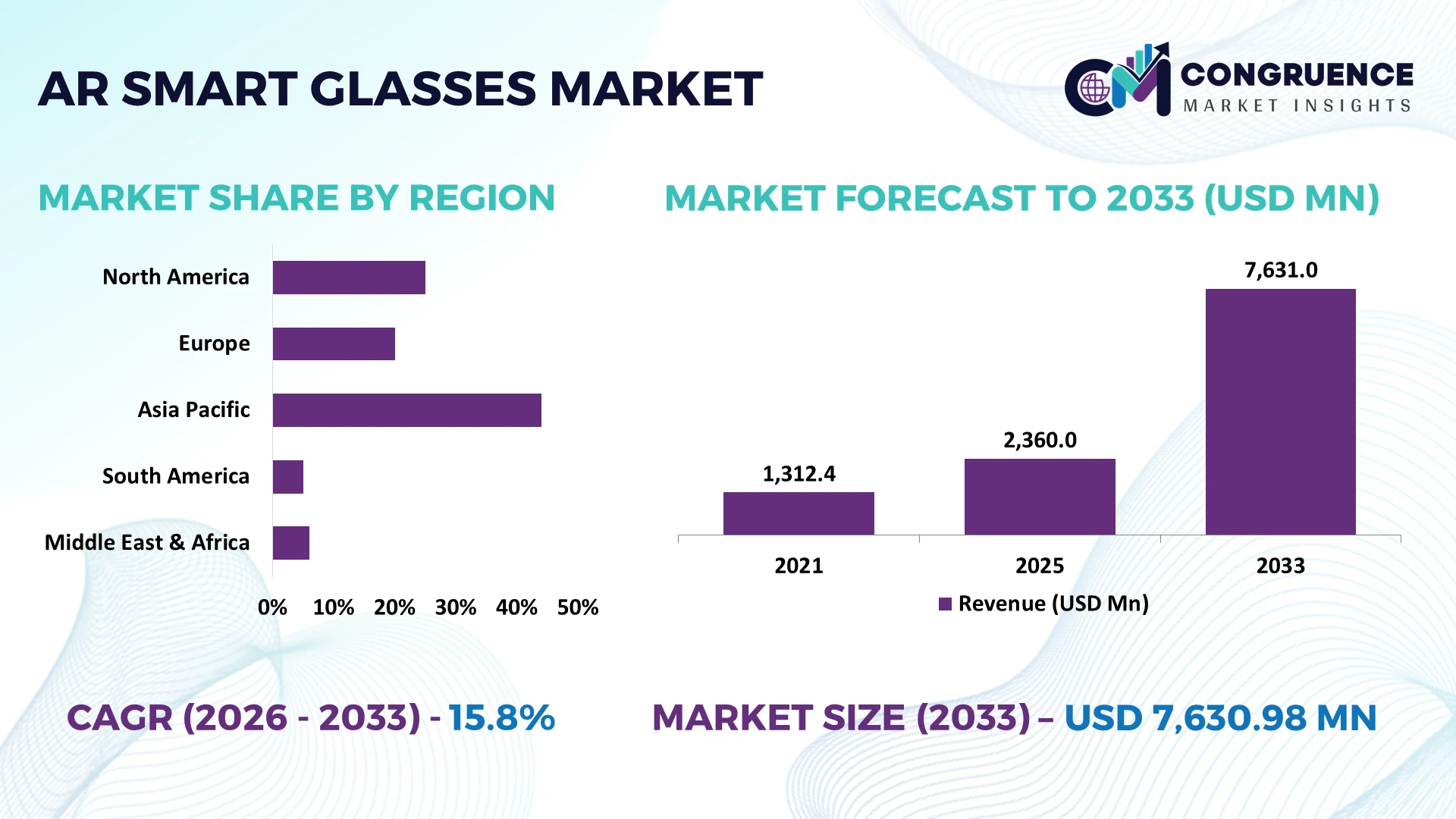
The Global AR Smart Glasses Market was valued at USD 2360 Million in 2025 and is anticipated to reach a value of USD 7630.98 Million by 2033 expanding at a CAGR of 15.8% between 2026 and 2033. Growth is driven by AI integrated visual assistance, microdisplay miniaturization, optical waveguide advancements, and enterprise adoption of wearable augmented reality systems for maintenance, logistics, and remote collaboration.
China holds a dominant position in AR smart glasses manufacturing, supported by Shenzhen's electronics supply chain, optical component production, and companies including XREAL, Rokid, and TCL RayNeo. China accounted for approximately 70% of global smartphone production in recent years, providing manufacturing infrastructure transferable to wearable displays. The United States leads in software ecosystems and enterprise integration, while China emphasizes hardware commercialization. Rokid and XREAL advance lightweight optical designs, supported by investments in micro OLED displays and waveguide manufacturing amid US China semiconductor trade restrictions.
Strategically, manufacturers should prioritize China's established electronics manufacturing ecosystem and enterprise deployment opportunities, targeting optical efficiency improvements of 15% and stronger integration with AI powered wearable computing platforms.
Market Size & Growth: USD 2,360 million in 2025, reaching USD 7,630.98 million by 2033 at 15.8% CAGR, supported by AI integration and advanced optical displays.
Top Growth Drivers: AI assisted workflow targets 20% efficiency improvement, optical optimization targets 15% lower power consumption, and remote assistance targets 25% faster troubleshooting.
Short Term Forecast: By 2027, enterprise AR deployments target 20% shorter technician training cycles through guided instructions and visual knowledge delivery.
Emerging Technologies: Micro OLED, optical waveguides, and multimodal AI represent 3 technologies reshaping wearable display performance and contextual computing.
Regional Leaders: Indicative 2033 allocations place Asia Pacific at USD 3,586.56 million, North America at USD 2,136.67 million, and Europe at USD 1,373.58 million, reflecting hardware scale, enterprise adoption, and industrial digitization.
Consumer/End User Trends: Enterprise AR implementations target 20% faster equipment inspection through hands free instructions and remote expert collaboration.
Pilot/Case Example: A proposed 2027 industrial maintenance pilot targets 25% shorter repair cycles using AR guided diagnostics and remote technical support.
Competitive Landscape: Meta, XREAL, Microsoft, Vuzix, and Rokid compete across wearable computing; individual AR smart glasses market shares remain unverified.
Regulatory & ESG Impact: European privacy requirements under GDPR influence wearable camera deployment, while energy optimized displays target 15% lower power consumption.
Investment & Funding: An illustrative USD 100 million investment program prioritizes optical waveguides, microdisplay manufacturing, and enterprise AI integration.
Innovation & Future Outlook: Next generation AR platforms integrate 3 priorities: spatial computing, contextual AI assistance, and compact optical architectures for everyday use.
The AR Smart Glasses Market is transitioning from specialized visualization devices toward intelligent wearable computing platforms supporting industrial productivity and consumer digital interaction. Micro OLED displays, optical waveguides, and integrated AI assistants are improving visual clarity, device portability, and contextual information delivery. Enterprise applications include warehouse picking, equipment inspection, medical visualization, and remote technical assistance. Lightweight glasses increasingly target device weights below 100 grams, strengthening practical workplace usability. China's component manufacturing ecosystem supports hardware scalability, while American technology companies advance AI software integration. Competitive positioning increasingly depends on optical performance, battery efficiency, developer ecosystems, and secure enterprise deployment capabilities.
AR smart glasses are becoming strategically important as enterprises transition from handheld information access toward wearable computing integrated with artificial intelligence and spatial visualization. Industrial manufacturers increasingly prioritize hands free maintenance instructions, remote technical assistance, and contextual information delivery. Enterprise deployment programs targeting 15% to 20% faster task completion strengthen investment justification. China's established optical manufacturing ecosystem supports hardware scalability, while the United States emphasizes AI software platforms, developer ecosystems, and enterprise application integration. European privacy regulations are also influencing camera functionality and workplace data governance.
Advanced optical waveguides and micro OLED displays improve device portability and visual performance compared with conventional bulky head mounted systems. Optimized wearable configurations target 20% lower device weight, improving usability during extended industrial operations. Between 2026 and 2028, manufacturers are expected to expand multimodal AI integration, spatial mapping capabilities, and enterprise device management. Japanese component suppliers emphasize precision optics, while American developers prioritize contextual computing and secure application deployment.
A practical deployment involves AR assisted warehouse picking, where visual instructions target 20% fewer selection errors and faster worker onboarding. Companies including Vuzix, XREAL, and Rokid are strengthening enterprise partnerships, improving optical systems, and expanding application compatibility. Competitive advantage increasingly depends on reliable hardware, measurable workflow improvements, and scalable software integration.
Industrial enterprises are accelerating AR smart glasses adoption to improve maintenance execution, equipment inspection, and technical knowledge delivery. Wearable visual instructions support targeted productivity improvements of 15% to 20%, while remote expert assistance can reduce troubleshooting time by approximately 25% in suitable workflows. AI assisted recognition systems further support inspection accuracy improvements approaching 10% under controlled deployment conditions. Germany's automotive manufacturing facilities and American logistics operations increasingly evaluate wearable computing to reduce reliance on handheld documentation. Companies including Vuzix and RealWear are strengthening industrial software partnerships and integrating voice controlled applications. Enterprise purchasing decisions increasingly depend on measurable task completion improvements, secure device management, and compatibility with established operational systems.
AR smart glasses manufacturers face structural limitations involving microdisplay availability, optical waveguide manufacturing yields, and specialized semiconductor sourcing. Advanced optical assemblies require precision manufacturing, increasing production costs relative to conventional wearable electronics. Manufacturers pursuing 10% to 15% lower optical assembly costs must improve component yields and reduce calibration requirements. Battery and thermal management constraints also influence product design, with developers targeting approximately 15% lower power consumption through display optimization. China's concentration of electronics manufacturing creates sourcing exposure amid international semiconductor export restrictions. Companies are diversifying optical component suppliers, strengthening manufacturing partnerships, and redesigning display architectures. Commercial scalability increasingly depends on stable component availability, repeatable optical quality, and disciplined manufacturing costs.
Multimodal artificial intelligence creates opportunities for AR smart glasses manufacturers to deliver contextual guidance through visual recognition, speech processing, and connected enterprise information systems. AI assisted maintenance workflows can target 20% faster diagnostic procedures, while integrated knowledge retrieval supports approximately 15% shorter technician training periods. Improved spatial interfaces also offer potential reductions of 10% in procedural errors during complex assembly tasks. India's expanding electronics manufacturing ecosystem provides opportunities for localized device assembly and industrial application development. Companies including XREAL, Rokid, and Vuzix are advancing optical designs, software integration, and developer partnerships. Subscription based enterprise software and specialized industrial applications strengthen recurring service opportunities, shifting competitive differentiation toward workflow intelligence rather than display hardware alone.
Scaling AR smart glasses across industrial environments requires reliable connectivity, secure identity management, application interoperability, and consistent device performance. Enterprise deployments targeting 99% system availability must address wireless coverage limitations, software compatibility, and operational support requirements. Battery optimization remains important for extended work shifts, with manufacturers pursuing approximately 20% longer operating duration through efficient processors and adaptive display controls. Camera equipped wearables introduce privacy and cybersecurity challenges, particularly under European data protection requirements. American industrial enterprises also require integration with maintenance management and enterprise resource planning systems. Manufacturers are investing in secure device management, application programming interfaces, and workforce training. Long term competitiveness depends on dependable deployment performance, secure information handling, and scalable technical support infrastructure.
Prescription Compatibility Reshapes Wearable Product Design: AR smart glasses manufacturers are introducing prescription lens inserts and adjustable optical configurations to address everyday usability barriers. Lightweight designs below 100 grams and prescription support across multiple lens strengths improve accessibility. XREAL and Rokid are refining ergonomic architectures, while optical partners develop interchangeable inserts. Product teams target 10% to 15% fewer fitting related returns, improving customer satisfaction and reducing replacement costs.
Display Brightness Becomes Procurement Differentiator: Manufacturers are increasing display brightness to maintain image visibility under varying lighting conditions. Micro OLED configurations delivering approximately 500 nits of perceived brightness and refresh rates reaching 120 Hz strengthen visual performance. Chinese manufacturers are refining optical engines and display calibration, while component suppliers optimize thermal management. Enterprise buyers increasingly evaluate brightness consistency and viewing comfort rather than display resolution alone.
Shared Device Fleets Gain Operational Importance: Industrial organizations are shifting from individually assigned glasses toward centrally managed device pools. Enterprise deployment programs increasingly target 90% device availability and 15% higher equipment utilization through automated provisioning and charging schedules. German manufacturing facilities emphasize standardized device sanitation, role based access, and shift level allocation. Vendors are strengthening management dashboards and service partnerships, reducing idle inventory and improving deployment economics.
Spatial Interface Standards Improve Application Portability: Developers are adopting standardized spatial computing frameworks to reduce software redevelopment across wearable platforms. OpenXR supports common application interfaces, while 3D interface optimization targets 20% shorter application adaptation cycles. American software developers are strengthening cross platform testing, and hardware manufacturers are expanding compatibility programs. This reduces dependence on proprietary ecosystems and improves enterprise flexibility when replacing or expanding wearable fleets.
Birdbath Display Glasses represent an estimated 35% of global AR smart glasses demand, supported by established optical manufacturing processes, relatively accessible pricing, and strong compatibility with portable entertainment and productivity applications. Their optical architecture supports high image clarity without requiring complex waveguide fabrication. Manufacturers including XREAL and TCL RayNeo continue developing compact display systems with improved viewing comfort. Optical Waveguide Glasses represent the fastest expanding category, supported by increasing investment in transparent optical systems and lightweight wearable designs. Advanced waveguide configurations target approximately 20% reductions in optical assembly thickness compared with bulkier conventional display architectures.
Monocular AR Glasses maintain relevance in industrial environments where technicians require contextual information without obstructing normal vision. Binocular AR Glasses support immersive visualization and coordinated visual overlays, particularly for complex training and precision applications. See Through AR Glasses serve applications requiring direct environmental awareness and digital information alignment. Manufacturers are expanding optical engineering partnerships, improving light transmission, and refining display calibration. Advanced optical systems target approximately 15% improvements in visual efficiency, strengthening product differentiation and encouraging investment in specialized component manufacturing.
Industrial Maintenance accounts for an estimated 34% of global AR smart glasses application demand, supported by equipment inspection, remote technical assistance, and guided maintenance procedures. Manufacturing facilities increasingly deploy wearable displays to provide contextual instructions while technicians perform complex operations. AR guided workflows target 15% to 20% faster maintenance task completion, improving equipment availability and reducing dependence on printed documentation. Germany's automotive and industrial machinery sectors maintain strong interest in wearable inspection and maintenance systems. Navigation and Logistics represents the fastest expanding application, supported by visual picking instructions, warehouse routing, and inventory verification.
Healthcare applications include clinical visualization, procedural assistance, and medical training, where display accuracy and secure information handling remain important. Retail applications emphasize assisted product visualization and contextual customer information, while Education supports interactive technical instruction and immersive learning. Warehouse deployment programs target approximately 20% fewer picking errors through visual confirmation and guided workflows. Manufacturers are expanding application partnerships, strengthening enterprise integration capabilities, and developing specialized software configurations. Investment increasingly follows applications demonstrating measurable productivity improvements and repeatable operational deployment.
Manufacturing Companies represent an estimated 42% of global AR smart glasses end user demand, supported by equipment maintenance, production inspection, technical training, and remote expert collaboration. Industrial enterprises prioritize wearable systems capable of integrating with maintenance platforms and established operational workflows. AR guided work instructions target 15% improvements in task execution efficiency, strengthening deployment justification. Germany, Japan, and the United States maintain established industrial automation ecosystems supporting enterprise wearable adoption. Healthcare Providers represent the fastest expanding end user category, supported by increasing interest in medical visualization, clinical training, and hands free access to procedural information.
Retail Enterprises are evaluating wearable assistance for inventory management, customer engagement, and store operations. Educational Institutions increasingly adopt AR glasses for technical training, interactive instruction, and practical learning environments. Healthcare deployments target approximately 20% reductions in selected documentation and information retrieval tasks through contextual display interfaces. Manufacturers are strengthening partnerships with healthcare software developers, developing secure device management capabilities, and expanding institutional deployment programs. Competitive differentiation increasingly depends on application customization, reliability, and integration with existing enterprise information systems.
Asia Pacific accounted for the largest market share at an estimated 47% in 2025 however, Asia Pacific is expected to register the fastest growth, expanding at an indicative CAGR of 18.2% between 2026 and 2033.
Enterprise Wearable Computing and AI Ecosystem Integration
North America accounted for an estimated 28% of global AR smart glasses demand in 2025, supported by established enterprise technology ecosystems, wearable computing innovation, and industrial digitalization. The United States dominates regional adoption through investments in spatial computing, artificial intelligence, and advanced optical engineering. Meta, Google, Vuzix, and enterprise software developers are strengthening wearable technology platforms for industrial assistance and contextual information delivery. Microsoft maintains significant experience in enterprise mixed reality systems, influencing application development and integration requirements. American logistics and manufacturing organizations increasingly evaluate wearable displays for inspection, inventory verification, and technical training. Enterprise deployment programs target 15% to 20% faster task completion through visual guidance. Manufacturers are expanding developer partnerships, improving device management capabilities, and integrating voice controlled interfaces. Competitive differentiation increasingly depends on application interoperability, secure enterprise connectivity, and dependable hardware performance.
United States Market Outlook: The United States maintains a strong position in AR smart glasses innovation through established technology companies, optical engineering expertise, and enterprise software development. Meta's Orion prototype demonstrated approximately 70 degrees of field of view, highlighting progress in advanced optical architectures. Vuzix supports industrial wearable applications, while American developers emphasize AI integration and spatial computing. Domestic enterprises prioritize secure device management, reliable connectivity, and compatibility with existing operational platforms.
Industrial Digitization and Privacy Focused Wearable Deployment
Europe represented an estimated 18% of global AR smart glasses demand in 2025, supported by advanced manufacturing, industrial automation, and enterprise digital transformation. Germany maintains strong deployment potential across automotive manufacturing, industrial machinery, and technical maintenance operations. France and the United Kingdom contribute through healthcare technology, software development, and professional wearable applications. European enterprises emphasize secure information handling, device interoperability, and compliance with workplace privacy requirements. The General Data Protection Regulation influences camera enabled wearable deployments, particularly where visual recordings capture identifiable individuals. Industrial AR implementation programs target 15% shorter technician training periods through contextual work instructions. Manufacturers are strengthening partnerships with enterprise software providers and developing privacy conscious device management capabilities. Competitive positioning increasingly depends on integration with industrial systems, operational reliability, and documented compliance procedures.
Germany Market Outlook: Germany benefits from established automotive engineering, precision manufacturing, and industrial automation capabilities. Volkswagen, BMW, Siemens, and industrial equipment manufacturers provide relevant environments for wearable inspection and maintenance applications. Germany's manufacturing sector contributes approximately 20% of national gross value added, supporting extensive industrial technology requirements. Enterprise buyers emphasize secure deployment, precise visual guidance, and integration with production management systems. Suppliers offering industrial software compatibility and dependable technical support maintain stronger competitive positioning.
Optical Manufacturing Scale and Consumer Wearable Commercialization
Asia Pacific dominated the global AR smart glasses market with an estimated 47% share in 2025, supported by extensive electronics manufacturing capabilities and established optical component supply networks. China maintains a leading position through Shenzhen's wearable electronics ecosystem and manufacturers including XREAL, Rokid, and TCL RayNeo. Japan contributes advanced microdisplay and optical component expertise, while South Korea supports semiconductor and display technology development. Chinese manufacturers emphasize compact display architectures, integrated AI functions, and scalable consumer product commercialization. Micro OLED displays with refresh rates reaching 120 Hz demonstrate improving wearable visualization capabilities. Regional suppliers are expanding optical manufacturing partnerships, refining waveguide fabrication processes, and strengthening international distribution networks. Competitive advantages include integrated component sourcing, manufacturing flexibility, and rapid product iteration. Enterprise adoption across Japan and South Korea also supports specialized industrial wearable development.
China Market Outlook: China maintains a substantial advantage in AR smart glasses hardware manufacturing through integrated electronics supply chains, precision optics suppliers, and established consumer technology distribution. XREAL, Rokid, and TCL RayNeo support product innovation across portable displays and transparent wearable systems. XREAL Air 2 Pro weighs approximately 75 grams, demonstrating progress in lightweight wearable design. Domestic manufacturers prioritize microdisplay integration, optical calibration, and scalable assembly processes, strengthening competitiveness in international wearable electronics markets.
Industrial Remote Assistance and Workforce Training Adoption
South America accounted for an estimated 4% of global AR smart glasses demand in 2025, with Brazil representing the principal regional enterprise market. Automotive manufacturing, mining, energy operations, and industrial equipment maintenance provide relevant applications for wearable visual assistance. Brazilian enterprises increasingly evaluate AR systems to improve remote troubleshooting and reduce dependence on onsite specialist availability. Industrial deployment programs target approximately 20% shorter technical support resolution times through connected expert assistance. Argentina, Chile, and Colombia contribute additional opportunities across mining operations, industrial maintenance, and technical training. Imported device costs and uneven enterprise connectivity influence purchasing decisions, encouraging suppliers to prioritize targeted deployments. Technology providers are strengthening local software partnerships, expanding training services, and developing implementation packages compatible with established enterprise systems. Commercial adoption depends on measurable operational benefits and reliable technical support.
Brazil Market Outlook: Brazil maintains the strongest regional opportunity through its established automotive, manufacturing, and industrial services sectors. São Paulo supports concentrated enterprise technology adoption, while mining and energy operations create demand for remote maintenance solutions. Brazil's industrial sector contributes approximately one fifth of national economic output, supporting substantial technical workforce requirements. Enterprises increasingly prioritize wearable systems compatible with Portuguese language interfaces, secure communications, and existing maintenance management platforms.
Smart Infrastructure Investment and Industrial Wearable Modernization
Middle East & Africa represented an estimated 3% of global AR smart glasses demand in 2025, supported by industrial modernization, infrastructure development, and digital transformation investments. Saudi Arabia and the United Arab Emirates maintain important opportunities across energy operations, construction, logistics, and smart infrastructure projects. Industrial organizations increasingly evaluate wearable visual assistance for equipment inspection, technical training, and remote collaboration. Saudi Arabia's Vision 2030 strategy encourages industrial digitization and advanced technology integration. Enterprise deployment programs target 15% to 20% faster maintenance task completion through contextual visual instructions. South Africa contributes demand from mining, industrial services, and technical training environments. Technology suppliers are developing regional distribution partnerships, strengthening enterprise application support, and expanding Arabic language interface capabilities. Competitive differentiation depends on reliable connectivity, environmental durability, and integration with established industrial systems.
Saudi Arabia Market Outlook: Saudi Arabia represents a strategically important AR smart glasses market through industrial diversification, infrastructure modernization, and technology investment initiatives. NEOM and other major development programs create potential applications for digital construction inspection and remote technical collaboration. The country's Vision 2030 framework supports broader adoption of advanced digital technologies across industrial operations. Enterprises prioritize wearable systems capable of operating in demanding environments, supporting secure communications, and delivering practical maintenance guidance.
The AR Smart Glasses Market features competition between Meta and Google in AI enabled wearable ecosystems, XREAL and Rokid in display focused consumer hardware, and Vuzix in industrial applications. The leading five suppliers collectively represent an indicative 55% market share, reflecting concentration around optical engineering and software integration capabilities. Chinese manufacturers compete through component sourcing and rapid product development, while American companies emphasize artificial intelligence, developer platforms, and enterprise integration. Advanced optical designs target 20% lower device weight, while optimized display architectures support approximately 15% lower power consumption. Manufacturers are strengthening semiconductor partnerships, expanding waveguide manufacturing, and developing proprietary software ecosystems. Competition is shifting toward contextual AI assistance, compact displays, and application interoperability. Optical fabrication complexity, intellectual property requirements, and enterprise certification create substantial entry barriers. Winning requires superior wearable ergonomics, dependable software integration, scalable production, and demonstrable operational value.
Meta Platforms, Inc.
Google LLC
XREAL Inc.
Rokid Corporation
Vuzix Corporation
TCL Technology Group Corporation
Epson Corporation
Lenovo Group Limited
Magic Leap, Inc.
RealWear, Inc.
Snap Inc.
Even Realities
INMO Technology Co., Ltd.
Brilliant Labs
Current AR smart glasses integrate micro OLED displays, birdbath optics, optical waveguides, and inertial sensors to deliver contextual visualization. XREAL and Rokid emphasize portable displays, while Vuzix targets industrial applications requiring unobstructed environmental awareness. Commercial devices already support 120 Hz refresh rates, improving motion clarity during visual interaction. Compared with conventional bulky headsets, lightweight glasses weighing approximately 75 grams demonstrate substantially improved portability. Enterprise deployments targeting 15% faster information retrieval strengthen productivity and reduce dependence on handheld terminals.
Emerging technologies include full color waveguides, eye tracking, and adaptive display brightness. Optical engineering programs target 20% thinner display assemblies, while intelligent brightness control offers potential power savings of 15%. Integrated eye tracking enables gaze directed interaction and more efficient interface navigation. Chinese manufacturers benefit from established optical component supply chains, whereas American developers emphasize software ecosystems and enterprise integration. Production investments increasingly prioritize waveguide fabrication consistency, display calibration, and compact thermal architectures.
Between 2026 and 2028, disruptive development will center on spatially aware artificial intelligence, holographic optical elements, and integrated visual processing. Context sensitive interfaces target 20% faster task execution, while optimized sensor fusion aims to reduce tracking errors by 10%. Manufacturers investing in optical miniaturization, embedded processing, and interoperable software platforms gain stronger differentiation across industrial, professional, and consumer applications.
September 2024: Meta unveiled Orion, its augmented reality glasses prototype featuring approximately 70 degrees of field of view. The demonstration advanced holographic visualization and neural wristband interaction, establishing technical foundations for future consumer AR hardware development and spatial computing. Source: about.fb.com.
January 2026: Google and XREAL extended their strategic partnership, naming XREAL a lead hardware partner for Android XR. The multiyear agreement aligned development of optical see through glasses with Project Aura's planned 2026 commercialization, strengthening hardware and software integration. Source: prnewswire.com.
June 2026: Snap introduced SPECS augmented reality glasses with dual Snapdragon processors and spatial computing capabilities. The device supports up to 4 hours of operation, expanding consumer access to standalone AR experiences while establishing a commercial platform for developers. Source: reuters.com.
October 2026: XREAL and Google launched AURA, the first wired Android XR glasses, featuring a 70 degree field of view. Initial ordering opened across 3 countries, expanding commercial access to Gemini integrated spatial applications and developer ecosystems. Source: blog.google.
The AR Smart Glasses Market Report examines technology development, product commercialization, enterprise deployment, and competitive strategies between 2026 and 2033. Type segmentation covers Optical Waveguide Glasses, Birdbath Display Glasses, Monocular AR Glasses, Binocular AR Glasses, and See Through AR Glasses. Application analysis evaluates Industrial Maintenance, Healthcare, Retail, Education, and Navigation and Logistics. End user coverage includes Manufacturing Companies, Healthcare Providers, Retail Enterprises, and Educational Institutions, highlighting procurement requirements, operational integration, and application specific adoption.
Regional analysis covers North America, Europe, Asia Pacific, South America, and Middle East & Africa, emphasizing China, the United States, Germany, and Japan. Technology assessment examines micro OLED displays, optical waveguides, spatial tracking, and contextual AI. Competitive evaluation supports investment planning, component sourcing, enterprise partnerships, manufacturing expansion, and differentiated product positioning.
| Report Attribute/Metric | Report Details |
|---|---|
Market Revenue in 2025 | USD 2360 Million |
Market Revenue in 2033 | USD 7630.98 Million |
CAGR (2026 - 2033) | 15.8% |
Base Year | 2025 |
Forecast Period | 2026 - 2033 |
Historic Period | 2021 - 2025 |
Segments Covered | By Type
By Application
By End-User
|
Key Report Deliverable | Revenue Forecast, Growth Trends, Market Dynamics, Segmental Overview, Regional and Country-wise Analysis, Competition Landscape |
Region Covered | North America, Europe, Asia-Pacific, South America, Middle East, Africa |
Key Players Analyzed | Meta Platforms, Inc., Google LLC, XREAL Inc., Rokid Corporation, Vuzix Corporation, TCL Technology Group Corporation, Epson Corporation, Lenovo Group Limited, Magic Leap, Inc., RealWear, Inc., Snap Inc., Even Realities, INMO Technology Co., Ltd., Brilliant Labs |
Customization & Pricing | Available on Request (10% Customization is Free) |




